
Quick answer
GAO says the travel card aimed to "improve convenience for the traveler," as of November 2026: it pays trip costs so you don't use your own cash. GSA adds worldwide acceptance, travel insurance and no petty cash. You still owe the bank, and an agency can deduct up to 15% of disposable pay per pay period for undisputed delinquent charges. Set up split disbursement first.
Defense Department travel training asks which item is a benefit of using the travel card, and federal travel rules answer it. A government travel charge card is a charge card a bank issues in your name under a government contract. It's for official travel costs only. Our examples follow one made-up civilian, a new cardholder on a first temporary duty (TDY) trip with a hotel and a rental car.
Before a first trip, we'd set up split disbursement. In our made-up example calendar, the card bill falls due 4 to 9 days before an on-time reimbursement can land. Past 61 days unpaid, OMB counts an undisputed balance as delinquent, and suspension, collections and salary offset can follow.
Key takeaways
- GAO says the program aimed to improve convenience for the traveler.
- Split disbursement sends the card share of your reimbursement straight to the bank.
- Your bill can come due before an on-time reimbursement arrives.
- Personal charges on the card are misuse under 41 CFR 301-51.5.
- Agencies may deduct as much as 15% of disposable pay for delinquency.
Which item is a benefit of using the travel card?
The plainest official wording comes from GAO. Its GAO-03-169 report on Army travel cards says the program was meant to "improve convenience for the traveler" and to cut the government's cost of running travel. OMB's Circular A-123 Appendix B puts the government side as "Reducing administrative costs and time for purchasing and paying for goods and services".
GSA, which runs the SmartPay contract the cards sit under, lists the rest. Its GSA SmartPay benefits page says the cards work "anywhere in the world where merchants accept cards." That page also lists "travel insurance and eliminating the need for imprest funds or petty cash at the agency." GSA's business lines page adds fares: the travel card is the main way to buy plane, rail and bus tickets at "significantly reduced fares under the GSA City Pair Program". Agencies, not cardholders, also earn refunds on card spending.
For the traveler, the gain shows in what the card replaces. Under 41 CFR 301-51.4, an employee exempt from the card may be told to use "personal funds, travel advances, or Government Transportation Request" instead. So the card lets you pay for an approved trip without spending your own money or waiting on an advance.
This isn't DoD's answer key. Still, choices about personal purchases or rewards fail two rules: the FTR bans personal use, and GSA says refunds go to agencies.
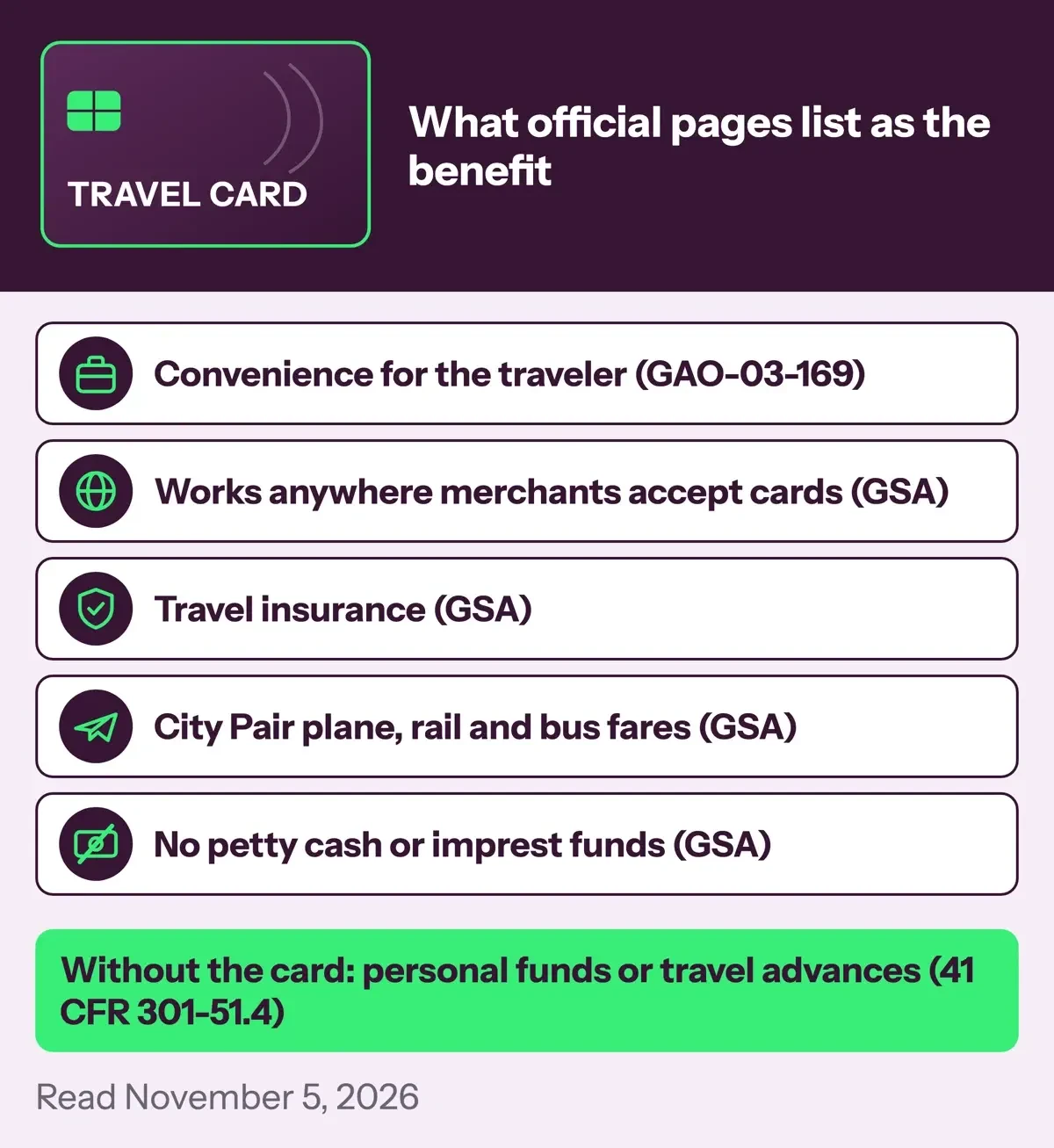 Diagram by DigitalTreed, from the GSA SmartPay benefits and business lines pages, GAO-03-169 and 41 CFR 301-51.4, read November 5, 2026.
What the government travel charge card is
That personal-use ban is built into the card's legal definition. For the Defense Department, 10 U.S.C. 2784a defines a Defense travel card as a charge or credit card issued under a DoD contract. The statute says it "is to be used for charging expenses incurred by the employee or member" on official travel. Agencies order their cards under GSA's SmartPay 3 contract, and GSA's how it works page names the two banks: Citibank and U.S. Bank. Most travelers carry an individually billed account, or IBA. GSA's SmartPay FAQ describes IBAs as "Travel accounts where payment is made directly to the bank by the individual," so the bill comes to you, not your office.
The statute says DoD "shall evaluate the creditworthiness" of each person first, and the Government Charge Card Abuse Prevention Act of 2012 requires the same of every executive agency.
OMB's appendix sets the bar for a standard card: "The credit score obtained must be 660 or higher." Below 660, OMB lets the agency require a "restricted" card with lower limits.
When you have to use the travel card
Once issued, the card must be used. The Travel and Transportation Reform Act of 1998 told GSA to make federal employees use it "for all payments of expenses of official Government travel." The FTR repeats the rule in 41 CFR 301-51.1: employees are "required to use the Government contractor-issued travel charge card for all official travel expenses".
The same rule lets you skip the card when a vendor won't take it or it imposes unreasonable burdens or costs. 41 CFR 301-51.2 adds exemptions for people with a pending application, people who aren't eligible and anyone whose card "would adversely affect the mission or put the employee at risk." The Secretary of Defense may ask GSA to exempt members of the uniformed services.
An agency head can grant exemptions too, but must notify GSA within 30 days with reasons.
DoD layers its own rules on top, in "DoD Instructions 5154.31 and the Joint Travel Regulations (JTR)," per GSA's FAQ. Both gave our checker a 403 bot-block on November 5, 2026, though they open in a browser. Read the current copies there, or ask your unit's travel card program coordinator.
How split disbursement pays the bank for you
OMB defines split disbursement as "dividing a travel voucher reimbursement between the charge card vendor and traveler," with each share sent straight to its party. GSA's travel card troubleshooting guide uses the same definition and adds that you should still check your card balance after each split payment posts to the account.
Government-wide, OMB makes split reimbursement and salary offset mandatory unless it grants a waiver.
DoD's rule is firmer. A 2003 amendment changed the statute's "may require" to "shall require". Under section 2784a of title 10, travel pay covering card charges is "disbursed directly to the issuer of a Defense travel card," unless the Secretary of Defense waives it.
Our made-up example voucher shows where the money goes. Only $600 of a $660 hotel bill is allowed, since the stay ran $165 a night against our made-up $150 cap.
| Voucher line (example, all made up) | On travel card? | Spent | Allowed |
|---|---|---|---|
| Hotel, 4 nights at $165.00 (made up) | Yes | $660.00 | $600.00 |
| Rental car (made up) | Yes | $220.00 | $220.00 |
| Rental car fuel (made up) | Yes | $38.50 | $38.50 |
| Meals and incidentals allowance (flat, made up) | No | $250.00 | $250.00 |
| Taxi paid in cash (made up) | No | $42.00 | $42.00 |
Allowed card charges go to the bank. You get the rest. In this example, that's $858.50 to the bank ($600 + $220 + $38.50) and $292.00 to the traveler ($1,150.50 - $858.50). The card still shows $60.00, the hotel overage, which the traveler pays from their own account.
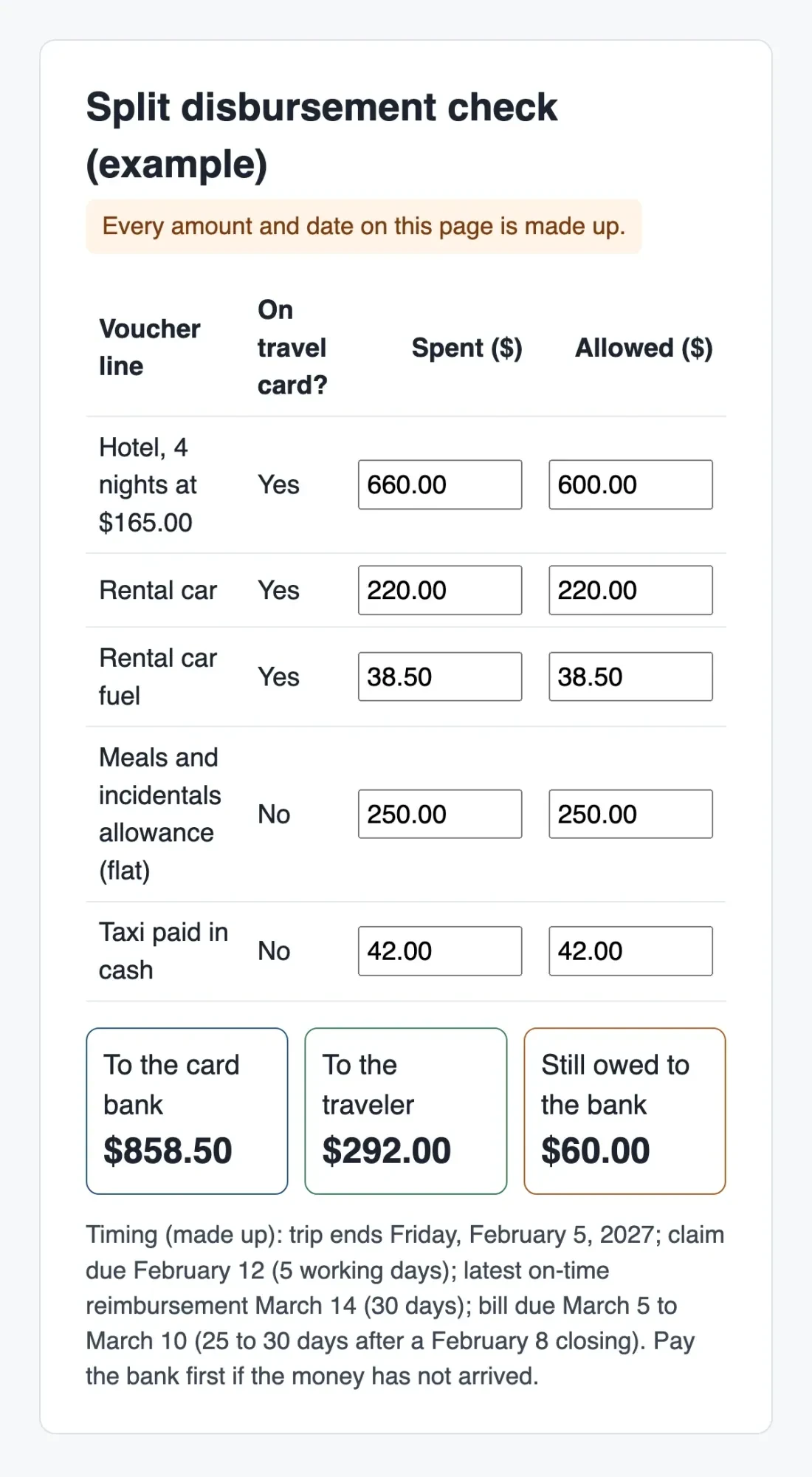 Screenshot: our split disbursement calculator served on 127.0.0.1, November 5, 2026. Every amount is a made-up example.
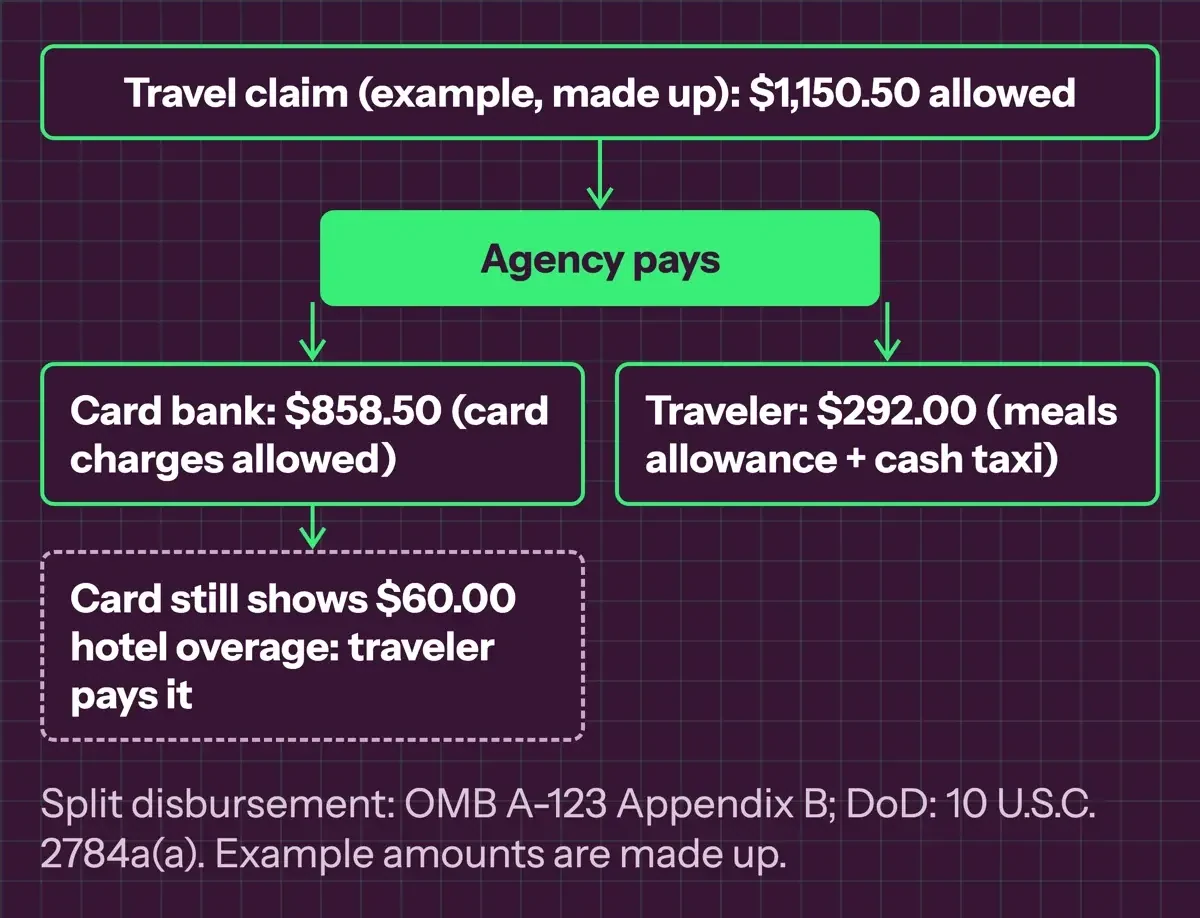 Diagram by DigitalTreed, from OMB Circular A-123 Appendix B and 10 U.S.C. 2784a, with our made-up example voucher.
What we tested
On November 5, 2026, our own Python checker read saved copies of the GSA, OMB, FTR and statute pages. It found all 11 rule phrases it looked for, word for word, from the 61-day delinquency line to the 15% offset cap. The script then ran the made-up example voucher and example trip calendar, and a small calculator page we served on 127.0.0.1 showed the same three totals.
Paying the bill when the reimbursement is late
Even with split disbursement, the bank in our example voucher gets nothing until the agency pays the reimbursement. Under 41 CFR 301-52.1, you must file a claim "within 5 working days after trip completion", or at least every 30 days on continuous travel. The agency then has 30 calendar days to pay a proper claim under 41 CFR 301-52.7. Meanwhile, GSA's Helpful Hints for Travel Account Use puts the card bill's due date "25 to 30 days after the closing date on the billing statement". Those three clocks run separately. The FTR sets the first two, and the bank's statement sets the third.
In our made-up example calendar, a trip ends Friday, February 5, 2027, and the statement closes February 8. Filing on the last allowed day, February 12, lets the agency pay as late as March 14 and still be on time under the 30-day rule. The bill is due March 5 to March 10. So in this example, an on-time reimbursement can land 4 to 9 days after the due date.
GSA's answer is blunt: pay the bank on or before the due date "regardless of the status of the card/account holder's voucher." If the agency pays after its 30 days, 41 CFR 301-52.10 owes you a late payment fee. It also owes "an amount equivalent to the late payment charge that the card contractor would have been able to charge". We'd file the claim the day you get home.
GSA's hints say to call your bank about billing questions. If paying first is tight, our guide to financial emergency options covers what to try.
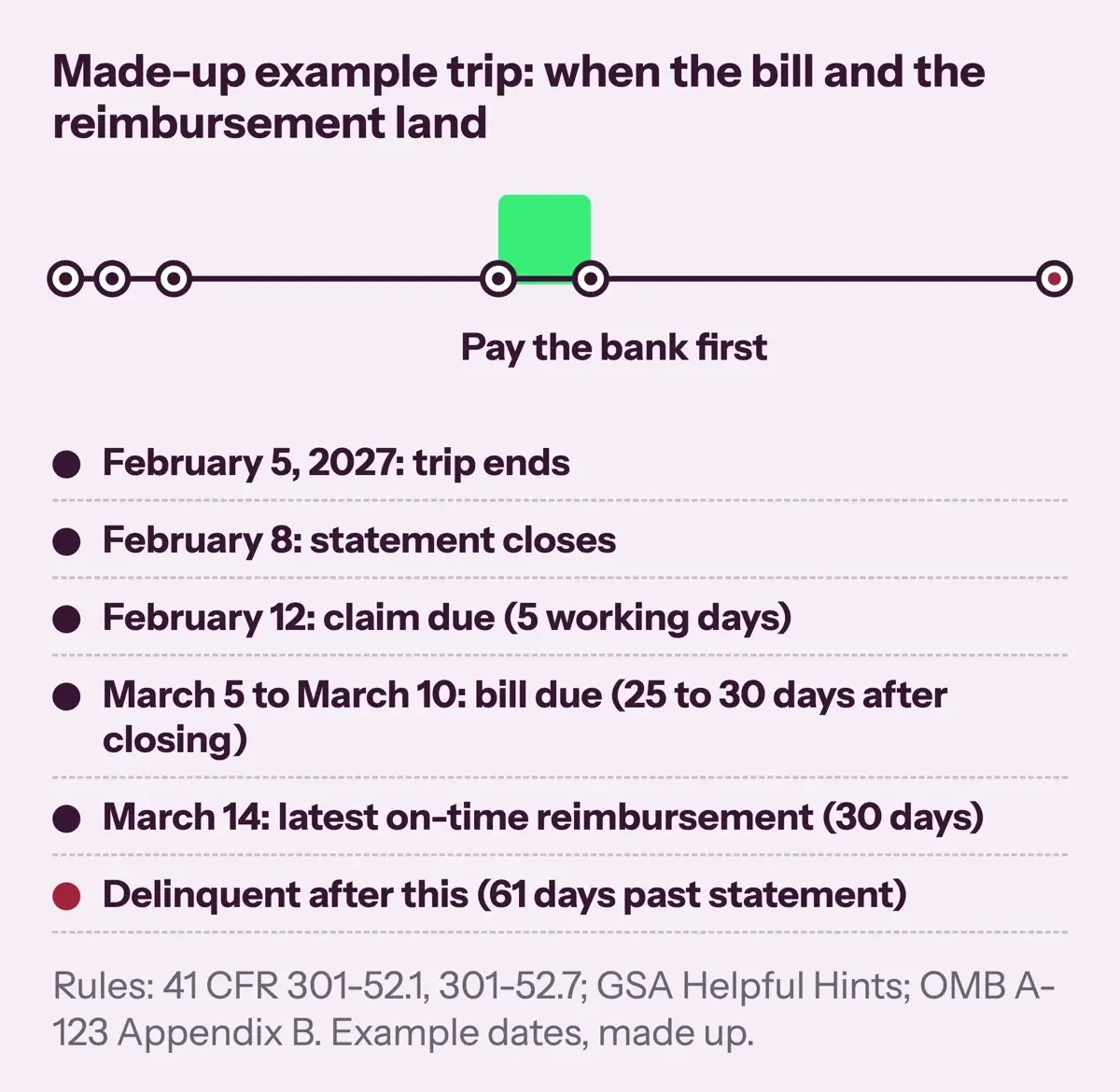 Diagram by DigitalTreed, from 41 CFR 301-52.1 and 301-52.7, GSA Helpful Hints and OMB A-123 Appendix B. Dates are a made-up example.
Misuse, delinquency and salary offset
Beyond late bills, the FTR's misuse rule, 41 CFR 301-51.5, says "Employees may not use the Government contractor-issued travel charge card for personal reasons." It also lets agencies act if you don't activate the card within 60 days. GSA's FAQ defines misuse as "Intentional use of government cards/accounts for other than official government business". Its examples include purchases over your limit, purchases the agency didn't authorize and purchases for personal consumption. Its list of potential consequences includes counseling, cancellation of the card, a written warning, a reprimand, suspension and termination of employment.
Delinquency starts at a set point. OMB's appendix defines a delinquent account as an undisputed balance "unpaid for more than 61 days past the statement date." The due date itself doesn't start that clock. OMB lets an agency suspend the card at 61 days and also have the bank cancel it, start collections, notify credit bureaus and add late fees. GSA's hints warn that paying late "could affect your personal credit rating."
The last step is salary offset. The TTRA, 41 CFR 301-54.102 and, for DoD, 10 U.S.C. 2784a all cap it at 15% of disposable pay per pay period. You can agree in writing to more. On a made-up example of $2,400.00 in disposable pay, that's at most $360.00 a pay period ($2,400 x 15%). Under 41 CFR 301-54.1, the agency acts on the bank's written request.
You get due process first. Section 301-54.100 requires written notice of the amount, a chance to inspect the records, an internal review and a chance to agree on a repayment plan with the bank. For DoD, 10 U.S.C. 2784a says its card regulations must provide adverse actions for misuse, abuse or fraud, "including removal in appropriate cases." For anyone subject to the Uniform Code of Military Justice, a violation is punishable under Article 92. A false travel claim is worse. Under 41 CFR 301-52.14, an employee who tries to defraud the Government forfeits reimbursement. The employee may also face a fine of up to $10,000, up to 5 years in prison, or both.
What the travel card is not
Even with your name on it, the card isn't a personal credit card. GSA's hints warn: "Don't forget that the account is issued in your name and liability for payment is your responsibility." GAO said the same in its 2002 Army report: an IBA cardholder is directly responsible for all charges. It isn't a rewards card either. GSA's refunds page calls refunds "a monetary payment provided by the contractor bank to agencies/organizations". Its statistics page counts "$471 million in refunds earned by agencies/organizations" for fiscal 2025. None of it reaches cardholders. For points on private-sector trips, our tips for saving money on business travel fit better.
Nor does it make you tax exempt everywhere. GSA's FAQ says "Each state determines the exemption status for IBAs," while OMB's appendix says centrally billed cards are tax exempt in every state and territory. A lost card is also on you until you report it: "You will be responsible for those charges made before the travel account was reported lost or stolen."
For a wrong charge, GSA says to use "your bank's dispute process." Our guide to disputing an unknown card charge shows how to trace one.
GSA says to pay "in full for each monthly bill." That differs from the personal card in our answer to the credit card financing quiz question.
Checklist for new cardholders
We wrote this list from GSA's do's and don'ts, the FTR and OMB's appendix, one action per line.
- Activate the card within 60 days of getting it.
- Read your agency travel card policy and save your A/OPC contact.
- Save the bank phone number shown on your card in your contacts.
- Use the card only for official travel costs on an approved trip.
- Never pay a coworker expenses, except a shared ride such as a taxi.
- Take ATM cash only for costs you expect to pay in cash on the trip.
- Keep receipts for lodging and any expense over $75.
- File your travel claim within 5 working days after the trip.
- Send the card charges on your claim to the bank by split disbursement.
- Check the bank balance after the reimbursement posts.
- Pay any balance left in full by the statement due date.
- Report a lost or stolen card to the bank, your A/OPC and your supervisor.
GSA's hints also warn about identity theft schemes aimed at cardholders. If you clicked a link in a text about your card, our steps after a phishing link help.
Travel card questions
Frequently asked
What do I do if I lose my travel card?
Tell the bank, your A/OPC and your supervisor. GSA's cardholder responsibilities page says the bank then blocks the account and issues a new number. GSA lists Citibank at (800) 790-7206 and U.S. Bank at (888) 994-6722.
Can I use the travel card for local travel?
Ask first. GSA's travel account hints say FTR Amendment 2010-02 limited the FTR to temporary duty travel, so local use depends on agency policy.
Can I take cash from an ATM with the travel card?
Only for the trip. GSA says: "Don't obtain travel advances through the ATM which exceed your expected out of pocket expenditures for a trip."
Who sees my credit score for the travel card?
The bank, not your office. OMB's A-123 Appendix B says "Credit worthiness scores are not provided to agencies or A/OPCs." Our guide to who may pull a credit report covers the rest.
How we made this guide: DoD's travel.dod.mil pages, the DoD FMR and DoDI 5154.31 gave our checker a 403 bot-block on November 5, 2026, though they open in a browser. Every quote here matches one of 26 saved GSA, OMB, GAO, statute and FTR pages. Facts checked by the DigitalTreed team on November 5, 2026.
First published January 2024 as a consumer prepaid travel card piece that pointed readers to an unnamed site. Rewritten November 5, 2026 around the government travel charge card question the title asks, from federal sources only.
Sources
- GSA SmartPay: Benefits of the Program
- GSA SmartPay: Business Lines
- GSA SmartPay: How GSA SmartPay Works
- GSA SmartPay: Frequently Asked Questions
- GSA SmartPay: Card/Account Holder Responsibilities
- GSA SmartPay: Helpful Hints for Travel Account Use
- GSA SmartPay: Travel Card/Account Troubleshooting Guide
- GSA SmartPay: Refunds
- GSA SmartPay: Statistics and Reports
- OMB Circular A-123, Appendix B (revised August 27, 2019)
- Travel and Transportation Reform Act of 1998, Public Law 105-264 (GovInfo)
- Government Charge Card Abuse Prevention Act of 2012, Public Law 112-194 (Congress.gov)
- 10 U.S.C. 2784a, Management of travel cards (Cornell LII)
- 10 U.S.C. 2784a (GovInfo, 2023 edition)
- 41 CFR 301-51.1, mandatory use
- 41 CFR 301-51.2, exemptions
- 41 CFR 301-51.4, payment methods after exemption
- 41 CFR 301-51.5, misuse
- 41 CFR 301-52.1, travel claim requirements
- 41 CFR 301-52.7, agency reimbursement timeframe
- 41 CFR 301-52.10, late payment fee calculation
- 41 CFR 301-52.14, penalties for defrauding the Government
- 41 CFR 301-54.1, collection of undisputed delinquent amounts
- 41 CFR 301-54.100, due process
- 41 CFR 301-54.102, maximum deduction
- GAO-03-169, Travel Cards: Control Weaknesses Leave Army Vulnerable


Comments
No comments yet. Start the conversation below.