
Quick answer
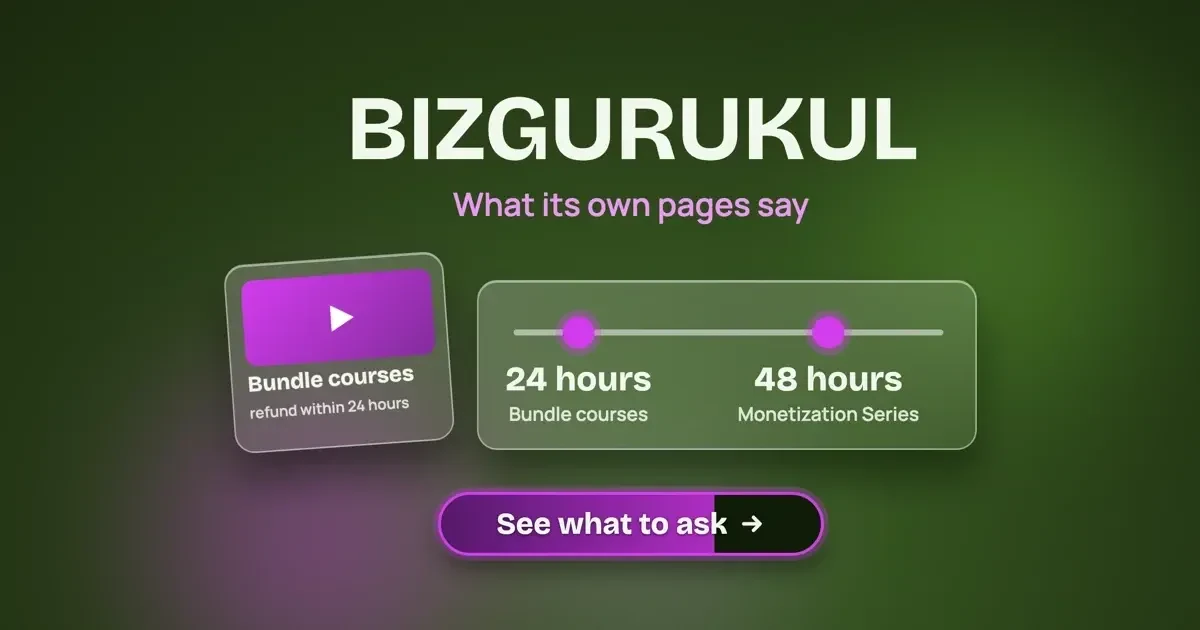
Bizgurukul is an Indian online course company whose Google Play app lists 500K+ downloads and in-app purchases, as of November 6, 2026. Read in a browser that day, its own pages describe a partner program that pays commissions twice a month and offers no guaranteed income. Bundle courses can be refunded within 24 hours, minus 7% in fees (2% + 5%).
Bizgurukul is an Indian online learning company that sells skill courses, mostly to people in India, and runs a partner program that pays commissions on referrals. Maybe a cousin in India has asked you to join from the US.
Apple has no US storefront page for the app, so what follows comes from its India listing, Google Play and four of Bizgurukul's own pages. India's rules bar a covered seller from selling you a course on the promise that your referrals will pay back its price.
Key takeaways
- Bundle course refunds: 24 hours, with 7% kept (2% + 5%).
- Its partner code says no fixed, guaranteed or assured income is offered.
- Apple's listing shows a release note saying international users can enroll.
- India's rules bar selling on a promise to recover the price through referrals.
- US sellers of business opportunities must back any earnings claim in writing.
What Bizgurukul sells, according to its own pages
Apple's App Store listing for Bizgurukul in India names the seller as "BIZGURUKUL PRIVATE LIMITED." The Google Play listing names Bizgurukul Private Limited as the developer, with an address in South West Delhi, and the developer's description is the same on both stores. It reads: "Bizgurukul offers an endless number of opportunities to its learners, such as upskilling their extent of knowledge and guiding them in their career aspects." It goes on to say the app "boosts your social media, which helps monetize the respective platforms."
Google Play adds a tagline, "Offers The Finest Online Learning Courses In India." It also shows a 500K+ download count, an In-App Purchases label and an update date of March 6, 2026. Apple's version history names one product. A May 9, 2025 note reads "New Freelancing Bundle Course Added." A December 16, 2023 note says users can now enroll from the mobile app, and four days later came "Purchase, gamify and some bugs fixed."
Neither store shows a course price.
Bizgurukul's disclaimer page names two companies behind the brand, Bizgurukul Private Limited and Bizgurukul International Private Limited, which it says "operate under the unified brand identity" of Bizgurukul.com. Its about page dates the company to March 24, 2020 and claims "4.5 Lakh+ Students," which is 450,000-plus by its own count. The refund policy lists what's on sale: bundle courses, a Monetization Series, an Upskilling subscription and add-on benefits.
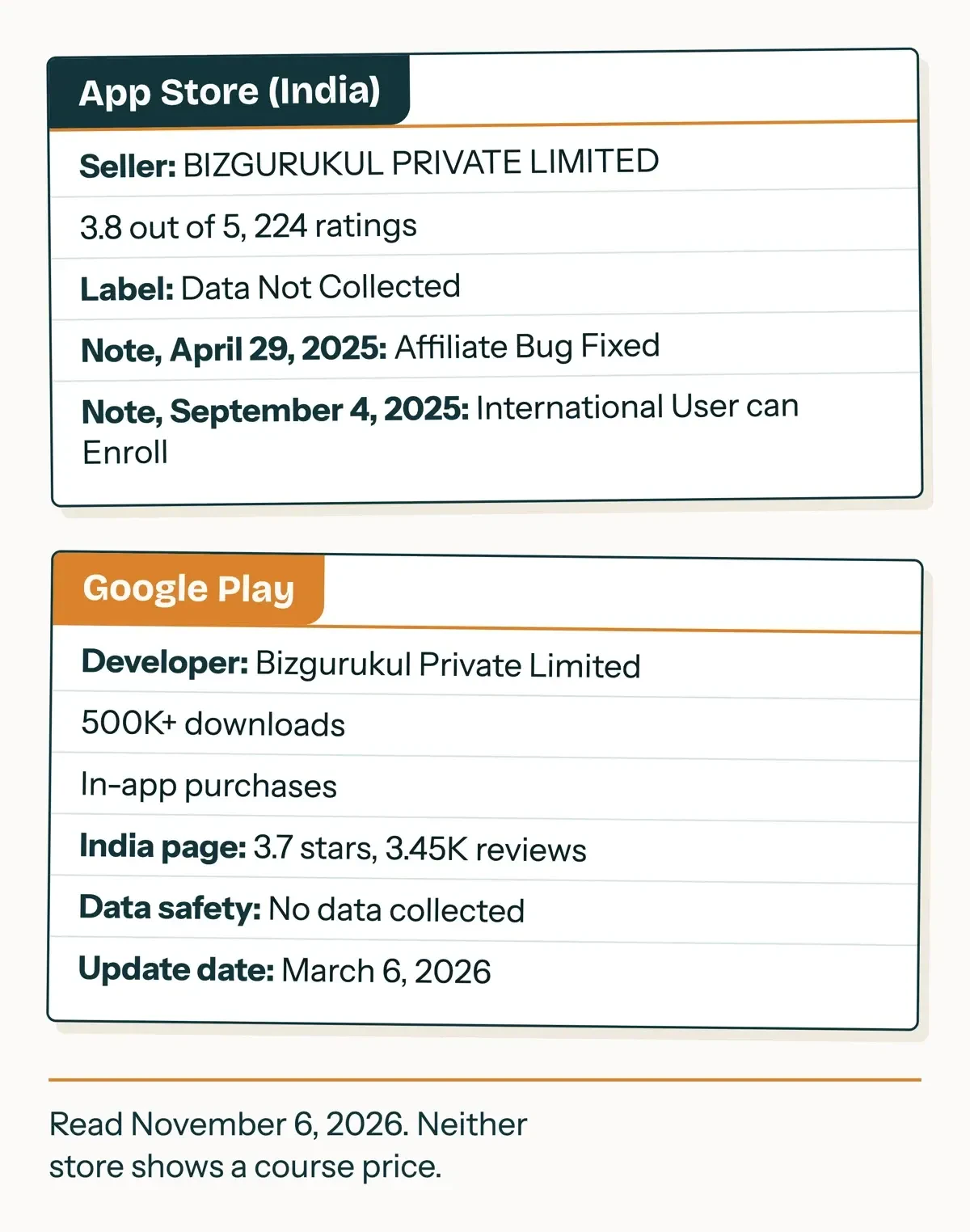 Diagram by DigitalTreed, from Bizgurukul's App Store (India) and Google Play listings, read November 6, 2026.
As of November 6, 2026, the App Store in India shows 3.8 out of 5 from 224 ratings, and Google Play's India page shows 3.7 stars from 3.45K reviews. Neither score says anything about what partners earn. We also requested the same app on Apple's US storefront on November 6, 2026 and got a 404, so Apple has no US page for it. Yet Apple's India listing carries a September 4, 2025 note: "International User can Enroll." Bizgurukul's refund policy backs that up with fees for international users. It keeps a 4.5% payment gateway fee and a 5% processing fee on their refunds, 9.5% of the paid amount (4.5% + 5%).
How does the Bizgurukul income plan work?
An April 29, 2025 release note on Apple's listing reads "Affiliate Bug Fixed," and Bizgurukul's own pages call the people who earn by referral partners. Its terms page sets the payout dates: commissions earned from the 1st to the 15th of a month go to the partner's bank account on the 18th. Those earned from the 16th to the 31st arrive on the 3rd of the next month.
Partners abroad pay any bank charges, foreign exchange fees or payment gateway charges on those transfers. Account holders must be over 18.
The income rules sit in a Partners Code of Conduct on the same disclaimer page. Partners must "Clearly state that no fixed, guaranteed, or assured income is offered by the Company," and that earnings depend on their own effort. The code bans any promise of "fixed, guaranteed, assured, or risk-free income." It also bans pitching the plan as "quick earnings," "easy money" or "copy-paste work," and using "fake, edited, fabricated, or exaggerated income screenshots."
Our checker got a 403 "Just a moment..." bot check on every bizgurukul.com page. We don't work around bot checks. So the pages quoted here were opened in a browser on November 6, 2026. Save a dated copy of each before paying in case Bizgurukul changes them.
The terms page doesn't show a commission rate or rupee earning figure. The other three pages don't give typical partner earnings either. So any rate or monthly figure you've heard came from a person. Pitches in India often quote sums in lakh (one lakh is 100,000 rupees), so ask whoever quotes one where Bizgurukul publishes it, and on what date.
What we tested
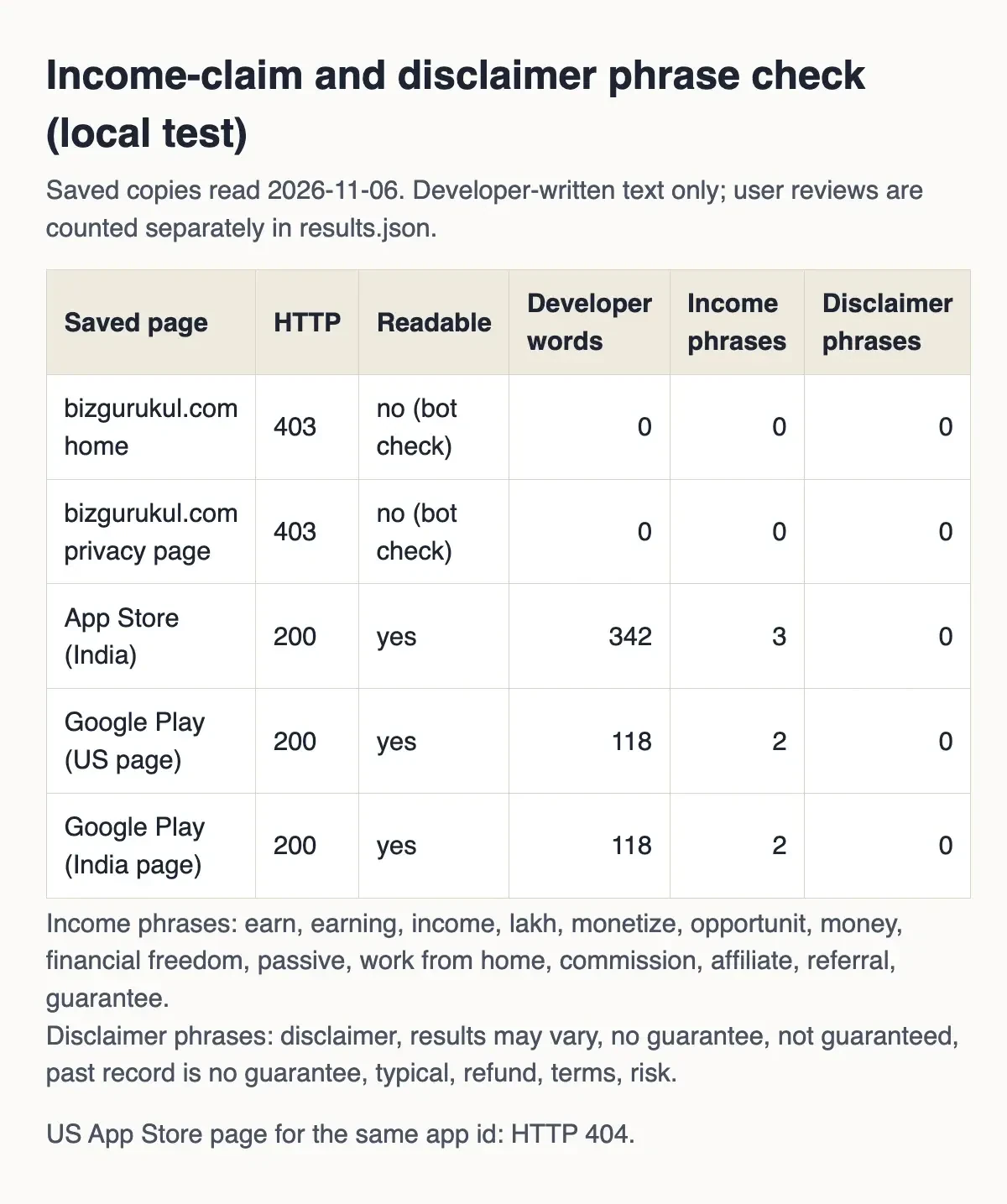
On November 6, 2026 we ran a Python script over every Bizgurukul page we could save. It counts 14 income-claim phrases, like lakh and commission, and 9 disclaimer phrases, like results may vary. The two bizgurukul.com pages it fetched came back as bot-check screens with 0 words. Apple's listing had 342 words outside the user reviews and 3 income-claim hits: monetize, opportunities and affiliate, while each Google Play page had 118 such words and 2 hits. Disclaimer phrases scored 0 everywhere. That doesn't prove no disclaimer exists. Opened in a browser, the disclaimer page does carry one.
 Screenshot: our phrase check report on 127.0.0.1, November 6, 2026.
India's Direct Selling Rules for anyone selling through a network
The Consumer Protection (Direct Selling) Rules, 2021 date from December 28, 2021, and we read them in the Tamil Nadu Government Gazette reprint and the Meghalaya Gazette reprint. Both reprints carry the central notification number, G.S.R. 889(E), and the Tamil Nadu copy ran in that state's gazette on August 10, 2022 after a June 27 state order. They cover every direct selling entity serving India, even one "which is not established in India, but offers goods or services to consumers in India."
No regulator we found has said whether Bizgurukul counts as a direct selling entity.
Four duties in rule 7 bear on an income pitch. Neither the company nor its sellers may "charge any entry fee or subscription fee." An offer can't lean on a testimonial "unless it is genuine, verifiable and relevant." Claims about verifiable facts must be "capable of substantiation." The fourth, rule 7(4), is the sharpest:
- They "shall not induce consumers to make a purchase based upon the representation that they can reduce or recover the price by referring prospective customers" to sellers.
Take a made-up example pitch: buy a course, refer two friends, and your fee comes back, which is the promise rule 7(4) bars a covered company from selling on.
The rules also define a Pyramid Scheme as people enrolling others "in order to receive any benefit, directly or indirectly, as a result of enrolment" of later members. Rule 10 bars both companies and sellers from promoting one. Rule 5 lists what a covered company's website must show: its registered name and address, a grievance officer's contact details, and "information relating to return, refund, exchange." Complaints must be acknowledged "within forty-eight working hours" and normally settled within a month. Question 8 in the checklist below asks a seller for that grievance contact.
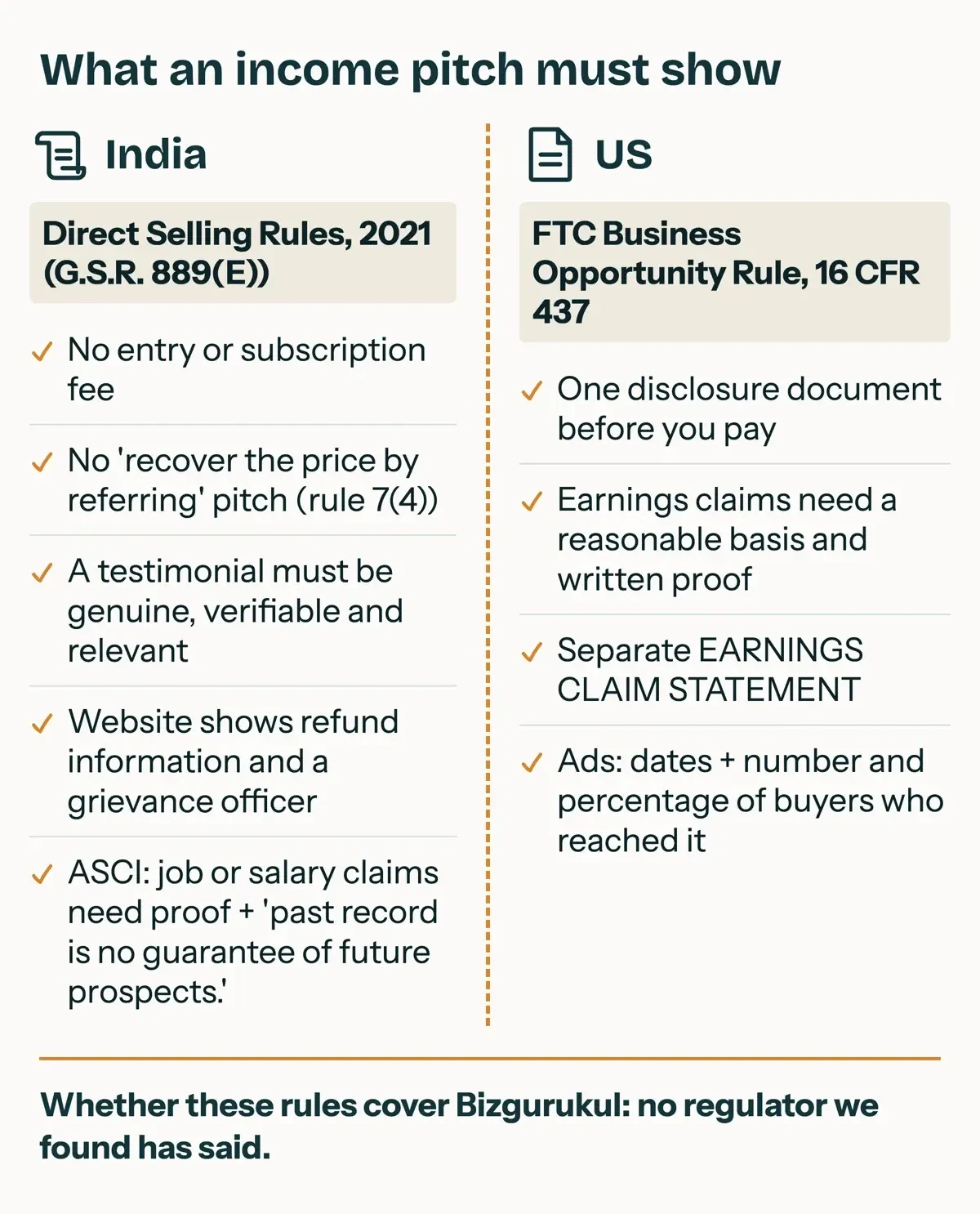 Diagram by DigitalTreed, from the Direct Selling Rules gazette reprints, ASCI guidelines and 16 CFR 437, read November 6, 2026.
ASCI rules on earning and job claims in course ads
The Advertising Standards Council of India, set up in 1985 by its own account, polices what ads may claim. Its guidelines for educational institutions, programmes and platforms name "Edtech platforms" in their scope. Guideline 3 bars an ad from implying enrollment will guarantee a job, "job promotions, salary increase, etc." without proof. Such an ad must also carry the line 'past record is no guarantee of future prospects.' in type at least as large as the claim.
Guideline 4 bans 100% claims about things you can't measure, using "100% Placement/Job assistance" as its example. Guideline 5(a) allows "the highest or average compensation of the students placed" only for the latest completed academic year, backed by evidence. The ASCI Code itself says ads must not "exploit their lack of experience or knowledge." These guidelines talk about jobs and salaries, not affiliate commissions. ASCI hasn't said they reach a referral payout, and we won't stretch them. Held to them, a course ad built on a big income screenshot would need a past-record line and a dated record behind the number. Bizgurukul's own partner code goes further and bans exaggerated income screenshots outright.
Course promoters on Instagram also face ASCI's influencer rules, covered in our look at social media influencers in India.
What the FTC expects from income claims in the US
Unlike ASCI's ad guidelines, the US test is mostly about paperwork. The FTC's Business Opportunity Rule is 16 CFR Part 437, and the FTC's rule page dates its final rule to December 8, 2011. It covers deals where you make a "required payment" and the seller says it will provide "outlets, accounts, or customers" for the goods or services you'll be selling. Under section 437.1, even a "chart, table, or mathematical calculation" of possible income counts as an earnings claim. A covered seller hands you one disclosure document under section 437.3, including legal actions from the past 10 years.
Under section 437.4, it needs "a reasonable basis" and written proof for any earnings claim, and it must also give you a separate "EARNINGS CLAIM STATEMENT." Ads that quote income must say when it was earned and the "number and percentage of all persons" who reached it.
We found neither document among Bizgurukul's pages.
The FTC's business guidance on multi-level marketing says "Most MLM participants earn little to no money." It calls an income disclosure misleading if it drops people "who lost money or earned no money." The FTC's consumer page on MLMs and pyramid schemes agrees that most people who join even legitimate MLMs "make little or no money." Some lose money. Back in 2021, the FTC issued its Notice of Penalty Offenses Concerning Money-Making Opportunities, which found certain recruiting practices "are unfair or deceptive, and violate the FTC Act."
Online course pitches draw their own warnings. The FTC's page on business offer and coaching scams says that if a pitch "promises guaranteed income, large returns" or a proven system, it's likely a scam. A May 18, 2026 FTC consumer alert adds, "No one can guarantee you'll make lots of money with little to no risk." Those are general warning signs for any coaching pitch, not findings about Bizgurukul, which the FTC pages we read don't mention at all. The same honesty rules apply to affiliate links, as our guide to working with social media influencers explains.
Bizgurukul vs a US course affiliate program: what each publishes
Coursera is the closest US match: a course marketplace with an affiliate program anyone can read. As of November 6, 2026, Coursera's affiliate program page says "Joining is fast, easy, and free." Its baseline commission runs from 15% to 45% on eligible purchases made within 30 days of a click on your link. Strong performers can earn bonuses.
Two limits apply. On subscriptions, "we only commission the first month's transaction," and "Degrees and Certificate purchases excluded."
| What a buyer can read | Bizgurukul (India) | Coursera affiliate program (US) | US business opportunity seller (FTC rule) |
|---|---|---|---|
| Cost to join the referral side | Not found on its pages | Free, per its affiliate page | Shown in the one-page disclosure |
| Commission rate | No rate found; paid on the 18th and the 3rd | 15% to 45%, 30-day window | Any earnings claim needs a written statement |
| Income disclaimer | Partner code: "no fixed, guaranteed, or assured income" | No income claim made | "EARNINGS CLAIM STATEMENT" required |
| Refund terms | 24 hours on bundle courses, 7% kept (2% + 5%) | Not on the affiliate page | Handed over before any payment |
| Must you buy a course first? | Not found on its pages | No | A required payment defines it |
Here's the math on an example $100 Coursera purchase (made up), at its rates as of November 2026: $100 x 15% = $15, and $100 x 45% = $45. The affiliate pays nothing to join, and Coursera pays them. The test is whether you earn from sales to outside buyers or pay to join so you can recruit. Plain affiliate deals like the Lego affiliate program and the Amazon affiliate website examples work the first way. Bizgurukul gives no rate to plug in.
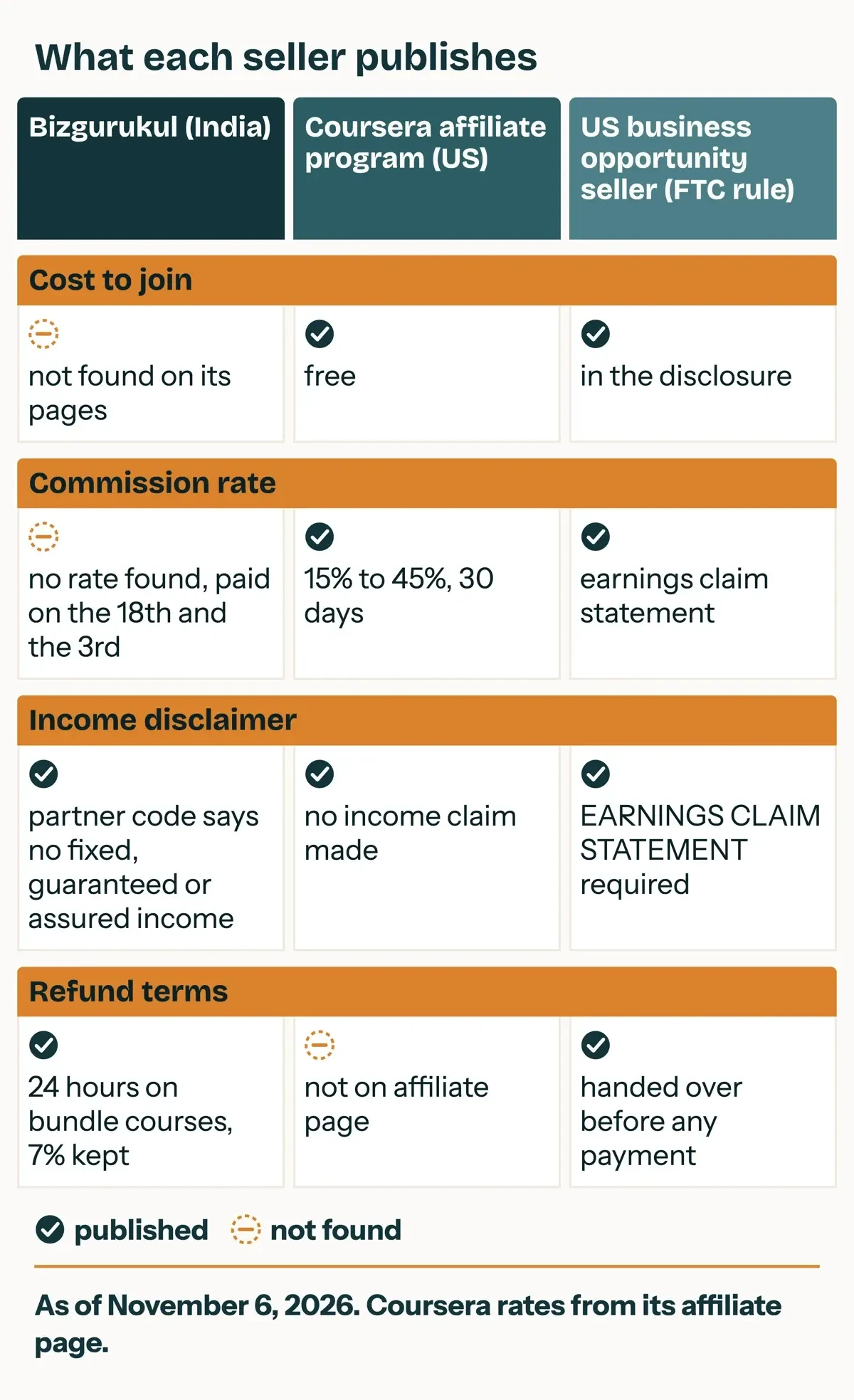 Diagram by DigitalTreed, from Bizgurukul's own pages and app listings, Coursera's affiliate page and 16 CFR 437.4, read November 6, 2026.
Questions to ask a Bizgurukul seller first
Bizgurukul's refund policy sets short windows. Bundle courses can be refunded within 24 hours. The policy keeps 2% of the paid amount as a payment gateway fee and 5% as a processing fee, 7% in all (2% + 5%). The Monetization Series allows 48 hours. The Upskilling subscription and add-on benefits can't be refunded. A refund "may take 7-10 working days" to arrive.
Those pages don't say what a partner earns. Copy these questions into a message to whoever invited you, and wait for written answers that link to Bizgurukul's own pages. Keep every reply:
- What is the full price of each course in rupees, including GST, and what does it include?
- Which refund window covers what I'm buying: 24 hours, 48 hours, or none?
- Do I have to buy a course before I can earn any affiliate commission?
- What commission rate is paid, and on which sales?
- Where does Bizgurukul publish what a typical affiliate earns in a year, including those who earn nothing?
- Is the income figure you showed me from Bizgurukul's records, and from which dates?
- Which company am I paying, Bizgurukul Private Limited or Bizgurukul International Private Limited, and in which currency?
- Who is the grievance officer, and how do I file a complaint?
If someone answers with an earnings screenshot instead of a link, ask for the company page behind it. Bizgurukul's partner code bans fake, edited or exaggerated ones, so a seller should be able to point to the source.
Our guide to starting as a freelancer and our SEO career guide are free to read if what you want is a skill that pays. Our affiliate marketing guide for beginners shows how commissions work when nobody charges a fee to join or makes you buy before you sell. If you've already paid and hit a problem, India's National Consumer Helpline takes complaints toll-free at 1915, 8 a.m. to 8 p.m., or at 1800114000. In the US, the FTC's coaching page says to report at ReportFraud.ftc.gov and to your state attorney general. We'd file in both countries if you and a relative in India each paid.
Bizgurukul questions
Frequently asked
Can I join Bizgurukul from the US?
The app has no US App Store page; our request returned a 404 on November 6, 2026. Apple's India listing says "International User can Enroll." Partners abroad pay their own bank and currency charges on payouts, per its terms.
Is Bizgurukul legal?
We found no regulator or court record about it, so we make no finding. India's Direct Selling Rules make covered companies declare they are "not involved in any Pyramid Scheme or money circulation scheme."
Does the Bizgurukul app collect my data?
The developer told both stores no: "Data Not Collected" on Apple, "No data collected" on Google Play. Apple adds that it hasn't verified this.
Is the FTC writing new income rules?
Maybe. Its MLM guidance says the FTC issued an advance notice of proposed rulemaking that raises whether to cover MLMs and other businesses under "a separate Earnings Claim Rule."
How we made this guide: A 403 bot check stopped our checker at bizgurukul.com. So a person read the four Bizgurukul pages quoted here in a browser on November 6, 2026. The app listings, rules and Coursera page were saved by the checker that day and matched quote by quote. Facts checked by the DigitalTreed team on November 6, 2026.
First published December 2023 as a review that praised Bizgurukul's earning potential without sources. Rewritten November 6, 2026 from Bizgurukul's own policy pages and app listings and the Indian and US rules on income claims.
Sources
- Apple App Store (India): Bizgurukul
- Google Play: Bizgurukul
- Google Play: Bizgurukul data safety
- Bizgurukul pages (403 bot-block to our checker, read in a browser on November 6, 2026): Disclaimer and Partners Code of Conduct, Refund Policy, Terms, About us
- Tamil Nadu Government Gazette No. 32, August 10, 2022: Consumer Protection (Direct Selling) Rules, 2021
- Meghalaya Gazette, November 24, 2022: Consumer Protection (Direct Selling) Rules, 2021
- ASCI: Guidelines for Advertising of Educational Institutions, Programmes and Platforms
- ASCI: The ASCI Code
- FTC: Business Opportunity Rule
- 16 CFR 437.1, Definitions (Cornell LII)
- 16 CFR 437.3, The disclosure document (Cornell LII)
- 16 CFR 437.4, Earnings claims (Cornell LII)
- FTC: Business Guidance Concerning Multi-Level Marketing
- FTC Consumer Advice: Multi-Level Marketing Businesses and Pyramid Schemes
- FTC: Penalty Offenses Concerning Money-Making Opportunities
- FTC Consumer Advice: When a Business Offer or Coaching Program Is a Scam
- FTC Consumer Alert: How to spot and avoid business coaching scams (May 18, 2026)
- Coursera: Affiliate Program
- National Consumer Helpline, Department of Consumer Affairs, India
Comments
No comments yet. Start the conversation below.