
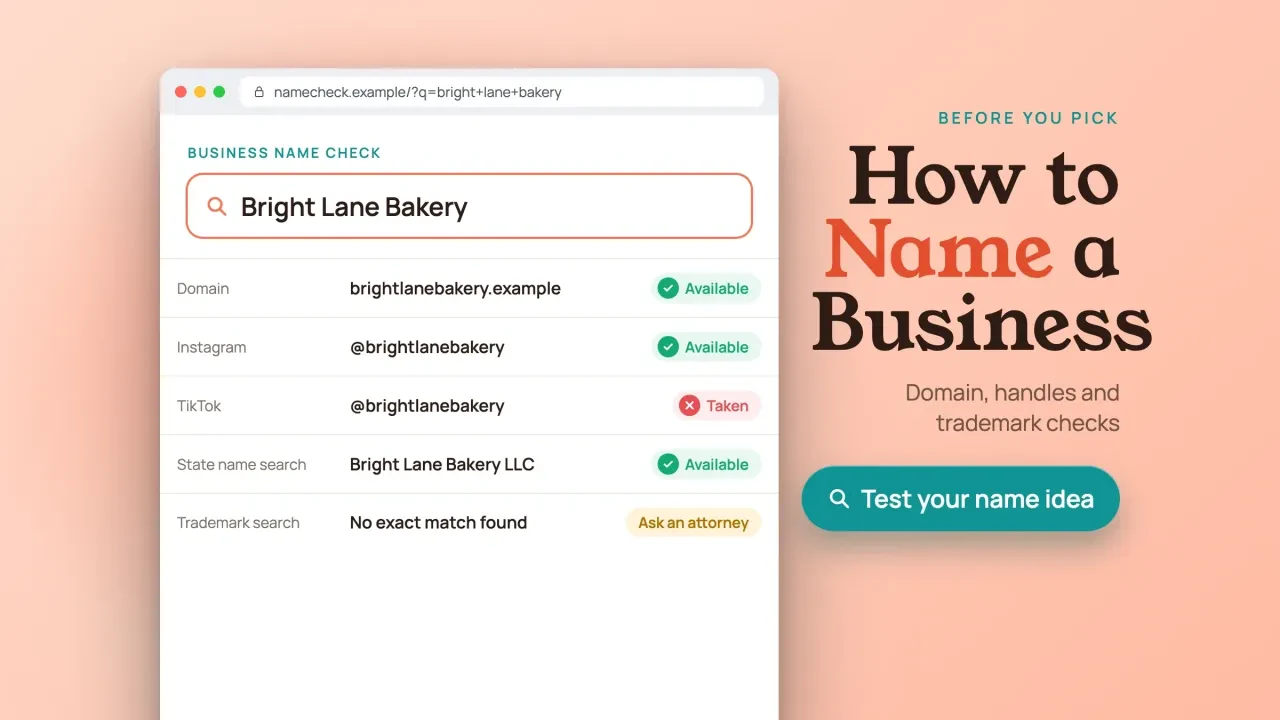
Quick answer
Here's how to name a business: brainstorm 15 to 20 names and keep the ones that are easy to say. Then run 5 checks in this order: a USPTO trademark search, your state's business-entity search, your DBA rules, the domain and the social handles. A state saying a name is "available" doesn't mean nobody owns it as a trademark.
Most naming advice stops at "be creative". The hard part comes after, when you find out whether you're allowed to use the name you love. This checklist covers both halves, for US owners about to form an LLC, file a DBA or open a first shop.
It sits beside our branding strategy plan for small businesses, which covers what the name has to carry.
Here are the 7 steps at a glance:
- Write one line about what you sell, then brainstorm 15 to 20 names in three styles.
- Say every finalist out loud and keep 3 to 5.
- Search the USPTO trademark database.
- Search your state's business-entity records.
- Check whether you need a DBA, and where to file it.
- Check the domain.
- Check the social handles and your Google listing name.
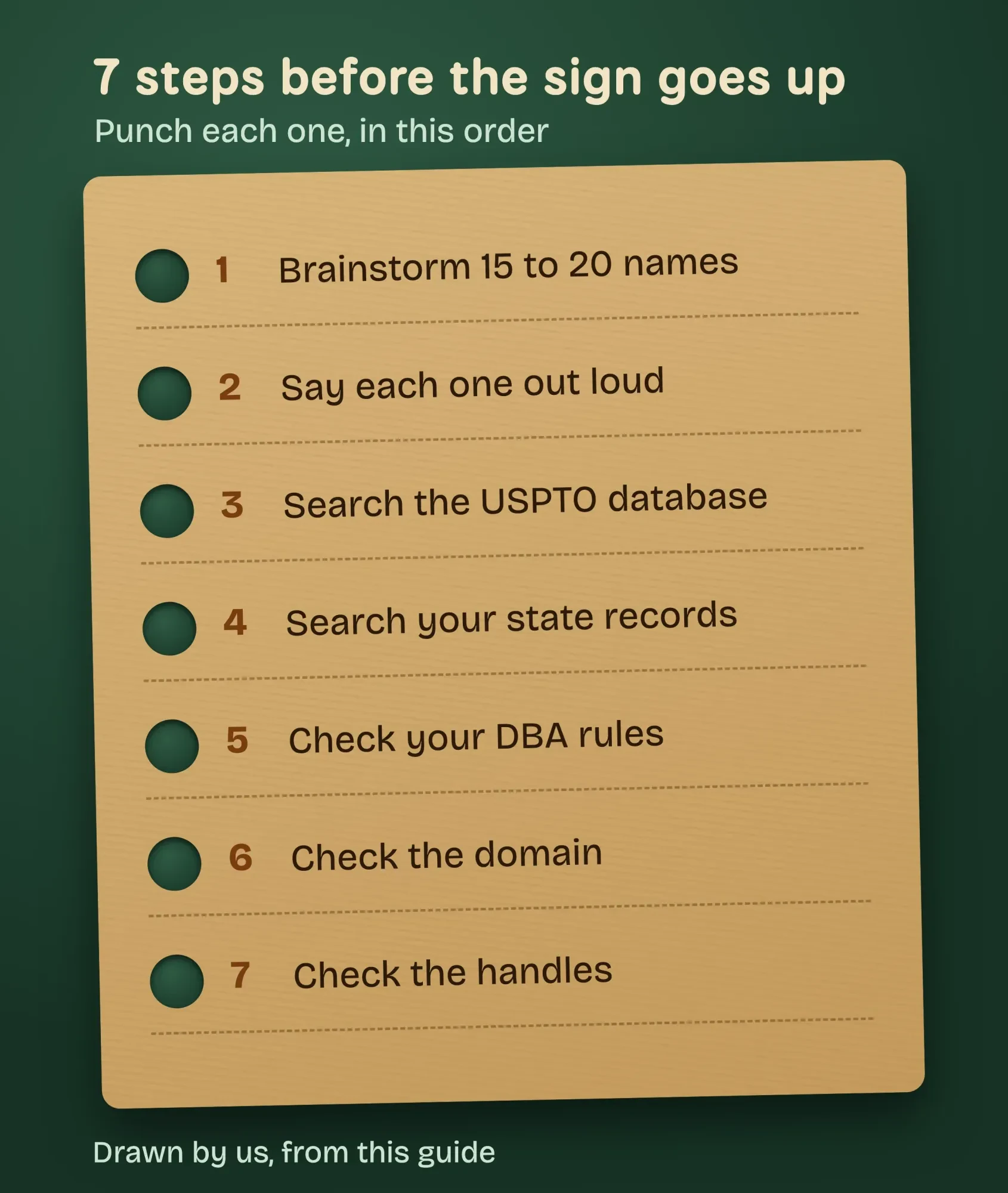 Drawn by us: the 7-step naming checklist from this guide.
Key takeaways
- Brainstorm 15 to 20 names, then keep 3 to 5 after a say-it test.
- Run the USPTO trademark search first; a conflict there can block a name anywhere.
- California's entity search does not check names against trademarks or DBAs.
- A DBA does not reserve the name for you.
- Don't order signs or stationery until the state files your documents.
Start with what you sell, then brainstorm in three styles
So before any name, write one plain sentence: what you sell, to whom, and where. For a made-up Waco shop, "Boot and leather repair for ranch hands and riders in Waco" is a sentence you can name from. "A lifestyle brand" isn't.
Then brainstorm 15 to 20 names across three styles.
A descriptive name says what you do. A suggestive name hints at it. An invented or borrowed word says nothing until you teach people what it means. The USPTO's page on strong trademarks puts it bluntly: "Strong trademarks are suggestive, fanciful, or arbitrary. Weak trademarks are descriptive or generic".
That page gives a clean example. Coppertone for suntan products is suggestive and registered, while "bronzer" for suntan oil "would be descriptive". Descriptive names feel safe because customers get them at once. They're also the hardest to protect.
Our take: for a local service business, a suggestive name with a plain tagline beats a purely descriptive name. You keep the clarity in the tagline and the protection in the name.
To see which plain words your customers actually type, type your service into our keyword suggestions checker and put those words in the tagline, not necessarily the name. Set the country to the United States first, because the tool starts on India. If you're stuck for raw ideas, our list of free business name generators can widen the pile.
Don't judge yet. Quantity first.
Say every finalist out loud before you check anything
Now cut the list. The USPTO says owners "should consider whether the public will remember, pronounce, and spell" a mark, on the same strong trademarks page. That's a test you can run in ten minutes.
Say each name to 3 people who haven't seen it written. Ask them to spell it back and to tell you what they think the business does. If two of three misspell it, it'll fail on the phone, in voice search and in word of mouth.
If they guess the wrong trade, your tagline will have to work harder.
Also check what the name means in other languages your customers speak. The USPTO page raises this for names used abroad, and it matters at home too in a bilingual town.
Keep 3 to 5 names. Checking 20 is a waste of an afternoon.
Search the USPTO trademark database first
Once you have a shortlist, the trademark search comes first, because it can kill a name in any state. The SBA's business name guide warns that "Businesses in every state are subject to trademark infringement lawsuits, which can prove costly".
The search is free at tmsearch.uspto.gov. When we loaded it signed out on October 26, 2026, it opened straight to a "Wordmark" search box. The USPTO's search page says logging in to a USPTO.gov account gives "a better search experience," but you don't need one to look.
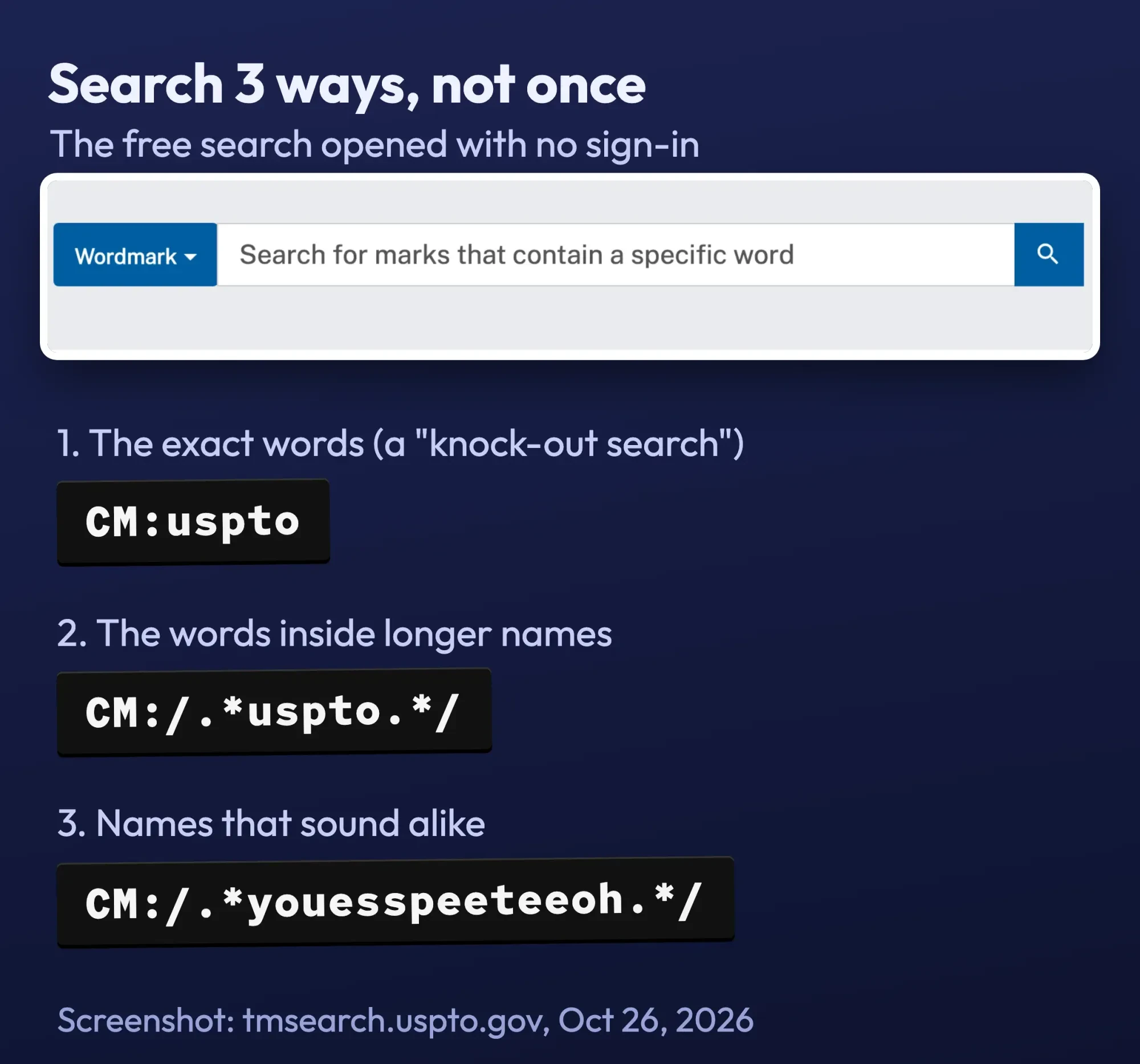 Screenshot: tmsearch.uspto.gov, signed out, October 26, 2026. Search strings from the USPTO federal trademark searching page.
Search more than once. The USPTO's federal trademark searching guide suggests starting with the exact words, such as "CM:uspto," and calls that a "knock-out search," but adds "don't stop there". Then search with wildcards, like "CM:/.*uspto.*/", and search for names that sound alike but are spelled differently.
A near match can still block you.
The USPTO's likelihood of confusion page says this is "the most common reason for refusing registration," and that marks "don't have to be identical to be confusingly similar". The goods matter too. Its example: if you sell hot dog buns, buyers may expect you to sell hamburger buns and bread as well.
Even the federal database isn't the whole picture. People get rights just by using a name, and those rights "only apply to the geographic area" where they trade, per the USPTO's trademark basics. So the USPTO's clearance search page says that, at a minimum, you should check its database and the Official Gazette, "and also search the internet for common-law use". Search the web and Google Maps for each finalist plus your trade.
One honest limit applies here.
The USPTO's federal searching guide says a search of its database "can't give you a clear-cut answer" about registration. A clean result is only a start. It calls clearance searches "complex" and suggests hiring a private trademark attorney. Filing itself happens in Trademark Center, which the USPTO calls "the only way you can apply to register your trademark".
Your state's name search is narrower than it looks
But a clean trademark search doesn't clear the name with your state. If you form an LLC or a corporation, the state checks the name against its own records, and each state runs that check its own way.
The SBA's name guide gives the general rule: "Most states don’t allow you to register a name that’s already been registered by someone else". It adds that "some states require your entity name to reflect the kind of business it represents".
California shows how narrow that check can be. Its Secretary of State's name availability page says names "are checked only against names of like entities," so an LLC name is checked against other LLCs. Then it says, in plain words: "Names are not checked against trademark or service mark registrations or against fictitious business names".
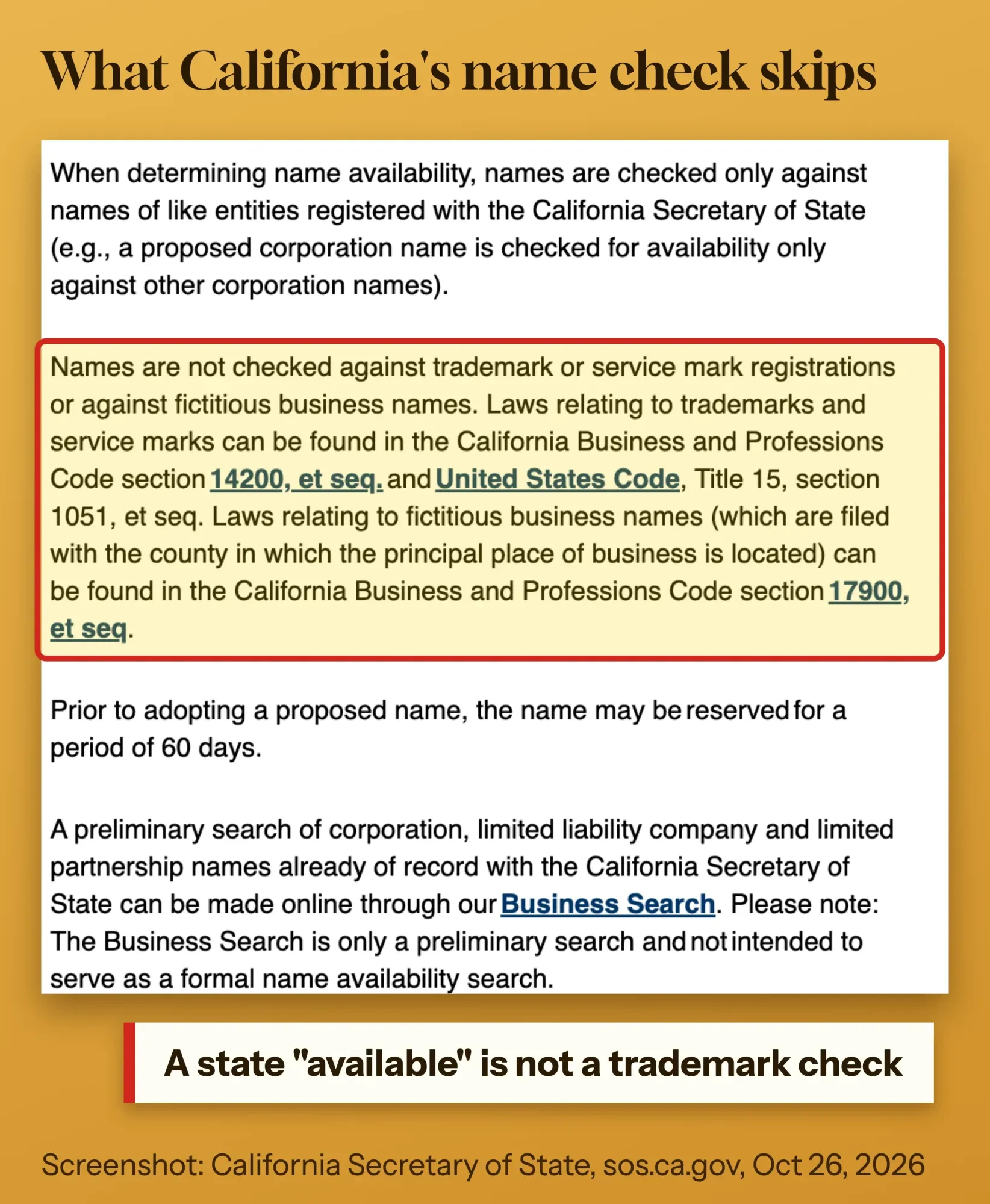 Screenshot: California Secretary of State, Name Reservations page, sos.ca.gov, signed out, October 26, 2026. Highlights added by us.
That page also calls its online Business Search "only a preliminary search". California lets you reserve a name for 60 days. And it warns that "Stationery, signs, etc., should not be ordered" until the state files your documents.
Texas runs a different check. Its Secretary of State name FAQ says an entity name "must be distinguishable in the records of the secretary of state". You can ask for a preliminary answer by phone or email. But the office says a final answer comes only after it processes your filing, and: "Do not make financial expenditures or execute documents based on a preliminary clearance".
Two states, two systems, the same warning.
Search your own state's business-entity database on its Secretary of State site, and read its name rules before you trust the result. Each state words them differently.
Do you need a DBA?
You need a DBA when you trade under any name other than your legal one: your own name as a sole owner, or your LLC's exact registered name. The SBA's guide says registering a DBA "doesn’t provide legal protection by itself, but most states require you to register your DBA if you use one".
Where you file depends on the state and your business type. In Texas, the Secretary of State FAQ sends sole owners and general partnerships to the county clerk in each county where they keep an office. LLCs and corporations file with the Secretary of State, which charges $25 per assumed name certificate as of October 2026. A certificate can last no more than 10 years.
California splits it again. Its name page says fictitious business names "are filed with the county in which the principal place of business is located". And the SBA’s registration guide notes that "Some counties and cities also require you to register your DBA," so check your city too.
Here's the catch most owners miss: a DBA doesn't reserve the name.
Texas says outright that several assumed name certificates can sit on file "for the exact same name." Its FAQ adds: "It is up to each business entity to protect its name and good will".
Check the domain, but don't buy one that copies a brand
Next, the domain. It doesn't have to match your legal name. The SBA's name guide says, "Your domain name doesn’t actually need to be the same as your legal business name, trademark, or DBA". If the plain .com is gone, adding your town or trade often works.
Buy it from a registrar on ICANN's list of accredited registrars. The SBA tells you to consult a directory of accredited registrars to see which ones are safe to use. Then set it to auto-renew, because the SBA notes you'll "need to renew your domain registration on a regular basis".
Don't treat a free domain as a green light.
Under ICANN's Uniform Domain-Name Dispute-Resolution Policy, every registrant promises that, to their knowledge, the domain won't infringe anyone's rights, and the policy says "It is your responsibility to determine" that. A trademark owner can file a complaint if your domain is "identical or confusingly similar" to their mark and the other tests in the policy are met. That's one more reason the USPTO search comes first.
Before you buy, type your name and domain into our SERP snippet preview tool to see how they'll look together in a Google result. Our WordPress website guide covers buying and protecting the domain. Once it's yours, set up a business email address on your domain.
Grab the same handle everywhere in the same week
Then claim the social handles, all in one sitting, so nobody grabs the name between your filing and your launch. Each platform has its own limits, so the shortest form of your name is the safest.
YouTube handles must be 3 to 30 characters, per YouTube Help, and they "aren’t case-sensitive". YouTube also says it "reserves the right to change, reclaim, or remove a handle at any time". Facebook, Instagram, TikTok and X each set their own username rules (see Facebook Help, for one), and those rules change. Check each platform's own help page before you settle on a form.
Your listing on Google has a stricter rule. Google's profile guidelines say your name "should reflect your business’s real-world name, as used consistently on your storefront, website, stationery". So pick the exact form you'll paint on the sign, and use it everywhere.
For the profile itself, see the name chapter of our guide to setting up a Business Profile. For everything else on each social profile, use the social media optimization checklist.
What each check covers, and what it doesn't
That's 5 checks, and each one answers a narrow question.
We built this table from the official pages we read on October 26, 2026.
| Check | Who runs it | A clean result means | It does not tell you |
|---|---|---|---|
| USPTO search | You, at tmsearch.uspto.gov | No conflicting federal filing found by your search | Common-law users, state marks, or what the examiner will decide |
| State entity search | Your Secretary of State | No like entity of record with that name | Trademarks or fictitious names (California says so) |
| DBA filing | State, county or city | You have told the public who trades under the name | That nobody else uses it (Texas allows duplicates) |
| Domain | An ICANN-accredited registrar | Nobody else holds that exact address | That it is safe from a trademark complaint |
| Handles | Each platform | The username is free today | Rights to the name; YouTube, for one, can reclaim handles |
The SBA puts the same point in one line: these name registrations "are legally independent".
Passing one tells you nothing about the next.
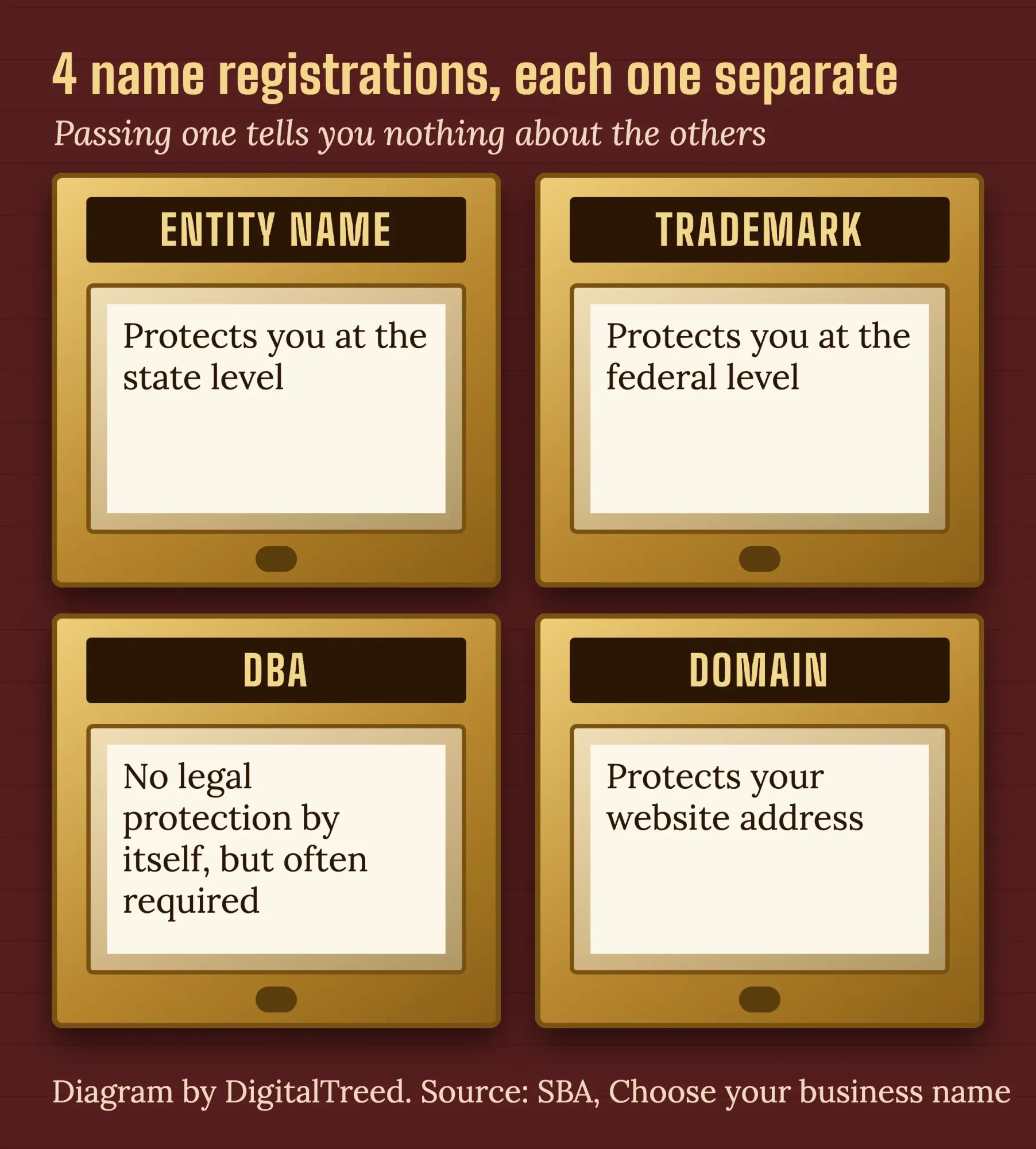 Diagram by DigitalTreed. Source: SBA, Choose your business name, October 2026.
Example: two partners in Waco name their boot repair shop
Example: two made-up partners are opening a boot and leather repair shop in Waco, Texas, as an LLC. Their one-line description is "boot and saddle repair for riders and ranch hands in Central Texas". They brainstorm 18 names and keep 3: "Waco Boot Repair" (descriptive), "Second Heel" (suggestive) and "Ironbark Leatherworks" (borrowed word).
The say-it test cuts "Ironbark" first. Two of three friends spell it "Iron Bark," and one guesses it's a tree service. "Waco Boot Repair" passes every ear test, but by the USPTO's strong-trademarks test it's descriptive, which makes it weak and hard to protect.
So they run "Second Heel" through the checks in order. A knock-out search, wildcards and sound-alikes go first. Then comes a web search for shoe and leather businesses with similar names, then the Texas preliminary check by email. Because the shop is an LLC, any DBA would go to the Secretary of State, not the county.
If any step turns up a live mark for related goods or services, they drop the name and go back to their list of 18.
They don't order the sign until the state files the LLC.
Frequently asked
How long does a federal trademark registration last?
It lasts as long as you keep using the mark and file on time. You file a declaration of use between the fifth and sixth years, then renew between the ninth and 10th years and every 10 years after. Each deadline has a six-month grace period with an extra fee, per the USPTO as of October 2026.
How long can I hold a business name in Texas before I form the LLC?
A Texas name reservation lasts 120 days, and you can file it online through SOSPortal at any hour. Reservations are now generic, so one made for a corporation can form an LLC. You can renew by filing a new application in the 30 days before it expires, per the Texas Secretary of State as of October 2026.
Can I add keywords or a tagline to my Google Business Profile name?
No. Google says adding unnecessary information to your business name isn't permitted and could get the profile suspended. Its examples rule out marketing taglines, such as a bank name followed by a slogan, per Google's profile guidelines as of October 2026. Keep the tagline for your website and sign.
Lock it in, in this order
Once a name passes, lock it in before you spend money on it. Order matters here. Reserve the name or form your LLC with the state. File a DBA if you'll trade under a different name, and buy the domain and handles the same week.
You can start using "TM" for goods or "SM" for services right away. The USPTO's trademark basics say you can use them "even if you haven’t filed an application," and that you're "not required to register". Federal registration gives you nationwide rights; the base filing fee is $350 per class of goods or services as of October 2026, per the USPTO's cost page. Our branding plan has the full fee table.
The USPTO doesn't require a lawyer for owners based in the US. The USPTO's attorney page says, "If you’re domiciled in the United States, you’re not required to have an attorney". It also warns that "trademark filing companies are not the same as law firms". And if your application fails, the USPTO says "we don’t refund filing fees".
Treat this page as a map of the official checks as of October 2026, not as legal advice on your name. Before you file a trademark, or if a search turns up a close match, talk to a US-licensed trademark attorney.
Renaming a business you already run? The order changes, and our rebranding checklist covers it. If your name is cleared and you need a logo and brand kit built around it, our graphics and design team can make them. We charge for that work, so compare us with another studio first.
Not sure you need a site yet? Read our honest take on whether your business needs a website. When the name is ready to go online, we build small-business websites on your new domain. That's paid work too.
How we made this guide: on October 26, 2026, the DigitalTreed team read the official pages listed under Sources and matched each rule here to one of them. They come from the SBA, the USPTO, two Secretaries of State, ICANN and three platform help centers, and most are linked where they're used. We loaded the USPTO search page signed out and took both screenshots that day. We didn't run searches for real names in any government system, and the Waco shop is invented.
First published July 2020. Rewritten October 26, 2026: a new 7-step checklist with the USPTO search, two state examples, DBA rules, domains and handles. We added a table of what each check covers and a worked example.
Sources
- SBA: Choose your business name
- SBA: Register your business
- USPTO: Search our trademark database
- USPTO Trademark Search system
- USPTO: Federal trademark searching
- USPTO: Likelihood of confusion
- USPTO: Comprehensive clearance search for similar trademarks
- USPTO: Why search for similar trademarks?
- USPTO: What is a trademark?
- USPTO: Strong trademarks
- USPTO: How much does it cost?
- USPTO: Do I need an attorney?
- USPTO: Trademark Center updates and training
- California Secretary of State: Name Reservations
- Texas Secretary of State: Name Filings FAQs
- ICANN: List of Accredited Registrars
- ICANN: Uniform Domain Name Dispute Resolution Policy
- YouTube Help: Learn about YouTube handles
- Facebook Help: Username guidelines
- Google Business Profile Help: Guidelines for representing your business

Comments
No comments yet. Start the conversation below.