
Quick answer
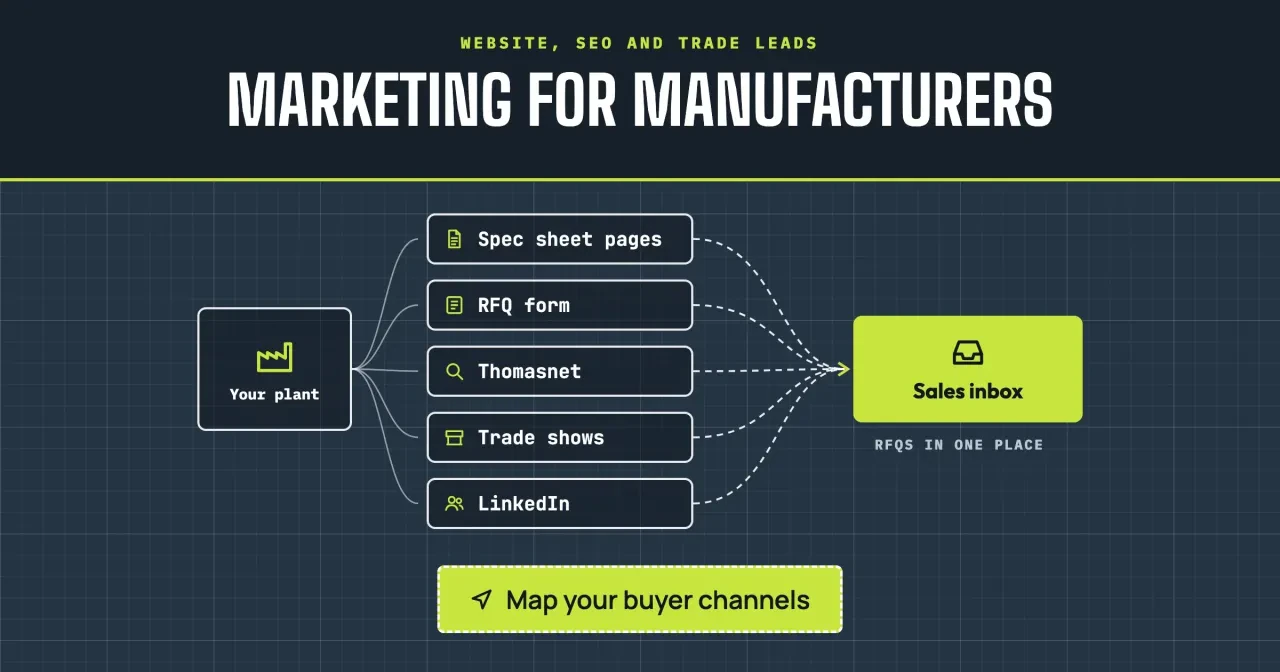
As of October 2026, a small manufacturer gets more customers online through five buyer channels: spec pages, an RFQ form, a free Thomasnet profile, a trade show and LinkedIn. Fix the part pages and the quote form first, because every other channel ends with a buyer on one of them. Then add one channel at a time.
Your shop may run on referrals and a couple of old distributors. Manufacturing marketing is the work of getting engineers and buyers to find your parts, trust your specs and send a request for quote. We'd start on your own part pages, because every other channel ends with a buyer reading one.
We start with why most US plants are small and buyers search by spec, then cover spec pages, what an RFQ form should ask for and the Thomasnet profile. After that: trade shows, LinkedIn for buyers who don't search, one sales inbox, and nine checks on two versions of a made-up part page.
Key takeaways
- Fix the part pages and RFQ form first; every channel sends buyers there.
- Quote-only part pages without a price or reviews can't get Google's product snippet.
- A file input's accept list is a hint; check uploads on the server.
- Thomas's "2.2M+" buyer figure is its own claim, with no method given.
- Tag every channel's link with utm_source so each RFQ arrives labeled.
Most US plants are small, and buyers search by spec
Start with the field you're competing in. The National Association of Manufacturers' facts page counts more than 239,000 manufacturers in the US, employing 12.6 million people. It also says 74% of manufacturing firms have fewer than 20 employees. NAM doesn't give a year or firm count for that share. Its only note says the figures update weekly from Bureau of Economic Analysis and Census Bureau data. Treat 74% as a rough share, then, but it still puts a shop your size in the majority. If part of your output also goes to consumers, our comparison of B2B and B2C marketing explains why those buyers need different pages.
That buyer is often an engineer typing what's on the drawing: a wire size, a material grade, an old part number. Google's advice for site owners points the same way. Its starter guide to search says to think about the words a user might search for. It also notes that people who know a topic well search with different keywords than newcomers do. Your buyers know the topic very well. The routing card below shows their path in four operations. You control the first and the last, your part pages and your RFQ form, so fix those before paying for the two in between.
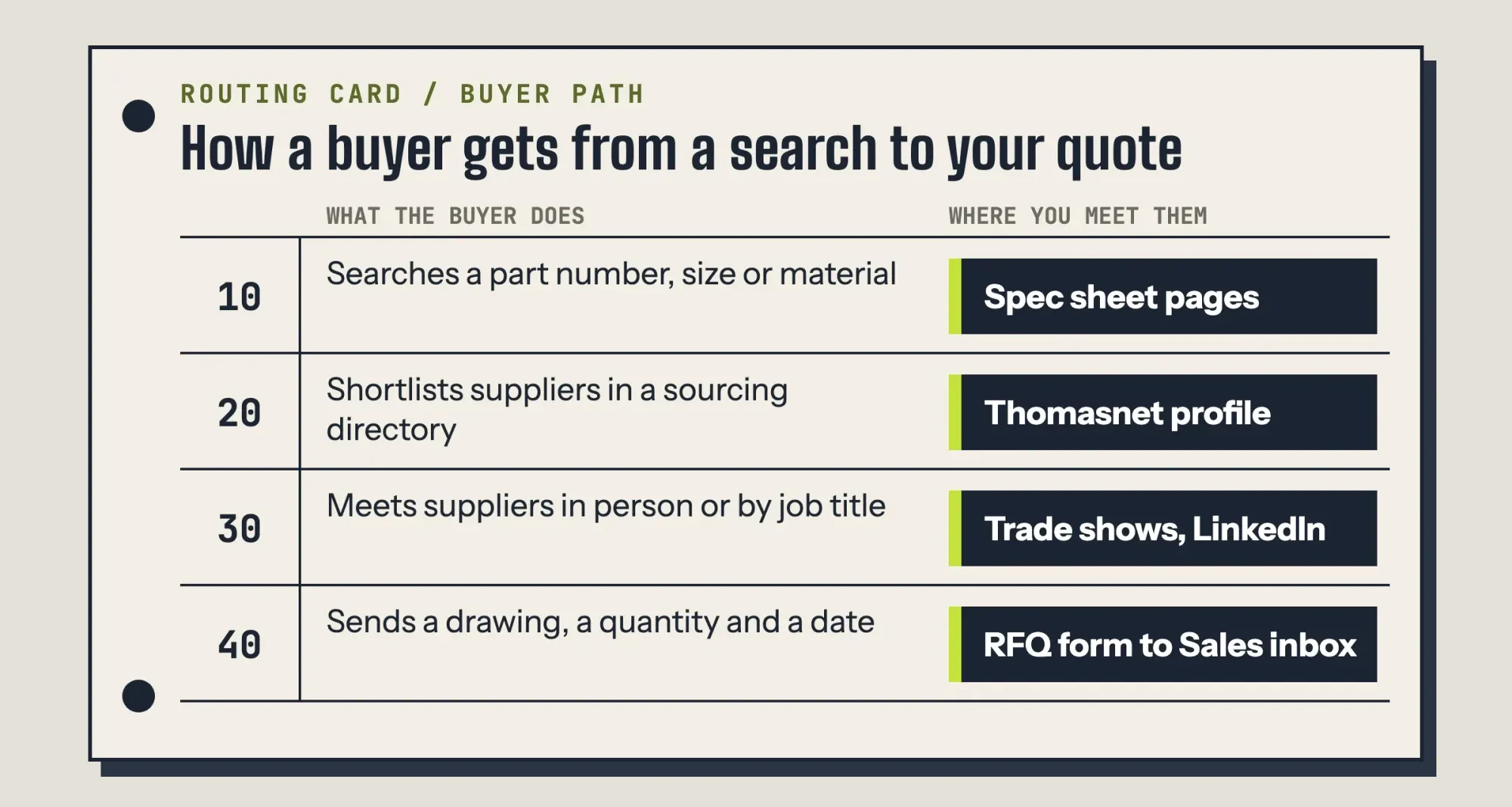 Drawn by us. A buyer's path from search to quote, one operation per channel.
Put each part family's specs on its own page
So fix your website before you spend money anywhere else. Give each part family its own page, with the part number or family name in the title and the H1, matching the string an engineer pastes into search. Google's guide to title links asks for a descriptive, concise <title> on every page and warns against repeated or boilerplate titles. A title reading "Products | Your Company" on forty pages is that boilerplate. Then put the numbers on the page as HTML. A spec table with wire diameter, outside diameter, free length, material, ends and finish carries the words the engineer typed. Keep the PDF download as well.
Product markup adds a layer on top. Schema.org's Product type has properties such as sku, material and brand, and our test page used all three. There's one catch that's easy to miss, though. Google's product snippet documentation requires a name plus one of review, aggregateRating or offers. A quote-only part with no price and no reviews isn't eligible, and our checker flagged exactly that on our own page. Our page's markup named PW-2210 with its sku, its ASTM A228 material and the brand, and the name check passed. Keep markup like that anyway. It still describes the part, but it's the title, H1 and spec table that'll carry the search work for a quote-only shop like yours.
Run your current part pages through our website audit tool to see which titles repeat. Any crawl or redirect problems it finds are covered in our step-by-step crawl and redirect checklist.
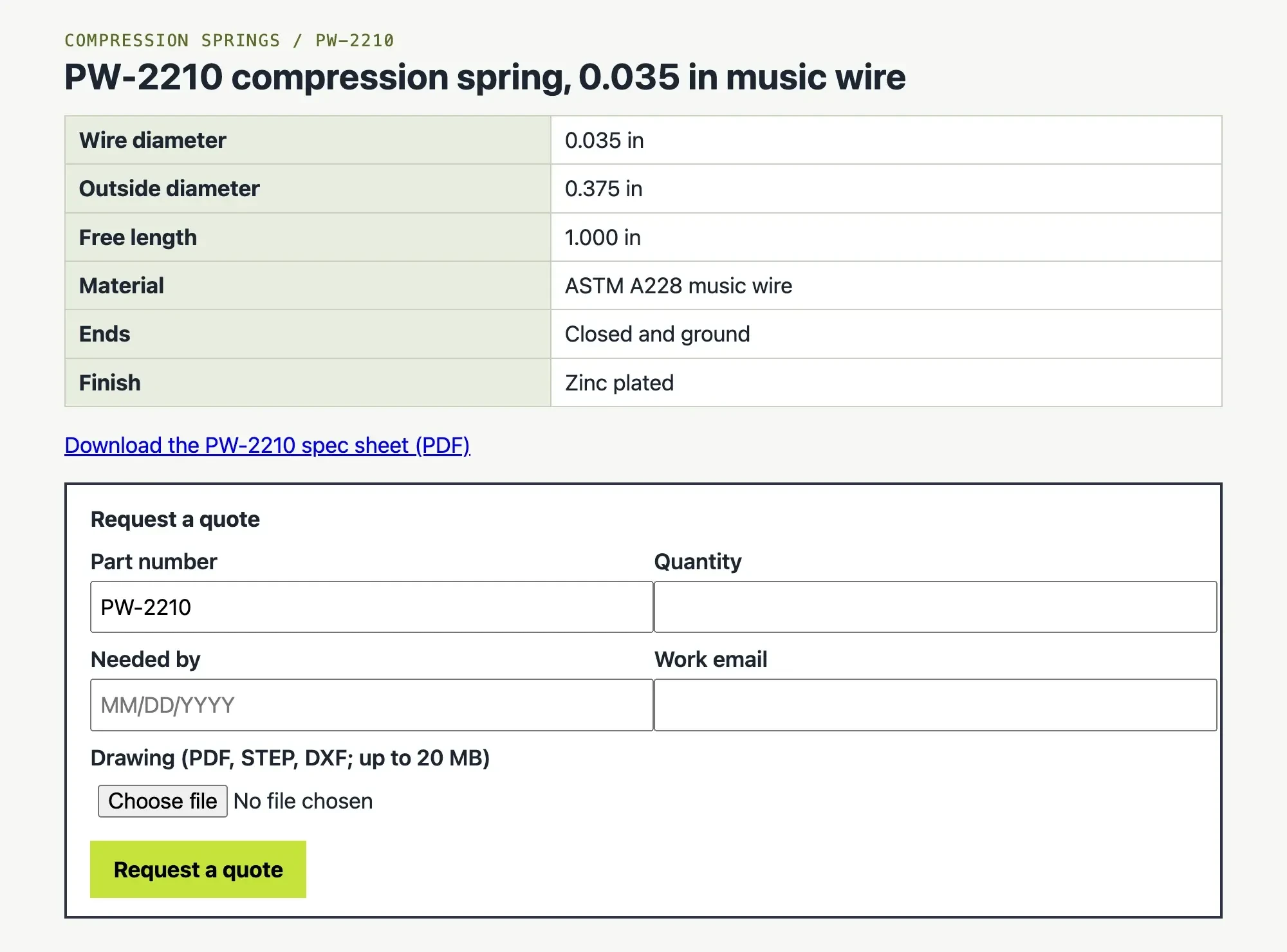 Screenshot: after.html for the made-up Pellwick PW-2210 spring, served at 127.0.0.1 on October 28, 2026.
What should an RFQ form ask for?
After the spec table, a name, email and message form makes a buyer write the RFQ from scratch. Ask for quote inputs instead:
| Field | Why it's there | Server rule in our test form |
| Part number | Ties the request to a page and a drawing | Required |
| Quantity | Price breaks depend on it | Required, a whole number of 1 or more |
| Needed by | Shows whether the job fits your schedule | Optional |
| Work email | Where the quote goes | Required, must look like an email address |
| Drawing | Carries the tolerances a form can't | Optional; .pdf, .step, .stp or .dxf, 20 MB or less |
| Source (hidden) | Records which channel sent the buyer | Filled from utm_source, else "direct" |
The upload field needs a second look. MDN's reference for file inputs says the accept attribute doesn't validate file types; it's only a hint to the browser. Buyers can override it in the file picker. So the real check has to run on the server. In our test, curl sent a .exe straight to the server, skipping the browser's accept list, and the server turned it away. Ours also capped files at 20 MB (20 × 1,024 × 1,024 = 20,971,520 bytes), which stopped a 22,000,000-byte test PDF.
Our server check had a gap, too. It didn't look inside files, only at the name's ending, so a renamed .exe would've passed. A real setup needs a content check too.
Label every field, too. The W3C's forms tutorial on labels asks for labels on all form controls, in most cases with the label element. Grey placeholder text doesn't count. It's gone once the buyer starts typing.
Defense work can change the rules for those drawings. DFARS clause 252.204-7012 says the covered contractor information system "shall be subject to the security requirements" in NIST SP 800-171. NIST's SP 800-171 page says those requirements apply to systems that process, store or transmit Controlled Unclassified Information. The clause points to the version "in effect at the time the solicitation is issued," and NIST published Revision 3 in May 2024.
A web form that emails attachments to a shared mailbox won't always meet them, because the mailbox and every laptop that opens it then become systems that store the drawing. Ask defense buyers how they'd like files sent, and ask a compliance adviser too.
Thomasnet: fill in the free profile before paying for placement
Once the pages and form work, list the shop on Thomasnet, a directory where industrial buyers search for and shortlist suppliers by product, capability and certification. Thomas's page for suppliers says you can claim your company profile with no fees and no commitment, then manage your description, capabilities, certifications and contact details. The same page makes three claims in its own words. It lists "2.2M+ Registered Industrial Buyers" and "66% of Buyers Visit Thomas With a Specific Purchasing Need." It adds "25X More Evaluations With a Sponsored Listing Over Non-Paid Accounts."
Thomas doesn't give a method, sample or date for any of the three. It also sells the Sponsored Listing it's comparing with free accounts, plus website design, SEO and PPC services to suppliers. Treat the three figures as sales claims. Claim the free profile first, then fill it with the same part families, certifications, company name and phone number as your website. If the profile lets you set a website link, tag it utm_source=thomasnet, with a medium and campaign tag, so those requests arrive labeled. After a few months you'll know how many RFQs the free profile sent, and that's the count to bring to any sales call about paid placement.
Choose trade shows by who walks the floor
Unlike that free profile, a trade show makes you pay for floor space, travel and a booth before you meet a single buyer. IMTS, run by AMT, says its 2026 show, held September 14-19, drew over 90,000 attendees and more than 1,700 exhibitors across over 1.17 million square feet. The next one's IMTS 2028. At that 2026 show, a small spring shop would've been one booth among more than 1,700. Before you sign for space, ask the show for last year's attendees by job title and industry, and check that your buyers were there.
Build the show its own link in our UTM builder, tagged utm_source=tradeshow plus a medium and campaign. Print it as a QR code on the booth sign and the spec sheets you hand out. A buyer who scans it a week later lands on the part page, labeled tradeshow.
Use LinkedIn for buyers who never search
Still, some buyers won't search or walk a show floor: a purchasing manager working from an approved vendor list, or an engineer who only looks when a supplier fails. That's where LinkedIn helps, since it reaches them by role. Its Pages overview says you can create a Page for your company for free. Post what a buyer would forward to a colleague, like a new material you can run or a finished part with its spec line. It's also where a buyer who found you on Thomasnet or at a booth can check that the shop's real and still active.
Paid reach works differently from search. LinkedIn's ad targeting page lists traits like job title, company name or industry. So an ad can go to purchasing managers at the 20 companies you'd most like to quote for. How much to spend there is a budget question, and our B2B marketing budget guide covers LinkedIn's daily minimums and the starting budget LinkedIn suggests for new advertisers. Write your list of 20 companies down before you build the ad, so it's aimed at real accounts instead of a whole industry. For reaching the same people person by person, compare cold calling and cold email for small B2B first.
Send every channel into one sales inbox
Those five channels only pay off when you know which one sent each request. So route them into one sales inbox that every form, profile link and booth code feeds. A shared mailbox is enough for one or two people quoting; it's worth moving to a CRM pipeline once each quote needs an owner and a follow-up date. Each request should carry a source label, such as thomasnet, tradeshow, linkedin or direct, which is what our test form's hidden field adds. Our SEO lead generation guide covers counting those labeled form leads in GA4. If a form doesn't reach that inbox at all, our guide to an HTML contact form that actually sends email fixes the mail side first.
Nine checks and six quote requests on a made-up page
That hidden field was one of nine checks we ran. We built two versions of one part page for Pellwick Spring and Wire, a made-up spring maker, and checked both with the same script. It asked whether the title and H1 named the part, how many spec rows sat in HTML and whether Product markup had a name. It also checked snippet eligibility, a quantity box, a drawing upload, a label on every visible field and the hidden source field. The before page, with its "Products" title, PDF link and name, email and message form, failed all eight pass-or-fail checks and had 0 spec rows. The after page passed seven and had 6 rows.
The before title ran 35 characters. The after one, at 58, reads "PW-2210 compression spring, 0.035 in music wire | Pellwick." It leads with the part number, then the wire size an engineer's likely to type.
Its one failure was the product snippet, because it's got no offers, review or aggregateRating, the three properties Google's documentation accepts for that result. We didn't add a made-up price or rating to make it pass.
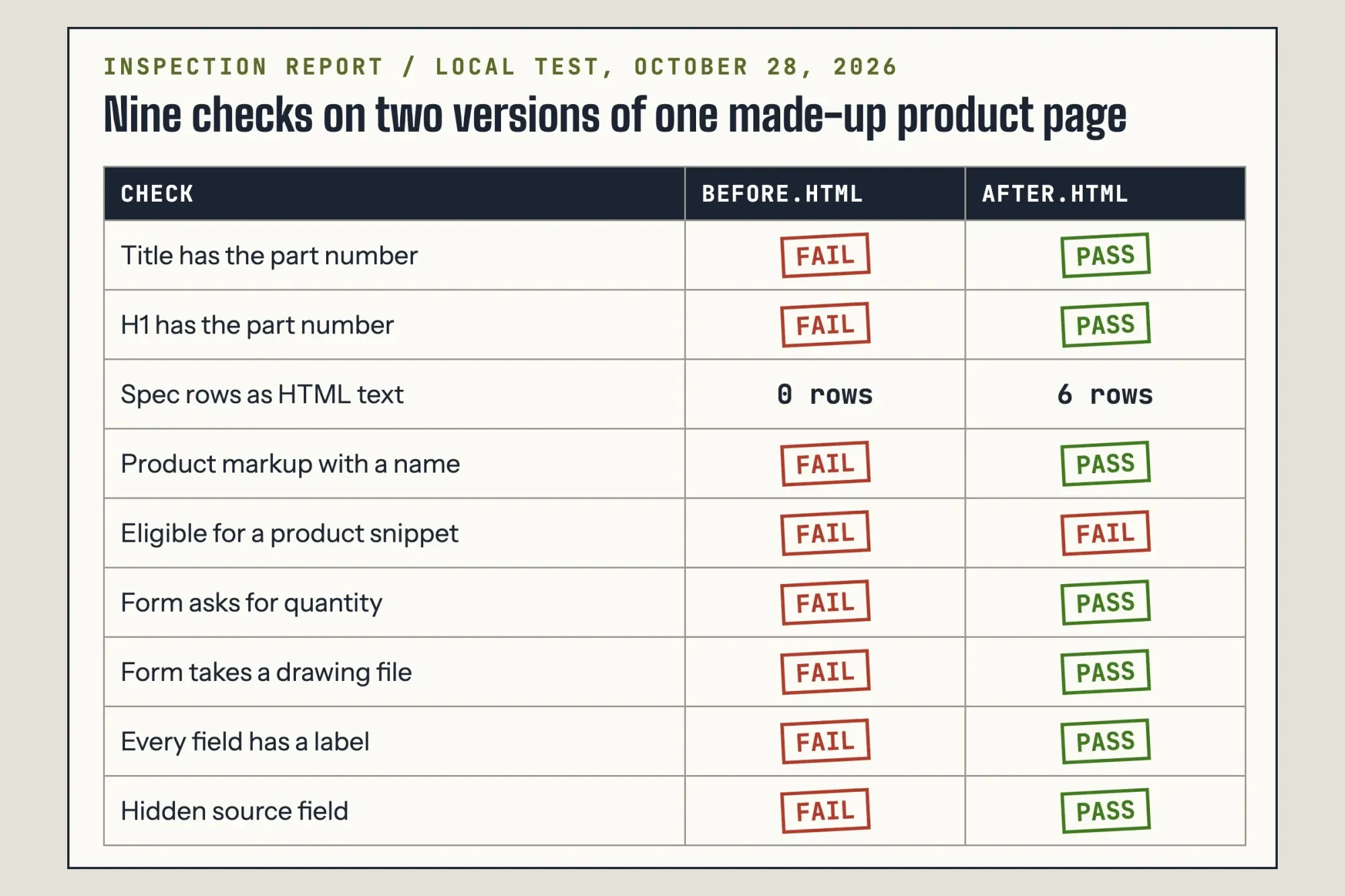 Diagram by DigitalTreed. check_pages.py output for two made-up pages, run October 28, 2026.
The before page is worth a closer look. Its title, "Products | Pellwick Spring and Wire," doesn't name a part at all. Its three form fields, name, email and message, had placeholder hints but didn't have a label element, which is why check 8 listed all three. There wasn't a quantity box or an upload, so a buyer would've had to type the order size into the message and email the drawing separately.
The after page fixed all of those with a six-row table, five labeled fields and one hidden field, and no new software. Its upload box lists .pdf, .step, .stp and .dxf, the accept list check 7 read back.
Next came the form: six curl posts, three built to fail, then a headless Chrome load with ?utm_source=thomasnet:
- STEP drawing, quantity 5,000, source thomasnet: accepted (HTTP 200).
- PDF drawing, quantity 250, source tradeshow: accepted (HTTP 200).
- No drawing, quantity 1,200, source linkedin: accepted (HTTP 200).
- A file named setup.exe: rejected (HTTP 422), file type not accepted.
- Quantity left blank: rejected (HTTP 422), quantity missing.
- A 22 MB test PDF (22,000,000 bytes): rejected (HTTP 422), file over 20 MB.
- Headless Chrome: the hidden source field read "thomasnet".
The three accepted requests landed in one inbox file with their source labels; the other three got an HTTP 422. We never tried a bad part number or email. Nothing was emailed, and no real traffic was measured.
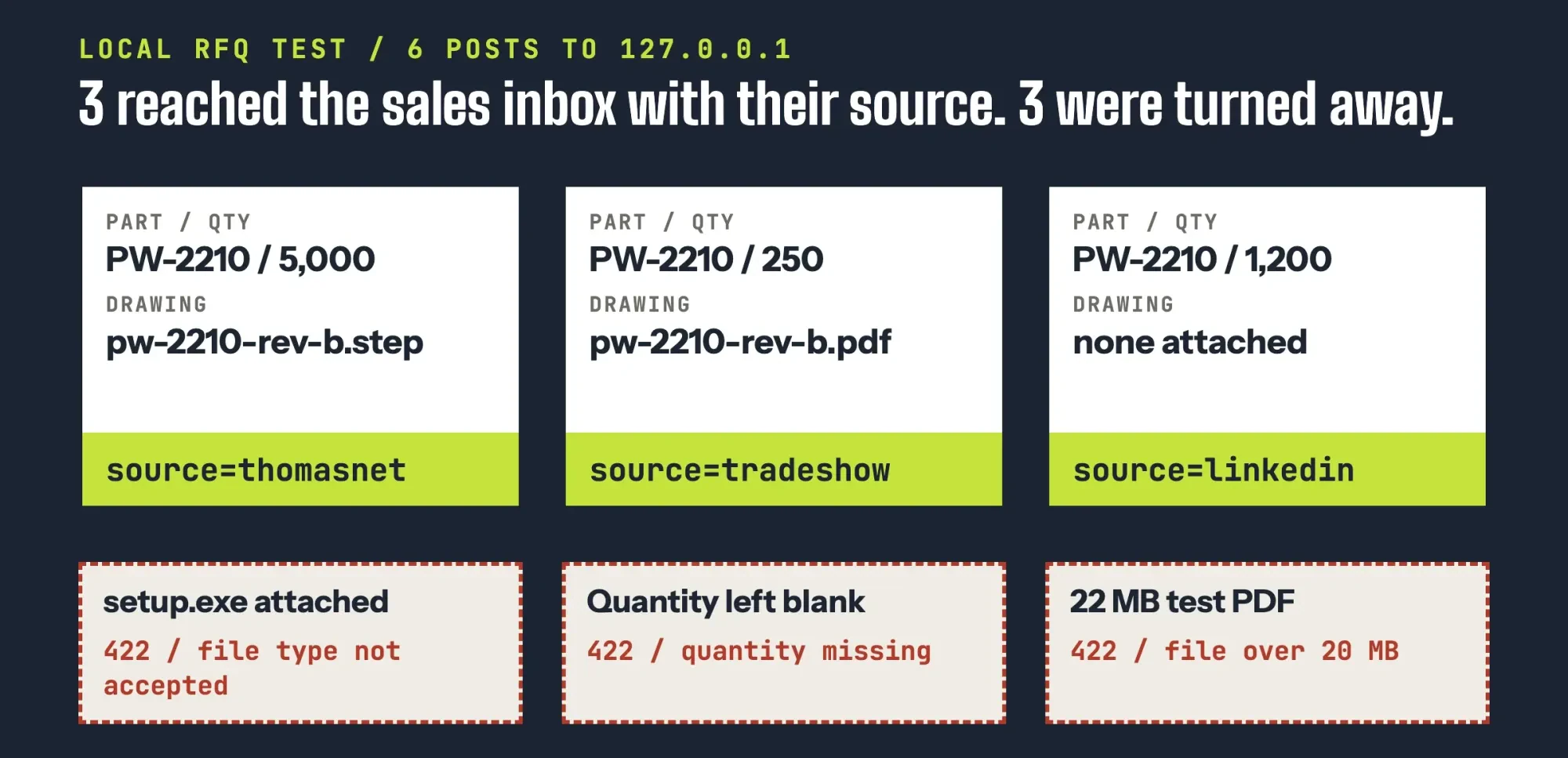 Diagram by DigitalTreed. All six local RFQ posts from run_test.sh, October 28, 2026.
Our take: if you only have a week, spend it on the part pages and the RFQ form. Every other channel sends buyers there, so a weak page wastes the Thomasnet profile, the trade show booth and the LinkedIn post, however much you spend on them. After that, add one channel a quarter, and at each quarter's end keep the one whose requests turned into real orders rather than quotes that went nowhere. The source labels tell you which. For a shop like the made-up Pellwick, that means part pages and the form in month one and the free Thomasnet profile in month two. A show comes later, once the source labels show which channels already send RFQs.
We build part pages and quote forms for manufacturers as paid work. Want to hand off only the RFQ form or a few part pages? Our project quote estimator shows a USD estimate.
What we tested
We ran everything on a Mac at 127.0.0.1 on October 28, 2026. Python handled the page checks and the form server, curl sent the posts, and headless Chrome loaded the tagged page.
bash test/run_test.sh # page checks, six RFQ posts, utm_source fill; writes out.txtManufacturing marketing questions
Frequently asked
Does Google index PDF spec sheets?
Yes. Google's list of indexable file types includes Adobe Portable Document Format (.pdf), plus Microsoft Office and OpenOffice files.
Can a grant help pay for an export trade show?
SBA's State Trade Expansion Program gives awards to states and territories that help small businesses join export trade show exhibits. Ask your state's STEP office what it covers.
What if a system holding defense drawings is hacked?
DFARS 252.204-7012 requires contractors to rapidly report cyber incidents, defined as "within 72 hours of discovery." A compliance adviser can walk you through it.
Who helps small manufacturers improve their business?
NIST's Manufacturing Extension Partnership has nearly 1,400 advisors and experts at more than 450 service locations, in all 50 states and Puerto Rico.
How we made this guide: Two versions of one invented spring page went through a nine-item checker, and six quote posts went to a server on 127.0.0.1. We kept every output file from that run on October 28, 2026. The same day we read the NAM, Thomas, IMTS, LinkedIn, Google, schema.org, MDN, W3C, DFARS, NIST and SBA pages linked at each fact. Facts checked by the DigitalTreed team on October 28, 2026.
First published August 2020 as an explainer on digital manufacturing. Rewritten October 28, 2026: now a plan for getting quote requests, with spec pages, an RFQ form, Thomasnet, trade shows, LinkedIn and a local test.
Sources
- National Association of Manufacturers: Facts About Manufacturing
- Google Search Central: SEO Starter Guide
- Google Search Central: Influencing your title links
- Google Search Central: Product snippet structured data
- Google Search Central: File types indexable by Google
- Schema.org: Product
- MDN Web Docs: input type="file"
- W3C Web Accessibility Initiative: Labeling Controls
- DFARS 252.204-7012: Safeguarding Covered Defense Information and Cyber Incident Reporting
- NIST SP 800-171 Rev. 3: Protecting Controlled Unclassified Information
- Thomas: Grow your business with Thomas
- IMTS: International Manufacturing Technology Show
- LinkedIn: LinkedIn Pages
- LinkedIn: Ad targeting
- NIST: Manufacturing Extension Partnership
- U.S. Small Business Administration: Grants (State Trade Expansion Program)
Comments
No comments yet. Start the conversation below.