
Quick answer
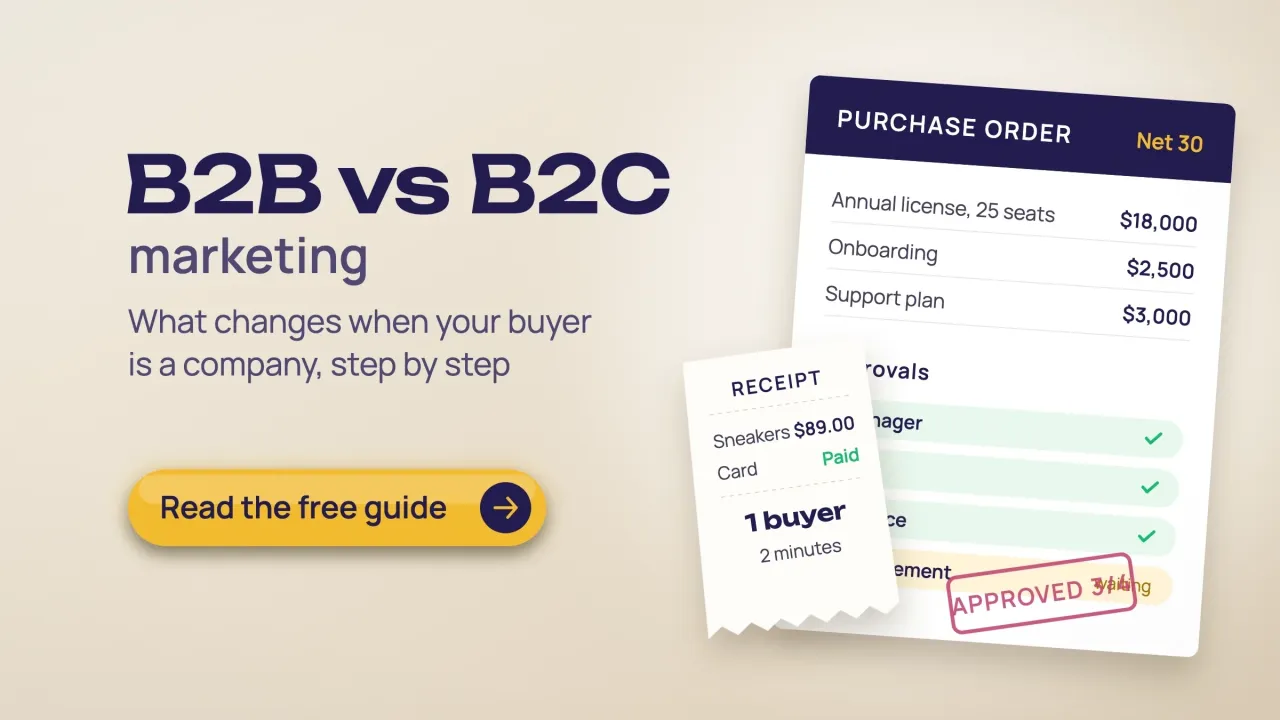
In B2B vs B2C marketing, B2B sells to people buying for a company. B2C sells to people buying for themselves. B2B buyers are fewer, decide in groups, compare suppliers on cost and risk, and take weeks or months. Consumers usually decide alone and fast. Many small businesses do both and need separate offers, prices and messages.
Key takeaways
- Most US e-commerce money is business to business. In 2022, manufacturers shipped $4.8 trillion through e-commerce, against about $1 trillion of online retail sales.
- B2B buyers research alone first. In a 2025 Gartner survey of 646 buyers, 67% said they prefer to buy without a sales rep.
- Big B2B purchases are slow: 6sense found an average cycle of 10.1 months for purchases of $25,000 or more.
- Lead costs on Google Ads vary more by industry than by B2B or B2C. WordStream's 2026 vendor data puts business services at $93.69 per lead and restaurants at $30.57.
- US law treats them differently. CAN-SPAM covers business email too, but many consumer rules, like subscription cancel rules, are B2C rules.
An Austin bakery sells croissants to walk-in customers. Then a cafe owner asks for six dozen every Tuesday, on an invoice. The croissant is the same. The buyer, the price and the paperwork change.
For a small business, that's the B2B vs B2C marketing question in one sale. We compare the two with US Census Bureau data, buyer surveys from Gartner, Forrester and 6sense, and US marketing law.
What do B2B and B2C mean?
B2B marketing is marketing to people who buy for a business. B2C marketing is marketing to people who buy for themselves or their household. The labels describe the buyer, not the product, so the same croissant can be sold both ways.
B2B means business to business. You sell to someone buying for a company: a cafe owner buying coffee beans, an office manager hiring a cleaning service, a contractor buying lumber. They spend company money, and they often need someone else's OK.
B2C means business to consumer. You sell to someone buying for themselves or their family. One person usually decides, often quickly, and feelings and convenience matter more.
Two related terms come up a lot:
- B2B2C: you sell to a business that sells your product to consumers. A bakery supplying cafes or a candle maker stocked in gift shops both work this way. Bigger examples include the Apple App Store, where developers sell apps to consumers, and Booking.com, where hotels reach travelers, per the US Chamber of Commerce.
- D2C or DTC (direct to consumer): a brand selling straight to shoppers online, without stores in between. It's a type of B2C.
Key B2B vs B2C facts for 2026
- In the second quarter of 2026, online sales made up 17.1% of US retail sales, seasonally adjusted, per the Census Bureau's quarterly report.
- In a Gartner survey published March 9, 2026, 67% of 646 B2B buyers said they prefer to buy without a sales rep. Of all 646 buyers, 45% had used AI during a recent purchase.
- On average, 13 people take part in a B2B buying decision, per Forrester's 2024 survey of more than 16,000 buyers worldwide.
- B2B purchases of $25,000 or more took 10.1 months on average in 6sense's 2025 buyer report, a vendor study.
- Since January 1, 2023, the California Consumer Privacy Act (CCPA) also covers data on business contacts. That applies only to companies that meet its thresholds, per the California Attorney General.
- Google Ads leads cost a median $93.69 for business services and $30.57 for restaurants, in WordStream's 2026 benchmarks of 13,474 US campaigns (vendor data).
The difference between B2B and B2C marketing at a glance
The biggest difference is who decides. Almost everything else follows from that: how long it takes, what they want to read, how you price and what you measure.
| B2B | B2C | |
|---|---|---|
| Who buys | A business, often several people | One person or a household |
| How they decide | Cost, risk, return, approvals | Feelings, convenience, price, reviews |
| How long it takes | Weeks to months for bigger purchases | Minutes to days, longer for cars or homes |
| Relationship | Repeat orders, contracts, account care | Often one-off; email and loyalty bring people back |
| Main channels | Website and search, LinkedIn, email, referrals, trade shows, sales visits | Search and Maps, Instagram, Facebook, TikTok, email, in-store |
| Content | Case studies with numbers, price and spec sheets, demos, guides | Short video, photos, reviews, offers |
| Pricing | Quotes, volume tiers, wholesale prices, payment terms | Fixed public prices, discounts, free shipping |
| What to measure | Qualified leads, quotes, win rate, reorders | Conversion rate, order value, repeat purchases |
Both still sell to people. A purchasing manager reads reviews and gets annoyed by slow websites, just like a shopper does. The difference is the job they're doing when they buy.
Which is bigger in the US: B2B or B2C?
B2B, by a wide margin, at least online. The US Census Bureau's E-Stats report counts e-commerce by sector. In 2022, manufacturers shipped $4.8 trillion through e-commerce and merchant wholesalers sold $3.8 trillion. Online retail sales to consumers were about $1.0 trillion. Service industries, which sell to both, took in about $1.8 trillion online.
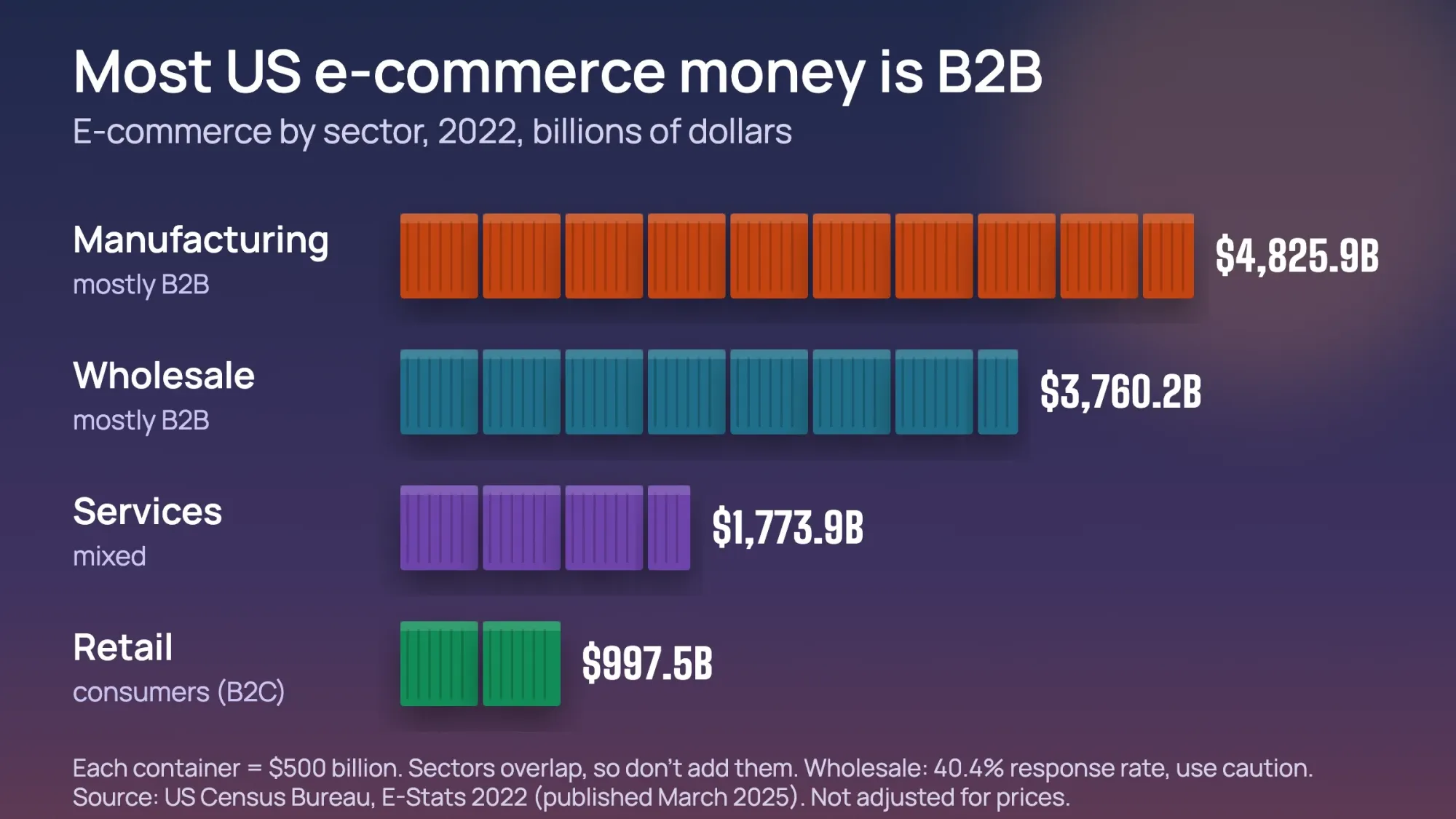 Source: US Census Bureau, E-Stats 2022 (published March 2025). Billions of dollars, not adjusted for prices. Sectors overlap, so don't add them up. Wholesale had a 40.4% response rate; Census advises caution.
Read these figures with care. Census counts shipments between a company's own plants as manufacturing e-commerce. It also counts orders sent automatically between companies' computer systems. The sectors also overlap, so don't add them up. A big B2B figure shows where the money moves, but it says little about how business buyers shop.
For B2C, the more useful number is how much of retail happens online. In the second quarter of 2026, e-commerce was 17.1% of US retail sales, seasonally adjusted. About five in six retail dollars are still spent offline. As first published, the second-quarter share has risen every year since 2021, when it was 13.3%.
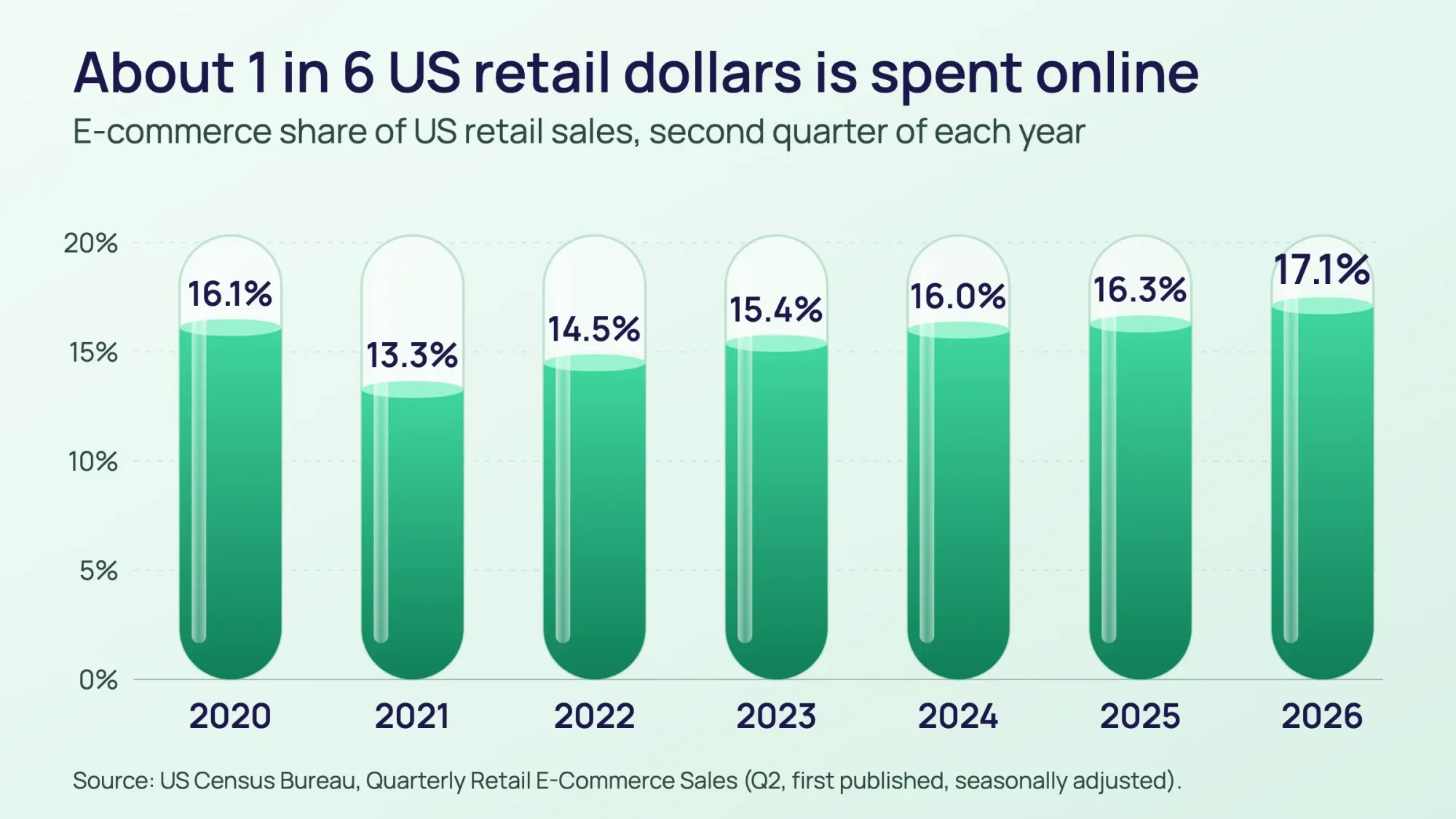 Source: US Census Bureau, Quarterly Retail E-Commerce Sales, second-quarter releases as first published (seasonally adjusted). Later revisions are not shown.
If you sell to consumers locally, your shop, your Google listing and your reviews still carry most of the weight. Our guide to automating Google review requests shows how to ask every buyer the same way. Our local SEO guide covers that side.
How do B2B buyers decide, and why is the sales cycle longer?
Business buyers decide in groups and compare cost, risk and return. The sales cycle is longer because several people must agree, more money is at stake and the purchase often needs budget approval.
B2B buyers do most of their homework before they talk to you. In a 2025 survey by 6sense, a sales software vendor, buyers first contacted a seller 61% of the way through their purchase. These surveys don't publish company sizes, and 6sense counted only purchases of $25,000 or more:
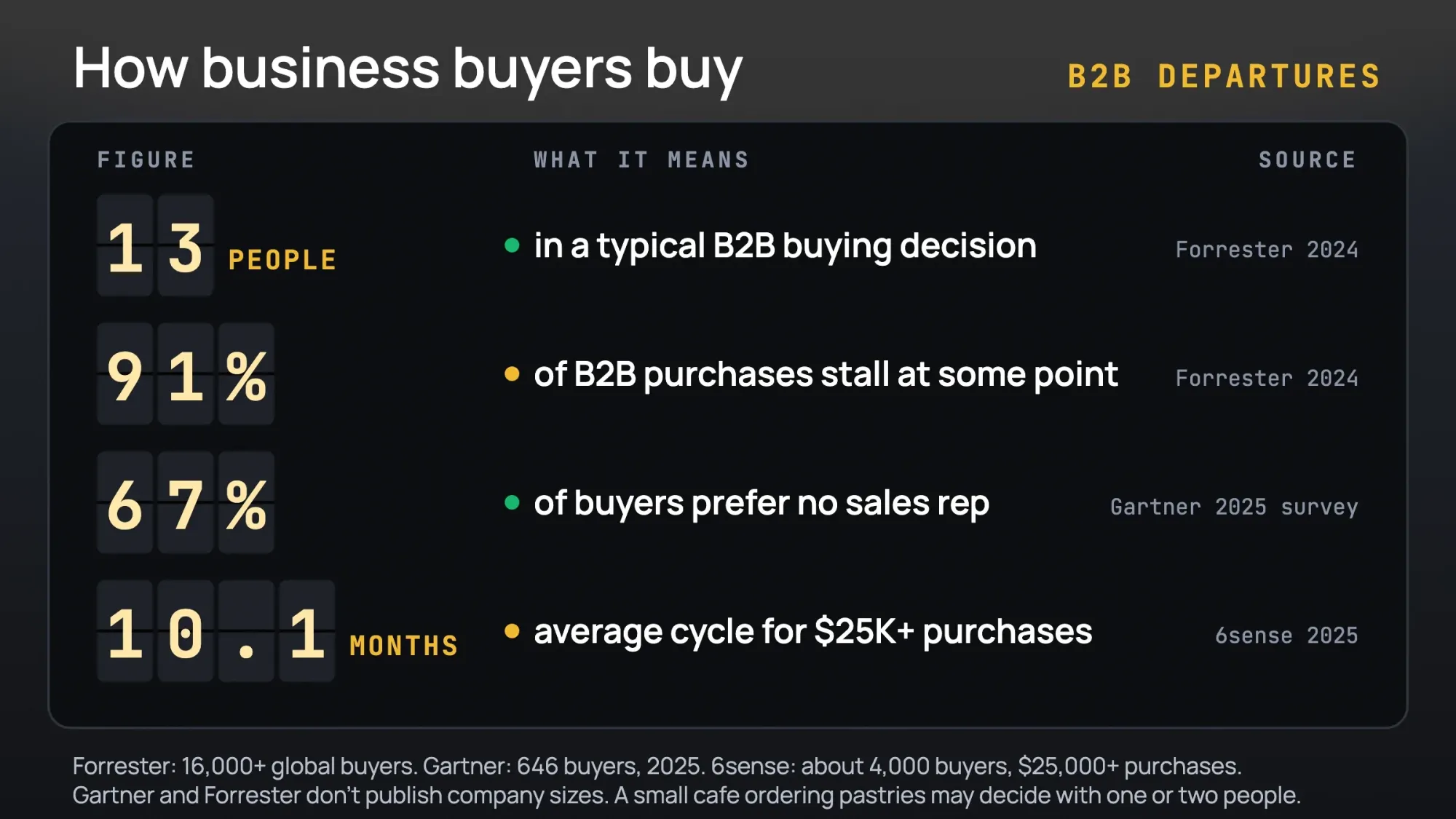 Sources: Forrester State of Business Buying 2024 (16,000+ global buyers); Gartner sales survey (646 buyers, Aug-Sep 2025); 6sense Buyer Experience Report 2025 (about 4,000 buyers, purchases of $25,000 or more). Gartner and Forrester don't publish company sizes.
- Forrester surveyed more than 16,000 business buyers worldwide in 2024. On average, 13 people were involved in a buying decision, and 91% of purchases stalled at some point.
- Gartner's survey of 646 B2B buyers found 67% prefer a buying experience without a sales rep. A year earlier, it was 61% of 632 buyers.
- 6sense, a sales software vendor, found an average buying cycle of 10.1 months in 2025. Its survey only covered purchases of $25,000 or more.
- The same 6sense study says the winning supplier was on the buyer's first shortlist 95% of the time. Four out of five deals went to the early favorite.
A cafe owner ordering pastries isn't a 13-person committee. No survey we found measures small buyers, but we'd expect a smaller version of the same habit. Many will check your website, prices and reviews before they call.
The 95-5 rule, from the LinkedIn B2B Institute and the Ehrenberg-Bass Institute, says about 95% of your potential business buyers aren't ready to buy today. It's a model based on how rarely companies buy. In their research, 75% of companies bought computers once every four years, and 80% changed banks once every five.
So B2B marketing needs patience. Stay visible and useful to the 95%, so you're the obvious pick when they're ready to buy.
How do B2C buyers decide?
Consumers usually decide alone and faster, based on price, reviews, photos and convenience. A pair of sneakers or a dinner reservation might take two minutes. Bigger purchases, like a sofa or a kitchen remodel, can take weeks and involve a partner.
What moves consumers is easier to see: photos, short videos, reviews, price, convenience and how the product makes them feel. Most US retail spending still happens offline, so local search, social media and the in-store experience matter a lot for B2C small businesses. We suggest a simple loyalty program, such as a punch card or points, to give shoppers a reason to come back.
For channel choice by age, see our social media marketing strategy. It uses Pew Research Center's 2026 platform data.
B2B vs B2C marketing strategies: channels and costs
Some channels work in both B2B and B2C marketing strategies, and others lean one way. New to all of this? Start with our digital marketing 101 guide for the order to set up each channel. Platform prices come from each company's own pricing or help pages, checked October 22, 2026:
| Channel | Best for | Cost (USD) |
|---|---|---|
| Google Business Profile and local SEO | B2C local, plus small local B2B | $0 |
| Google Ads search | Both, when people search for what you sell | No stated minimum; Google can spend up to twice your average daily budget on a given day |
| B2B | $0 organic; ads from $10 a day, $100 lifetime minimum for new campaigns | |
| Instagram, Facebook, TikTok | B2C | $0 organic; Meta sets no fixed public minimum; TikTok ads need $50 a day per campaign and $20 a day per ad group |
| Both | Mailchimp free up to 250 contacts, paid from $13 a month; Constant Contact from $12 a month | |
| CRM (customer relationship management) software to track leads and reorders | B2B | HubSpot has free tools; Starter from $7 a month |
| Sales visits and calls | Local B2B | Your time and samples |
| Trade shows and expos | B2B | Ask the organizer for booth, power, travel and sample costs |
Paid search gives a rough view of the cost gap. WordStream, an online ad company, studied 13,474 US search campaigns from April 2025 to March 2026. Business services paid a median $93.69 per lead, against $30.57 for restaurants. Home improvement, a consumer category, paid $90.92, so B2B isn't always the pricier side.
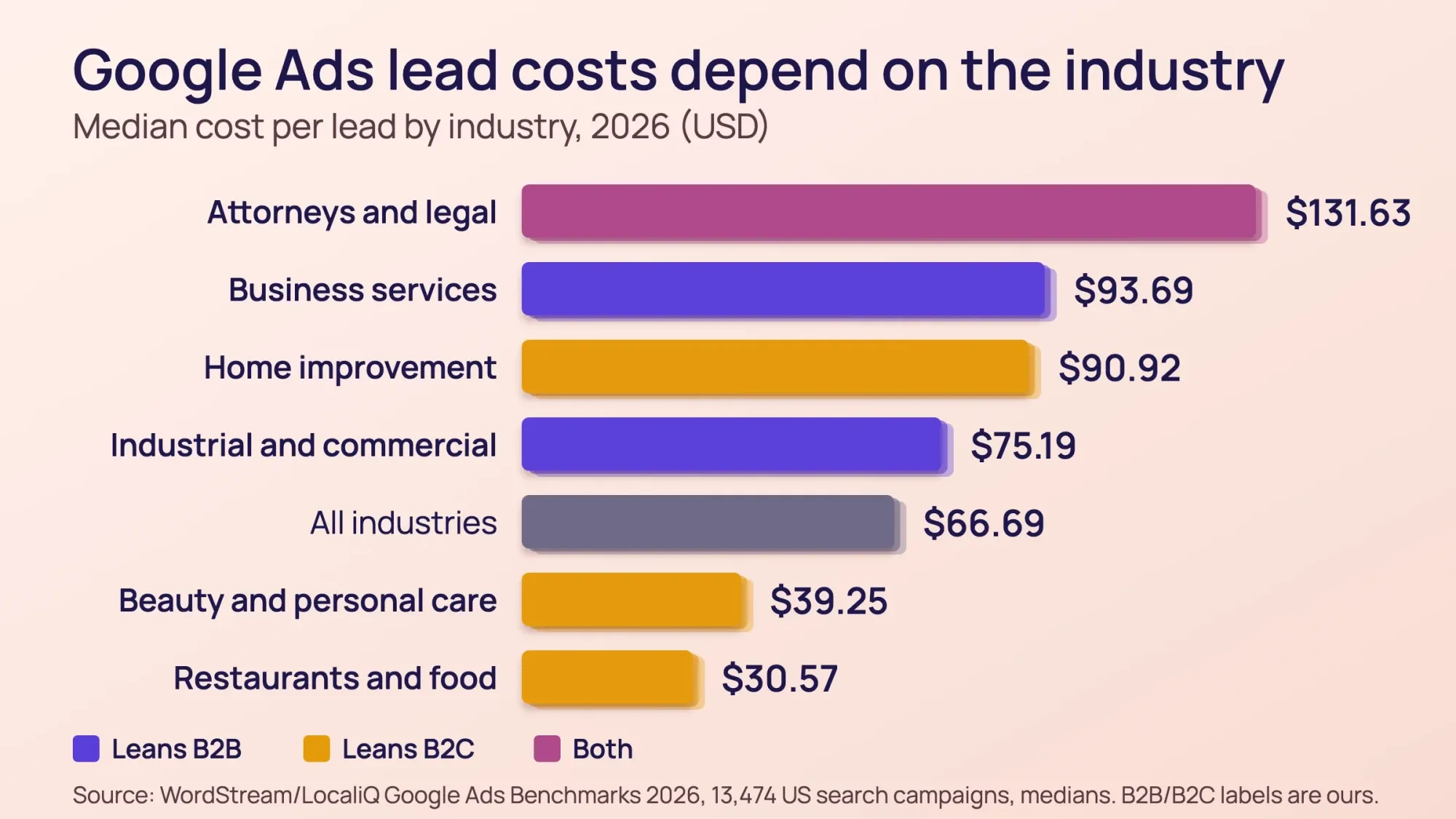 Source: WordStream/LocaliQ Google Ads Benchmarks 2026 (13,474 US search campaigns, April 2025 to March 2026, medians). Vendor data from its clients. The B2B and B2C labels are ours.
A $93 lead can still be cheap if that business orders every week for a year. Compare your cost per lead with what one account brings in. Our PPC guide explains how Google Ads budgets work.
What content works for B2B and B2C buyers?
B2B buyers want proof and details they can pass to the people who sign off. Consumers want to see the product and trust the reviews.
| B2B buyers want | B2C buyers want |
|---|---|
| A one-page price and spec sheet | Photos and short videos of the product in use |
| Case studies with real numbers, shared with the customer's permission | Honest reviews, gathered without rewards |
| A clear "how to order" page: minimums, delivery, terms | A simple checkout and clear shipping costs |
| Proof of insurance, licenses and certifications | Offers, seasonal drops and gift ideas |
| Short demos or samples for each person who signs off | Posts by local creators, labeled "#ad" when you gave them something free |
| A useful monthly email with order deadlines | Short emails with new products and deals |
In a Gartner survey of 632 B2B buyers, published in June 2025, 73% said they actively avoid suppliers who send irrelevant outreach. In the same survey, 69% saw differences between a supplier's website and what its sales reps told them. Keep your website and your pitch saying the same thing.
Show at least a starting price or a range on your business page. Buyers who prefer to research alone may skip a supplier who makes them call for basics.
For longer B2B content, use the test from the 2024 Edelman-LinkedIn B2B Thought Leadership Impact Report. It surveyed nearly 3,500 managers in seven countries. Its summary says good thought leadership "cites strong research and data, helps buyers understand their business challenges, and offers concrete guidance." If your buyers follow trade voices on X, see our guide to marketing on X for sharing that thought leadership there.
How does the message change between B2B and B2C?
The product can stay the same while the pitch changes. Here is how our made-up Austin bakery might word each part for a cafe owner and for a shopper.
| To a cafe owner (B2B) | To a shopper (B2C) | |
|---|---|---|
| Headline | Fresh croissants delivered by 7 a.m. every Tuesday | Warm croissants, out of the oven at 7 |
| Proof | Price per dozen, minimum order, delivery days and a reference from another cafe | Photos, reviews and a short video |
| Call to action | Request a free sample box | Order ahead for pickup |
| Follow-up | An email with invoice terms and the next order deadline | A weekend email with new flavors |
For the creator side of B2C, see our beginner's guide to influencer marketing. To plan pieces like these, read our guide to content marketing.
How is B2B pricing different from B2C pricing?
Consumers see one public price. Business buyers expect wholesale prices, minimum orders, payment terms and quotes, and the paperwork changes too:
- Wholesale prices sit below retail so the reseller keeps a margin. How much margin is a business decision; there's no standard percentage.
- Minimum orders, such as two dozen pastries or one case of candles.
- Payment terms, such as "net 30", meaning the invoice is due 30 days later.
- Resale certificates. In many states, a buyer who resells your product gives you one, so you don't charge sales tax. Keep it on file.
- Quotes for anything custom, with a date they expire.
What should you measure for B2B and B2C?
Judge B2B marketing by accounts won and kept, because one account can reorder for years. Marketers call that total customer lifetime value. Judge B2C marketing by sales, order value and how often shoppers come back.
| B2B | B2C | |
|---|---|---|
| Top of funnel | Inquiries and quote requests | Website visits, calls, direction requests |
| Middle | Qualified leads, samples sent, quotes sent | Add-to-carts, email sign-ups |
| Result | Win rate, accounts opened | Conversion rate, average order value |
| Long term | Reorder rate, yearly value per account | Repeat purchase rate |
How do B2B and B2C marketing funnels differ?
A B2C funnel is short. A shopper sees a post or an ad, checks the reviews and often buys in the same visit. A B2B funnel has more steps: inquiry, quote, sample, approval and reorders.
Each B2B step can involve a different person, so plan something for each one. Send a price sheet after the inquiry, a case study with the quote and a short check-in after each delivery.
Tag every link you share with UTM codes, short labels that tell Google Analytics where a visit came from. Then you can see which channel brings business buyers and which brings shoppers. Our Google Analytics 4 guide shows how to set it up.
Which US marketing laws treat B2B and B2C differently?
CAN-SPAM, texting consent rules, endorsement rules and Made in USA rules apply to both B2B and B2C. The Telemarketing Sales Rule exempts most calls to businesses, and subscription cancel rules mainly protect consumers. This is plain-English guidance, not legal advice.
| Rule | B2B | B2C |
|---|---|---|
| CAN-SPAM (email) | Applies. The Federal Trade Commission (FTC) says the law "makes no exception for business-to-business email." | Applies |
| TCPA, the Telephone Consumer Protection Act (texts and autodialed calls) | Written consent needed for autodialed marketing texts to cell numbers, a business owner's included | Same, plus the Do Not Call list for home and personal cell numbers |
| FTC Telemarketing Sales Rule | Most calls to businesses are exempt, but lying is still banned | Applies |
| California's CCPA | Covers business contacts since January 1, 2023, if your company meets its thresholds | Covers consumers, same thresholds |
| Subscriptions and auto-renewal | Mostly a contract matter | Federal ROSCA (Restore Online Shoppers' Confidence Act) and roughly 30 state auto-renewal laws, per law firm Jones Day |
| Endorsements and reviews | Apply to testimonials, case studies and staff posts | Apply |
| "Made in USA" claims | Must be "all or virtually all" made in the US | Same |
CAN-SPAM penalties can reach $53,088 per email in 2026. The CCPA covers for-profit companies with gross revenue over $26,625,000. It also covers smaller ones that buy, sell or share data on 100,000 or more California residents or households. A third test covers firms earning half their revenue from selling such data. Most small businesses meet none of these tests. Our email marketing guide covers the email rules in detail.
The FTC's 2024 click-to-cancel rule for subscriptions was struck down by a federal appeals court in July 2025. In March 2026, the FTC asked for comments on whether to amend its older Negative Option Rule. If you sell subscriptions to consumers, make the terms clear and cancelling simple.
Can a small business sell to both? Hybrid and B2B2C models
Yes. Many small businesses sell to consumers and to other businesses, often without planning it. The sign is businesses asking you for an invoice, a W-9 tax form, bulk pricing or payment terms.
Common small-business versions include a coffee roaster supplying cafes, a maker selling on Etsy and to boutiques, and a landscaper serving homeowners and property managers. A print shop serving walk-ins and offices fits too. Strictly, only the roaster and the maker are B2B2C, because a cafe or boutique resells to consumers. The landscaper and print shop sell to both sides directly.
Keep the two sides apart where it matters:
- A separate "Wholesale" or "For businesses" page with its own request form.
- A separate price list, with minimums and terms.
- Separate email lists, so cafe owners don't get your weekend coupon.
- Separate ad campaigns and landing pages.
Check the rules that only show up in B2B. Food is a common example. Texas law says a cottage food operation "may not sell food at wholesale", except to a cottage food vendor under contract. So a Texas home baker will likely need a licensed kitchen to supply cafes. We didn't research the licensing steps, so ask your local health department. Other states differ, so check yours.
If you sell online, our ecommerce website guide shows how to set up a store you can add a wholesale page to.
Should your small business focus on B2B or B2C?
Start with the buyers who already come to you, then test the other side on a small scale. Our advice is to run four checks first:
- Count the requests. Invoices, W-9 forms and bulk price questions show real business demand.
- Compare profit, not sales. Set one business account's yearly profit, after the wholesale discount, against an average shopper's.
- Check your cash. With net 30 terms, you deliver now and get paid a month later.
- Check the rules for your product, such as licensing, labels and resale certificates.
If most checks look good, try the 90-day plan below while you keep serving consumers.
B2B vs B2C marketing examples
These B2B vs B2C marketing examples use three made-up businesses. The rules and data are real and sourced. The goals and channel picks are our suggestions.
| Bakery, Austin, TX | Commercial cleaner, Columbus, OH | Candle shop, Charlotte, NC | |
|---|---|---|---|
| Model | B2C adding B2B (B2B2C) | B2B | B2C online, plus boutiques |
| Buyers | Walk-ins and Instagram followers; then cafes within 5 miles | Office managers, property managers, medical offices | Online shoppers; gift shop owners |
| Goal | 6 cafe accounts in 90 days | 8 new contracts this year | 20 boutique accounts by spring |
| Channels | Google Business Profile for shoppers; sample visits and a wholesale page for cafes | Google Ads on "office cleaning Columbus", LinkedIn posts, property manager referrals | Instagram and TikTok video, email; a line sheet emailed to gift shops |
| Content | Price sheet, minimum order, delivery days | Cleaning checklist, insurance proof, two case studies | Product video; case packs and wholesale prices |
| Rule to watch | Texas cottage food law bars most wholesale from a home kitchen | Written consent before texting leads' cell phones | "Made in USA" only if wax, wicks and jars qualify |
A 90-day plan for adding a B2B line
Add business customers in 90 days
- Days 1-30: decide and set up Pick one type of business buyer and one area. Check licensing, resale certificates and the insurance buyers ask for. Set wholesale prices, a minimum order, delivery days and payment terms. Add a "For businesses" page with a request form, and list 30 to 50 target businesses.
- Days 31-60: reach out and prove it Visit or contact 10 businesses a week with samples or a short demo. Follow up by email within two days, with an unsubscribe link. Track every lead in a free CRM. Turn your first one or two accounts into short case studies, with their written permission.
- Days 61-90: keep and grow Check reorders, margins and delivery load, and drop accounts that lose money. Start a monthly email for business buyers. Ask happy accounts for referrals. Then decide: a wider area, a second buyer type or a trade show next season.
Expect B2B to be slower than you'd like. Follow up every month with prospects who aren't ready, because the 95-5 rule says most potential buyers aren't in the market today.
Free checklist: are you ready to sell to businesses?
Use this checklist before you pitch your first business buyer. It sums up this guide in ten lines, so you can print it or copy it into a note.
- Licenses and permits cover selling wholesale in your state and city.
- Wholesale prices leave you a margin, and you have set a minimum order.
- Delivery days and payment terms, such as net 30, are written down.
- You have enough cash to wait 30 days for an invoice to be paid.
- You know how to accept and file resale certificates, if your state uses them.
- A "For businesses" page shows a starting price and a request form.
- Proof is ready: insurance, licenses and one or two short case studies.
- Business emails go to a separate list. Each one has a clear way to opt out and your postal address, as the FTC's CAN-SPAM guide requires.
- You have written consent before sending autodialed marketing texts to cell phones, under the FCC's texting rules.
- A free CRM tracks every lead, quote and reorder.
Common B2B and B2C marketing mistakes
Do not
- Send the same message to shoppers and business buyers
- Assume business email is exempt from CAN-SPAM
- Expect B2B ads to pay back in two weeks
- Offer discounts only for positive reviews
- Put "Made in USA" on a product with more than negligible imported parts
- Copy big-company tactics when your buyer is one owner
Do
- Write separate offers, pages and emails for each audience
- Show business buyers prices, minimums and terms up front
- Get written consent before texting anyone's cell phone
- Judge B2B by qualified leads and accounts opened
- Check licensing before you sell wholesale
Frequently asked questions
Frequently asked
What is the difference between B2B and B2C marketing?
B2B marketing sells to people buying for a company, who often decide in groups and take longer. B2C marketing sells to individuals, who usually decide alone and faster. Offers, content, prices and channels change to match.
What do B2B and B2C stand for?
B2B stands for business to business. B2C stands for business to consumer. B2B2C means you sell to a business that resells to consumers.
What is an example of B2B vs B2C marketing?
A bakery selling croissants to walk-in customers is doing B2C marketing. The same bakery pitching weekly orders to cafes, on an invoice, is doing B2B. Because the cafes resell the pastries, that's B2B2C.
Can a business be both B2B and B2C?
Yes, and many small businesses are. A bakery can serve walk-in customers and supply cafes. Keep separate pages, price lists, email lists and ads for each side.
Is B2B or B2C marketing harder?
Neither is harder in general. B2B has fewer, bigger and slower deals, with more people to convince. B2C has more, smaller and faster sales, with more competition for attention.
Is B2B or B2C more profitable?
Neither is more profitable by default. B2B orders are usually bigger and repeat, but wholesale prices are lower and invoices may be paid 30 days later. B2C sales earn the full retail price, but each sale is smaller, so you need many more buyers. Compare the profit per account over a year.
Is Amazon B2B or B2C?
Both. Amazon.com sells to consumers. Its Amazon Business store offers business-only prices, quantity discounts from two units, quotes for large orders and a pay-later credit account. Those are the same B2B levers as in our pricing section.
Why is the B2B sales cycle longer?
More people are involved and more money is at stake. Forrester's 2024 global survey found 13 people in the average buying decision. 6sense found a 10.1-month average for purchases of $25,000 or more.
Do the same marketing laws apply to B2B and B2C?
Some do and some don't. CAN-SPAM, the texting consent rules and the FTC's endorsement rules apply to both. Most calls to businesses are exempt from the Telemarketing Sales Rule, and subscription cancel rules mainly protect consumers.
Is LinkedIn only for B2B?
No, but it suits B2B best because people use it in their work role. Its ads start at $10 a day. Consumers are easier to reach on Instagram, Facebook and TikTok.
If Facebook is one of them, our comparison of the best time to post on Facebook shows how to pick and test a first slot.How we made this guide: we used US Census Bureau data and FTC and FCC rule text. Buyer surveys come from Gartner, Forrester and 6sense. We checked the numbers against the sources listed below in October 2026. Where a figure comes from a vendor or a law firm, we say so. Updated October 23, 2026: added key facts, a message example, a funnel comparison, a B2B or B2C decision guide, a checklist and two FAQs. We read the new sources that day.
Want help reaching business buyers or shoppers? Our content marketing service builds the case studies, pages and emails described above.
Sources
- US Census Bureau: E-Commerce Activity Across Sectors, 2021 and 2022 (March 25, 2025)
- US Census Bureau: Quarterly Retail E-Commerce Sales (Q2 2026, August 18, 2026)
- Gartner: 67% of B2B buyers prefer a rep-free experience (March 9, 2026)
- Gartner: 61% of B2B buyers prefer a rep-free buying experience (June 25, 2025)
- Forrester: The State Of Business Buying, 2024 (December 4, 2024)
- 6sense: The B2B Buyer Experience Report for 2025
- LinkedIn B2B Institute: The 95-5 rule and Ehrenberg-Bass Institute: The 95:5 rule
- WordStream: Google Ads Benchmarks 2026 (May 18, 2026)
- FTC: CAN-SPAM Act compliance guide for business
- 47 CFR 64.1200: FCC telemarketing and texting rules
- 16 CFR 310.6: Telemarketing Sales Rule exemptions
- California Attorney General: CCPA and CPPA: monetary thresholds in the CCPA
- FTC: comment request on the negative option rule (March 2026) and Latham and Watkins: Eighth Circuit vacates click-to-cancel rule (July 2025)
- FTC: Complying with the Made in USA Standard
- Texas Health and Safety Code, chapter 437 (cottage food)
- LinkedIn: Maximize your budget and Google Ads: About average daily budgets
- Mailchimp pricing, Constant Contact pricing and HubSpot Marketing Hub pricing (checked October 22, 2026)
- US Chamber of Commerce: B2B vs. B2C and Amazon Business: What is Amazon Business? (read October 23, 2026)
- TikTok Ads: Budget
- Edelman and LinkedIn: 2024 B2B Thought Leadership Impact Report; Jones Day: FTC revives click-to-cancel rule (May 15, 2026)
Comments
No comments yet. Start the conversation below.