
Quick answer
Walmart's pages don't bar people with felony records, and the White House named it among 185 Fair Chance Business Pledge signers on August 16, 2016. As of November 2026, Walmart's hiring FAQ doesn't mention background checks at all. Firearms stores differ: one dated Walmart posting requires a firearms-specific criminal background check. Any check bought from a screening company comes with FCRA notice rights.
Does Walmart hire felons? That's the question if you've got a conviction record and a Walmart store or warehouse job in mind. You may expect the record to end things at the first screen, even years after a sentence ended. A background check is a consumer report that a screening company sells to an employer, and the Fair Credit Reporting Act (FCRA) gives you rights at each step. This guide sticks to facts and steps, not legal advice.
Walmart publishes very little about records. Most of what shapes your application sits in agency rules: the FCRA notices, the EEOC guidance and fair chance laws in four places. Federal bonding, the WOTC credit, the steps to apply, our test and our take come after.
Key takeaways
- Walmart's hiring FAQ mentions no background checks or criminal records.
- One posting says firearms stores need a firearms-specific background check.
- Before rejecting you over a report, an employer must send you a copy.
- The EEOC weighs the offense, the time passed and the job.
- California, New York City, Illinois and Washington limit when employers ask about records.
What Walmart's own pages say about records
Only Walmart can state Walmart's policy, so we began with its careers site. The How we hire page answers 12 applicant questions, and as of November 2026 none of them mention a background check, a conviction or a criminal record. It does give a time: "On average, it takes 20-25 minutes to complete your application for the first time." Some roles add assessments, the page says.
Walmart's careers pages end with the same footer, which says that "Walmart, Inc. is an Equal Opportunity Employer" and that it "participates in E-verify."
The clearest public commitment is from 2016. On August 16, 2016, a White House fact sheet brought the Fair Chance Business Pledge to 185 employers. It named the new signers: "The new commitments are from a diverse range of employers including: Walmart, Dropbox, and the University of Pennsylvania." Signers backed practices like delaying "criminal history questions until later in the hiring process," the fact sheet says. The April 11, 2016 launch fact sheet lists the same practices for its first 19 companies.
Walmart's newsroom adds two posts from 2021. A September update from the Walmart.org Center for Racial Equity covered the company's criminal justice Shared Value Network, or SVN. It said the SVN was moving forward with "second-chance hiring pilots to boost employment outcomes for formerly incarcerated individuals." In December, Walmart and the NAACP announced a scholarship that "will provide 20 recipients with a $5,000 award." It's open to people who've completed their sentence. No later Walmart page we read reports how the hiring pilots turned out. You may have read that Walmart dropped the conviction question from its application in 2014, as this post once said. No Walmart page we could read gives a year, so we've left it out.
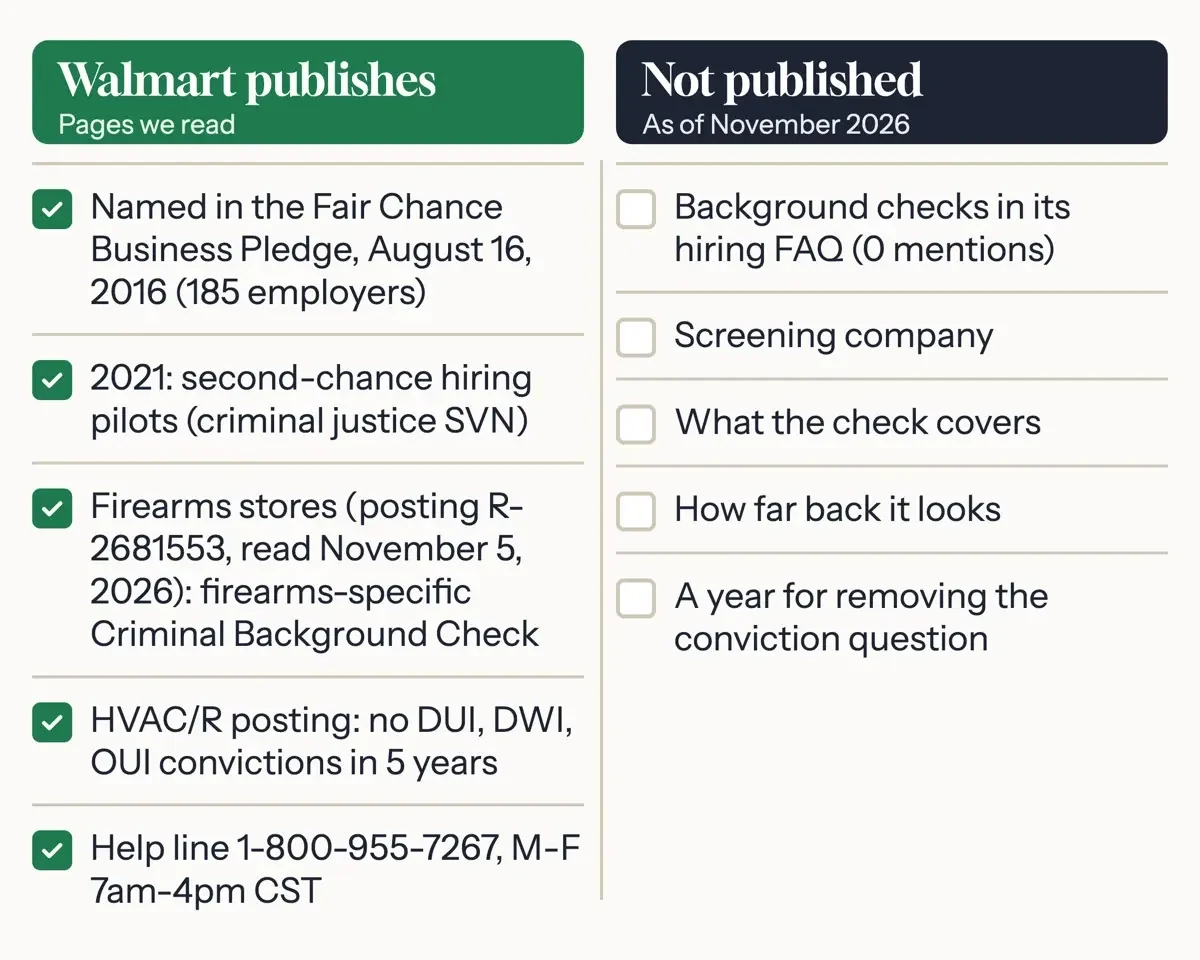 Diagram by DigitalTreed, from Walmart careers and newsroom pages and the White House fact sheet of August 16, 2016, read November 5, 2026.
Which Walmart jobs require a criminal background check
Unlike the FAQ, some Walmart job postings do name a check. As of November 5, 2026, a Walmart posting for a Fashion Coach in Swansboro, North Carolina (R-2681553) covers stores that sell firearms. There, the role "will require successful completion of a firearms- specific Criminal Background Check (CBC) and Firearms Authorized Training." Ammunition-only stores with state rules "may require a current state issued Certificate of Eligibility." Postings close, so read the one for your store.
Driving is the other place a record shows up in Walmart's own text. An HVAC/R technician posting in Owosso, Michigan (R-2682274) asks for a "Commercial driving record with no convictions for DUI, DWI, OUI within the last five (5) years." Neither posting, both open on November 5, 2026, names any other kind of conviction. Walmart doesn't publish which screening company it uses, what its check covers or how far back it looks, and we won't guess. Some limits come from law, not from the employer. The EEOC's page on arrest and conviction records gives an airport example. Federal law bars "anyone convicted of certain serious crimes in the last 10 years" from working as a security screener there.
How the background check works under the FCRA
Whichever posting you answer, federal law sets how the check runs. The FTC's page for job seekers says employers "must get your written permission before running a background check with a background reporting company." The FTC's guide for employers adds that the notice "must be in writing and in a stand-alone format." It can't sit inside the job application. You can say no. The FTC is plain about the cost: "if you do, you may not get the job." The EEOC's page for applicants agrees that the employer "may reject your application." When you do sign, the CFPB's list of reporting companies suggests you "ask for the name(s) of the employment screening company being used."
Those screening companies supply "criminal arrest and conviction information," among other records, the CFPB list says. Across the FTC's two pages the notices come in four steps, and only the second, the pre-adverse notice, puts the report in your hands.
| Before the check | A stand-alone written notice and a request for your written permission | Ask which screening company will run it |
| Before a no (pre-adverse action) | The report itself, plus A Summary of Your Rights Under the Fair Credit Reporting Act | Read every entry; flag errors to the company and the employer |
| After a no (adverse action) | The company's name, address and phone; a note that it didn't decide; your right to dispute | Ask the company for a free report within 60 days |
| Dispute | The screening company's own dispute instructions | Send proof and ask for the corrected report to go to the employer |
The time between the first notice and the final decision is your window to flag a wrong entry. The FTC tells employers that early notice gives the person "the opportunity to review the report and tell you if it is correct."
Mistakes are on the record: in docket 2015-CFPB-0028, filed October 29, 2015, the CFPB acted against two large screening firms over "Serious Inaccuracies" in employment reports.
If an employer skipped your permission or the notices, the FTC wants a report at ReportFraud.ftc.gov. Employers get the same rules from their side in our employer background check rules post.
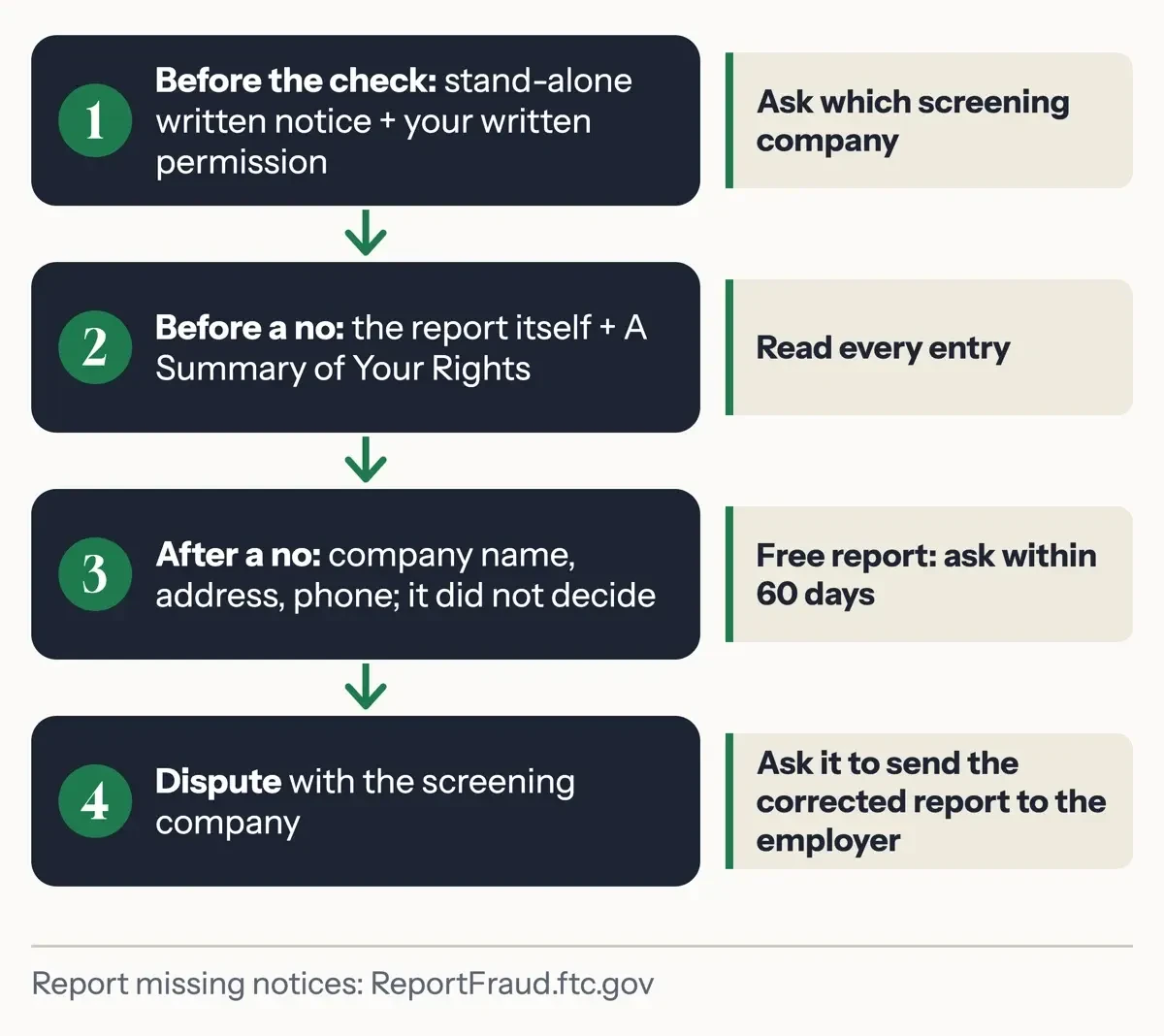 Diagram by DigitalTreed, from the FTC pages for job seekers and employers and the CFPB list of reporting companies, read November 5, 2026.
What does the EEOC guidance mean for your record?
The EEOC's guidance on arrest and conviction records dates to April 25, 2012, when it replaced the agency's 1987 and 1990 policy statements, according to the EEOC's Q&A. The laws the EEOC enforces cover private employers with 15 or more employees, its records page says.
The guidance doesn't stop employers from looking at records. "Employers can consider criminal records when they make the final decision about hiring," the EEOC says. It asks them to weigh how serious the offense was, how much time has passed since it or since the sentence ended, and the nature of the job itself. The Q&A traces those three factors to a 1977 court case, Green v. Missouri Pacific Railroad. Blanket bans get the sharpest warning. The EEOC says an employer that rejects everyone with a conviction "is likely engaging in discrimination." The Q&A adds that a screen without an individualized assessment "is more likely to violate Title VII."
Arrests sit apart. "An employer cannot refuse to hire people simply because they have been arrested," the EEOC says, though it may ask about the conduct behind one. The EEOC also names what can help, including "job training programs while incarcerated" and "employment and character references." It's worth gathering those papers before an interview, not after a notice arrives. If you think a decision turned on race or national origin rather than the job, there's a clock. Applicants have 180 days to file a charge, or 300 calendar days where a state or local agency enforces a similar law. The EEOC's number on its records page is 1-800-669-4000, and filing doesn't need a lawyer.
Federal jobs follow the Fair Chance to Compete for Jobs Act. With some exceptions, an agency or federal contractor "may not ask whether you have a criminal record" before a conditional job offer, the EEOC says. The EEOC calls it similar to state and city ban-the-box laws.
Fair chance laws in California, New York City, Illinois and Washington
We picked four state and city ban-the-box laws whose agencies explain them on their own pages. Their size floors are low: four workers in NYC, five in California.
California's Fair Chance Act took effect on January 1, 2018. The California Civil Rights Department says it "generally prohibits employers with five or more employees from asking a job candidate about conviction history before making a job offer." New York City's law came first. The city added its Fair Chance Act on October 27, 2015. The NYC Commission on Human Rights applies it to employers with four or more employees, and they can't ask about criminal history before a conditional offer. To pull an offer, an employer must share its inquiry and written analysis, then "Allow the applicant a reasonable period of at least five business days" to respond.
Under the Illinois Job Opportunities for Qualified Applicants Act, the state's Department of Labor says the question waits until an applicant is found qualified and "selected for an interview." If there's no interview, it waits until after a conditional offer. Washington's Fair Chance Act, RCW 49.94, bans job ads that say “no felons,” and the state's Attorney General says employers can't run a criminal history check before an offer. Before rejecting someone over a record, they must name the record they're relying on and hold the job open "for a minimum of two business days." Amendments passed in August 2025 start July 1, 2026 for employers with 15 or more workers, and January 1, 2027 for smaller ones.
| California | Fair Chance Act (January 1, 2018) | Five or more employees | After a job offer |
| New York City | Fair Chance Act (October 27, 2015) | Four or more employees | After a conditional offer |
| Illinois | Job Opportunities for Qualified Applicants Act | Size not stated on the agency page we read | After you are picked for an interview, or after a conditional offer |
| Washington | Fair Chance Act, RCW 49.94 (June 2018) | Amendments start by size: July 1, 2026 or January 1, 2027 | After a conditional offer |
If your state isn't in the table, the FTC notes that local laws "might impact if or when employers can ask about your criminal or credit history." The EEOC sends you to your state or local Fair Employment Practice Agency. None of these laws replace the FCRA notices; they're extra steps on top.
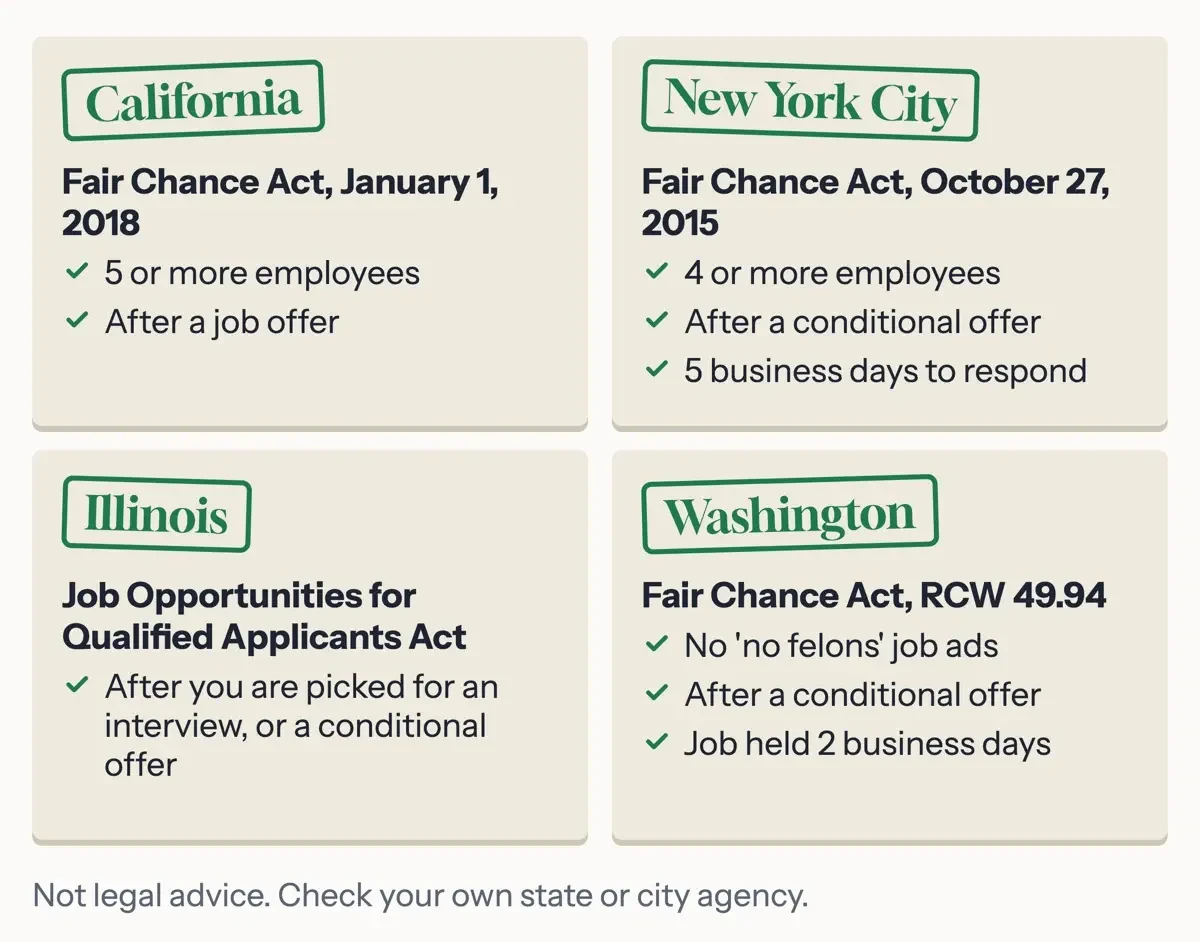 Diagram by DigitalTreed, from the California Civil Rights Department, NYC Commission on Human Rights, Illinois Department of Labor and Washington Attorney General pages, read November 5, 2026.
Federal bonding and the WOTC tax credit
Two federal programs are aimed at employers who weigh records. Neither program's page says whether Walmart uses them. The Federal Bonding Program dates to 1966, when the U.S. Department of Labor set it up for hard-to-place job seekers. Its bonds "cover the first six months of employment at no cost to the job applicant or the employer." As of November 2026, the home page also lists "a $0 deductible." The Labor Department lists the program on its reentry employment page.
To reach your state bonding coordinator, call 1-800-233-2258, the number on the program's job seeker page, which says the bond can be handled over the phone in most cases. A bond pays the employer back for "any loss due to employee theft of money or property," the program's FAQ says. It doesn't cover poor work or job injuries.
The Work Opportunity Tax Credit (WOTC) is a federal tax credit for hiring people from certain groups. One IRS group is "the formerly incarcerated or those previously convicted of a felony." The IRS WOTC page says it covers people who "begin work on or before December 31, 2025." For them, the credit is generally "40% of up to $6,000 of wages" for a first-year worker with 400 or more hours. That's 0.40 x $6,000 = $2,400. The IRS calls that the usual maximum. The new hire must first be certified by what the IRS calls a designated local agency, or state workforce agency, and the DOL WOTC page lists the same step.
As of November 5, 2026, the DOL page says "WOTC is authorized until December 31, 2025." The IRS page, last updated July 20, 2026, gives the same date. Neither shows an extension. So an employer can't plan a 2026 hire around the credit unless Congress renews it, and your state workforce agency can say whether it's taking requests.
How to apply at Walmart with a record
Walmart's FAQ says it tries to answer applicants "within a week of submission," though it adds that some take longer.
- Look up your state or city fair chance law, so you know when a record question is allowed.
- Set aside 20 to 25 minutes and finish in one go; Walmart says you can't change an application after submitting.
- Ask for an accommodation if you need one; Walmart's FAQ says to tell your manager, recruiter or recruiting coordinator.
- When you sign the background check permission, ask which screening company will run it.
- Have proof of training, work history and references ready.
- If a pre-adverse notice arrives, read the report that day and dispute any wrong entry.
- For help submitting, call Walmart's candidate help line at 1-800-955-7267, open M-F 7am-4pm CST, listed on its hiring FAQ.
Don't put a Social Security number on a resume. The FTC says "If a company asks you for this information before you even interview, it's probably a job scam."
Those scams often arrive as fake HR calls and texts. Our explainer on why you can't run a free people search by Social Security number covers what a stranger can and can't do with it. For the work history section of the application, our ATS-friendly resume guide helps.
Record sealing or expungement is a separate court process, and it changes by state. California's court self-help site says "true expungement does not exist in California," though other options may clean a record. Look for your own state court's self-help pages, and talk to a legal aid office before you file anything, since the rules differ from state to state.
What we tested
On November 5, 2026, a second script, check.py, worked only on the 29 pages our fetch script saved. It counted nine record terms on Walmart's How we hire FAQ. Each came up 0 times. The Fashion Coach posting had one background check line; the HVAC/R posting had one line on convictions. Then we built a notice checklist from made-up dates. Say a pre-adverse notice arrives Monday, December 7, 2026, and the final decision comes Monday, December 21, 2026. Washington's two-business-day hold would end Wednesday, December 9, and New York City's five-day window Monday, December 14. The 60-day free report request runs to Friday, February 19, 2027. All 8 rules matched their saved agency pages.
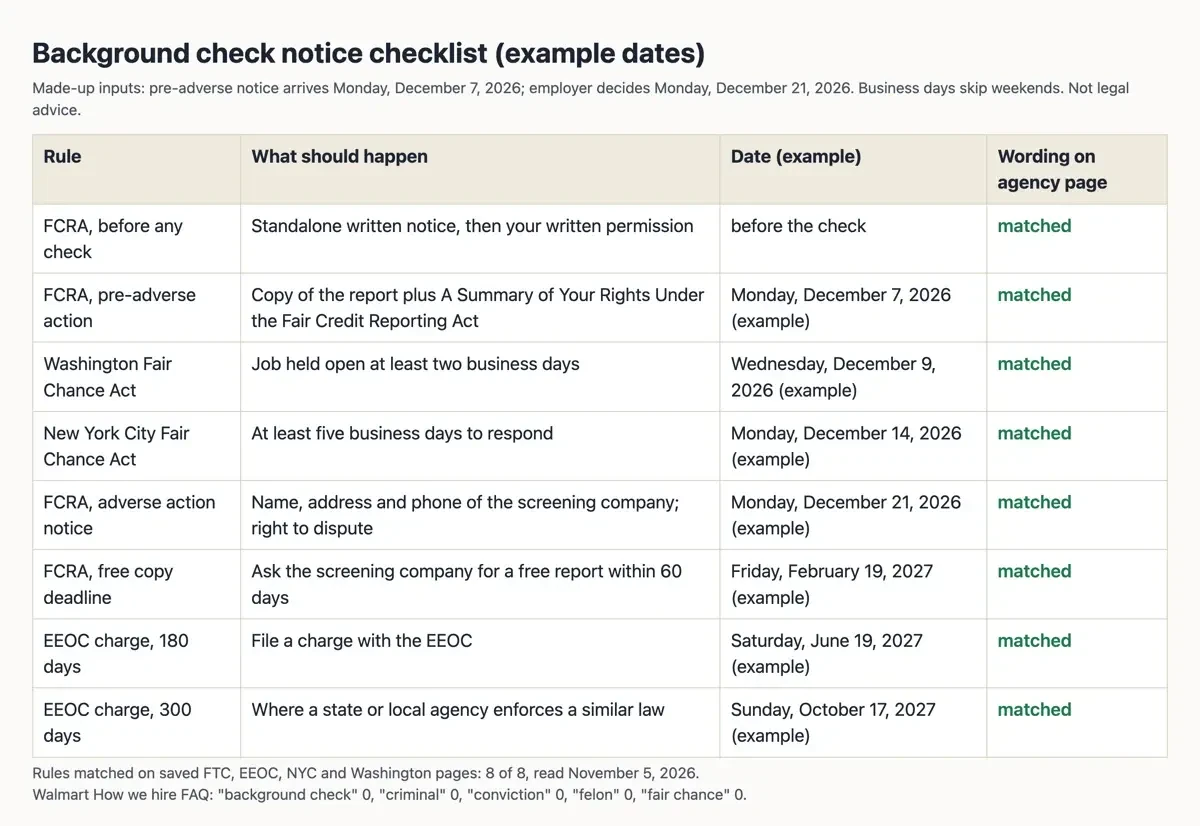 Screenshot: our background check notice checklist on 127.0.0.1, built from saved agency pages on November 5, 2026. Dates are examples.
Our take before you apply
If we had a record and wanted a Walmart job, we'd apply rather than rule ourselves out. Walmart's FAQ answers 12 applicant questions without raising records once, and the 2016 pledge it joined points to asking about records later in the process.
We'd put the effort into the notices: keep every letter, read the report within a day of getting it, and dispute any error in writing with the screening company.
We're giving steps here, not legal advice, and a local legal aid office can go over your state's rules and your own record with you before you apply.
If you get an offer, checking a salary against BLS data helps you read the pay. Former associates can find old tax forms in our Walmart W-2 guide. Employers can see the hiring side in our hiring manager guide.
Walmart background check questions
Frequently asked
Can an employer turn me down for an arrest alone?
Not for the arrest alone, under EEOC guidance. The EEOC says "The fact that a person was arrested is not proof that they committed a crime." Washington's law also bars rejecting applicants over an arrest record, except an adult arrest pending trial.
What if the background check shows someone else's record?
Dispute it with the screening company and tell the employer. The FTC says to "Include any supporting documentation you have with your request." Then ask the company to send the corrected report to the employer.
Can I reapply at Walmart if I don't get an interview?
Yes. For hourly roles, Walmart's hiring FAQ says "your application remains in our system for 60 days," and you can add other positions in that time.
Is a federal bond like a bail bond?
No. The program's FAQ says its bond "Is NOT a bail bond or court bond needed in adjudication." It pays the employer back for employee theft.
How we made this guide: On November 5, 2026, a plain script read 29 public pages from Walmart, the archived White House site, and federal, state and city agencies. Three pages refused it and one EEOC address was gone, so we didn't use those. Facts checked by the DigitalTreed team on November 5, 2026.
First published March 31, 2025, with a 2014 date for the application change and jobless and reoffending figures, none sourced. Rewritten November 5, 2026 around Walmart's own pages and agency rules, without those figures.
Sources
- Walmart Careers: How we hire (hiring process FAQ)
- Walmart Careers: Fashion Coach posting R-2681553, Swansboro, NC
- Walmart Careers: Developmental Technician, Facility Services HVAC/R posting R-2682274, Owosso, MI
- Walmart: Center for Racial Equity update on criminal justice (September 16, 2021)
- Walmart: Walmart and NAACP scholarship for returning citizens (December 9, 2021)
- The White House (archived): new commitments to the Fair Chance Business Pledge (August 16, 2016)
- The White House (archived): launch of the Fair Chance Business Pledge (April 11, 2016)
- FTC: Employer Background Checks and Your Rights
- FTC: Using Consumer Reports, What Employers Need to Know
- FTC and EEOC: Background Checks, What Employers Need to Know
- CFPB: List of consumer reporting companies
- CFPB: General Information Services and e-Backgroundchecks.com enforcement action
- EEOC: Arrest and Conviction Records, resources for job seekers, workers and employers
- EEOC: Questions and Answers about the EEOC's Enforcement Guidance on Arrest and Conviction Records
- EEOC: Background Checks, What Job Applicants and Employees Should Know
- California Civil Rights Department: Fair Chance Act
- NYC Commission on Human Rights: Fair Chance Act
- Illinois Department of Labor: Job Opportunities for Qualified Applicants Act
- Washington Attorney General: Fair Chance Act
- The Federal Bonding Program
- The Federal Bonding Program: FAQs
- The Federal Bonding Program: services for job seekers
- U.S. Department of Labor, ETA: Reentry Employment Opportunities
- U.S. Department of Labor, ETA: Work Opportunity Tax Credit
- IRS: Work Opportunity Tax Credit
- California Courts Self-Help Guide: Clean your record


Comments
No comments yet. Start the conversation below.