

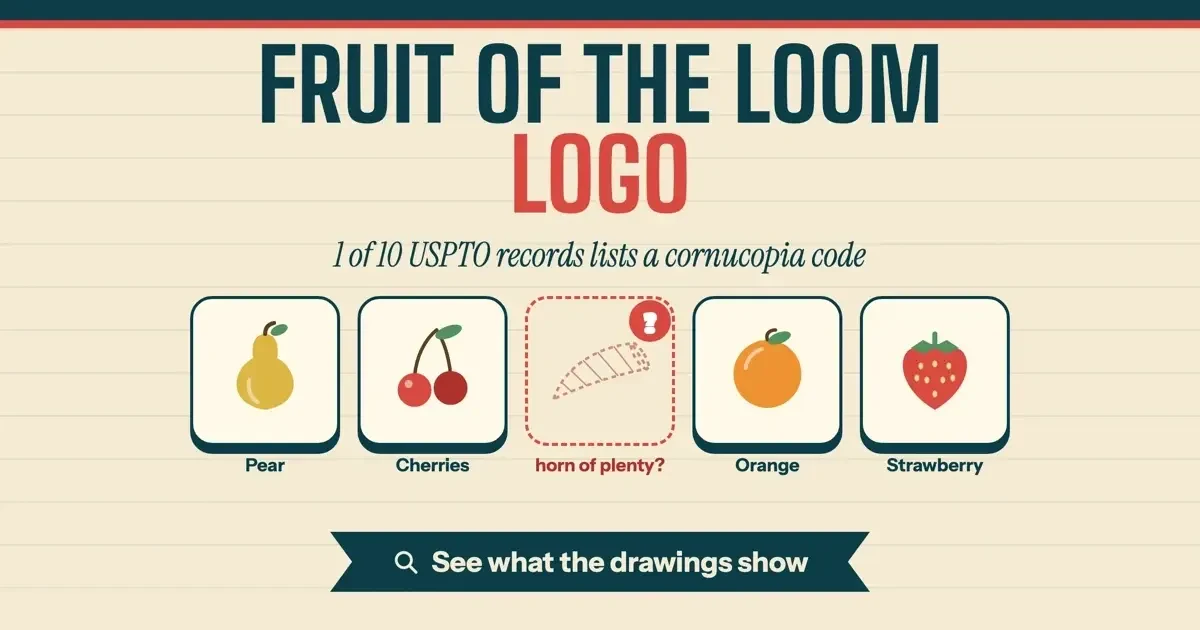
Quick answer
No. As of November 3, 2026, Fruit of the Loom's FAQ says "the cornucopia has never been a part of the Fruit of the Loom® logo." None of the 4 USPTO drawings we opened shows a horn. One 1974 laundry detergent record does name a cornucopia, but only in a search code an examiner added. Our check covered 10 records, not every filing.
You probably remember a brown horn of plenty curling behind the apple and grapes. In a University of Chicago study's preprint, people picking the real logo out of three versions scored below chance, and a cropped screenshot keeps the horn going online. The Fruit of the Loom logo is a registered trademark, though, so the answer sits in records anyone can open. We read 10 of them on November 3, 2026.
Each record below links to its TSDR page, which opens without an account. A small business can check its own logo record there the same way. Our Mandela effect numbers come from the study authors' preprint.
Key takeaways
- Only 1 of the 10 USPTO records we read names a cornucopia.
- That 1974 laundry detergent drawing shows apple, grapes, berries and leaves, no horn.
- Fruit of the Loom's FAQ says its logo never had a cornucopia.
- USPTO examiners add design codes; the filed drawing, not the code, is the mark.
- A 2022 study preprint lists this logo among seven commonly misremembered icons.
What Fruit of the Loom says about the cornucopia
Fruit of the Loom's Help and FAQ page asks the question in capitals: "HAS THERE EVER BEEN A CORNUCOPIA IN THE FRUIT OF THE LOOM® LOGO?" The link under it opens a cornucopia FAQ page, which answers "No." before it explains anything. That page isn't dated. Every quote from it here is as read November 3, 2026.
The denial covers every trademark the company has held, not only the logo. In "over 170 years of manufacturing," the company says it has "never used, applied for, or registered a trademark design/logo depicting a cornucopia." The company traces a recent wave of claims to a social post showing a cropped corner of a 1973 trademark application filed for laundry detergent. What about photos of an old neck label with a horn behind the fruit? Fruit of the Loom says each one is either "the result of some creative photoshopping" or "an actual counterfeit apparel item." We haven't examined any of those photos ourselves.
What do the USPTO trademark records show?
TSDR, short for Trademark Status and Document Retrieval, is the USPTO's public view of federal trademark filings, showing the dates, status, goods and drawing for each one.
Fruit of the Loom's FAQ links to serial number 73006089, so we began with that laundry detergent record and followed the registrations each record claimed until we had these 10:
| Registration | Filed | Registered | Goods (start of list) | Status on TSDR | Design codes |
|---|---|---|---|---|---|
| 124729 to 124733 (5 records) | not shown | March 11, 1919 | not shown | Dead, backfile cancelled or expired (October 25, 2005) | none listed |
| 174998 | November 29, 1922 | October 30, 1923 | Women's and children's textile underwear; pajamas for men | Live, renewed (status date February 2, 2024) | none listed |
| 175314 | June 2, 1923 | November 6, 1923 | Sheets and pillow cases | Dead, cancelled (May 2, 2016) | none listed |
| 688053 | July 23, 1958 | November 10, 1959 | Bias tape, shoe laces, sewing notions | Dead, cancelled (December 29, 2000) | Grapes; oranges; apples |
| 913840 | June 4, 1970 | June 8, 1971 | Clothing for men, women and children | Dead, expired (June 15, 2002) | Leaf; grapes; apples; oval; underlined words |
| 993305 | November 12, 1973 | September 24, 1974 | Laundry detergents | Dead, cancelled (November 28, 1988) | Berries; grapes; apples; 05.09.14 baskets, containers, cornucopia |
Only one of the 10 is still live. Registration 174998 was filed in 1922, and its TSDR page says "The registration has been renewed" with a status date of February 2, 2024. It also gives a first use date of November 25, 1891, the same date TSDR shows on registrations 175314 and 913840. Its drawing is the words FRUIT OF THE LOOM in an arch, and there's no fruit in it. Among these 10, fruit doesn't show up in the codes until 1959. Registration 688053 from 1959 and registration 913840 from 1971 are both coded for grapes and apples, and neither for any container.
The five 1919 entries, starting with registration 124729, show no mark text or owner. Registration 175314 covered sheets and pillow cases. It's been cancelled since May 2, 2016.
Of these 10 records, registered from 1919 to 1974, we opened the drawings for 174998, 688053, 913840 and 993305, and there's no horn in those 4. We didn't open the 175314 drawing, and TSDR doesn't list a drawing type for the 1919 entries.
Registration 993305, the laundry detergent record, ended in 1988. The two sources word that ending differently. Fruit of the Loom says the design was "allowed by Fruit of the Loom to expire in 1988." TSDR's status line reads "Registration cancelled under Section 18 by the Trademark Trial and Appeal Board." It's dated November 28, 1988.
The file location reads "FILE DESTROYED," so the board's reasons aren't on TSDR, and we can't say why the two accounts differ.
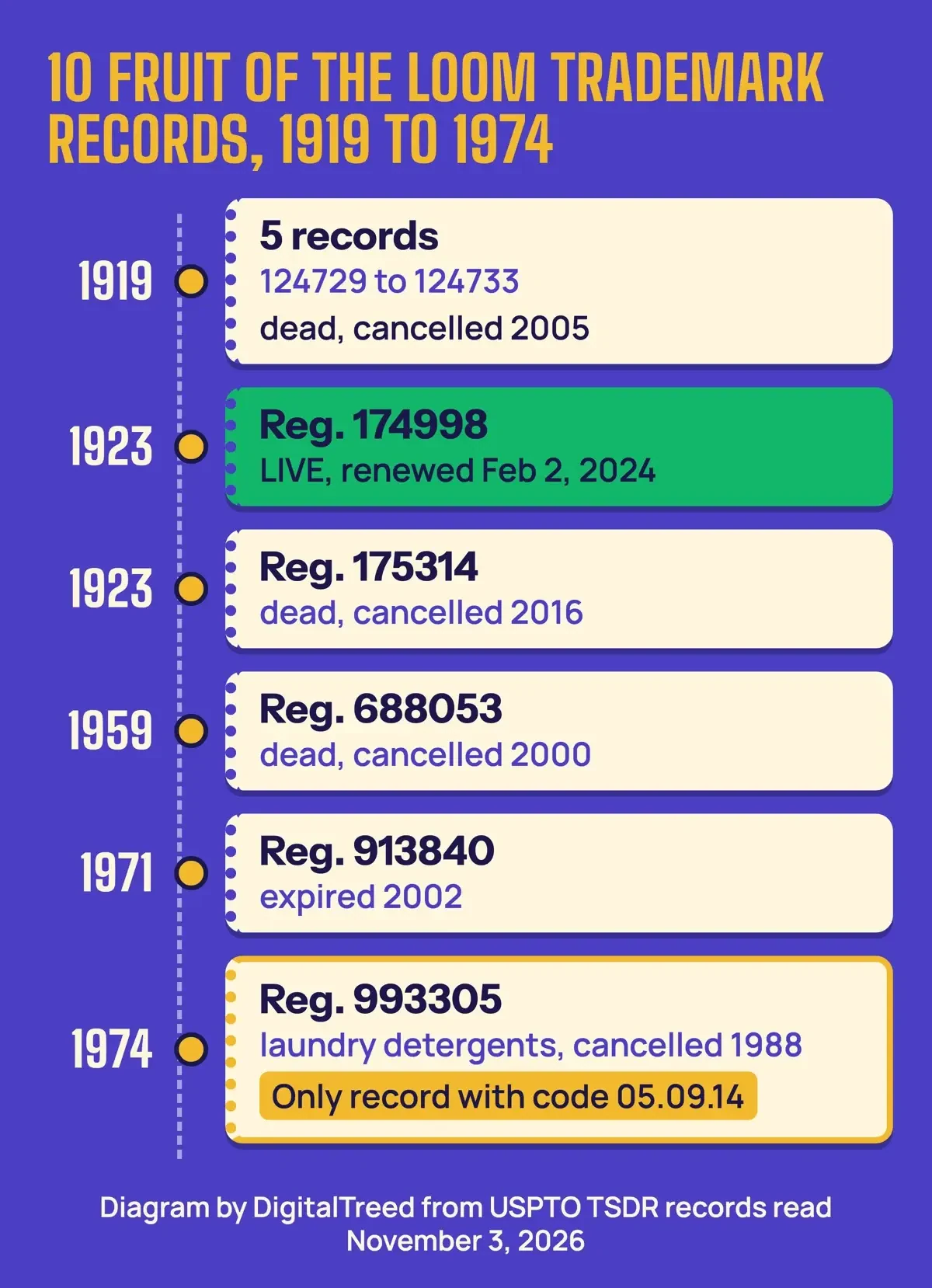 Diagram by DigitalTreed from USPTO TSDR records read November 3, 2026.
Why one record lists a cornucopia code
The word cornucopia on that 1974 record comes from a USPTO filing system, not from the picture. The USPTO's design search codes page explains that "A design search code is a six-digit number we use to identify a particular design or design element."
The first two digits are a broad category, the middle two a division and the last two a section. That's why every code on this record starts with 05.09, the fruit group.
Code 05.09.14 is one shelf with three labels: "Baskets of fruit; Containers of fruit; Cornucopia (horn of plenty)." The record's other codes are 05.09.01 for berries, raspberries and strawberries, 05.09.02 for grapes and 05.09.05 for apples, all in that same fruit group. Fruit of the Loom's FAQ says "These generic descriptions were assigned by a USPTO Trademark Examiner (not Fruit of the Loom)."
The viral post showed that code line, and Fruit of the Loom says the cropped picture left out "the actual trademark design," the drawing the code was assigned to.
Federal rule 37 CFR 2.52 opens with "A drawing depicts the mark sought to be registered." The drawing is the mark, not the code. The drawing for serial 73006089 on TSDR shows an apple, a bunch of grapes, small berries and leaves above the words, and no horn, basket or bowl.
TSDR doesn't give a reason for code 05.09.14, and the record's file location has read "FILE DESTROYED" since March 6, 1994, so the examiner's notes can't be checked there.
Written descriptions don't add a horn either. Under 37 CFR 2.37, "A description of the mark must be included if the mark is not in standard characters." None of the 10 records we read has one.
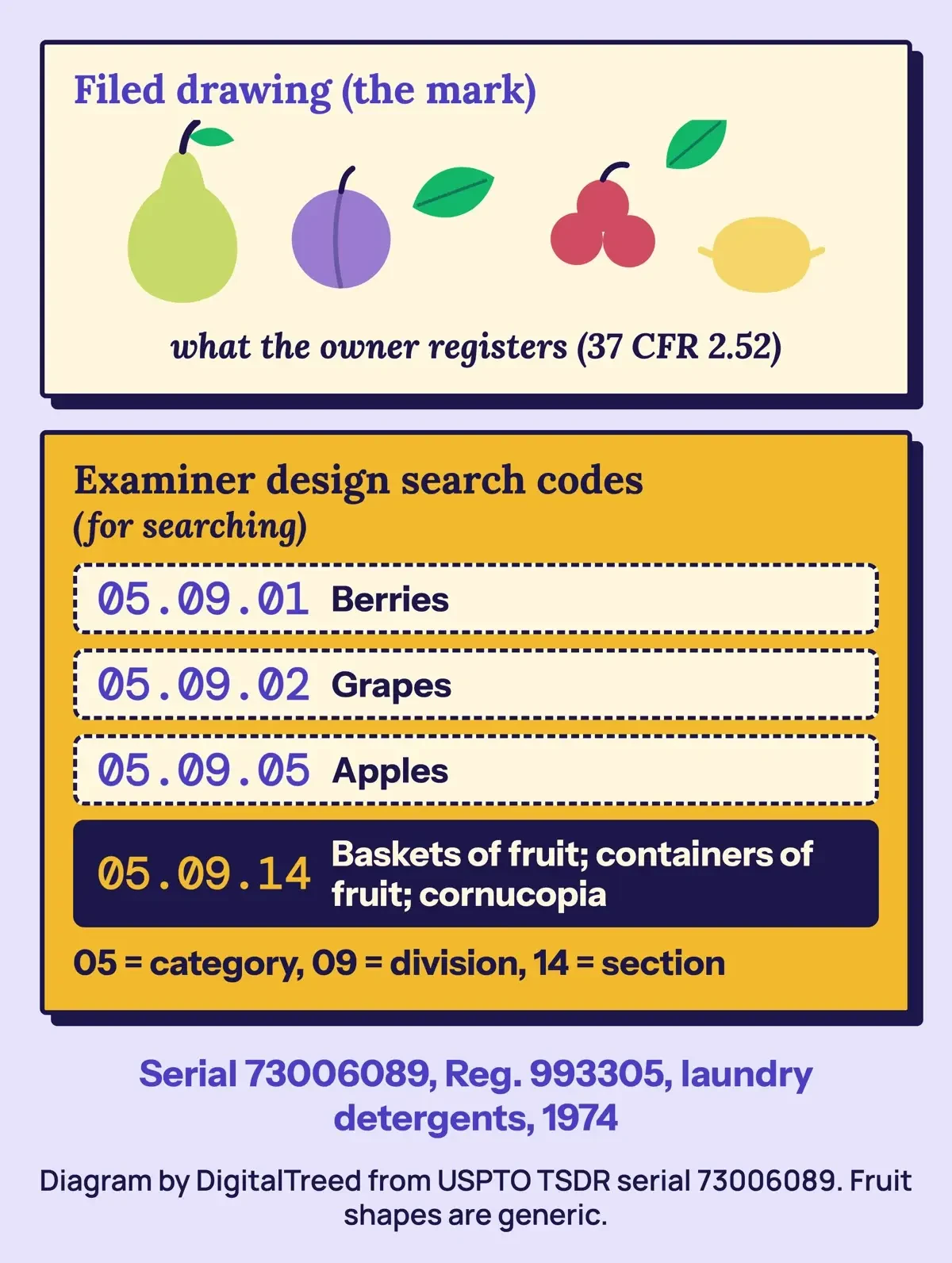 Diagram by DigitalTreed from USPTO TSDR serial 73006089 and the USPTO design search codes page, November 3, 2026. Fruit shapes are generic, not the trademark drawing.
What we tested
On November 3, 2026 we saved those 10 TSDR records with a small Python script. It sent plain page requests with an honest user agent, 6 seconds apart, because the USPTO's terms of use warn about "unusually high numbers of database accesses." A second script read the saved copies offline. Full result: 10 records; 3 with design codes (688053, 913840, 993305); 0 with a description of mark; 1 with a cornucopia code (993305); 1 live (174998). Five 1919 records show no mark text or owner, and an unknown drawing type. We viewed 4 drawings by eye and none shows a horn, but today's fruit cluster registrations weren't in our chain, so this isn't every filing.
The Mandela Effect in plain words
A widely shared memory of something that was never there has a name in psychology. The 2022 study's abstract on PubMed calls the Mandela effect "an Internet phenomenon describing shared and consistent false memories for specific icons in popular culture."
A Popular Science explainer from January 27, 2026 puts it more simply: "The Mandela effect is a communal example of a false memory."
The name itself comes from one shared mistake. The study's preprint on PsyArXiv says Fiona Broome coined the term for her false memory of Nelson Mandela dying in prison in the 1980s. Popular Science notes he actually died in 2013, at 95.
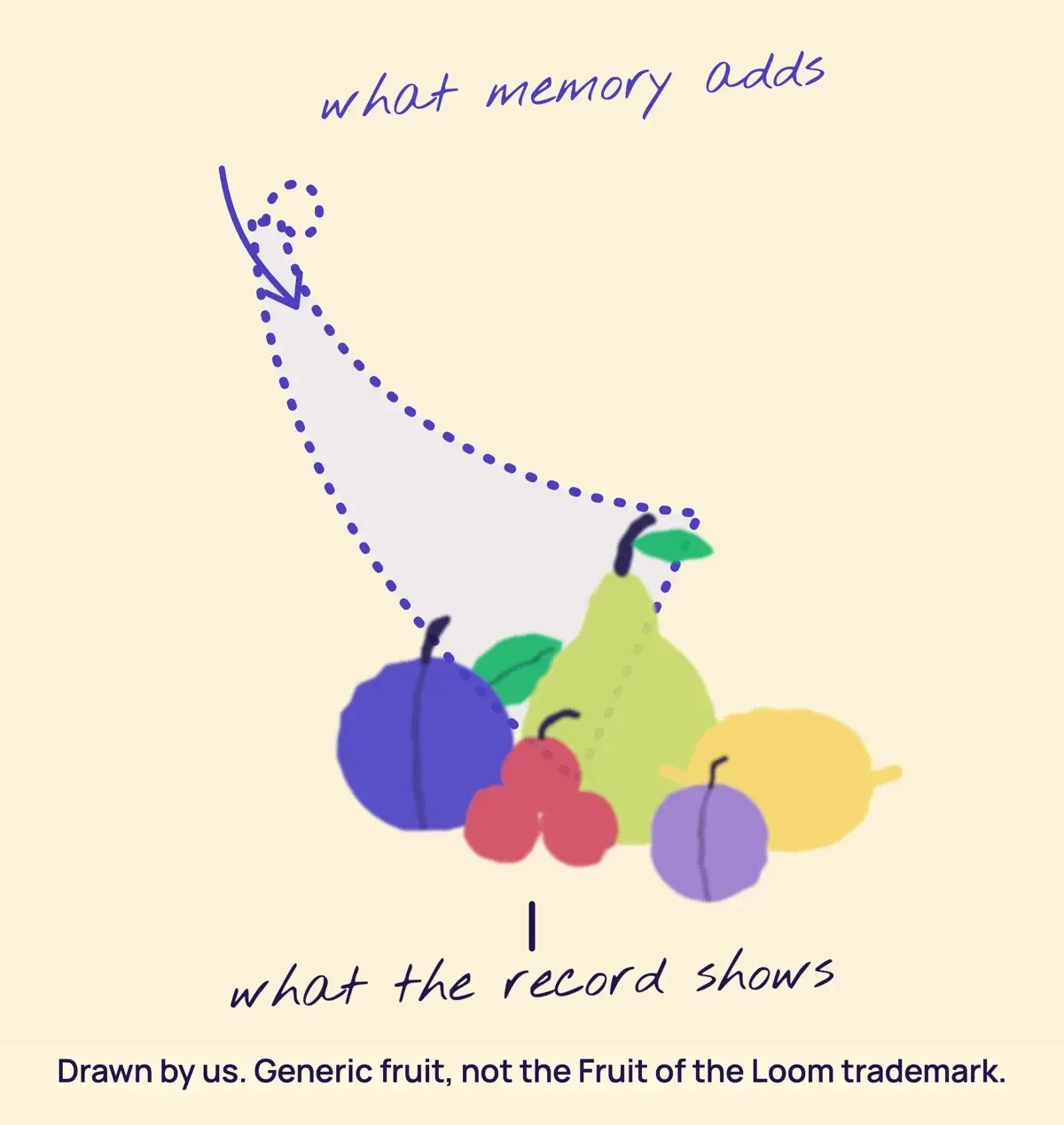
Popular Science describes false memories as recollections of events that never happened or facts that aren't true. Wilma Bainbridge is the study's corresponding author. She's a University of Chicago memory psychologist, and she told Popular Science that "Our memories are really like a filtered-down version of the original experience." The article adds that the brain fills gaps with details it expects to see together, but the study's authors don't think that explains this particular logo. They call a cornucopia "intuitively atypical to the schema" for it, so a horn isn't what people would normally expect there.
 Drawn by us. Generic fruit, not the Fruit of the Loom trademark.
What the 2022 Psychological Science study tested
The paper is "The Visual Mandela Effect as Evidence for Shared and Specific False Memories Across People" by Deepasri Prasad and Wilma Bainbridge. It ran in Psychological Science in December 2022, volume 33, issue 12, pages 1971 to 1988 (DOI 10.1177/09567976221108944). The Brain Bridge Lab publications page lists it too. The preprint says the online participants came from Amazon Mechanical Turk and Prolific, screened for US location and English. Its abstract says the visual version of the effect "has not yet been empirically quantified or tested," so the team ran four experiments:
- Experiment 1: 100 adults picked the real image from 3 versions of each of 40 famous icons, then rated their confidence and familiarity.
- Experiment 2: 60 adults took an eye-tracking-like test of where attention goes on each image.
- Experiment 3: the team gathered images of the seven flagged icons from the internet to see how often the wrong version really appears.
- Experiment 4: 50 adults drew icons from memory.
In the published abstract on PubMed, "certain images from popular iconography elicit consistent, specific false memories." Experiment 2 found "no attentional or visual differences that drive this phenomenon." The error also held "despite the majority of visual experience being the canonical image," a finding from the Experiment 3 count of real-world images scraped from the internet.
This logo was one of the 40 test images. The PsyArXiv preprint lists its false version as "a cornucopia for the Fruit of the Loom logo." It names the logo among the seven of 40 images labeled "VME-apparent," meaning accuracy fell below chance and people kept picking one specific wrong version. Correct answers came with reasons like "only saw the fruit, not the cornucopia." One participant who chose the horn wrote "there was a cornucopia in the image I saw." For this logo, the image search found people "will rarely, if ever, encounter the VME version in the real world." The few horn versions it did find sat on pages about the Mandela Effect.
The horn showed up least in the drawing test. Among people who knew the icons well, 16.13% added the false feature when drawing this logo from memory, while C3PO was highest at 94.44%. Its false version had a golden leg.
These figures come from the PsyArXiv preprint, first posted May 25, 2021, and the file there now is the version the journal accepted on March 28, 2022. The journal's own page refused our script, so we couldn't compare the printed article, and its numbers may differ slightly. The preprint also reports that 67.92% of the Experiment 2 participants who answered had heard of the effect. The authors say such memories "may become amplified" as the effect gets better known, and that's partly why our drawings here show the horn only as a dotted outline.
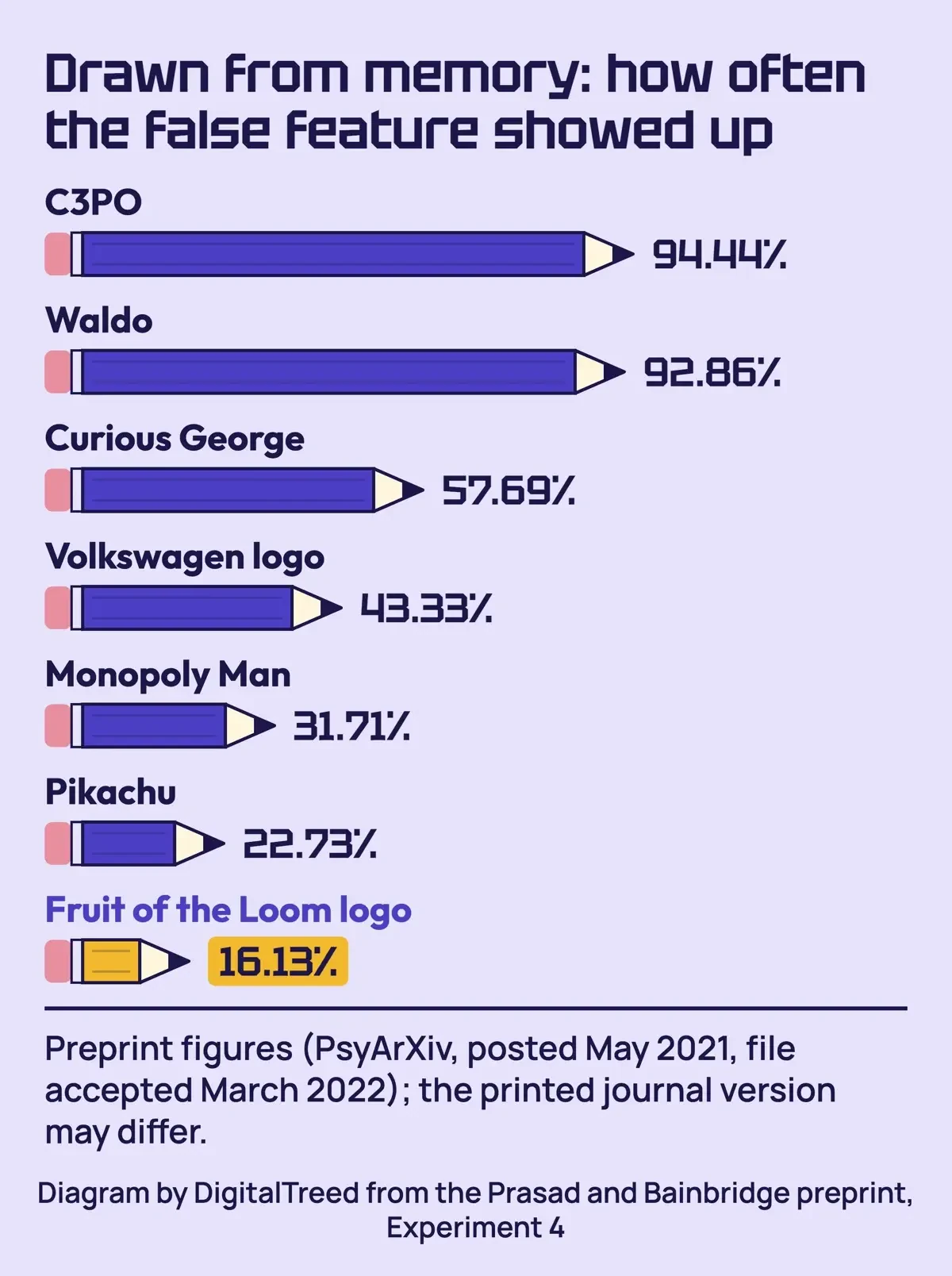 Diagram by DigitalTreed from the Prasad and Bainbridge preprint, PsyArXiv (posted May 25, 2021; file marked accepted March 28, 2022), Experiment 4.
What a small business can take from this
If your shop files its logo with the USPTO, your federal record is the drawing you file. TSDR shows it next to codes you didn't pick. When you file, and again before each renewal, read three lines on your record: status, drawing and design search codes. An odd code is a search shelf, as the 1974 laundry detergent record shows.
You don't need an account. TSDR status pages open at an address ending in the serial number, like tsdr.uspto.gov/statusview/sn73006089, which is the exact form our script used. Registration numbers take rn in front: rn174998. Save the page as a PDF each time you check, and you'll have a dated copy of your record for your files.
Keep your own dated logo files too: the original vector file, the date it was finished, who drew it, and the version you actually filed. If a designer makes it, ask for the layered source file too. Fruit of the Loom could answer a viral claim with a serial number and a 1973 drawing. A design-app export with no filing doesn't give you a serial number or dated drawing to point to. For the design side, see our visual identity guide for small businesses and the walkthrough on creating a shop logo. Before you print anything, how to name a business walks through checking a name, and our rebranding checklist lists what to update if the mark changes.
Our take: check the brand's own FAQ and its TSDR record before you repost a viral logo claim. Those two pages settled this one. Hiring someone for the drawing? See what a graphic designer costs in the US. Our branding strategy plan shows where the logo fits, and protecting website content from copying helps when a copy of your logo turns up somewhere else.
Fruit of the Loom logo questions
Frequently asked
When was the Fruit of the Loom trademark first used?
TSDR lists a first use date of November 25, 1891 on registration 174998, the 1922 filing that's still live.
Did Fruit of the Loom really sell laundry detergent?
The 1973 TSDR record lists laundry detergents, with first use in commerce on September 28, 1973.
Which other icons did the 2022 study flag?
The preprint names seven: C3PO, Curious George, this logo, the Monopoly Man, Pikachu, the Volkswagen logo and Waldo. Its stimuli and participant responses sit in the study materials on OSF.
How we made this guide: We read Fruit of the Loom's two FAQ pages, 10 USPTO records and the other Sources. A script saved every copy on November 3, 2026. A second script listed the records offline. We viewed 4 drawings by eye. Per-icon study numbers come from the PsyArXiv preprint, because the journal's page refused our script. Facts checked by the DigitalTreed team on November 3, 2026.
First published October 2024 with a 51% vs 49% survey chart we couldn't trace to a source. Rewritten November 3, 2026 around the company's statement, USPTO records and the 2022 study.
Sources
- Fruit of the Loom: Cornucopia and Michigan FAQ
- Fruit of the Loom: Help / FAQ
- USPTO TSDR: serial 73006089, Reg. 993305 (laundry detergents, 1974)
- USPTO TSDR: Reg. 174998 (1923, live)
- USPTO TSDR: Reg. 175314 (1923)
- USPTO TSDR: Reg. 688053 (1959)
- USPTO TSDR: Reg. 913840 (1971)
- USPTO TSDR: Reg. 124729 (1919)
- USPTO: Design search codes
- eCFR: 37 CFR 2.52, Types of drawings and format for drawings
- eCFR: 37 CFR 2.37, Description of mark
- USPTO: Terms of use for USPTO websites
- PubMed: Prasad and Bainbridge, Psychological Science, 2022
- Psychological Science (SAGE): DOI 10.1177/09567976221108944
- PsyArXiv preprint: The Visual Mandela Effect (2021)
- OSF: study stimuli and data
- Brain Bridge Lab, University of Chicago: publications
- Popular Science: What's a false memory? (January 27, 2026)


Comments
No comments yet. Start the conversation below.