
Quick answer
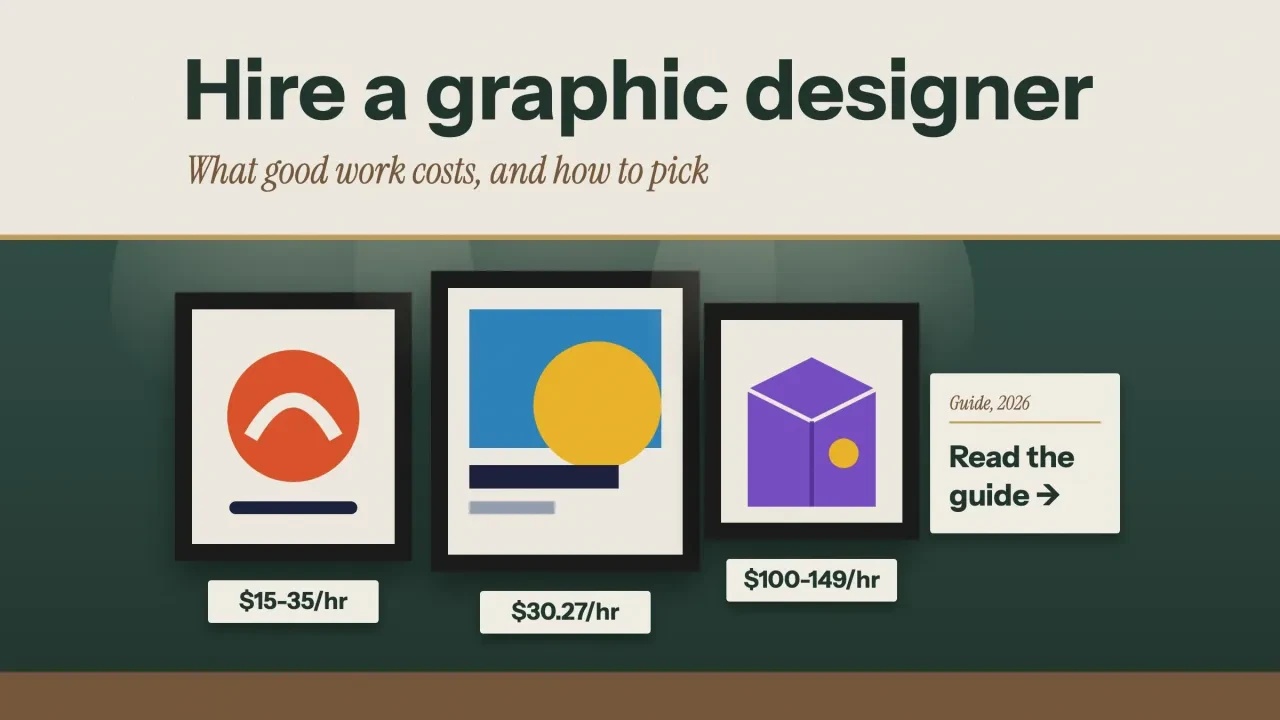
Hiring a graphic designer costs about $15 to $150 an hour as of October 2026. Marketplace freelancers, many outside the US, sit at the low end and agencies charge around $100 to $149. Staff designers earn a median $30.27. The rate matters less than what the quote includes, above all who owns the files.
So how much does a graphic designer cost for your job? That depends on who you hire, and the gap is wide.
When we priced one small job across five public sources, the cheapest full-job price and the priciest were almost ten times apart.
This guide shows the ranges with their sources, what pushes a price up, that one job priced four ways, the costs that come after the invoice, and the paperwork that decides whether you own the work. Hiring someone to build a website instead? Our guide to hiring a web designer covers that.
Key takeaways
- Most graphic design quotes land between $15 and $150 an hour.
- BLS puts median graphic designer pay at $30.27 an hour in May 2025.
- One test job we priced varied almost ten times from cheapest to priciest.
- A copyright transfer is not valid unless it is in writing.
- File a 1099-NEC for each non-employee you paid at least $2,000.
Most quotes land between $15 and $150 an hour
The low end of that range comes from marketplaces and the high end from agencies. Upwork's cost page for graphic designers showed a median band of $15 to $35 an hour when we checked it (October 23, 2026). It also said rates run "from $15 to $150 an hour, with an average rate of around $25 per hour." Its footnote says the figures come from contracts worldwide, not only US ones.
Agencies aren't cheap. Clutch, a directory that sells agency leads, says on its graphic design pricing page that "most graphic design companies charge between $100–$149 per hour" for their services. Its row for the United States shows the same range (as of October 2026).
Neither number is neutral, since both companies earn money when you hire through them.
For a neutral anchor, look at wages. The Bureau of Labor Statistics Occupational Outlook Handbook puts median pay for graphic designers at $62,960 a year, or $30.27 an hour, in May 2025. The lowest 10% earned under $39,520 and the top 10% over $104,910. On a 2,080-hour year, that's about $19 and $50 an hour.
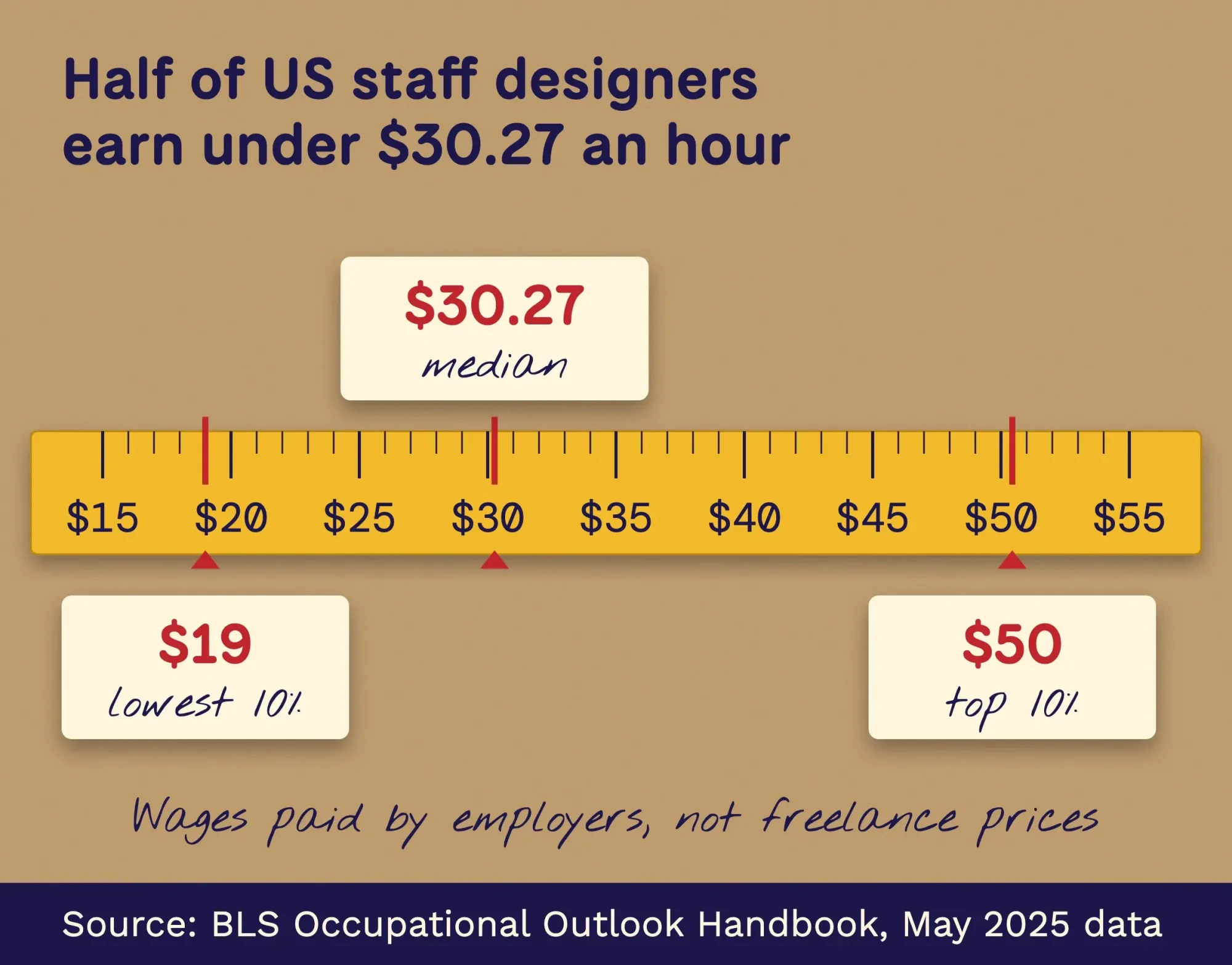 Source: U.S. Bureau of Labor Statistics, Occupational Outlook Handbook, May 2025 data. The 10th and 90th percentile hourly figures are the annual figures divided by 2,080. Diagram by DigitalTreed.
Here's the catch with wages.
They're what an employer pays a person on staff, not what a freelancer charges you. A freelancer also covers their own software, self-employment tax, health insurance and the unpaid hours spent finding clients. That's why a fair US freelance rate usually sits above the wage band, not inside it.
Five things move the price more than talent does
An hourly rate is only half of a quote. Two designers with the same rate can send quotes far apart, because they're pricing different jobs.
Scope comes first, and it's the big one. A logo alone is one job. A logo plus a brand sheet, business cards, a price list and six social templates is five. If you haven't settled your positioning yet, our branding strategy plan walks through it, and it's cheaper to do that before a designer starts guessing.
Revision rounds come next.
Two rounds is a plan. "Unlimited revisions" usually means a padded price, or a designer who's tired of you by round six.
Then there are rights and files. A quote that includes the editable source files and a written transfer of copyright costs more than one that hands over a PNG, and it should, because you'll use those files for years.
Speed is the fourth. A one-week deadline pushes other clients aside, and designers charge for that.
The last is who actually does the work. A senior designer, an agency junior, an overseas subcontractor or an AI image tool can all sit behind one storefront. The BLS itself expects AI tools to make designers "more productive and reduce the need for these workers."
So ask how much of your job a person will do.
Prices by route, as of October 2026
Put those drivers together and you'll get six ways to buy design, plus doing it yourself. Each one fits a certain kind of job.
| Route | Fits | Price signal (Oct 23, 2026) | Source |
|---|---|---|---|
| Marketplace freelancer | small one-off jobs | $15 to $35 an hour (median band) | Upwork |
| Logo contest | a logo, if you can judge concepts | US$249 to US$1,050 per contest | 99designs |
| US freelancer | logo and a small brand kit | above the $30.27 staff wage | BLS (a wage) |
| Design subscription | design work every week | from $699 a month, billed monthly | ManyPixels |
| Studio or agency | full identity or a rebrand | $100 to $149 an hour | Clutch |
| In-house hire | daily design work | $62,960 median salary plus benefits | BLS |
The contest prices come from 99designs' pricing page: Bronze US$249, Silver US$399, Gold US$799 and Platinum US$1,050, before sales tax. On ManyPixels' pricing page, the entry plan was $699 a month on monthly billing, $629 on quarterly and $559 on yearly when we read it in October 2026.
Each is one company's list price. It isn't a market average.
Doing it yourself is the seventh route. Simple crops and cutouts you can do yourself with a free photo editor. Template tools work for weekly social posts once you've got a brand kit. Our roundup of logo maker tools shows what they can and can't do, and these graphic design tutorials cover the basics. Just remember that a template logo can look like thousands of others.
Our take: for a first logo and brand kit, an independent freelancer with a written contract is usually the best value. A contest only makes sense if you're good at judging concepts. A subscription pays off only when there's design work every week.
We priced one job four ways
That table is easier to judge with one real brief run through it. So we read the four vendors' public pricing pages and the BLS pay data in one sitting, October 23, 2026, and priced the same job across them.
Example (fictional): Copper Paw is a made-up mobile pet-grooming van in Lansing, Michigan. It needs a refreshed logo, a one-page brand sheet, artwork for the van doors, business cards and 6 social templates. We assumed 30 hours of design work. That's our assumption, not a quote.
At Upwork's median band of $15 to $35, 30 hours comes to $450 to $1,050 (prices as of October 2026). At the BLS median wage, the labor alone is about $908 before any overhead. Clutch's US agency rate of $100 to $149 turns the same 30 hours into $3,000 to $4,470. A 99designs contest covers the logo alone for US$249 to US$1,050. One month of ManyPixels' entry plan is $699, if the queue gets through all of it in a month.
Same brief. Almost ten times the price from one end to the other.
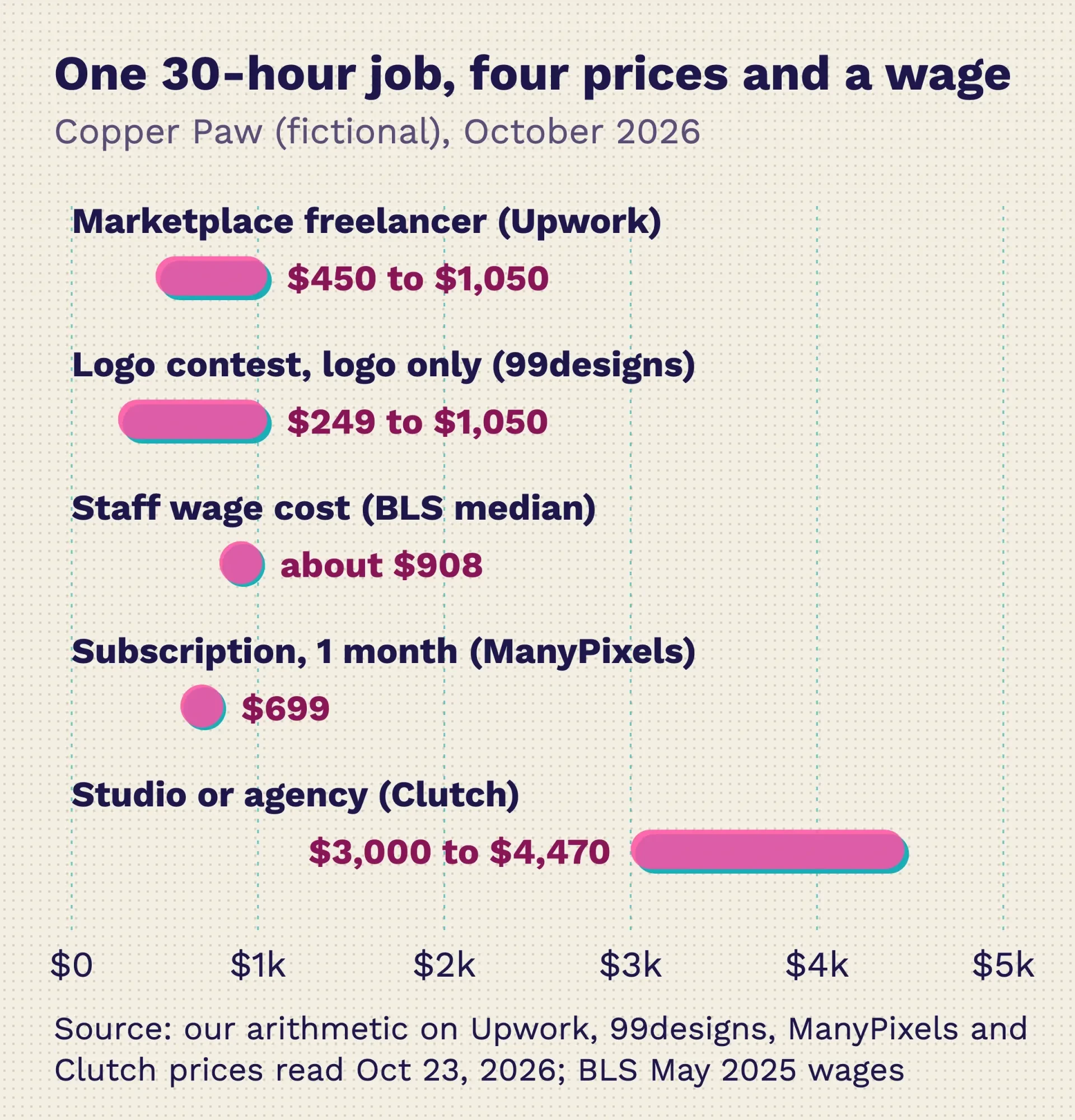 Diagram by DigitalTreed. Our arithmetic on public prices read October 23, 2026 (Upwork, 99designs, ManyPixels, Clutch) and BLS May 2025 wages. Copper Paw is a fictional example.
For Copper Paw, we'd send the brief to two or three independent freelancers. We'd expect their quotes to land somewhere between the marketplace band and the agency figure. The van artwork is the reason not to go cheapest, since a large print file that's built wrong costs more to fix at the print shop than it cost to design.
None of that math is a real quote, but it shows how two honest quotes can sit thousands of dollars apart.
What costs come after the designer's invoice?
Even a fair quote rarely covers everything you'll pay for that design. Ask about these before you sign.
- Font licenses: some fonts are free for business use and some aren't, so ask for a list of every font and its license. Have a sample font only in a photo? Identify the font from the image before the brief, and ask the designer to confirm the license.
- Stock photos, icons and illustrations, each with its own license.
- Printing, vinyl wraps and signs, which the design fee doesn't include.
- Extra revision rounds, usually billed by the hour.
- Quiet months on a subscription, which you pay for anyway.
- A trademark filing, if you choose to register: the USPTO's fee page lists $350 per class of goods or services, before any additional fees (as of October 2026).
Social templates have one more hidden cost: an image that crops badly when it's shared. Before you pay the last invoice, put a page using the new image through our free social preview checker.
Paying for a logo doesn't make it yours
The biggest hidden cost isn't on any invoice.
It's finding out, years later, that you never owned the logo you paid for.
Under US copyright law, the person who creates a work is usually its author and owner. The Copyright Office's Circular 30 explains the exception, called a work made for hire. For an outside freelancer, it covers only nine listed kinds of work, such as a compilation or a contribution to a collective work. And it applies only "if the parties expressly agree in a written instrument signed by them."
A standalone logo or flyer usually isn't on that list.
So a "work for hire" clause on its own may not move ownership of a logo. A written transfer does, and that's the part people skip. Under 17 U.S.C. 204(a), a transfer of copyright "is not valid unless" it's in writing and signed by the owner of the rights. Ask for a signed assignment of copyright in the final designs, effective on your last payment.
Simple logos have a twist. Circular 33 says names, short phrases, typeface and "familiar symbols and designs" generally aren't protected by copyright. A plain wordmark may have little copyright to transfer. Its real protection comes from trademark law.
You don't have to register a trademark. The USPTO's trademark basics page says a mark can be "a word, phrase, design, or a combination" that identifies your goods or services, and that "it is your choice" whether to protect it. Still choosing a name? Our brand name guide lists the checks to run before anyone draws a logo.
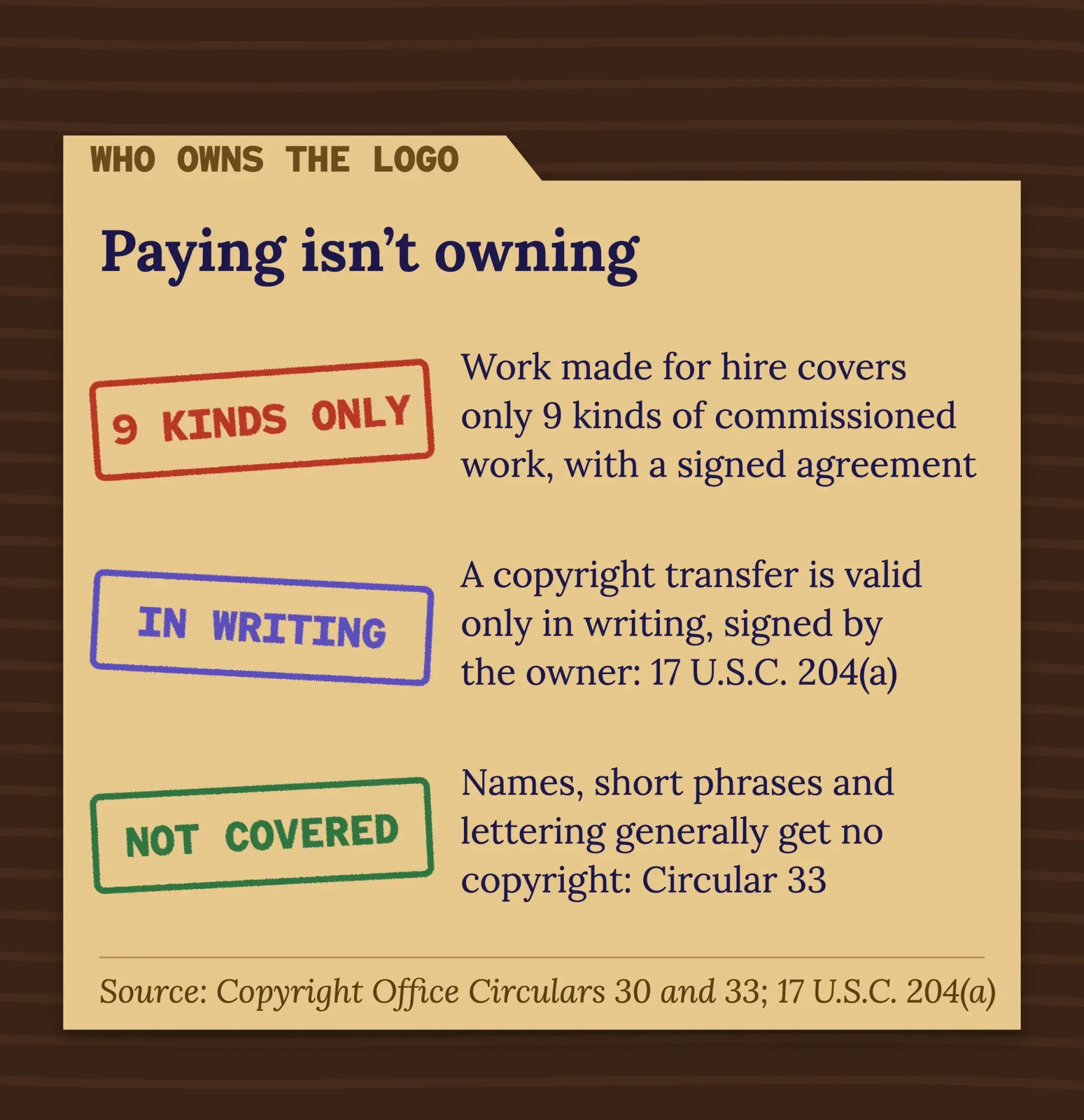 Diagram by DigitalTreed, based on Copyright Office Circulars 30 and 33 and 17 U.S.C. 204(a).
Everything above is a working designer's sketch of who owns what, not a ruling on your own deal. Pay an attorney to check the assignment clause before you sign, and again before a logo goes to the USPTO.
Want one team to handle the whole job? Our graphics and video service does logos, brand kits and social graphics, with source files and a written assignment included. (We get paid when readers hire us for design, which you should factor in when judging these tips.)
The 1099 line is $2,000 for 2026 payments
That's the legal paperwork. Taxes are the other half, and the IRS line moved this year.
The IRS instructions for Form 1099-NEC, revised December 2026, say you file the form for each non-employee you paid "at least $2,000" for services in the year. It's due by January 31. So if you pay an unincorporated US freelancer $2,000 or more in 2026, expect to file one by January 31, 2027. Payments to corporations are generally excepted.
Get a Form W-9 before the first payment, since that's how the designer gives you their taxpayer ID.
Paying through a marketplace or by card? Ask your CPA how that changes who reports what. We didn't research those rules for this guide.
Worker status is the other trap. The IRS contractor or employee page weighs behavioral, financial and relationship control. It says a remote worker is your employee "if you can control what will be done and how it will be done." A designer who works set hours under your direction every week may be an employee, whatever the contract says.
These rules aren't special to design; our guide to hiring an SEO freelancer runs into the same ones. None of it is tax advice for your business, and a CPA can tell you what applies.
How to spend less without getting a worse logo
That covers the paperwork. Most money wasted on design goes to rework, not to high rates.
Start with a one-page brief. It says what the business does in one sentence and who buys from you. Add three words for the feel, two logos you like and why, and what to keep from the old one. Then list every file and size you need, the deadline, the budget range and who makes the final call.
A designer with that page quotes tighter, because there's less to guess.
Give feedback once per round, in one list, from one person. Three people sending notes on different days is how two rounds turn into six.
For a big job, pay for a small test first, like one social template or a business card. It doesn't cost much, and you'll learn how the person works.
Then keep the repeat work cheap. Once you've got a brand kit, the designer can build post templates once, and your social media plan decides how many you need.
Questions to ask before you sign
Those habits help after you hire. These questions help you pick the right person first, after you've looked for portfolio work like yours.
- Can you show me 3 projects like mine, and what was your part in each?
- What's included: how many concepts, rounds, files and sizes?
- Will I get the editable vector files (AI, EPS, SVG or PDF) and a brand sheet?
- Will you assign the copyright to me in writing on final payment?
- Which fonts, stock images or icons will you use, and what licenses do I need?
- Do you use AI image tools, and if so, where?
- Who does the work: you, or someone you subcontract?
- What are the payment terms, and what happens if we stop halfway?
A good designer answers all eight without fuss.
If questions 3 or 4 make them hesitate, you've learned most of what you need to know.
Red flags worth walking away from
Some answers to those questions should end the conversation. These are the ones we'd walk away from.
- No contract, or one that says nothing about ownership and files.
- PNG and JPG only, or a fee to "release" source files that wasn't in the quote.
- A portfolio that looks like stock templates, with no story behind any piece.
- Full payment up front from someone you've never worked with.
- A price far below the wage band and no clear answer on who does the work.
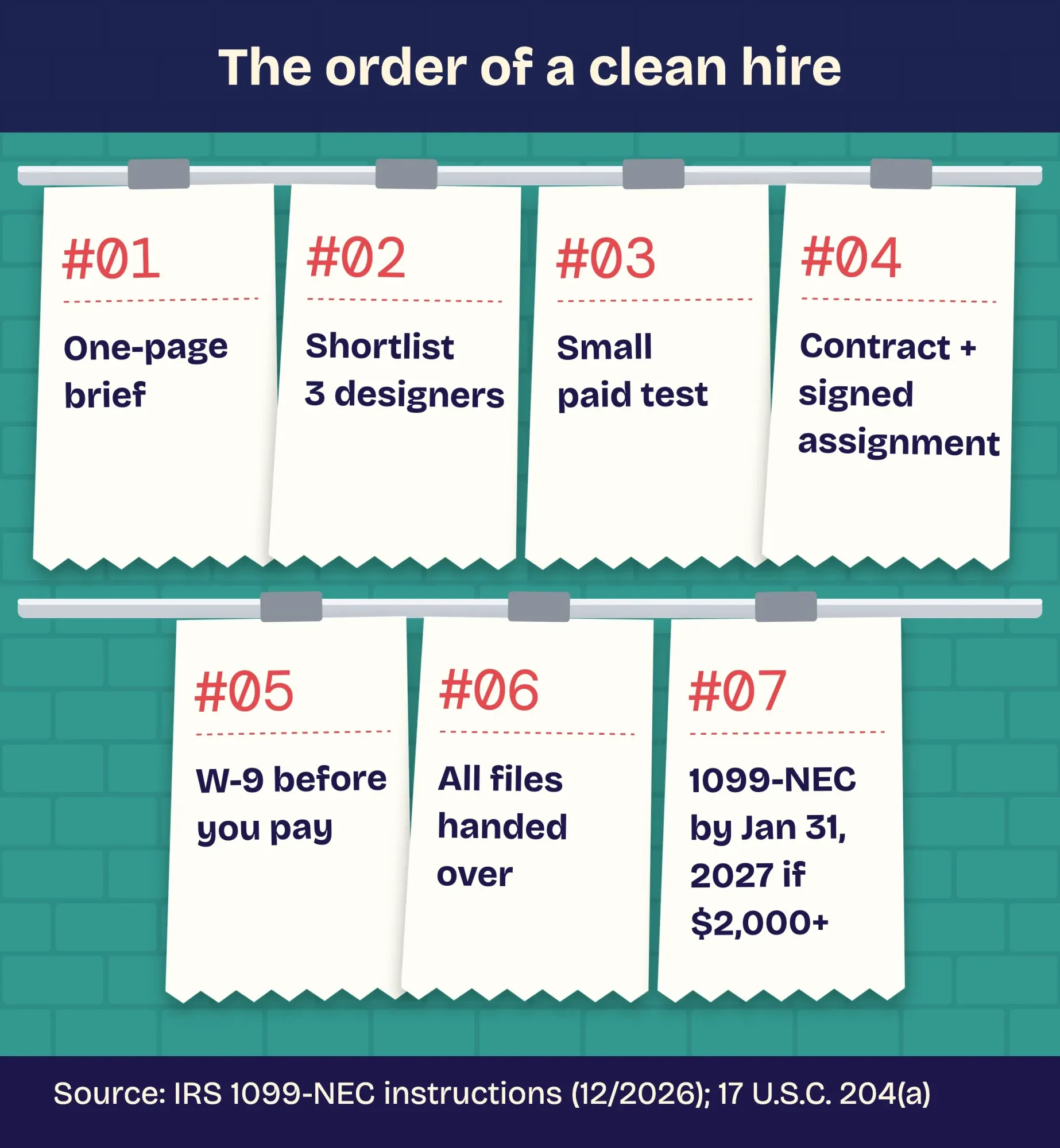 Diagram by DigitalTreed. Tax dates from the IRS 1099-NEC instructions (12/2026); ownership from 17 U.S.C. 204(a).
Frequently asked
Can I copyright a logo my designer made with AI?
Only the parts a person shaped. In its January 2025 AI report announcement, the Copyright Office said AI output is protected only where a human author determined enough expressive elements. Prompts alone don't count, as of October 2026. So ask the designer how much of the logo a person drew or changed.
How much does it cost to register the copyright in a logo?
As of October 2026, the Copyright Office fee page lists $45 for an online single application. That covers one author, one work, not made for hire. Other online claims use the Standard Application at $65. A plain wordmark may have too little artwork to register.
Can I record the copyright transfer from my designer?
Yes, the Copyright Office records transfer documents. As of October 2026, its fee page lists $95 to record a document online, or $125 on paper. That base fee covers one work identified by one title or registration number. Keep the signed original either way.
Getting quotes you can compare
That list works best when the quotes line up. Send the same one-page brief to three designers, and ask each to price the same files, the same number of rounds, the same payment milestones and a written assignment. Building an app rather than a brand kit? See what a full stack developer costs.
Then compare like for like, and don't stop at the total.
A higher quote that includes source files, two rounds and the copyright transfer is often the cheaper one by the end of the year. Pricing marketing help beyond design? Our guide to digital marketing agency costs works the same way.
If you'd like our price on the same terms, send the brief through our quote form and we'll price it line by line.
How we made this guide: Our team checked every rate and rule against its source, finishing October 23, 2026. We read BLS wage data, the pricing pages of Upwork, 99designs, Clutch and ManyPixels, two Copyright Office circulars, the U.S. Code, the USPTO and the IRS. Pricing one job four ways was our own arithmetic, and its business is made up. Sources are linked where each fact appears.
First published August 2021. Rewritten October 23, 2026: replaced the list of famous design studios with a US buyer's guide to rates, routes, ownership, trademark and 1099 rules.
Sources
- U.S. Bureau of Labor Statistics: Occupational Outlook Handbook, Graphic Designers (May 2025 pay)
- Upwork: How much does it cost to hire a graphic designer? (vendor data, read October 23, 2026)
- Clutch: Graphic Design Company Pricing Guide (vendor data, read October 23, 2026)
- 99designs: Pricing (vendor data, read October 23, 2026)
- ManyPixels: Pricing (vendor data, read October 23, 2026)
- U.S. Copyright Office: Circular 30, Works Made for Hire
- 17 U.S.C. 204, Execution of transfers of copyright ownership (Cornell LII)
- U.S. Copyright Office: Circular 33, Works Not Protected by Copyright
- USPTO: Trademark, patent, or copyright
- USPTO: How much does it cost?
- IRS: Instructions for Forms 1099-MISC and 1099-NEC (12/2026)
- IRS: About Form W-9
- IRS: Independent contractor (self-employed) or employee?

Comments
No comments yet. Start the conversation below.