


Quick answer
An AI rack needs high-density colocation because one NVIDIA DGX B200 is rated at up to 14.3 kW as of November 2026, above a traditional rack's 5 to 10 kW. Four in one rack reach 57.2 kW, close to the 60 kW racks that pushed supercomputer sites toward liquid cooling, per DOE. Size the rack from the spec sheet, then ask the questions below.
Moving your first GPU servers from the cloud into a rented cage? The provider's first question will be how many kilowatts per rack. High-density colocation is a colocation service built for racks that draw far more power than an ordinary rack. We'd answer from the server maker's spec sheet.
The worked example below puts 8 DGX B200 servers for Brindlecove Vision, a made-up startup, at 114.4 kW, enough heat that cooling decides which halls can take it.
Key takeaways
- One DGX B200 draws up to 14.3 kW, above a traditional 5-10 kW rack.
- Four of them need 57.2 kW, beyond a single 415 V 60 A circuit.
- Losing two of six power supplies already slows a DGX B200.
- A PUE of 1.6 instead of 1.3 cost $30,452 more in our example.
- NVIDIA lists two different top temperatures for the same server.
How much power does one AI rack draw?
Start with the spec sheet, because a rack's draw is just the sum of the boxes you bolt into it, plus the switches and cables between them. NVIDIA's DGX B200 product page lists "~14.3 kW max" for eight Blackwell GPUs in 10 rack units. The DGX B200 user guide gives the same 14.3 kW, six 3.3 kW power supplies and a weight of 313.9 lb. One generation back, the DGX H100/H200 user guide lists 10.2 kW in 8U, so the B200 draws about 4 kW more per box than the H100 system before it.
Now compare an ordinary rack. CyrusOne's July 16, 2025 Intelliscale post says that in a traditional data center "average rack densities are between 5 – 10 kW per rack." One DGX B200 tops that by itself. NVIDIA's GB200 NVL72 page describes 72 GPUs in "a rack-scale, liquid-cooled design" but gives no rack power figure.
Ask the seller for that rack's power figure in writing.
Power cords matter as much as the kW figure. Each of the six supplies in a DGX B200 takes 200 to 240 volts AC at 16 A, per NVIDIA's user guide, so one server needs six outlets. Four servers in a rack need 24 outlets on the power strips, split between two feeds, and that count decides which strips the provider has to install. The H100-generation guide lists the same six 3.3 kW supplies, so an older fleet won't make the wiring any simpler.
Here's how 8 DGX B200 systems spread across three example layouts at NVIDIA's maximums. Your average draw will run lower than these figures, but circuits, breakers and cooling all get sized for the peak, so plan from the maximum first:
| Example layout (8 systems) | Racks | Max power per rack | Heat per rack | Server weight per rack |
|---|---|---|---|---|
| 1 system per rack | 8 | 14.3 kW | 48,794 BTU/hr | 313.9 lb |
| 2 systems per rack | 4 | 28.6 kW | 97,588 BTU/hr | 627.8 lb |
| 4 systems per rack | 2 | 57.2 kW | 195,176 BTU/hr | 1,255.6 lb |
Four per rack fills 40U and needs six fewer racks than one per rack. Weight is the quieter limit, since that layout puts 1,255.6 lb of servers on one footprint before the rack, power strips and cables. One per rack keeps each at 14.3 kW, which far more halls can serve, but you'll pay for eight racks and longer cable runs between the GPUs.
Circuits set the next limit. Three-phase capacity in kVA is volts × amps × 1.732 ÷ 1,000, and with power factor taken as 1 that's roughly kW. A 415 V 60 A circuit gives 43.1 kVA; a 208 V 30 A circuit gives just 10.8. So a 57.2 kW rack needs at least two of the bigger circuits before you add any redundancy.
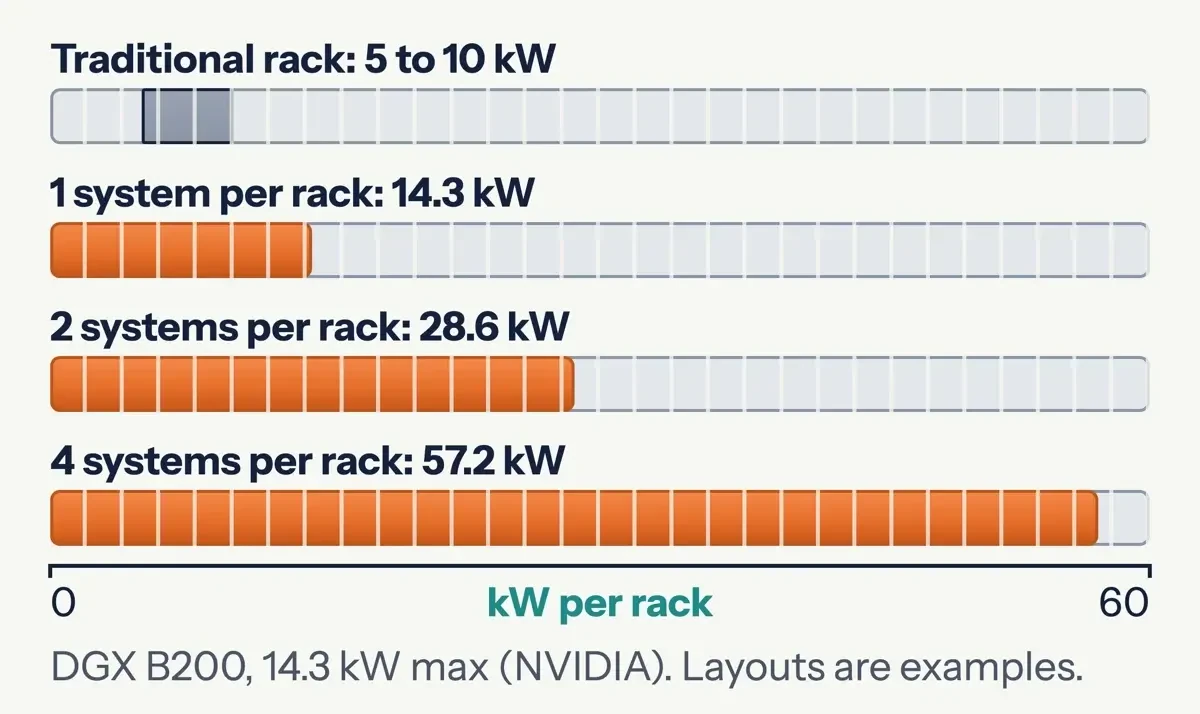 Diagram by DigitalTreed: kW per rack from NVIDIA and CyrusOne pages read November 7, 2026; layouts are examples.
Why grid power has become the scarce part
Those kilowatts come from a grid that data centers already lean on hard, and DOE puts their 2023 use at 176 TWh, up from 58 TWh in 2014. On December 20, 2024, the U.S. Department of Energy said data centers used "about 4.4% of total U.S. electricity in 2023." The figure comes from a Lawrence Berkeley National Laboratory report, the update to the lab's 2016 study that the Energy Act of 2020 asked DOE to publish.
It doesn't stop there. DOE's summary projects 325 to 580 TWh by 2028, about 6.7% to 12% of U.S. electricity. Berkeley Lab's catalog page dates the report December 19, 2024. Providers say much the same; Colovore's home page warns that "AI demand is outpacing metro-edge supply."
So get committed kW per rack in writing. It's the unit all three providers below use for their limits.
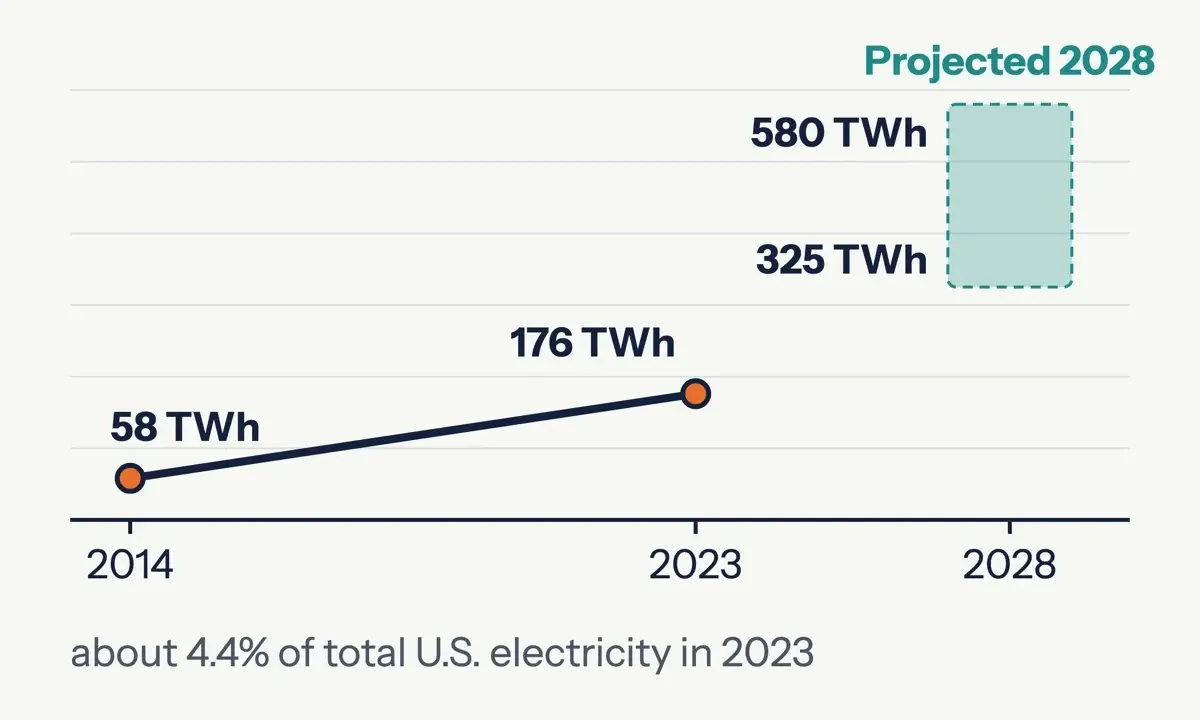 Source: U.S. Department of Energy release on the Berkeley Lab 2024 report, December 20, 2024. Chart by DigitalTreed.
Cooling: when air stops being enough
That power all leaves the rack as heat, and NVIDIA's user guide puts the DGX B200 at 48,794 BTU/hr of heat and 1,550 CFM of airflow. It checks out. Multiply 14,300 W by 3.412 BTU/hr per watt and you get 48,792.
The air limits come from ASHRAE, the heating and cooling engineers' society, and DOE reprints them in its FEMP Best Practices Guide for Energy-Efficient Data Center Design. The recommended range is 64.4°F to 80.6°F at the server inlet. Allowable stretches to 59°F to 89.6°F for Class A1 and 50°F to 95°F for A2. A Berkeley Lab webinar gives the same recommended and A1 numbers. ENERGY STAR's raise-the-temperature page says ASHRAE widened the recommended range in 2008 from 68°F to 77°F. Behind an 80.6°F cold aisle, it adds, the hot aisle could reach 105°F to 110°F.
Ask what that aisle measures at full load; staff work in it.
Check one detail before you sign. The DGX B200 user guide lists 10°C to 35°C, or 50°F to 95°F, which lines up with Class A2. The product page pairs the same 10-35°C with 50-90°F. Since 35°C is 95°F, we'd plan against the user guide and ask which class the hall runs to.
Past some density, air can't keep up. The FEMP guide sorts liquid cooling into three classes. Rear-door heat exchangers put a water coil on the back of the rack. Cold plates swap chip heat sinks for plates with liquid channels, and immersion sinks the servers in a nonconductive fluid. Most setups also use a cooling distribution unit (CDU), which sits between the building's water loop and the IT gear and sets temperature, pressure and fluid chemistry.
DOE's guide adds that high-performance computing racks hit 60 kW in 2013 and now pass 125 kW. Per the FEMP guide, ASHRAE's water classes now carry the top supply temperature in Celsius: W17, W27, W32, W40, W45 and W+. A W32 loop, for example, supplies water up to 32°C, or 89.6°F, while W45 goes up to 113°F. Warmer chilled water, the FEMP guide says, adds hours when a water-side economizer can run. The class still has to match what the server maker allows. Provider pages use the same terms, and DataBank's home page says it adds CDUs to the chilled water loop for rear-door or direct chip cabinets.
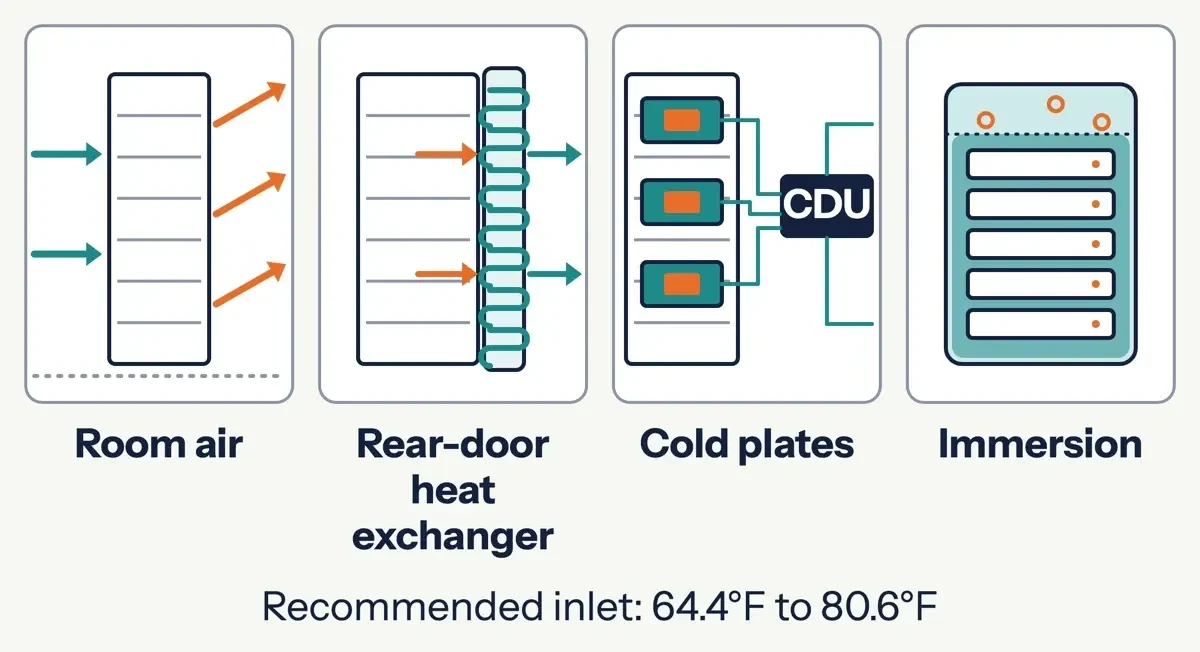 Diagram by DigitalTreed: cooling classes as described in the DOE FEMP Best Practices Guide (2024).
What the power costs over a year
That heat shows up on your bill through PUE, power usage effectiveness. The FEMP guide defines it as a facility's total annual energy divided by the annual energy its IT equipment draws. It puts the average data center at 1.6. Example yearly energy cost = IT kW × average load × 8,760 hours × PUE × price per kWh. Our 8-system example uses 114.4 kW of maximum draw, an example 70% average load, and the EIA's U.S. average commercial rate for August 2026, 14.47 cents per kWh. That's 701,501 kWh a year at the servers, before PUE:
| PUE (example) | Facility energy per year | Energy cost per year (example) |
|---|---|---|
| 1.3 | 911,951 kWh | $131,959 |
| 1.6 (FEMP average) | 1,122,401 kWh | $162,411 |
In this example, that's a gap of $30,452 a year on the same servers, from the building alone, at EIA's rate as of August 2026.
Location matters too: EIA's August 2026 commercial price was 11.14 cents in Virginia and 8.96 cents in Texas. Your colocation bill may price power per kW, per kWh or both, so ask how it works. Our guide to cutting costs without cutting corners covers the wider budget.
Two inputs carry the risk. The 70% load is our guess, and a cluster that trains around the clock sits much closer to its maximum. At an example 100% load, the servers would use 1,002,144 kWh a year before PUE, or $188,513 at PUE 1.3 and 14.47 cents (EIA, as of August 2026). The price is EIA's average for all commercial customers, not a quoted data center rate. Use your contract's rate instead.
What three providers publish
Three US operators publish rack figures on their own pages. Each one below is quoted as it read on November 7, 2026. We haven't used any of them, so read what follows as a sample of what operators publish about themselves, not as a ranking or a recommendation.
Digital Realty's high-density colocation page lists Air-Assisted Liquid Cooling (AALC) and Direct Liquid Cooling (DLC). It reads "Starting at just 30 kW per cabinet" and scales to 150 kW per cabinet.
Colovore's home page advertises "5-600+ kW per rack" and "100% uptime." Its Dallas page lists a PUE of 1.3 at both sites there. A home-page uptime figure isn't an SLA, though. Ask what period it covers and what counted as downtime.
The same Dallas page lists 44.8 MW at its Mesquite site and 32 MW at Fort Worth. As an example of scale, 44.8 MW ÷ 14.3 kW is about 3,130 DGX B200 systems at full draw. The page doesn't say whether that's facility power or IT load. If it's facility power, the listed PUE of 1.3 leaves about 34.5 MW for IT, or about 2,410 systems.
CyrusOne's Intelliscale post says it supports "cabinets from 12-kilowatt to 300-kilowatt" configurations.
All three are platform maximums. What one hall can deliver this quarter, on the circuits and cooling loop you'd actually be assigned, is the number that belongs in your contract.
What we tested
On November 7, 2026 we ran a short planning script for Brindlecove Vision, a made-up startup placing 8 DGX B200 servers. It checks each spec against the pages we saved that day before doing any math.
Heat came out 2 BTU/hr under NVIDIA's figure. Of four example circuits, only 415 V 60 A covered two systems per rack, and none covered 57.2 kW alone. With one system per rack, three of the four were enough: 208 V 60 A, 415 V 32 A and 415 V 60 A. The script also confirms both temperature lines as NVIDIA prints them, 50°F to 95°F and 50-90°F. It uses maximum draw, and no provider quoted us.
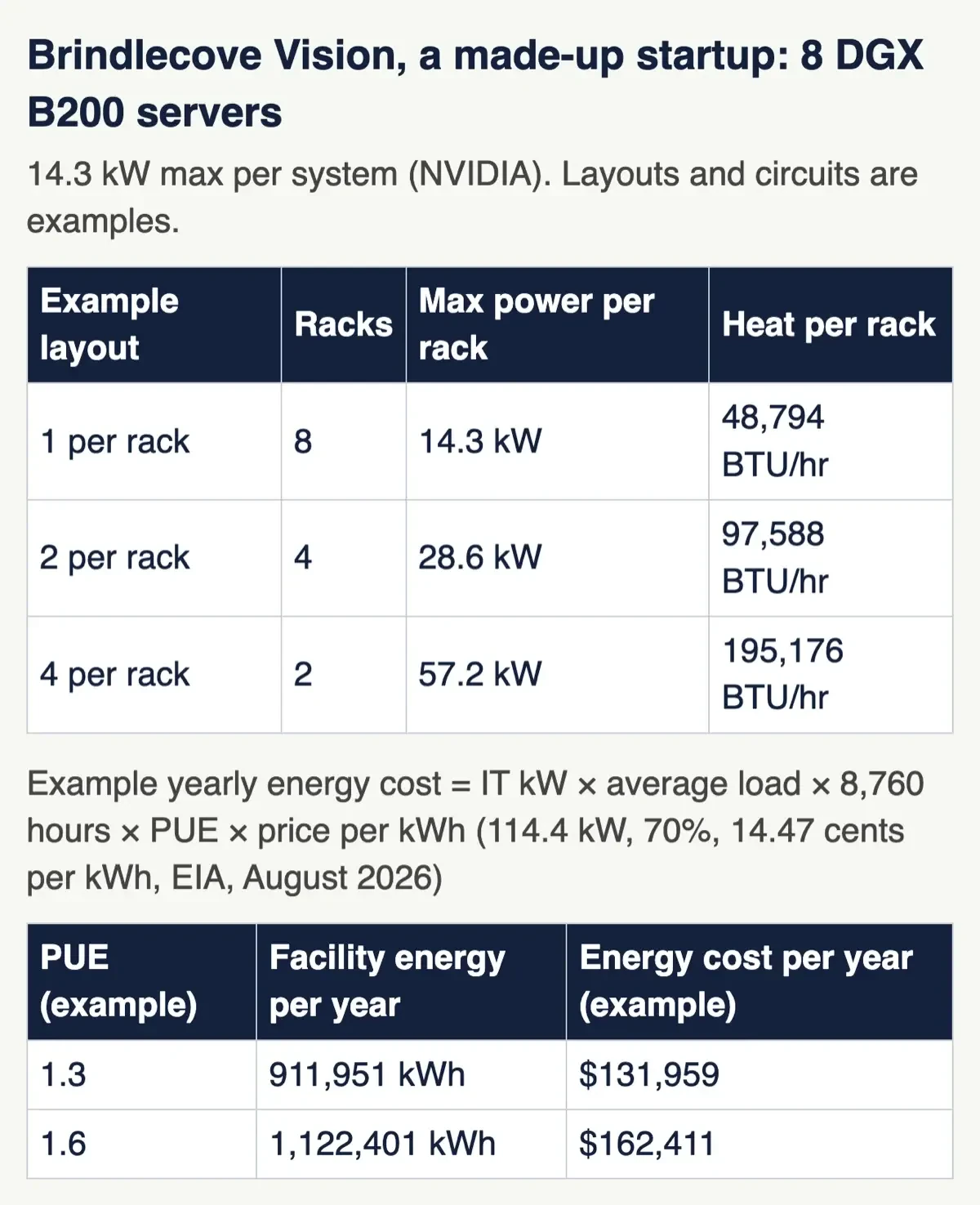 Screenshot: our local test page at 127.0.0.1, November 7, 2026.
Questions to put to a colocation provider
This example list is ours; send all 12 to every provider before a tour:
- What kW per rack can you deliver in this hall today, in writing?
- Which circuits feed the rack: voltage, amps, phase and count?
- How do the A and B feeds split across a server with six power supplies?
- Is power billed per committed kW, per metered kWh, or both?
- Which ASHRAE inlet range is the hall run to, and what is the setpoint?
- Do you support rear-door heat exchangers, cold plates or immersion here?
- Which W class does the liquid loop supply, and who owns the CDU?
- What floor load per rack is allowed, in pounds?
- What does the SLA count as downtime, and what credit does it pay?
- What was the annual PUE for this site last year, and how was it measured?
- Can we reserve more kW for later, and at what price and date?
- What notice and fees apply if we leave when the term ends?
The A and B feed question matters more than it looks. NVIDIA's B200 guide says its six power supplies run as 5+1. If two lose power, the system keeps going "at a reduced performance level." It only boots with at least three working. So a feed failure that drops three of the six cords isn't a no-impact event for that server, whatever the redundancy line in the brochure says.
Contract terms decide what happens when something breaks or you outgrow the cage, so get the kW commitment, expansion option, SLA credit and exit terms into one document. Our AI services partner checklist covers vetting the firm across the table. Run your own uptime monitoring, and keep a cloud backup outside the cage. Not ready for a cage? Renting GPUs still works. Our cloud computing guide explains the models, and the cloud architecture explainer shows how the layers fit. For training data, see our cloud storage comparison.
Frequently asked
How much power does one H100 GPU draw?
NVIDIA's H100 page lists up to 700 W for the SXM version and 350 to 400 W for PCIe.
Does every GPU server need liquid cooling?
No. NVIDIA's DGX B200 page lists the 14.3 kW system as air-cooled in its performance notes.
How much can a warmer data hall save?
ENERGY STAR says each degree warmer at the inlet could save up to 4% on cooling costs.
What is the lowest PUE a data center reaches?
The FEMP guide says some recent super-efficient data centers get below 1.1.
How we made this guide: We began at the server's spec sheet, then read DOE, ENERGY STAR, Berkeley Lab, EIA and provider pages. Berkeley Lab's report blocked our checker, so its numbers come from DOE's summary. Facts checked by the DigitalTreed team on November 7, 2026.
First published October 2025 as a general piece with no sources. Rewritten November 7, 2026: rack power from spec sheets, U.S. energy data, cooling classes, cost math, provider examples, a question list and a test. The old claims had no source and were cut.
Sources
- NVIDIA: DGX B200 product page (read November 7, 2026)
- NVIDIA: DGX B200 User Guide, Introduction
- NVIDIA: DGX H100/H200 User Guide, Introduction
- NVIDIA: H100 Tensor Core GPU
- NVIDIA: GB200 NVL72
- U.S. Department of Energy: DOE Releases New Report Evaluating Increase in Electricity Demand from Data Centers (December 20, 2024)
- Berkeley Lab: 2024 United States Data Center Energy Usage Report (catalog page)
- DOE FEMP: Best Practices Guide for Energy-Efficient Data Center Design (2024)
- Berkeley Lab: Data center environmental conditions webinar (2017)
- ENERGY STAR: Raise the temperature (data centers)
- ENERGY STAR: How to balance ambient data center setpoints with IT equipment energy use
- EIA: Electric Power Monthly, Table 5.6.A (August 2026 data, released October 23, 2026)
- DataBank: home page, data hall design (read November 7, 2026)
- Digital Realty: High-Density Colocation (read November 7, 2026)
- Colovore: home page (read November 7, 2026)
- Colovore: Dallas market page (read November 7, 2026)
- CyrusOne: Intelliscale blog post (July 16, 2025)


Comments
No comments yet. Start the conversation below.