

Quick answer
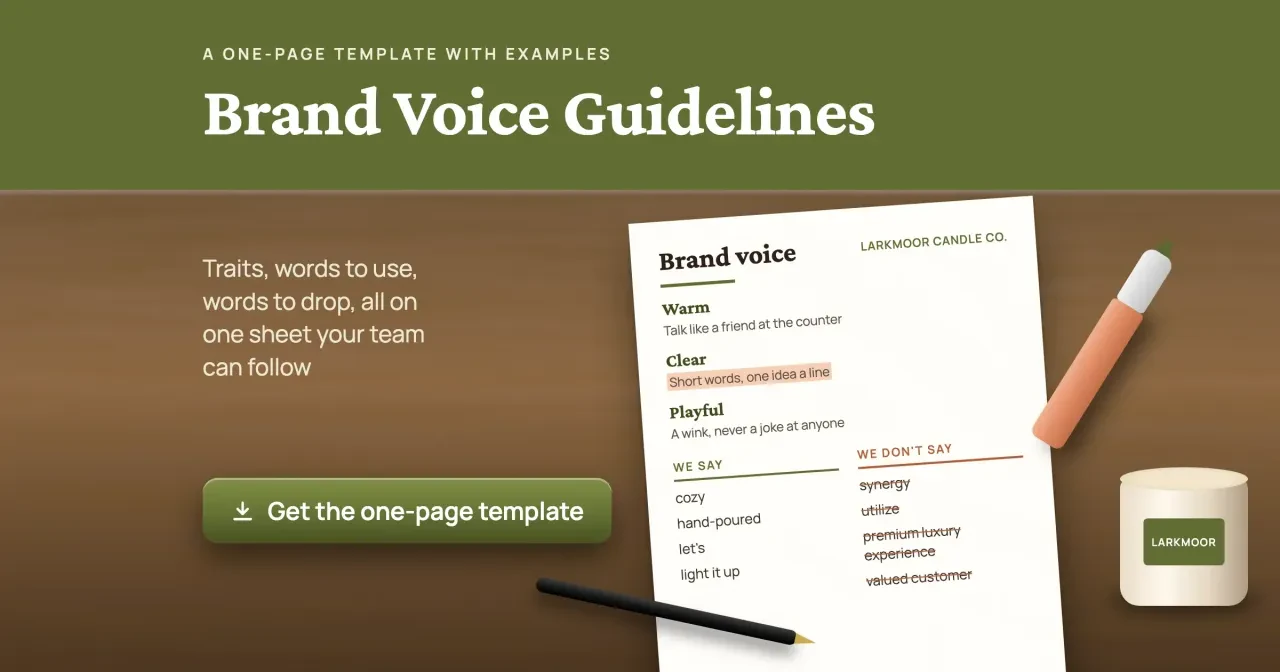
As of October 2026, brand voice guidelines for a small shop fit on one page with 7 parts, built around 3 traits and two word lists. If other people or an AI tool write your posts, add 3 before-and-after examples. Copy our blank template below, then test it on six of your own posts.
Maybe your posts come from you, a part-time helper and a freelancer, and they read like three different shops. Brand voice guidelines are a single page that tells everyone how your business sounds: which traits, which words, and how the tone shifts when something goes wrong. We wrote one for a made-up candle shop and tested it.
We start with what brand voice guidelines need, then how to pick 3 traits, write the word lists and set the tone for each kind of post. Next comes whether AI can write in your brand voice, followed by before and after examples and what we tested. We end by handing the page to everyone who writes for you.
Key takeaways
- Three traits, each with a this-not-that line, fit on one page.
- Trust accounted for 52% of the variation in NN/g's recommend scores.
- Apology posts get no exclamation marks and no jokes, even from playful brands.
- Our checker flagged 28 slips in 6 made-up drafts and 0 after rewrites.
- No script catches a joke at a customer, so a person still reads.
What brand voice guidelines need: 7 parts on one page
The page has one job: anyone who writes for you can read it in two minutes and sound like you.
Ours has 7 parts. It names who you talk to, then gives 3 traits with a short line each, a We say list and a We don't say list. Below those sit a few lines you always swap, a short set of hard rules, and a tone line for each kind of post. Here's how the parts look when they're filled in for Larkmoor Candle Co., a made-up candle shop we use as the example all the way through.
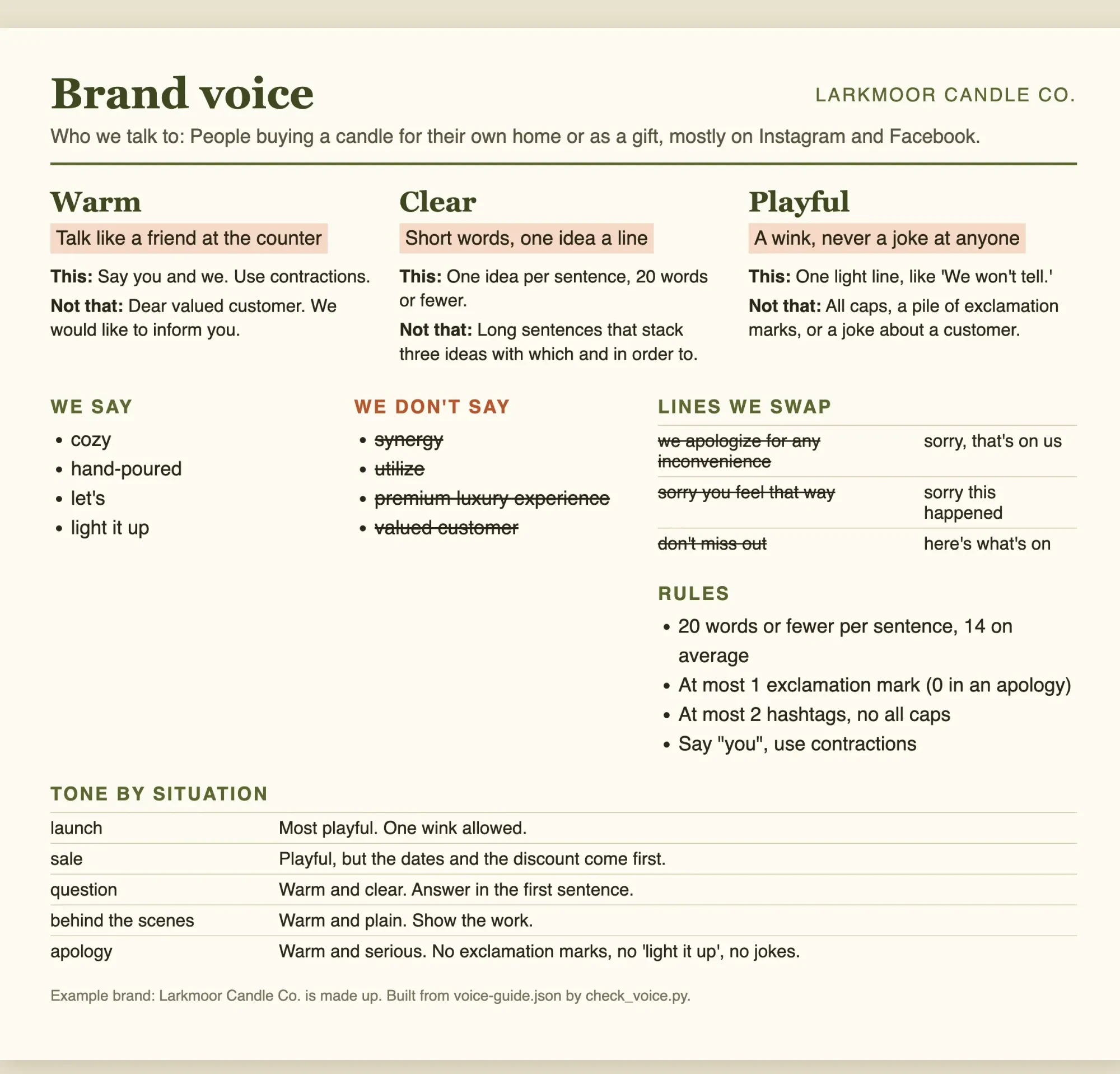 Screenshot: our voice-guide.html for Larkmoor Candle Co. (made up), built by test/check_voice.py and served on 127.0.0.1, October 28, 2026.
Start with the "who we talk to" line, because every other choice depends on it. Federal writers work from the same idea. Digital.gov says the Plain Writing Act of 2010 "established the requirement that content for the public is written for its specific audience". That law covers agencies, not your shop. The habit still carries over. Larkmoor's line is plain: people buying a candle for their own home or as a gift, mostly on Instagram and Facebook. Write yours in the words your customers use, not the words in your pitch deck.
Here's the same page blank, as plain text for a doc, a pinned note or your team's spreadsheet. The 7 parts run in the same order as the screenshot.
BRAND VOICE: [BRAND NAME]
Who we talk to: [one line]

Trait 1: [one word]
  Means: [one line]
  This: [what it sounds like]
  Not that: [what it does not sound like]
Trait 2: [one word]
  Means: [one line]
  This: [what it sounds like]
  Not that: [what it does not sound like]
Trait 3: [one word]
  Means: [one line]
  This: [what it sounds like]
  Not that: [what it does not sound like]

We say: [4 words or phrases]
We don't say: [4 words or phrases]
Lines we swap: [3 old lines, each with its new line]

Rules: [sentence length] [exclamation marks] [hashtags] [you and contractions]

Tone by situation:
  launch: [one line]
  sale: [one line]
  question: [one line]
  behind the scenes: [one line]
  apology: [one line]
Fill it top to bottom, and stop when it runs past one page. Logos, colors and fonts belong in the visual side of your brand, which our 9-step branding strategy plan covers in its one-page brand guidelines step. If you're changing names at the same time, finish that first with our rebranding checklist, since a voice page written for the old name will need a redo.
Pick 3 traits your customers would recognize
Once the reader line is set, the traits come next, and they're the hardest part to get right. Nielsen Norman Group, a US usability research firm, splits tone into 4 dimensions: formal or casual, serious or funny, respectful or irreverent, and matter-of-fact or enthusiastic. Place your brand on each scale first. Then turn those spots into 3 everyday words a customer might use about you, like Larkmoor's Warm, Clear and Playful.
Big companies publish theirs, and they're short. Microsoft's style guide lists 3 voice principles: "Warm and relaxed," "Crisp and clear" and "Ready to lend a hand". Under each one sit just a few short sentences that explain it. That's the model for your page: a word, then a line or two a new writer can act on. Just don't pick traits for how they sound in a meeting. In NN/g's tone study, which surveyed 100 American adults, trustworthiness explained 52% of the variability in whether people would recommend a brand, while friendliness added only 8%. So a trait like Playful has to sit next to one that earns trust, which is why Larkmoor pairs it with Clear.
That's why every trait needs its this-not-that line. Warm means "Say you and we. Use contractions," not "Dear valued customer. We would like to inform you." Playful means one light line, like "We won't tell," not all caps or a pile of exclamation marks. Without the "not that" half, two writers can read Warm in opposite ways. Test each line by handing it to someone who has never written for you and asking for one post. If their post lands near yours, the line works; if it doesn't, the line is too vague, so rewrite it before you add anything else.
Write the word lists and the lines you swap
With the traits written, the word lists turn them into choices a writer makes in the middle of a sentence. Larkmoor's We say list has 4 entries: cozy, hand-poured, let's and light it up. Its We don't say list also has 4. Three are utilize, premium luxury experience and valued customer, and the fourth is a piece of meeting-room jargon you can see struck through in the screenshot.
Public word lists help you start. Mailchimp's content style guide has a "Words to avoid" list. It includes "ninja, rockstar, wizard, unicorn" and "crushing it, killing it". Those are someone else's habits, though. Go back through your own last 20 posts, mark the words that made you wince, and keep the 4 that show up most.
Lines you swap work like the word lists, but for whole phrases that sound stiff.
Larkmoor's page has 3. "We apologize for any inconvenience" becomes "sorry, that's on us". "Sorry you feel that way" becomes "sorry this happened", and "don't miss out" becomes "here's what's on". All 3 turned up in our before drafts, in the delay, sale and complaint posts.
All 4 of Larkmoor's We say words turned up at least once in our 6 rewritten posts.
The hard rules come from plain-language guides you can borrow. Microsoft's top 10 tips say to "Use contractions like it's, you'll, you're, we're, and let's". Digital.gov's plain-language writing guide asks for active voice, as in "You must do it" rather than "It must be done". Our page turns that into numbers a script can count. No sentence runs past 20 words, and a post averages 14 or fewer. Each post also gets at most 1 exclamation mark and 2 hashtags, plus "you" and contractions. If you hire help, the page goes out on day one, next to the writing test from our freelance copywriter hiring guide.
Set the tone for each kind of post
Next comes tone, the part people mix up with voice. Mailchimp's style guide puts it simply: "You have the same voice all the time, but your tone changes" with the reader's mood. How far you lean on each trait depends on whether the post is a launch, a sale or an apology. A playful tone can cost trust when the moment is serious. In NN/g's study, a playful insurance sample was rated friendlier by 0.3 points on a 5-point scale, but its serious rival was rated 0.3 points more trustworthy. That's why Larkmoor's tone line for apologies reads: warm and serious, no exclamation marks, no 'light it up', no jokes.
Of Larkmoor's 5 tone lines, the apology line is the only one our checker enforces in code.
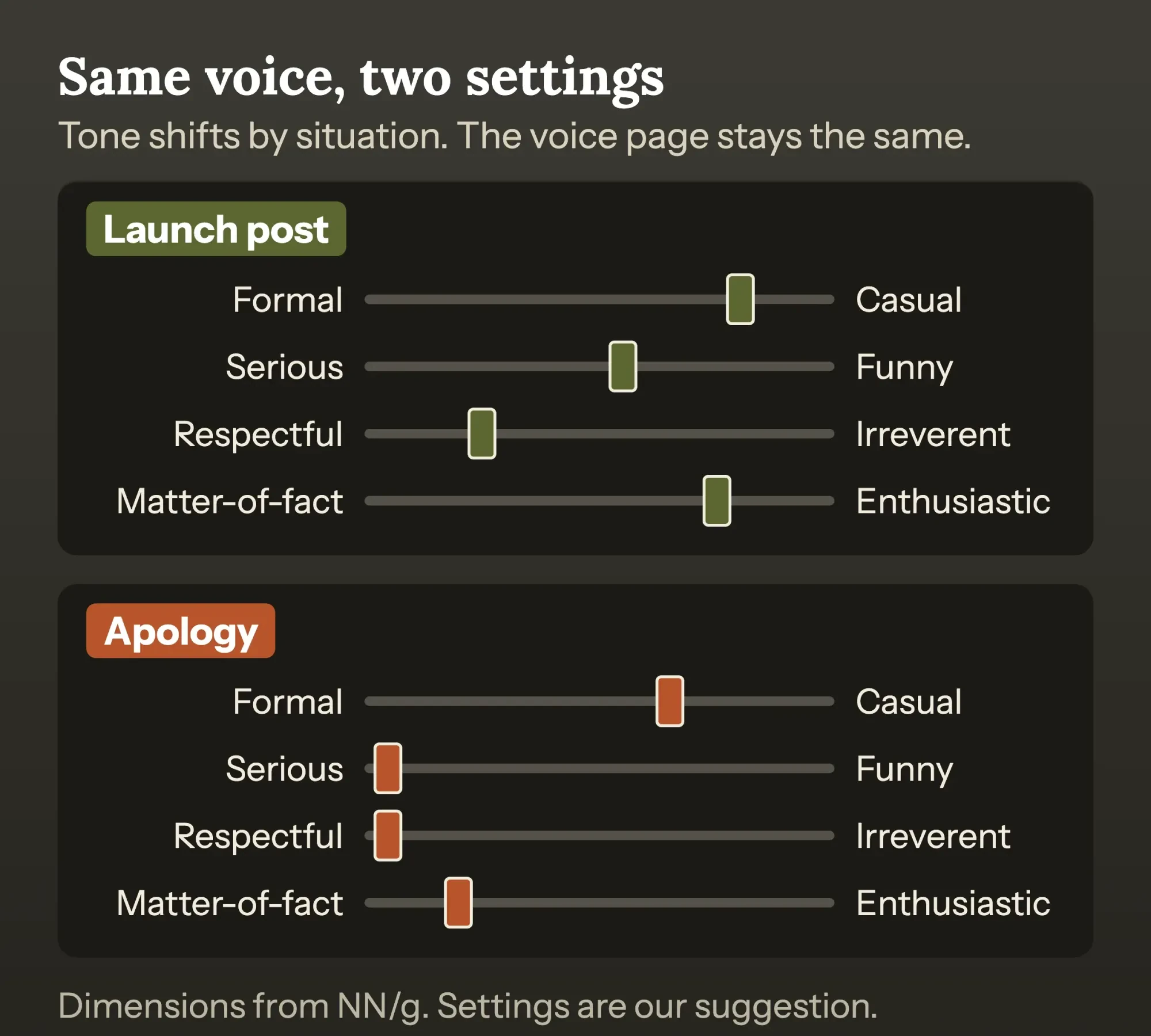 Diagram by DigitalTreed. Tone dimensions from Nielsen Norman Group; the settings are our suggestion for Larkmoor Candle Co. (made up), October 2026.
Write one tone line for each kind of post you actually make; Larkmoor's page has 5, from launch to apology. Keep each to a single line, since writers read it mid-draft.
Start with the apology line. That's where the NN/g trust gap above bites.
Can AI write in your brand voice?
The same page can brief an AI tool, though the tool follows it only as well as you write it into the prompt. Anthropic and OpenAI both say examples do the steering. Anthropic's prompting guide says examples steer "format, tone, and structure". It adds a number: "Include 3–5 examples for best results". OpenAI's guide on few-shot prompts says to "show a diverse range of possible inputs with the desired outputs". So our checker also writes the page out as a prompt, with 3 reject-and-write examples wrapped in example tags, as Anthropic's guide suggests. Here's the blank version, with the slots in capitals and 3 example slots, the low end of Anthropic's range:
You write social media posts for [BRAND], [WHAT YOU SELL]. Who we talk to: [ONE LINE ABOUT YOUR CUSTOMER]

Our voice has 3 traits:
- [TRAIT 1]: [ONE-LINE MEANING]. Do: [THIS]. Avoid: [NOT THAT].
- [TRAIT 2]: [ONE-LINE MEANING]. Do: [THIS]. Avoid: [NOT THAT].
- [TRAIT 3]: [ONE-LINE MEANING]. Do: [THIS]. Avoid: [NOT THAT].

Words we use when they fit: [YOUR WE SAY LIST].
Words we never use: [YOUR WE DON'T SAY LIST].
Lines we swap: "[OLD LINE]" becomes "[NEW LINE]".

Rules:
- Keep every sentence to 20 words or fewer, and the average to 14 or fewer.
- Use at most 1 exclamation mark and 2 hashtags. No words in all caps.
- Say "you" to the reader and use contractions.
- Match the tone to the situation: [ONE LINE PER SITUATION, FOR EXAMPLE "apology: warm and serious, no jokes"]

Here are 3 examples. Each shows a draft we would reject and the post we want.

<example>
Situation: [SITUATION]
Reject: [A REAL DRAFT THAT SOUNDED WRONG]
Write: [THE SAME NEWS IN YOUR VOICE]
</example>
[2 MORE EXAMPLES IN THE SAME FORMAT]

Now write a post for this situation: [SITUATION]. Facts to include: [FACTS].
Use only the facts given. Do not invent reviews, quotes, prices or dates.
We didn't run this prompt through an AI tool for this post, so we can't tell you how well any one model follows it. What we'd do is paste in your filled page, ask for 5 posts, and hold each one against the same rules before a person reads it. Nothing in a warm-voice prompt stops a model from making up a warm customer quote, so the prompt's last line forbids invented reviews, quotes, prices and dates. Keep that line even if you cut everything else.
Before and after: 6 posts in one voice
Whether a person or a tool writes the draft, rules are easier to follow once you see them fixed in a real post. We wrote 6 draft posts for Larkmoor in common off-voice habits, then rewrote each one with the page open. All 12 posts are examples we made up for this test, not real customer messages. The table shows each pair and what our checker flagged in the first draft.
| Example post | Flags in the before draft | What went wrong | Flags after |
| Fall candle launch | 6 | "utilizing", "premium luxury experience", a 26-word sentence, no contraction, 3 "!", 4 hashtags | 0 |
| Shipping delay | 4 | "valued customer", a swap line, no contraction, 1 "!" in an apology | 0 |
| Holiday sale | 6 | The fourth We don't say word, "don't miss out", a 22-word sentence, no "you", 4 "!", all caps | 0 |
| Burn-time question | 4 | "utilized", a 34-word sentence, a 19.5-word average, no contraction | 0 |
| Pour day | 5 | "premium luxury experience", one 31-word sentence (so a 31-word average), no "you", no contraction | 0 |
| Complaint reply | 3 | "sorry you feel that way", 2 "!" and "light it up" in an apology | 0 |
Added up, the before drafts carried 6 + 4 + 6 + 4 + 5 + 3 = 28 flags, and the after drafts carried 0. Every rewrite passed. The sale post shows the pattern clearly. Its first draft opened with HUGE SALE and three exclamation marks, and the rewrite reads: "Our holiday sale starts Friday: 20% off every candle through Monday. Stock up on gifts, or keep one for yourself. We won't tell. Let's light it up."
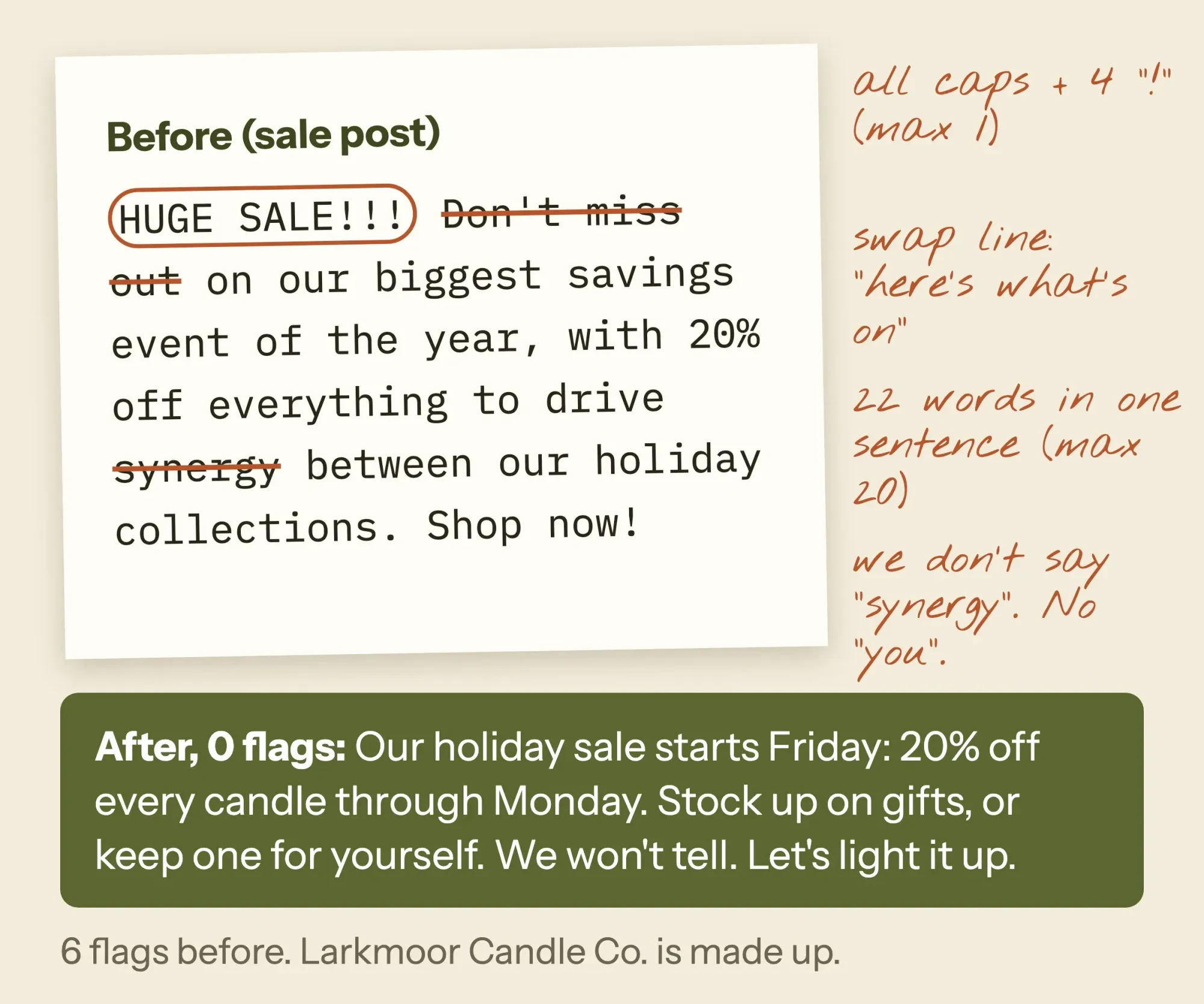 Drawn by us. The sale post from our example set (Larkmoor Candle Co. is made up), flags from test/check-output.txt, October 28, 2026.
Length changed far less than the flag count. By a plain word count, the 6 drafts went from 194 words to 165, which is 29 fewer. The launch, question and pour day posts lost 13, 12 and 6 words. The other three barely moved: the delay post went from 29 words to 30, the sale post from 26 to 27, and the complaint reply stayed at 25. What changed most was where the words went. The stiff drafts spent them on throat-clearing like "Thank you for reaching out" and "each and every candle". The rewrites put the ship day, the burn time and the next step up front.
By rule, the 28 flags split into 6 for We don't say words, 6 for sentence length, 6 for missing warmth, 5 for playfulness and 5 for the rest.
Put 3 of these pairs on the back of your page; for Larkmoor, that's the delay, the sale and the question. Our Facebook post ideas sorted by goal give you 30 more to practice on.
What we tested
On October 28, 2026, we turned Larkmoor's page into a Python checker and ran it over the 6 example pairs. It counts only what a script can see, such as banned words, sentence length and exclamation marks. The before drafts got 28 flags in 6 of 6 posts, and the after drafts got 0. We wrote both sets ourselves, so that 0 only shows our rewrites follow our own page, not that the page will fix your posts.
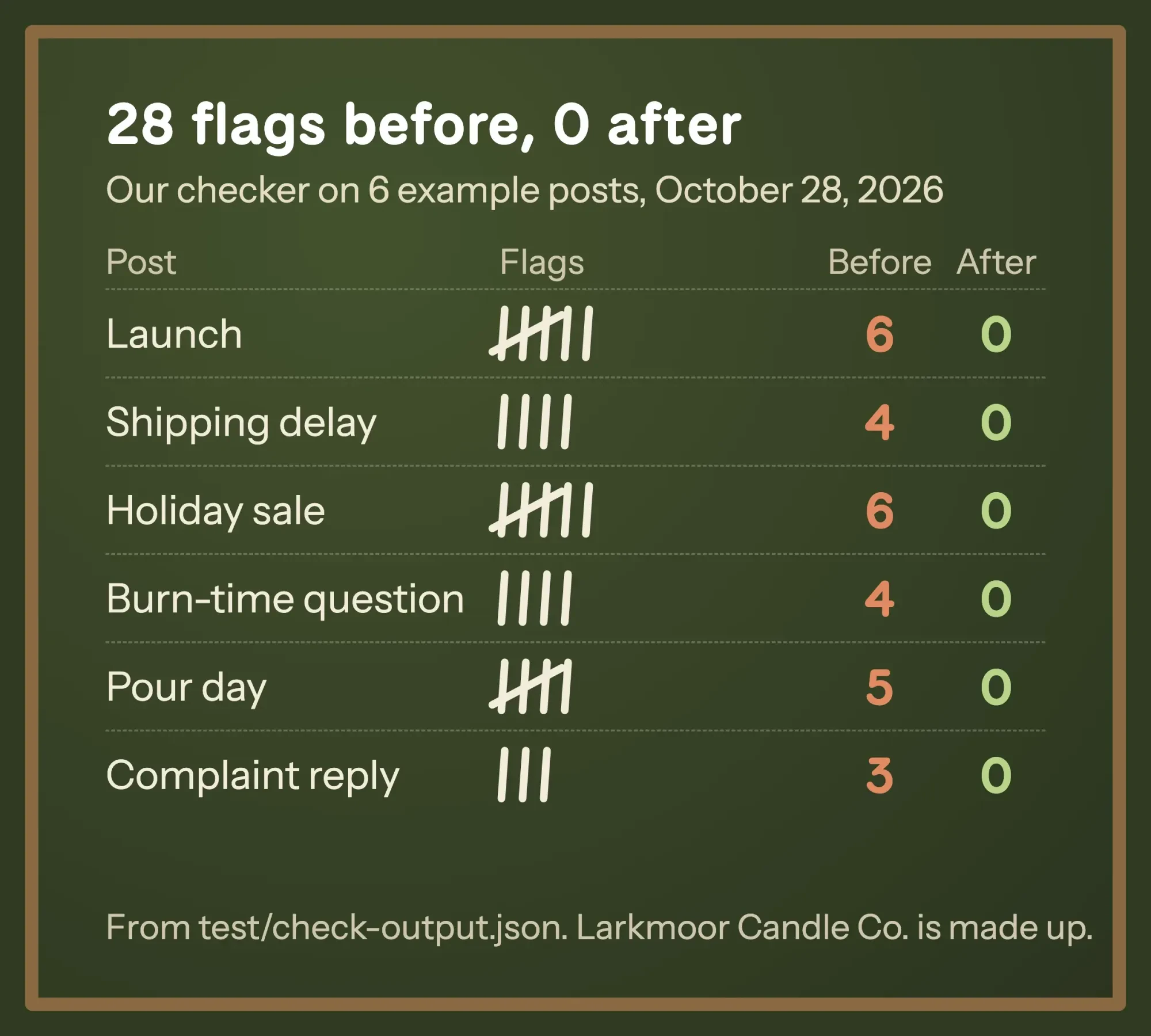 Diagram by DigitalTreed. Results from our checker run, test/check-output.json, October 28, 2026. Larkmoor Candle Co. is made up.
Two other details matter. Our first launch rewrite failed for having no "you" or "your", so we fixed it and kept the failed draft. We also wrote a probe post on purpose, with a joke aimed at the customer. It passed with 0 flags, because no word count can tell kind from rude, so a person still reads every post before it goes out.
Hand the page to everyone who writes
Once the page and the prompt exist, link the page in the header of your social media content calendar. Then every row gets written with it one click away, and the 3 example pairs can sit right beside it.
A shared folder works too, as long as the link sits somewhere your writers already look every day, like the team chat's pinned messages. When a new freelancer or tool starts, the page is their first task, not an attachment to an email they'll skim. If a writer asks something the page doesn't answer, add the answer that day.
Review the page each quarter, using real posts. Pull the comments and replies that went well into your monthly social media report, and look for words that keep showing up in your best ones. Add one of those words to We say and retire one that's gone stale. That keeps the list sounding like the shop you run today. The same page works for email too; our email marketing examples show how a short, plain voice reads in an inbox.
Our take: write 3 traits, 8 words and 3 swaps, then test them on six of your own posts, the way we did. Larkmoor's whole page fits on one screen, and the 3 pairs on its back show the rules at work in a post. Channels and goals live in our step-by-step plan for small-business social media. Rather not write the posts yourself? DigitalTreed's social media service for small businesses can write from a voice page like this one. That's paid work, so get a freelancer's price too and compare the two.
Frequently asked questions
Frequently asked
What's the difference between brand voice and tone?
Voice is who you are, and tone is how you adjust it. Microsoft's guide says its voice stays constant while it adapts tone from serious to empathetic to lighthearted to fit the customer's state of mind.
Can AI write customer reviews in our brand voice?
No. FTC rule 16 CFR 465.2 bars a business from writing or creating a consumer review that misrepresents that the reviewer exists or used the product. That's a summary, not legal advice, so ask an attorney about your own posts.
Does a casual voice make a brand look less trustworthy?
Not by itself. In NN/g's study, a casual bank sample was rated more trustworthy by 0.3 points than a serious one.
Should a brand voice be funny?
Only if it's natural. Mailchimp warns that forced humor can be worse than none at all, and Google's developer style guide lists "Wackiness, zaniness, and goofiness" among things to avoid.
How we made this guide: We read the 12 pages in Sources on October 28, 2026. Then we wrote a one-page voice guide for a made-up candle shop, 6 pairs of example posts and a Python checker, and ran it on a local computer. Facts checked by the DigitalTreed team on October 28, 2026.
First published April 2026. Rewritten October 28, 2026: now a one-page template with tested examples and an AI prompt.
Sources
- Nielsen Norman Group: The Four Dimensions of Tone of Voice
- Nielsen Norman Group: The Impact of Tone of Voice on Users' Brand Perception
- Mailchimp Content Style Guide: Voice and Tone
- Mailchimp Content Style Guide: Word List
- Microsoft Writing Style Guide: Microsoft's brand voice
- Microsoft Writing Style Guide: Top 10 tips for Microsoft style and voice
- Google developer documentation style guide: Voice and tone
- Digital.gov: Plain language writing
- Digital.gov: Plain language guide series
- Anthropic: Prompting best practices
- OpenAI: Prompt engineering
- eCFR: 16 CFR 465.2, fake or false consumer reviews and testimonials


Comments
No comments yet. Start the conversation below.