

Quick answer
To personalize outreach, put one true, checked detail about the recipient in each email and keep the legal parts. As of November 2026, that means CAN-SPAM's postal address and opt-out, plus a spam complaint rate under 0.3% at Gmail and Yahoo. Personal templates break easily: in our example test, 23 of 30 merged emails had a problem before we fixed the templates. Run a merge check first.
Personalized outreach is a first-contact email written for one recipient, using a true detail about them, their company or their market. Say you own a small US web studio. You send 20 to 50 of these a week from a spreadsheet and a Gmail inbox, and you'd like replies, not spam complaints or an FTC letter.
First comes what outreach in marketing covers and the three levels of personal: segment, company and person. Then the prospect data you may use, Gmail and Yahoo sender rules, writing the template and checking merge fields. AI-driven personalization and what we checked on November 25, 2026 close it out. Our view: write one checked detail per email, and test the merge before anything goes out.
Key takeaways
- Fixing two templates cut flagged example emails from 23 to 12.
- The person-level template stayed weakest after fixes: 5 of 10 example emails clean.
- CAN-SPAM has no B2B exception; each bad email risks up to $53,088.
- Gmail and Yahoo both want spam complaints under 0.3%.
- Never send an AI-written fact about a prospect you haven't checked.
What is outreach in marketing?
Outreach in marketing is contacting a specific person or business first, before they've asked to hear from you. It covers cold sales emails, partnership asks, pitches to editors and community outreach to local groups. Pitching editors is its own craft, covered in our quality blogger outreach post. This guide stays with the sales and partnership emails a small business sends.
An outreach plan answers four questions before anyone writes a line: who you'll contact, why them, what you'll offer and how you'll follow up. An outreach campaign is one run of that plan. A made-up example: 40 dental offices in one metro area, a first email on day 1 and follow-ups on days 4 and 9. Put the plan on one page with those dates in it, so a prospect who already replied doesn't get the day 9 email.
Size doesn't change the law. Per the FTC compliance guide for business, CAN-SPAM "doesn't apply just to bulk email," so a campaign of 40 follows the same rules as one of 40,000.
Three levels of personal: segment, company, person
Personal comes in three depths, and each one costs more research per email than the last. Bernard Marr's 2022 Forbes contributor article argues for using data to understand customers' preferences, behaviors and needs, so you can predict what they'll want. In outreach, that data is mostly public facts about the recipient's business.
A segment-level email goes to a group that shares a trait, like an industry or a city, and changes one or two fields. Our template A opens with "A faster website for {city} small businesses." A company-level email names something true about the business, such as its website, a service or a location, the way template B asks about the {company} website. A person-level email mentions something the recipient did or published recently, which we call the trigger. Template C's subject is just "Saw" plus the trigger, so the whole email rests on one free-text cell that somebody typed by hand. The table shows how each one held up on the same 10 made-up rows.
| Level | What you look up | Subject line in our test template | Merge fields used | Clean example rows: first run / after fixes |
|---|---|---|---|---|
| Segment | Industry, city | A faster website for {city} small businesses | 2 | 7 of 10 / 7 of 10 |
| Company | Company name, website, city | A question about the {company} website | 3 | 0 of 10 / 6 of 10 |
| Person | A recent public trigger | Saw {trigger} | 3, one free text | 0 of 10 / 5 of 10 |
Row 3 shows the pattern. Its company cell was blank, which template A never uses, so A produced a clean email while B and C, which both name the company, failed that row.
The segment template stayed at 7 clean rows both times because it used only two fields. The other two started at zero, mostly from long lines, plus template C's missing footer, and reached 6 and 5 once we fixed the template text.
That's why we'd save person-level research for the few accounts you'd most like to win. Write those trigger lines yourself.
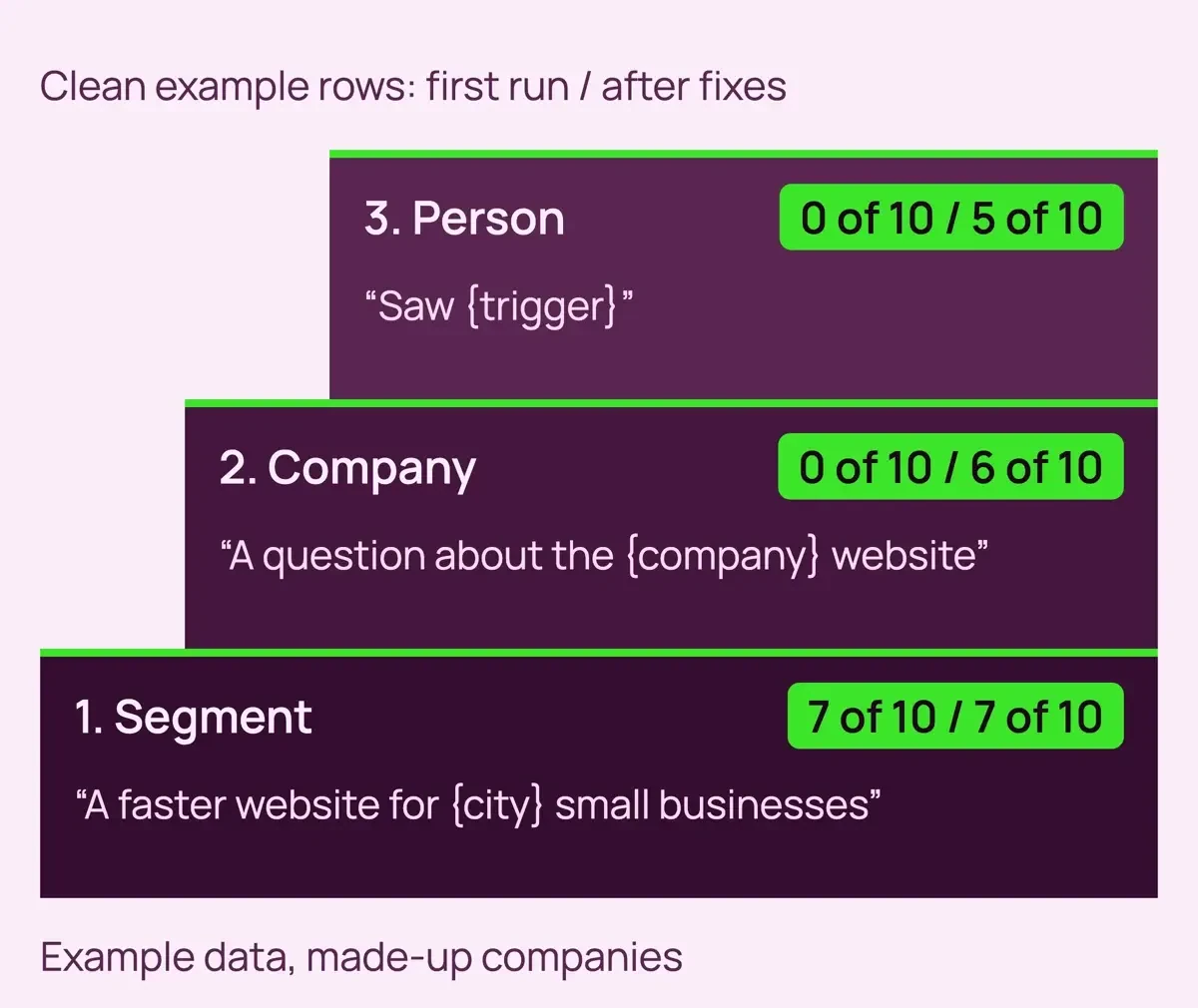 Drawn by us from our merge_check.py test, November 25, 2026 (example data, made-up companies).
Which prospect data you may use
Every field in a template, trigger lines included, came from somewhere, and US law cares where. CAN-SPAM covers commercial email, and the FTC guide states that "The law makes no exception for business-to-business email." As of November 2026, the same FTC page puts the penalty for each separate email in violation at up to $53,088. That's per email, not per campaign. The FTC's CAN-SPAM Rule page lists the regulation as 16 CFR Part 316.
Where you got an address matters more than most people expect. The FTC guide lists "harvesting email addresses or generating them through a dictionary attack" among the aggravated violations that can bring criminal penalties. Platforms add their own limits. The LinkedIn User Agreement bars software "to scrape or copy the Services, including profiles and other data from the Services." Safer sources are a prospect's own contact page, a business card, a referral, or a directory listing the business filled in so customers could reach it. Health, family or money details go further, into the privacy questions our data collection ethics and privacy guide covers.
Texts fall under a different law. Under 47 CFR 64.1200(e), the FCC's rules in paragraphs (c) and (d) also cover "telemarketing calls or text messages to wireless telephone numbers." Paragraph (c) bars telephone solicitations before 8 a.m. or after 9 p.m. local time, and to numbers on the national do-not-call registry. Phone rules are in our cold calling vs cold email breakdown.
Recipients can report you, too. The FTC's spam text advice tells people to forward unwanted texts to 7726 (SPAM).
Gmail and Yahoo sender rules for outreach emails
A perfectly legal email can still land in spam. Gmail's sender guidelines have applied to everyone who emails a Gmail account since February 1, 2024, so even a 20-a-week studio needs SPF or DKIM on its domain. Google's target is a spam rate below 0.10%, and its hard line is never reaching 0.30%. Our custom-domain email setup guide covers both records.
Yahoo's sender best practices set the same 0.3% ceiling and ask for SPF or DKIM at a minimum. Yahoo calculates its spam rate on mail delivered to the inbox, so messages filtered to spam don't count toward the total. For a small sender, one click can do it. At 300 delivered emails in a week (example), one person clicking Report spam puts the rate at 0.33% (example: 1 / 300 = 0.33%). On 1,000 delivered emails, three complaints already reach the line Google says never to hit (example: 3 / 1,000 = 0.3%), so a merge error that annoys a few people matters. Google's Postmaster Tools dashboards show your domain's spam rate next to its authentication status.
Past 5,000 messages to Gmail accounts in one day, Google also wants DMARC and one-click unsubscribe on marketing mail. Per its sender guidelines FAQ, "Bulk sender status doesn't have an expiration date," so one big send day counts for good.
Yahoo's bulk senders owe more as well: SPF and DKIM, plus DMARC at p=none or stricter. Daily send caps per mailbox are in our cold email software comparison.
The one-click header itself comes from RFC 8058, a January 2017 standard. Its header carries the value List-Unsubscribe=One-Click.
Opt-out deadlines run from 10 business days down to 2 days, depending on who sets them. CAN-SPAM gives you 10 business days to honor an opt-out. Yahoo says to "Honor unsubscribes within 2 days," and Google's FAQ lists unsubscribes not honored within 48 hours as a reason mitigation is unavailable. Honor every opt-out within 2 days and you meet all three.
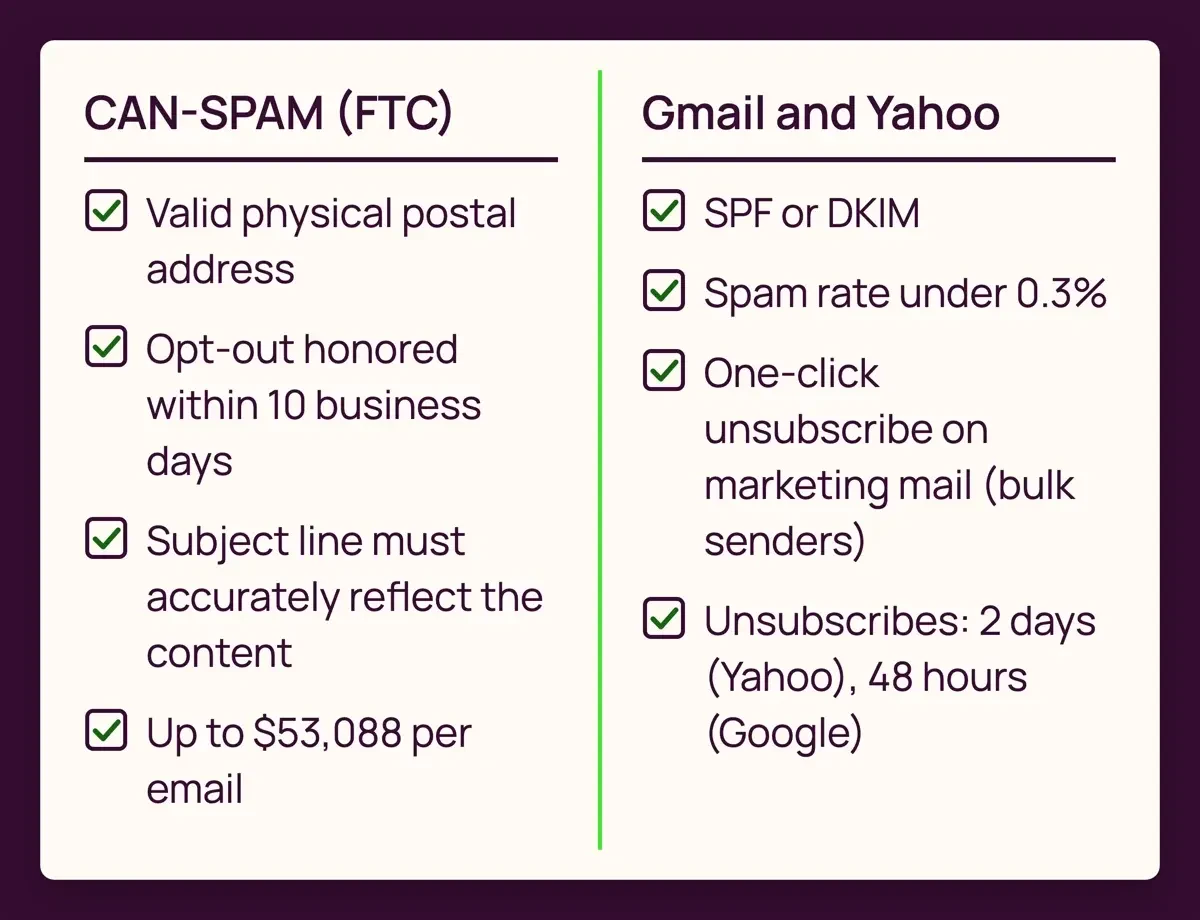 Drawn by us from the FTC CAN-SPAM guide and the Google and Yahoo sender pages, read November 25, 2026.
Writing the outreach template
Every template needs a true subject line and a working opt-out. CAN-SPAM's subject rule is plain: "The subject line must accurately reflect the content of the message." The footer needs "your valid physical postal address," which the FTC guide says can be a post office box registered with the U.S. Postal Service.
Template B after our fix is below, with its 81-character line split across three shorter lines. Put your business name and address in the footer, and rewrite the idea line for each company.
- Subject: A question about the {company} website
- Hi {first_name},
- I was looking at the {company} website and had one idea
- for your contact page. A short quote form near the top could
- help visitors in {city} reach you faster.
- Want me to send a quick sketch?
- Kestrine Web Studio (made up), 100 Example Ave, Springfield, ST 00000
- Reply "stop" and we will not email you again.
The 78-character limit comes from RFC 5322, the email format standard, which says each line "SHOULD be no more than 78 characters." It's a SHOULD, not a MUST. The hard limit in the same section is 998 characters. We still keep plain-text outreach under it, because it's easy to check and our merge test caught two templates that broke it.
Checking merge fields before you send
A merge turns one template into many emails, and every empty or wrong cell in the spreadsheet ships with it. Microsoft's Word mail merge guide says "Excel spreadsheets and Outlook contact lists are the most common data sources." A blank first-name cell turns the greeting into 'Hi ,' and a blank company cell leaves 'the website' with two spaces. Our checker ran over a made-up 10-row prospect list and the three templates, 30 merged emails in all. It looks for six problems: empty fields, another row's company name, lines that grow past 78 characters, a missing postal address, a missing opt-out and duplicate addresses.
| Template | Clean example emails, first run | Clean, fixed template | What still failed after the fix |
|---|---|---|---|
| A, segment | 7 of 10 | 7 of 10 | Rows 2 and 8 empty fields, row 10 duplicate |
| B, company | 0 of 10 | 6 of 10 | Rows 2, 3 and 8 empty fields, row 10 duplicate |
| C, person | 0 of 10 | 5 of 10 | Rows 2 and 3 empty, row 5 wrong company, row 6 long trigger, row 10 duplicate |
Template C had no postal address or opt-out, so all 10 of its emails failed on both, and templates B and C each had an 81-character line before any merging. Those are template bugs. One edit to each template cleared them for all 10 rows at once.
The 12 flagged emails left after the fix all came from list problems, which you fix row by row. Rows 2, 3 and 8 had blank cells, and a filter for empty cells in the spreadsheet would've caught all three before the merge. Row 5 was the one that would've embarrassed us. Its trigger cell, pasted from another prospect's notes, praised reviews for Hollinwick Bakery in an email to a plumber. Row 10 reused row 1's address, so one person would've gotten two pitches. Before a real send, run the list through one of the email verification tools we compared and the pre-send email campaign checklist.
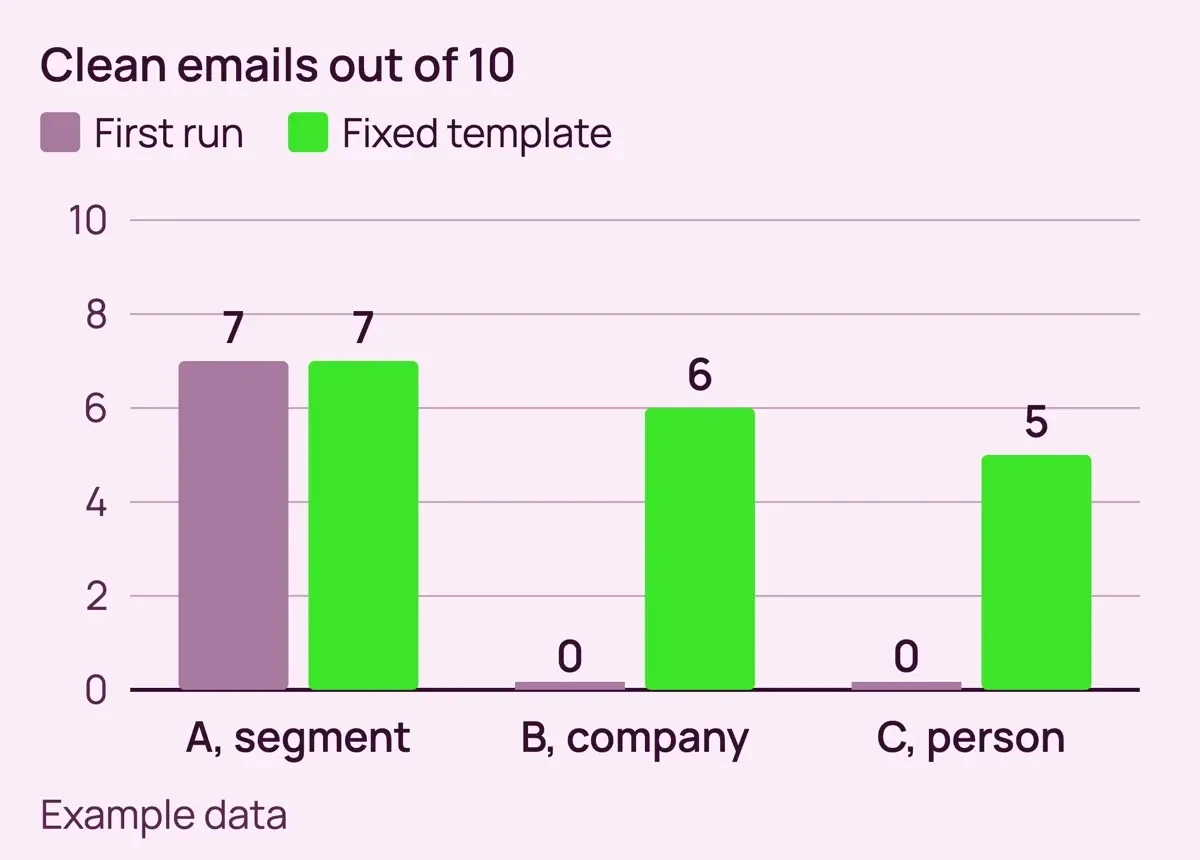 Drawn by us from our merge_check.py output, November 25, 2026 (example data, made-up companies).
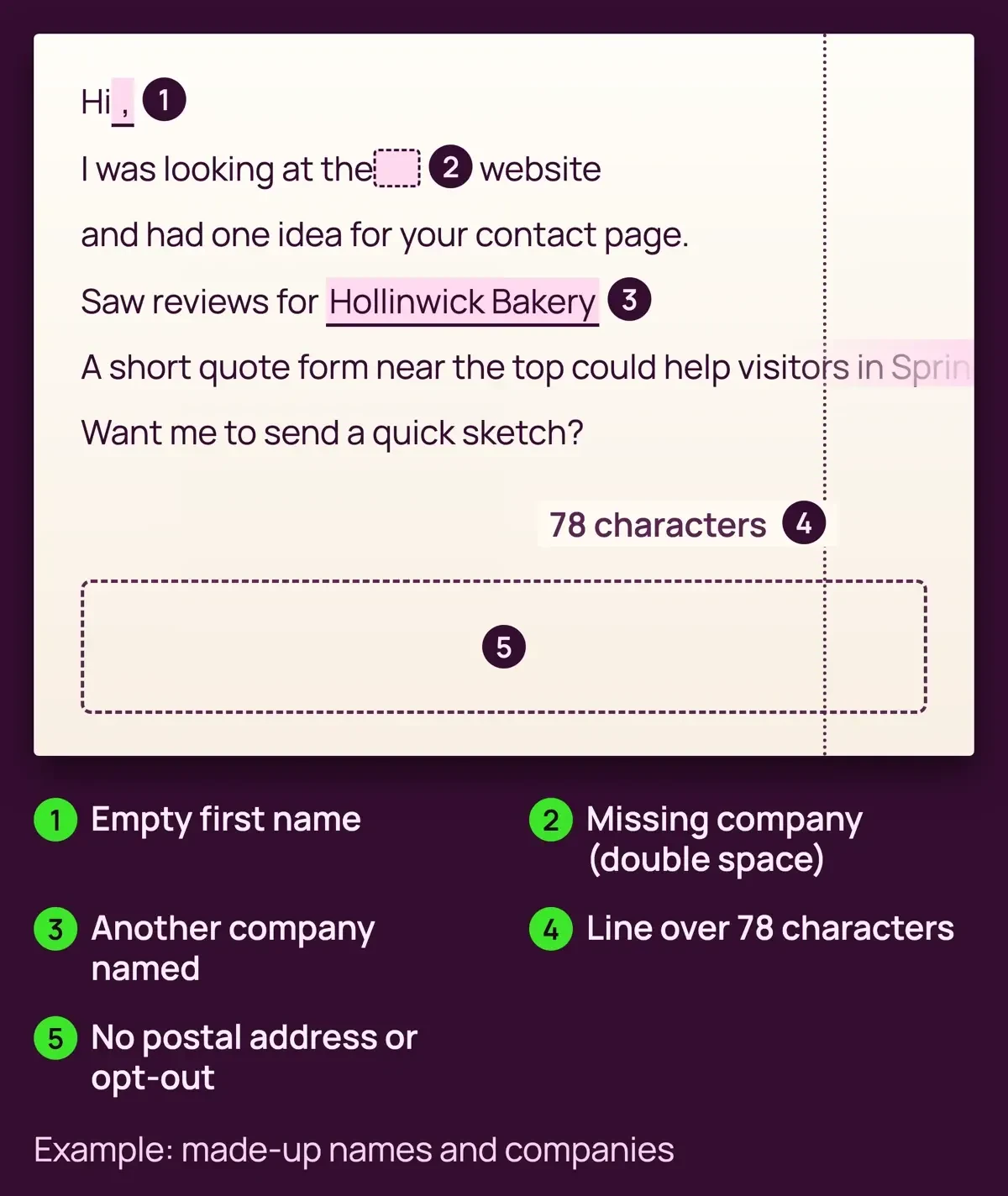 Drawn by us from rows in our example merge check, November 25, 2026 (made-up names and companies).
What we tested
On November 25, 2026, our standard-library Python script flagged 23 of 30 merged example emails on the first run. After we fixed two templates, it flagged 12. The list, templates and both output files are saved with the script.
What AI-driven personalization can and can't do
Hyper personalization is tailoring each message with many data points, usually assembled by software and often written by an AI model. Used well, an AI tool can draft five versions of your opening line, summarize a prospect's About page that you've pasted in, or tell you your tone sounds stiff. It can't verify what it writes. Give it only a company name, request a personal opener, and it has to invent the detail, and that invented detail goes out with your name and signature on it. Checking each opener against the prospect's own website is the step we wouldn't hand to software, since it's the step that catches an invented detail.
The FTC has already acted on that gap: its Operation AI Comply release of September 25, 2024 described Rytr, an AI writing service sold to paying subscribers. Its generated reviews held "specific, often material details that had no relation to the user's input." Then-Chair Lina M. Khan said there is "no AI exemption from the laws on the books."
The Rytr complaint passed 3-2. Commissioners Melissa Holyoak and Andrew Ferguson voted no, and the FTC's site lists Ferguson as Chairman as of November 2026.
Ad platforms draw lines around sensitive data too. Google's personalized advertising policy restricts targeting in categories such as health, religious beliefs, sexual orientation and negative financial status. We'd keep the same topics out of outreach emails entirely, even when a detail is public. Follow-ups don't need AI at all. Rule-based ones are in our list of CRM automation examples.
Checked on November 25, 2026: what held up and what didn't
A plain script saved the FTC, Google, Yahoo, IETF, LinkedIn and Microsoft pages as text on November 25, 2026. Every quote above matches those saved copies word for word, and every test number in the tables comes straight from the script's saved output files. Yahoo's page says its requirements are subject to change, so reopen both sender pages before a big campaign.
Two pages blocked our checker. Forbes returned a 403 (blocked) response, and our team opened the Marr article in a regular browser that day. Cornell's copy of 47 CFR 64.1200 refused our checker at first, so our team read paragraph (e) in a browser that day; a later plain request matched it.
We also left out reply-rate claims for personalized emails. The survey we tried to read timed out, and we don't publish percentages we haven't seen on the source page.
Frequently asked
What are some examples of personalized advertising?
A made-up example: a gym showing ads only to people within 5 miles, or an email that names the recipient's city. Google says personalized ads work "by targeting groups of people based on specific criteria you select." For housing, employment and consumer finance ads, the policy limits that targeting across the US and Canada.
Who is responsible if an agency sends outreach for my business?
Possibly both of you. Per the FTC, "more than one person may be held responsible for violations," the brand and the sender alike.
How fast can a sender recover from a high Gmail spam rate?
It takes at least a week. Google's sender FAQ says bulk senders become eligible for mitigation "when their spam rates remain below 0.3% for 7 consecutive days."
Can I run personalized outreach with a Word mail merge?
Yes, for a small list. Microsoft describes merge fields as placeholders that pull each recipient's details from a data source. Check the spreadsheet first, since a blank cell merges as a blank, as row 2 did in our test.
How we made this guide: A plain script saved each public source as text, and we ran a local merge check on made-up data. Facts checked by the DigitalTreed team on November 25, 2026.
First published February 7, 2023. Rewritten November 25, 2026 with US rules, sourced sender requirements and a tested merge check.
Sources
- FTC: CAN-SPAM Act, A Compliance Guide for Business
- FTC: CAN-SPAM Rule, 16 CFR Part 316
- Google: Email sender guidelines
- Google: Email sender guidelines FAQ
- Google: Postmaster Tools dashboards
- Yahoo: Sender Best Practices
- IETF RFC 8058: Signaling One-Click Functionality for List Email Headers
- IETF RFC 5322: Internet Message Format
- LinkedIn: User Agreement
- 47 CFR 64.1200, Delivery restrictions (Cornell LII)
- FTC Consumer Advice: How to recognize and report spam text messages
- FTC: Crackdown on deceptive AI claims and schemes (September 25, 2024)
- Google Ads policy: Personalized advertising
- Microsoft Support: Use mail merge for bulk email, letters, labels, and envelopes
- Forbes: How to understand your customers and their needs with the right data (Bernard Marr, 2022; 403 bot-block, opens in a browser)
Comments
No comments yet. Start the conversation below.