
Quick answer
A large language model is a program trained on vast text to predict the next token, which Google puts at about 4 characters for Gemini as of October 2026. When your facts aren't in its context, it guesses. In our 2-word toy model, which is not a real LLM, 25% of 300 sentences had a wrong price or time. So give it your facts, then check every number.
If you've drafted a product page or customer reply with ChatGPT, Gemini or Claude, you've used one. It goes fine until a draft states a price you never charged. So what is a large language model, and why does it do that? Our view: it's a fast first-draft writer that's never seen your price list, so hand it the facts and check its work.
We start with what a large language model is and how tokens set the bill, then training and the context window. After that comes how it writes, one next-word guess at a time, then why it makes things up. It ends with how to get fewer made-up answers and what an LLM changes for your content and data.
Key takeaways
- A model that lacks your facts in the prompt will guess them.
- Our 2-word toy model put a wrong price or time in 25% of sentences.
- Google puts one Gemini token at about 4 characters of English text.
- Free Gemini API use lets human reviewers read your prompts, per Google's terms.
- Google allows AI-written pages but asks you to fact-check them first.
What is a large language model?
A large language model, or LLM, is a program that learned from an enormous pile of text which pieces of language tend to follow which. Google's machine learning course says LLMs "predict a token or sequence of tokens" in its introduction to large language models. A token can be a whole word, part of a word or a single character. The everyday picture is the row of suggestions above your phone's keyboard, which offers "tomorrow" after you type "see you." An LLM does the same job with far more text behind it and more of your sentence in view. A 400-word email from a chat tool is several hundred of those predictions in a row. That's the whole trick.
The "large" part is about size, measured in parameters, the adjustable numbers a model tunes during training.
OpenAI's researchers described GPT-3 in a May 2020 paper with "175 billion parameters, 10x more than any previous non-sparse language model." Nobody can picture 175 billion of anything. Those numbers hold patterns of language, not a filing cabinet of facts it can look up, and that's why it can sound sure about your prices without knowing them. Chat apps put a friendly window on top of a model like this, and our Grok vs ChatGPT comparison covers how two of them differ in daily use. Here we'll stay with the engine underneath, starting with the unit it reads and charges in.
Tokens are how an LLM reads and bills your text
An LLM never sees your words the way you do. It sees tokens.
Google's Gemini guide to counting tokens says a token "is equivalent to about 4 characters" for Gemini models, and that "100 tokens is equal to about 60-80 English words." Short common words are often one token each, while long words, odd spellings and product codes get chopped into several.
We ran both rules on the 20-sentence FAQ we wrote for a test shop, Pelican Gate Pet Grooming in Port Aransas, Texas. The shop is made up. The arithmetic is real, and the two rules land close together:
| Rule (Google) | Our input | Formula | Estimate |
| About 4 characters per token | 902 characters | 902 / 4 | 226 tokens |
| 60-80 words per 100 tokens | 182 words | 182 / 0.8 to 182 / 0.6 | 228 to 303 tokens |
Your bill and your limits both count in tokens, so this small unit is worth knowing. Google's page says that with billing on, "the cost of a call to the Gemini API is determined in part by the number of input and output tokens." A pasted price list, a policy PDF and the model's own reply all add up, so a short, clean prompt costs less and is easier to check. Output counts too. When a short answer will do, ask for one, because every word of the reply is billed as well.
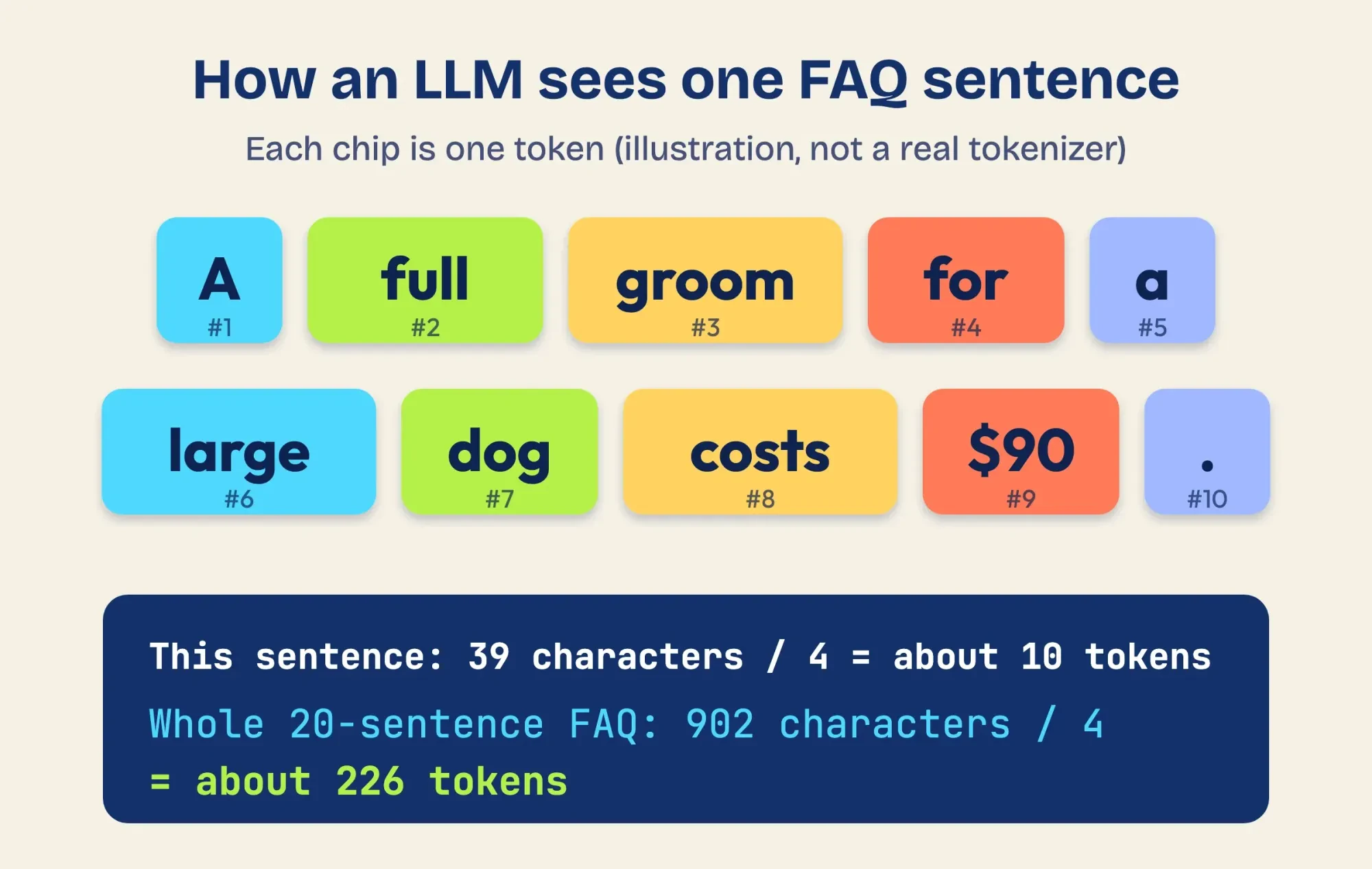 Diagram by DigitalTreed, using Google's rule of about 4 characters per token (read October 28, 2026). The split is an illustration, not a real tokenizer's output.
Training happens once, and your prompt is all it sees after that
Tokens are also what a model learns from, and the amounts are hard to picture. Meta's April 18, 2024 Llama 3 announcement says the model "is pretrained on over 15T tokens." That's seven times the data used for Llama 2, and dividing 15 trillion by our FAQ's 226 tokens gives more than 66 billion copies of the FAQ.
During pretraining the model plays one game over and over: it hides the next token, guesses it, compares the guess with the real text and nudges its parameters. Nobody types in answers at this stage, because the text itself is the answer key, which is why the pile has to be so big. Self-attention is the part that lets it use a whole sentence, not just the last word. Google's LLM lesson says it "allows the model to weigh the importance of different words in relation to each other." That's how "bank" in a fishing post and "bank" in a loan post get read differently.
A freshly pretrained model is good at continuing text but poor at following requests, so a second stage teaches it to answer questions the way an assistant would. In the March 2022 InstructGPT paper, people ranked model answers, and the model was tuned toward the ones they preferred. Answers from its 1.3 billion parameter version "are preferred to outputs from the 175B GPT-3, despite having 100x fewer parameters." Being trained to help mattered more than raw size. The same paper reports that InstructGPT models "show improvements in truthfulness and reductions in toxic output generation."
Then training stops, and that's the part owners tend to miss: your prompt doesn't teach the model anything on the spot.
Instead, it reads your prompt inside its context window, which Anthropic's context window docs call a "working memory." The docs say it's "different from the large corpus of data the language model was trained on." Those windows are now big. Google's tokens page lists an input budget of 1,048,576 tokens for its Gemini 3 and 2.5 models, or about 4,600 copies of our 226-token FAQ. So there's room for your real price list and a few pages of policies without trimming. Whether your public pages ended up in some model's training data is a separate question, and our AI crawler checker shows which AI crawlers your robots.txt lets in.
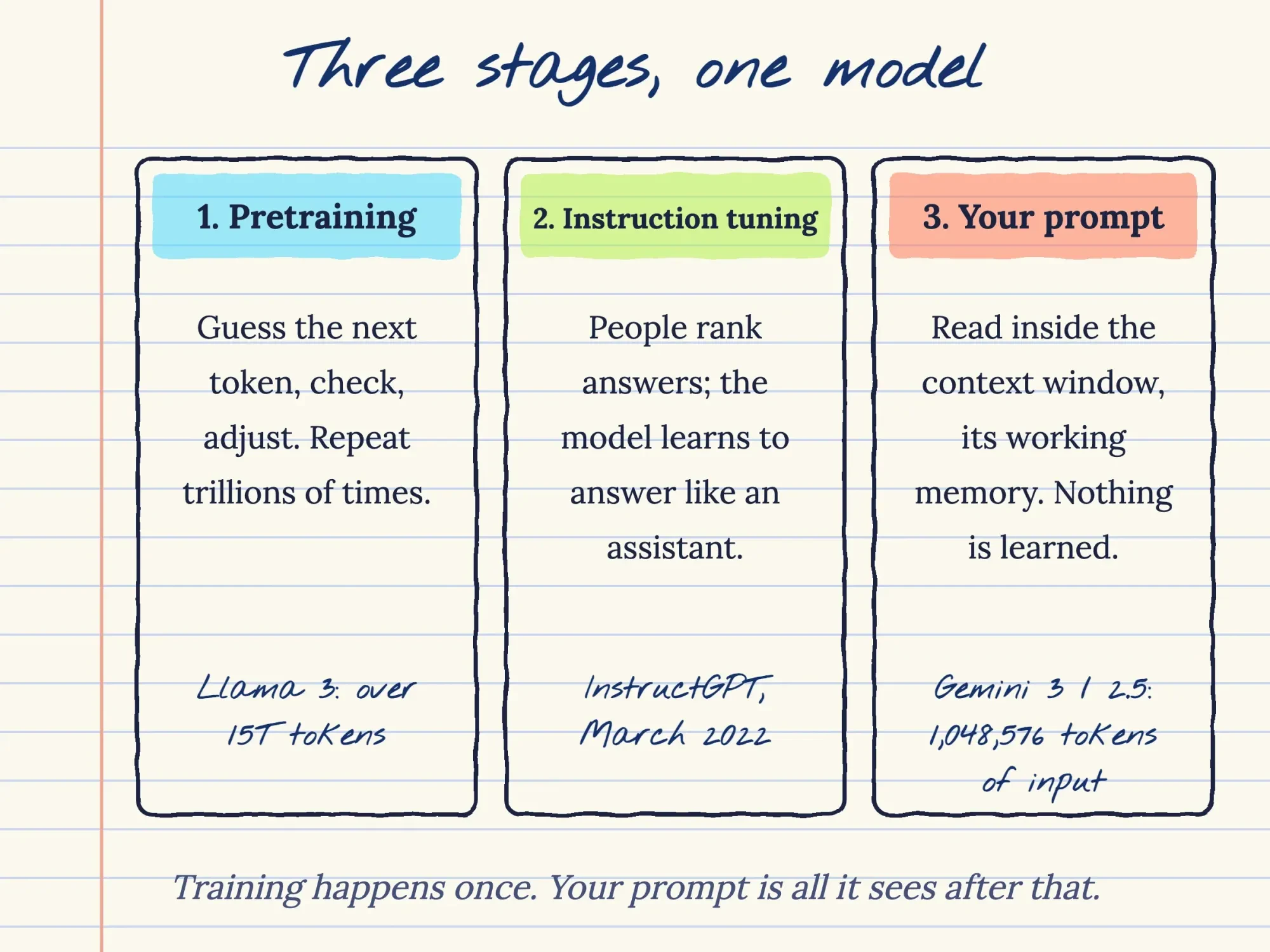 Drawn by us. Sources: Meta Llama 3 announcement, InstructGPT paper and Anthropic's context window docs, read October 28, 2026.
Writing is one next-word guess at a time
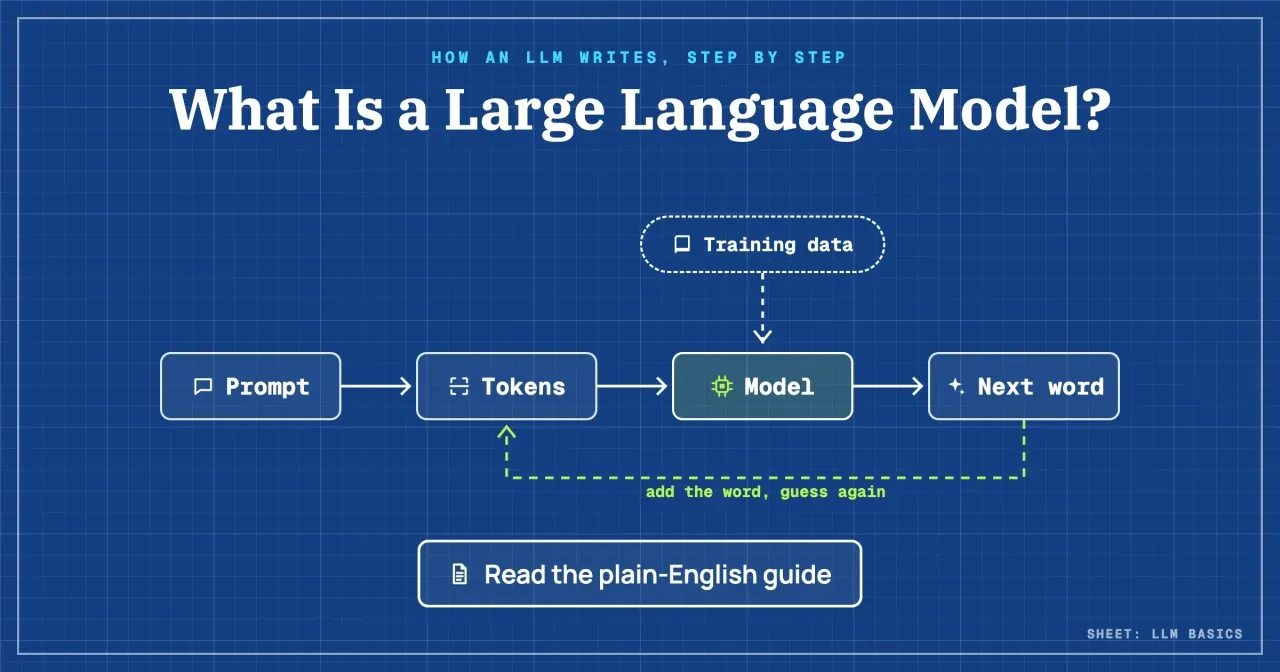
With training done and your prompt in its working memory, the model writes in a loop. It turns your prompt into tokens, scores every possible next token, picks one, adds it and scores again. Google's guidance on generative AI content says these models "predict a likely sequence of words based on their training data." Each pick depends on the ones before it, so one early wrong word can drag the words after it off course, like one wrong turn on a drive. Our featured diagram calls each pick the next word. Strictly, it's the next token.
Our toy model makes the loop easy to see. It learned from the 20 FAQ sentences only. One version looks at the last 2 words before it guesses, while the other looks at the last 6, a crude stand-in for a model with more context. It isn't a real LLM, so its error rates are not error rates for ChatGPT, Gemini or Claude.
We gave both the prompt "A full groom for a large dog costs." The 2-word version sees only "dog costs," and in the FAQ that pair comes before four different prices. So it gives $40, $55, $65 and $90 one chance in 4 each, or 25%. Only $90 is right. That's a 1 in 4 shot at the truth, stated in the same flat tone as the right answer, with nothing to warn you. The 6-word version sees "groom for a large dog costs" and gives $90 a 100% chance, because just one FAQ sentence matches.
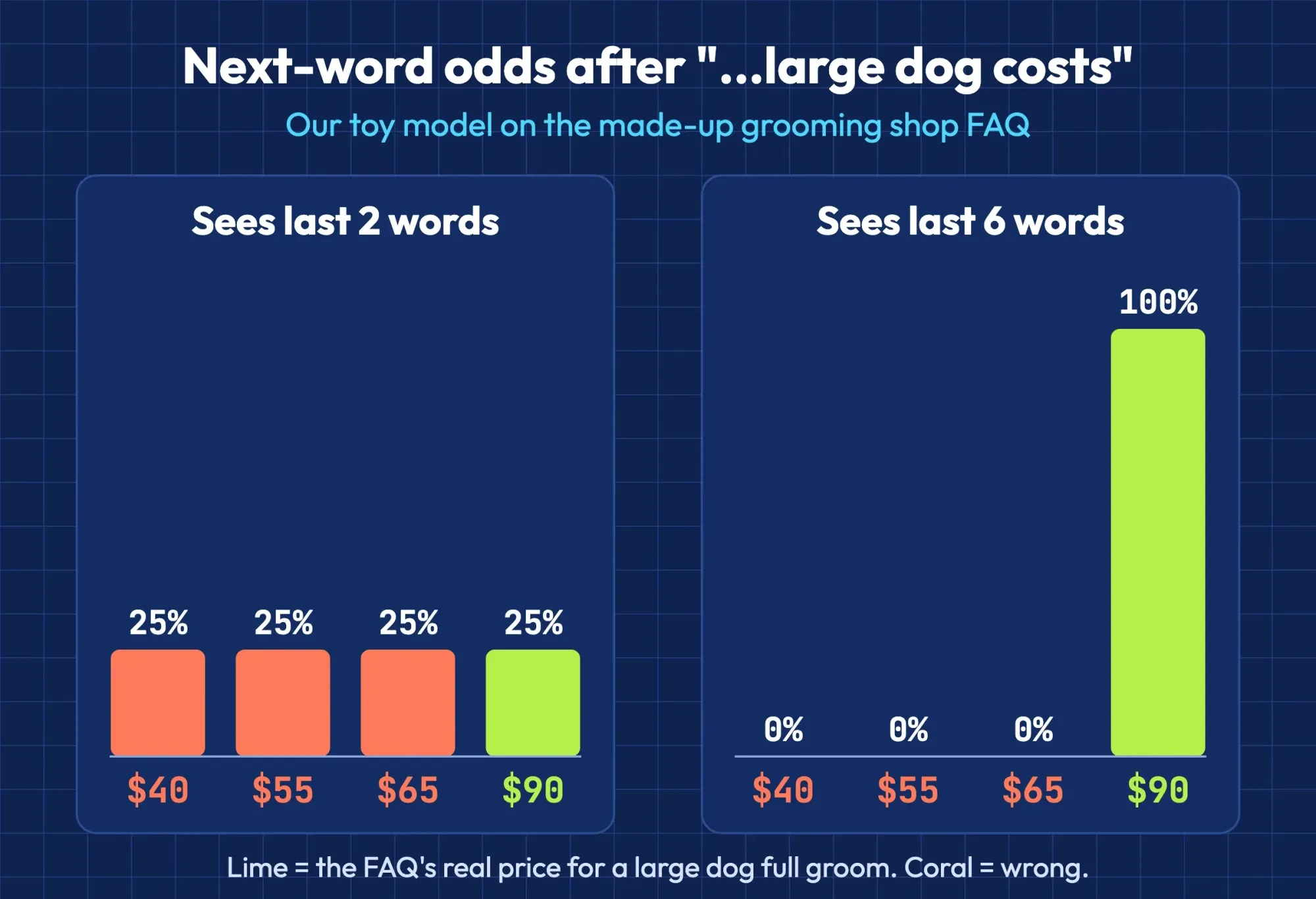 Diagram by DigitalTreed. Source: our toy model on the made-up Pelican Gate Pet Grooming FAQ, run October 28, 2026.
Notice what the 2-word model never says: "I'm not sure." It picks a price by chance and wraps it in a clean, confident sentence. In a real chat app the same thing can happen with your holiday hours, your refund rule or a phone number the model has never seen.
Why does an LLM make things up?
An LLM makes things up because writing likely text and stating true facts are different jobs, and it was trained for the first one.
Google's Search guidance on AI content says "generative models don't retrieve facts," and it adds that their outputs "may contain inaccuracies (also known as hallucinations)." Google's machine learning course is blunter: "LLMs hallucinate, meaning their predictions often contain mistakes."
The US government's term is confabulation. NIST's Generative AI Profile, NIST AI 600-1, published in July 2024, defines it as "the production of confidently stated but erroneous or false content." Confidence is the trap. A wrong opening hour reads just as smoothly as a right one, so the tone of an answer tells you nothing about whether it's true.
Our toy model, which is not a real LLM, shows that trap at a size you can count. Out of 300 sentences, the 2-word version wrote 75 with a wrong price or time, and 75 / 300 is 25%. Counting only its 103 new sentences, 75 / 103 is 72.8% wrong. Its mistakes read like real policy, such as "A nail trim costs $15 and takes about three hours." The 6-word version made no errors, but it never wrote a new sentence either. And the 28 new sentences with no fact error weren't all usable; one read "We are open tuesday to saturday from 8 a.m. to 5 p.m. costs $10."
What we tested
We wrote both models in a 151-line Python script and ran it locally on October 28, 2026, with no network or AI service. Each wrote 300 sentences from fixed seeds, graded against the prices and times in that FAQ.
| Model | FAQ copies | New, no error | Wrong price | Wrong time |
| Last 2 words | 197 | 28 | 43 | 32 |
| Last 6 words | 300 | 0 | 0 | 0 |
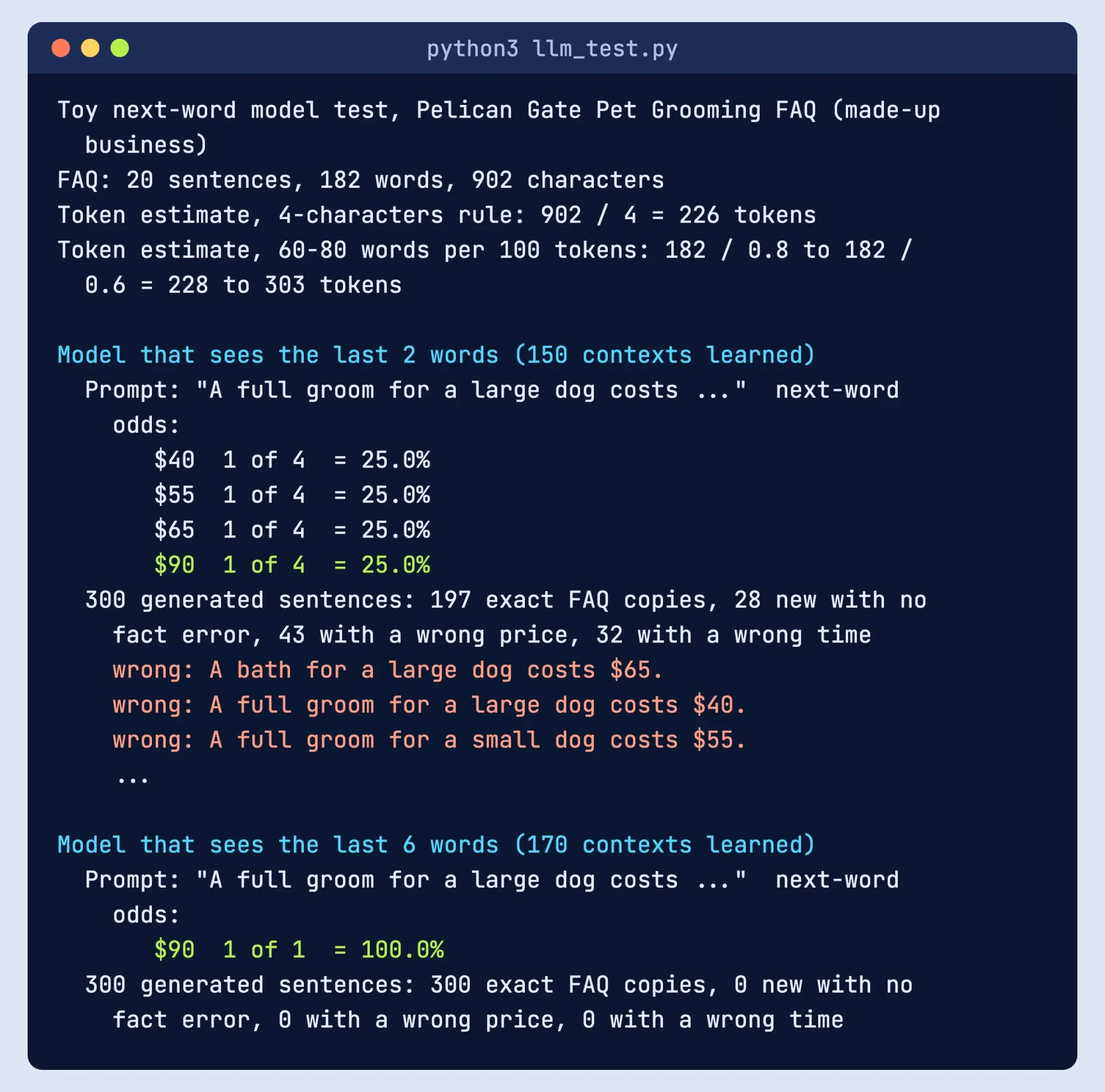 Screenshot: our toy model's terminal output, October 28, 2026 (trimmed). The shop is made up.
How to get fewer made-up answers
The 6-word result is the useful one for a business: wrong facts fell to zero once the right words sat inside the context the model read.
Our toy isn't a real LLM, and real models write new sentences far better, but we'd bet on the same lesson. You can't change a model's training. You do fully control your prompt. Anthropic's guide to reducing hallucinations backs two habits we'd add to that. Giving the model explicit permission to admit uncertainty "can drastically reduce false information," it says. For documents over 20,000 tokens, it suggests asking for "word-for-word quotes first," so you can check each claim against the source. Here's the routine we'd use for any customer-facing draft:
- Paste the facts it needs, such as prices, hours and policies, into the prompt.
- Tell it to answer only from those facts and to say "I don't know" otherwise.
- For a long document, ask for the exact quotes before the summary.
- Check every number, name and date in the draft against your own records.
Don't skip step 4. Google's guidance says the fact-check "also applies to metadata like <title> elements, meta description elements, structured data, and alternate texts for images." Those are the bits owners forget, because nobody reads them on the page. A wrong price in a meta description can show up in Google's results, yet nobody on your team sees it while browsing your own site. Our guide to using ChatGPT for digital marketing has prompt examples you can adapt with your own facts pasted in.
What an LLM means for your content and data
Once you know the model guesses, Google's rules on AI content make more sense. Its February 2023 post on AI-generated content and Search says "appropriate use of AI or automation is not against our guidelines." The current guidance adds a limit. Using AI "to generate many pages without adding value for users may violate Google's spam policy on scaled content abuse." So a checked draft with your own prices and photos is fine. A hundred near-identical city pages aren't. For our made-up grooming shop, one services page with real prices and real photos beats twelve AI pages for "dog grooming in" each nearby town.
Rewording someone else's article through a chatbot doesn't make it yours, as our post on whether ChatGPT rewriting counts as plagiarism explains.
AI detectors also disagree often enough that our look at why AI detectors give different answers advises against trusting one score. For how Google weighs experience in AI-assisted writing, read the E-E-A-T and AI-assisted writing notes in our SEO path.
Data is the other half. Free and paid tiers differ here. Google's Gemini API terms cover unpaid services such as Google AI Studio and the free API quota. There, Google uses what you submit to improve its products, and "human reviewers may read, annotate, and process your API input and output." The terms also say "do not submit sensitive, confidential, or personal information to the Unpaid Services." On paid services, Google says it doesn't use your prompts or responses to improve its products. So a free AI Studio session is the wrong place for a customer list, even for a quick test of a mail-merge idea.
So customer names, phone numbers and anything under a confidentiality promise stay out of free tools. Our AI tools guide on training opt-outs and what never to paste covers each app's settings.
Our take: treat an LLM as a quick, tireless first-draft writer that's never met your customers. Give it your facts, check what it hands back, and keep private data in paid tools or out entirely. That covers most of the risk. For where LLMs fit in a wider plan, from ads to email, read the role of AI in digital marketing. If you'd like people to write and fact-check your posts, the DigitalTreed content marketing team does that work. We sell it, so read this line knowing that.
Frequently asked
How many parameters does a large language model have?
It varies, and many companies don't publish it. Google's LLM course page says Transformer models hold hundreds of billions or even trillions of parameters.
Is a bigger context window always better?
Not always. Anthropic's context window docs list windows of up to 1M tokens, depending on the model. They also warn that "as token count grows, accuracy and recall degrade," which they call context rot.
Can I copyright a blog post an LLM wrote for me?
Not from your prompts alone. The US Copyright Office's Part 2 report, released January 29, 2025, found that "prompts alone do not provide sufficient human control" to make you the author. Ask an attorney about a specific work.
What is a transformer in AI?
It's the leading design behind today's LLMs. The June 2017 paper Attention Is All You Need proposed "the Transformer, based solely on attention mechanisms."
How we made this guide: We read primary pages from Google, Meta, Anthropic, NIST and the Copyright Office, plus the original papers. We also built a toy next-word model in Python and graded its 600 sentences locally. Facts checked by the DigitalTreed team on October 28, 2026.
First published February 2023. Rewritten October 28, 2026: now built around tokens, training, context and made-up answers, with a local test.
Sources
- Google AI for Developers: Understand and count tokens
- Google Machine Learning Crash Course: What's a large language model?
- Brown et al. (2020): Language Models are Few-Shot Learners
- Vaswani et al. (2017): Attention Is All You Need
- Meta AI: Introducing Meta Llama 3 (April 18, 2024)
- Ouyang et al. (2022): Training language models to follow instructions with human feedback
- Claude Platform Docs: Context windows
- Claude Platform Docs: Reduce hallucinations
- Google Search Central: Google Search's guidance on using generative AI content
- Google Search Central Blog: Google Search's guidance about AI-generated content (February 2023)
- NIST AI 600-1: Generative Artificial Intelligence Profile (July 2024)
- Google: Gemini API Additional Terms of Service
- U.S. Copyright Office: Copyright and Artificial Intelligence
- U.S. Copyright Office: Part 2, Copyrightability (January 29, 2025)


Comments
No comments yet. Start the conversation below.