
Quick answer
Grok vs ChatGPT for a US small business: pick ChatGPT for most teams. Its Business plan costs $25 per user a month, or $20 billed yearly, as of October 2026, and OpenAI says it doesn't train on that data by default. Grok makes sense if your marketing lives on X.
Grok is the AI assistant from xAI, whose docs now sign as SpaceXSI. It's sold in one subscription with X and the Cursor code editor. ChatGPT is OpenAI's assistant, sold on its own plans from Free to Enterprise. Both write, search the web, read files and make images, so the real differences sit in price, data terms and where each one looks for news.
We wrote this for an owner deciding where five or ten seats of budget should go. We didn't run chat tests, because that takes accounts we chose not to open for this guide. Instead we read each company's own pricing and data pages on October 25, 2026, screenshotted the public ones and did the seat and API math ourselves.
Key takeaways
- ChatGPT Plus costs $20 a month, while Grok Premium costs $30.
- Five ChatGPT Business seats cost $125 a month at list price.
- OpenAI's Business plan says it doesn't train on business data by default.
- Every Grok Imagine image carries a watermark that no setting removes.
- Never let either chatbot write reviews for customers who don't exist.
Grok and ChatGPT side by side, as of October 25, 2026
That math starts with the basics. Here's how the two compare on what a small business pays for or worries about, with each row sourced in the sections below.
| Grok | ChatGPT | |
|---|---|---|
| Made by | xAI (docs now signed SpaceXSI) | OpenAI |
| Free plan | Yes, limited usage | Yes |
| First paid plan | Plus, $8 a month | Go, $8 a month |
| Everyday paid plan | Premium, $30 a month | Plus, $20 a month |
| Team seat | $30 per seat (Premium) | $25 per user monthly, $20 yearly (Business) |
| Business data used for training | Not stated for team seats on the pages we read | Not by default (Business, Enterprise, Edu) |
| Live information | Web search plus posts on X | Web search and deep research reports |
| Images | Grok Imagine, watermark can’t be removed | Built-in image generation |
| Main API model, per 1M tokens in / out | grok-4.7: $2 / $6 | gpt-6.1-sol: $2 / $10 (gpt-6-astra: $10 / $50) |
Two rows decide it for most owners: the team seat and the training line.
The rest is closer than either company's marketing suggests. Both write well enough for first drafts and cite web sources, and both charge by usage once you build on their APIs. If you're weighing more tools, our guide to ChatGPT, Perplexity and Gemini for SEO tasks compares three assistants job by job.
Both start free, and both charge $8 for the first paid step
So the cheapest paid step costs the same. As of October 2026, both have a free tier and an $8 entry plan. After that, ChatGPT Plus costs $20 a month while Grok's comparable Premium plan costs $30, so the everyday tier is cheaper on ChatGPT.
Grok is now sold through what xAI calls The X Subscription. As of October 2026, its pricing page lists Plus at $8, Premium at $30, Super at $100 and Ultra at $200 a month. Paying yearly helps: Premium is $300 a year instead of $360. xAI also notes that list prices don't include sales tax, so your checkout total can be higher.
The bundle is the part most comparisons miss. Plus adds an X checkmark and fewer ads, and Premium and up add full X Premium+ benefits. If you already pay for X Premium, the bundle can replace that bill. Older SuperGrok and X Premium plans keep running unless you change them, but xAI warns that switching "is permanent" once you do.
It's a one-way door, so decide before you click.
| Step | Grok (The X Subscription) | ChatGPT |
|---|---|---|
| Free | $0, limited usage | $0 |
| Entry | Plus, $8 a month | Go, $8 a month |
| Everyday | Premium, $30 a month | Plus, $20 a month |
| Heavy use | Super $100, Ultra $200 a month | Pro at $100, $200 or $500 a month |
| Teams | $30, $100 or $200 per seat | Business, $25 per user monthly or $20 yearly |
| Large companies | Enterprise, through sales | Enterprise and Edu, through sales |
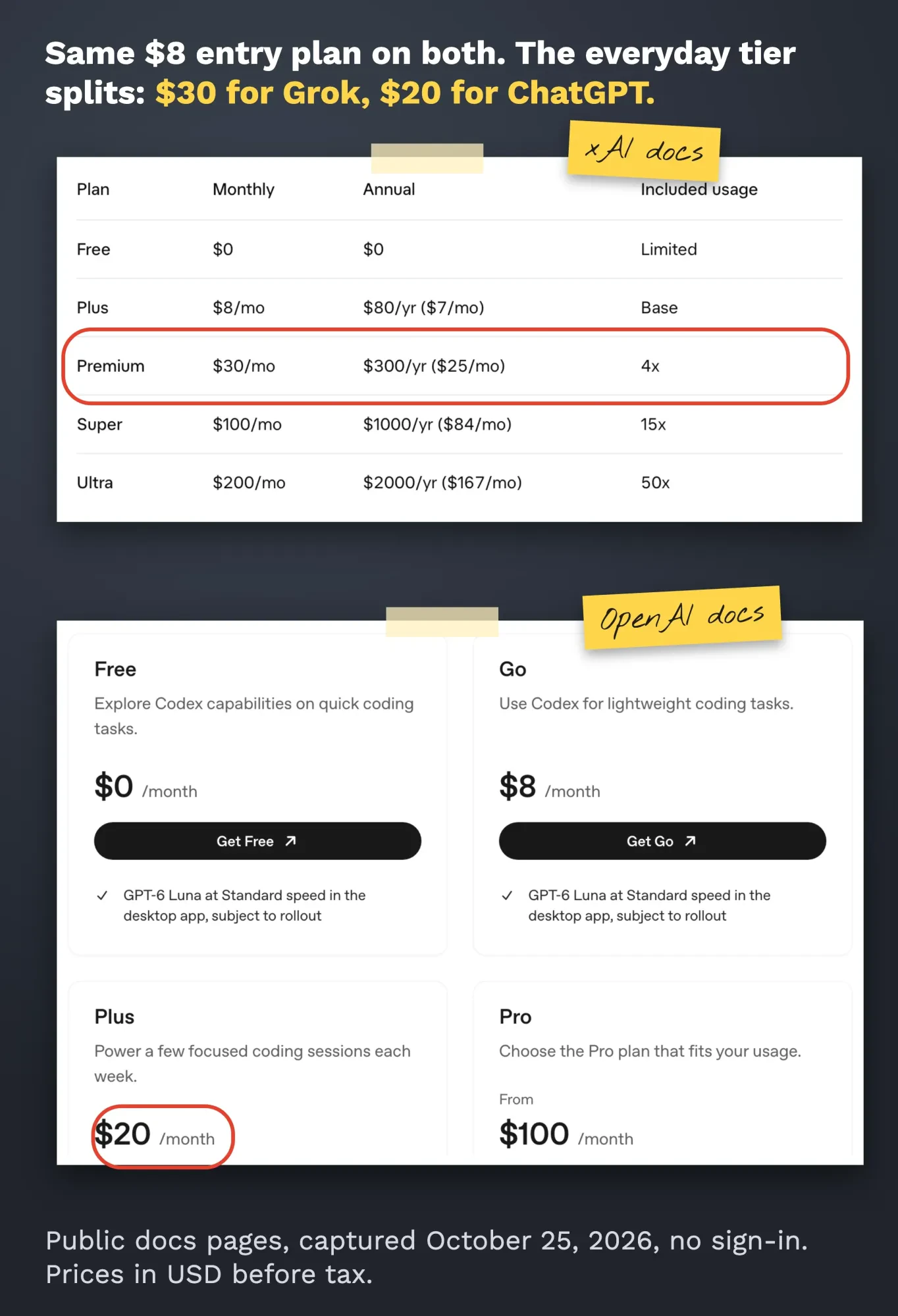 Screenshot: docs.x.ai X Subscription pricing and learn.chatgpt.com ChatGPT pricing, public pages captured October 25, 2026 without signing in; notes by DigitalTreed.
For one person, the everyday tiers differ in what they bundle. OpenAI's docs list GPT-6.1 Sol and GPT-6 Luna on ChatGPT Plus, plus its Codex coding agent and extra credits when you run out. Grok Premium gives four times the base usage and full X Premium+ benefits.
Which costs less for a team of five, Grok or ChatGPT?
Those monthly prices matter most once you're buying seats for staff. ChatGPT Business is $25 per user a month, or $20 billed yearly for two or more users, as of October 2026. Grok team seats start at $30 on Premium, and xAI doesn't sell its $8 Plus tier to teams.
Example: Caprock Pool Supply is a made-up five-person shop in Lubbock, Texas. The owner wants AI help with product copy, customer emails and a few social posts a week. Here's the math on October 2026 list prices, before tax. On ChatGPT Business, five seats cost 5 x $25 = $125 a month, or 5 x $20 x 12 = $1,200 a year on annual billing. On Grok Premium team seats, five people cost 5 x $30 = $150 a month. The page we read doesn't show a yearly team price, so we've left it out.
So Caprock pays $25 a month more for Grok on monthly billing, which is $300 over a year. Put ChatGPT on annual billing and the gap grows to $600 a year, though that sets ChatGPT's yearly price against Grok's monthly one.
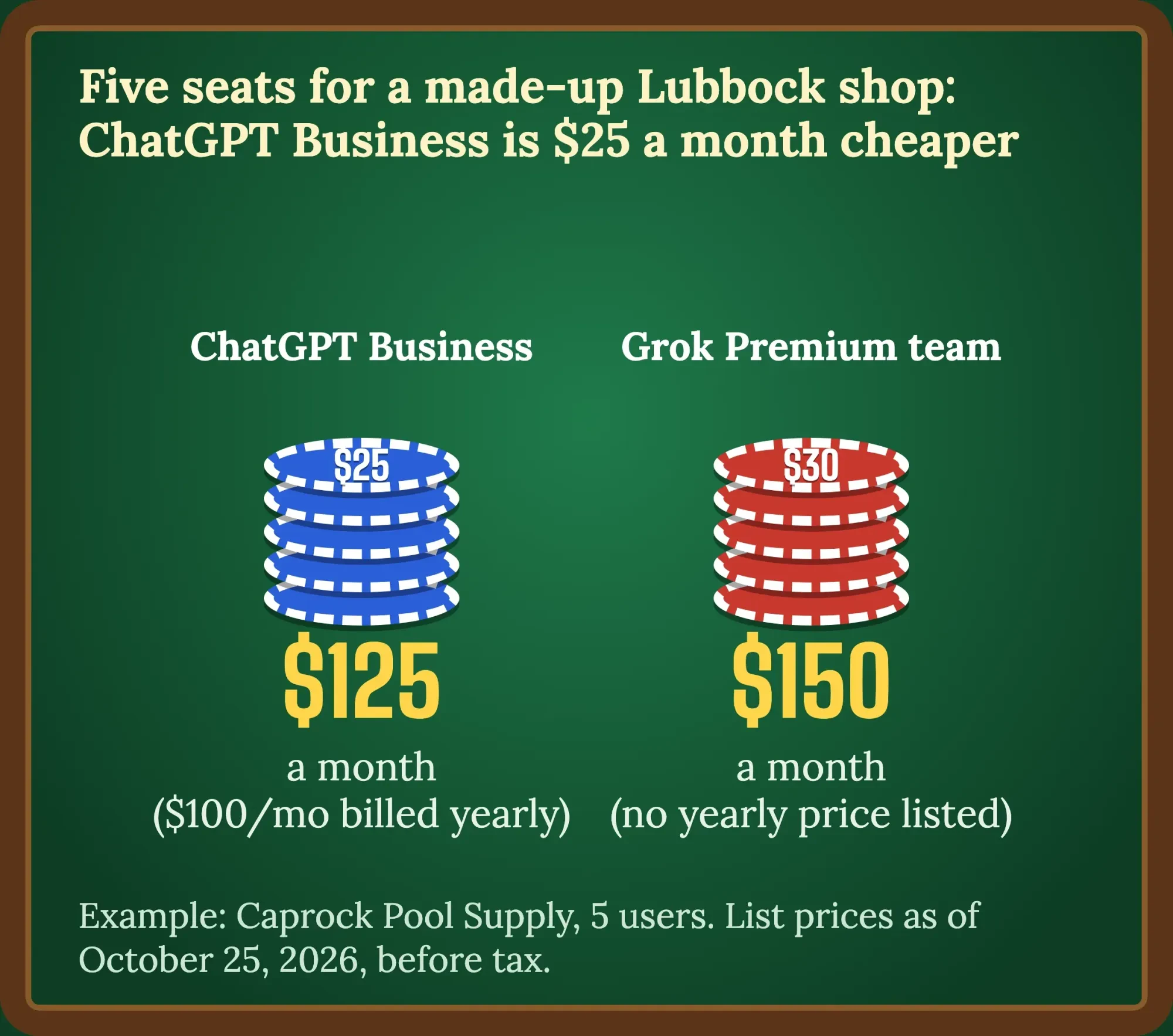 Diagram by DigitalTreed from docs.x.ai X Subscription pricing and learn.chatgpt.com pricing, read October 25, 2026. Caprock Pool Supply is a made-up example.
Money isn't the whole story, though.
What the seat buys differs too. The same ChatGPT Business card lists SAML single sign-on, multi-factor sign-in and a dedicated workspace. Grok's team plans list central billing, usage analytics and mixed seat tiers. So one heavy user can sit on Super while everyone else stays on Premium. That suits a shop where only one person writes all day.
On privacy, ChatGPT's business plans promise more in writing
That workspace promise is the bigger difference. OpenAI's ChatGPT pricing docs list "No training on your business data by default" on the Business plan, and Enterprise and Edu include everything in Business. You get that in writing from the first Business seat.
On xAI's side, Grok Business workspaces come with privacy terms set by xAI's enterprise terms of service, and shared chats open only for licensed team members. The newer X Subscription team pages talk about billing, seats and usage, but they don't mention training. Before staff paste client details into Grok, ask xAI's sales team which terms your seats fall under.
Personal plans need a setting change on both. Grok's data controls include an "improve the model" toggle, and xAI's security FAQ says chats in its Build mode may be used for model improvements when it's on. Grok also offers Private Chats on grok.com and mobile. In ChatGPT, turn off "Improve the model for everyone". Our walk-through of training opt-outs and temporary chats shows where each switch lives.
The APIs are closer. OpenAI says data sent to its API is not used to train or improve its models unless you opt in, and xAI's security FAQ says the same for Grok's API. Both keep API requests for up to 30 days for abuse checks. xAI also runs a US endpoint that keeps model requests in the United States (files and server-side tools excluded), at 1.1 times the normal token price.
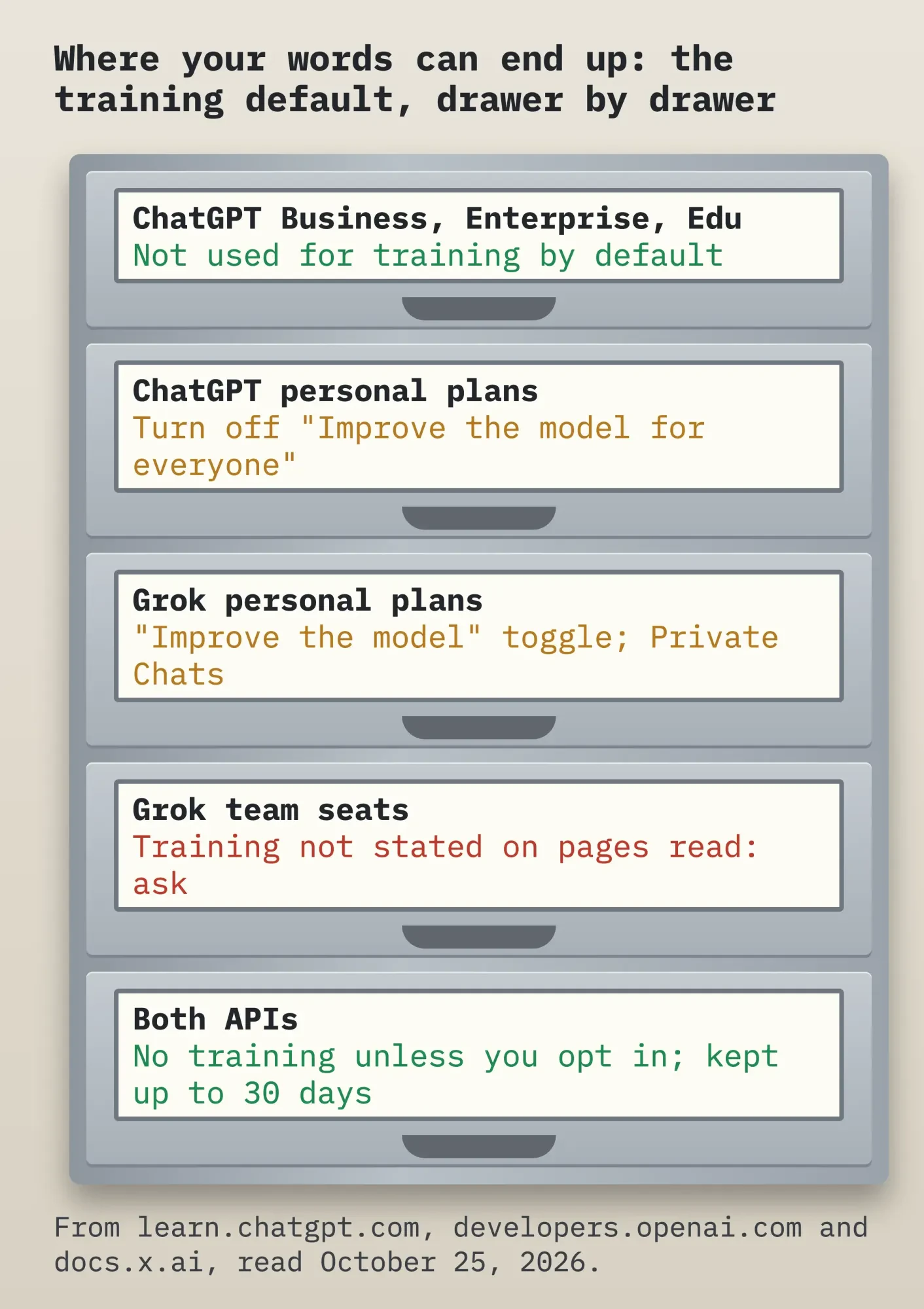 Diagram by DigitalTreed from learn.chatgpt.com, developers.openai.com and docs.x.ai data pages, read October 25, 2026.
Whichever you pick, keep card numbers, health details and passwords out of every chat window.
For writing, judge the drafts yourself with the same five tasks
Privacy settles where your words go; writing quality is about what comes back. Published head-to-head tests don't agree. A July 2026 test on tldv's blog had Grok winning its research round 15-0, while Zapier's April 2026 review headed one section "ChatGPT is the one to pay for". Neither company's own pages give a writing score we'd repeat, so we won't hand you one.
The fix is a 20-minute test on both free tiers, using your own work. Run the same five prompts in each and score them on the checks below.
The five-task test
- Product description: paste one real product's specs and ask for 80 words. Check every claim against the spec sheet.
- Complaint reply: paste a customer email with names removed. Check the tone, and that it promises nothing you can't deliver.
- Research with sources: ask a question you already know the answer to, like your state's sales tax rate, and ask for links. Open every link.
- One image: ask for a spring-sale banner. Look at hands, text and anything that resembles someone else's logo.
- Spreadsheet formula: ask for a formula that totals sales by month. Test it on 10 rows you can add up by hand.
If both pass, pick on price and privacy. If one fails the facts check twice, you have your answer.
If you use either one for page titles and meta descriptions, paste the result into our SERP snippet preview to see whether Google is likely to cut it off. Our SEO writing tips from Google's checklist help with the edit. And if you're feeding someone else's article into a chatbot to reword it, read our note on whether AI rewriting counts as plagiarism first.
For research, Grok reads X and ChatGPT writes longer reports
That facts check matters most for research. Grok can search the web and X itself; xAI's docs list a Web Search tool with citations and an X Search tool for posts, profiles and threads. ChatGPT has its own web search that shows citations in the chat, and deep research for questions that need many sources and a written report.
So if your customers praise, argue or complain on X, Grok sees that conversation directly.
If they don't, that edge mostly disappears. OpenAI's own docs say to "Treat all web results as untrusted input," which is good advice for both tools. And Grok 4.7's knowledge cut-off is May 2026, so anything newer needs search switched on.
One more rule: don't take search volumes or market stats from either chatbot. They'll give a confident number nobody measured. Check keyword ideas in our free keyword suggestions tool instead, and set the country to the US first.
For images, both make them, and Grok adds a watermark you can't remove
Research aside, both tools make pictures for ads and posts. ChatGPT generates and edits images in the chat, and OpenAI says image limits depend on your plan. Grok makes images and video with Grok Imagine, and every one carries a Grok watermark. xAI's help page says "There is no setting to remove the watermark," and removing it breaks xAI's use policy.
The label is honest, but it may not suit a product photo on your own site.
There's a brand-safety point too. On January 14, 2026, California Attorney General Rob Bonta opened an investigation into sexually explicit images made with Grok. It's an investigation, not a finding. Still, some owners will want their ad images made elsewhere while it runs.
On the APIs, xAI lists grok-imagine-image-2.0 at $0.04 to $0.08 per image by size and quality as of October 2026. OpenAI bills its image models by tokens, so its cost per picture also depends on size and quality.
On the API, Grok's flagship costs less per token
Moving from the chat apps to the API changes the math again. As of October 2026, xAI lists grok-4.7 at $2 per million input tokens and $6 per million output tokens. OpenAI lists gpt-6.1-sol at $2 in and $10 out, below its top gpt-6-astra at $10 and $50.
Example: Caprock wants 1,000 product descriptions for its online store. Say each one takes 300 tokens of instructions and specs and returns 250 tokens of copy. That's 300,000 tokens in and 250,000 out. On grok-4.7 that's $0.60 in plus $1.50 out, or $2.10 in total. On gpt-6.1-sol it's $0.60 plus $2.50, or $3.10. The budget models go lower still: grok-4.3 comes to $1.00 and gpt-6-luna to about 16 cents, at the October 2026 list prices.
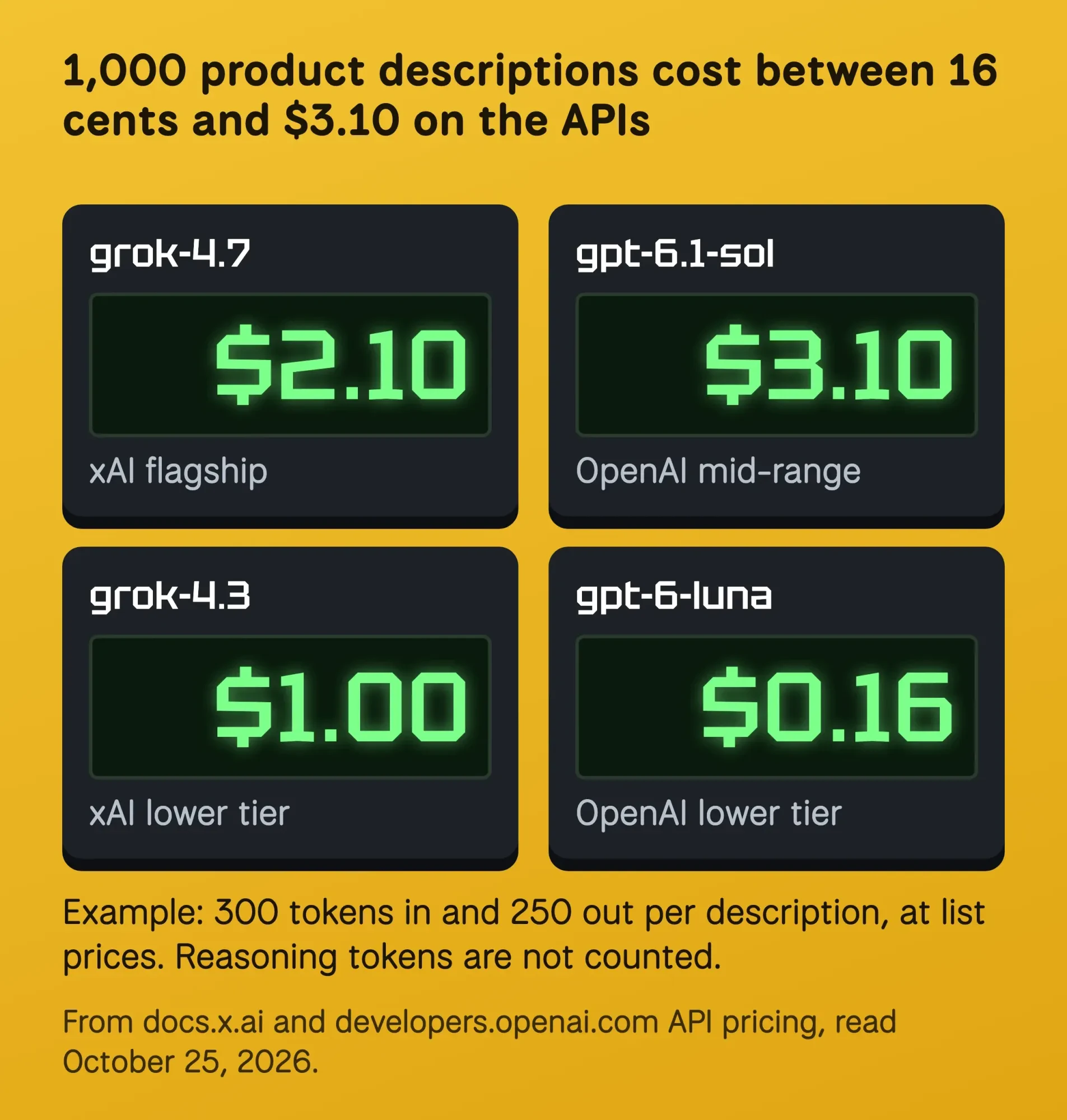 Diagram by DigitalTreed from docs.x.ai and developers.openai.com API pricing, read October 25, 2026. Token counts are our assumption for a made-up example.
Those sums leave out any reasoning tokens a model spends, so a real run will cost more.
Even so, it's pocket change next to a $25 seat.
Web search costs extra on both APIs, as of October 2026: $5 per 1,000 calls at xAI and $10 per 1,000 calls at OpenAI. The writing still needs a human edit; the API only makes the first draft cheap. If what you really want is a chatbot on your own website, our guide to website chatbots compares ready-made options.
Neither one should have the last word on facts, reviews or client data
Cheap drafts only help if you check them, and both companies admit limits in their own docs. OpenAI calls web results untrusted, and xAI's models page says Grok has "no knowledge of current events or data beyond what was present in its training data" unless search tools are on.
Reviews are the legal trap. The FTC's rule on fake reviews, 16 CFR 465.2, makes it unfair or deceptive for a business to "write, create, or sell" a review that misrepresents whether the reviewer exists or what they experienced. That covers a five-star review a chatbot writes for a customer who doesn't exist.
That's our plain reading of the federal rule, not legal advice. A business attorney in your state can tell you how it applies to your own marketing.
Client data is the third limit.
Keep contracts, health details and anything under an NDA out of personal plans on both tools. If staff need AI for that work, put them on a business plan whose data terms you've actually read.
Getting your business mentioned in these chatbots' answers is a separate job, which our guide to getting cited by AI answers covers. Start with our AI crawler checker, which shows whether ChatGPT's and other AI bots may crawl your site at all.
Choose ChatGPT if you want one safe default, Grok if you live on X
Put it all together and the verdict is short.
Choose ChatGPT if you're buying seats for staff, if anyone will paste client details, or if you want the cheaper everyday plan. Plus is $20 a month and Business seats are $25, or $20 billed yearly, as of October 2026. Its Business plan says, in OpenAI's own docs, that it doesn't train on your business data by default.
Choose Grok if your customers talk about you on X, if you already pay for X Premium and the bundle replaces that bill, or if you're building on the API. There, grok-4.7 costs less per output token than gpt-6.1-sol.
Our take: most five-person businesses should start on ChatGPT Business and add a Grok seat later for X monitoring, not the other way round. The price gap is small; the paperwork gap isn't.
Once you've picked, our guide to using ChatGPT for digital marketing has ideas for the first month, and our overview of AI in digital marketing covers the rules to follow.
Rather hand the writing to people? Our content marketing team writes and edits for US small businesses, with AI as a tool rather than the author. That's our own paid service, so weigh it against the plans above. If you'd like a price, use our quote form.
Frequently asked
Is Grok free?
Yes. xAI says "Grok is free to start", and its pricing page lists a Free tier with limited usage. Paid plans share one weekly usage pool, and when paid users hit that limit they still get Grok's free-tier Chat and Voice, per the Grok help page.
Grok vs ChatGPT for coding: which should I use?
Both cover coding. OpenAI's docs say its Codex coding agent is included in every ChatGPT plan from Free to Enterprise. The X Subscription includes the Cursor editor, and xAI's API lists a grok-build-0.1 coding model at $1 in and $2 out per million tokens, as of October 2026.
Can Grok see posts on X?
Yes, when search is on. xAI's API has an X Search tool for posts, profiles and threads, billed at $5 per 1,000 posts as of October 2026. The OpenAI docs we read list no X-specific search tool for ChatGPT.
How we made this guide: on October 25, 2026, we read xAI's and OpenAI's own pricing, privacy and help docs, and captured the two public pricing pages in a headless browser without signing in. We didn't run chat tests, because those need accounts; the five-task test is for you to run. The sites openai.com, chatgpt.com and x.ai blocked our automated visits that day, so OpenAI's prices come from its learn.chatgpt.com docs. The seat and API sums are ours, and Caprock Pool Supply is made up. Every fact links to its source in the text. Eram N. reads and approves this rewrite ahead of publication.
First published December 2023. Rewritten October 25, 2026: now a small-business comparison with both companies' current plans and prices, a team-seat and an API cost example, privacy and training settings, and a test you can run yourself. The old claim that Grok is a tool for specific industries is gone.
Sources
- xAI docs: The X Subscription pricing
- xAI docs: What is The X Subscription?
- xAI docs: X Premium customers moving to The X Subscription
- xAI docs: Team plans, workspaces, seats and invites
- xAI docs: Welcome to Grok
- xAI docs: Grok help and FAQ
- xAI docs: Grok Business user guide
- xAI docs: Security FAQ
- xAI docs: API pricing
- xAI docs: Models (last updated September 21, 2026)
- xAI docs: Web Search tool
- OpenAI ChatGPT docs: Pricing
- OpenAI ChatGPT docs: ChatGPT Work overview
- OpenAI ChatGPT docs: Web search
- OpenAI ChatGPT docs: Image generation
- OpenAI API docs: Pricing
- OpenAI API docs: Data controls in the OpenAI platform
- California Attorney General: investigation into xAI and Grok (January 14, 2026)
- 16 CFR 465.2, Fake or false consumer reviews (eCFR)
- tl;dv: Grok vs ChatGPT comparison (July 2026)
- Zapier: Grok vs. ChatGPT (April 2026)
Comments
No comments yet. Start the conversation below.