

Quick answer
AI in digital marketing pays off most on first drafts: posts, emails, ad headlines, chat replies and report summaries. The Census Bureau's latest count has 24.3% of US firms with 1 to 4 employees using AI. Use it for speed, then check every fact yourself, because the FTC and Google judge what you publish.
You've probably typed "write me an Instagram caption" into a chatbot and wondered what else it's good for. The short answer is a lot of the typing.
Not the judgment.
We'll go through it channel by channel: what to hand over, what you have to check by hand, and the US rules that apply. If you're still setting up the channels themselves, start with our digital marketing 101 plan and come back.
Key takeaways
- AI saves the most time on first drafts, not on final copy.
- Check every number, name, date and promise in an AI draft yourself.
- The FTC rule bans fake reviews, with penalties up to $53,088 per violation.
- Google allows AI content but can treat many pages without value as spam.
- AI output is protected by copyright only where a person added enough expression.
About one in four small US firms uses AI now, and marketing comes first
AI in digital marketing is software that writes, sorts or predicts so it can do marketing work for you: drafting a post, choosing who sees an ad, answering a customer at 11 p.m. It isn't only a big-company habit anymore.
We pulled the data files behind the Census Bureau's Business Trends and Outlook Survey on October 25, 2026 and charted them by firm size. In the survey period ending November 30, 2025, 17.0% of firms with 1 to 4 employees said they'd used AI. By the period ending October 18, 2026, it was 24.3%. Every size class rose, and firms with 250 or more employees went from 30.5% to 43.6%.
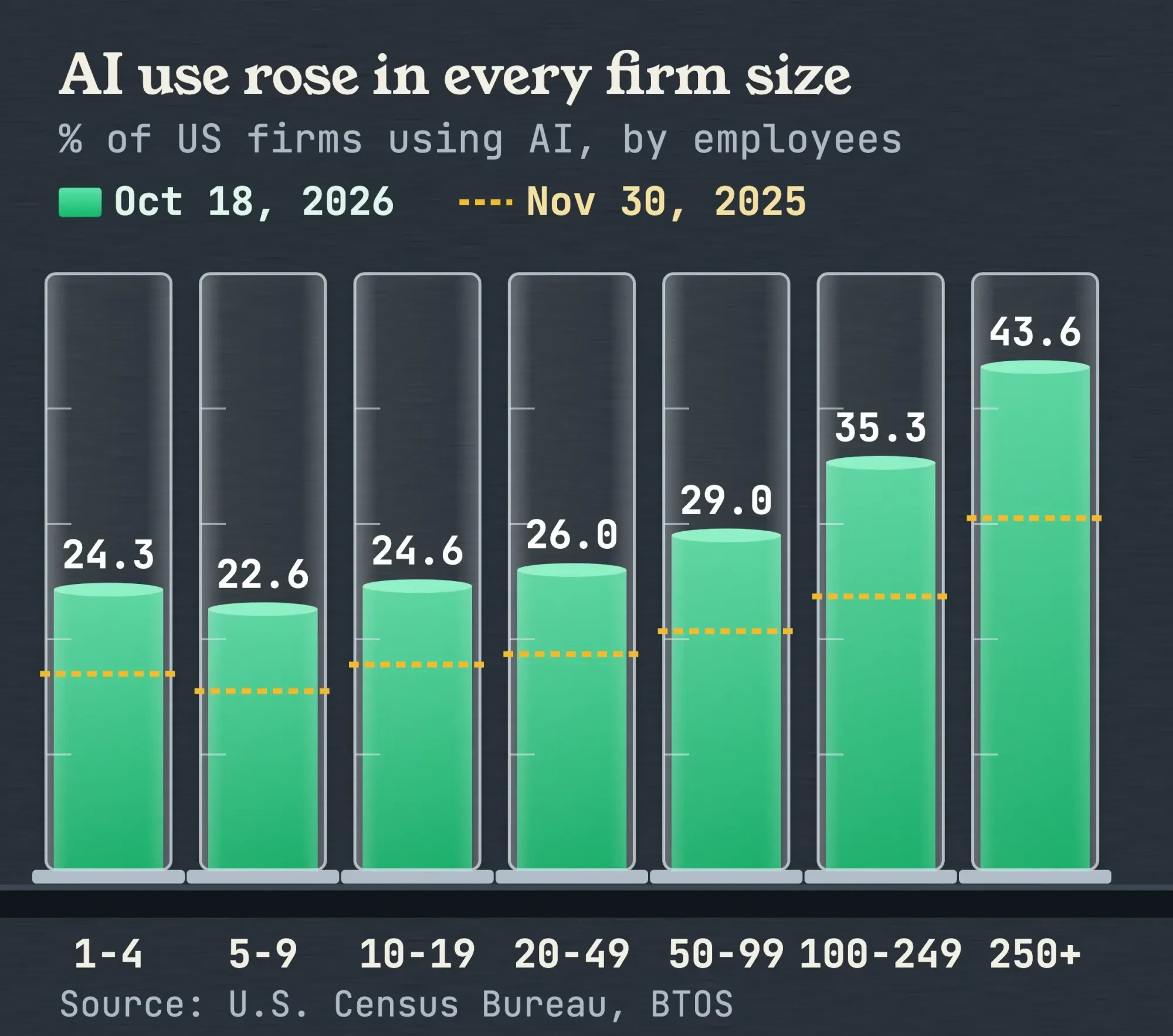 Source: U.S. Census Bureau, Business Trends and Outlook Survey, periods ending November 30, 2025 and October 18, 2026. Chart by DigitalTreed.
Marketing is where most of them start. In the Bureau's AI supplement, fielded from November 2025 to January 2026, sales and marketing came first of 15 business functions, at 14.3% of businesses. A Census working paper on the same survey puts it at 52% among firms that use AI.
One caution: the Bureau reworded its main AI question in November 2025, so don't line these numbers up against older ones.
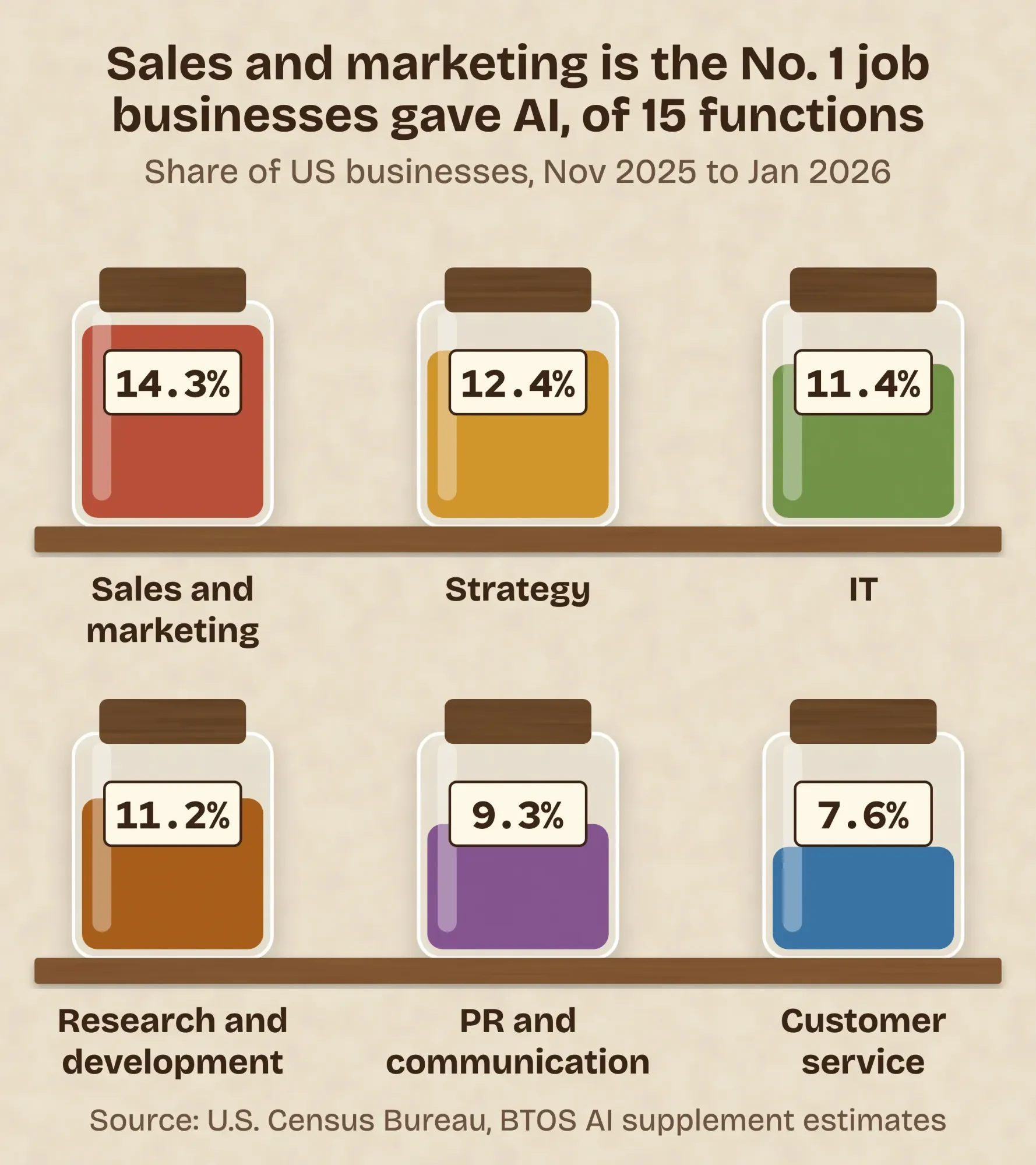 Source: U.S. Census Bureau, BTOS AI supplement, November 2025 to January 2026. Drawn by us.
Your customers are on these tools too. Pew found that 44% of US adults said they ever use ChatGPT, in a survey run February 17 to 23, 2026.
Use AI for the first draft, never the last one
So where does it actually save time? Drafts. In the same Census supplement, 85.4% of firms whose staff used generative AI used it for writing or editing documents, emails or messages. No other task came close.
That fits what these tools do well. A chatbot can turn your rough notes into a blog outline, rewrite a stiff service page in plain words, or give you 10 caption options for one photo. It's quick at structure and tone.
It's bad at facts.
A language model predicts likely words. Unless the tool says it's searching the web, it isn't looking anything up. So a draft can contain a confident price you never charged, a rule that doesn't exist, or a statistic with nothing behind it. Treat every number, name, date, quote and promise in a draft as unchecked until you've checked it.
Example: Fieldstone Chimney & Masonry is a made-up two-truck chimney business in Akron, Ohio. The owner asks a chatbot for a fall email and three ad headlines, and the draft is good, except for two lines. One calls the company "nationally certified," which it isn't. The other says it's "rated 4.9 by 300 Akron homeowners," when the business has 41 reviews. Both read perfectly naturally, and both are false.
A 5-minute check caught them. A busy Friday wouldn't have.
AI drafts also tend to run long and formal. Paste the final version into our free readability checker and cut whatever it flags. For blog posts meant to rank, our SEO content writing tips walk through Google's own checklist.
Never let AI write a review or a testimonial
Fieldstone's made-up "300 homeowners" line is a short step from the one hard line in AI marketing. Since October 21, 2024, the FTC's rule on consumer reviews has made it illegal for a business to write, create or sell a review that misrepresents whether the reviewer exists or used the product.
When it announced the rule, the FTC said it would "deter AI-generated fake reviews." Each violation can bring a civil penalty of up to $53,088, as of October 2026. The same rule bans rewarding customers for reviews that must say something good (or bad), and buying bot-made followers or likes to fake your reach.
There's one wrinkle you may read about. On December 22, 2025, the FTC set aside an earlier order against Rytr, a writing tool that could churn out reviews. That order was about the tool maker. It didn't touch the review rule, which applies to the business that posts or buys the fake.
Testimonials in ads follow the same logic. Federal endorsement rules at 16 CFR 255 say an endorsement "must reflect the honest opinions, findings, beliefs, or experience of the endorser." A quote no customer said fails that, however good it sounds.
What AI can do here is draft a polite review request that you send to real customers. Automating review requests inside the rules is covered step by step on our blog.
Is AI-generated content bad for SEO?
No, not by itself. Google's position since February 2023 is that "appropriate use of AI or automation is not against our guidelines." What breaks the rules is using it "with the primary purpose of manipulating ranking in search results," according to Google Search Central.
Its current guidance, updated October 1, 2026, names the trap a small site is most likely to fall into. Generating "many pages without adding value for users" can count as scaled content abuse, one of Google's spam policies.
We'd call 50 near-identical city pages churned out by a bot the classic case.
The same page tells you to check the work by hand. That includes the parts you don't see on the page.
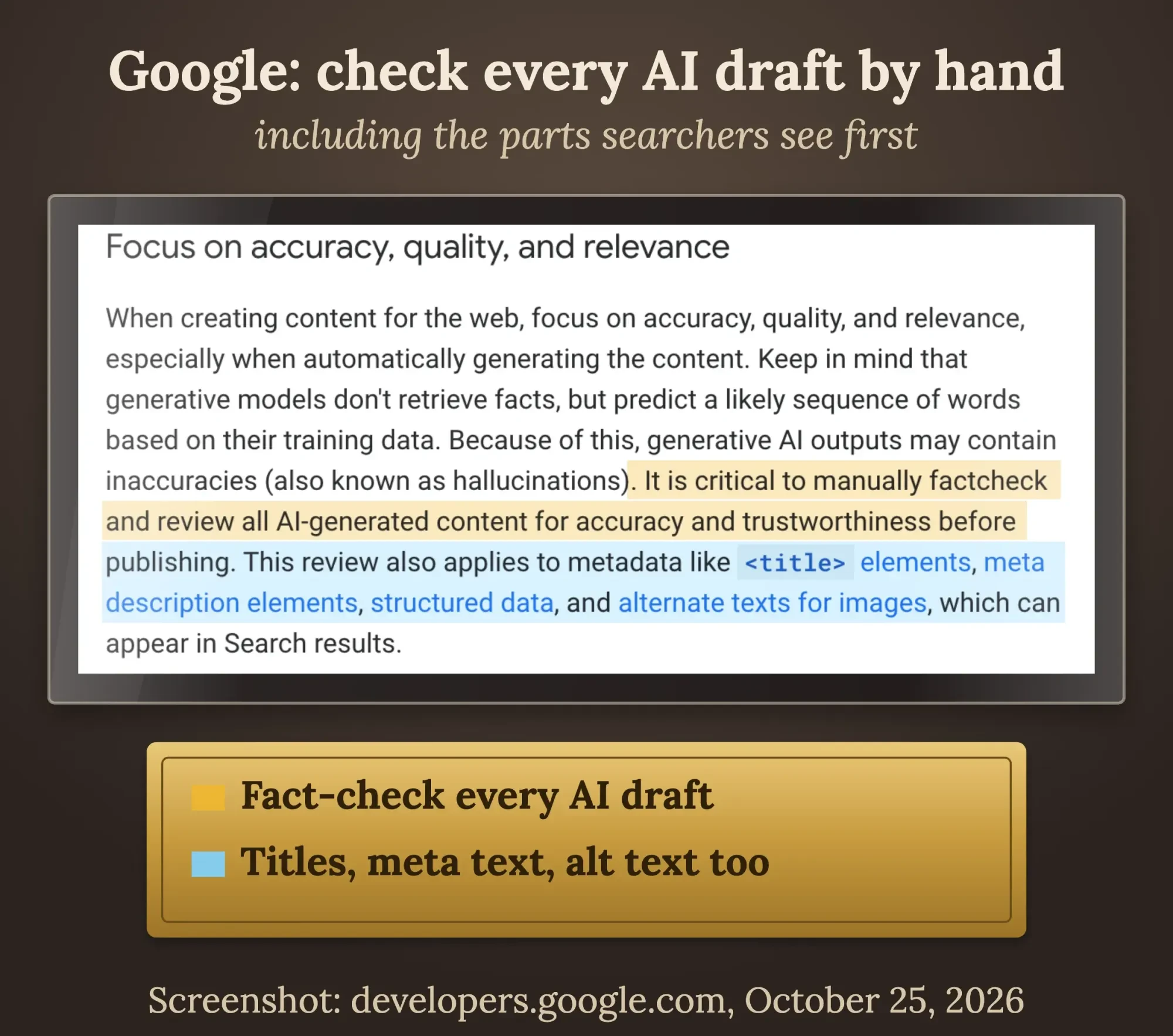 Screenshot: Google Search Central, guidance on generative AI content, October 25, 2026, our marks.
Check the title tag, meta description, structured data and image alt text a tool wrote for you. Paste the title and description into our SERP snippet preview to see how they'll look in Google before you hit publish.
What helps a page rank is what always helped: something only you can say. Your prices, your photos, your finished jobs, the question a customer asked last Tuesday. AI answers in search pull from pages like that. How they pick their sources is the subject of our generative engine optimization guide.
Email subject lines are the safest first job to hand over
Once drafts feel safe, email is a good first channel, because you already have a list, a platform and past results to compare against. Ask for 10 subject lines, 5 preview texts or a shorter version of your newsletter. Then pick one, edit it and send.
The law doesn't care who wrote it, though. Under CAN-SPAM, a subject line likely to mislead a reader about what's inside is unlawful, and opt-out requests have to be honored within 10 business days.
The FTC's compliance guide puts the penalty at up to $53,088 for each email that breaks the rules, as of October 2026. It also says "you can’t contract away your legal responsibility to comply with the law." That line is about hiring an email firm, and it's a fair rule for a tool as well.
Most email platforms will also suggest send times or audience segments now. Use them, but look at who's in a segment before a discount goes to people who paid full price yesterday. For lists and timing, see how to plan email marketing.
AI can write your ads, and the ad rules still apply
Then there are ads. Paid ads have run on machine learning for years: bidding, audiences, which headline shows. What's new is that the platforms write and draw the ads too. Google Ads can generate image assets from a prompt, and it may suggest generated images for you to review.
That doesn't buy you a softer review. Google's help page says "All advertising content is subject to Ads Policy, regardless of how it’s created," and tells advertisers to check generated assets so they're "accurate, not misleading" before they run. Images made inside Google Ads also carry a hidden SynthID watermark that marks them as AI-made.
The bigger risk is your own claim.
In February 2025 the FTC finalized an order making DoNotPay pay $193,000. The company had sold an "AI lawyer," and the FTC alleged it hadn’t tested whether the tool worked at the level of a human lawyer. As the FTC chair put it when the agency's Operation AI Comply began in 2024, "there is no AI exemption from the laws on the books."
If your ad says "AI-powered," "smarter" or "instant," be ready to prove it.
New to paid search? Our PPC guide covers budgets and setup before any of this matters.
When does an AI ad need a label?
Most ads with an AI-written headline need no label from Google or Meta. Labels come in for a handful of cases: election and issue ads, ads made with Meta's own AI tools, and ads seen in New York that show a fake person. Here's what each rule asks, as we read the pages on October 25, 2026.
| Your ad | What the rule asks | Source |
|---|---|---|
| Google election ad with realistic AI-made people or events | Tick "Altered or synthetic content"; Google adds the label in some formats, you add it in others | Google Ads policy, July 2024 |
| Meta social issue, election or political ad with a realistic AI image, video or audio | Disclose it, or Meta rejects the ad | Meta ad standards |
| Any Meta ad fully made or materially edited with Meta's own AI tools | Meta adds "AI info", shown beside "Sponsored" when the ad has a photorealistic AI person | Meta Help |
| An ad seen in New York with an AI "synthetic performer" | A conspicuous disclosure; $1,000 for a first violation, $5,000 after (since June 9, 2026) | AP report on the state law |
| Ads shown in the EU or India with AI assets | Labels may be required; Google offers an AI label setting | Google Ads Help |
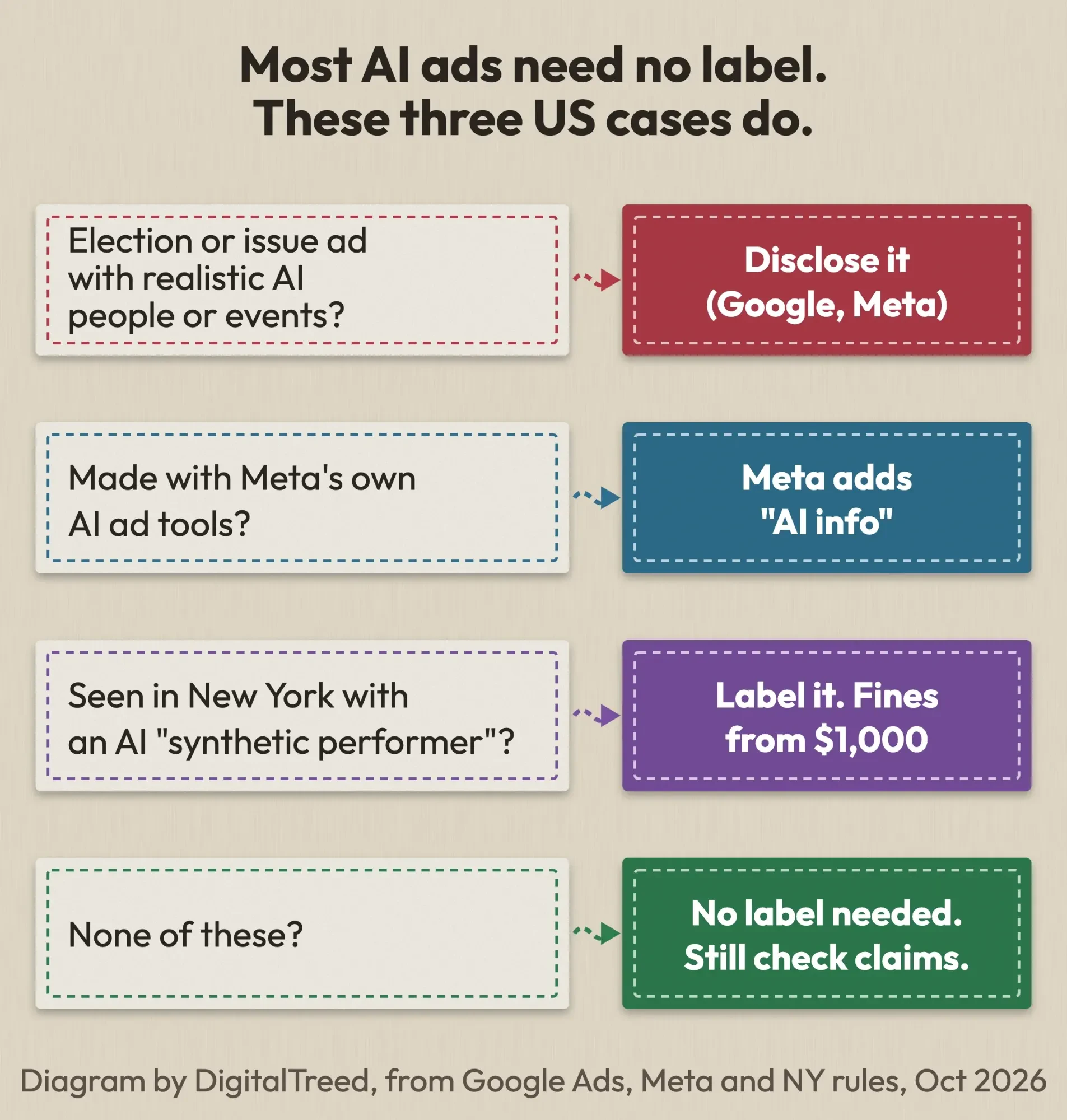 Diagram by DigitalTreed, from Google Ads, Meta and New York rules, October 2026.
Our take: label any ad that shows a realistic person who doesn't exist, wherever it runs. It costs a line of small text, and it's the exact case lawmakers are writing rules about.
This table, like the email, review and copyright parts of this guide, is a marketer's reading of the rules, not legal advice. If you run political or issue ads, or New York ads with AI people in them, have a lawyer read the actual rule first.
A support chatbot works when it answers only from your own pages
Chat is different: here AI talks to your customers directly, so a mistake costs more. Fewer firms go there: the Census supplement shows 7.6% using AI in customer service, about half the sales and marketing figure.
The setups that work keep the bot on a short leash. Give it your FAQ, prices, hours and policies. Tell it to say it doesn't know and hand over to a person when the answer isn't there. Then read a sample of its chats every week, because that's where you'll spot the odd promise.
Anything the bot promises, you've promised.
Be careful with customer data, too.
Don't paste names, orders or phone numbers into a free tool before you've read what it does with them. Among firms with no plans to use AI, 20.7% named privacy or security worries in the same Census supplement. We compared nine tools on price and speed in our AI chatbot guide.
Let AI summarize your reports, then check the numbers
Reports are a calmer job to hand over, and a good fit. Export last month's traffic or ad results, ask for the three biggest changes, and you'll get a readable summary in seconds.
Then open the real report and check each number.
Summaries drop context and now and then invent a figure. AI also can't fix data you never collected: if your links aren't tagged, no tool can tell which email brought the sale. The UTM builder on our site tags each campaign link in seconds, free. For the reports themselves, follow the Google Analytics 4 setup guide.
You might not own what the AI made
Ownership is the rule most owners don't expect. The US Copyright Office said in January 2025 that AI output is protected "only where a human author has determined sufficient expressive elements," and "not the mere provision of prompts."
In plain terms, a logo that came straight out of an image tool may not be yours to stop others copying. Text you wrote and AI tidied, or AI pieces you rearranged and changed, can still be protected.
So if a brand asset matters, have a person make it or substantially rework it. The Office also has registration guidance for works that include AI material.
How to use AI in digital marketing in your first month
That's a lot of rules. Here's a calm way to start without breaking any of them.
- Week 1, drafts only: pick a channel you already run, usually email or social posts, and use AI only to draft. You still edit and send.
- Week 2, a rule sheet: write one page on what AI may draft, what a person checks, who approves, and what never goes into a free tool, such as customer data.
- Week 3, one more job: try ad headline variants or a report summary. Run it next to your usual version so you can compare.
- Week 4, keep what worked: count the time saved and the errors caught. Keep the jobs that saved time without new mistakes, and drop the rest.
Then make one habit stick. Before anything AI-made goes out, check:
- Every number, price, date and rating against its source.
- Names, quotes, laws and certifications.
- No invented reviews, testimonials or customers.
- The title, meta description and image alt text.
- A label, if a realistic fake person or event appears.
- Would you sign your name under it?
That last question catches more than the other five.
Frequently asked
Should I tell readers that AI helped write a page?
Google suggests it when automation did much of the work. Its helpful content guidance asks whether the use of AI is self-evident to visitors and whether you explain how and why it was used, as of October 2026. A short note on how the page was made is enough.
Can I use AI-generated product photos in Google Shopping?
Yes, with a label built in. As of October 2026, Google Merchant Center says every image made with generative AI must carry metadata marking it as AI-generated, such as the IPTC DigitalSourceType tag. Don't strip that tag when you edit or compress the file.
Can AI write my product titles and descriptions for Google Shopping?
It can, but the data needs a label. Google's guidance on generative AI content says AI-generated title and description attributes must be specified separately and labeled as AI-generated in Merchant Center, as of October 2026. Check each one for wrong sizes, prices or claims first.
Where a person still has to own the work
AI cuts the typing.
It doesn't decide what to say, who it's for or whether a claim is true, and that's most of marketing.
Firms in the Census survey describe it the same way. Of those using AI, 43.7% said it helped with a task an employee still does, against 10.1% who said it took a task over. And 95.7% said their headcount didn't change.
Want a person to own that part? Our content marketing team writes and fact-checks posts, emails and pages for small businesses. It's our paid service, so now you know where our interest lies. You can also ask for a quote first.
How we made this guide: our team read the rules and data files linked here and finished the last check on October 25, 2026. We read the New York law only through the AP report, because the state's site blocked our requests. On that day we downloaded the Census Bureau's public Business Trends and Outlook Survey files and built both Census charts from them ourselves. We also took the Google screenshot from its public page with no account. We didn't test any chatbot or AI tool, since each one needs an account. Facts link to their sources where they appear. Fieldstone Chimney & Masonry is made up. Aijaz Alam reads this rewrite and approves it before it goes live.
First published June 2023. Rewritten October 25, 2026: new text for US small businesses, our charts from the Census AI data, a channel-by-channel guide, and the FTC, Google, Meta, New York and Copyright Office rules. The old unsourced claims are gone.
Sources
- U.S. Census Bureau: Business Trends and Outlook Survey data
- U.S. Census Bureau: Large Firms With at Least 20 Employees Biggest AI Users (May 2026)
- U.S. Census Bureau: working paper CES-WP-26-25 on AI diffusion (April 2026)
- Pew Research Center: share of Americans who use ChatGPT (2026)
- Google Search Central: guidance on using generative AI content
- Google Search Central blog: guidance about AI-generated content (February 2023)
- Google Search Central: spam policies
- Google Ads Help: About generated images in Google Ads
- Google Ads policy: disclosure requirements for synthetic content (July 2024)
- Meta Help: how AI-generated images in ads are identified and labelled
- Meta Transparency Center: ads about social issues, elections or politics
- Associated Press via WTOP: New York synthetic performer ad law (June 2026)
- eCFR: 16 CFR Part 465, Rule on the Use of Consumer Reviews and Testimonials
- Federal Register: final rule on consumer reviews and testimonials (August 2024)
- FTC: final rule banning fake reviews and testimonials (August 2024)
- eCFR: 16 CFR 1.98, adjusted civil penalty amounts
- eCFR: 16 CFR Part 255, Endorsement Guides
- FTC: crackdown on deceptive AI claims and schemes (September 2024)
- FTC: final order with DoNotPay (February 2025)
- FTC: Rytr LLC case, order reopening and setting aside the 2024 order (December 22, 2025)
- 15 U.S.C. 7704, CAN-SPAM requirements (Cornell LII)
- FTC: CAN-SPAM Act compliance guide for business
- U.S. Copyright Office: Part 2 of the Artificial Intelligence Report (January 2025)
- Federal Register: copyright registration guidance for works with AI-generated material (March 2023)
Comments
No comments yet. Start the conversation below.