

Quick answer
Guest posting still works with Google when the article informs another site's readers. As of November 2026, Google's link spam policy names guest posts whose links carry optimized anchor text, and paid placements need rel="sponsored" or rel="nofollow". Start with one blog whose readers match yours, a short pitch to its editor, and a bio with one brand-name link.
Guest posting is a trade: you write an article that another site publishes under your byline, and a short bio links back to you. Paid placements and posts you pitch yourself fall under different Google rules. Paid links have to be marked. That matters if a vendor has offered to place guest posts for your business for a fee.
The rules come from three places: Google Search Central for links, the FTC for paid posts, and Gmail's sender rules if you pitch in volume. Our examples follow Fernwick Bookkeeping, a made-up three-person firm, through one pitch and one draft.
Key takeaways
- Google lists optimized anchor text in guest posts as an example of link spam.
- Paid or gifted placements need rel="sponsored" or rel="nofollow" on every link.
- Moz scores Domain Authority from 1 to 100, and Google does not use it.
- Our made-up template pitch passed 1 of 9 checks, and the rewrite passed 9.
- One brand-name bio link with UTM tags shows the visits a post sends.
Guest posting SEO: where Google draws the link spam line
Google doesn't ban guest posts. Its webspam team said so on May 25, 2017, in a Search Central post on large-scale article campaigns. Google "does not discourage these types of articles in the cases when they inform users, educate another site's audience or bring awareness to your cause or company." It objects when the main intent is "to build links in a large-scale way back to the author's site."
The rule that applies now is on Google's spam policies page for web search, which showed a last update of August 28, 2026. Link spam there means "the practice of creating links to or from a site primarily for the purpose of manipulating search rankings." Its examples include "Exchanging money for links, or posts that contain links" and "Sending someone a product in exchange for them writing about it and including a link."
Guest posts get their own line. Google names "links with optimized anchor text in articles, guest posts, or press releases distributed on other sites." Its example is three sentences about wedding rings carrying five links, and every anchor is a keyword phrase such as best ring, buy flowers or wedding dress. None is a brand name. Now swap in a bookkeeping firm. One bio link with the firm's name as the anchor is nowhere near that line. Three body links on phrases like affordable bookkeeping for small business match Google's example, paid or not. For links in general, see our explainer on backlinks that help SEO.
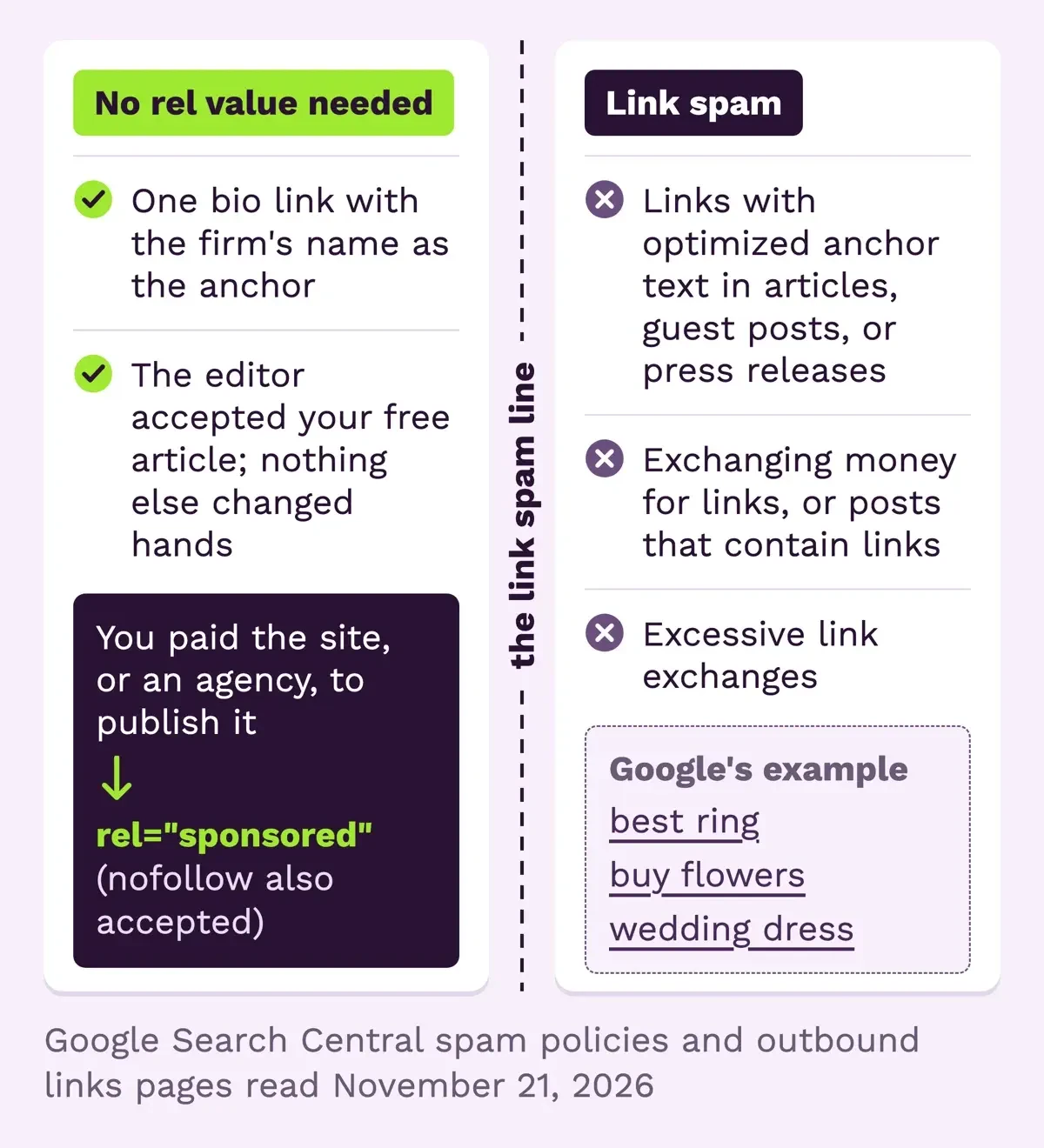 Diagram by DigitalTreed, from the Google Search Central spam policies and outbound links pages read November 21, 2026.
Which rel value does a guest post link need?
It depends on whether anything of value changed hands for the post. Google's guide to qualifying outbound links was last updated December 10, 2025. It says to mark "advertisements or paid placements" as sponsored, and that nofollow "is still an acceptable way to flag them" too. Plain links need nothing. "For regular links that you expect Google to fetch and parse without any qualifications, you don't need to add a rel attribute." The spam policy says the same from the other side. Buying and selling links is a normal part of web advertising, it says, and such links don't break its rules once they're qualified.
| What happened | Link marking (Google) | Reader label |
|---|---|---|
| The editor accepted your free article; nothing else changed hands | No rel value needed | No paid label needed |
| You paid the site, or an agency, to publish it | rel="sponsored" (nofollow also accepted) | Label the post as paid |
| You sent a free product or service in return for the post | rel="sponsored" | Label the post as paid |
| You swapped posts or links with another site as a habit | Listed as link spam when excessive | Not a labeling fix |
| A reader adds a link in the comments under your post | rel="ugc" | Host site decides |
Readers never see a rel value. A paid or gifted post needs a notice they can read. The FTC's guidance on native ads says "it's deceptive to mislead consumers about the commercial nature of content." A needed disclosure has to appear clearly and prominently, so a paid post gets a plain Sponsored label near the top. We show label wording in how to write a sponsored blog post readers trust. The host's editor sets the rel value on their own site, so don't buy from a seller who promises you a followed link on someone else's blog. Sellers can read our guide on guest post buyers who never pay.
Choosing a blog whose readers match yours
Choose the host blog first. Google's 2017 post accepts guest articles that inform the host's users, so who those users are decides whether your post belongs there.
Sellers usually quote Domain Authority, a score built by the SEO software company Moz. The Moz page on Wikipedia now lists places, people and other things by that name. It has no entry for the company, so our facts come from Moz itself. Moz's Domain Authority explainer says the score "ranges from 1 to 100" and "is not a Google ranking factor and has no effect on the SERPs." You can look one up with our Domain Authority checker guide, but it won't tell you who reads the site.
Google's 2017 post lists the questions a careful host should ask about anyone who sends an article, and they work just as well turned around. "Do I know this person?" "Does this person's message fit with my site's audience?" "Does the article contain useful content?" Answer all three yourself before you pitch anyone. For Fernwick Bookkeeping, the right host is a blog that one-person shop owners already read. Give a candidate site twenty minutes and look for these six signs. The fourth follows the FTC's labeling guidance and the fifth Google's link rules; the other four are our own editorial checks.
- The last 10 posts are on topics your own customers ask about.
- Readers leave real comments or questions under recent posts.
- The site has a contributor or write-for-us page with rules you can follow.
- Paid or sponsored posts carry a visible label.
- Recent guest posts don't stack links to service pages on shopping phrases.
- An editor or team member is named, so your pitch can reach a person.
A site that fails the fourth or fifth check shows signs of selling links. For candidates to check, see our 65 checked write-for-us pages, niche sites to submit a guest post and a short pick of vetted guest post sites.
Writing a guest post outreach email
The pitch is a short email to one named editor, sent from your own mailbox rather than a tool that blasts the same text to hundreds.
Google's 2017 post says site owners "generally prefer not to receive aggressive or repeated" requests to publish articles, and it points them to Google's spam report form. A mass-mail pitch can land there. Our local checker scores a pitch on nine points taken from the editor's side of the inbox.
- A subject line of 60 characters or fewer that names the topic
- The editor's first name, from the masthead or contributor page
- One recent post on their site and what your piece adds to it
- A body of 75 to 250 words
- One to three specific titles written for their readers
- One to three links to articles you have already published
- No request for a dofollow link and no offer to pay
- A line saying the draft is original and unpublished elsewhere
- Your own name at the end, not a team signature
We ran those nine checks on two made-up pitches, and the template pitch passed only the length check, at 83 words. Its 94-character subject failed, along with its Dear Sir/Madam greeting and its offer of a fee for a permanent dofollow link. The rewrite passed all nine at 145 words by naming one post on the host blog and offering three titles.
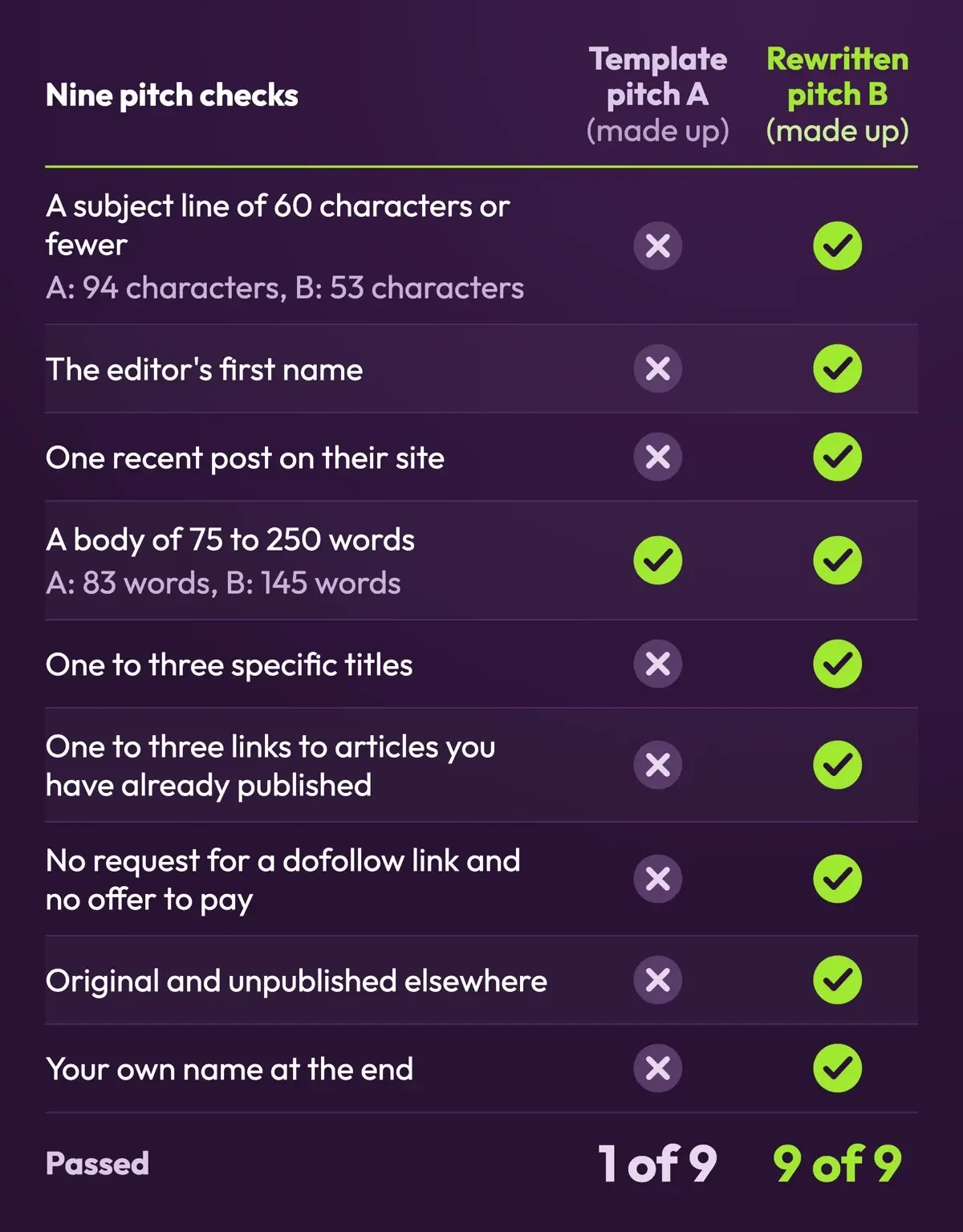 Drawn by us from our local check of two made-up pitches, November 21, 2026.
US email law can cover a pitch when the email also sells your services. The FTC's CAN-SPAM Act compliance guide covers "any electronic mail message the primary purpose of which is the commercial advertisement or promotion of a commercial product or service." It adds: "The law makes no exception for business-to-business email." The FTC says penalties reach $53,088 for each violating email, as of November 2026. A commercial message also needs your physical postal address and a clear way to opt out. Ask a lawyer whether a pitch for a free article counts as commercial, or simply include both lines.
Gmail adds its own limits. Google's email sender guidelines have applied to everyone sending to Gmail accounts since February 1, 2024, and extra rules start at 5,000 messages a day.
Every sender, however few emails they send, is told to keep spam rates reported in Postmaster Tools below 0.3%. Here's an example: 3 spam reports on 40 pitches is 7.5% (3 / 40), or 25 times that line (7.5 / 0.3). Postmaster Tools measures the rate its own way, so read that as a sense of scale, not as Gmail's figure.
Drafting a guest blog post an editor will publish
Once the editor says yes, write for the host's readers. Google's guide to creating helpful, reliable content asks: "Does the content provide original information, reporting, research, or analysis?" In a three-person firm, original usually means a checklist you use with clients, a mistake you fix every month or numbers from your own jobs.
Google's link best practices page calls anchor text "the visible text of a link" and adds that it "tells people and Google something about the page you're linking to." The SEO Starter Guide calls it "the text part of a link that you can see." Body links should go to sources a reader needs, like an IRS page. Your own site belongs in the bio.
Keep to the length and format the editor asked for. In your cover note, say whether any link in the draft is paid or affiliate.
In our made-up draft 1, all 5 links to the firm's site used keyword-style anchors such as cheap bookkeeper near me, and three of them sat in the body. Draft 2 kept the IRS link, cut the sales links from the body and gave the firm one bio link, with its name as the anchor.
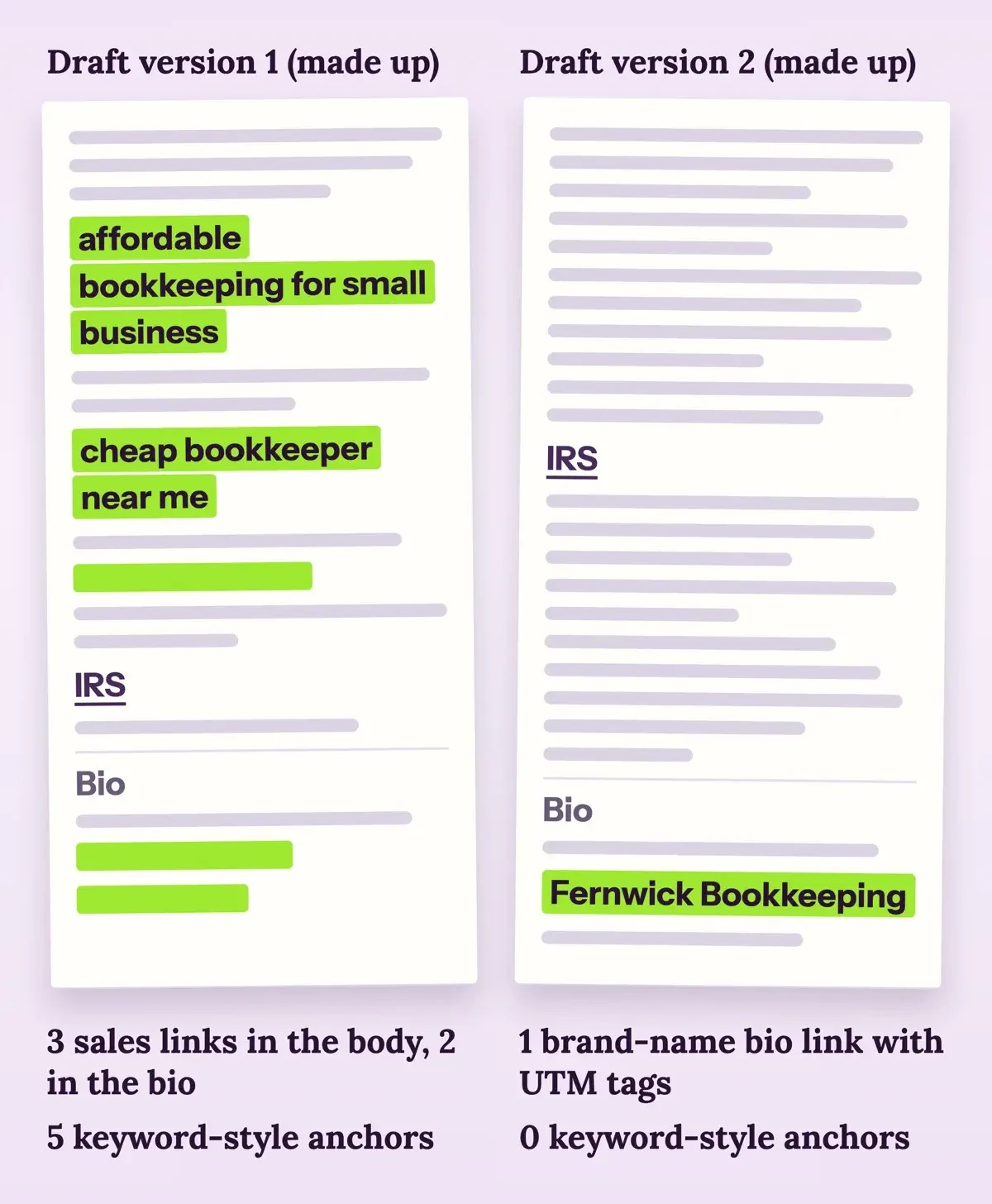 Drawn by us from our local check of two made-up drafts, November 21, 2026.
What we tested
On November 21, 2026, we wrote two made-up pitches and two made-up drafts for Fernwick Bookkeeping. Our Python script scored each pitch on the nine points and counted links, anchors and UTM tags in each draft. The thresholds are ours.
| Sample | Result | Notes |
|---|---|---|
| Template pitch A (made up) | 1 of 9 | 83 words; asks for a dofollow link |
| Rewritten pitch B (made up) | 9 of 9 | 145 words; names one host post |
| Draft version 1 (made up) | 5 keyword-style anchors | 3 sales links in the body, 2 in the bio |
| Draft version 2 (made up) | 0 keyword-style anchors | 1 brand-name bio link with UTM tags |
Pitch B's 53-character subject named the topic, and its 145 words held three titles, two published samples and the editor's first name.
Writing the author bio and tracking its visits
Draft 2's bio is one sentence: Sam runs Fernwick Bookkeeping, a three-person firm that closes the books for small shops every month. The firm's name is the only link. It tells readers why they'd click. Tag that link so visits show up in your analytics. Google Analytics Help lists the UTM parameters for campaign URLs: utm_campaign names the promo, utm_source the referrer and utm_medium the marketing medium. Draft 2 uses utm_source=smallbiz-ledger, utm_medium=referral and utm_campaign=guest_post_close. Ask the editor before tagging it. Once it's live, count the visits from the tagged link in Google Analytics, the inquiries that follow over the next month and any newsletter sign-ups from that page.
Search Console shows the link from Google's side. Per its Links report documentation, Top linking sites shows "the root domain of sites with the most links to your site, sorted by count of links." Check it a few weeks after launch. Our look at what business guest posts do for traffic and leads walks through measuring it.
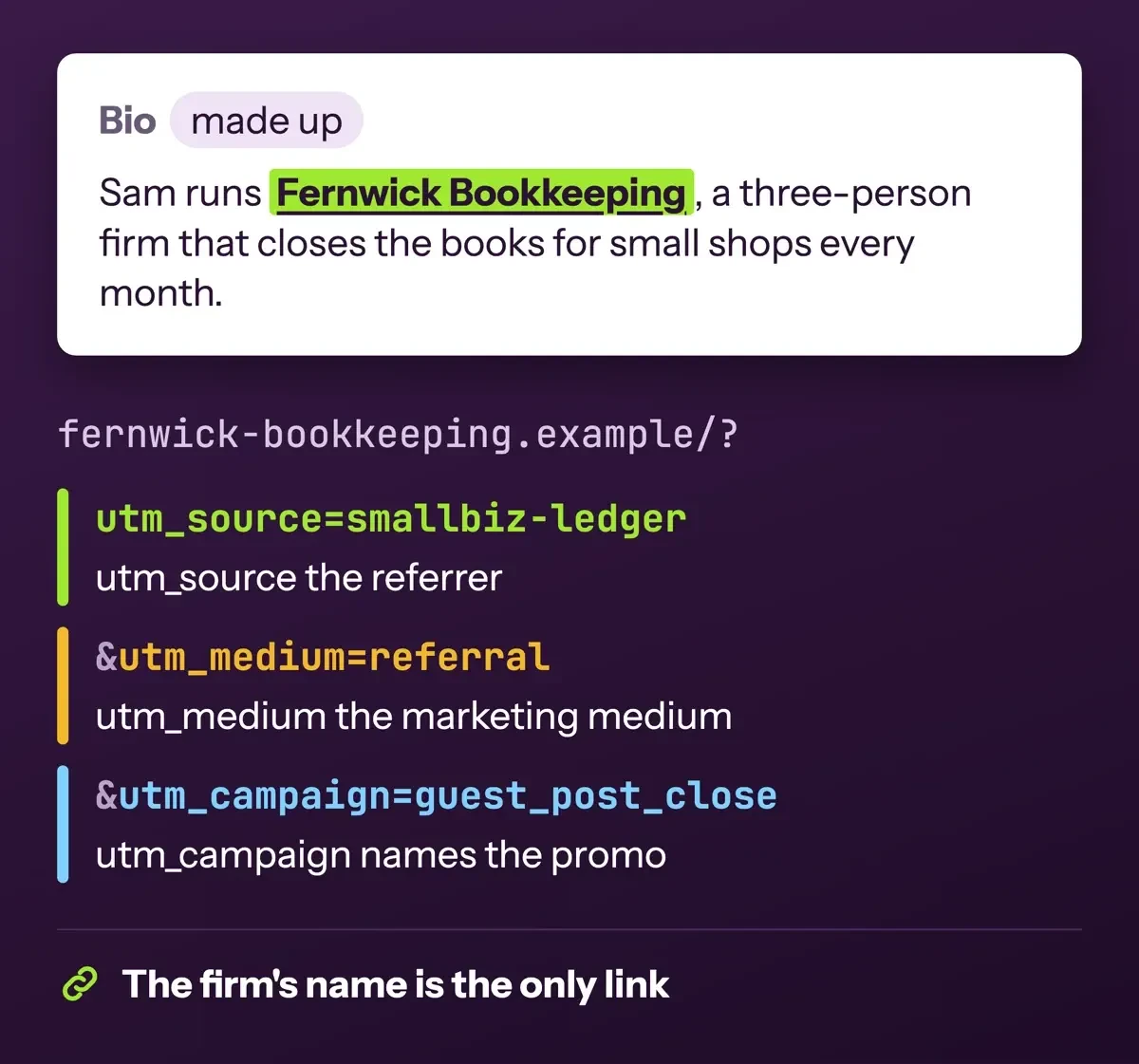 Diagram by DigitalTreed, from draft 2 of our made-up test and the Google Analytics Help UTM page.
Where our checks stopped, and what to check yourself
Every rule here comes from a page we read as plain text on November 21, 2026. Google Search Central gave us the link spam wording, the rel values and the 2017 guest post guidance. The FTC's own site gave us the CAN-SPAM penalty. Gmail's limits came from Google's help center, and the Domain Authority facts came from Moz. Some guides still quote a line about large-scale guest posting campaigns with keyword-rich anchor text links. That phrase isn't on Google's current spam policy page, so we quote the current wording. The federal register copy of the endorsement rules showed our checker a bot check. We used the FTC's guidance pages in its place.
The footer of the Wikipedia Moz page we link showed a last edit on June 19, 2026. Moz's Domain Authority explainer showed a last update of March 18, 2025.
Google doesn't publish how much one guest post link counts. We make no ranking promise. Before you pitch, read the host's contributor rules and link policy, and check the last-updated date on Google's page.
Frequently asked
Is a link exchange with another blogger allowed?
Google's link spam rules name "Excessive link exchanges" and "partner pages exclusively for the sake of cross-linking" as link spam.
Can I republish my guest post on my own blog?
Google's 2017 guidance says duplicating a full article from your own site calls for rel="canonical" plus rel="nofollow" on the copy.
Why doesn't my guest post link show in Search Console?
The Links report "shows a sample of internal and external links" and its tables are limited to 1,000 rows.
Does the FTC go after guest post writers?
Per the FTC's answers on endorsements, its "focus usually will be on advertisers or their ad agencies and public relations firms."
How we made this guide: We read Google, FTC and Moz pages as plain text, then scored made-up pitches and drafts with our own script. Facts checked by the DigitalTreed team on November 21, 2026.
First published July 25, 2021 as a general guest posting guide. Rewritten November 21, 2026 around Google's link rules and one pitch, start to finish.
Sources
- Google Search Central: Spam policies for Google web search
- Google Search Central: Qualify your outbound links to Google
- Google Search Central Blog: A reminder about links in large-scale article campaigns
- Google Search Central: Link best practices for Google
- Google Search Central: SEO Starter Guide
- Google Search Central: Creating helpful, reliable, people-first content
- FTC: Native Advertising, A Guide for Businesses
- FTC: FTC's Endorsement Guides, What People Are Asking
- FTC: CAN-SPAM Act, A Compliance Guide for Business
- Gmail Help: Email sender guidelines
- Search Console Help: Links report
- Google Analytics Help: Collect campaign data with custom URLs
- Moz: What is Domain Authority?
- Wikipedia: Moz


Comments
No comments yet. Start the conversation below.