

Quick answer
A Domain Authority checker shows Moz's 1-to-100 score for how likely a site is to rank, built mostly from links in Moz's own index, as of November 2026. The score is relative, so a 30 can be strong in one niche and weak in another, and Moz says Google doesn't use it. Check yours free in Moz Link Explorer, then compare it only with your rivals.
Maybe an email landed this week offering "DA 50+ guest posts," and you went looking for a Domain Authority checker to see what your own site scores. Domain Authority is a score from the SEO company Moz that predicts how well a whole site may rank, based mostly on the links pointing to it. We'd check it once, write it down, and spend far more time on what Google itself measures.
As of November 2026, Moz shows the number free in two places: Link Explorer, 10 queries a month with an account, and Domain Analysis, "3 free reports per day."
Key takeaways
- Compare your DA only with sites ranking for your own searches.
- Moz Link Explorer gives 10 free lookups a month with an account.
- Moz says new websites always start at a Domain Authority of 1.
- Google says third-party tools have no access to its ranking data.
- Buying links to raise any score breaks Google's link spam policy.
What is Domain Authority, in Moz's own words?
Moz's Domain Authority page calls DA "a search engine ranking score developed by Moz" that predicts how likely a website is to rank against competitors. The score runs from 1 to 100. Moz builds it with a machine learning model fed mostly by backlink data from its own Link Explorer index. Linking root domains, meaning separate websites that link to you, are among the most important inputs, per Moz.
Moz's Page Authority page describes this kind of score on a "100-point logarithmic scale." The DA page adds that it's "easier to grow your score from 20 to 30 than it is to grow it from 70 to 80." Moz's own example is Facebook gaining a billion new links. Every other site's DA would drop relative to Facebook, even if nothing about those sites changed.
Moz says there's no universal good or average score, and "a DA of 30 might be exceptional in one industry but low in another." It also says "New websites always start with a Domain Authority of 1," which corrects a common claim that new sites begin around 5 to 15. Scores move when your links change, when rivals' scores change, or when Moz updates the model. Moz's page also notes that sites with links from trusted domains like Wikipedia tend to score higher, while small local business sites often score lower with fewer inbound links.
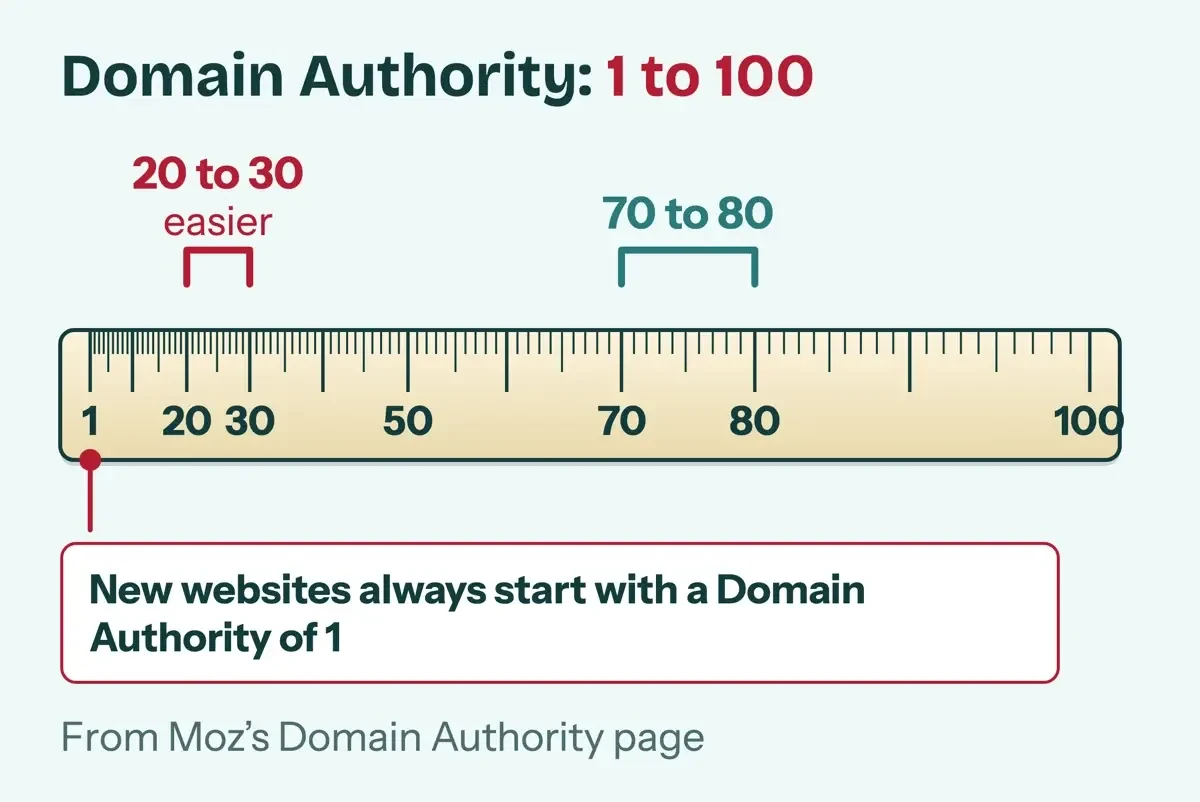 Diagram by DigitalTreed: why a 20-to-30 gain is easier than 70-to-80 on a log scale, from Moz's Domain Authority page.
Page Authority, DR and Authority Score are different numbers
Not every free checker shows Moz's number. Ahrefs's Website Authority Checker page says its Domain Rating is "not to be confused with the Domain Authority (DA) metric from Moz." Each row below describes a score in its maker's own terms.
| Score | Made by | Scale | Built from, per the maker |
|---|---|---|---|
| Domain Authority (DA) | Moz | 1 to 100 | Machine learning over link data, mainly linking root domains |
| Page Authority (PA) | Moz | 1 to 100 | The same approach for one URL |
| Domain Rating (DR) | Ahrefs | 0 to 100 | Unique linking domains, weighted by their own DR |
| Authority Score (AS) | Semrush | 1 to 100 | Link power, organic traffic and six spam checks |
Ahrefs's Domain Rating help page says a site divides its rating equally among the domains it links to. By that page's example, a DR-10 site linking to three domains can move your DR more than a DR-80 site linking to a million. Semrush's Authority Score article calls its score a "compound metric that grades the overall quality of a website or a webpage." It also folds in traffic and spam checks, so it can land far from DA for the same site. Ahrefs adds that DR tracks Google rankings less closely than its page-level URL Rating does.
When you report a score, name the vendor beside it: "Moz DA 24" or "Ahrefs DR 31," never a bare "authority 24." Both numbers are made-up examples.
Free ways to check DA and PA with a Domain Authority checker
Real DA and PA come only from Moz, which owns both. These routes are from its own pages, read November 11, 2026.
- Link Explorer: per Moz's Link Explorer page, you enter a URL, create and verify a free account, then "Get 10 free queries per month." Results include DA, PA, Spam Score and link counts.
- MozBar: a "free extension for both Google Chrome and Firefox," per the MozBar page, showing PA, DA and Spam Score as you browse. Brand Authority needs Moz Pro.
- Domain Analysis: Moz's Domain Analysis page shows DA, PA, ranking keywords and top competitors for a domain with "no login required." It offers "3 free reports per day" as of November 2026. Our scripted check got a 403 there; the page loads in a browser.
Spend the 10 monthly Link Explorer queries on your own home page, two or three rivals that outrank you, and one site you might get a link from. That's four or five lookups in this example plan. For bulk checks, Moz's DA page points to the Moz API; its pricing page refused our checker, so we list no price. Weighing a paid plan? Read our Moz Pro guide for what the plan adds.
Ahrefs and Semrush run free checkers too, but they show their own metrics rather than Moz DA. The Ahrefs checker returns Domain Rating, and its page offers a free DR API to "Pull DR for as many domains as you need." Semrush's Website Authority Checker shows Authority Score from 1 to 100 with backlinks, referring domains and estimated organic traffic. Our Ahrefs review covers that suite's paid plans.
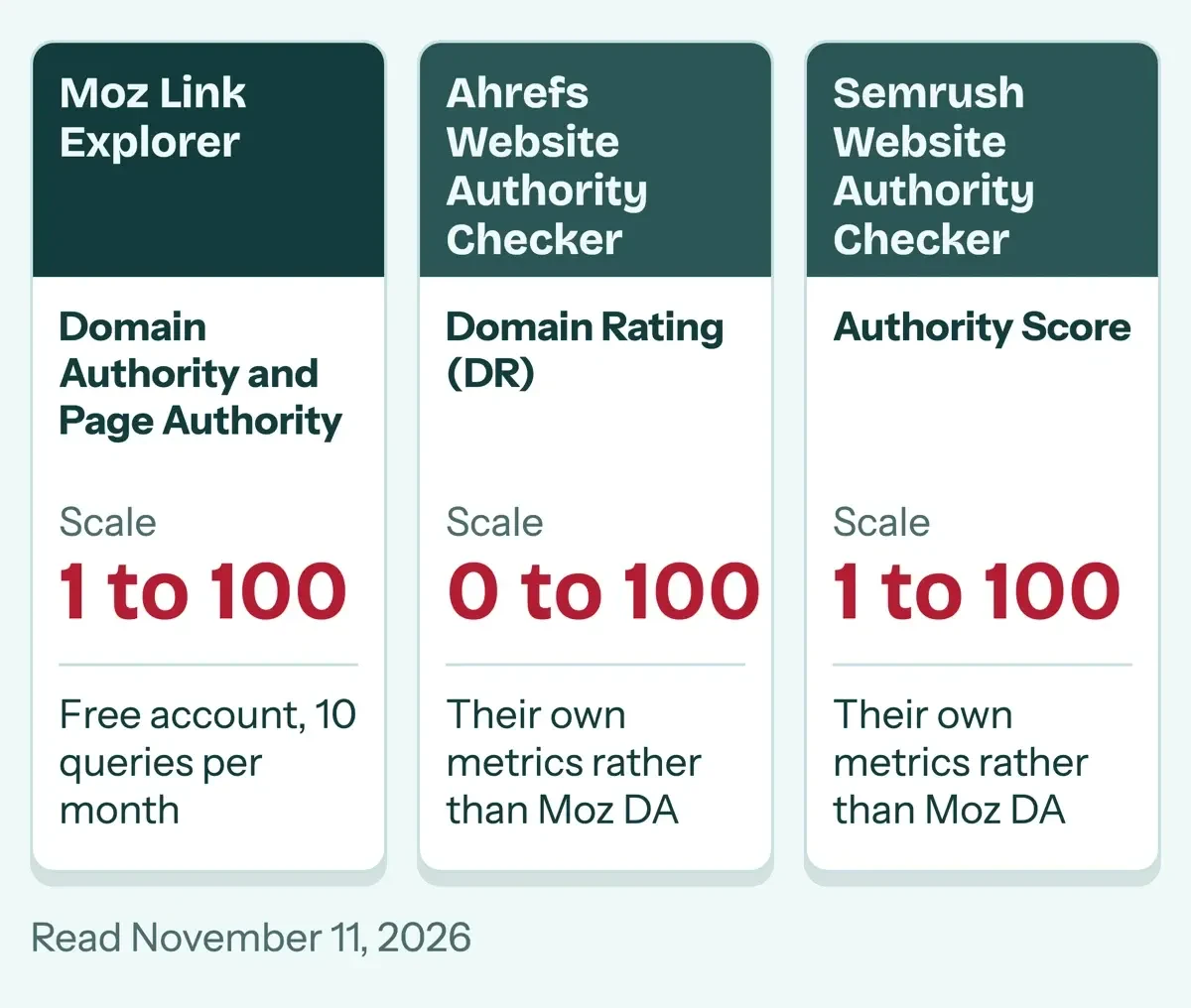 Drawn by us: what each free authority checker shows, from the Moz, Ahrefs and Semrush pages read November 11, 2026.
Why Google doesn't use Domain Authority
Moz's own DA page says Domain Authority "is not a Google ranking factor and has no effect on the SERPs." Google agrees. Its page on hiring an SEO states "Google doesn't evaluate or endorse third-party SEO tools," and adds that those tools can't see its internal ranking data. Google's guidance on third-party SEO tools goes further. It says some tools provide data that users "misinterpret as somehow being from Google," and adds, "Any predictions are their own." A seller's "DA 50+" pitch leans on that confusion, since the number sounds official but comes from Moz's index.
Links still count with Google, just through its own systems. Google's ranking systems guide says PageRank, its original link system, "continues to be part of our core ranking systems." The SEO Starter Guide adds that Google has many signals and "PageRank is just one of those." Moz's page also warns that DA and PageRank are separate tools with different methods, a point our breakdown of Google ranking systems covers. E-E-A-T, Google's shorthand for experience, expertise, authoritativeness and trust, gets the same mix-up. Google's helpful content page says "E-E-A-T itself isn't a specific ranking factor." Google adds that "using a mix of factors that can identify content with good E-E-A-T is useful." Our ranking factors check sorts more claims.
Our test: why a DA-style score jumps around
Moz's Facebook example is hard to picture, so we rebuilt it with a script and a made-up web of 63 sites with .example names and 136 links. The script gives each site a raw score, its share of link credit after 100 rounds of passing credit along links, then log-scales the results from 1 to 100. It's a toy, not Moz's model, and it copies only two ideas the vendors state: credit splits across outbound links, and scores are relative.
First, we gave a made-up bakery one link from a small site linking out to 2 domains. A made-up plumber got one link from the top site, which held 46.6 times the small site's raw score but linked out to 1,000 domains. Per link, the small site passed 10.7 times more credit, and the bakery ended with 1.37 times the plumber's raw score, in line with the split-credit idea on Ahrefs's page.
Next, the top site got 500 new made-up linking domains and nothing else changed. Site03 fell from 51 to 35 without losing a single link. In all, 16 of the 63 original sites dropped, and only site05 rose, because the top site links to it.
Ahrefs gives the same answer for its own score. Asked why DR fell with no lost backlinks, its help page answers: "Most likely, other websites gained a lot of backlinks."
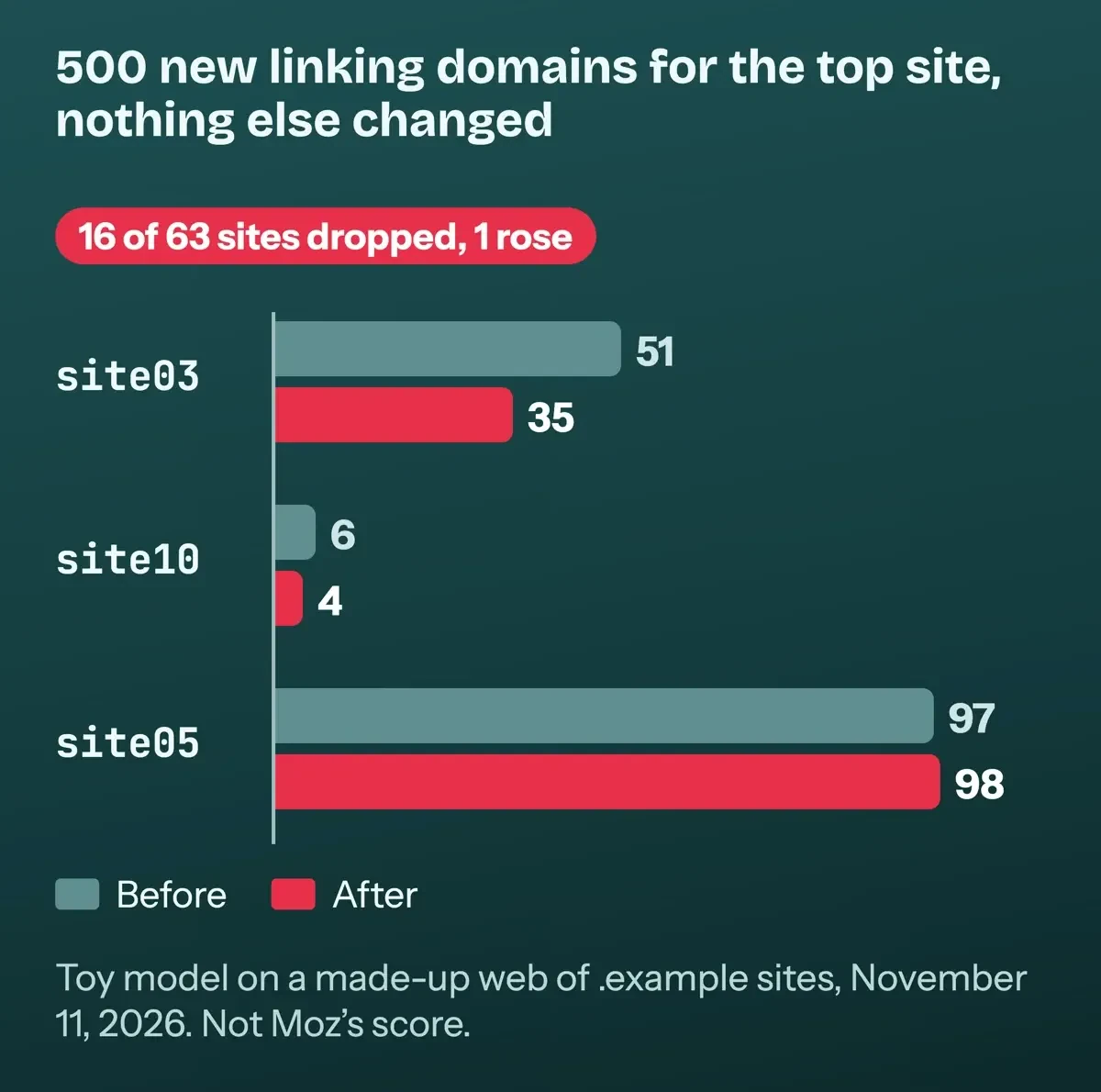 Diagram by DigitalTreed: our toy_authority.py run on November 11, 2026, on a made-up web of .example sites.
What we tested
We ran test/toy_authority.py offline on November 11, 2026, and saved its output as results.json and run-log.txt. Every domain in it is made up.
What actually builds authority with Google
Google's How Search Works page says one quality factor is whether "other prominent websites link or refer to the content." Its helpful content page asks whether your content offers "original information, reporting, research, or analysis." A landscaper who publishes the real cost of 20 local jobs gives other sites a reason to link, and a rewrite of someone else's tips gives them none. The SEO Starter Guide adds: "One of the most effective and lasting ways is word of mouth." Our backlink guide and off-page SEO checklist cover outreach.
Google's spam policies define link spam as "creating links to or from a site primarily for the purpose of manipulating search rankings." Its examples include several things DA sellers push:
- Paying money, goods or services for links meant to boost rankings
- Excessive link swaps ("Link to me and I'll link to you")
- Automated programs or services that build links
- Low-quality directory or bookmark site links
- Keyword-optimized anchor text in guest posts and press releases
Paid placements are allowed when they are labeled. Google's outbound link guidance asks you to mark "advertisements or paid placements" with rel="sponsored" and calls nofollow "still an acceptable way to flag them." The spam policy lists "text links that don't block ranking credit" as link spam. For bad links you never bought, Google's disavow help page says "most sites will not need to use this tool." It advises a disavow only with "a considerable number of spammy, artificial, or low-quality links" plus a manual action, or one likely to come. Moz's DA page tells readers to disavow "toxic" links, but Google's page sets the stricter bar. If you meet it, our disavow file generator formats the list.
Google's own advice: "we strongly encourage using our first-party tool, Google Search Console." Its Links report shows top linking sites and top linked pages, but warns "This report isn't a comprehensive list of every link on your site."
Its tables "are limited to 1,000 rows." Our small business SEO audit guide shows where the report fits in a monthly check.
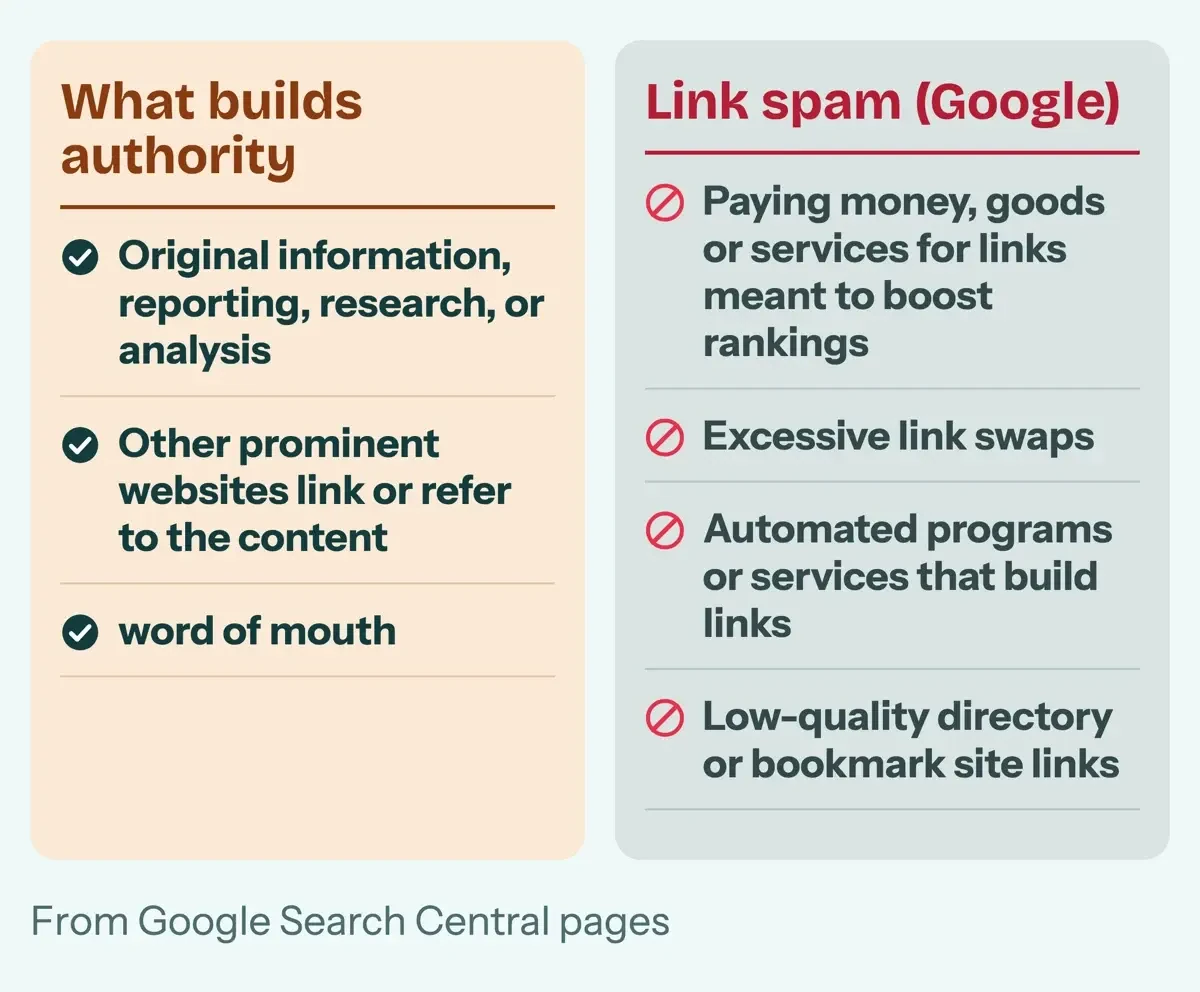 Diagram by DigitalTreed: what builds authority versus what Google calls link spam, from Google Search Central pages.
How to read a DA number a seller quotes
The first four questions below come from Ahrefs's DR help page, written about its own score; the fifth is ours:
- Does the site get organic traffic of its own?
- Is it on the same topic as your business?
- Does it link out to lots of other websites?
- Will it likely still be around in a year?
- Will a paid link carry rel="sponsored"?
A no on that last question means the deal asks you to break Google's link spam policy, whatever the DA. We'd pass and put the money into one piece of original content, after a free DigitalTreed website audit of your own site's SEO, speed and security.
Frequently asked
Which Domain Authority score counts as good?
None by itself. Moz says DA is relative, so aim to match or beat the sites ranking for your searches.
Why did my Domain Authority drop?
Moz lists three causes: shifts in your backlinks, rivals' scores rising, and model updates. Its PA page says the algorithm is updated constantly.
Is Domain Rating the same as Domain Authority?
No. DR is Ahrefs's 0-to-100 score, and its checker page says DR ignores link spam, traffic and domain age.
Can I check DA in bulk for free?
Link Explorer's free tier stops at 10 queries a month. Moz's DA page points bulk checks to the Moz API.
How we made this guide: Every page in Sources but one was saved as text on November 11, 2026, and each quote was matched against those copies. Moz's Domain Analysis page blocked our scripted check and was read in a browser the same day. We looked up no real site's score and signed up for no tool. Facts checked by the DigitalTreed team on November 11, 2026.
First published March 2025 as a page selling a manual DA check service. Rewritten November 2026 as a neutral guide to checking and reading DA; the service, its form and unsourced claims about typical scores were cut.
Sources
- Moz: Domain Authority, what it is and how it is calculated
- Moz: What is Page Authority?
- Moz: Link Explorer, check your backlinks for free
- Moz: Free Domain Authority Checker (Domain Analysis), 403 to our checker, opens in a browser
- Moz: MozBar SEO extension and toolbar
- Ahrefs: Website Authority Checker
- Ahrefs Help: What is Domain Rating (DR)?
- Semrush Knowledge Base: What is Authority Score?
- Semrush: Website Authority Checker
- Google Search Central: Do you need an SEO?
- Google Search Central: Guidance on third-party SEO tools and advice
- Google Search Central: A guide to Google Search ranking systems
- Google Search Central: SEO Starter Guide
- Google Search Central: Creating helpful, reliable, people-first content
- Google: How Search Works, ranking results
- Google Search Central: Spam policies for Google web search
- Google Search Central: Qualify your outbound links
- Search Console Help: Links report
- Search Console Help: Disavow links to your site
Comments
No comments yet. Start the conversation below.