
Quick answer
Business guest posts are worth it for reach, referral visits, brand searches and leads from readers who already trust the host site. They aren't a safe way to buy rankings, since Google treats paid links that pass ranking credit as link spam. Pay only when the readers match your buyers, the post is labeled, and the cost per lead beats your other channels.
A business guest post is an article you write, or have written in your name, for another company's blog, a trade magazine or an industry site. Back in 2021, this article promised SEO gains and a pile of backlinks. That pitch hasn't aged well. We've rewritten it for US owners and marketers who want to know what the money or the hours really buy.
Below you'll find five things a guest post can do, and why the link won't buy you rankings. Then come the 38 contributor pages we read for what they say about your link, the label paid placements need, and when paying is worth it, with a worked example. The last parts cover how to measure results and where earned and paid spots differ.
Key takeaways
- A guest post's real value is the host's readers, not the link.
- Google treats paid links that pass ranking credit as link spam.
- Mark paid links rel="sponsored" and label the post for readers.
- 12 of 38 contributor pages we read say where your own link can go.
- Pay when the cost per lead beats what your other channels cost.
Five things a business guest post can do
In 2017, Google's Search Central blog said it doesn't discourage these articles "when they inform users, educate another site's audience or bring awareness to your cause or company." Each part of that maps to a number you can check.
The first is a new audience. A trade blog or an industry magazine has readers who've never heard of you but already trust the editor. In its starter guide to SEO, Google calls word of mouth "One of the most effective and lasting ways" to promote a site. A guest post is word of mouth with a byline, and the editor's choice to run it does the vouching that an ad can't do for you.
Second, referral visits. When a reader clicks through, Google Analytics files the visit under the Referral channel. Its default channel group page defines that channel as users who "arrive at your site via non-ad links on other sites/apps (e.g., blogs, news sites)." Those visits are few, but they're easy to count, and since they land on the page you linked, your analytics shows what each visitor did next.
A visitor who reads two more pages and books a call tells you more than a thousand impressions on a banner. One who leaves in ten seconds tells you the host's readers weren't your buyers.
Third, brand searches. Some readers won't click at all. They'll remember the name and look it up days later. That shows up in Search Console, which Google's page on Search Console and Analytics data says reports "which search terms bring people to your website (queries)." Fourth, leads. A visit only matters if it turns into something. Think form fills, booked calls and trials. In GA4, those actions are tracked as key events. The key events help page calls a key event "an event that measures an action that's particularly important to the success of your business."
The fifth is harder to measure: expertise signals. Google's helpful content guide says it helps readers judge content "when it's clear who created it." A byline on a respected business site, with a bio that says what you've done, makes your name easier to trust the next time a buyer sees it.
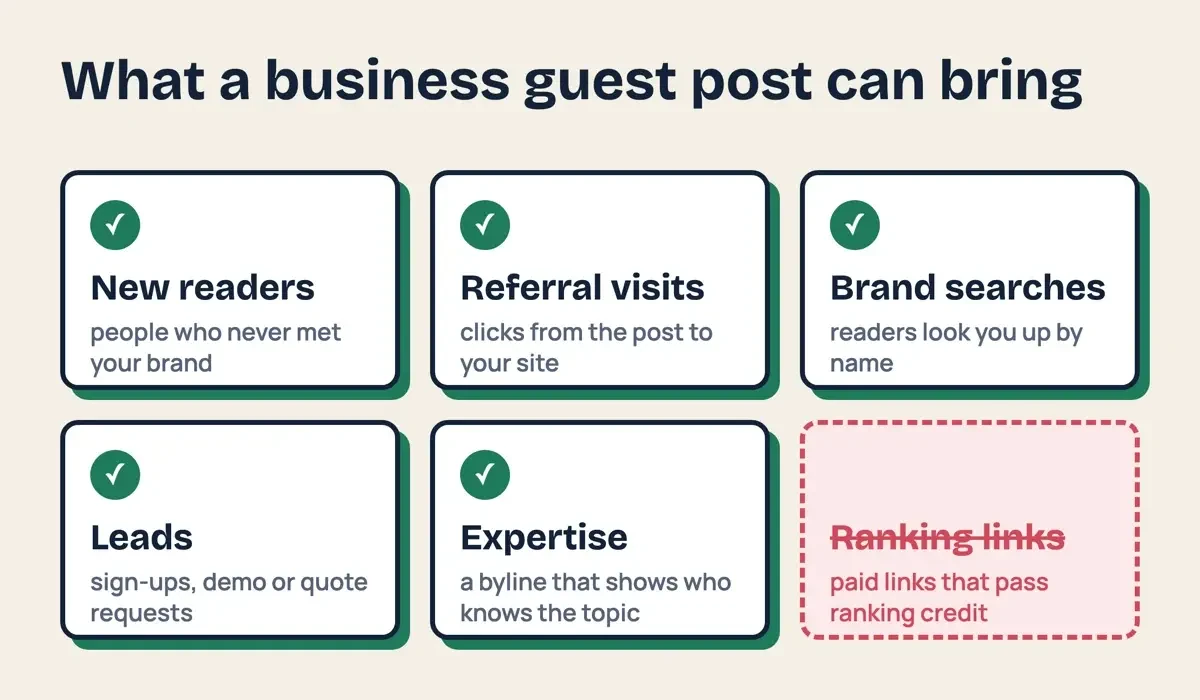 Diagram by DigitalTreed, from Google Search Central and Google Analytics help pages read November 1, 2026.
Why the link won't buy you rankings
Those five results all come from people. The link is where paid deals get risky. Google's spam policies define link spam as links created "primarily for the purpose of manipulating search rankings." One example is "Exchanging money for links, or posts that contain links." Another is links "with optimized anchor text in articles, guest posts, or press releases distributed on other sites."
So a paid post with a keyword-rich link that passes ranking credit is the exact pattern the policy names. Our backlink primer covers the basics if the idea is new to you.
The 2017 note lists warning signs that, "when taken to an extreme," can signal a link scheme. Stuffing keyword-rich links into your articles is one. Having articles published across many different sites is another, and so is hiring writers who don't know the topic. If a seller's offer reads like that list, you're paying for risk. Labels change how Google treats the link, not whether it exists. Google's nofollow update from 2019 says the sponsored, ugc and nofollow attributes "are treated as hints about which links to consider or exclude within Search." A labeled link can still send readers.
You just can't count on a labeled link to move rankings, so don't price it as if it will.
There's one more policy, aimed at the host site rather than you. Google's site reputation abuse post describes "third-party content" published on a host site "in an attempt to take advantage of the host's already-established ranking signals." A big business site that rents out a section to anyone who pays is taking that risk. Under the spam policies, a site found in breach "may rank lower in results or not appear in results at all." Your post goes down with the host, even if your article was good. That's one more reason to pick hosts whose editors still say no to most pitches.
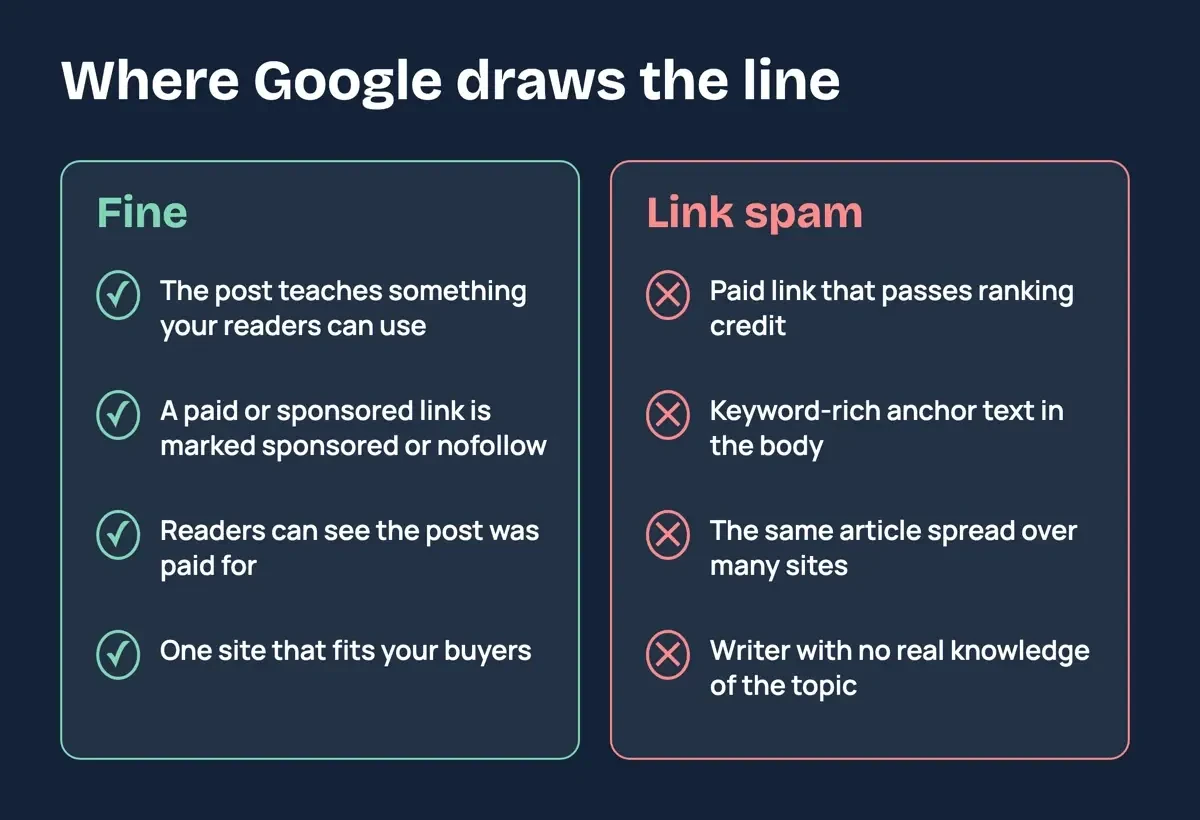 Diagram by DigitalTreed from Google's spam policies and its 2017 note on large-scale article campaigns, read November 1, 2026.
What 38 contributor pages say about your link
So what do editors tell guest writers about links? Here's what the contributor pages of the 38 business, technology and SaaS sites we kept say:
| Section | Pages read | Link allowed (bio or body) | Not a link-building route | No promotional writing | Pays writers | Refuses paid posts or links |
| Business | 14 | 5 | 3 | 10 | 1 | 4 |
| Technology | 18 | 4 | 3 | 8 | 4 | 1 |
| SaaS | 6 | 3 | 0 | 2 | 1 | 0 |
| All three | 38 | 12 | 6 | 20 | 6 | 5 |
Read the table as a rough map, not a ranking. Only 12 of the 38 pages say where your own link can go, and 10 of those mention a bio or byline link. Just 4 allow one inside the article. More than half, 20 of the 38, turn away promotional or self-promotional writing in plain words, and 6 say outright that the page isn't a backlink or link-building route.
Money runs both ways: 6 pages say they pay writers, from a per-article rate to an honorarium, and 3 say the work is unpaid. On the other side, 5 refuse money for posts or links, while 3 point companies to a separate sponsored option. Not one of the 38 pages names nofollow, a rel attribute or a "sponsored" link value, so if labels matter to you, ask the editor before you send a draft. And 8 pages say nothing about links, money or promotion at all.
So you earn a spot on these sites with a pitch, not a payment. Our business guest post sites guide lists the business pages we kept and how to pitch each kind.
What we tested
On October 31, 2026, we saved the contributor page of every business, technology and SaaS site that passed our site check, by plain GET. A day later, we tagged each page by hand, and a script checked every tag against the page's own words. Small business and branding pages weren't saved, so the 2 kept sites in that group aren't counted.
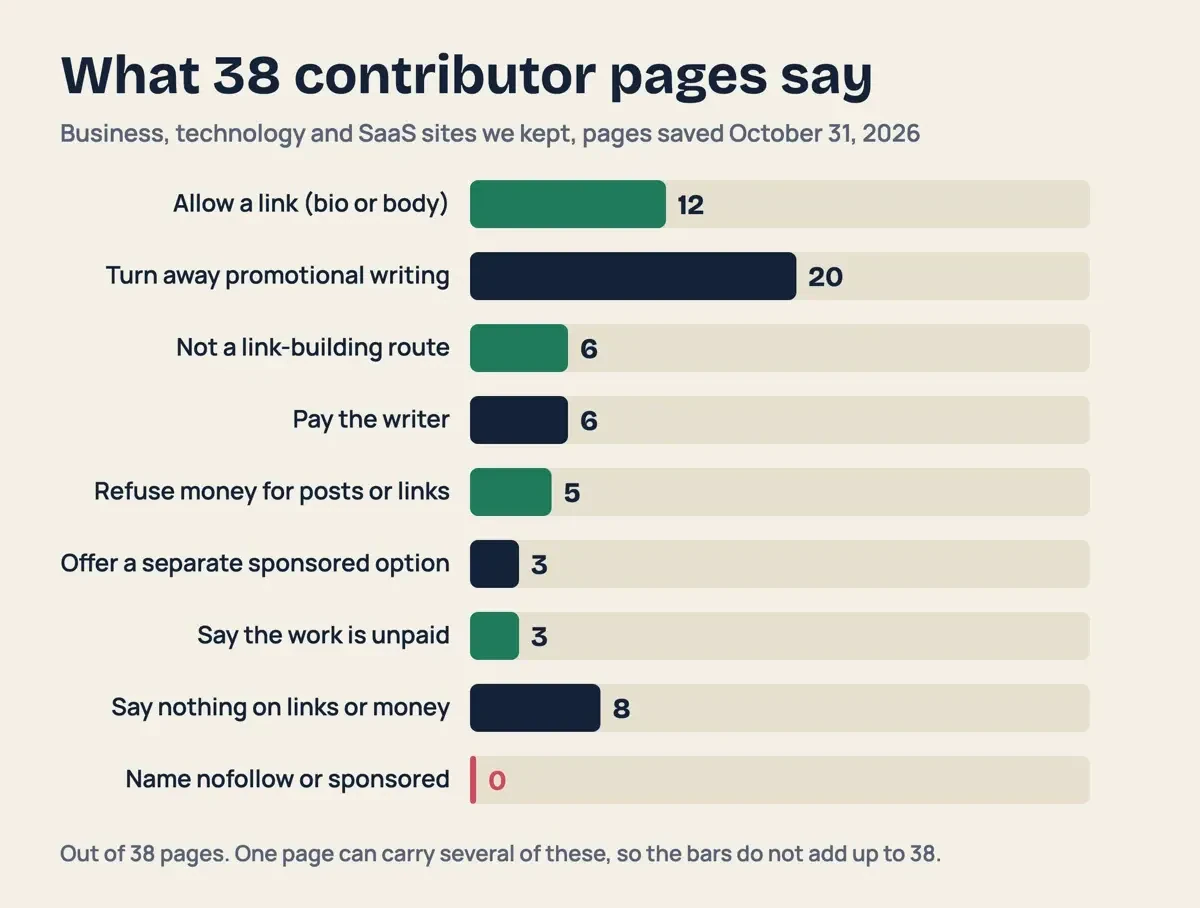 Chart by DigitalTreed from 38 contributor pages saved October 31, 2026. Source: our own reading of each page.
Paid placements need a label for Google and the FTC
Even a good paid post has to be marked twice, once for search engines and once for readers. Google wants a link attribute, and its outbound link rules say to "Mark links that are advertisements or paid placements (commonly called paid links) with the sponsored value." The spam policies say the same links are fine "as long as they are qualified with a rel="nofollow" or rel="sponsored" attribute." Ask the seller which value the link will carry.
Get the answer in writing before you pay, because a promise made on a call is hard to point to in a dispute.
For readers, the rule comes from the FTC. Its guidance on native ads says "it's deceptive to mislead consumers about the commercial nature of content." Its list of wording people understand includes "Ad," "Advertisement," "Paid Advertisement" and "Sponsored Advertising Content." Its answers to common endorsement questions cover ties between an endorser and a marketer. If "a significant minority of consumers wouldn't expect" the tie, and it would change how they judge the endorsement, it "should be disclosed clearly and conspicuously." Money isn't the only trigger, either. A separate FTC disclosure primer for creators says to disclose "any financial, employment, personal, or family relationship with a brand." For label wording readers notice, see our sponsored post disclosure guide.
When is a business guest post worth paying for?
With rankings off the table, the question gets simpler: will this host's readers turn into enough leads to justify the fee? We'd pay when all four of these hold:
- The host's readers match your buyers by job, industry or company size.
- The site labels the post and marks your link sponsored or nofollow.
- You can name the page you'll send readers to and the action you want.
- The cost per lead you'd need is one you've beaten in another channel.
Here's a worked example with made-up numbers. Say a trade blog quotes an example fee of $350 for a labeled post. Your current channels bring leads at about $60 each, and 3% of guest post visitors fill in your form, both examples, so the formula is fee / (visits x 3%). At 300 visits, that's $350 / 9 leads = $38.89 per lead.
| Example visits from the post | Leads at 3% (example) | Cost per lead | Beats $60 (example)? |
| 100 visits | 3 leads | $116.67 | No |
| 300 visits | 9 leads | $38.89 | Yes |
| 600 visits | 18 leads | $19.44 | Yes |
To break even against your $60 example target, you'd need 6 leads ($350 / $60, rounded up). At a 3% lead rate, that's about 200 visits. Ask the seller how much referral traffic past guest authors got, because a site that can't say, or quotes only Domain Authority, gives you nothing to plug in. Now add what a lead is worth. If 10% of leads close at $1,200 in first-year value (both examples), 300 visits bring about $1,080. That's against a $350 fee, so at that traffic level the example value is 3.1 times the fee.
Run the same sum with your own close rate and deal size before you sign anything.
The numbers flip fast at the low end. At 100 visits the same example post costs $116.67 a lead. So pitch an unpaid editorial spot first. Our page on SEO lead generation covers the landing page side, so the visits that do arrive have somewhere to go.
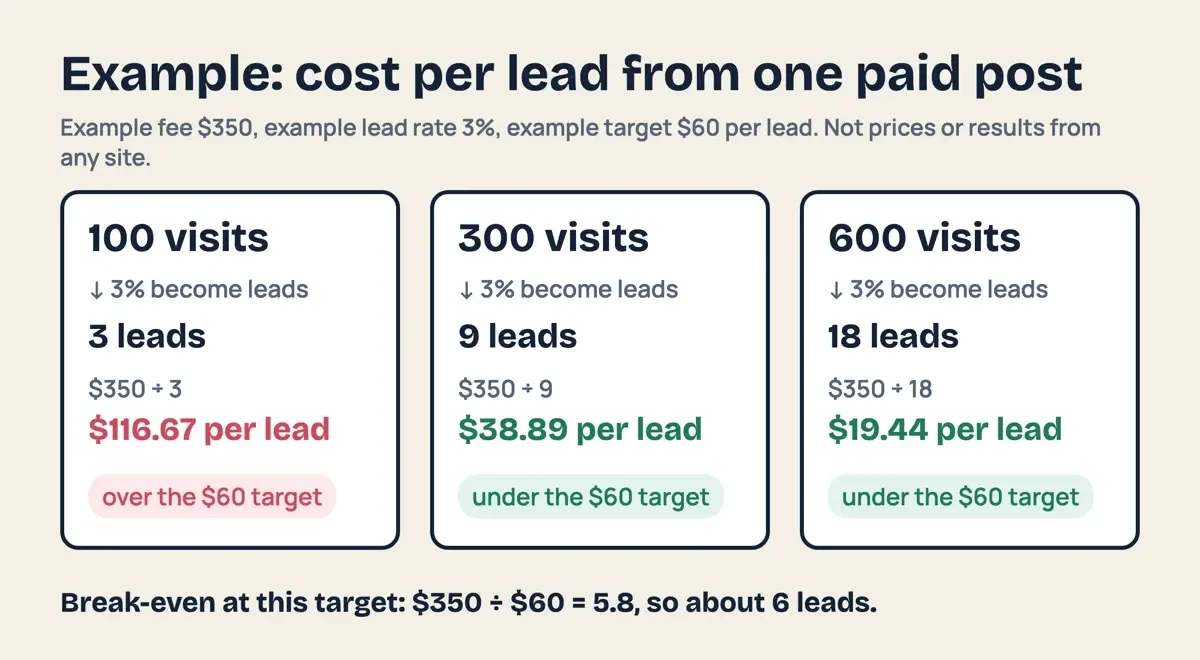 Diagram by DigitalTreed. Example numbers, not prices or results from any site.
How to measure one guest post's results
That math only works if you can count what one post sent. Set it up before publishing, because you can't tag a link later on someone else's site.
Ask the editor to use a tagged link. Google Analytics' help page on UTM parameters lists the tags. utm_source names the referrer, and utm_campaign names the product or promo. Set utm_source to the host's name and utm_medium to referral, and the visit stays in the Referral channel. Some editors strip tracking tags, which leaves the visit under the host's domain but makes two posts on one site hard to tell apart. Next, mark your form submission or booked call as a key event in GA4. Each lead then counts against the session that brought it. If many visits show no source, our guide to unassigned traffic in GA4 explains the usual causes.
For brand searches, open the Search Console Performance report, filter the queries for your company name, and compare the weeks before and after the post. It won't prove the post caused the rise, but a jump right after publication, with no other campaign running, is a fair sign that readers went looking for you. We'd judge a post over about 90 days, since referral visits trickle in while the article sits in the host's archive.
Keep three numbers in one place: visits, leads and brand searches. After two or three posts, you'll know which hosts deserve another pitch.
Earned spots, paid spots and where we stand
Those numbers come out best on earned spots, where an editor accepts your pitch and no money changes hands. Paid spots are a media buy. Judge them like one. Paid writer programs are a third kind, where the site pays you. They're the hardest to get, and the ones that teach you most about what an editor wants. For earned spots, our niche site vetting checklist works on any host you find. After that, browse the guest posting sites we checked and our short best guest post sites pick. If you also sell placements, our guide on paid guest post scammers shows sellers how to collect the money before they publish.
Note
Want a byline on DigitalTreed? A quick fit check: if your article helps bloggers, agencies, SaaS teams or startup founders with SEO, business, AI tools or online growth, it may suit us. Our contributor guidelines explain the editorial pitch, which wants an outline before you draft, and the sponsored route with "One relevant contextual link to your website or brand." New clients pay "50% upfront and the remaining 50% after the post is published." Our media kit has the rates.
Business guest post questions
Frequently asked
Do business guest posts still help SEO?
Not through paid links. Google's spam policies count paid links that pass ranking credit as link spam. A post can still bring readers who search for you or buy.
Is it legal to pay for a guest post in the US?
The FTC's guidance on native ads is about disclosure: ads mustn't mislead readers about their "commercial nature." Label the post, and talk to a lawyer about your own case.
How many guest posts does a small business need?
There's no set number. Google's 2017 note flags articles "published across many different sites," so a few well-matched hosts beat volume.
Should I pay a site that promises a do-follow link?
We wouldn't. Google's link guide asks for the sponsored value on paid placements.
How we made this guide: We read the Google, FTC and Analytics pages linked above by plain GET. We tagged the saved contributor pages by hand, and a script checked each tag against the page. Facts checked by the DigitalTreed team on November 1, 2026.
First published August 2021 as an SEO benefits list. Rewritten November 1, 2026 with Google's link rules, FTC disclosure and our reading of 38 contributor pages.
Sources
- Google Search Central: Spam policies for Google web search
- Google Search Central: Qualify your outbound links
- Google Search Central Blog: A reminder about links in large-scale article campaigns (2017)
- Google Search Central Blog: Evolving nofollow, new ways to identify the nature of links (2019)
- Google Search Central Blog: Updating our site reputation abuse policy (2024)
- Google Search Central: Creating helpful, reliable, people-first content
- Google Search Central: SEO starter guide
- Google Search Central: Using Search Console and Google Analytics data for SEO
- FTC: Native Advertising, A Guide for Businesses
- FTC: Endorsement Guides, What People Are Asking
- FTC: Disclosures 101 for Social Media Influencers
- Google Analytics Help: URL builders and UTM parameters
- Google Analytics Help: Default channel group
- Google Analytics Help: About key events
- Search Console Help: Performance report (Search results)
Comments
No comments yet. Start the conversation below.