
Quick answer
Write it as a story your readers would want anyway, with "Sponsored by" and the brand's name above the first paragraph and at least one honest con. Google's link rules, read October 29, 2026, ask you to mark every brand link rel="sponsored" or nofollow. In our test of 4 drafts, only 1 put the label ahead of the brand, so plan the story first.
Your first brand deal just landed. The fee is agreed and the product is in the mail. In two weeks you owe a post that pleases the brand without reading like its ad copy. A sponsored blog post is a paid placement told as a story: the brand covers the cost, and you keep the voice. Here's how to write a sponsored blog post once the deal is done, with a made-up hiking blog and rain shell brand as the example.
First come the brief and the angle, then three story shapes and where the product should show up. Next are the cons and their numbers, the label above the first paragraph, and the brand links to mark sponsored. Then come our checker on four drafts, the label at word 51 that still came second, and the rounds of brand edits. Our view: plan the story before you place a single link.
Key takeaways
- In our test, two of three labeled drafts showed a brand link first.
- Put "Sponsored by" plus the brand's name above your first paragraph.
- Pick an angle your readers would want even with no brand paying.
- Keep at least one con, and back it with a photo or measurement.
- Mark every brand link rel="sponsored"; Google also accepts nofollow.
Read the brief before you pick an angle
Before you write a word, get the brief in writing. It tells you what the brand needs, and it gives you something to point at when a request falls outside it. A useful brief answers six things: the campaign goal, the product facts, any claims the brand must make, the links it wants, the deadline and the review rounds. If the brand sends a page of slogans instead, ask for the facts behind them, since slogans don't survive a reader's first question. Ask about weak spots too. A brand that knows its shell runs warm would rather you say so plainly than have readers find out on a steep climb and blame the review.
Then pick the angle for your readers before the brand. Google's guide to helpful, people-first content asks whether your audience would find a page useful "if they came directly to you." We'd run that test on any paid angle. Our worked example uses two invented names. Trailmere Notes is a made-up hiking blog, and Lumacrest is a made-up brand selling a rain shell. Trailmere's readers come for trip reports, so the angle became a wet weekend on a ridge trail. The shell turned into one part of that weekend, not its subject. That small shift in the outline changed every paragraph after it, as the brief card below shows.
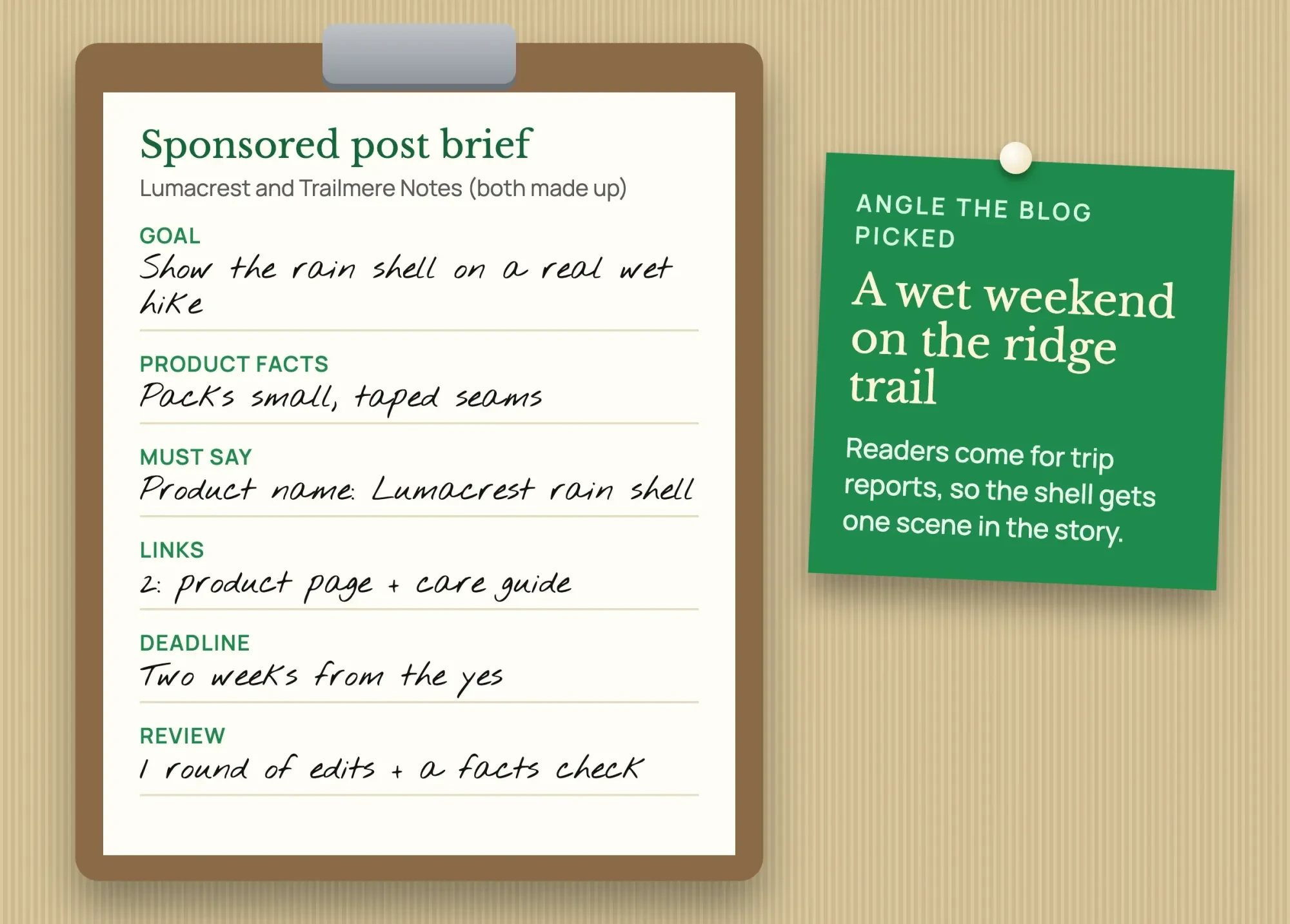 Drawn by us: an example brief for Trailmere Notes and Lumacrest, both made up
Three story shapes that carry a sponsored product
With the angle set, choose a shape for the post. Each of these three gives the product a job inside the story, and that job keeps a paid post from reading like a press release. The examples use the made-up Trailmere and Lumacrest pair:
| Shape | Fits when | Where the product goes | Example outline |
|---|---|---|---|
| Trip or project report | You used the product on a real outing | At the moment it mattered | A wet weekend on the ridge trail: rain at mile 3, saddle camp, the climb out, verdict |
| How-to with the product as one tool | Readers want steps | One step out of five or six, with alternatives named | How to keep a pack dry on a two-day hike: liner, dry bags, the shell, camp routine |
| Side by side with your old pick | Readers already own something similar | Next to the gear you used before | Our old shell and the Lumacrest on the same wet trail |
We'd start with the report. It's the hardest to fake, because its details come from a day you actually had. The how-to suits a product that does one small part of a bigger job. The side-by-side only works if you'll let the old pick win a round. For outlines and headlines in general, see our blog post writing guide; this post sticks to what changes when a brand pays.
Where should the product show up in the story?
Later than the brand would like, and sooner than you'd fear. The reader needs the problem before the product means anything, so in the Trailmere draft, rain starts at the first switchback and wind drives it sideways at saddle camp. Only then does the shell get its scene, and by that point the reader's earned it.
Give the product that one real scene, not a paragraph of features. Google's review guidance for site owners asks for evidence "of your own experience" with what you review, such as visuals or audio. A photo of the shell beading water at camp does more than three adjectives. So does one small detail, like where the hood cinch sits when your hands are numb. After that scene, step back. Name the brand where it matters and let the stretches in between belong to the trail, the weather and the people you hiked with. The sample draft we wrote in a brand's voice did the opposite: it opened on the product name and saved the label for the last line.
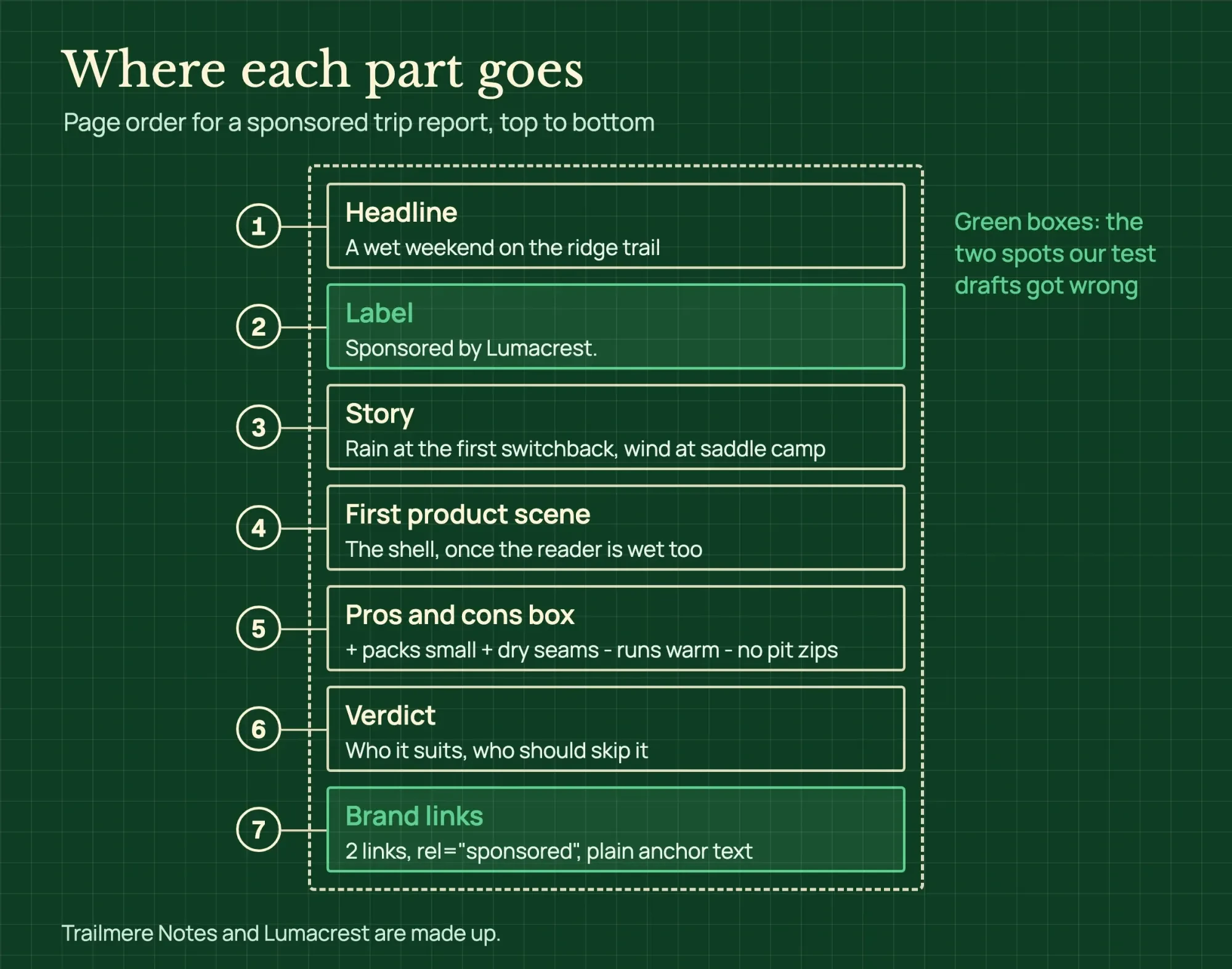 Diagram by DigitalTreed: the page order we recommend for a sponsored trip report (Trailmere Notes and Lumacrest are made up)
Keep the cons, and put numbers on them
Once the product has its scene, write down what didn't work. Google's review guidance says to "Discuss the benefits and drawbacks of something, based on your own original research." It asks for measurements too. Its example is a car review that treats fuel economy and safety as the deciding factors. For a rain shell, they're staying dry and staying cool, so the made-up Trailmere draft keeps two cons next to two pros. The shell packs small, and its seams stayed dry after two days of rain. It also runs warm on climbs and has no pit zips. A reader planning a humid summer hike needs those cons. They're also what makes the pros believable.
Put a number on what you can measure yourself: packed weight on a kitchen scale, hours in the rain from your phone, packed size in a photo. A con with a number attached reads as a finding rather than a complaint, and it's much harder for a brand to ask you to cut a finding. Next, read the draft aloud. If it starts to sound like the brand's product page, paste it into our readability checker and cut the sentences that went stiff once the product walked in. Tell the brand early that the cons stay, too, since agreeing before the draft beats arguing in the review.
Put the label above the first paragraph
Now place the label where nobody scrolls past it. Google's 2016 advice for bloggers who review products says a disclosure "can appear anywhere in the post." It adds that the most useful spot is the top, "in case users don't read the entire post." In the Trailmere example it's the first line under the headline.
The FTC's answers on its Endorsement Guides make the same point from the reader's side. They say "A disclosure in the middle or at the end of a post is easier to miss and thus less likely to be effective." That page also calls "Sponsored by XYZ" clearer than "Sponsored" on its own.
The FTC's influencer page, Disclosures 101, tells creators not to use vague labels such as sp, spon or collab. So name the brand, then say what it paid for.
Here's the label from the final Trailmere draft, word for word: "Sponsored by Lumacrest. Lumacrest paid for this post and sent the rain shell we wore. The opinions and the cons are ours." It's three short sentences above the first paragraph, set in the same plain type as the story rather than tucked into a footer or a gray caption.
Who carries the legal duty, and what a missed label can cost the brand or the blogger, is in our sponsored post disclosure and link rules guide. Neither guide is legal advice, so have a lawyer read your contract before you sign.
Two or three brand links, each marked sponsored
After the label come the links. Brands may ask for more links than a story needs. Google's 2016 post lists the ones companies sometimes urge bloggers to add: the company's site, its social accounts, a merchant's product page, a review service page and the company's app. It tells bloggers to use nofollow on all of them, since they wouldn't exist without the deal. We'd keep two or three: the product page and one page that helps the reader, like the care guide. Google's page on qualifying outbound links says to mark paid links with rel="sponsored". Nofollow is "still an acceptable way to flag them, though sponsored is preferred." Our hyperlink generator builds the tag. Here's the final Trailmere link:
<a rel="sponsored" href="https://shop.lumacrest.example/rain-shell">Lumacrest rain shell product page</a>Don't stop at the tag. Watch the words inside the link too. Google's link spam policy names "links with optimized anchor text in articles" inside paid advertorials as spam. Its anchor text guidance asks for link text that's "descriptive, reasonably concise, and relevant." It also says not to chain links next to each other.
So if the brief hands you "best waterproof rain jacket" as link text, use the product's name. Affiliate links get the same tag with a different disclosure, covered in our affiliate links guide.
Four drafts through our label-and-link checker
To see how these rules hold up on a page, we wrote the made-up Trailmere post four ways and ran one script over all of them. The drafts share the same trail story and differ only in the label, the brand sentences and links, and the pros and cons box.
Version 1 is a draft we wrote the way a brand's sample might read. Versions 2 to 4 are our rewrites of it, each fixing some problems and not others.
The script is ours, not an FTC or Google tool, and it reads only the article text. It looks for the first clear label ("Sponsored by", "Paid partnership", "Advertisement" or "Ad:") and flags vague words such as collab. It notes the word number of the first Lumacrest mention and the first brand link. Then it counts brand links by rel value, link text matching the brand's keyword list, and items under a Cons heading. A link counts as the brand's when it points at a Lumacrest site or the brand's social or app page. A draft scores yes for label first only when a clear label comes before both the brand's name and its first link.
What we tested on 127.0.0.1
On October 29, 2026 we served the four HTML drafts from 127.0.0.1 and fetched each one with Python's urllib. All four returned 200, and the script's output is saved in the post folder as test/output.txt.
A label at word 51 still came second
Every check ran on every draft, and here is the full result for all four:
| Draft | Clear label (word) | First brand link (word) | Label first | Brand links: sponsored / nofollow / none | Keyword anchors | Cons |
|---|---|---|---|---|---|---|
| 1. Brand-style sample | Sponsored by (152 of 154) | 9 | No | 0 / 0 / 5 | 2 | 0 |
| 2. Collab label | None ("collab" flagged) | 105 | No | 0 / 3 / 0 | 1 | 1 |
| 3. Link before label | Sponsored by (51) | 47 | No | 2 / 0 / 1 | 0 | 2 |
| 4. Final | Sponsored by (8) | 124 | Yes | 2 / 0 / 0 | 0 | 2 |
Version 1 put Lumacrest at word 9 and the label at word 152 of 154, so a reader met the brand long before learning it paid. The story, all five brand links and the verdict came before that label. It carried five brand links with no rel value, two with keyword anchor text, and no cons. Version 2 moved a label to the top, but it read "Collab with Lumacrest," so the script didn't find a clear label, even with the brand's name at word 10. Its three links were nofollow, which Google accepts, and one still used a keyword anchor. It listed one con.
Version 3 is the one to study. It says "Sponsored by Lumacrest" at word 51, yet a sponsored link to the shell sits at word 47, in the first paragraph. Its app link has no rel value at all, which you'd only catch by reading the HTML. Only version 4 cleared every check we ran: the label at word 8, two sponsored links with plain anchors, and both cons listed under their own heading. The script doesn't judge the story, so a clean result only means the label and the links are in order, not that anyone would want to read the post.
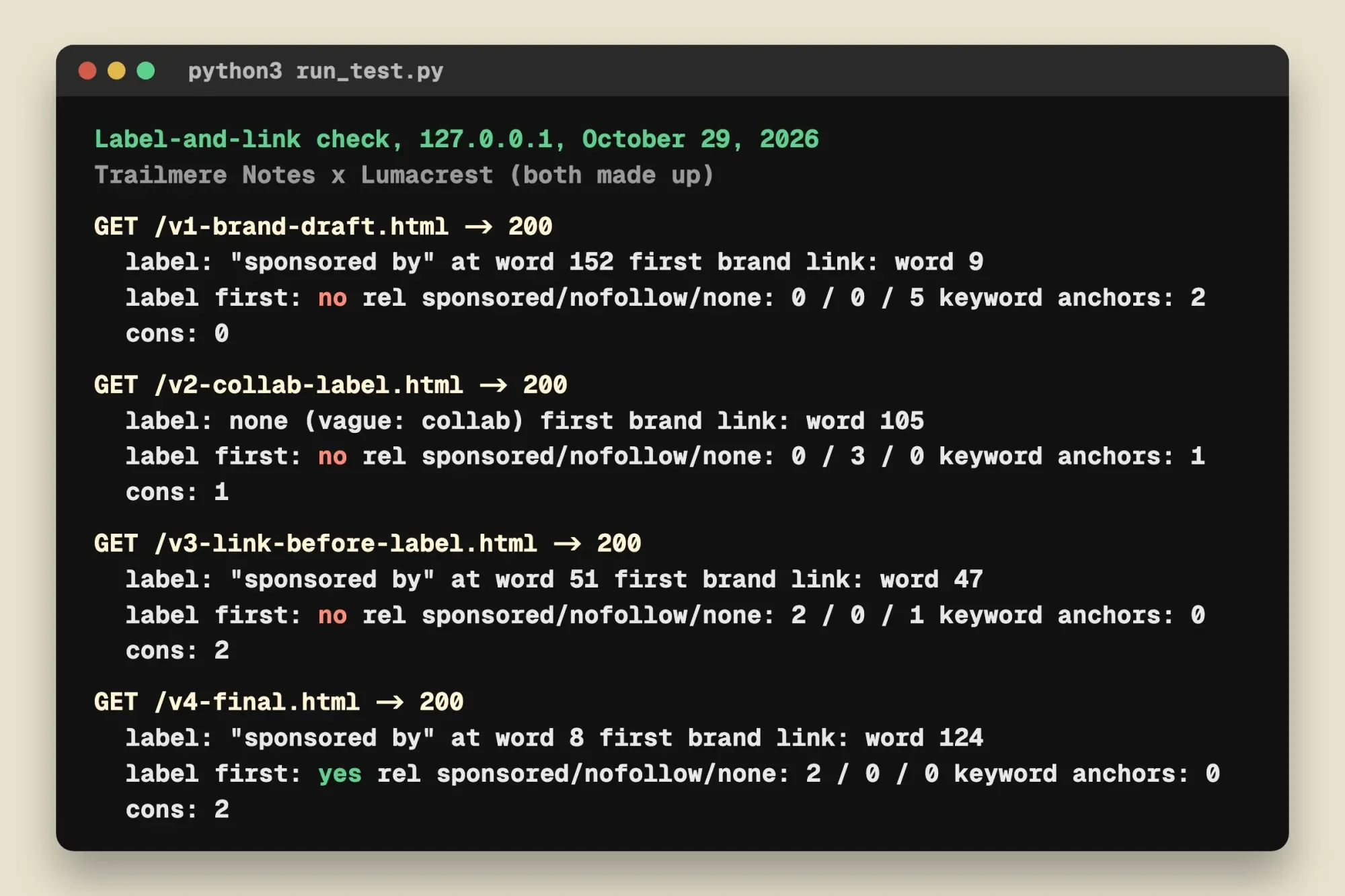 Drawn by us: the results saved in test/output.txt after our 127.0.0.1 run on October 29, 2026 (Trailmere Notes and Lumacrest are made up)
How many rounds of brand edits should you allow?
With a clean draft in hand, it's the brand's turn to read it, and the number of review rounds should already be agreed between you. Put that number in writing before you start; it's covered, with the other deal terms, in our post on how to get sponsors for your blog.
We'd offer one round of edits plus a final facts check. That gives the brand a real say without turning the post into a committee draft.
Split the edits into two piles. One pile is facts, and the brand can fix those: the product name, specs, prices, availability, link targets and any claim it must word a set way. The story, your opinion, the cons and the label stay yours. When a brand asks to cut a con, ask what's factually wrong with it. A wrong fact gets corrected, while an opinion you can back with a photo or a measurement stays in. If the brand disputes a measurement, ask how they took theirs and print both numbers when the methods differ.
If the brand wants to track clicks, run its links through our UTM builder before the draft goes over, not after the edits are done. That way the tagged URLs get checked in the same round, and nobody waits on a second pass.
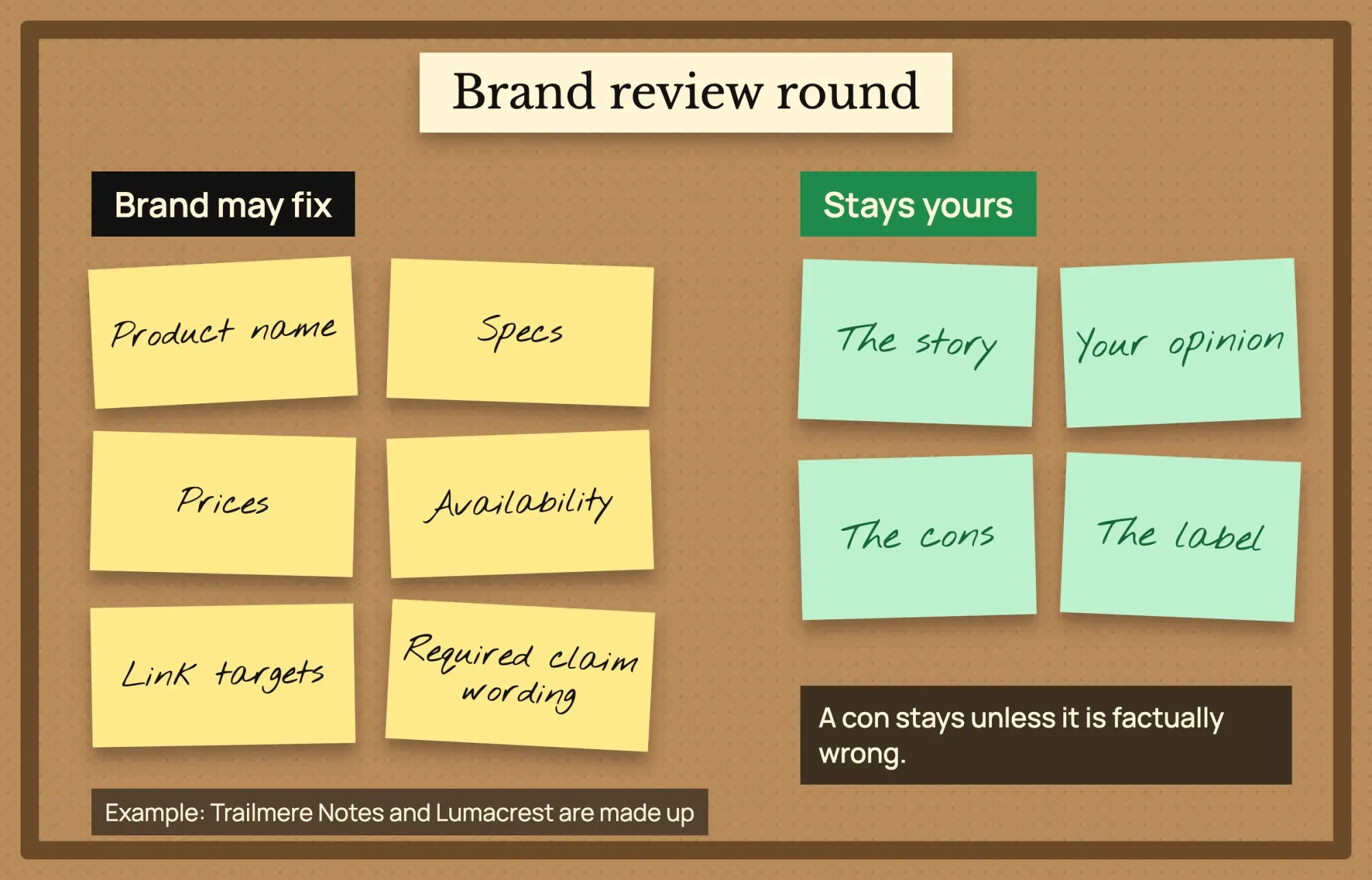 Drawn by us: our split for brand review rounds, using the made-up Trailmere and Lumacrest example
Our take, after four drafts: the label and link fixes were small edits to the same story, so spend your planning time on the story itself. Write the post your readers would want anyway, then make room for the brand.
DigitalTreed's content marketing service plans and writes posts for small businesses. We sell that work. So read this link as an ad of our own, label included.
Sponsored post writing questions
Frequently asked
Do I still mark the links if the brand only sent a free product?
Yes. Google's spam policies list "Sending someone a product in exchange for them writing about it and including a link" as link spam, unless the link is marked nofollow or sponsored.
Is rel="nofollow" enough for a sponsored link?
Google accepts it. Its September 10, 2019 announcement says "We prefer the use of sponsored, but either is fine," and calls rel="ugc sponsored" a valid combined value.
Can the brand write the sponsored post for me?
It can, but vet it like an editor. Google's May 25, 2017 note on article campaigns lists using the same or similar content across many articles as a warning sign, when taken to an extreme.
Can a sponsored post still rank in Google?
The format alone doesn't break Google's rules. Google's site reputation policy says advertorial pages meant "to share content directly to readers" are not considered inconsistent with it.
How we made this guide: Eight Google Search Central pages, opened on October 29, 2026, back the link and review rules, each linked beside its claim. The two FTC quotes and one FTC paraphrase come from pages read for our disclosure guide on October 24, 2026, since ftc.gov blocked our page reader today. We wrote the four drafts and the checker ourselves and ran them on 127.0.0.1 with made-up names. Facts checked by the DigitalTreed team on October 29, 2026.
First published August 2021 as a list of sponsored post examples. Rewritten October 29, 2026 as a how-to for writing the post, with a worked example and a local test.
Sources
- Google Search Central Blog: Best practices for bloggers reviewing products they receive from companies (March 11, 2016)
- FTC: FTC’s Endorsement Guides, What People Are Asking
- FTC: Disclosures 101 for Social Media Influencers
- Google Search Central: Qualify your outbound links to Google
- Google Search Central: Spam policies, link spam
- Google Search Central: Spam policies, site reputation abuse
- Google Search Central: Write high quality reviews
- Google Search Central: Link best practices for Google
- Google Search Central: Creating helpful, reliable, people-first content
- Google Search Central Blog: A reminder about links in large-scale article campaigns (May 25, 2017)
- Google Search Central Blog: Evolving nofollow, new ways to identify the nature of links (September 10, 2019)
Comments
No comments yet. Start the conversation below.