
Quick answer
A backlink is a link on another website that points to yours. Google uses links to find pages and as one of many ranking signals. A few relevant links from real businesses and publications can help you rank. Links you buy or trade just to move rankings break Google's rules.
Key takeaways
- A backlink is a link from someone else's site to yours; Google treats links as one signal among many, not the whole game.
- "Dofollow" isn't a real HTML attribute. Google only defines nofollow, sponsored and ugc, and since 2019 treats all three as hints.
- Paid links are fine for ads and sponsorships if they carry rel="sponsored" or rel="nofollow"; paid links that pass ranking credit are link spam.
- For a small business, the best links usually come from people you already work with: suppliers, local groups, customers and the local press.
This guide is for small business owners who keep hearing "you need backlinks" and want to know what that means first. We'll cover what a backlink is and how much Google says links matter. Then we'll show which links help, which can hurt, and 10 ways to earn good ones on a small budget. New to SEO in general? Start with our SEO for beginners guide.
What is a backlink?
A backlink is a clickable link on another website that sends people to a page on your site. People also call them inbound links or incoming links. The name describes the link from your side: when a site links to you, you get a backlink, and they get an outbound link.
Here's an example. A food blogger in Austin writes "the best kolaches we tried this year" and links the words "Sunrise Bakery" to your bakery's homepage. That link is a backlink for you. The words people click, "Sunrise Bakery", are the anchor text.
Google says anchor text "tells people and Google something about the page you're linking to". So a link that names your business or your service carries more meaning than a vague "here".
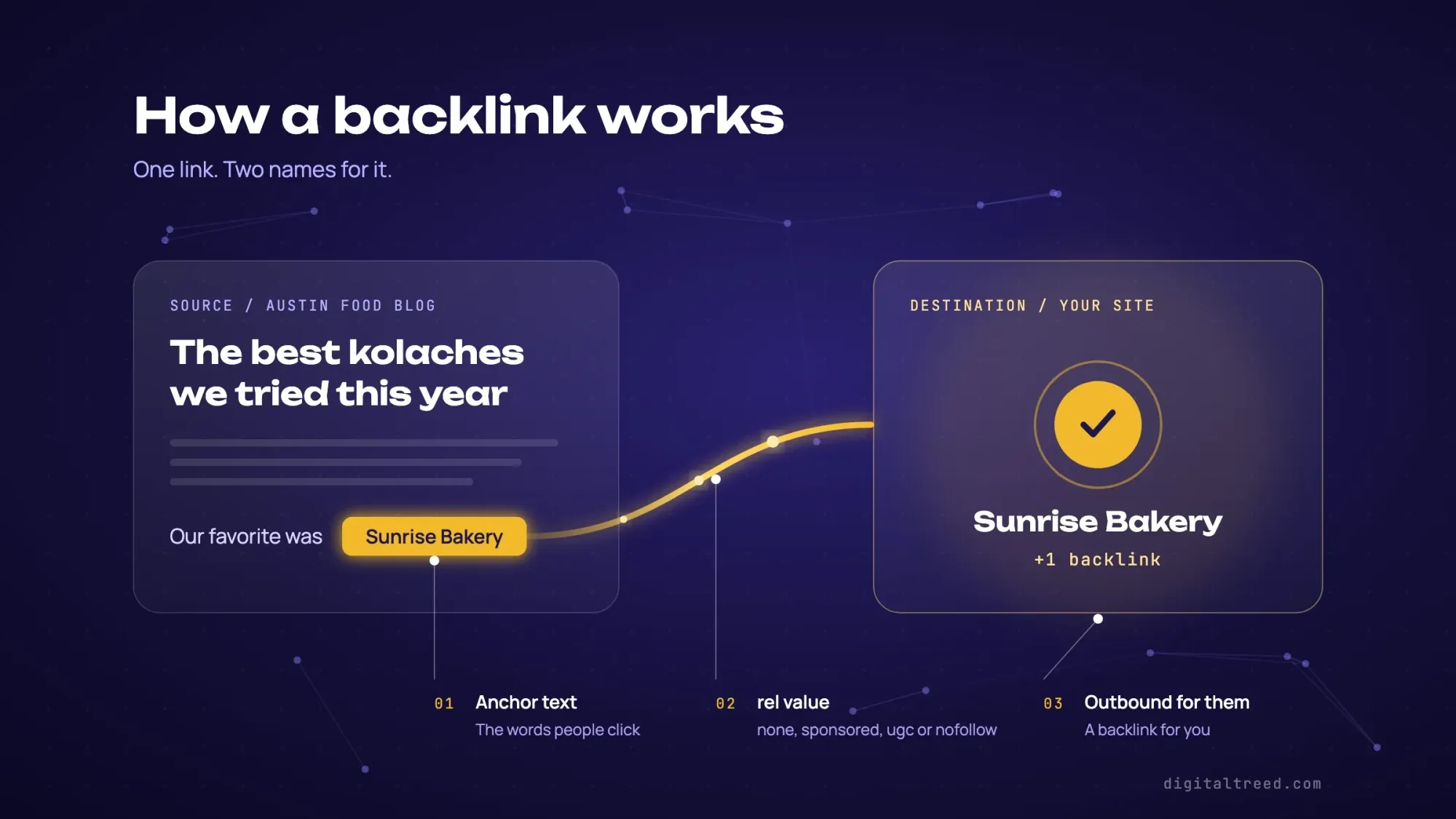 Illustration: how a backlink works. The businesses are made up.
Backlinks, internal links and outbound links
| Link type | Where it lives | Where it points | Example |
|---|---|---|---|
| Backlink (inbound) | Someone else's site | Your site | A local news story links to your clinic |
| Internal link | Your site | Another page on your site | Your homepage links to your services page |
| Outbound link | Your site | Someone else's site | Your blog post links to a Google help page |
Backlinks vs referring domains
SEO tools count two things that sound alike. Backlinks are every single link. Referring domains are the number of different websites linking to you.
If one directory links to you from 40 pages, that's 40 backlinks but only one referring domain. When you compare yourself with a competitor, look at referring domains first. Links from 10 different local sites mean more than one site linking to you 10 times.
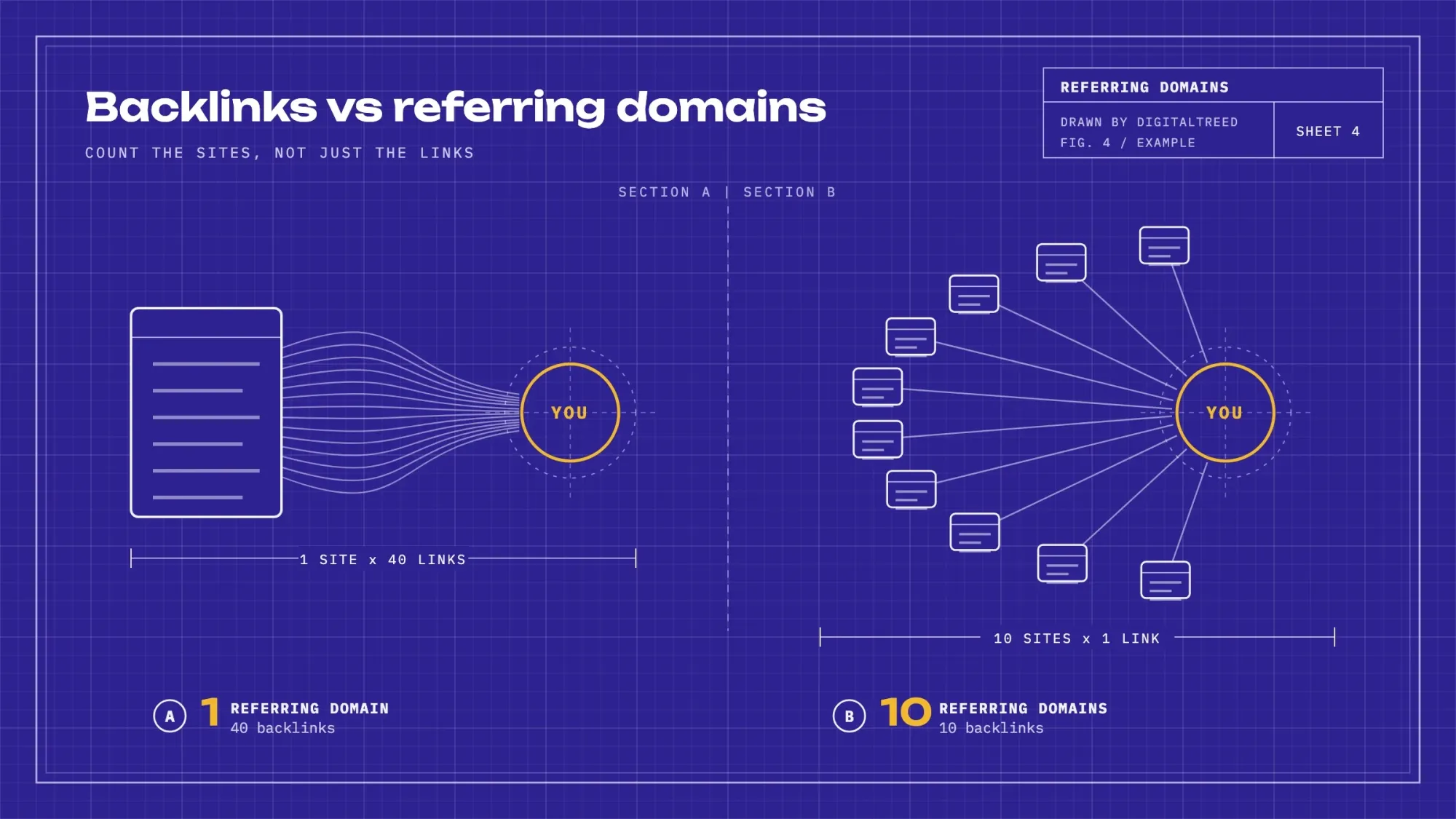 Illustration: 40 links from one site count as one referring domain.
Are backlinks still important for SEO?
Yes, but they are one signal among many. Google still uses links to find new pages, and it says PageRank, its original link-based system, is still part of its core ranking systems. Our take: links won't make up for a thin page, a slow site or an incomplete Business Profile.
Links do two jobs for Google. First, discovery. Google's SEO Starter Guide says "Google primarily finds pages through links from other pages it already crawled". A brand-new page that nothing links to can sit unnoticed for a long time.
Second, ranking. Google's guide to its ranking systems says some of its systems look at how pages link to each other. It adds that PageRank, the link-based system Google launched with, "continues to be part of our core ranking systems".
The same Starter Guide adds a line that SEO sellers tend to skip. "PageRank is just one of those" signals, it says, and "there's much more to Google Search than just links".
So links count, but they won't rescue a thin page or a slow site. Our take: get your pages right first, then go after links. Give each page a clear answer, check that you have a fast site, and keep a complete Google Business Profile. That's also what keeps the links you earn from going to waste.
96.55%
of pages in Ahrefs' index of about 14 billion pages get no traffic from Google; "no backlinks" is one of the reasons it lists (Ahrefs, vendor study, Dec 2023)
48.6%
of 518 SEO professionals named digital PR the most effective way to earn links (Editorial.link, vendor survey, Mar 2026)
Both figures come from SEO tool vendors, so treat them as rough signals. The first is from the Ahrefs search traffic study of December 2023. The second is from an Editorial.link survey of 518 SEO professionals, published in March 2026.
Links also matter outside rankings. A link from a local news site or a supplier's "where to buy" page sends real visitors. Those visitors already trust the site that sent them.
Key backlink facts
- Since September 10, 2019, Google has treated nofollow, sponsored and ugc as hints rather than strict rules for ranking. Crawling and indexing followed on March 1, 2020.
- On December 14, 2022, Google said its SpamBrain system can detect sites buying links and sites used to pass outgoing links. Google uses it to neutralize unnatural links.
- In local results, Google weighs relevance, distance and prominence (its help page also calls it popularity). Google Business Profile Help says prominence is partly based on "how many websites link to your business" (checked October 23, 2026).
- In a May 2025 vendor study of 75,000 brands, Ahrefs found that web mentions correlated with AI Overview visibility at 0.664, and backlinks at 0.218.
- Search Console's Links report shows only a sample of your links. Its tables stop at 1,000 rows, and it doesn't say which links are nofollow (checked October 23, 2026).
Types of backlinks: follow, nofollow, sponsored and UGC
You'll read about "dofollow" and "nofollow" backlinks everywhere. Here's the part most guides get wrong: there's no such thing as a dofollow attribute. A "dofollow" link is just a normal link with no special rel value on it. Google's documentation on qualifying outbound links defines only 3 values:
| rel value | What Google says it's for | Typical example |
|---|---|---|
| None (a normal link) | A regular link that needs no qualification, so no rel value is added | A blogger recommends your shop in a post |
| rel="sponsored" | "Advertisements or paid placements (commonly called paid links)" | A sponsored post or a paid event listing |
| rel="ugc" | "User-generated content (UGC) links, such as comments and forum posts" | A link you leave in a forum reply |
| rel="nofollow" | "When other values don't apply" and the site would rather Google not associate the site with the linked page, or crawl that page from it | A link to a source the site doesn't vouch for |
One change from 2019 still confuses people. Google used to leave nofollow links out of its ranking signals completely. Then, on September 10, 2019, it changed course. All 3 link attributes (sponsored, ugc and nofollow) "are treated as hints about which links to consider or exclude within Search". From March 1, 2020, that applied to crawling and indexing too.
In plain words: a nofollow link probably won't pass ranking credit, but it isn't worthless. It can still bring visitors, and Google may still use it to find your page. Our take: links you post yourself in forum replies or blog comments are user-generated content, so expect little ranking credit from them.
What makes a high-quality backlink?
The best backlinks come from real sites related to your business. They sit inside the text and use natural anchor text. No official score exists, so ask these 5 questions before you chase one:
- Is the site related to what you do or where you are? A link from your city's home-builders association beats a link from a random gadget blog for a roofing company.
- Is it a real site with real readers? If the site exists only to sell links, its links are the kind Google tries to neutralize.
- Is the link inside the content? A link in a sentence that talks about you means more than one buried in a footer next to fifty others.
- Does the anchor text describe you naturally? Google wants anchor text that's "descriptive, reasonably concise, and relevant". Your business name or a plain description is ideal. The same keyword-stuffed phrase on dozens of sites looks bought.
- Would anyone click it? If the link could send you a customer, it's probably the kind of link Google wants to count.
Note
About Domain Authority and Domain Rating. Moz's Domain Authority, Ahrefs' Domain Rating and Semrush's Authority Score are scores made by SEO tool companies. They're handy for comparing sites, but Google doesn't use them. Google's John Mueller said in 2020 that "we don't use domain authority at all in our algorithms", as reported by Search Engine Journal. Don't pay for a link because a seller promises a high score.
Do backlinks help you show up in AI answers?
Backlinks seem to matter less for AI answers than mentions of your brand do, at least in the data we've seen. In May 2025, Ahrefs compared 75,000 brands with how often Google's AI Overviews mentioned them. Mentions of a brand across the web lined up far more closely with AI Overview mentions than raw backlink counts did.
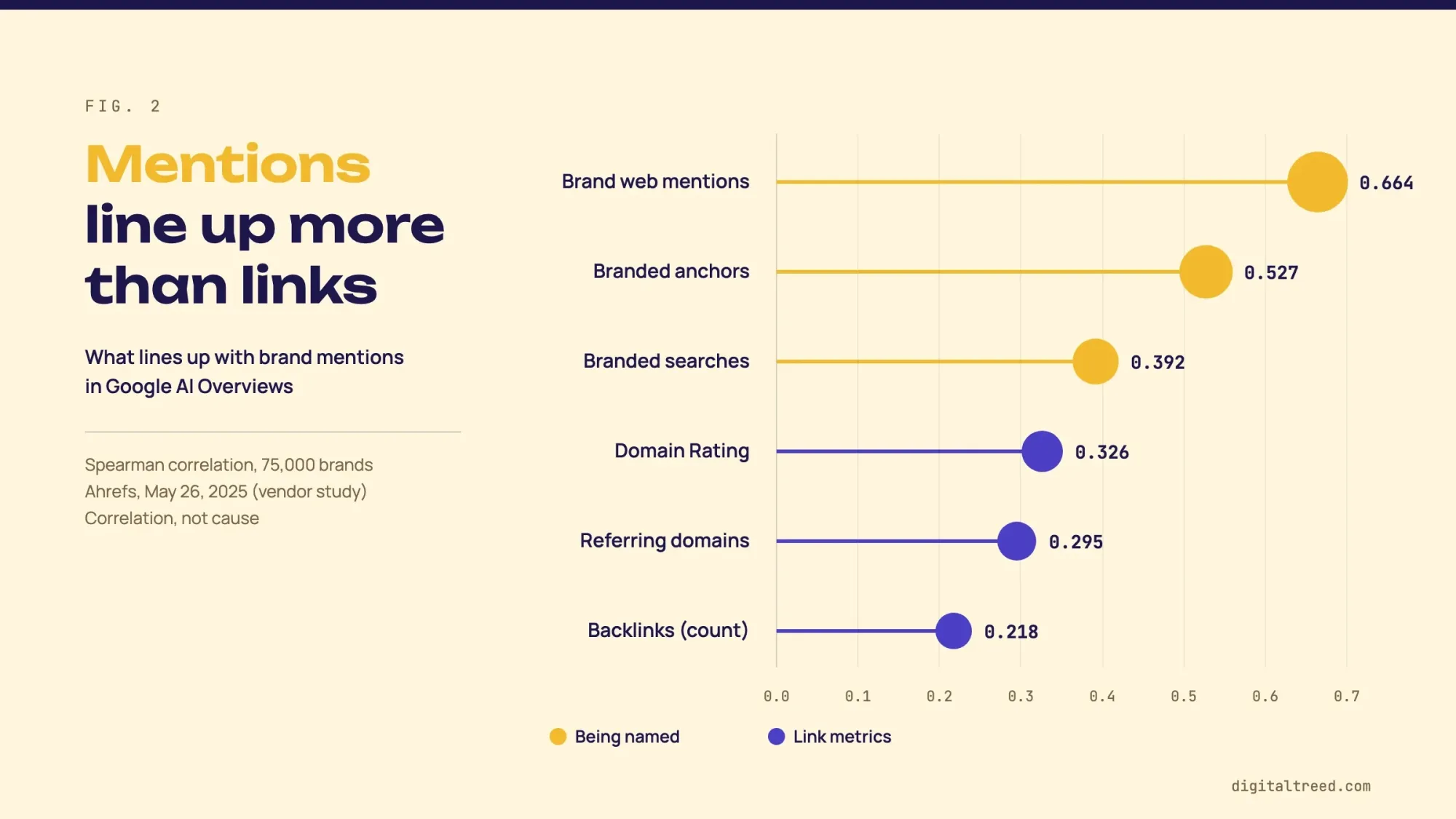 Spearman correlation with brand mentions in Google AI Overviews. Source: Ahrefs, May 2025 (vendor study of 75,000 brands). Correlation, not cause.
Two cautions. This is a study by a tool vendor, and correlation doesn't prove that one thing causes another. Still, the direction makes sense for a small business. Being named in local news, on partner sites and in reviews looks like a better bet for AI answers than links nobody reads.
How to get backlinks: 10 ways that work for a small business
Most "how to get backlinks" guides are written for software companies with a content team. Say you run a dental practice in Columbus or a landscaping company in Tampa. Your best links come from the people you already do business with.
Start at the top of this list; the first few cost little more than an email. Links are one part of off-page SEO; our off-page SEO checklist covers reviews, mentions and the rest.
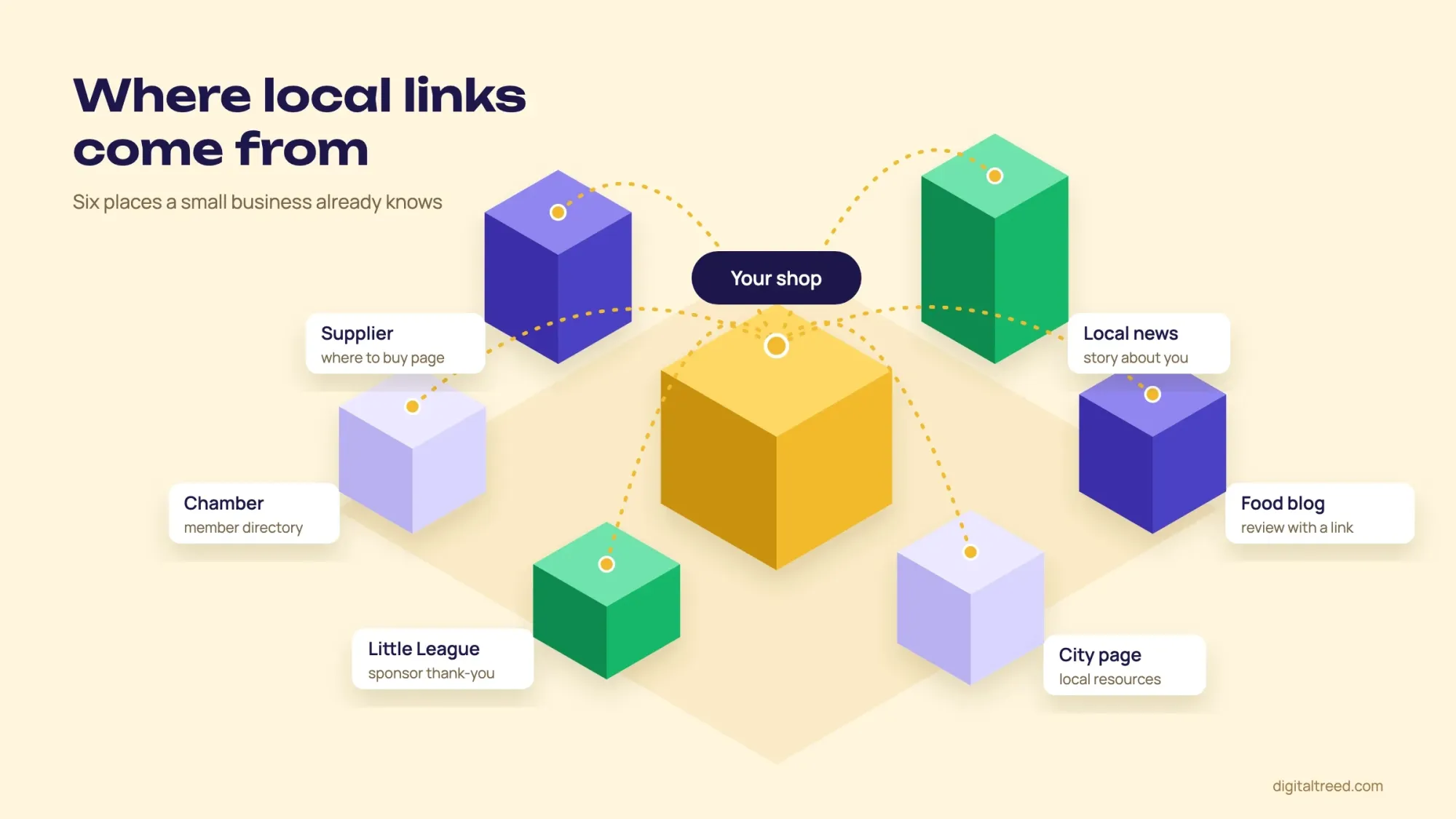 Illustration: 6 places a local business can earn links. The places are examples.
1. Ask your suppliers and manufacturers
Many brands keep a "where to buy", "dealers" or "partners" page. If you stock their products or install their equipment, ask to be listed with a link. A plumbing company that installs a known water-heater brand, or a boutique that carries a local designer, can often get this with one email. Keep it to real partners: Google's spam policy lists "partner pages exclusively for the sake of cross-linking" as link spam.
2. Join your chamber of commerce and trade associations
Most chambers of commerce and industry associations list members in an online directory, usually with a link. Join the ones you'd join anyway for the networking. The link is a bonus; the referrals and local events are often worth more. The same goes for well-known directories in your trade or city that customers actually use. Google's spam policy names "low-quality directory or bookmark site links" as link spam, not every directory.
3. Sponsor something local, and label it properly
Little League teams, 5K runs, school fundraisers and charity events thank their sponsors on their websites. Because you paid, that link is a paid placement. Google says paid links are fine "as long as they are qualified with a rel="nofollow" or rel="sponsored" attribute value". So don't ask the organizer to remove that label.
The real value is local goodwill, a mention in the event's emails, and sometimes a photo in the local paper.
4. Turn unlinked mentions into links
Local blogs and news sites sometimes mention a business without linking to it. Set up a free Google Alert for your business name, and when a mention shows up without a link, send a short, friendly note.
Ask for a link from an unlinked mention
- Confirm the mention Open the page and check that it really names your business and has no link to you.
- Find the right person Look for the writer's name or the site's contact page. An editor or the author beats a generic inbox.
- Say thanks first Thank them for the mention in one sentence, so the email isn't only a request.
- Make it easy Paste the exact sentence and the URL you'd like linked, usually your homepage or the page about what they mentioned.
- Follow up once If there's no reply in a week, send one short reminder, then let it go.
Tip
Free template: the unlinked-mention email. Copy it and change the parts in capitals.
Subject: Thank you for mentioning BUSINESS NAME.
Hi NAME, thank you for including BUSINESS NAME in your post on TOPIC. We really appreciated it. Would you consider linking our name to PAGE URL? That way, readers can find us in one click. Either way, thanks again for the kind words.
5. Publish something local people want to cite
This is digital PR at small-business size (DigitalTreed sells this service). It can be a short survey of your customers, a yearly price guide for your trade in your city, or numbers from your own jobs.
A pest-control company could publish which months bring the most termite calls in its county. Reporters and bloggers link to numbers they can't get anywhere else.
Note
From our work: a sports platform. A global sports platform and networking community had its technical SEO and speed in good shape. But its posts linked to no outside sources at all, so nothing in them showed where its facts came from. And its link building relied on spammy tactics. We changed course and added sports statistics, with their sources, to the posts. Collaboration requests started coming in from other sites, and they brought links from inside their articles and mentions of the brand by name. Traffic rose 60%. The lesson: publish something worth citing, and the links come to you.
6. Answer journalists' questions
Services that send reporters' questions to experts have changed hands a lot. HARO (Help a Reporter Out) was renamed Connectively, which its owner Cision shut down on December 9, 2024. In April 2025, Featured.com bought HARO and restarted it.
Other services such as Qwoted and Source of Sources do a similar job. Answer only questions you can answer well, quickly, and in 2 or 3 quotable sentences.
7. Fix broken links, theirs and yours
Broken link building means finding a dead link on a relevant site and suggesting your page as the replacement. The easier win is closer to home. If you've redesigned your site, other sites may still link to old URLs that now show an error page. Check your old addresses, and redirect each one to the page that replaced it, so the links pointing at them still count.
8. Get listed on resource pages
Cities, counties, libraries, universities and nonprofits keep lists of useful local services. A senior home-care agency might fit a county's aging-services page; a bike shop might fit a city's cycling page. Search for your city plus "resources" or "useful links" and your trade, then ask to be added where you genuinely fit.
9. Write guest posts for the audience, not the link
Guest posting still works when you write for a site your customers read. Google said in 2017 that it doesn't discourage guest articles that "inform users, educate another site's audience or bring awareness to your cause or company". What breaks the rules is publishing articles across many sites mainly to build links, especially with keyword-stuffed anchor text. One useful article on your local business journal's site beats 20 on sites nobody visits.
10. Give testimonials to the tools and vendors you use
Software companies and suppliers love short, specific customer quotes, and they often publish them with your name and a link. If your booking software or your POS system saved you hours, tell them, and offer a two-line testimonial they can use.
Link building tactics compared: cost, effort and risk
| Tactic | Effort | Cash cost | Google's view |
|---|---|---|---|
| Supplier and partner pages | Low | Free | Fine for real partners |
| Chamber and trade groups | Low | Membership fee | Fine |
| Local sponsorships | Low | Sponsorship fee | Fine with rel="sponsored" or nofollow |
| Unlinked mentions | Low | Free | Fine |
| Local data and digital PR | High | Your time | Fine |
| Journalist requests | Medium | Free or paid plans | Fine |
| Broken links and redirects | Medium | Free | Fine |
| Resource pages | Medium | Free | Fine |
| Guest posts | High | Your time | Fine for the audience; spam at scale or with stuffed anchors |
| Testimonials | Low | Free | Fine |
| Buying links that pass ranking credit | Low | Often hundreds of dollars a link | Link spam |
How much does a bought link cost? In Editorial.link's March 2026 survey, 412 SEO professionals put the average acceptable cost of one high-quality link at $508.95 (vendor survey, as of March 2026). That fits the last row of the table. Free tactics cost you time instead.
Link building tactics that break Google's rules
Google's spam policies define link spam as "creating links to or from a site primarily for the purpose of manipulating search rankings". Here are 5 of Google's examples, in its own words:
Do not
- "Buying or selling links for ranking purposes", including swapping goods or services for links
- "Excessive link exchanges ("Link to me and I'll link to you")"
- "Using automated programs or services to create links to your site"
- "Low-quality directory or bookmark site links"
- "Forum comments with optimized links in the post or signature"
Do
- Earn links from partners, local groups and press that know your business
- Mark anything you paid for with rel="sponsored" (or nofollow)
- Use your business name or a plain description as anchor text
- Write guest posts for sites your customers actually read
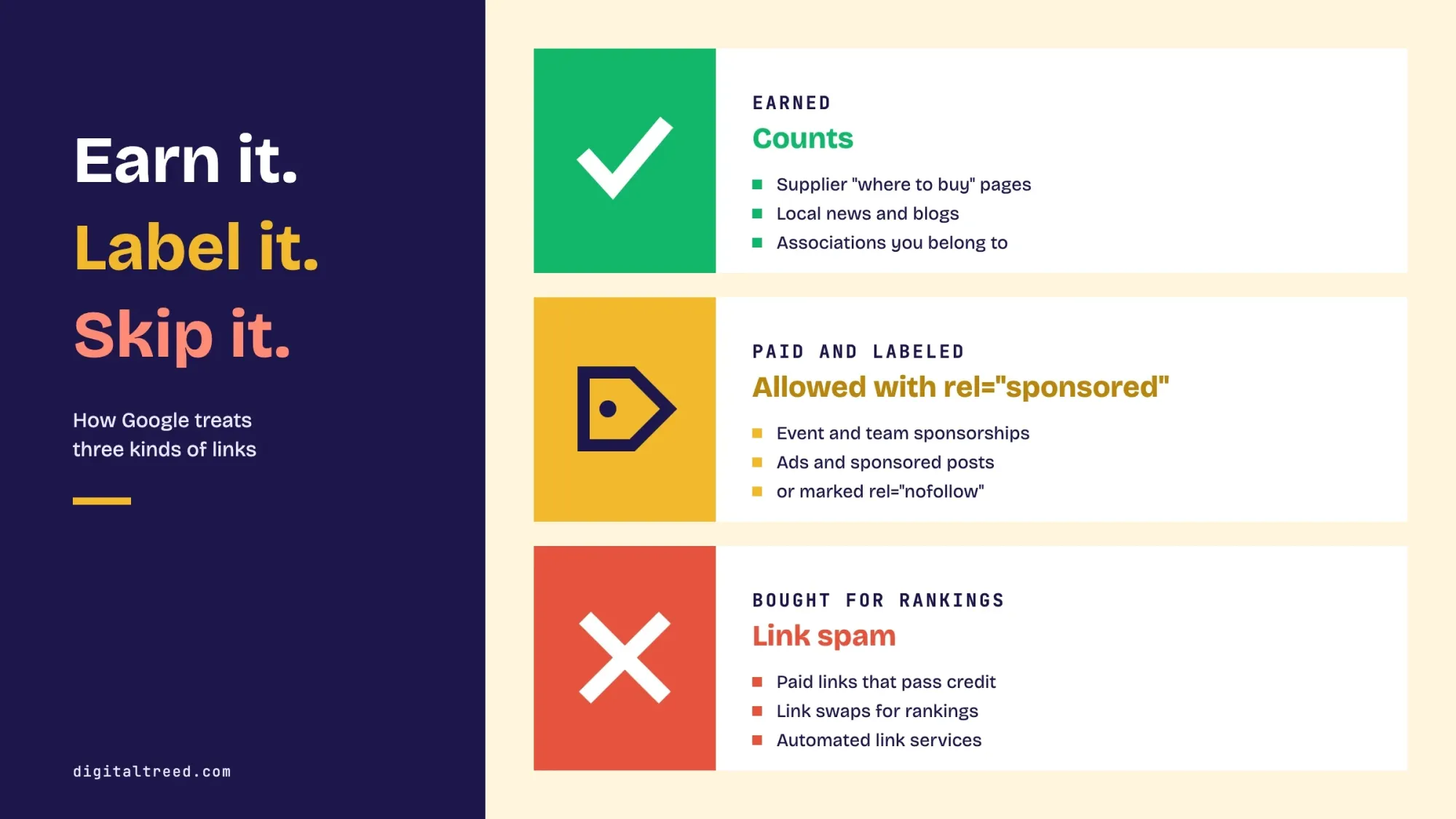 Illustration: which links help, which need a label, and which to skip.
Spam isn't only caught by hand. In December 2022, Google said its AI-based spam system, SpamBrain, "can now detect both sites buying links". It also spots sites used to pass outgoing links, and credit from such links is lost. In other words, the money you spend on bought links may simply be ignored, if you're lucky.
If you're unlucky, Google can take manual action against your site.
Warning
Paying for a link is also a disclosure question in the US. If you sponsor a blog post or pay an influencer for a review that links to you, the reader has to be told. The FTC's Endorsement Guides expect paid relationships to be disclosed clearly. The rule itself, 16 CFR 255.5, says such a connection "must be disclosed clearly and conspicuously". So a paid post or review with a link needs 2 labels: rel="sponsored" for Google, and a plain-words disclosure for people. This is general information, not legal advice; check with an attorney for your situation.
Do you need to disavow "toxic" backlinks?
Probably not. Many SEO tools flag "toxic" links and suggest disavowing them, but that's not a term Google uses. Google's disavow help page says "most sites will not need to use this tool".
It says to disavow only if you have a considerable number of spammy, artificial or low-quality links. Those links must also have caused, or be likely to cause, a manual action against your site.
Every site picks up odd links from scraper sites over time. Google is used to ignoring them. Say you once paid for a pile of links, and Search Console's Manual actions report shows an action against your site. That's when a disavow file makes sense. Otherwise, spend that hour earning one good link instead.
How many backlinks do you need?
There's no magic number, and anyone quoting one is guessing. It depends on who you're up against. A plumber in a small town may rank in the local results with a well-kept Business Profile, good reviews and a handful of local links. A personal-injury lawyer in Chicago is competing with firms that have spent years earning links.
A practical way to set a target: search your main service and city, and note the top 3 businesses (not directories). Then check in a backlink tool how many different sites link to each of them. Aim to close the gap with links from your own community, a few a month, rather than buying a package of hundreds.
How do you check your backlinks?
Start with Google Search Console, which is free. Its Links report shows your top linking sites, the pages they link to, and the anchor text they use. It's Google's own sample of what it found, so it won't list everything.
Together, these links make up your backlink profile. It shows which sites link to you, which pages they point to and what anchor text they use.
See your backlinks in Google Search Console
- Open the Links report In Google Search Console, open the Links report for your site.
- Check your top linking sites Under External links, open Top linking sites and click MORE for the full list. Make sure you recognize the sites.
- Check your top linked pages Open Top linked pages to see which of your pages get the most links, and whether they are the pages you expect.
- Check your top linking text Open Top linking text. The anchor text should describe your business accurately and should not look spammy.
- Export the list Use the Export button. Latest links gives the newest links Google found, up to 100,000 rows.
Google's Links report help page says the report is a sample, not every link. It also lists links that may have been removed since, and it doesn't mark which links are nofollow.
For a fuller list and for checking competitors, paid tools such as Ahrefs, Semrush and Moz keep their own link indexes. Their numbers will differ from each other and from Google's, because each crawls the web separately.
Frequently asked
What is a backlink example?
A local newspaper writes about a new coffee shop and links the shop's name to its website. For the coffee shop, that link is a backlink. For the newspaper, it's an outbound link.
Are backlinks good or bad?
Most are good or neutral. Links from relevant, real sites can help you rank and send visitors. Links bought or traded to manipulate rankings break Google's spam policies, and Google says it neutralizes them.
Can backlinks hurt your site?
Rarely, unless you bought or built them to move rankings. Google says its systems neutralize spammy links, and its disavow help page says most sites will not need the disavow tool. A pattern of paid or traded links can still lead to a manual action.
How much do backlinks cost?
Earned links cost time, not cash. Bought links are expensive and risky: in Editorial.link's March 2026 vendor survey, the average acceptable cost of one high-quality link was $508.95. Buying links that pass ranking credit also breaks Google's rules.
Is it illegal to buy backlinks?
The main problem is Google's rules, not the law: buying links that pass ranking credit breaks Google's rules. Paid links are allowed when marked rel="sponsored" or rel="nofollow". In the US, paid endorsements also need a clear disclosure for readers under the FTC's Endorsement Guides. This is general information, not legal advice; check with an attorney for your situation.
How long does it take for backlinks to work?
Google has to find the linking page first, and that can take days or weeks depending on how often it crawls that site. Any effect on rankings usually shows over weeks or months, and it's mixed in with everything else Google looks at.
Can you rank without backlinks?
Yes, for some searches, especially local ones with little competition. Google's local results weigh relevance, distance and prominence (also called popularity), and Google Business Profile Help says links are only part of prominence. Our take: in a crowded search, a page with no links usually has a harder time.
Can you get backlinks from Wikipedia?
Probably not ones that pass ranking credit. On October 23, 2026, we checked 2 English Wikipedia articles, "Backlink" and "Small business". All 130 links to outside sites carried rel="nofollow". Wikipedia's external links guideline also asks you to avoid linking to a site you own, maintain or represent.
Are nofollow links worth getting?
Yes, if real people will see them. Since 2019, Google treats nofollow as a hint rather than a strict block. A nofollow link on a busy local site can still bring customers and brand searches.
How do I get backlinks for free?
Start with people who already know you. Try suppliers' "where to buy" pages, local associations you belong to and unlinked mentions of your business. Testimonials for tools you use and local resource pages work too. Most of these cost one polite email.
Your next step: pick 3 tactics from the list above and work on them for a month, starting with your suppliers and local groups. If you'd like a hand with links and the rest of your SEO, see our search engine optimization service.
First published May 2020. Rewritten October 2026: Google's current rules on nofollow, sponsored and ugc links, Ahrefs' 2025 AI Overview data, the HARO changes and US disclosure rules.
How we made this guide: we built it from Google Search Central's pages and blog posts on links, spam and nofollow, and Search Console Help. US disclosure rules come from the Endorsement Guides and 16 CFR 255.5, and the data from vendor studies by Ahrefs and Editorial.link. We checked every number against the source named next to it on October 22, 2026. Updated October 23, 2026: added an answer-first "Are backlinks still important" section, a key facts list and Search Console steps. We also added a free outreach email template and Editorial.link's link cost data. New too: notes on directories and forum links, our own Wikipedia nofollow check and 4 FAQs.
Sources
- Google Search Central: SEO Starter Guide (updated December 10, 2025)
- Google Search Central: A guide to Google Search ranking systems (updated December 10, 2025)
- Google Search Central: Qualify your outbound links to Google (updated December 10, 2025)
- Google Search Central: Link best practices
- Google Search Central: Spam policies for Google web search (updated August 28, 2026)
- Google Search Central Blog: Evolving "nofollow" (September 10, 2019)
- Google Search Central Blog: A reminder about links in large-scale article campaigns (May 25, 2017)
- Google Search Central Blog: A reminder on qualifying links and our link spam update (July 26, 2021)
- Google Search Central Blog: December 2022 link spam update (December 14, 2022)
- Search Console Help: Disavow links to your site
- FTC: Endorsement Guides, what people are asking
- Ahrefs: 96.55% of content gets no traffic from Google (vendor study, December 1, 2023)
- Ahrefs: what correlates with brand mentions in AI Overviews (vendor study, May 26, 2025)
- Editorial.link: Link building statistics for 2026 (vendor survey, March 25, 2026)
- Search Engine Journal: Domain Authority: Is it a Google ranking factor?
- Featured.com acquires HARO from Cision (press release, April 2025)
- Wikipedia: Help a Reporter Out (quotes Cision's shutdown email for Connectively)
- eCFR: 16 CFR 255.5, Disclosure of material connections (checked October 22, 2026)
- Google Business Profile Help: Tips to improve your local ranking on Google (checked October 23, 2026)
- Search Console Help: Links report (checked October 23, 2026)
- Wikipedia: External links guideline (checked October 23, 2026)
Comments
No comments yet. Start the conversation below.