

Quick answer
Nintendo and The Pokemon Company filed the Palworld lawsuit in the Tokyo District Court on September 18, 2024, and no ruling is public as of November 3, 2026. Pocketpair's latest notice, from May 8, 2025, says it disputes the claims over three Japanese patents and calls them invalid. Start with the patent table, then the status section.
The Palworld lawsuit is a patent infringement case that Nintendo and The Pokemon Company filed in Japan against Pocketpair, the Tokyo studio behind the game. Every notice the three companies have posted on it is about patent rights, and not one of them reports a ruling.
We built this from six notices the three companies posted between January 2024 and May 2025, Palworld's Steam patch notes and the Japan Patent Act. The plaintiffs' notices don't name any patents, so the three numbers come from Pocketpair, the side being sued, and we checked them against Google Patents.
Key takeaways
- No court ruling on the Palworld lawsuit is public as of November 3, 2026.
- The case rests on three Japanese patents, not on a copyright claim.
- Each plaintiff asks for 5 million yen plus late payment damages.
- Pocketpair says its summoning and gliding changes came from the litigation.
- Pocketpair's Japanese notice says the changes stay until a court clears the old design.
What is the Palworld lawsuit about?
Nintendo's own news release of September 19, 2024 has the core facts. It says Nintendo, with The Pokemon Company, "filed a patent infringement lawsuit in the Tokyo District Court against Pocketpair, Inc." The filing date it gives is September 18, 2024. The release says the suit "seeks an injunction against infringement and compensation for damages." Its stated reason is that Palworld, a game Pocketpair developed and released, "infringes multiple patent rights." The Pokemon Company posted the same notice, in Japanese with an English translation underneath, on its corporate news release page that same day. Nintendo's release also gives Pocketpair's head office address in Shinagawa, Tokyo, so there's no doubt which company it names.
An injunction is a court order to stop an act, and Pocketpair later summed up the one asked for here in four words: "An injunction against Palworld."
Pocketpair's first notice on the suit, posted September 19, 2024, said "we are unaware of the specific patents we are accused of infringing upon." Neither plaintiff's notice lists patent numbers. The public only learned which patents were at issue 51 days later, when Pocketpair published its own report on November 8, 2024.
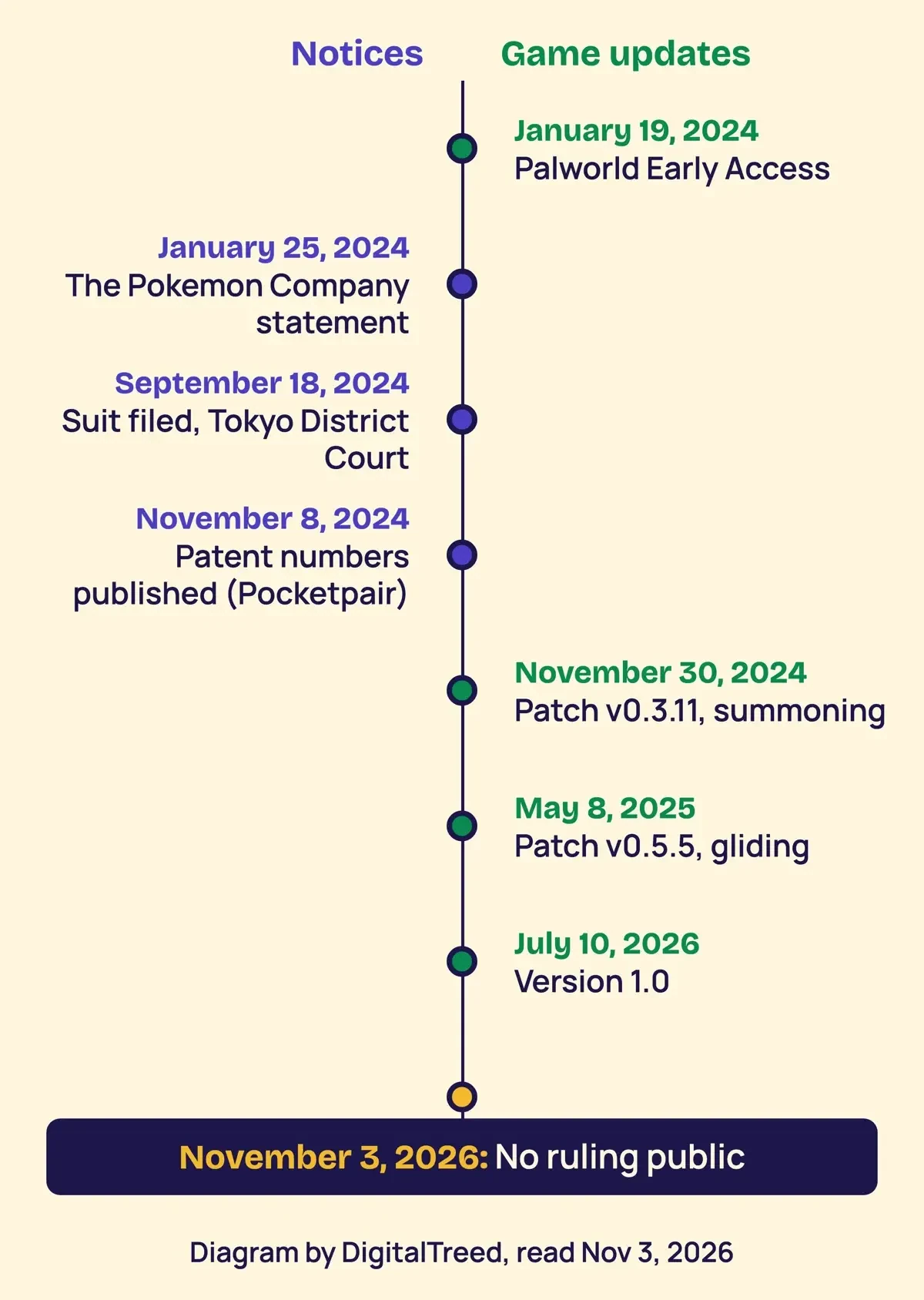 Diagram by DigitalTreed, from the Nintendo, The Pokemon Company and Pocketpair notices and the Palworld Steam patch notes, read November 3, 2026.
The three patents named in the case
Those numbers came in Pocketpair's report on the lawsuit of November 8, 2024. It lists each patent with its application and registration dates, and we've added the days from registration to the September 18, 2024 filing. You can look each one up on J-PlatPat, the Japan Patent Office's public search database.
| Japanese patent | Application date | Registration date | Days from registration to filing |
|---|---|---|---|
| No. 7493117 | February 26, 2024 | May 22, 2024 | 119 |
| No. 7528390 | March 5, 2024 | July 26, 2024 | 54 |
| No. 7545191 | July 30, 2024 | August 27, 2024 | 22 |
All three applications were filed in 2024, after Palworld's Early Access launch on January 19, 2024, the date Pocketpair gives in the same report. But Google Patents lists each one as a divisional application with a priority date of December 22, 2021, owned by Nintendo and The Pokemon Company. Here's why that date matters: Article 44 of the Patent Act says a divisional "is deemed to have been filed at the time of filing of the original patent application." The newest patent, No. 7545191, went from application to registration in 28 days and was only 22 days old when Nintendo and The Pokemon Company filed suit.
Under Article 66 of the Japan Patent Act, a patent right comes into effect when it's registered. So each right in the table starts on its registration date. Pocketpair's report says the plaintiffs want "compensation for a portion of the damages incurred between the date of registration of the patents and the date of filing of this lawsuit." For patent 7545191 that span is 22 days, and for patent 7493117 it's 119. The injunction request doesn't have that window.
Pocketpair lists "Payment of 5 million yen plus late payment damages to The Pokémon Company" and the same to Nintendo. That makes 10 million yen before late payment damages. We've left the figure in yen. We didn't read an exchange rate source for this post, so there's no dollar amount here.
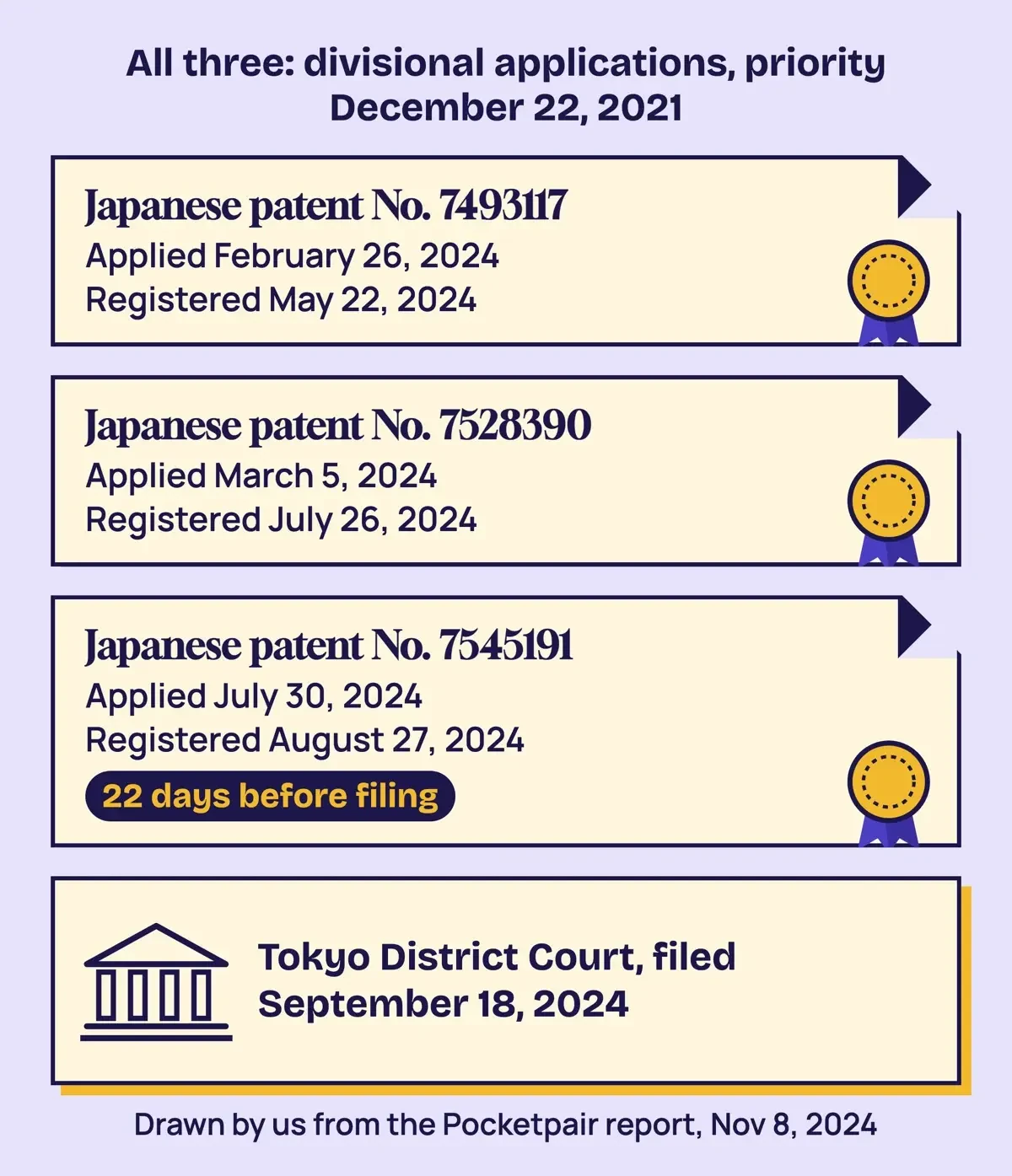 Drawn by us from Pocketpair's report of November 8, 2024 (English and Japanese versions), read November 3, 2026.
What the three companies said, in their own words
Between them, the three companies have posted six notices touching on Palworld since January 2024, and we read all six. The earliest came from The Pokemon Company on January 25, 2024, six days after Palworld launched. It opens: "We have received many inquiries regarding another company's game released in January 2024." It doesn't name that game. The same statement says "We have not granted any permission for the use of Pokémon intellectual property or assets in that game." It adds "We intend to investigate and take appropriate measures" against acts that infringe Pokemon's intellectual property rights. When the suit came eight months later, Nintendo's release described it as a patent infringement case.
Both plaintiffs closed their September 19, 2024 notices with a general line about protecting intellectual property, not with any detail about the patents or the game. Nintendo wrote that it "will continue to take necessary actions against any infringement of its intellectual property rights including the Nintendo brand itself." The Pokemon Company's English text says it "will continue to take appropriate actions against any infringement of its intellectual property rights." Neither notice names a patent, says which game features are at issue, or gives a hearing date. So the list of patents in the case came from Pocketpair's November 2024 report. The plaintiffs haven't published any.
Pocketpair has posted three notices on the case, all on its Important Notice list in English and Japanese, between September 19, 2024 and May 8, 2025. The September 2024 one called Pocketpair "a small indie game company based in Tokyo" and apologized to fans for the worry. It also said "It is truly unfortunate that we will be forced to allocate significant time to matters unrelated to game development due to this lawsuit." It promised to do its utmost so "that indie game developers are not hindered or discouraged from pursuing their creative ideas."
The November 2024 report is drier, and it ends: "We will continue to assert our position in this case through future legal proceedings."
The third notice, from May 8, 2025, is the most direct: "We continue to dispute these claims and assert the invalidity of the patents in question."
Nintendo hasn't added anything since. Nintendo's own news list data, 879 items running to October 6, 2026, doesn't hold a later notice on the case.
The game changes Pocketpair made because of the case
That May 2025 notice ties two patches to the suit, and Palworld's official Steam notes give the same dates. Patch v0.3.11 arrived on November 30, 2024. Its note reads: "Changed the behaviour of summoning player-owned Pals so that they are always summoned near the player." The same patch also changed the interface, since "The reticle will now only be displayed when aiming." Pocketpair's English notice adds that "Several other game mechanics were also changed with this patch," but it doesn't list them.
Steam files the patch under the title "Update v0.3.11: Changes to player controls," and those two lines are the whole note, with nothing about Pal Spheres or the lawsuit.
Pocketpair's May 8, 2025 notice says the patch "removed the ability to summon Pals by throwing Pal Spheres." It also says "these changes were indeed a result of the ongoing litigation." Patch v0.5.5 came out the same day. From then on, "gliding will be performed using a glider rather than with Pals," and Pals in your team only add passive buffs. The Japanese version of the May 8 notice says more than the English one, and in our translation it calls the changes a precaution meant to make non-infringement clearer. It also says Pocketpair won't restore the old design until the court clearly finds that design didn't infringe. The English page doesn't have that line.
Palworld left Early Access with version 1.0 on July 10, 2026, and the changelog opens: "Today, Palworld exits early access." In those notes, a glider Pal still "modifies the performance of the equipped glider." A player returning to 1.0 after a long break needs a glider in the inventory to glide, as the May 2025 notice set out.
Patent suit or copyright suit: how they differ
The five case notices speak of patent rights, and not one uses the word copyright. The two aren't the same right under US or Japanese law. The US Copyright Office's general FAQ says "Copyright protects creative works, such as books, drawings, photographs, songs, and movies." By contrast, "A utility patent protects new inventions or processes." The same FAQ adds that "Copyright does not protect facts, ideas, systems, or methods of operation, although it may protect the way these things are expressed." Patents work differently. On the USPTO patent essentials page, a US patent gives the right to "exclude others from making, using, offering for sale, or selling" the invention.
Japanese law governs this case. Article 68 of the Japan Patent Act gives a similar exclusive right and says "The patentee has an exclusive right to work the patented invention in the course of trade." Article 2 treats a product invention as "including a computer program," so a patent can reach something a game does in code.
- Protects: copyright covers creative works such as drawings, songs and computer software; a patent covers a new invention or process.
- Starts: a work is protected "the moment it is created and fixed in a tangible form," per the Copyright Office; a patent must be applied for and granted.
- Lasts: a Japanese patent ends 20 years after the application date under Article 67; US utility patents run up to 20 years from filing.
- Court orders: under Article 100, a patent holder may claim "the cessation or prevention of the infringement," the injunction asked for here.
- Defense: under Article 104-3, a patent that should be invalidated in an invalidation trial can't be enforced against the other side.
Pocketpair's claim of "the invalidity of the patents" matches the defense Article 104-3 allows inside the suit, and Article 123 also sets out a separate trial for patent invalidation. No statement says whether one was requested.
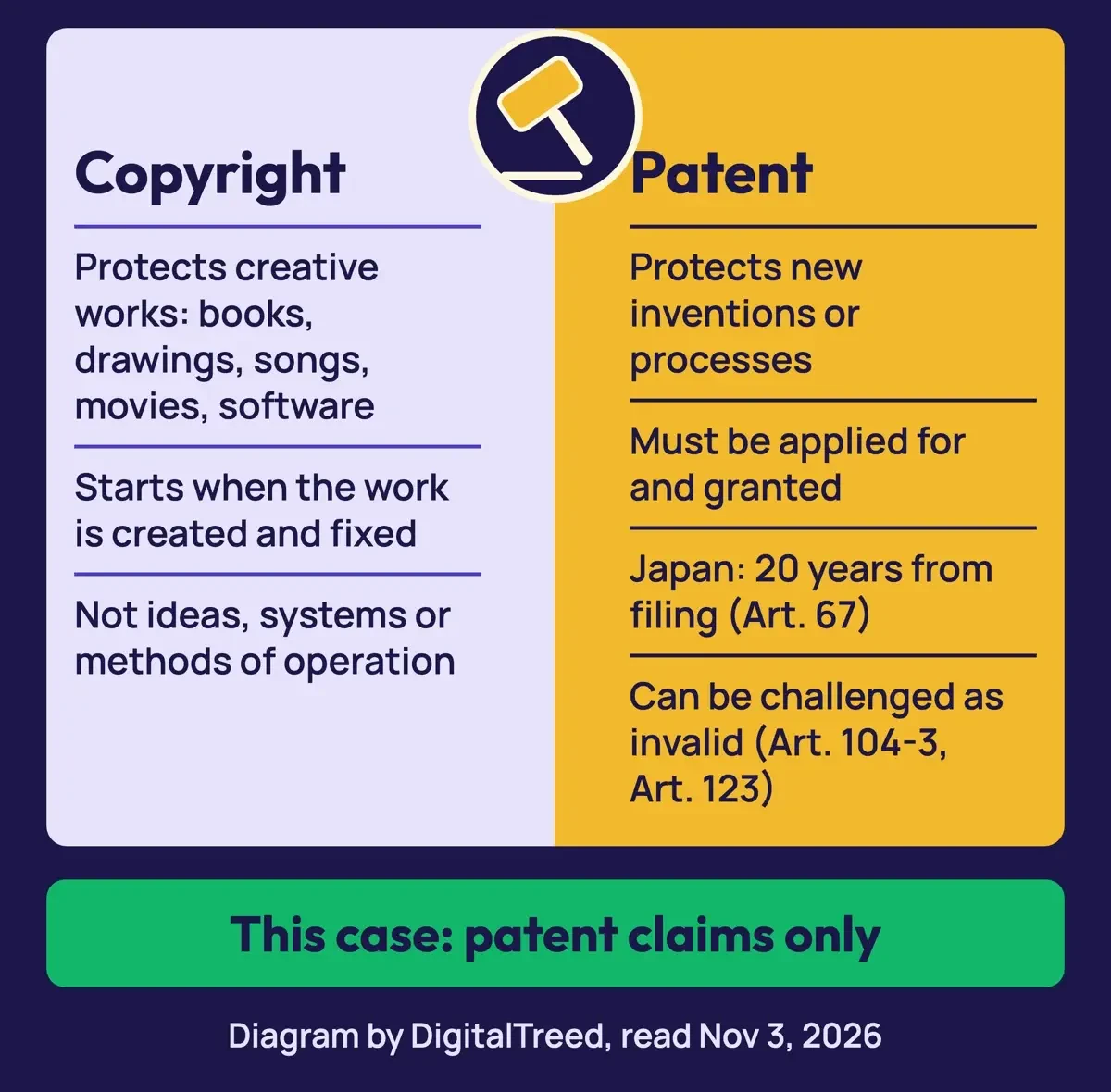 Diagram by DigitalTreed, from the US Copyright Office FAQ, the USPTO patent essentials page and the Japan Patent Act, read November 3, 2026.
Where the Palworld lawsuit stands today
As of November 3, 2026, no ruling, settlement or withdrawal shows up on Pocketpair's notice list, The Pokemon Company's news release list or Nintendo's news list. The suit has been open for 776 days, counted from September 18, 2024.
Pocketpair's last notice on the case is still the May 8, 2025 one, 544 days before our check. It said "we remain involved in prolonged legal proceedings regarding alleged patent infringement." The Pokemon Company's news release list runs to September 15, 2026. It holds 110 items going back to February 8, 2013, so older notices don't drop off it. Only two of those items deal with this matter: the January 2024 statement and the September 2024 filing notice. Nothing newer from The Pokemon Company mentions Pocketpair or Palworld. Pocketpair's own November 2024 report said it would "refrain from responding individually to inquiries regarding this case."
If the Tokyo District Court rules, either side may appeal. The IP High Court jurisdiction page says "Appeals from district courts in civil cases relating to patent rights" belong to the Tokyo High Court. Its IP High Court branch hears them. That page also says "Suits against appeal/trial decisions made by JPO" go to that court too, which covers a patent invalidation trial decision. For later news on the case, the pages to check are Nintendo's corporate releases, The Pokemon Company's news list and Pocketpair's Important Notice list. Pocketpair's November 2024 report says "If any matters arise that require public notice, we will announce them on our website, etc."
What we tested
On November 3, 2026, we sent plain GET requests, user agent DigitalTreed-check/1.0, to every statement page here. A script then checked 51 wordings we rely on against the saved text. All 51 matched.
| Page | What our plain GET got |
|---|---|
| Nintendo release | 200; Last-Modified November 7, 2024 |
| Nintendo news list data | 200; 879 items, latest October 6, 2026 |
| The Pokemon Company releases | 200 (English URL: 308) |
| Pocketpair notices | 200; all Last-Modified October 30, 2026 |
| J-PlatPat | 200, loading page only |
| JPO English page | 403 bot-block, opens in a browser |
Every Pocketpair page carries the same Last-Modified time, which looks like a site rebuild rather than an edit to any one notice. Since J-PlatPat needs a browser, the patent numbers here come from Pocketpair's notice in two languages, and Google Patents lists the same three. The script wrote the matches and day counts to a local timeline page on 127.0.0.1, shown below.
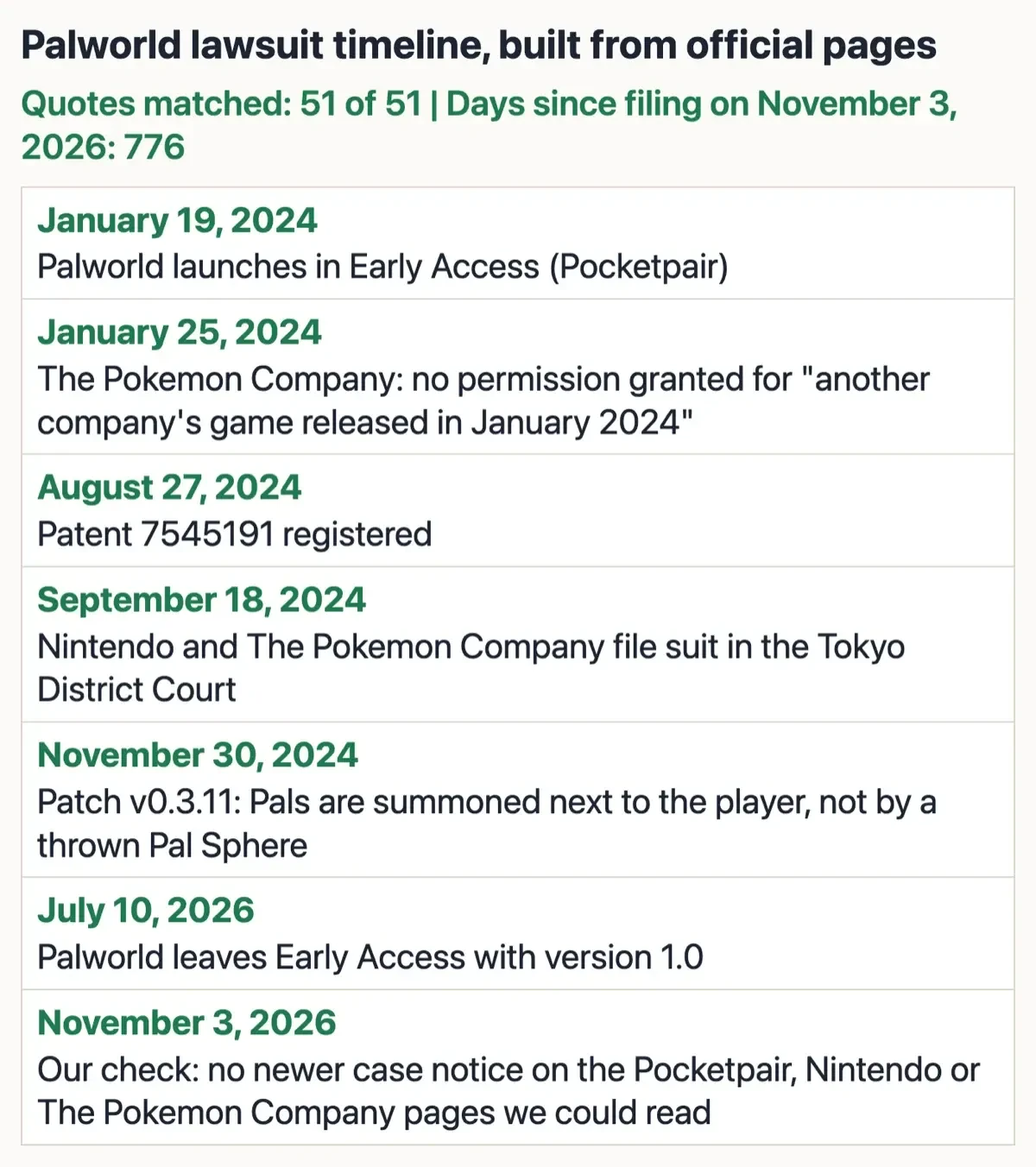 Screenshot: our local timeline page on 127.0.0.1, November 3, 2026 (selected rows shown).
Does the case affect US players and indie developers?
For US players, nothing in the three companies' statements asks anyone to stop playing or buying Palworld, and Steam patches kept coming through September 2026. The suit sits in a Japanese court over Japanese patents. The USPTO notes that "U.S. patents are effective only within the U.S. and its territories and possessions." None of the three companies' statements names a US patent, a US court or any action outside Japan.
For indie developers, the concrete point is in Pocketpair's May 2025 notice. It changed how players summon Pals and glide. It ties those changes to a patent suit, not to art or music. Copyright covers the art, music and software you make; the list above shows how differently the two rights start and end.
The USPTO lists utility patents as those "for inventing a new or improved and useful process, machine, article of manufacture, or composition of matter." Japan's Article 2, as quoted above, goes further and names computer programs outright. In the US, those patents run up to 20 years from filing. The USPTO also says owners must pay maintenance fees after a utility patent issues "in order to keep it in force," so a patent you find may have lapsed.
Our guide to how to protect your website content covers the copyright side, and the business naming checklist covers a trademark search before launch.
This guide reports public records and isn't legal advice. If a feature in your game looks close to a granted patent, talk to a patent attorney before launch.
More gaming reads: what Stardew Valley 1.6 changed on Switch and whether Princess Daisy is in the Super Mario movie. There's also how to claim free Steam games safely and how to check a Call of Duty ban. For art questions, see the rules for ChatGPT image styles.
Palworld lawsuit questions
Frequently asked
Is Palworld still available while the lawsuit runs?
Yes. Version 1.0 came out on July 10, 2026, and patch v1.0.5 followed on Steam on September 15, 2026.
Is the Palworld lawsuit a copyright case?
The notices name patent rights only. Pocketpair's report says the plaintiffs claim Palworld "infringes upon the following three patents held by the Plaintiffs."
How long do the Palworld patents last?
Article 67 sets 20 years from filing, and a divisional counts from the original filing. Google Patents shows December 22, 2041 for all three, which it says isn't a legal conclusion.
Can Pocketpair challenge the patents?
Yes. Article 123 of the Patent Act says "a request for a trial for patent invalidation may be filed," and Pocketpair says it asserts the patents are invalid.
How we made this guide: We read only the official pages listed under Sources. A script fetched them on November 3, 2026, matched every quote and counted the days. Facts checked by the DigitalTreed team on November 3, 2026.
First published August 7, 2024, six weeks before the patent suit was filed, as a general overview that described contract claims and an unnamed plaintiff. Rewritten November 3, 2026 from the companies' own records.
Sources
- Nintendo: Filing Lawsuit for Infringement of Patent Rights against Pocketpair, Inc. (September 19, 2024)
- The Pokemon Company: news release on the patent suit (September 19, 2024, Japanese and English)
- The Pokemon Company: Inquiries Regarding Other Companies' Games (January 25, 2024)
- The Pokemon Company: news release list
- Pocketpair: Regarding The Lawsuit (September 19, 2024)
- Pocketpair: Report on Patent Infringement Lawsuit (November 8, 2024)
- Pocketpair: Regarding the lawsuit, changes to Palworld and the future (May 8, 2025)
- Pocketpair: Japanese version of the May 8, 2025 notice
- Pocketpair: Important Notice list
- Pocketpair: Palworld marks two years since Early Access launch
- Palworld on Steam: Update v0.3.11 (November 30, 2024)
- Palworld on Steam: Update v0.5.5 (May 8, 2025)
- Palworld on Steam: v1.0 Official Release Changelog (July 10, 2026)
- Palworld on Steam: v1.0.5 (September 15, 2026)
- J-PlatPat: Japanese patent 7545191
- Google Patents: JP7545191B1, JP7493117B2 and JP7528390B2
- Japan Patent Act, official English translation
- Intellectual Property High Court: Jurisdiction
- USPTO: Patent essentials
- US Copyright Office: Copyright in General FAQ

Comments
No comments yet. Start the conversation below.