
Quick answer
As of November 1, 2026, two of the 89 B2B marketing and sales sites we checked passed every step: UpLead and Selling Power. One is a sales management magazine and the other is a B2B data company's blog. Neither mentions paying writers. Pitch with named sources, cited numbers and a short idea before any draft.
Say your team ran an account-based pilot last quarter, with 40 named target accounts, weekly sales syncs and a shared sheet showing which of those accounts booked meetings. That sheet is what B2B editors want to see, and searching "write for us B2B marketing" is how most people start hunting for one. A contributor page is a publication's own rulebook for outside writers: what it accepts, what it turns down and where a pitch should go.
First comes the proof two very different editors ask for, then why old B2B contributor lists go stale so fast. Next come search strings in demand gen and sales words, a casino on a B2B domain, a five-row check and the two sites that passed. It closes with checking a site in your own browser, pitching, and the disclosure line a vendor's employee owes readers.
Key takeaways
- Only two of 89 B2B candidates passed our November 1, 2026 check.
- Selling Power says to assume a no after 14 business days of silence.
- UpLead asks for three outside links that back your claims.
- Six B2B homepages now redirect elsewhere, four to another company.
- Vendor employees should name the job tie inside the post.
Note
Run B2B campaigns you could write up? Our submission page describes DigitalTreed as "a digital marketing and technology publication" with Business among its topics, and it names the readers as "bloggers, agencies, SaaS teams and startup founders". Editorial ideas start small: "Send a short pitch first, not a finished article." The page says a good pitch shows "a clear problem, who it is for, and what you learned solving it". A sponsored guest post includes "One relevant contextual link to your website or brand", and "New clients pay 50% upfront and the remaining 50% after the post is published." There are no rates on that page; it says "Prices by niche, trial offers and payment terms are in our media kit".
Two editors, two kinds of proof: what B2B sales and marketing pages ask for
The two pages that passed come from different corners of B2B, a sales magazine and a data vendor's blog, and they don't define proof the same way.
Selling Power is a sales management magazine, and the footer of its submissions page names "Personal Selling Power, Inc." as the publisher. It wants to know who you'd quote, adding "we're looking for VP-level sources". It also says "Case studies, best practice reports, and client success stories will get more attention from us than a straight product pitch." What it doesn't want is "a generic rehash of a sales coaching philosophy or sales training methodology".
UpLead sells B2B contact data, with menu items like "Data Enrichment", and its guest post guidelines read like a research brief. "Word count of submitted posts should be 1,500+ words", the page says, then: "Add at least three links to resources that substantiate your claims." Those links must be outside sources: "These links should be unaffiliated to you".
On opinion, it's blunt: "If your statement or assertion can't be backed up by research or statistics, then it doesn't deserve a place in your post."
Neither editor wants a product tour dressed up as advice.
Put the two together and B2B proof looks like this. Name the people you quote with their job titles. Say where each number came from, which date range it covers, and whether it's your own CRM data, a customer's figure or a vendor's survey of strangers. A pipeline figure with no time window won't survive either editor.
There's a legal reason vendors watch this too. The FTC's advertising basics page says "Under the law, claims in advertisements must be truthful, cannot be deceptive or unfair, and must be evidence-based." Its policy on substantiation expects advertisers to "have a reasonable basis for advertising claims before they are disseminated". Those lines are about ads, but they make a sound habit for any post that praises your own product: keep the data behind every result you claim.
Google's guide to helpful content asks whether a page shows "first-hand expertise and a depth of knowledge". In B2B, that first-hand part is the campaign you ran, the deal you lost and the dashboard you built.
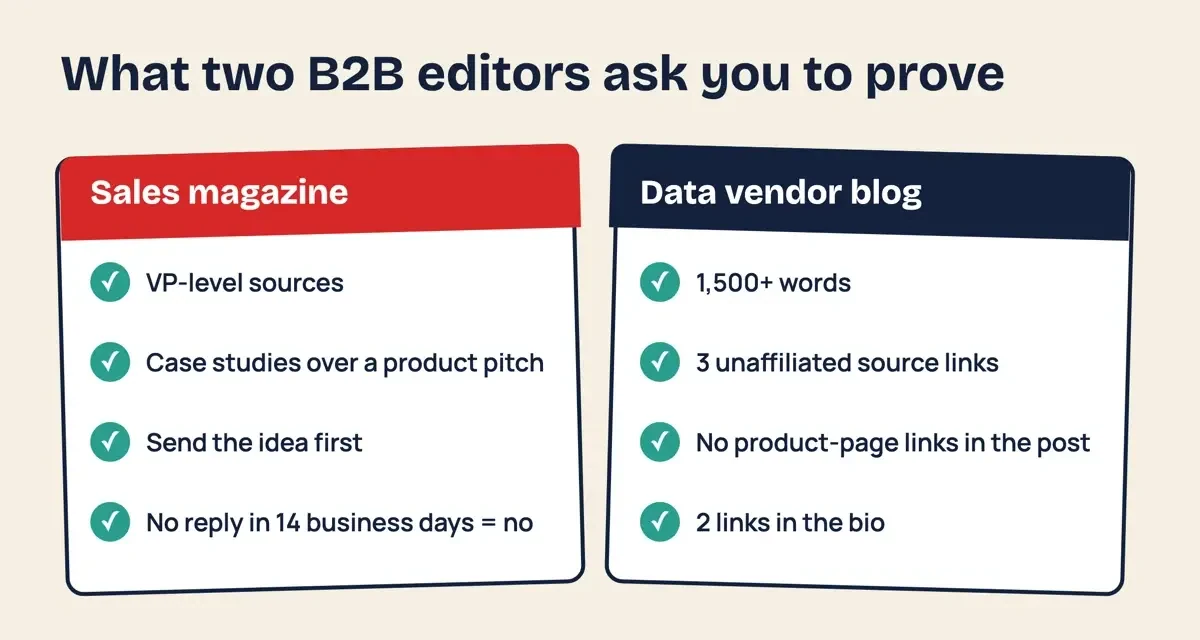 Diagram by DigitalTreed of what two B2B contributor pages ask writers to prove, from the pages as read on November 1, 2026.
Redirects, bot walls and dead hosts: why B2B contributor lists go stale
That proof is half the job. The other half is finding an editor who's still there, and the B2B vendor map keeps moving under old lists.
In our run, six candidates had homepages that now send visitors to a different domain. In four of them it's another company's site: Drift goes to Salesloft, Terminus goes to DemandScience, Pardot goes to Salesforce and Topo goes to Gartner. Older B2B guest post lists may still carry names like these. When a homepage lands on another company's site, check whether the old blog program still exists before you pitch it.
Bot checks blocked 17 more, including the review platforms G2, Capterra and TrustRadius, plus Demand Gen Report and Sales Hacker. Our checker sends one plain request and stops at a wall, so treat these as unknown rather than failed. A person in a browser may find a live contributor page there.
Then come the 51 where our checker found no contributor page, Forrester, ZoomInfo, Gong and Apollo among them. A famous brand doesn't guarantee a public route for outside writers, and on these our checker found none. B2B Marketing's only match was a 2019 page about awards entries, which isn't an invitation to write.
So before you draft anything, paste each submission URL from an old list into DigitalTreed's HTTP status checker. A redirect to another company's homepage tells you the program you read about has likely moved or ended.
Redirects change, so rerun it the morning you send a pitch.
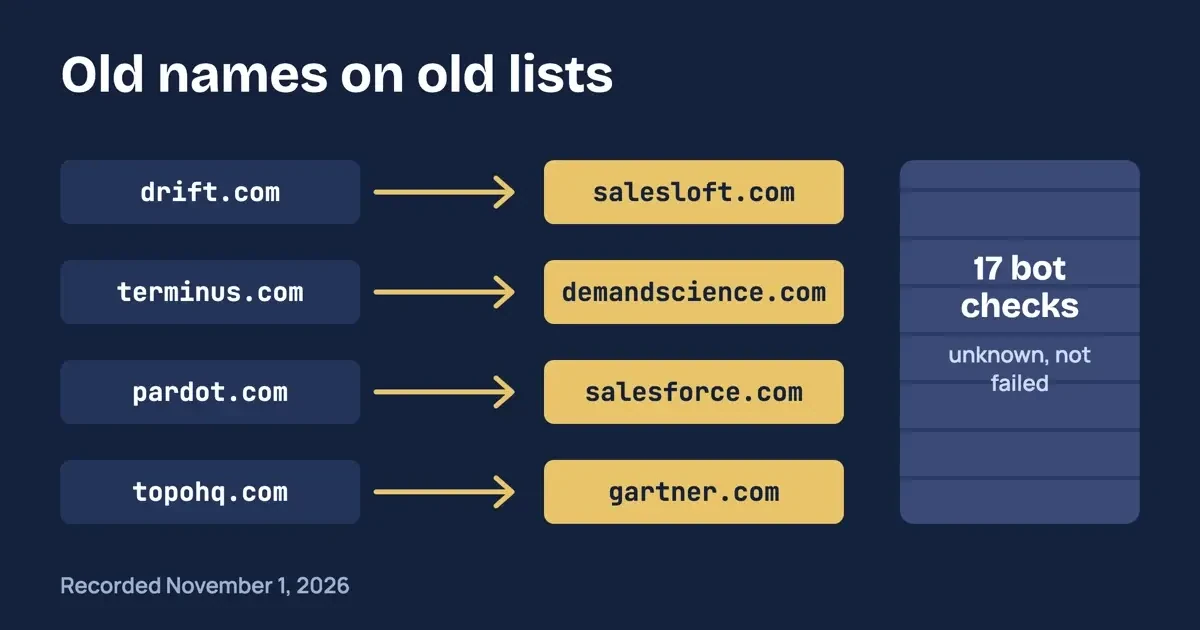 Diagram by DigitalTreed of redirects and bot checks recorded by our November 1, 2026 site check.
Search strings in demand gen, ABM and sales enablement words
Once the dead programs are out, a fresh search finds the live ones. Google's Search Help guide to refining searches covers exact-phrase quotes, the minus sign for excluding a word, site: and the before: and after: date filters. It adds a caution: "Do not put spaces between the operator and your search term." The strings below use only those operators.
Find B2B marketing and sales contributor pages
"contributor guidelines" "demand generation"
"guest post guidelines" "account-based marketing"
"editorial submissions" "sales management"
"write for us" "sales enablement" -casino
"submit an article" "revenue operations"
"guest post guidelines" "B2B lead generation" after:2026/01/01

Vet one domain (swap its name in for example.com)
site:example.com casino
site:example.com "payday"
site:example.com "sponsored post"
"example.com" "guest post" price
Search in the words your buyers' teams use, not in marketing slang. Terms like RevOps, enablement, intent data and pipeline coverage tend to pull up the trade publications that sales leaders, marketing ops staff and enablement managers actually read. Broad phrases like "digital marketing" mostly return general marketing blogs. Skip them here.
Read the vet results as a hint, not a verdict. Google's help entry on the site: operator says it "Returns a list of indexed and serving URLs." It also warns: "The list of URLs returned is not always exhaustive." An empty result doesn't prove a site is clean, and it doesn't prove the opposite either.
A casino on a B2B domain and link promises in the pitch
Those vet strings matter because the worst B2B footprint isn't on a blog's posts at all.
One candidate with B2B marketing in its domain name now opens on a page ranking online casinos. A topic jump that big can mean the domain changed hands, and the archive row in the card below is how you'd spot it. Any list that still files it under B2B marketing hasn't been checked in a while. Check the homepage first.
The run looked for 11 casino-type words across as many as eight sitemap files on each domain, and it cut a site only at 3 or more matches. No B2B candidate failed that screen, so the casino domain was caught by its homepage title, not by slugs. You can read a site's slugs yourself with DigitalTreed's XML sitemap validator.
The other two drops were about how contributing was sold. Their pages made the backlink part of the offer. Google's link spam rules list "Exchanging money for links, or posts that contain links", and a page that leads with the link invites that kind of deal.
UpLead shows the opposite stance. Its page lets you cite your own research "as long as you do not link directly to your product/service pages within your post".
Which B2B blogs pass a five-row check?
Those footprints, plus rank and archive history, fit on one card scored green, yellow or red, and it works the same for a sales magazine or a vendor blog. The full checklist lives in our hub of guest post sites by niche, and this card keeps the five rows that sorted B2B sites fastest.
A single red means skip it. With two yellows or more, read the latest five posts before writing a word.
| Row | Green | Yellow | Red |
| Submission rules | Written rules and a named route for pitches | Live, with a catch such as a closed window | Missing, paused or priced |
| Links and money | No price and no link promise | Link terms left vague | A dofollow promise or a price list |
| Tranco rank | Inside the top 100,000 | From #100,001 through #1,000,000 | Outside the top million and no traffic proof |
| Archive titles | One sales or marketing topic over the years | Blank years or a parked-looking title | Three or more topic changes |
| Sitemap slugs | No casino-type words | One or two, explained by the niche | Casino, loan or pill slugs |
The rank row uses Tranco, a research list billed as "Hardened Against Manipulation". Its methodology combines "rankings from (currently) five providers" averaged "over the past 30 days". On a vendor's domain, much of that rank comes from the product, not the blog. One more quick test: run a guest post published in the last month through DigitalTreed's noindex tag checker, since a noindexed post never shows in Google.
Score every site on the same day you pitch it.
Both listed sites, scored from recorded data only:
- UpLead. Submission rules: green, length, sourcing and topic rules plus an email route. Links and money: green, no price; two bio links allowed, none to product pages in the post. Tranco rank: yellow, #234,822. Archive titles: yellow, a bare domain-name title in 2013, the data product by 2019, then blank titles. Sitemap slugs: green, no casino-type words in the 544 URLs read. Result: two yellows and no red, so read its five newest posts before you write.
- Selling Power. Submission rules: green, a named inbox, a set subject line and a 14-business-day answer window. Links and money: green, no price, no link terms and no pay mentioned. Tranco rank: yellow, #405,569. Archive titles: green, sales management in every readable title since 1996. Sitemap slugs: green, no casino-type words in the 67 URLs read. Result: one yellow, no red; pitch it.
UpLead's second yellow comes from its archive titles, not from anything on the page. A bare domain name as a title can mean a parked domain before the product launched. It isn't a fault, but it's a reason to read recent posts before you spend a week on a draft.
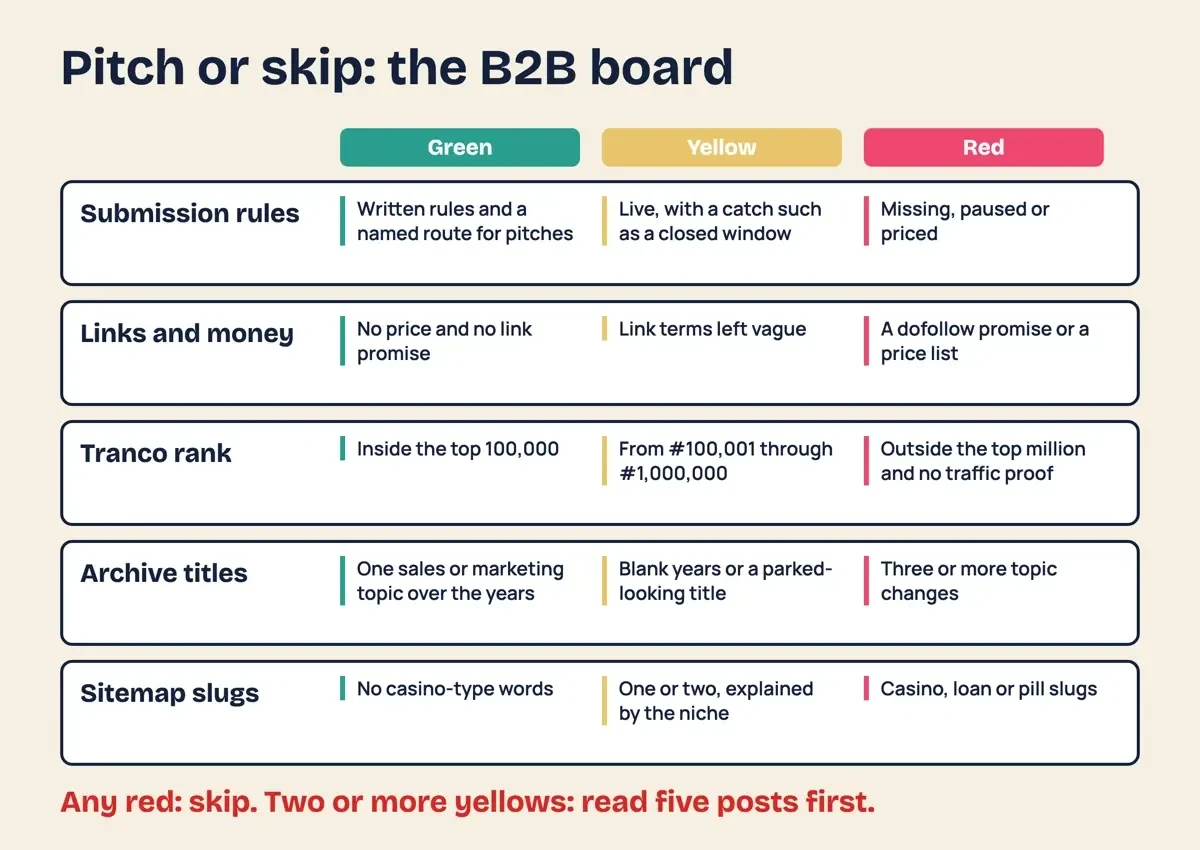 Diagram by DigitalTreed: five rows for scoring a B2B marketing blog, using the cutoffs in this guide and the site check of November 1, 2026.
Write for us B2B marketing: two sites passed on November 1, 2026
The card above is also the bar for this table. The Vetted label on this guide's cover image applies to these rows and nothing else. Each row cleared the run on November 1, 2026 and our second read of its page that afternoon. Being listed doesn't mean an editor will answer, or that any link survives the edit. Site names stay unlinked; each row's one link, marked rel="nofollow", opens its submission rules.
| Site | Submission rules (nofollow) | What the page asks | Tranco | Checked on |
| UpLead | Contributor page | Email three title ideas and a writing sample; 1,500+ words; at least three unaffiliated source links; no product-page links in the post, two in the bio | #234,822 | November 1, 2026 |
| Selling Power | Contributor page | Email a query with the set subject line; idea first is better; short Sales Management Digest pieces run up to 500 words; no reply in 14 business days means no | #405,569 | November 1, 2026 |
Why only two? Our B2B search produced 89 candidates, and the funnel narrowed fast. Of those, 51 showed no contributor page on the homepage or at any path our checker tried. Another 17 sat behind a bot check, and 14 either didn't answer or now redirect to another site. Two more sold contributing on the backlink a writer would get, and one B2B-named domain opens on casino rankings.
One sales enablement site passed everything except the Tranco rule, and after we checked its traffic on November 2, 2026, it joins the list below. The last of the 89 was a web agency blog that our website development guide counts instead, so it isn't a B2B pick.
We know two sites is a thin list for a niche this big, and we'd rather show two that held up than pad the table with unchecked names. Our checker named itself as DigitalTreed, obeyed robots.txt and paused between requests. It didn't sign in or submit forms. With no paid traffic tool on hand, a domain's position on the Tranco list dated October 29, 2026 (ID PYK6J) stood in for traffic. For each year we kept a single homepage title, taken from the Internet Archive's CDX server, whose docs say "Results may be filtered by timestamp using from= and to= params."
Writing about channels like SEO, social or paid ads rather than B2B pipeline? Our digital marketing guest post guide fits better. Product-led growth and software stories belong with the SaaS guest post guide. Team leadership and sales operations pieces may suit the business management guest post guide or the business blog guide. Each site sits in only one of our niche guides.
One smaller sales enablement site, added November 2, 2026
Sales Enablement Collective has no Tranco rank. Even so, the Ahrefs free traffic tool put it above 10,000 organic visits a month on November 2, 2026, most of them from the US.
| Site | Guidelines (nofollow) | What the page asks (our read) | Ahrefs organic estimate (monthly) | Top country (share) | Checked |
| Sales Enablement Collective | Create and contribute | 800+ words; no product promotion or links to your company | 11,200 | US (78%) | November 2, 2026 |
Its page bars product promotion and company links in contributed articles. Sponsorship is sold separately.
What we tested
The test behind this guide is our own site check, run on November 1, 2026. It read 89 B2B marketing and sales candidates, kept 2 and dropped 85. The biggest reasons were no contributor page (51), bot checks (17) and not loading or sent elsewhere (14). Of the not-loading group, six homepages redirected to a different domain and eight didn't answer at all.
That afternoon we downloaded both kept pages again and matched every rule quoted here against the new copies. Both pages still matched every rule we quote, so the reread cut nobody. Neither page promises a dofollow link, and neither mentions paying writers.
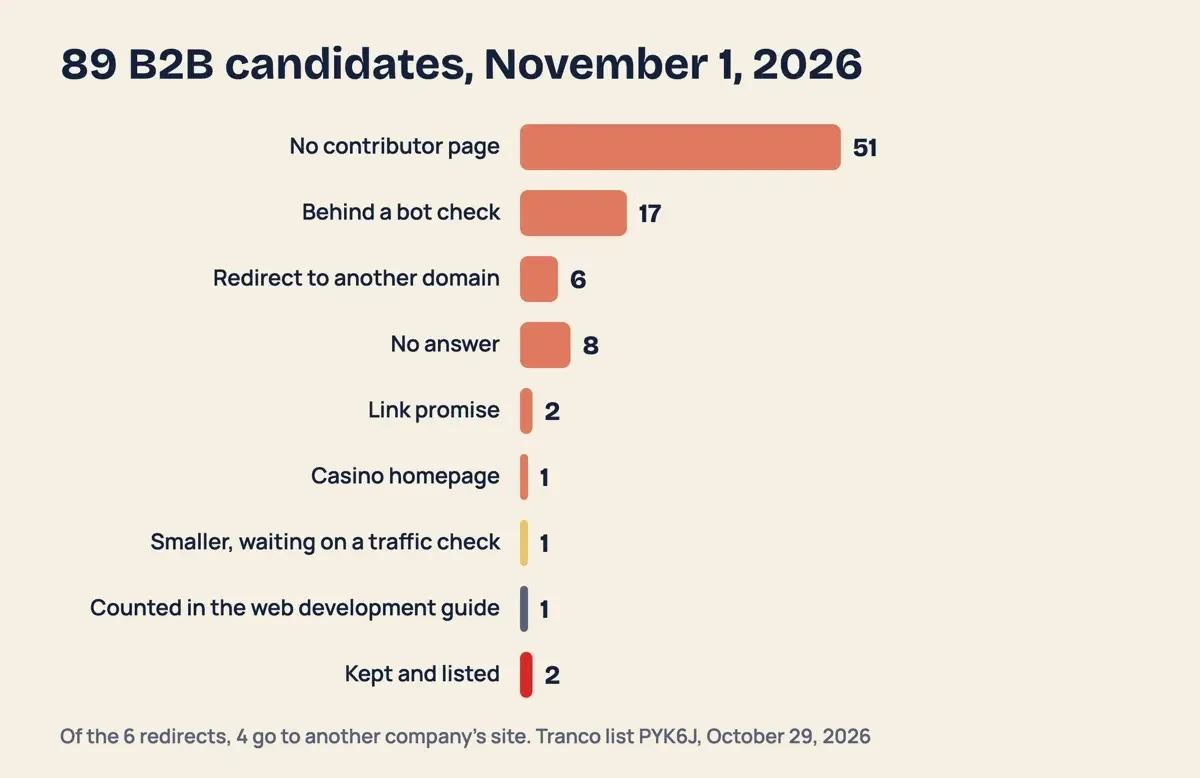 Diagram by DigitalTreed, drawn from the counts of our November 1, 2026 site check.
When the list runs out: checking a B2B site in your own browser
With only two names in the table, you'll find most of your targets yourself, through searches, newsletters you already read and the speaker lists of sales events. Expect dead ends. Start with the bot-walled group, since a browser can open what our plain request couldn't.
Open the site in a normal browser window and look through the footer, the About menu and the blog's sidebar for words like contribute, submissions or guest authors. If nothing turns up there, the program probably isn't public. Next, open the five newest posts. Check the dates, the bylines and whether outside writers appear at all. Then score the site on the card above. Read its homepage titles in the Wayback Machine for the history row and its sitemap for the slug row. Last, read the link rules twice. A page that sells the backlink fails, and one that bans product links but allows a bio link is normal for B2B.
Fit matters more than rank here. Selling Power describes its readers as "our audience of sales managers and their teams", while UpLead says it likes "content that works for marketers and sales teams". If you're unsure which buyer you're writing for, our explainer on how B2B and B2C buyers differ helps you pin down the reader.
A page your browser opens without a challenge is fair to read; if it asks you to prove you're human, that's the site's call, so move on.
Pitching a sales editor or a data vendor's blog
Follow each site's first-contact rule exactly.
Selling Power takes email with the subject line "Query for Selling Power Editors." Its advice is that "it's better to send your idea so we can evaluate it before you do a lot of work". If the piece ran elsewhere, it asks you to "Tell us if, where, and when the article was published previously". It also warns: "If your email contains grammatical mistakes or is poorly written, you won't receive a response." Its newsletter runs "two short articles (up to 500 words) about B2B sales leadership", so a tight 500-word idea has a real home.
UpLead wants "3 potential titles/topics that are valuable & actionable." plus "At least 1 sample of your writing". Plan around the wait, because the page warns "it can take up to two months before your content gets published".
DigitalTreed asks for the same order: "Please do not send a finished article before we agree on the topic." Google's 2017 note on links in large-scale article campaigns gives editors a first question, "Do I know this person?" The sample below answers it in the opening lines.
Subject: Query for {publication} editors: {one-line idea}

Hi {editor first name},

I run {role} at {company}, selling {what} to {buyer title}.
In {quarter and year} we {what you changed} and saw {metric}
move from {before} to {after} over {date range}.

The piece would show the steps, the numbers and one thing
that failed. Sources: {VP-level person and title}, {data source}.
Length: about {word count} words. No product pitch.

Published before? {where and when, or no}
Ties: {companies in the post that pay or employ me, or none}
Samples: {link 1}, {link 2}

{name}
Keep it short. Swap each braced field for your own details, and pull the numbers from reports you can show an editor. Keep the ties line even when it says none. We ask about AI as well, because our page says "AI-assisted content must be edited, reviewed by a person and fact-checked."
Need an angle? Each of these starts from records a B2B team already keeps:
- A cold email test with reply rates by segment and the opt-out steps you followed. The FTC's compliance guide for CAN-SPAM says "The law makes no exception for business-to-business email."
- Cleaning a contact list for California prospects. The state's CCPA page says the exemption for "personal information reflecting business-to-business transactions" "expired on December 31, 2022".
- How a data vendor gets ready for the Delete Act. The CPPA says that "beginning August 1, 2026", data brokers must access the state's deletion mechanism "at least once every 45 days" and "process consumer deletion requests, subject to limited exceptions".
- An ABM pilot: accounts targeted, meetings booked, cost per opportunity and what you would drop next time.
- A sales enablement change measured by new reps' time to first deal, before and after.
Our comparison of cold calling and cold email for small B2B teams shows the trade-offs editors like to see spelled out, with cost and time per meeting compared.
Work for a vendor? Disclosure lines for B2B guest posts
That ties line in the pitch matters most in B2B, where writers often work for, consult for or resell a company that the post mentions by name.
The FTC's endorsement FAQ says "if an ad features an endorser who is a relative or employee of the marketer, the ad is misleading unless the connection is made clear". Saying you were simply paid isn't enough for staff: "That wouldn't be good enough, however, if you're an employee or co-owner." On reviews it says "You definitely should disclose your employment relationship when writing such a review."
Placement counts as much as wording. The FAQ says "The closer the disclosure is to your recommendation, the better." The agency's disclosure basics warn: "Disclosures are likely to be missed if they appear only on an ABOUT ME or profile page". So a byline that reads "VP of Marketing at Acme" helps a little, but a plain sentence next to the first mention of your product helps a lot more.
Disclosure isn't a footnote job. Put it in the post.
Google wants its own signal on paid links. Its page on qualifying outbound links says to "Mark links that are advertisements or paid placements (commonly called paid links ) with the sponsored value." It accepts nofollow too, "though sponsored is preferred". The 2017 note also lists "Stuffing keyword-rich links to your site in your articles" as a warning sign.
Weighing whether a guest post pays off at all? Our piece on what a business guest post actually earns covers traffic, authority and leads. Selling posts on your own B2B blog? Before you take an order, our guide to buyers who skip paying for guest posts explains deposits and holding drafts.
Questions B2B writers ask before pitching
Frequently asked
Do B2B marketing blogs pay guest writers?
Neither site on our list mentions pay. Selling Power invites freelance writers but states no rate on its submissions page, and UpLead offers a byline and two bio links.
Can I link to my own product in a B2B guest post?
Usually not in the body. UpLead lets you cite your own research "as long as you do not link directly to your product/service pages within your post" and allows two links in the bio. Selling Power prefers case studies to a product pitch.
Does CAN-SPAM cover B2B cold email?
The FTC's compliance guide says the law covers all commercial messages and adds: "The law makes no exception for business-to-business email." If your post teaches cold email, show the opt-out and sender details you used.
Does Google penalize B2B guest posts?
Not by itself. Google's 2017 post says "Google does not discourage these types of articles in the cases when they inform users". The trouble starts "when the main intent is to build links in a large-scale way back to the author's site".
How we made this guide: One site check on November 1, 2026 produced the table, every count and both scorecards. A script then downloaded the two kept pages and each source again, and every quote was compared with those fresh copies. Nobody here pitched the listed sites, used their forms or signed up for anything. Facts checked by the DigitalTreed team on November 1, 2026.
The address first went up in November 2023 as a short call for B2B marketing submissions to DigitalTreed. It now explains where B2B writers can pitch.
Sources
- FTC: Advertising and Marketing basics
- FTC: Policy Statement Regarding Advertising Substantiation
- FTC: FTC's Endorsement Guides, What People Are Asking
- FTC: Disclosures 101 for Social Media Influencers
- FTC: CAN-SPAM Act, A Compliance Guide for Business
- State of California Department of Justice: California Consumer Privacy Act (CCPA)
- California Privacy Protection Agency: Data Brokers
- Google Search Central: Creating helpful, reliable, people-first content
- Google Search Central: Spam policies for Google web search
- Google Search Central: Qualify your outbound links to Google
- Google Search Central Blog: A reminder about links in large-scale article campaigns (May 25, 2017)
- Google Search Central: site: search operator
- Google Search Help: Refine Google searches
- Tranco: A Research-Oriented Top Sites Ranking Hardened Against Manipulation
- Tranco: Methodology
- Internet Archive: Wayback CDX Server API
Comments
No comments yet. Start the conversation below.