
Quick answer
None of the 179 blockchain sites we checked on October 31, 2026 made our list. Of those, 18 blocked our checker with a challenge page or an access error, so they're unknowns rather than rejects. Before you pitch any blockchain outlet, run the four footprint checks and the scorecard in this guide.
If you searched "write for us blockchain", you've likely built something on a ledger, such as a supply-chain pilot or a smart contract. A blockchain is a distributed digital ledger of signed transactions grouped into linked blocks, as the NIST glossary defines it. You want a byline developers respect, yet three of the blockchain writer pages our check turned up offered a backlink or a dofollow link as part of the deal. This page once held DigitalTreed's own request for blockchain posts; now it helps you pitch other outlets.
We start with why our list for this niche has zero sites, using the counts from our October 31 check. Then come what enterprise and developer editors look for, four footprints that sink a site, and where outlets that take articles actually are. After that you'll get a scorecard, the rules when a protocol or token sponsor pays you, and a sample pitch with five topic ideas. We'd rather see you land one edited article on a developer outlet than buy a followed link from a site that sells them.
Key takeaways
- None of 179 blockchain candidates made it through our October 31, 2026 check.
- Three writer pages named a backlink or dofollow link as a perk.
- All 8 spam drops showed casino words in sitemap slugs or homepage titles.
- ethereum.org reviews Ethereum-focused builder articles via GitHub and won't list token promos.
- Paid to promote a token that's a security? The SEC wants the pay disclosed.
Note
Have a ledger or smart contract story for DigitalTreed? Our submission page starts with "DigitalTreed is a digital marketing and technology publication." Blockchain isn't one of the seven topics on its list, but it isn't shut out. The page puts it on its extra review list, so expect extra editorial review: "Finance, crypto, forex, blockchain, real estate and legal topics are accepted with additional editorial review and need approval before publication." Write it for the people the page names: "Our readers are bloggers, agencies, SaaS teams and startup founders." The same page turns away "get-rich-quick schemes", so leave token tips out. It asks you to "send a short pitch first, not a finished article". On AI, the rule is "No fully AI-generated content." Guest posts get "one relevant contextual link to your website or brand". Sponsored post prices are listed in the DigitalTreed media kit.
Why our write for us blockchain list has zero sites
So, the result first. Our checker worked through 179 candidates on October 31, 2026. They came from older guest post lists, well-known blockchain publications and web searches for writer pages. It kept zero. That isn't a sign that nobody publishes blockchain writing. It's a sign of what the writer pages in this niche tend to offer, and the drop reasons show it. Most of them never got past step one: 106 showed no page inviting writers anywhere our checker looked, and 41 didn't resolve, showed a parked page or redirected elsewhere. Some of the contribute pages it did find were for code, translations or events, which isn't the same as a call for articles.
Another 18 put a challenge page or an access error in front of our checker, and we stopped there instead of working around it. Those aren't rejects; you can open them in a browser yourself. That left 14 sites that got past the writer-page step, and each failed on something else. Eight had casino or CBD words in several sitemap slugs or the homepage title. Three writer pages offered a backlink or a dofollow link as part of the deal. One events page listed followed links in a priced placement menu. The last two were dropped by a word match, and our reread changed that part of the story.
That check is what the Vetted badge in this page's banner stands for, and no blockchain site earned it. So you get the method, not a padded table.
Here's how the check worked. Each request was a plain GET with a DigitalTreed user agent, and we had no paid traffic data for this run.
Traffic came from the Tranco top 1 million list of October 29, 2026 instead. Its methodology page says it takes the "average ranks over the lists of all four providers over the past 30 days". History came from yearly homepage titles in the Wayback Machine's CDX index, which can "collapse" captures to one per year. Spam signs came from the words in each sitemap's page addresses.
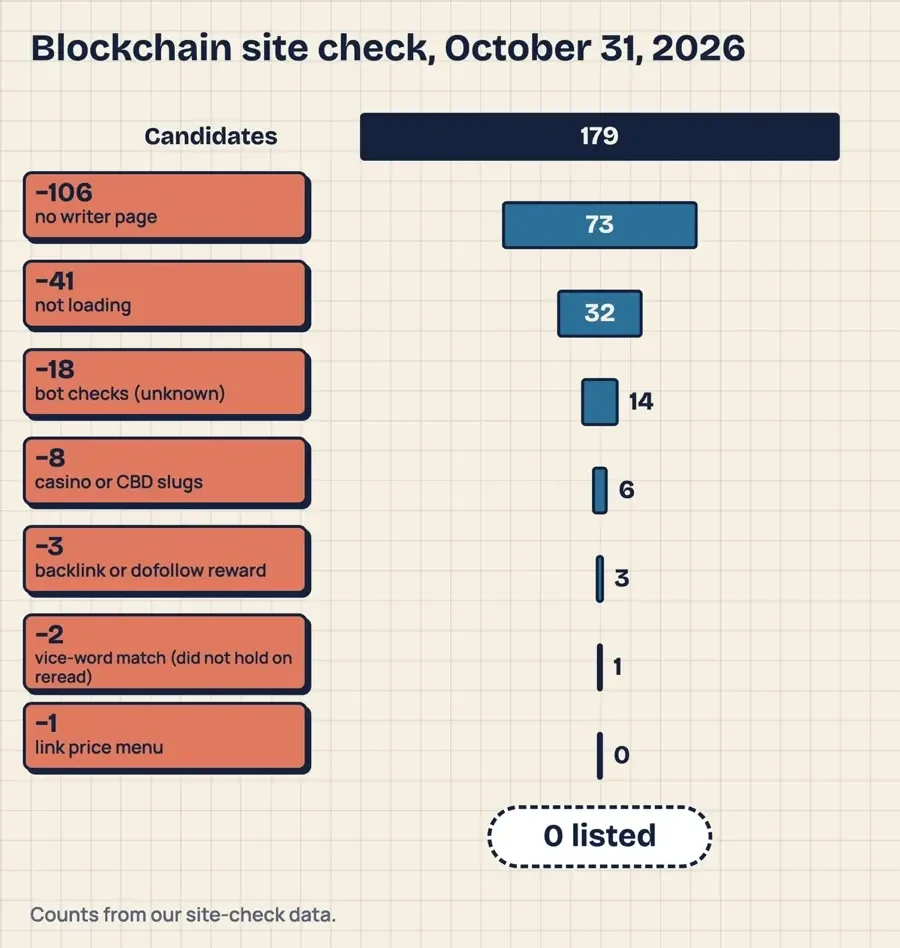 Diagram by DigitalTreed: where 179 blockchain candidates dropped out of our October 31, 2026 check. Counts from our site-check data.
What enterprise and developer blockchain editors look for
Across the pages we opened that day, the dropped ones included, three asks kept coming back. Editors want something a reader can run or verify, a source under each claim, and no token promotion.
ethereum.org is the clearest example, though it isn't a guest post site in the usual sense, and it isn't on our list. Our checker landed on its translators page rather than its article route, so the run counted it among the sites with no writer page. Its builder articles are "internally hosted, long-form articles", and each one "must be primarily about Ethereum, its protocol, tooling, or builder ecosystem". A general piece about ledgers won't fit there.
Its policy for builder articles says "The site does not list articles that primarily promote a specific product, token, or commercial service." It also asks writers to "Cite EIPs, official announcements, or onchain data where possible." That rules out most marketing copy. An EIP, or Ethereum Improvement Proposal, is the public spec for a protocol change, so the editors want you to point at the spec rather than paraphrase it.
A developer-tools company's guest program we reread sets its bar in five words. It says "we require all submissions to have uniqueness, expertise, depth, accuracy, and clarity". It wants "practical examples, tutorials, comparisons, tables, and original diagrams where appropriate". That page also sells search benefit as a reason to write, which kept it off our list. Its quality bar is still the one to aim at.
One blockchain blog's guest rules ask about you, not the piece: "Disclose the nature of any relationship with a company or person that is mentioned in your content". If you work for the vendor whose ledger you're describing, put that in the first lines of your pitch.
Google wants much the same. In its helpful-content guidance, it asks whether your work shows "first-hand expertise and a depth of knowledge". In blockchain, first-hand usually means a repo, a testnet transaction or a benchmark you ran yourself. A summary of someone else's whitepaper doesn't count.
If your piece is more about code than ledgers, our software development guest post guide covers developer outlets outside this niche, where working code carries the pitch.
Four footprints that sink a blockchain guest post site
Our run's drops showed three of the four marks below. It didn't count the fourth, token promotion, so that one's a search you'll do by hand.
The first is a writer page that sells the link instead of the readers. One page we reread offers "one DoFollow profile link" with paid guest articles. Another pitches "earning backlinks from authoritative domains" as a reason to write.
Under Google's spam policies, "Exchanging money for links, or posts that contain links" counts as link spam. Further down, the policy allows paid links "as long as they are qualified with a rel="nofollow" or rel="sponsored" attribute value". What should worry you is the followed link sold as the payoff, not the payment.
Casino pages are the second mark. They don't hide well. In our run, 8 crypto news, data and learning sites showed casino or CBD words in sitemap page addresses or the homepage title. Casino appeared on all 8 of them, and CBD on two. Search site:example.com casino, then site:example.com "crypto casino", and read what comes up. To see every page address, load the site's sitemap in the DigitalTreed sitemap validator, then read the slugs for casino or slots.
Token promotion is the third. A blockchain writer page that welcomes presale, airdrop or guaranteed-return pieces is selling reach to token issuers, and your engineering article would sit beside those promotions. The FTC puts it bluntly: "Only scammers will guarantee profits or big returns." A CFTC and SEC advisory lists "claims of high guaranteed returns" among the red flags of fraud. Why didn't our run count these words? It had no word list of its own for blockchain, only general spam terms, so presale and airdrop never got scored.
The fourth is a paid release or event menu. One events page we reread lists "Dofollow links" inside a priced placement package. Google's policy also names paid placements whose links pass ranking credit in "press releases distributed on other sites". A Google blog reminder from May 2017 flags "Stuffing keyword-rich links to your site in your articles". Ask how release links are marked. If the answer is a followed link for a fee, walk away.
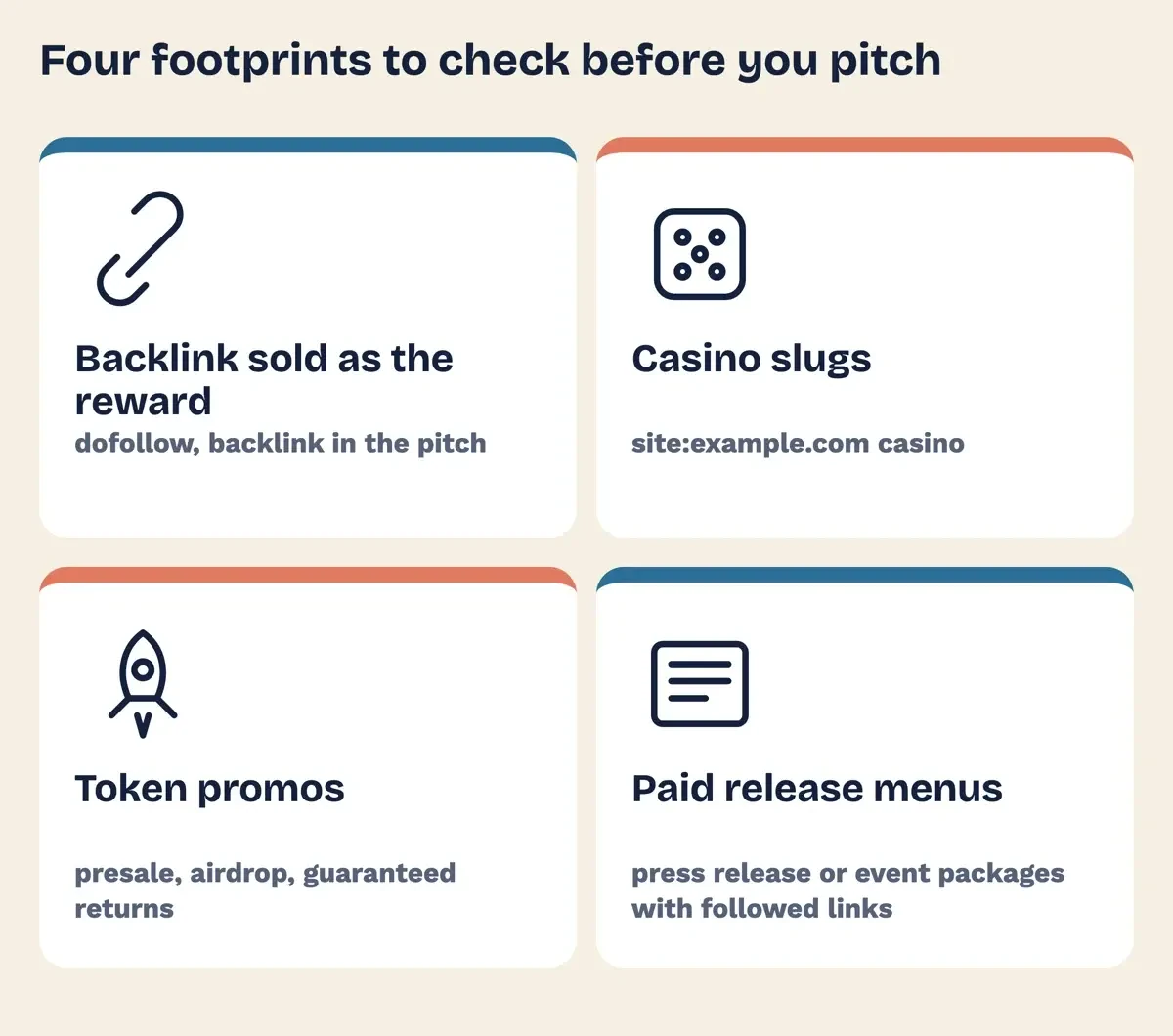 Drawn by us: four footprints to check on a blockchain site before you pitch.
Where do enterprise and developer blockchain outlets take articles?
So where do you look, if the old guest post lists come up empty? Start with search strings that name the work rather than the reward. Then check the foundation and project routes that take articles through GitHub. Run these in your own browser, each on its own:
"blockchain" "submit an article" -casino -presale
"smart contract" "contributor guidelines"
"enterprise blockchain" "guest author"
"zero-knowledge" "contribute an article" -airdrop
"hyperledger" OR "besu" "blog" "contribute"
site:github.com "builder article" ethereum
The minus sign drops pages with that word; Google's search help says to "Enter - in front of a word that you want to leave out".
The site: operator lets you "request search results from the particular domain, URL, or URL prefix" you name. Read the first two pages of results for each string, note every site with a page for writers, and skip any result that's a list of other people's lists.
Developer outlets often skip the usual submission page. ethereum.org's contributing page says "All updates are made via the GitHub PR process." For a builder article, the policy says to "create an issue on GitHub". Nothing on that policy page mentions a backlink, so expect a review by the ethereum.org team, which checks every submission before it's published, rather than a paid placement. Enterprise consortiums work differently. In our run, hyperledger.org redirected to LF Decentralized Trust, whose contribute page asks you to "Make changes, test, and submit a pull request." That's a code route. It won't give you a byline by itself, but a merged pull request is proof a blockchain editor can click and check.
Conference talk calls are a third route, and they're easy to miss in a search for writers. One research group's call we reread asks for an abstract, and accepted talks are "assigned a slot with roughly 10 to 30 minutes for presentation". It adds that "The slide-decks and videos of the presentations will later be made available online". We haven't listed that group. It has no Tranco top-1M rank and never went through our Wayback and sitemap checks. Still, a recorded talk on your proof system is something an editor can watch before reading your pitch.
Found a candidate? Open its submission page in the HTTP status tool on DigitalTreed before anything else. In our run, 41 candidates were dead, parked or bounced to another domain, and a dead page ends the search before you've read a word.
If your topic is trading, tokens or coin news, our crypto guest post guide covers those outlets and their own footprints.
Score a blockchain site before you write a word
Once a site clears those searches, score it on five rows. The full A to F checklist, with every check explained, lives in our guest post vetting hub.
| Check | Green | Yellow | Red |
| Writer page | Names topics and an editing step; no link promise | Allows a bio link, or asks for "SEO-optimized" copy | Offers a dofollow link or backlink as the reward, or prices links |
| Spam slugs | No casino, CBD or slots words in page addresses | 1 or 2 such slugs | 3 or more (our run's cutoff) |
| Token promos | None on the site | Token news on the site, none invited on the writer page | Presale, airdrop or "guaranteed returns" pieces welcome |
| Tranco rank | Rank 100,000 or better | Rank 100,001 through 1,000,000 | Unranked in the top 1 million: look for traffic signs elsewhere |
| Wayback titles | Same topic for years | One change, such as a rebrand | A topic switch three times or more, or a casino or for-sale title |
One red ends it, and two yellows mean you email the editor with questions before you write anything. The spam-slug cutoff of 3 is the one our run used. A site outside the top 1 million isn't automatically bad, but it needs a post from the last three months and some sign of real readers first.
Here's the card on a real page, using only what we recorded. Take the blog our run dropped for "gambling". Its writer page turns that topic down and asks you to disclose your ties, which reads green on the writer-page row. Its token row is yellow at best, since the page says "We cover ICO's", though not "unproven ICO's". It isn't in the Tranco top 1 million, which is red until a traffic check says otherwise. Its history and slugs weren't checked, so two rows are still blank. That's not a pass. A card with a red and two blanks stays off our list, even when the writer page reads well.
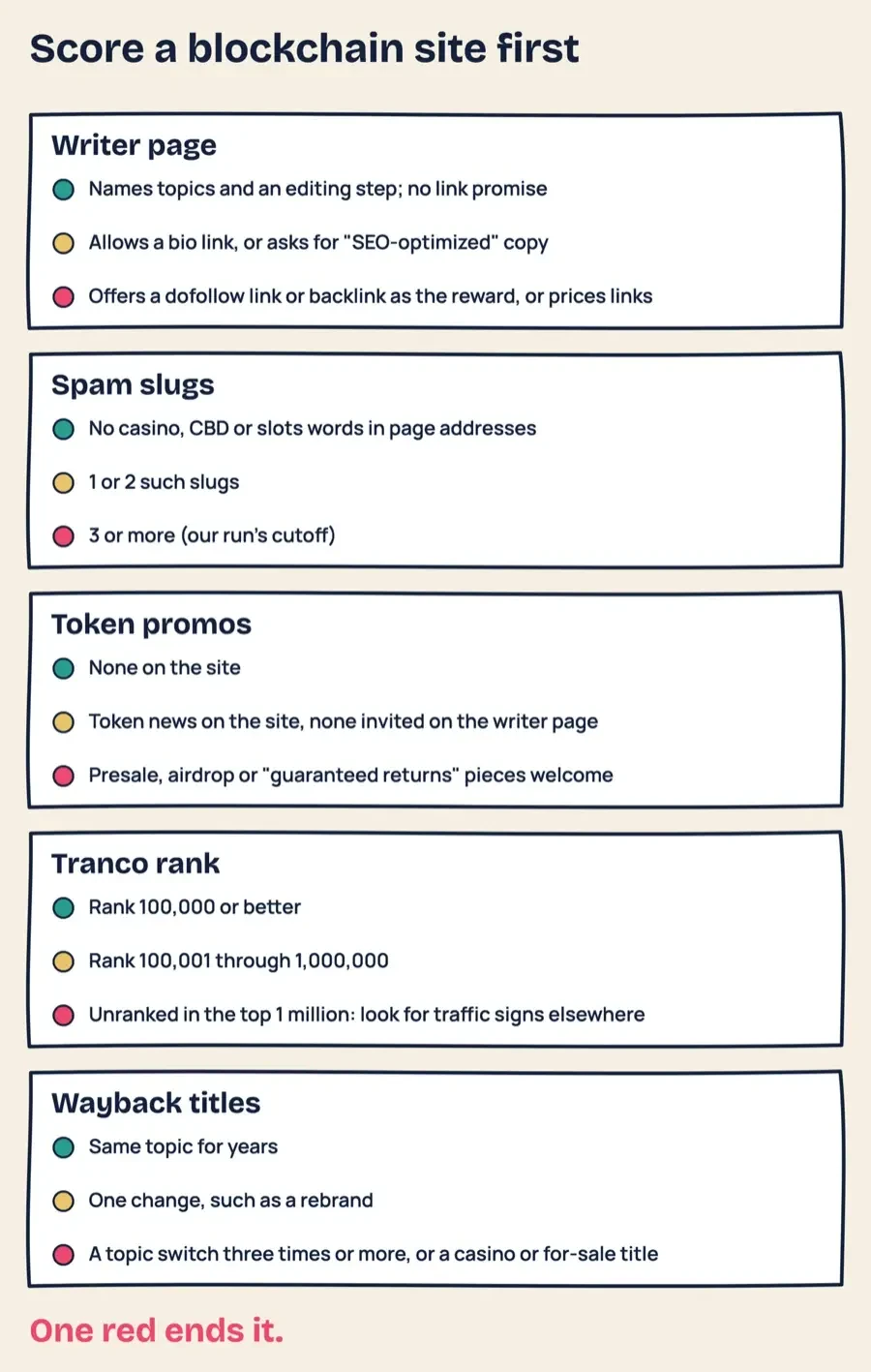 Drawn by us: the five-row blockchain scorecard from this guide.
What we tested
That example came from our reread. A word match needs a person's eyes, so on October 31, 2026 we reread the six pages behind the run's later drops and saved each copy. Four held up. Two writer pages offered a followed link or a backlink as the reward, and the events page priced its placements. The third writer page was the closest call. It allows "a brief bio with a backlink", pitches that as a way to "drive traffic to your own digital presence" and prefers SEO-optimized content. On our scorecard a plain bio link is yellow, but a backlink offered as a reason to write is red, and that's how we read this page.
Two didn't hold up. The page dropped for "gambling" lists it among topics it won't cover, and the one dropped for "slot" is the talk call above. We still haven't listed either of them, because neither has a Tranco top-1M rank and neither went through our Wayback and sitemap checks. Our list stays at zero until a full recheck says otherwise.
When a protocol or token sponsor pays you
So far we've assumed nobody pays you. Often someone does, whether it's an employer, a grant or a foundation, and then the FTC, the SEC and Google each have a say.
The FTC starts with the relationship. Its Disclosures 101 guide counts "a personal, family, or employment relationship or a financial relationship" as a "material connection" to the brand.
A separate FTC Q&A on endorsements adds that "employees endorsing the post should disclose their relationship to the company". So if you're a developer advocate covering your employer's chain, say so plainly in the byline or the first paragraph, even when the outlet never asks.
Format counts too. In its guide to native advertising, the agency says it "will find an ad's format deceptive if the ad materially misleads consumers about its commercial nature". A sponsored deep dive that reads like independent reporting is the case to watch for.
The SEC comes in when the token is a security. Its 2017 statement on token promotions says a promoter "must disclose the nature, scope, and amount of compensation received in exchange for the promotion". Its 2022 enforcement release repeats the point: anyone "who promotes a crypto asset security must disclose the nature, source, and amount of compensation they received". Both rest on 15 U.S.C. 77q(b), which lists an "article" among the ways a paid writer can't describe a security "without fully disclosing the receipt". Whether your token falls under securities law isn't something we can answer here. Before you write a paid piece about one, get a securities lawyer's view.
Then there's the link. Google's rules for outbound links cover it: "Mark links that are advertisements or paid placements" by adding rel="sponsored". If a sponsor pays for the piece, its link should carry that attribute.
Do you sell posts on a blog of your own? Our post on paid guest post scammers explains how to collect payment before any link goes live.
A blockchain pitch email and five topic ideas
Keep the pitch short. Lead with the problem you solved and put any ties in the first lines. Every bracket below is a placeholder for your own details.
Subject: Pitch: what our [network] pilot taught us about [problem]

Hi [editor first name],

I'm [name], a [role] at [company]. Last quarter our team ran [project] on [network],
and [one result with a number you can show].

Proposed piece for [outlet]: "[working title]"
- Who it is for: [developers / architects / operations teams]
- What readers can run: [repo, testnet contract or benchmark script]
- Sources: [EIPs, official docs, onchain transactions]

Disclosure: I work for [company], which builds on [network].
I hold [no tokens / these tokens: ...]. Nobody else is paying for this piece.

Past work: [link 1], [link 2]

Thanks,
[name]
Before you send it, paste the summary paragraph into our readability checker and cut whatever an editor would skim. If the editor's reply quotes a fee for a followed link, you're back at the first footprint, and it's fine to thank them and say no. Now pick an angle. Each idea below starts from work you can show:
- Permissioned or public chain for a supply-chain pilot: the questions that decided it for our team
- How to read an EIP before you upgrade a production contract
- What a smart contract audit report covers, and the bugs it can still miss
- Zero-knowledge proofs for an age check: a walkthrough with working code
- Benchmarking a private network: what a single throughput number leaves out
Each one hands the editor something to open: a repo, a test log or a measured run. If your idea only works with a token price or a product link in it, it's closer to a sponsored post, and the disclosure rules above apply.
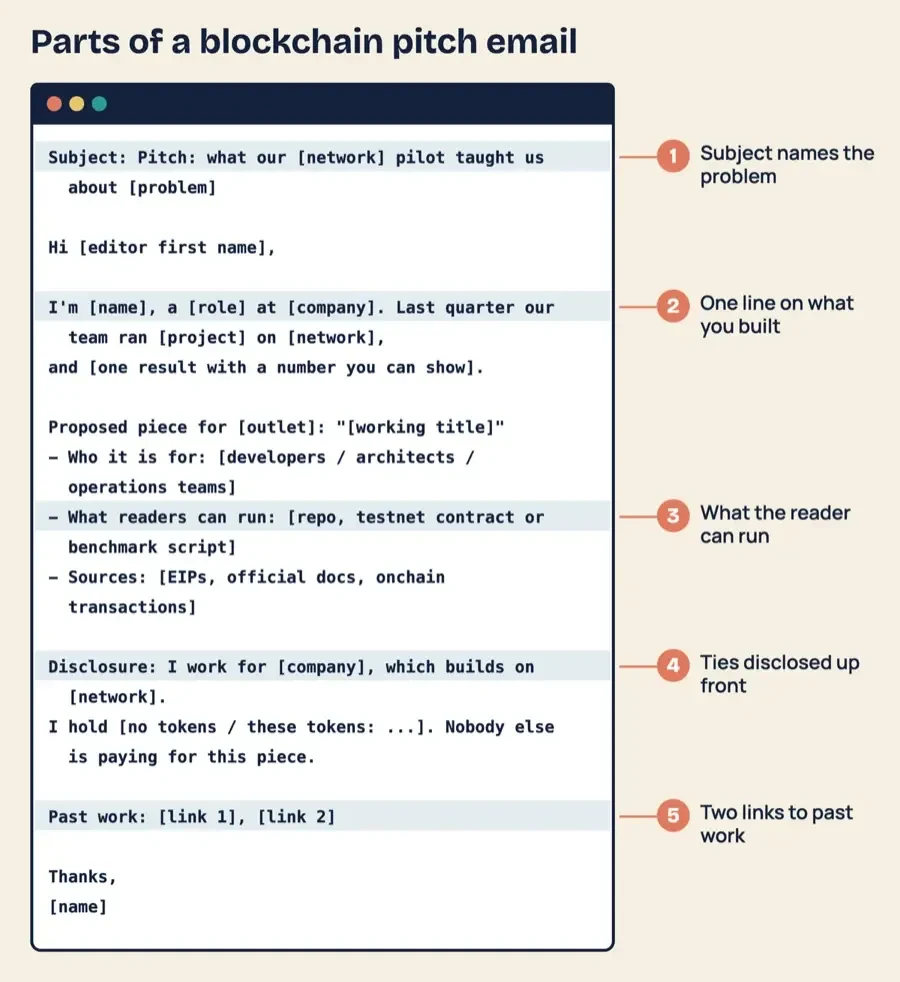 Drawn by us: the parts of a blockchain pitch email, using the template in this guide.
FAQ: blockchain guest posts
Frequently asked
Is a nofollow link from a blockchain outlet still worth it?
For a real outlet, yes. For paid links, Google's link guidance notes that nofollow "is still an acceptable way to flag them, though sponsored is preferred".
Do I disclose a free node, API credits or tokens I got for testing?
Yes. The FTC Q&A says "your connection to the company should be disclosed everywhere you endorse the product" after a free or discounted product.
What does a Tranco rank measure?
Popularity, blended from several lists. Its methodology page names the "Chrome User Experience Report (CrUX)" as one source.
How long should a blockchain guest post be?
The outlet decides. Our submission page says "1,000 words or more is recommended for in-depth articles." One page we reread says "Aim for at least 800 words per article".
How we made this guide: A DigitalTreed script sent plain GET requests to every blockchain candidate on October 31, 2026, and we reread the six later-stage drops by hand. Rules come from Google, the FTC, the SEC, the CFTC, NIST and ethereum.org, linked where used. Facts checked by the DigitalTreed team on October 31, 2026.
Back in November 2023, this page went live as our call for blockchain guest posts. The October 31, 2026 rewrite turned it into a guide to vetting other blockchain outlets.
Sources
- NIST CSRC Glossary: blockchain
- NIST IR 8202: Blockchain Technology Overview
- Google Search Central: Spam policies for Google web search
- Google Search Central: Qualify your outbound links to Google
- Google Search Central Blog: A reminder about links in large-scale article campaigns (May 25, 2017)
- Google Search Central: Creating helpful, reliable, people-first content
- Google Search Central: site: search operator
- Google Search Help: Refine Google searches
- Tranco: A Research-Oriented Top Sites Ranking Hardened Against Manipulation
- Tranco: Methodology
- Internet Archive: Wayback CDX Server API
- Internet Archive Help Center: Using the Wayback Machine
- ethereum.org: Contributing
- ethereum.org: Adding articles
- LF Decentralized Trust: Contribute to code
- FTC: Disclosures 101 for Social Media Influencers
- FTC: FTC's Endorsement Guides: What People Are Asking
- FTC: Native Advertising: A Guide for Businesses
- FTC Consumer Advice: What to know about cryptocurrency and scams
- CFTC and SEC: Watch out for fraudulent digital asset and cryptocurrency trading websites
- SEC: Statement Urging Caution Around Celebrity Backed ICOs (November 1, 2017)
- SEC press release 2022-183 (October 3, 2022)
- Cornell Law School LII: 15 U.S. Code 77q
Comments
No comments yet. Start the conversation below.