

Quick answer
One crypto site, Bitcoin News, had a live call for guest writers and passed our October 31, 2026 check, out of 124 candidates. Another 23 answered our plain requests with a bot check or a 403 or 429 error, so they're unknowns, not rejects. Before you pitch any crypto site, run the footprint searches and the 2-minute scorecard below.
If you searched "write for us crypto", you probably cover Bitcoin, wallets, DeFi or crypto tax and want your byline on an outlet that readers and editors respect. A crypto write-for-us page is a public page where an outlet spells out what it'll take from freelancers and how to send it. Not every site with that page wants writers. In our October 31 check, 18 of 124 candidates showed press releases, presales or airdrops on the page our checker opened, often right in the site's menu. This URL used to carry our own call for crypto posts. We've rebuilt it for people who're pitching other crypto publications.
The guide opens with what crypto editors ask of a guest writer and why Google treats crypto as a YMYL topic. Then come search strings for writer pages, the presale, airdrop and 100x footprints, and a two-minute scorecard. After that: the one site that passed, why the list is short, the SEC, FTC and Google rules on pay, and a pitch email with five topic ideas. Every writer page we quote below asked, one way or another, for the same two things: where your numbers come from and what you own.
Key takeaways
- Only one of 124 crypto candidates passed our October 31, 2026 check.
- 18 candidates showed press-release, presale or airdrop words on the page we opened.
- Tell the editor which tokens you hold or were given, before you're asked.
- The SEC says paid promoters of crypto asset securities must disclose the pay.
- Search "100x" by hand, because our checker never counted that word.
Note
Want to write for DigitalTreed? Our guest post and pitch page opens: "DigitalTreed is a digital marketing and technology publication." Crypto isn't among the seven topics it lists. It's accepted with extra editorial review, though. The page's exact words: "Finance, crypto, forex, blockchain, real estate and legal topics are accepted with additional editorial review and need approval before publication." So the question is whether your piece helps our readers. "Our readers are bloggers, agencies, SaaS teams and startup founders." Taking stablecoin payments from clients is one crypto angle that can work for them. Token picks can't, since the page rules out "get-rich-quick schemes". "Send a short pitch first, not a finished article." The page also says "No fully AI-generated content." A sponsored post includes "One relevant contextual link to your website or brand." Prices are in our media kit.
What do crypto editors ask of a guest writer?
We opened the crypto writer pages in our check on October 31, and the same three asks kept coming back. Don't call prices, say what you hold, and put a source under every number.
Price calls come first. Blockport covers crypto next to iGaming and didn't make our list. Its page turns away "price prediction articles with no rigorous methodology" and "token promotions or project marketing". A blockchain project's guide for invited team writers says it in capitals: "NEVER give financial advice & NEVER mention TOKENS or PRICE". Bitcoin News, the site that did pass, is more casual about it. It wants "Bitcoin-focused content" and says it's "here to help move Bitcoin forward, not shill your favorite altcoin". Then it adds "No AI generated slop". Read together, those lines agree. A pitch that hints at where a coin is going reads as marketing.
Holdings are the second ask, and here crypto is stricter than most niches. Blockport's page says: "If you hold relevant assets, work with a mentioned company, advise a related project, or have another material connection, disclose it upfront." Tokens count as well as cash, and the FTC's disclosure guide for influencers puts it simply: "Financial relationships aren't limited to money." So airdropped tokens count, so do tokens a project sent you to try, and so does a paid advisory role or a stake in a wallet startup. Put all of it in one plain line near the end of your pitch, even when the piece doesn't name the coin you hold.
The third ask is sourcing. Blockport wants "commentary grounded in data, first-hand expertise, or primary-source documentation". It also tells writers to "Use primary sources wherever possible". For an on-chain claim, link the transaction or address on a block explorer and give the block height or date. A volume or TVL figure gets the dashboard's name and the day you read it, because those numbers change by the hour and an editor will check.
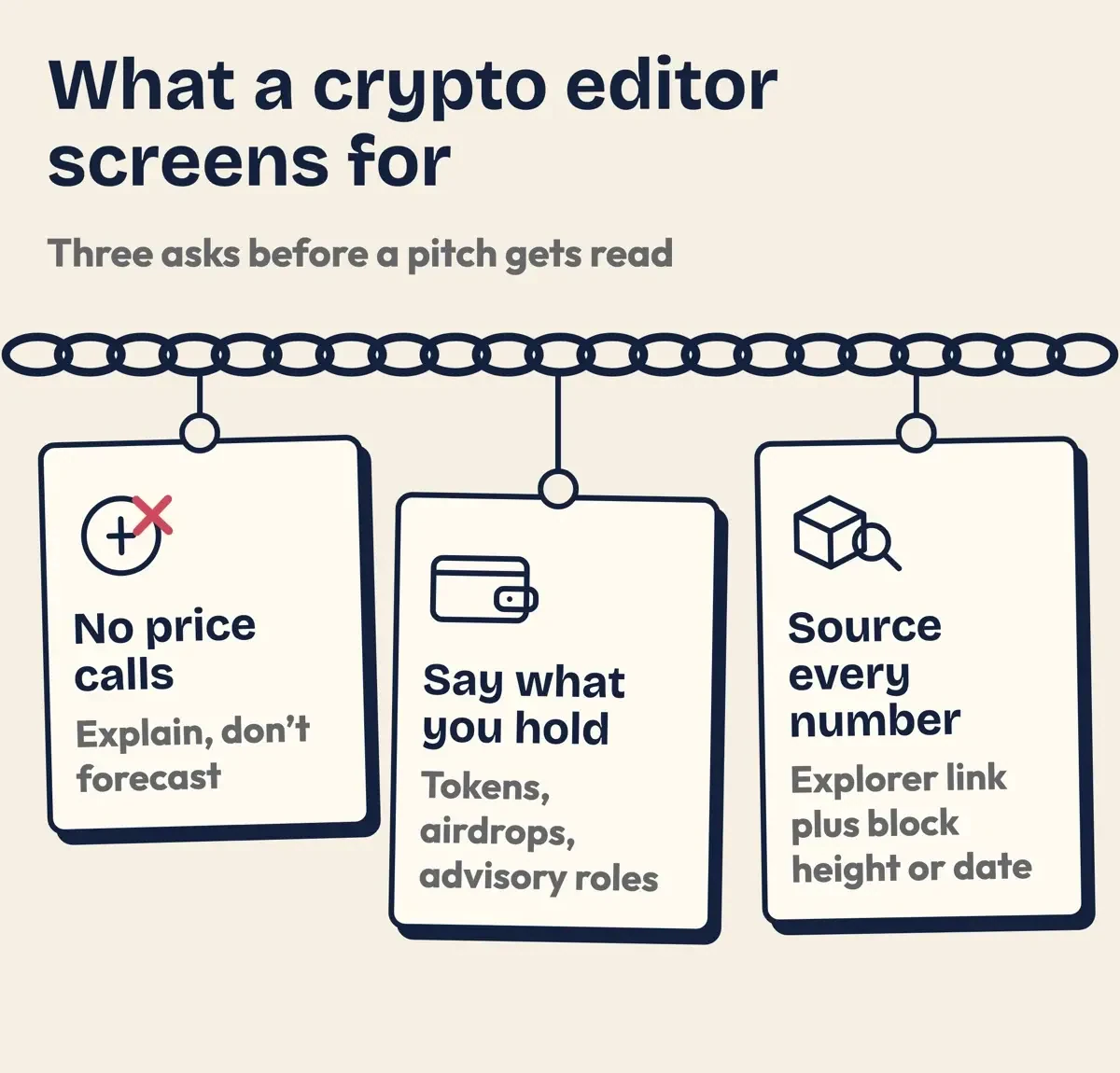 Diagram by DigitalTreed of the asks we found on crypto writer pages and in FTC guidance read on October 31, 2026.
Crypto is a YMYL topic, so Google sets a higher bar
Google treats money content the same way. Its page on creating helpful, reliable content gives "even more weight to content that aligns with strong E-E-A-T" for subjects that touch people's "financial stability". Google's overview of the rater guidelines calls them "Your Money or Your Life" topics. It adds: "Raters apply very high PQ standards for pages on YMYL topics". Crypto fits, and the FTC's crypto consumer page says "Cryptocurrencies tend to be more volatile than more traditional investments". Raters can't lift or sink a page alone. In the overview's words, "no single rating – or single rater – directly impacts how a given page or site ranks in Search". Still, their standard shows what Google wants its ranking systems to reward.
So explain how a protocol, a tax rule or a wallet works, and link records anyone can open, such as a filing or a transaction. If you're a CPA who files crypto returns, say so in your first two lines.
Search strings that surface crypto writer pages
So how do you find the outlets that still take outside crypto writers? Free Google search does this part. Google's search refinement help page covers each operator below. Quotes force an exact match, and the minus sign works as written: "Enter - in front of a word that you want to leave out". The first group finds writer pages and keeps out presale and press-release pages, so you won't wade through them. The second checks one site you've already found.
Find crypto writer pages
"write for us" bitcoin -presale -airdrop
"write for us" crypto -"press release" -casino
"contributor guidelines" blockchain analysis
"submit an op-ed" crypto
"guest post" defi -presale
"pitch us" web3 after:2026/01/01
"editorial guidelines" crypto "disclose"
"contribute" "on-chain" research

Check one crypto site (replace example.com)
site:example.com presale
site:example.com airdrop
site:example.com "100x"
site:example.com "guaranteed returns"
site:example.com "press release"
site:example.com "link insertion"
site:example.com casino
"example.com" "crypto guest post" price
Old guest post lists age badly in crypto, and 26 of our 124 candidates didn't load at all when our checker asked for their homepage. Run every writer page through the DigitalTreed HTTP status checker first. A redirect to the homepage is a closed door. And when a site: search for presale comes back empty, that proves less than it seems. As Google's site: operator page puts it, "The list of URLs returned is not always exhaustive".
Presale, airdrop and 100x: crypto footprints that end the check
Those check searches hunt for a site that earns from token launches, not readers, and our checker did the same across up to eight sitemap files a site. It counted slugs with "presale", "pre-sale", "airdrops", "guaranteed-returns", "casino", "betting" or "press-release-distribution", plus words like "cbd" and "escort". Three or more hits ended it. So did a writer page naming "presale", "pre-sale", "airdrop", "guaranteed returns" or "press release" with no refusal nearby. On October 31 the rule took out 23 crypto candidates. Five had three or more counted slugs, most often "betting" and "airdrop". The other 18 showed press releases (14), presales (2) and airdrops (2) on the page the run had taken for a writer page, with no refusal nearby.
Why those words? "Guaranteed" is the oldest tell in crypto marketing. The FTC's consumer page on crypto scams says "Only scammers will guarantee profits or big returns". A joint SEC and CFTC investor alert on digital asset fraud lists red flags. Among them: "claims of high guaranteed returns and promises that the investments carry little or even no risk". Our checker didn't count "100x", so search for it by hand on any site you're weighing. It's the same promise in meme form, and the FTC warns: "Don't trust people who promise you can quickly and easily make money in the crypto markets".
Airdrops and presales are the other half. The FTC page says "free money promises are always fake". A site whose archive is mostly token-claim guides and presale roundups earns from launch teams, and an editor at your next target can see that archive too. In our run, airdrop slugs turned up on four of the five sites dropped for sitemap words, and presale slugs on three. Betting slugs showed up on five, and four of the five carried token-launch and gambling words together.
Press releases are the trickiest footprint, because an honest outlet can carry them too. Google puts "links with optimized anchor text in articles, guest posts, or press releases distributed on other sites" on the list of link spam examples in its spam policies.
A word match can't tell a paid placement from a label, so we reopened all 14 press-release drops by hand that afternoon. In each case the words "press release" came from the site's menus or story labels, not from its rules for writers.
None of them came back. Our checker had taken 10 of those pages for writer pages, and they weren't calls for writers at all. Five were news stories with "pitch" in the web address. The rest were an old contest post, a list of contributor bios, an editorial policy with no way in, a not-found page and a blog post about guest posting. Two sites charge to publish. One tags every paid piece Sponsored or Press Release, and the other allows nofollow links only. One offers to add a company's backlink to articles it's already published, and one has no Tranco rank.
Link insertion menus are the last footprint, and the label decides how much they matter. Google's link spam rules cover "Exchanging money for links, or posts that contain links". Further down, the policy adds: "Google does understand that buying and selling links is a normal part of the economy of the web for advertising and sponsorship purposes". Its next line: "It's not a violation of our policies to have such links as long as they are qualified with a rel="nofollow" or rel="sponsored" attribute value".
So a paid link isn't the warning sign by itself. The footprint is a menu that sells followed links inside old stories on any topic, with no word about rel="sponsored" or nofollow. Our checker found four crypto writer pages that offered a link price menu or promised followed links. It didn't count the phrase "link insertion" itself. When the search block turns one up, look for how those links are marked, then read the slugs in the DigitalTreed XML sitemap validator.
Score a crypto site in two minutes
A site that clears the footprint searches gets five rows, about two minutes' work. The longer checks live in our guest post vetting hub.
Three rows (rank, yearly titles, sitemap words) are data the run logged. You fill in the top two by reading the writer page yourself.
| Row | Green | Yellow | Red |
| Writer page | An open call that spells out its rules | A submit form only, or company posts with no disclosure ask | Missing, closed, a link price menu, or followed links promised |
| Disclosure and readers | Asks for holdings and ties; US readers | Bans shilling but asks nothing about holdings | Invites presale, airdrop or press-release posts |
| Tranco rank | Top 100,000 | Inside the top million, below 100,000 | Unranked, and no person has checked traffic |
| Yearly homepage titles | One crypto brand in every snapshot | A parked or placeholder year, crypto before and after | Several topic switches, or casino titles |
| Counted sitemap words | None | One or two, or a sitemap that wouldn't load | Three or more |
A single red ends it. Two yellows or more mean you open the five newest posts and look for unlabeled token promotions before you write a word. Run the site's guest-post category URL through our noindex tag checker as well, since a few sites hide contributor posts from search. Tranco supplies the rank row. It bills itself as "A Research-Oriented Top Sites Ranking Hardened Against Manipulation". According to the methodology page, "we average ranks over the lists of all four providers over the past 30 days". So the rank shows that people visit, not whether they're US readers who'd care about a crypto tax explainer.
Here's the scorecard on the one listed site, using the run's records and our reread that day:
- Bitcoin News. Writer page: live, with a submit form and an open door to company posts (yellow). Disclosure and readers: the page asks nothing about holdings or ties, and the run's reader note says "global" (yellow). Tranco: 997,085 (yellow). Yearly titles: Bitcoin News in 2011 and again in 2026, with a "Coming Soon" placeholder in 2022 (yellow). Counted sitemap words: 1, "betting" x1 (yellow).
So Bitcoin News is yellow on all five rows, with no red. It's fine to pitch once you've read a week of its posts.
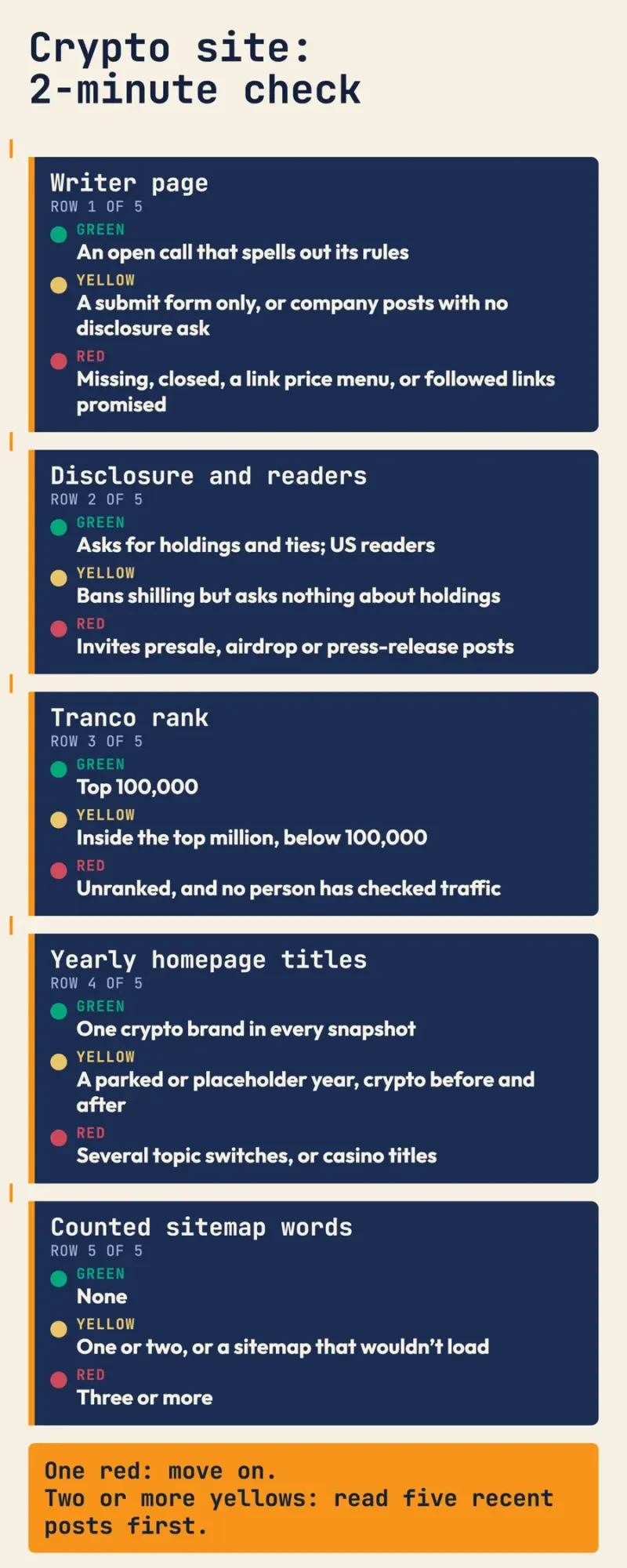 Diagram by DigitalTreed of the crypto 2-minute check, with the thresholds our October 31, 2026 site check used.
Write for us crypto: the one site that passed, and why the list is short
Which crypto sites are left after all that? Only ones that passed our October 31, 2026 run and still read as open calls when we reopened them by hand that afternoon.
The Vetted stamp in this page's header art means exactly that, nothing more. It doesn't promise anything about reply times, payment or traffic. The run kept one crypto site, and on our reread its writer page still read as an open call, word for word as the run had saved it. So the table has one row. We aimed for 15 and stopped where the checks stopped. A padded crypto list would send you straight to the presale and press-release sites this guide warns about. We left each site name unlinked, and its guidelines link carries rel="nofollow".
| Site | Guidelines page (nofollow) | Rules on the page | Audience (run note) | Tranco rank | Earliest Wayback capture | Reread on |
| Bitcoin News | Write for Bitcoin News | Open; Bitcoin-only pieces, no altcoin promotion, no AI-written text; submit form; pays 21,000 sats once published | global | #997,085 | 2011 | 10/31/2026 |
Two lines on that page deserve a second look. It pays "you’ll receive 21,000 sats sent directly to the wallet address you provided", so you're paid in bitcoin, not dollars.
Its FAQ also answers "Can I post on behalf of a company? Absolutely", so if your employer is a Bitcoin company, the FTC disclosure rules further down apply to you.
Why so few? Of the 124 candidates, 23 blocked our checker, and some of the best-known names are in that group: CoinDesk, Decrypt, The Block, The Defiant and CoinGecko. That doesn't say anything bad about them. Open their pages in a browser and run the scorecard yourself. Another 46 had no writer page at all. They were news sites, exchanges, wallet makers and data sites with no public call for outside writers. Two pages the run did find used the word contributor for something else, a translators list and a social metrics page.
And 18 showed press-release, presale or airdrop words on the page our checker opened, which the footprint section covers. None of that's a verdict on those outlets. It's only about whether they belong in this table today.
Want more sites to vet? Try our blockchain write for us guide for the neighboring niche, or the finance write for us guide for money sites.
Each request carried a DigitalTreed user agent, obeyed robots.txt, and left at least 1.5 seconds between calls to the same host. Refusal codes and bot checks meant we left the site alone, with no workaround of any kind. We don't pay for Ahrefs, Semrush or Similarweb, so the Tranco rank (list PYK6J, dated October 29, 2026) stood in for traffic. No crypto site outside the top million cleared the other checks with a post dated in the last three months, so there's no Smaller sites table.
Site history came from the Internet Archive's CDX server API: one homepage title per year. Its Wayback Machine help pages admit gaps: "some sites were not archived because they were password protected, blocked by robots.txt, or otherwise inaccessible to our automated systems".
What we tested
Our checker worked through 124 crypto candidates on October 31, 2026, keeping one and dropping the other 123. 46 showed no page inviting outside writers. 26 more failed to load at all. 23 returned a bot check or a 403 or 429 code, and we left them unjudged. 23 hit the crypto footprint rule. The rest split into link price menus (2), followed-link promises (2) and unranked with no recent post (1). The listed site ranks below Tranco's first 100,000. The funnel chart traces each cut in order.
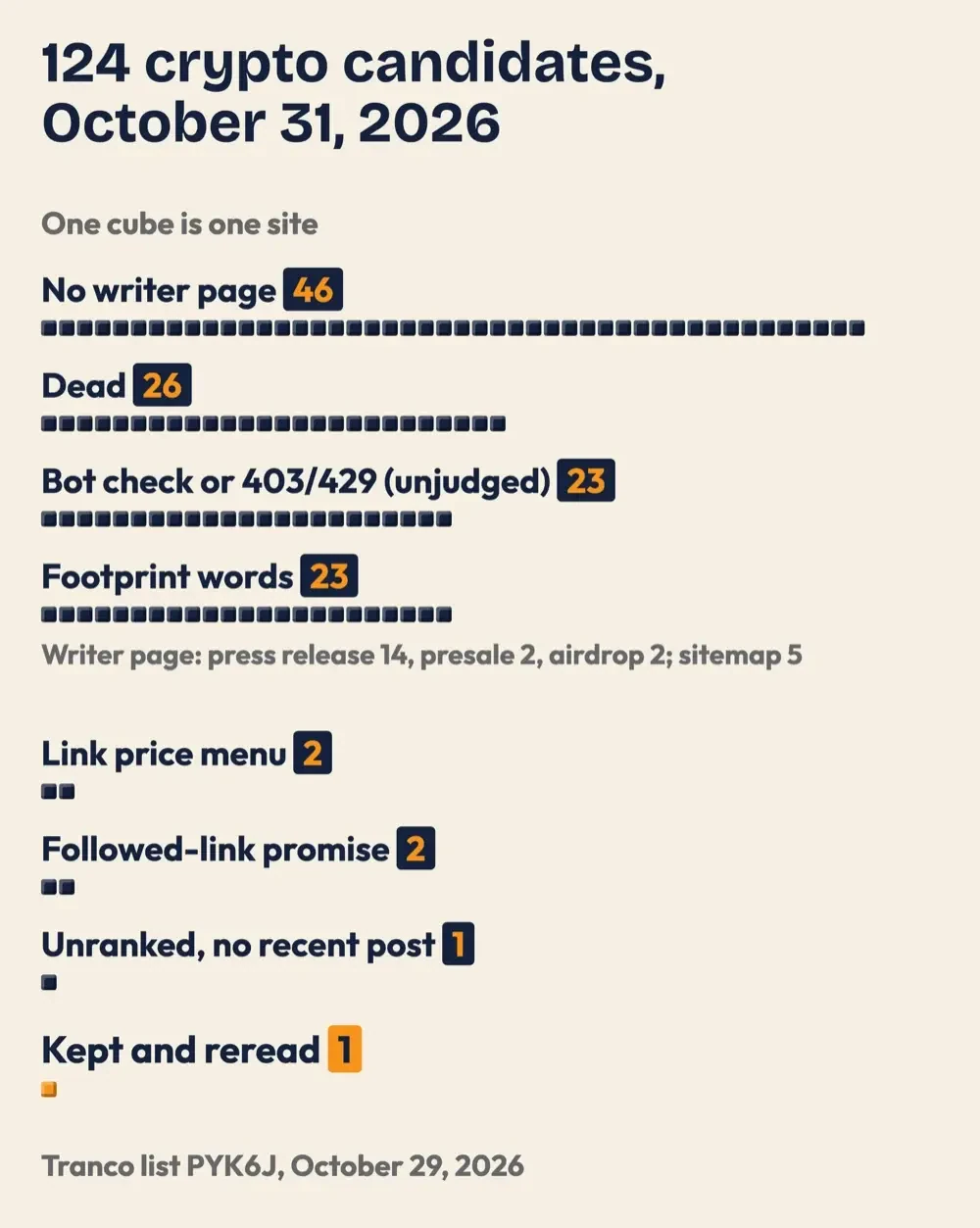 Diagram by DigitalTreed; counts from the site check we ran on October 31, 2026.
Paid to write about a token: what do the SEC, FTC and Google expect?
Everything so far assumes nobody pays you. Once a project or PR agency sends money or tokens, Google, the FTC and sometimes the SEC have rules for the piece.
Google's outbound link guide covers the link: "Mark links that are advertisements or paid placements", marked with rel="sponsored". Google's 2017 blog post on large article campaigns lists "Stuffing keyword-rich links to your site in your articles" among the signs of a link scheme.
The FTC looks at the reader. Its Endorsement Guides Q&A speaks plainly about freebies. If free products or other perks arrive with the hope of a mention, "the FTC Act applies to you". Tokens a project sends you ahead of its launch, hoping you'll write about it, are exactly that kind of perk. Don't count on readers assuming you're paid. The same Q&A notes that some creators are, but "others may have no connection to marketers whose products they mention", so readers can't tell which kind you are. The FTC's native advertising guide adds that the more a paid piece looks like the site's own articles, "the more likely that a disclosure will be necessary to prevent deception".
So open the piece with the disclosure, such as "The project paid me in tokens to write this." A line under the author bio is easy to skip.
Then there's the SEC, a layer most niches don't have. Its staff issued a statement on Nov. 1, 2017 about paid celebrity promotions of ICOs and other investments. Those endorsements, it said, "may be unlawful if they do not disclose the nature, source, and amount of any compensation paid". It covers pay made "directly or indirectly, by the company in exchange for the endorsement".
Five years later the SEC charged a celebrity on Oct. 3, 2022 over a paid Instagram post about a token. Its order found the celebrity "failed to disclose that she was paid $250,000 to publish a post on her Instagram account". The celebrity settled, and didn't admit or deny those findings. The enforcement director spelled it out: anyone who promotes a crypto asset security "must disclose the nature, source, and amount of compensation they received".
The law behind it is 15 U.S.C. 77q(b), part of the Securities Act of 1933, and its text names articles as well as ads. Whether a token counts as a security is a legal question we can't answer, so ask a securities lawyer first if anyone offers to pay you for writing about one. If you're the one being promoted, our crypto marketing guide covers the same rules from the project's side. Selling sponsored crypto posts yourself? Then the risk of not being paid sits with you; our seller-side guide to guest post scams deals with deposits and drafts.
A crypto pitch email and five topic ideas
Bitcoin News takes articles through its submit form and points questions to its Telegram. Whatever site you pick, follow its page, not your usual template. The email below is invented, and we've put placeholders in braces. Its last lines carry what a crypto editor checks first: where each number comes from and what you hold.
Subject: Pitch: What {N} months of self-custody taught our {team / household}

Hi {editor first name},

I'm a {role, such as tax preparer or wallet support lead} who has
handled {what you did} since {year}. In {month, year}, I {moved
funds / filed / audited something}, and I kept records of each step.

I'd like to write {word count} words on what went wrong, what it
cost and how to avoid it. On-chain figures link to the transaction
on a block explorer, with the block height or date.

Holdings: {I hold no tokens named / I hold some BTC / I advise X}.
No one is paying me for this piece, and it makes no price call.

Recent work: {link 1}, {link 2}
{your name}
Run the summary paragraph through the DigitalTreed readability checker and cut anything an editor would skim. Short on angles? Here are five for US readers, each tied to a public record:
- How you reported digital assets on your federal return, walked through with the IRS's own pages and a note to talk to a tax pro.
- Reading a stablecoin issuer's reserve report line by line, linked to the report itself.
- Moving savings to a hardware wallet: the steps, the mistake you nearly made and what it would have cost, with no product link.
- Tracing one well-known on-chain event in a block explorer, showing each transaction you opened.
- What a state money transmitter license means for a crypto app's users, sourced from the state regulator's page.
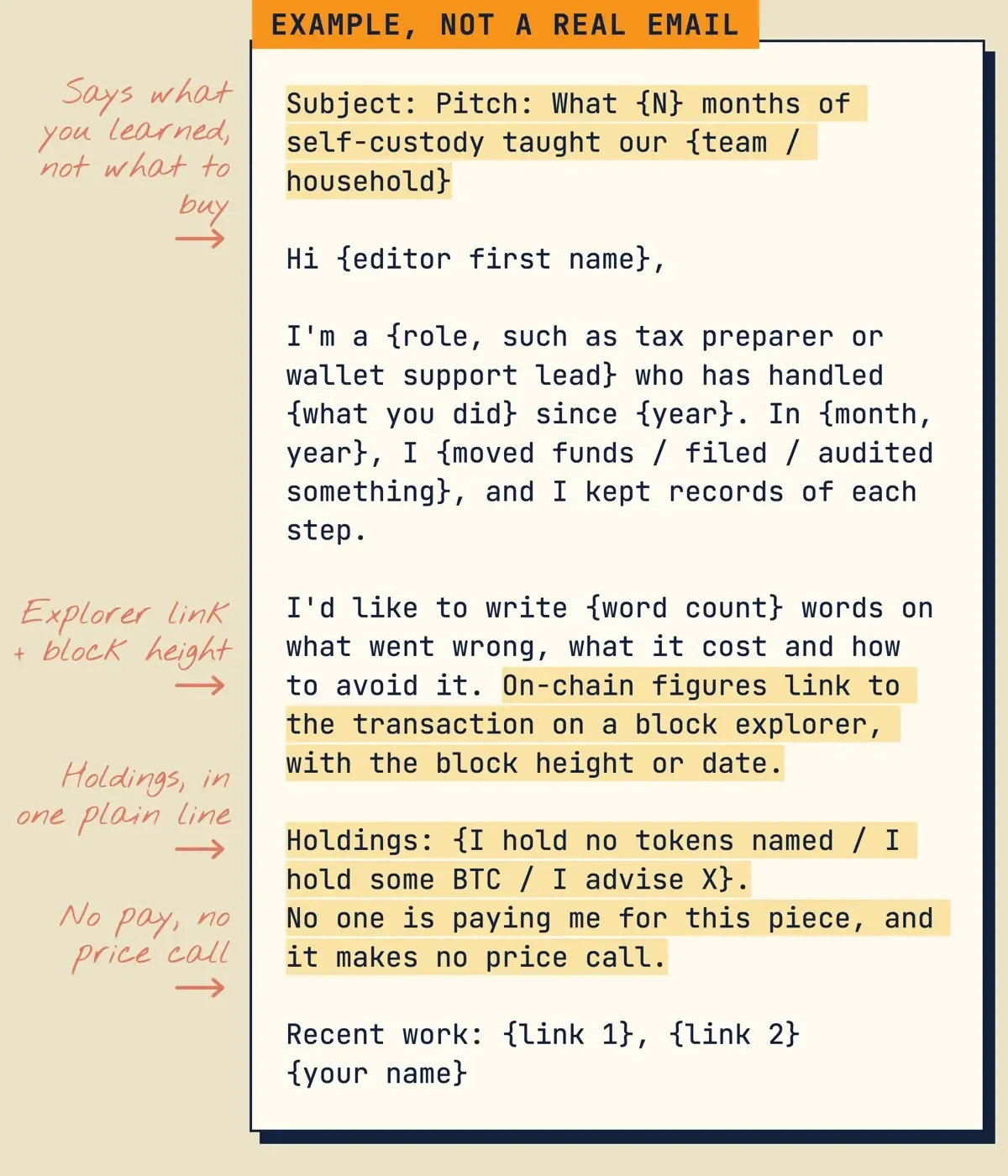 Drawn by us: a made-up crypto pitch with placeholder details, not a real email.
FAQ: crypto guest posts
Frequently asked
Do crypto sites pay guest writers?
Some do. Bitcoin News says that once an article is published, "you’ll receive 21,000 sats sent directly to the wallet address you provided". Most of the writer pages in our check didn't mention pay at all, so ask before you write rather than after the editor says yes.
Do I have to disclose crypto I own?
If you're writing about it, expect an editor to ask. The FTC's influencer guide sets the wider rule: "Disclose when you have any financial, employment, personal, or family relationship with a brand." Owning a coin isn't a brand deal by itself. Editors ask anyway, so say it in the pitch.
Is it legal to promote a token if I disclose the payment?
Disclosure is only one part. The SEC's 2017 statement warned of other risks for paid ICO promoters. They may be liable "for participating in an unregistered offer and sale of securities, and for acting as unregistered brokers". Get a securities lawyer's view before you sign any deal to write about a token.
Will a crypto site give me a dofollow link?
Don't pay for one. Google's spam policies treat paid articles with links "that pass ranking credit" as link spam. Two crypto writer pages in our check were dropped for promising followed links.
How we made this guide: Each site name and count here traces back to the site check DigitalTreed ran on October 31, 2026, using plain requests only. We saved the kept writer page again that afternoon, and nobody slipped a site in by hand. Every quote matches a copy of its page saved the same day, from FTC and SEC pages to crypto editors' guidelines and Google's rater guidelines overview PDF. We didn't pitch anyone, submit a form or log in to any account. Facts checked by the DigitalTreed team on October 31, 2026.
DigitalTreed first published this URL in October 2023 as its own call for crypto guest posts. Since the October 31, 2026 rebuild, it's meant to help you find crypto outlets worth a pitch.
Sources
- Google Search Central: Creating helpful, reliable, people-first content
- Google: Search Quality Rater Guidelines, an overview (PDF)
- Google Search Central: Spam policies for Google web search
- Google Search Central: Qualify your outbound links to Google
- Google Search Central Blog: A reminder about links in large-scale article campaigns (May 25, 2017)
- Google Search Central: site: search operator
- Google Search Help: Refine Google searches
- Tranco: A Research-Oriented Top Sites Ranking Hardened Against Manipulation
- Tranco: Methodology
- Internet Archive: Wayback CDX Server API
- Internet Archive Help Center: Using the Wayback Machine
- FTC Consumer Advice: What to know about cryptocurrency and scams
- FTC: Disclosures 101 for Social Media Influencers
- FTC: FTC's Endorsement Guides: What People Are Asking
- FTC: Native Advertising: A Guide for Businesses
- CFTC and SEC: Investor alert, watch out for fraudulent digital asset and cryptocurrency trading websites
- SEC: Statement Urging Caution Around Celebrity Backed ICOs (November 1, 2017)
- SEC press release 2022-183 (October 3, 2022)
- Cornell Law School LII: 15 U.S. Code 77q
Comments
No comments yet. Start the conversation below.