
Quick answer
Five cloud and DevOps publications passed our cloud site check on October 31, 2026, and two of them, Kubernetes and Cloud Native Now, take a pitch with no catch. Of the 171 candidates we checked, 107 showed no page inviting contributors and 42 didn't load at all. Run any other cloud blog through our scorecard before you pitch it, and bring pinned versions and dated, region-tagged costs.
Say you run Kubernetes on a public cloud for a mid-size US company and just spent a week chasing a node autoscaling bug nobody else had seen. Searching "write for us cloud computing" returns editor-run calls for writers next to pages that sell placements, and the results don't say which is which. NIST's definition is a fair anchor: cloud computing is a model for "on-demand network access to a shared pool of configurable computing resources". A cloud submission page is a publication's standing call for people who run that kind of setup to write about it.
First up is what cloud editors check in a draft, and how foundation blogs differ from vendor blogs. Then come the search strings that surface submission pages and three footprints: free VPS giveaways, cracked panels and reseller link farms. After that you'll find a 2-minute check and the publications that passed ours. It closes with a pitch email, five topics, what to disclose when a vendor pays you and a few reader questions.
Key takeaways
- Cloud editors want pinned versions, dated region prices and stated security limits.
- Kubernetes refuses vendor pitches and anything already published, even on your own blog.
- A free VPS or RDP giveaway post is reason enough to skip a blog.
- Our sitemap scan never searched for VPS, RDP or nulled panel words.
- If a cloud vendor employs you, say so inside the article itself.
Note
Pitching DigitalTreed with a cloud story? Our submission page calls DigitalTreed "a digital marketing and technology publication". Its topic list reads "SEO", "Business", "AI tools", "Blogging", "WordPress", "Affiliate marketing" and "Online growth". Cloud computing isn't one of them, so a pure Kubernetes deep dive won't fit here. A cloud piece would have to sit inside a listed topic, such as a WordPress or AI tools story told from the server side. An editorial pitch sends "A working title", "A few lines on what the reader will learn", "An outline" and "Two links to things you have written". Fully machine-written drafts are out: "No fully AI-generated content". Sponsored guest posts are a separate route with "One relevant contextual link to your website or brand". Payment comes in two parts: "New clients pay 50% upfront and the remaining 50% after the post is published." For costs, the page points elsewhere: "Prices by niche, trial offers and payment terms are in our media kit".
Cloud editors ask for versions, regions and dates
Three of the five contributor pages in our table, reread on October 31, 2026, put the same rule in writing: the piece can't sell anything.
Cloud Native Now's writer page says "Articles must be vendor-neutral and vendor-agnostic and NOT promotional in any way (this includes links)." DEVOPSdigest's editorial guidelines want "objective, vendor-neutral, thought leadership pieces".
Versions come first. Cloud tooling changes fast enough that an undated config can break within a year. The Kubernetes releases page keeps branches for the "most recent three minor releases", each with "approximately 1 year of patch support". On October 31, 2026, the newest release it listed was 1.37.1, out September 15, 2026.
So name the exact version of everything in your draft: the cluster, kubectl, the Terraform provider and the Helm chart. Someone copying your manifest next fall will need to know what it ran on, especially once 1.37 has dropped out of the three supported minor releases.
Cost numbers need a region and a date, and they should come from the provider's own pricing page rather than a blog that copied it. Google's Cloud Storage pricing page says "Storage rates vary depending on the storage class of your data and location of your buckets." Its worked example bills "Standard storage in a dual-region comprised of Iowa and Oregon" at "$0.022 per GB per month for the us-central1 dual-region SKU". Amazon's S3 pricing page states, in its own example, "Inter-region Data Transfer OUT from US-West (Oregon) to US-East (N. Virginia) is $0.02 per GB". We read both pages on October 31, 2026. Mind the units: the first figure is storage per month, the second is data moved.
Write your cost lines the same way: service, tier, region, price, unit, the date you read it, plus the page's URL. Then an editor can open that page and compare the number, and a reader in another region can see why their bill differs.
Security caveats come third. The Kubernetes Secrets page carries a caution: "Kubernetes Secrets are, by default, stored unencrypted in the API server's underlying data store (etcd)." A tutorial that stores a database password in a Secret and never mentions that default teaches readers a weak setup, and whoever copies it into production inherits the gap.
The Kubernetes blog guidelines go further and expect to reject a post that recommends "turning off an important security control in production clusters".
The last filter catches vendor marketing dressed as a tutorial. Kubernetes wants a submission that will "focus on upstream Kubernetes as opposed to vendor-specific configurations", and Google's helpful content questions ask, "Does your content clearly demonstrate first-hand expertise". A rewritten feature list won't pass either. So write about the incident, migration or bill you actually dealt with. Name a product only where the reader can't follow along without it.
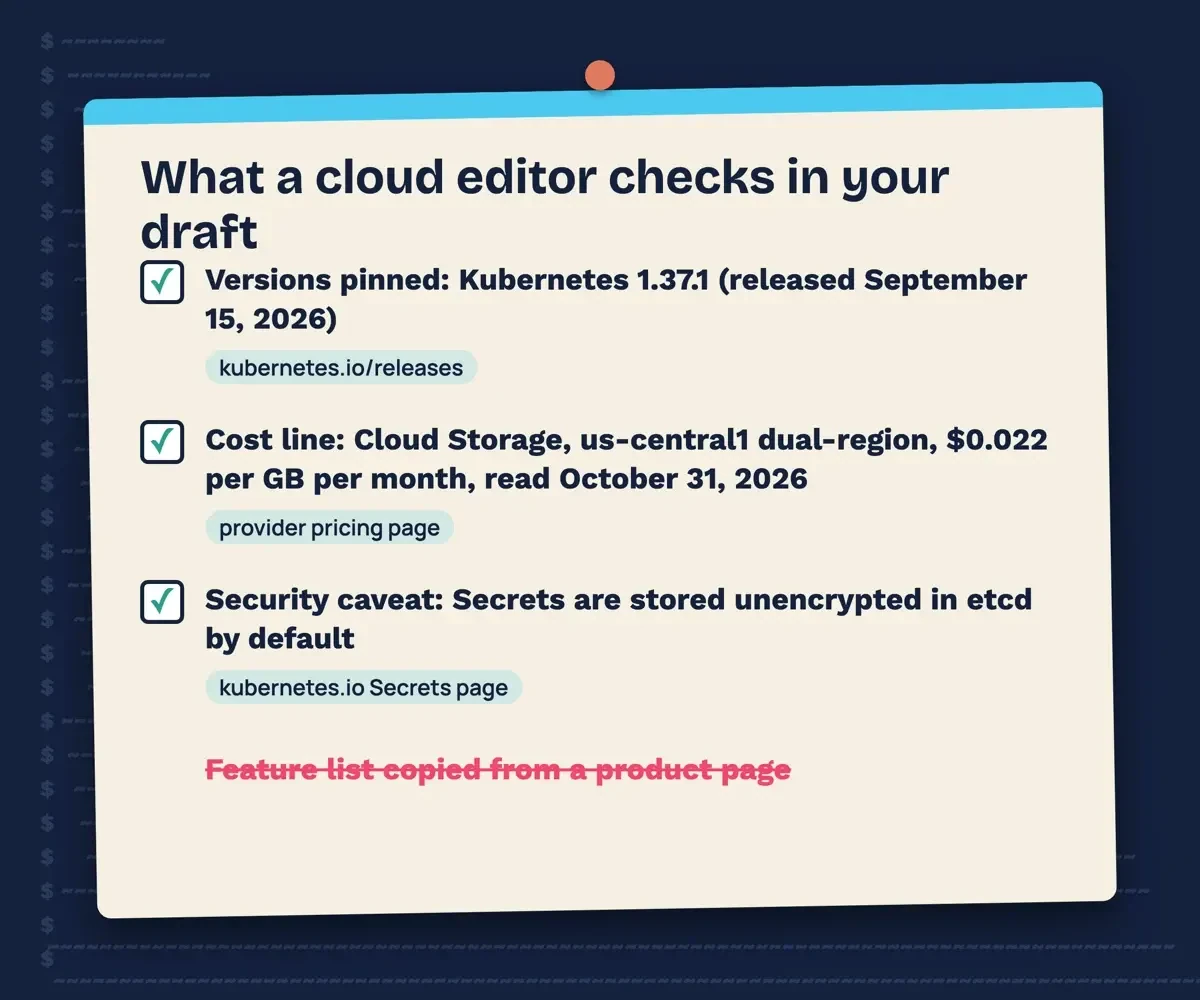 Diagram by DigitalTreed of what cloud editors check, drawn from the contributor pages and provider pages we read on October 31, 2026.
Foundation blogs and vendor blogs run on different rules
Those editor demands get stricter on foundation blogs, which run less like magazines and more like open source projects with an editor attached. The CNCF blog guidelines welcome posts from "CNCF members, project maintainers, ambassadors, mentors and mentees, scholarship recipients, and Technical Advisory Groups (TAGs)". It's just as plain that "CNCF does not accept paid or sponsored blog posts." A member's post may close with "one (1) link to an external site", and "All posts must follow the Creative Commons Attribution license."
Member companies get quotas, too: "Gold and Platinum Members may submit up to 4 blogs per year". Linux.com, run by the Linux Foundation, takes a similar line: its contribute page says, "we would like to offer our members (and others) the opportunity to partner with us".
If your employer is a member, your company may already have a slot, so ask around internally before you pitch cold.
The Kubernetes blog is open wider than that. Its contributor guide says "Anyone can write a blog post and submit it for publication." The guidelines add the catch: the project "cannot accept content for the blog if it has already been submitted or published outside of the Kubernetes project". It also won't publish "articles about using Kubernetes with a specific cloud provider".
So a post on one managed service's quirks belongs somewhere else, while a scheduler feature you tested on a plain upstream cluster fits the rule.
Vendor blogs flip that around, because the product is the point. Serverless Inc.'s contribute page asks for "Success stories from using the Serverless Framework", and guest posts carry "a contributor bio and contact information, including links to social media". That page is dated October 10, 2018. On the first page of the blog index, all 13 posts, from September 2024 to October 28, 2026, were signed by the Serverless Team rather than by a guest. You can reach the team by email, or, as the page puts it, "add an issue on the blog repo or submit a pull request on our blog repo".
So pitch it only with something you built on that framework, and expect your post to sit among the team's own.
Trade publications sit between the two. DEVOPSdigest splits contributors by employer, and "Vendor blogs are posted in the Vendor Forum". Cloud Native Now wants pieces "exclusive to Techstrong Media properties", which it names as DevOps.com, Security Boulevard and itself, so one article can't run twice inside that group.
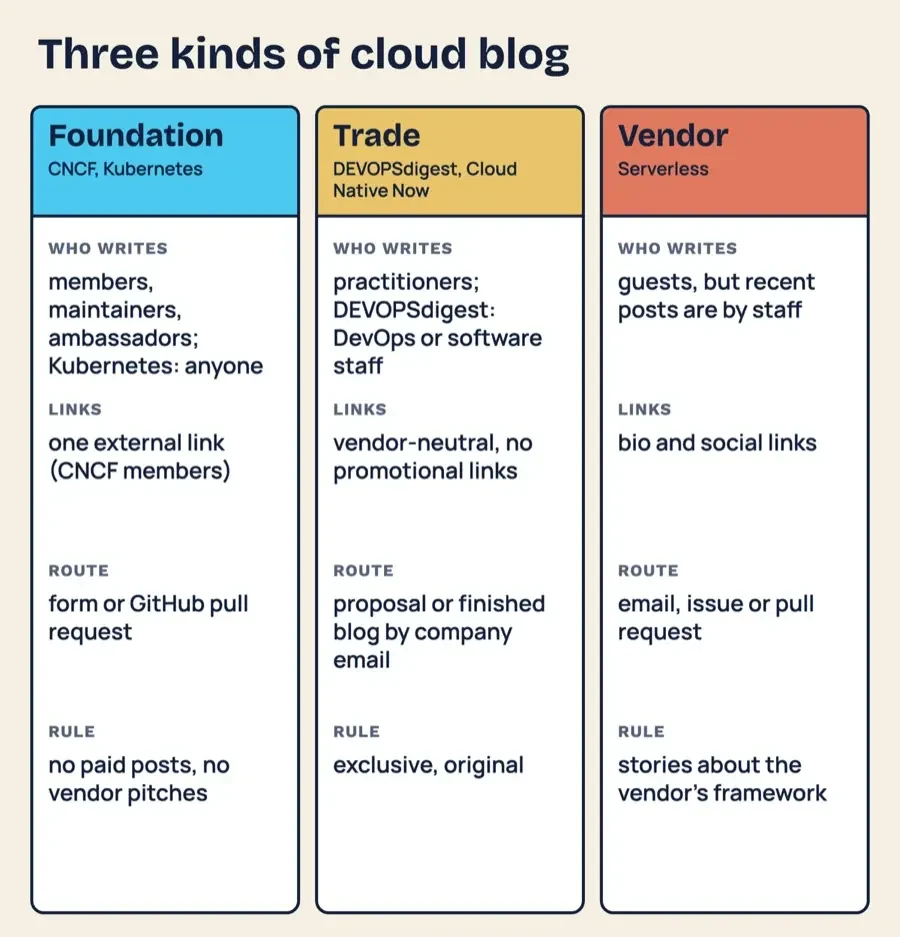 Diagram by DigitalTreed comparing foundation, trade and vendor cloud blogs, based on the CNCF, Kubernetes, DEVOPSdigest and Serverless pages we read on October 31, 2026.
Search strings for cloud and DevOps contributor pages
Once you know which lane suits your story, search for its submission page using the words cloud editors themselves use, such as upstream, platform engineering and cloud native. Google's refine searches page explains quotes, the minus operator and after:, all used below. OR doesn't appear on that page, so when one of those lines comes back noisy, run each half on its own.
The first block looks for contributor pages written in cloud vocabulary. The second checks one domain for the three footprints covered below.
Find cloud submission pages
"write for us" kubernetes "contributor guidelines"
"contribute" "cloud native" blog -casino
"submit a guest post" DevOps Terraform
"guest post guidelines" AWS OR Azure OR "Google Cloud"
"become a contributor" "platform engineering"
"write for us" cloud after:2026/01/01

Vet one cloud site (replace example.com)
site:example.com "free VPS" OR "free RDP"
site:example.com nulled OR cracked cPanel
site:example.com WHMCS nulled
site:example.com "reseller hosting" "guest post"
site:example.com "link insertion" price
"example.com" "guest post" price
The after: line keeps pages "last updated after a particular date", which filters out pages left alone for years. A clean vet result isn't proof. Google's site: documentation admits "The list of URLs returned is not always exhaustive". Our own pool shows how quickly cloud lists go stale, since 42 of 171 candidates didn't load and 14 answered with a bot challenge. Before you email anyone, test each submission URL with our HTTP status code checker and drop any that doesn't return 200. A contributor page that redirects elsewhere or shows an error can't take your pitch.
Free VPS giveaways, cracked panels and reseller link farms
Those vet lines hunt for three footprints that cloud blogs share with low-grade hosting forums, and each one would put your byline next to something you'd rather avoid. Free VPS and free RDP giveaways come first. Real free tiers live on the provider's own pages: Google Cloud's free program page offers "free usage of 20+ popular products, including Compute Engine and AI APIs". Microsoft's Azure free services page says "Some are always free to all Azure customers, and some are free for 12 months to new customers only."
A blog that hands out RDP logins or "free Windows VPS" accounts is offering something else. The FBI's IC3 warned in a public service announcement that "Threat actors buy and sell stolen RDP login credentials on the Dark Web." CISA's ransomware guide adds that "Threat actors often gain initial access to a network through exposed and poorly secured remote services".
A giveaway post doesn't show where its logins came from, and you can't check. We'd pass on any blog that runs them, however clean its writer page looks.
Cracked control panel downloads are the second footprint. Posts offering nulled copies of cPanel, WHMCS or a paid hosting script hand readers an installer from nobody in particular. Google's spam policies define malware as software "specifically designed to harm a computer, a mobile device, the software it's running, or its users". Its unwanted software policy flags programs where "It is bundled with other software and its presence is not disclosed."
Reseller link farms are the third. Picture a cluster of hosting and "cloud tips" blogs that all sell posts from one price sheet. The spam policies count "Exchanging money for links, or posts that contain links" as link spam. Selling links isn't banned in itself; the policy says it's fine "as long as they are qualified with a rel="nofollow" or rel="sponsored" attribute value". Moz's own Domain Authority page says "Domain Authority is not a Google ranking factor". So a menu sorted by DA tells you what the seller charges, not what Google sees.
Our run didn't catch any of these on its own. Its sitemap scan dropped a site at 3 hits from a fixed word list, and that list holds "casino", "cbd", "viagra", "escort", "mod-apk", "payday-loans", "title-loans", "betting-tips", "online-slots", "slot-machines" and "essay-writing-services".
VPS, RDP, nulled and cracked aren't on it. Cloud got no extra word list either; the run's code gives one only to sports, cricket, game, crypto and finance.
The scan's one cloud hit still led somewhere. Collabnix, a long-running Docker and Kubernetes community blog, had 1 "casino" address in its sitemap, below the cutoff of 3, so the run kept it for our second read. When we opened that address on October 31, 2026, it was a post titled "Streamlining Success: How DevOps Powers Online Casino Games". Its author bio points to Gamblizard. The post links that same site for "new online casinos" and a "5 dollar deposit" offer. Neither link carries a sponsored or nofollow value. So we took Collabnix off the list, even though its writer page still invites contributors.
You can run the same check in a few minutes. Our XML sitemap validator lists every address in a sitemap, and an off-topic slug like that one stands out on a quick scroll.
Does a cloud blog pass the 2-minute check?
The card below sets those footprint searches next to four lookups, one row each, for a single blog. Our niche sites hub has the long version; this is the cloud cut.
Rows one to four come from what our run recorded for each site, and row five comes from your own vet searches.
| Check | Green | Yellow | Red |
| Contributor page | Live; asks for a proposal or an outline | Live with a catch: employer rule, old page or a bare form | Closed, a link price or a followed-link promise |
| Tranco rank | Ranked 1 to 100,000 | Inside the top million only | Unranked, with no traffic check |
| Wayback homepage titles | One cloud or DevOps title throughout | A placeholder or a different name in early years | Three or more topic changes |
| Sitemap spam words | None | 1 or 2, or the sitemap won't load | 3 or more |
| Your vet searches | Nothing found | Sponsored posts, labeled as such | VPS or RDP giveaways, cracked panels or an unlabeled link menu |
One red ends it. If the card passes, paste a recent guest post's URL into the DigitalTreed noindex checker. When guest pieces carry noindex, yours would sit out of search too.
Tranco supplied the rank row, and it describes itself as a "Research-Oriented Top Sites Ranking". Its methodology page explains that it combines providers' lists "over the past 30 days" with the "Dowdall rule".
Tranco's rank reflects how popular a domain is, not who reads it. It won't say whether the readers run production clusters or are new to the field.
Here's the card filled in for three of the listed publications, using only what the run saved plus our second read:
- Kubernetes: contributor page open (green); Tranco #4,989 (green); homepage titles: Kubernetes from 2014 to 2026 (green); sitemap 0 flagged words (green).
- DEVOPSdigest: contributor page has a catch (yellow); Tranco #337,017 (yellow); homepage titles: gmi2.net in 2015, DEVOPSdigest from 2018 (yellow); sitemap no readable sitemap (yellow).
- Serverless Framework: contributor page has a catch (yellow); Tranco #141,268 (yellow); homepage titles: a placeholder in 2002, the Serverless Framework from 2019 (yellow); sitemap 0 flagged words (green).
Across all five listed publications, four show at least one yellow. None shows a red. Counted by row, the yellows are a rank past 100,000 (4), a page with a catch (3), a different early homepage (2) and an unreadable sitemap (1). Kubernetes stayed green on every row we hold data for. We'd still pitch a site with one yellow; at two or more, we'd read a handful of its recent articles before drafting anything.
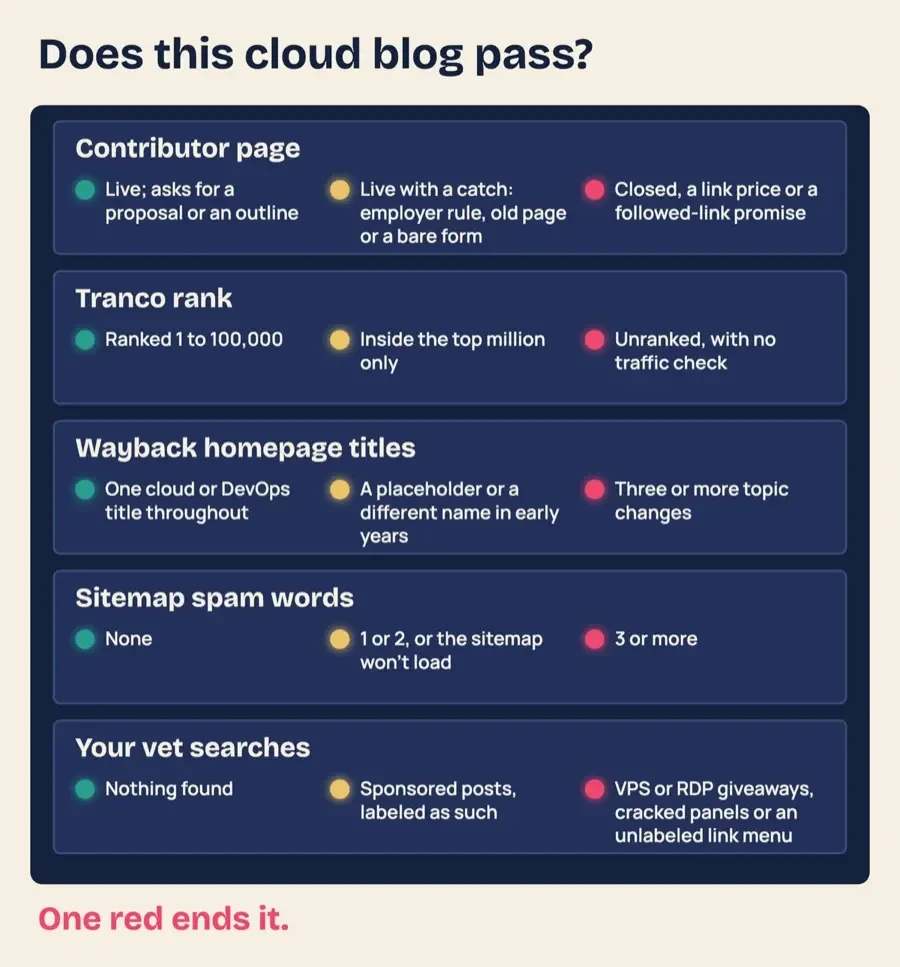 Diagram by DigitalTreed of the 2-minute check for cloud publications, using the thresholds our October 31, 2026 run applied.
Write for us cloud computing: the publications that passed on October 31, 2026
Every name in this table survived the October 31, 2026 run, and that evening we fetched each contributor page again and read it from top to bottom. The Vetted stamp on this page's header image means exactly that. It doesn't say anything about reply times, traffic or how a publication tags links. The run kept six cloud sites, and our second read took one out:
- Collabnix: its call for writers is still open, but the site hosts a DevOps-for-casinos post whose casino bonus links carry no sponsored or nofollow value
That leaves five. Our goal was 15 per guide, and we'd rather list five real calls than pad the table with failures. Most of the loss came early: 107 of the 171 candidates had no contributor page our checker could find.
Four of the five take a pitch from any writer, and two come with no catch. Serverless Framework's catch: its guest post page is dated October 10, 2018, and the newest posts on its blog were signed by the Serverless Team. DEVOPSdigest's catch: it takes posts only from people who work in DevOps or software, sent from a company email. Platform Engineering's catch: the page has no written rules, and its article button opens a form. Publication names are plain text, and each row's only link is a rel="nofollow" link to its contributor page.
| Publication | Contributor page (nofollow) | Their main asks | Tranco # | Archived since | Checked |
| Kubernetes | Blog guidelines | Open to anyone; original work only, never published elsewhere; upstream Kubernetes, not one vendor or one cloud; links mostly to the Kubernetes docs | #4,989 | 2014 | 10/31/2026 |
| Serverless Framework | Contribute to the Serverless Blog | Open by email, issue or pull request on the blog repo; serverless how-tos and Serverless Framework stories; bio and social links allowed | #141,268 | 2002 | 10/31/2026 |
| DEVOPSdigest | Editorial Guidelines | Only for staff of DevOps or software firms; company email; no AI-written posts; 500 to 1,000 words; vendors use a separate forum | #337,017 | 2015 | 10/31/2026 |
| Cloud Native Now | Write for Cloud Native Now | Open; send a proposal to the editors; 600 to 1,000 words for practitioners; vendor-neutral with no promotional links; exclusive to the Techstrong sites | #501,928 | 2023 | 10/31/2026 |
| Platform Engineering | Contribute | Open; platform stories and technical deep dives through a form; no written rules on the page itself | #736,279 | 2022 | 10/31/2026 |
Wayback years can mislead, since the archive's earliest capture of a domain sometimes shows an older site that used the same name.
Two more cloud candidates were dropped because the program was on hold. The New Stack's contributions page says its "contributed article program for guest bylines is currently on pause". Better Stack's writer page says "We are temporarily closed to new writers". The New Stack says "The contributor program may return down the road", and Better Stack lets you register your interest.
Writing more code than infrastructure? The software development guest post guide keeps its own list, and general tech outlets sit in the technology blogs guide. Hosting-focused sites belong to the web hosting guest post guide. None of the publications above shows up on the software development or technology lists, or in the hub.
About the checker itself: it sent plain GET requests with DigitalTreed in the user agent, read robots.txt before anything else and hit no host more than once every 1.5 seconds. Where a site put up a bot wall or refused us, we logged it and stopped there, with no proxy and no other user agent. Ahrefs, Semrush and Similarweb weren't part of the check, so traffic rests on Tranco alone (Tranco's October 29, 2026 snapshot, PYK6J). No unranked cloud site cleared the other checks, so there's no Smaller sites table here. Sitemaps came from the lines each site lists in robots.txt, or from /sitemap.xml when it lists none.
For each domain we asked the Wayback CDX API for a single homepage capture per calendar year; the archive's help pages describe how captures work.
What we tested
We started with 171 cloud candidates. The run kept 6 and dropped 165. Of the dropped sites, 107 had no contributor page our checker could find. Another 42 never loaded for us. A further 14 sat behind a bot wall or turned our checker away, and we left them alone. The last 2 had put their writer programs on hold.
Only one of the five listed publications sits inside Tranco's top 100,000. No cloud candidate was cut for selling links or for sitemap spam words. The scan's one cloud hit was the casino address described earlier. You can see each step of that drop in the funnel chart below.
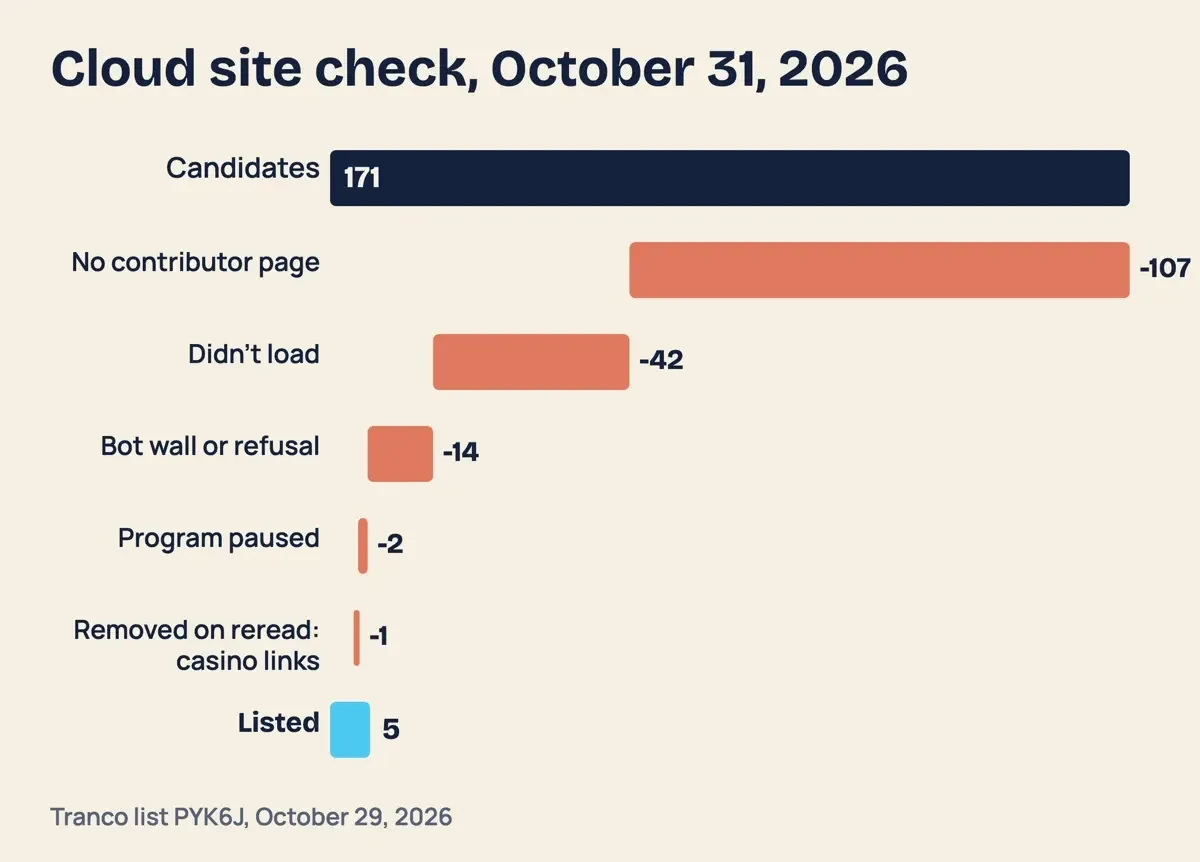 Diagram by DigitalTreed; counts from the site check we ran on October 31, 2026.
Pitching a cloud editor: a sample email and five topics
With a shortlist ready, follow each publication's own first step, since the four routes below barely overlap. Cloud Native Now asks you to "submit your proposed content to our editorial team". Kubernetes allows you to "start directly with a pull request in GitHub", but its submission page adds "The blog team actually don't recommend this". On either route the team tries to pair you with a "writing buddy and a blog editor".
The CNCF route is to "Submit your blog post in a Google doc or word document" through its form. DEVOPSdigest wants the finished blog, sent from your company email.
Our own page asks for the opposite order: "Please do not send a finished article before we agree on the topic." So read the route first, then decide whether you're sending a one-paragraph proposal, a placeholder pull request or a finished draft from a company address.
This sample is invented; swap each placeholder in braces for your own details. Keep the version line, the cost line and the disclosure line; those are the parts a cloud editor checks first.
Subject: Pitch: {what broke} on {platform} {version}, and the fix

Hi {editor first name},

I run {workload} on {managed service or self-hosted} for {team type}.
In {month year} we hit {problem} on Kubernetes {x.y.z} with
{tool} {version}. It took {time} to trace; the fix was {one line}.

What the post would cover, in order:
1. {symptom and how we found it}
2. {config before and after, versions pinned}
3. {cost line: service, tier, region, $ per unit, date read, link}
4. {security caveat a reader should not skip}

Vendor-neutral: no product pitch, links mostly to upstream docs.
Never published elsewhere, including my own blog.

Earlier writing: {link 1}, {link 2}
Disclosure: I work at {employer}, which sells {product}; nobody paid for this pitch.

{your name}
Short on angles? The first four build on pages quoted above, and the fifth is a plain incident review:
- A Kubernetes minor-version upgrade, such as 1.36 to 1.37, with each API you had to replace and how long the node drains took.
- A storage bill you cut, written as before-and-after lines with the service, region, price per GB and the date you read each price.
- Moving Secrets past the unencrypted default: encryption at rest or an external store, the steps you took and what broke on the way.
- A cross-region transfer charge you didn't expect: the traffic path, the per-GB rate from the pricing page and the change that removed it.
- An incident review of an autoscaling failure, with config versions, a timeline and the alert you added afterward.
Whichever angle you pick, keep the manifests, the billing export and the dashboards behind each claim, so you can answer an editor's question with the file itself. The Kubernetes good practices page for Secrets repeats the default you'd be writing about: "By default, Secret objects are stored unencrypted in etcd".
If a cloud vendor pays you, say so in the post
Working for a company that sells cloud products or services doesn't bar you from writing, as long as readers can see the tie. Even the Kubernetes guidelines allow a link to an option you're tied to, "so long as you fully disclose your conflict of interest / relationship". The FTC makes the same point in its disclosure guide for influencers: "Disclose when you have any financial, employment, personal, or family relationship with a brand."
The FTC spells out why in its Endorsement Guides Q&A. It says "if an ad features an endorser who is a relative or employee of the marketer, the ad is misleading unless the connection is made clear". The same Q&A adds: "Listing your employer on your profile page isn't enough." A bio naming your employer won't cover a paragraph that praises its managed database, so put the tie in the body, right next to the claim.
Money for the post itself brings in Google's link rules. Its outbound links page tells sites to "Mark links that are advertisements or paid placements" using rel="sponsored"; its 2019 nofollow post says nofollow works too: "either is fine". The FTC's native advertising guide suggests labels such as "Sponsored Advertising Content" and says "Advertisers should not use terms such as "Promoted"".
We aren't lawyers, so have one read any paid contract before you sign it, especially one that tells you how to word the disclosure.
Selling sponsored posts on your own cloud blog instead? Then you're the one who might not get paid. Our paid guest post scammers guide, written for sellers, covers deposits and holding a post back until the money clears.
Cloud pitch questions
Frequently asked
Do cloud blogs pay guest writers?
None of the five pages in our table mentions payment. The New Stack, whose guest program is paused, points individual writers to Towards Data Science. Its contributions page says TDS "runs an Author Payment Program so you actually earn from the work".
Can I write about my employer's cloud product?
Not as a pitch on Cloud Native Now or the Kubernetes blog, since both rule out promotion. DEVOPSdigest routes vendor staff to its Vendor Forum. Even there, its editorial guidelines say "Do not mention any product brands or make negative references to a company, brand or product in any blogs on the Vendor Forum."
Can I republish the piece on my own site later?
DEVOPSdigest allows it: "you are free to re-post your own blog on your own website, as long as you mention that the blog was posted on DEVOPSdigest". Kubernetes runs the other way: its blog guidelines rule out a piece you've already published, "even if only to your own low-traffic blog".
How we made this guide: The counts, table rows and scorecard examples all trace to the October 31, 2026 cloud run and the files it wrote. That evening we fetched each listed contributor page and every quoted source with a plain GET, then a script matched each quote to the saved text. One kept site fell out on that reread. We didn't contact an editor, fill in a form or open an account anywhere during this work. Facts checked by the DigitalTreed team on October 31, 2026.
We first published this address on November 8, 2023, asking cloud writers to pitch us. The October 31, 2026 rewrite turns it into a guide to pitching cloud publications in general.
Sources
- NIST SP 800-145: The NIST Definition of Cloud Computing
- Kubernetes: Releases
- Kubernetes: Version Skew Policy
- Kubernetes: Secrets
- Kubernetes: Good practices for Kubernetes Secrets
- Kubernetes: Contributing to Kubernetes blogs
- Kubernetes: Submitting articles to Kubernetes blogs
- CNCF: Blog Guidelines (cncf/foundation on GitHub)
- Linux.com: How to contribute content to Linux.com
- Google Cloud: Cloud Storage pricing
- Amazon Web Services: Amazon S3 pricing
- Google Cloud: Free Google Cloud features and trial offer
- Microsoft Azure: Free services
- FBI IC3: Cyber Actors Increasingly Exploit the Remote Desktop Protocol to Conduct Malicious Activity (September 27, 2018)
- CISA: #StopRansomware Guide
- Google: Unwanted Software Policy
- Google Search Central: Spam policies for Google web search
- Google Search Central: Qualify your outbound links to Google
- Google Search Central Blog: Evolving nofollow, new ways to identify the nature of links (September 10, 2019)
- Google Search Central Blog: A reminder about links in large-scale article campaigns (May 25, 2017)
- Google Search Central Blog: Updating our site reputation abuse policy (November 19, 2024)
- Google Search Central: Creating helpful, reliable, people-first content
- Google Search Central: site: search operator
- Google Search Help: Refine Google searches
- FTC: Disclosures 101 for Social Media Influencers
- FTC: FTC's Endorsement Guides: What People Are Asking
- FTC: Native Advertising: A Guide for Businesses
- Moz: What is Domain Authority? (vendor metric)
- Tranco: A Research-Oriented Top Sites Ranking Hardened Against Manipulation
- Tranco: Methodology
- Internet Archive: Wayback CDX Server API
- Internet Archive Help Center: Using the Wayback Machine
Comments
No comments yet. Start the conversation below.