

Quick answer
As of November 1, 2026, 2 of the 77 web hosting sites we checked passed every step: Plesk and ScalaHosting. Plesk's contributor page offers "150-300$*" per accepted piece, and ScalaHosting's page names no pay. Most of the rest had no contributor page, no longer loaded, or showed a bot check and stayed unchecked. Read each host's rules and label any affiliate link you add.
Say you moved a client's WooCommerce store from shared hosting to a VPS last spring and kept the load-time logs from both sides. That log is what a hosting editor wants, and "write for us web hosting" is what people type when they go looking for one. A hosting submission page is a host's or a hosting publication's written call for pitches, with its rules on length, links and pay. Hosting companies also court affiliates. ScalaHosting's own affiliate page, read on November 1, 2026, tells partners they can "earn up to $500 per sale!" Offers like that are why disclosure matters more here than in most tech niches.
We've put the sections in working order. It opens with the test logs, configs and dated prices hosting editors want, then host-run contributor programs and who pays. Next are search strings for contributor pages, the coupon farms and unlabeled "best host" lists to skip, and a five-row card for scoring a blog. It ends with the two that cleared our November 1, 2026 check, a pitch email with five topics, and the FTC's affiliate rules.
Key takeaways
- Hosting editors want your own test logs, not specs copied from a sales page.
- Only 2 of 77 hosting sites passed our November 1, 2026 check.
- Plesk's page offers 150-300$* per accepted piece; the asterisk has no footnote.
- Coupon-only pages and unlabeled "best host" lists are footprints to skip.
- An affiliate link in a guest post needs its own plain disclosure.
Note
Tested a host or moved a site for a client? Our submission page calls DigitalTreed "a digital marketing and technology publication". Hosting isn't one of the topics that page lists. WordPress and Affiliate marketing both do, though, and a measured migration or an honest host comparison fits either one. For an editorial piece, send a title idea, a short note on the reader's takeaway, an outline, and links to two pieces you've written. The page is firm on order: "Please do not send a finished article before we agree on the topic." Sponsored guest posts are a separate, paid route, and the DigitalTreed media kit lists prices by niche.
Test logs, configs and dated prices: what hosting editors want
Before you look for sites, get the proof together, because hosting readers run servers of their own and will check every number you give them against their setup. Google's guide to writing high-quality reviews sets the bar: "Share quantitative measurements about how something measures up in various categories of performance." It also asks writers to "Provide evidence such as visuals, audio, or other links of your own experience" with the product. For a host, that's the plan, the region, the PHP version and your test dates. Leave one out and a sharp editor will ask for it.
Screenshots help too. Show your own panel and numbers, never a vendor's graphic.
A log beats an adjective. "Fast" means nothing to an editor, but a time to first byte measured from two cities every hour for a week, with the dates attached, means a lot.
So does a config snippet. So does a restore you actually timed from a backup, with the file size and the minutes it took written next to it. Quoting a price? Write the plan name, the billing term and the date you saw it. Hosting prices often change at renewal and during sales, so an undated number can be out of date within weeks. An editor who runs servers will also want your stack named: the web server, the database and any CDN in front. Without those, a reader can't repeat your test on their own server, and an editor can't check it either.
Both listed sites put their expectations in writing. ScalaHosting's rules say "Write at least 1,500 words to guarantee a complete cover of the topic." They add "we don't accept AI-generated content" and want real images: "Include high-quality, relevant images (not generic stock photos)". Plesk wants ideas on WordPress and on "Hosting and Server Management", and "We welcome submissions of infographic and video content ideas."
Write as someone who runs servers, not someone who sells plans, because a host's editor reads plenty of affiliate copy already. ScalaHosting's page says "Content should not be promotional but educational, informative, and valuable". It goes further: "We will remove irrelevant or overly promotional content, links, or images." That right doesn't end at launch either. The page adds "We also reserve the right to remove content or links that no longer meet our guidelines after publication."
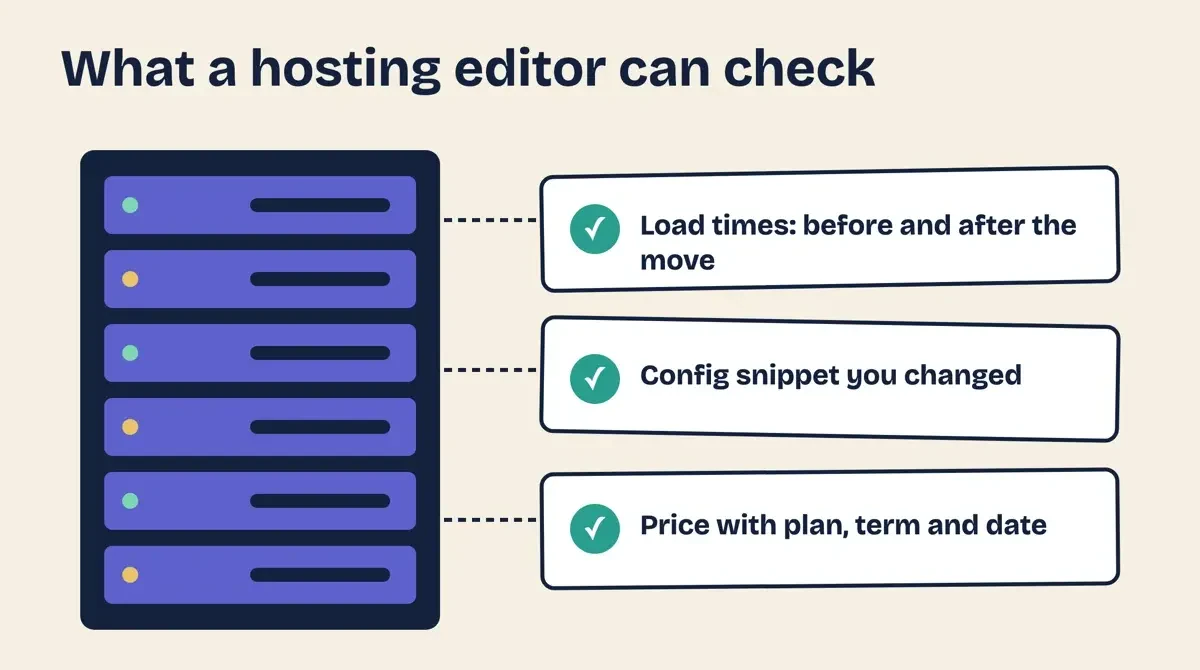 Diagram by DigitalTreed of the proof a hosting editor can check in a pitch, drawn from Google review guidance and two contributor pages read on November 1, 2026.
Host-run contributor programs and who pays
Once your proof is ready, look at who runs the page you're pitching. In hosting, the publisher is often the host or the control panel maker itself. That's not the same deal as an independent blog, because the company edits for its own product line and may pay you well or offer nothing at all.
This guide reports pay only where a contributor page states it in writing, so read the silences below as silences, not as a no.
Plesk's page states an amount. In its words: "we offer 150-300$* for every contribution we accept and publish across our network." There's an asterisk after the dollar sign, and we found no footnote for it in the page text. A byline with a bio and photo is possible, but the FAQ says "it incurs reduced remuneration". You start with an abstract: "Submit your abstract via the online form, and get a confirmation in your inbox." Then "Plesk reviews your submission, and we will respond to successful applicants within three weeks."
Three weeks is long. Pitch something that won't go stale by then, like a monthly process rather than this week's outage.
Plesk also claims "With 100K visitors to the Plesk blog every month". That's the company's own number, and since we had no analytics access for its blog, we couldn't check it or say where those visitors live.
Its full rules sit in a submission guide PDF, which our header check showed was last modified on June 3, 2021. Read it before you pitch, but it dates from 2021, so check anything time-bound, such as the monthly topic list, against the live page. ScalaHosting's page says nothing about pay in either direction, so don't assume money or a fee. Its Guest Posts category lists six posts, and the newest carries a publish date of August 7, 2026. There's no email address or form on the rules page itself. The only route we saw was the general Contact Us link in the footer.
Not every well-known program is open. DigitalOcean's Write for DOnations page describes a way to "Share your knowledge and get paid, while supporting tech-focused nonprofits and charities." On the copy our run saved, it still read "Paused until 2025". Further down: "We're currently reviewing our backlog of submissions and are paused for new topics until 2025." It's now past 2025. We left it out until the page changes. If it reopens, treat it like any new page: reread the rules, check the topic list, and date the newest tutorial before you pitch.
Whoever pays, the link rules don't move. Google's spam policies count "Exchanging money for links, or posts that contain links" as link spam.
A host paying you for words is fine; a site asking you to pay for a followed link isn't. Our guide to guest post scams covers that second case from the seller's side.
Search strings for hosting contributor pages
So where do you find more pages like these? Google's search operator help documents quotes, the minus sign and site:. It warns: "Do not put spaces between the operator and your search term."
Pair a hosting word with a contributor phrase, then add minus words for the coupon and deal pages that crowd almost every hosting query you'll try.
Find hosting contributor pages
"contributor program" hosting -coupon -promo
"guest post guidelines" "web hosting" -"best hosting"
"write for us" VPS OR "server management"
"submit an article" cPanel OR Plesk OR WordPress hosting
"we pay" "per article" hosting OR sysadmin

Vet one site (replace example.com)
site:example.com coupon OR "promo code"
site:example.com "best web hosting"
site:example.com casino OR CBD OR loan
site:example.com "affiliate disclosure" OR "we may earn"
Swap VPS for the stack you actually run, such as LiteSpeed, Nginx or a managed WordPress plan, and keep the minus words, since coupon pages outrank most contributor pages. Treat the site: lines as a sample. Google says the operator "Returns a list of indexed and serving URLs.", and that list isn't always complete. A coupon page or two on a host's own blog is normal. Hundreds of them on a "review" site is the pattern covered next. If a string returns nothing useful, try the names of control panels, server tools and stacks instead of the word hosting. DigitalOcean's program, for example, sits among its community pages, and Plesk's has its own page outside the blog.
Ahead of drafting, check the contributor URL's response code with the status checker on DigitalTreed. In our run, seven hosting candidates didn't load or now redirect to another site. Brands change: A2 Hosting's homepage, for one, now sends visitors to hosting.com.
Coupon farms, unlabeled "best host" lists and copied specs
Those vet strings matter because hosting commissions draw templates. The $500 figure from the intro is ScalaHosting's own offer to its affiliate partners, stated on its affiliate program page as of November 1, 2026. It's a separate program from the company's guest post rules, which don't mention affiliate links at all. Commissions like that give some publishers a reason to build pages that exist mainly to send a click. Expect a host's editor to read every pitch for a sales angle.
The first footprint is the coupon farm: page after page of promo codes with no testing behind them. Hosts see it too. ScalaHosting's affiliate terms rule out "Sites that are only offering coupon codes and promotions and do not have blog and/or review section". The review it asks for must mention ScalaHosting, "containing minimum 1000 (one-thousand) characters". Pitch a site that's mostly coupon pages, and your careful migration guide ends up in the same archive as hundreds of untested discount offers and expired deals. Readers will treat it the same way.
The second is the "best host" list whose links all carry affiliate tags and no label. Google's review guidance wants a reason for each pick. Its words: "When recommending something as the best overall or the best for a certain purpose, include why you consider it the best, with first-hand supporting evidence."
The FTC has a rule on review sites a company controls. Its final-rule announcement says the rule prohibits a business from misrepresenting that a site it controls "provides independent reviews or opinions" about a category including its own products. The text is 16 CFR 465.6, part of a rule published at 89 FR 68077 on August 22, 2024. The FTC's Q&A page on the rule covers an owned site that discloses its owner: "you would violate this section if the website has an express claim of independence".
For a writer, the practical point is simple: when a "best host" list calls itself independent, look at who owns the site before you pitch it.
The third footprint is copied specs. Google's spam policies define thin affiliation as "publishing content with product affiliate links where the product descriptions and reviews are copied directly from the original merchant" with nothing original added. The policy adds: "These sites often appear to be cookie-cutter sites or templates". On a hosting blog, that's the same plan table, word for word, on every "review" in the archive. It's easy to spot.
When a list's links all start with /go/ or /recommends/, run one through our redirect checker. You'll see each hop the link takes, and a tracking host from an affiliate network in the middle of that chain means the click is paid for. That's fine when it's labeled. It's a footprint when nothing on the page says so.
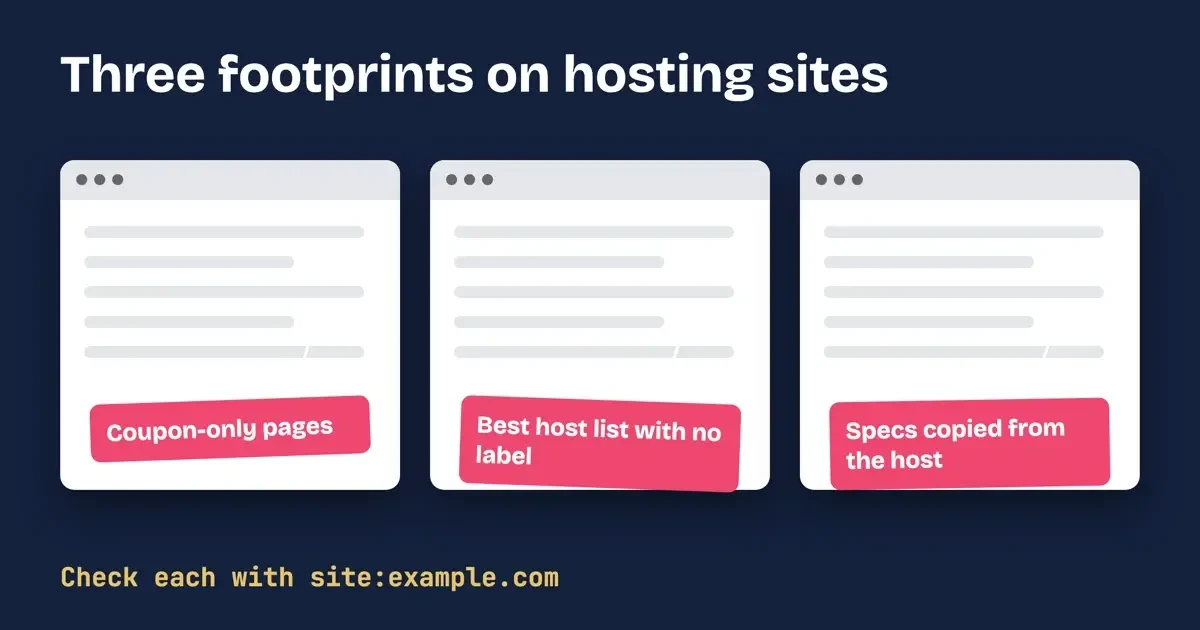 Diagram by DigitalTreed of three warning signs on hosting sites, based on Google and FTC pages and a host affiliate agreement read on November 1, 2026.
Does a hosting blog pass a five-row card?
Next, put those footprints on a card you can fill in for one site in about two minutes. Each row is green, yellow or red. One red means stop. Two yellows mean you read the latest five posts first, then decide whether the site's readers would ever care about your test.
| Row | Green | Yellow | Red |
| Contributor page | Written rules and a form, an address or a stated process | Rules, but no route on the page, or an old guide file | Paused, priced, or promising dofollow links |
| Tranco rank | Top 100,000 | In the top million, below 100,000 | Missing from Tranco's million |
| Homepage history | The same hosting or server business throughout | A blank or parked stretch | Repeated switches between unrelated subjects |
| Newest post | Posted within 6 months | Last post 7 to 24 months ago | Nothing posted for over 2 years |
| Hosting scan | No coupon, "best hosting" or vice slugs | Its own coupon or "best hosting" pages | Mostly coupon pages, casino or loan slugs, or unlabeled affiliate lists |
The rank comes from Tranco, which calls itself "A research-oriented top sites ranking hardened against manipulation". Tranco's method notes explain the math: "we average ranks over the lists of all four providers over the past 30 days". We leaned on it because we didn't have Similarweb, Semrush or Ahrefs numbers, and a top-sites rank is the one traffic signal anyone can check for free. A rank won't tell you where the readers live, though.
History comes from the Wayback Machine, whose CDX server notes say "Results may be filtered by timestamp using from= and to= params." That's how the run pulled one homepage title per year. A hosting brand that was a casino blog in 2019 isn't the same site as one that's sold reseller plans since 2008. If the titles show a parked page or a for-sale notice for a few years, mark the row yellow and read what the site published right after it came back.
One more ten-second test: run the domain through our SSL checker. A hosting blog with a broken certificate is its own warning.
Here's the card on both listed sites, using only what the run recorded, what our reread found and what the sitemap scan counted:
- Plesk. Contributor page: green, written rules, an online form and a stated pay range. Tranco: green, #391. Homepage history: green, a hosting control panel in every yearly title since 2000, with one blank title in 2018. Newest post: green, October 27, 2026. Hosting scan: green, no coupon, "best hosting" or vice slugs in 685 posts. Result: green on every row.
- ScalaHosting. Contributor page: yellow, written rules, but no address or form on the page. Tranco: yellow, #190,914. Homepage history: green, a hosting company in every yearly title since 2008, from reseller plans to cloud servers. Newest post: green, October 30, 2026. Hosting scan: yellow, a coupon page and 10 "best ... hosting" slugs among 718 posts. Result: three yellows, no red.
ScalaHosting's yellows come from the missing route, a rank past the first 100,000, and its own deal pages. That's normal for a host's blog, but your piece will sit beside sales pages, so keep it free of anything that reads like one.
Plesk came up green on all five rows. DigitalOcean would stop at row one, on its "Paused until 2025" label.
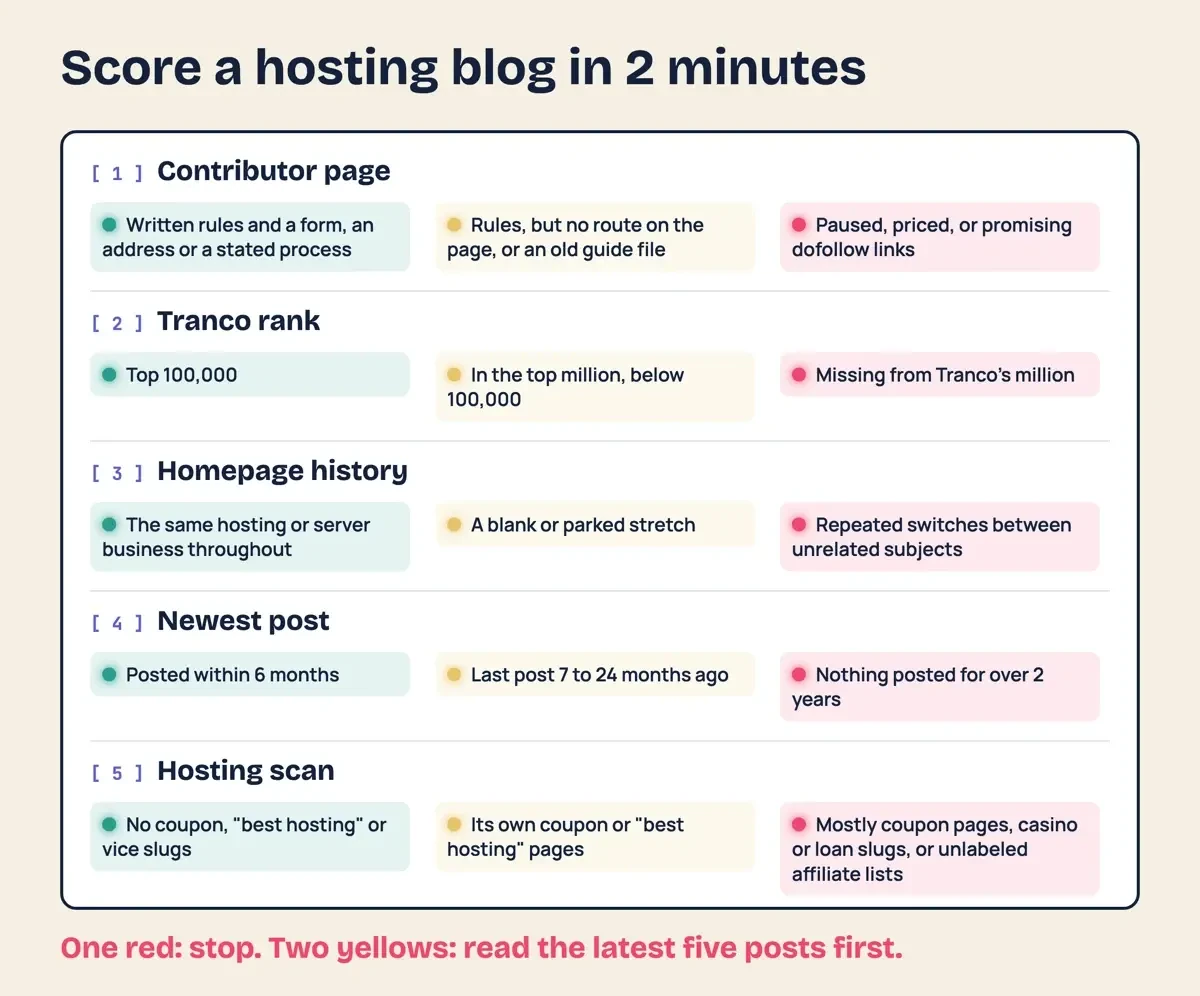 Diagram by DigitalTreed: five rows for scoring a hosting blog, with the cutoffs used in this guide on November 1, 2026.
Write for us web hosting: the two hosts that cleared our November 1, 2026 check
Run that card over what the batch check kept, and two sites remain. Both are companies that sell to site owners: Plesk makes a server control panel, and ScalaHosting sells hosting plans. Each name below is plain text, and only the contributor page carries a link, marked nofollow so that our table passes no ranking credit to either company. Passing our check doesn't promise a reply, traffic or a followed link. Both companies also run affiliate programs, linked from their own menus. Those programs are separate from the contributor pages, and our check didn't look at them or depend on them. If you add an affiliate link to either host's plans, the disclosure section near the end applies.
| Site | Where to pitch (nofollow) | What the page asks | Tranco rank | Latest post | Checked |
| Plesk | Plesk Contributor Program | Paid program: abstract first through an online form, reply to accepted applicants within three weeks; pay range on the page | #391 | October 27, 2026 | November 1, 2026 |
| ScalaHosting | Guest Post Guidelines | Open; 1,500+ words, no AI-generated text, bio of 3-4 sentences; promotional links may be removed; no pay mentioned | #190,914 | October 30, 2026 | November 1, 2026 |
Why only two? Of 77 hosting candidates, 48 showed no contributor page where our checker looked. That was the biggest single group, at 62% of the candidates.
For 16 others, the reply was a bot screen (HTTP 403 or 429, or a challenge page), and our checker goes no further than that. That group includes the hosting publications HostingAdvice, HostAdvice, WebHostingTalk and Cybernews, and hosts such as Bluehost, HostGator, GoDaddy, Cloudways and Namecheap. We don't work around those screens, so these sites are simply unchecked, and this guide draws no conclusion about them.
Seven more didn't load or now redirect elsewhere; Hosting Tribunal's homepage, for example, goes to webtribunal.net. One program was paused (DigitalOcean's). The last three came off for casino-type sitemap slugs, a fee to publish, or vice topics on the contributor page. We don't name those last three, because a one-line drop reason isn't a full verdict on a site.
No hosting site landed in the smaller-sites group this time, so nothing is waiting on a traffic check for this page. Our list also skips any site already listed in an earlier guide in this series. The cloud computing guide and the website development guide carry server and WordPress pages that aren't repeated here. For the full checklist behind the card, open the hub on finding and checking niche guest post sites.
What we tested
Our run on November 1, 2026 checked 77 hosting candidates with a plain GET, our own user agent and robots.txt obeyed. It kept 2 and dropped 75. Ranks come from Tranco list PYK6J of October 29, 2026. Sitemaps were scanned for words like "casino", "cbd", "viagra" and "escort". The run had no hosting words, so we added a scan of each kept site's post sitemap: 718 ScalaHosting URLs and 685 Plesk URLs. Neither had a casino, betting, CBD or loan slug. ScalaHosting had one coupon page and 10 "best ... hosting" slugs; Plesk had none. Each site's newest post, dated from its own publish tag, was October 30, 2026 and October 27, 2026. We reread both pages that day.
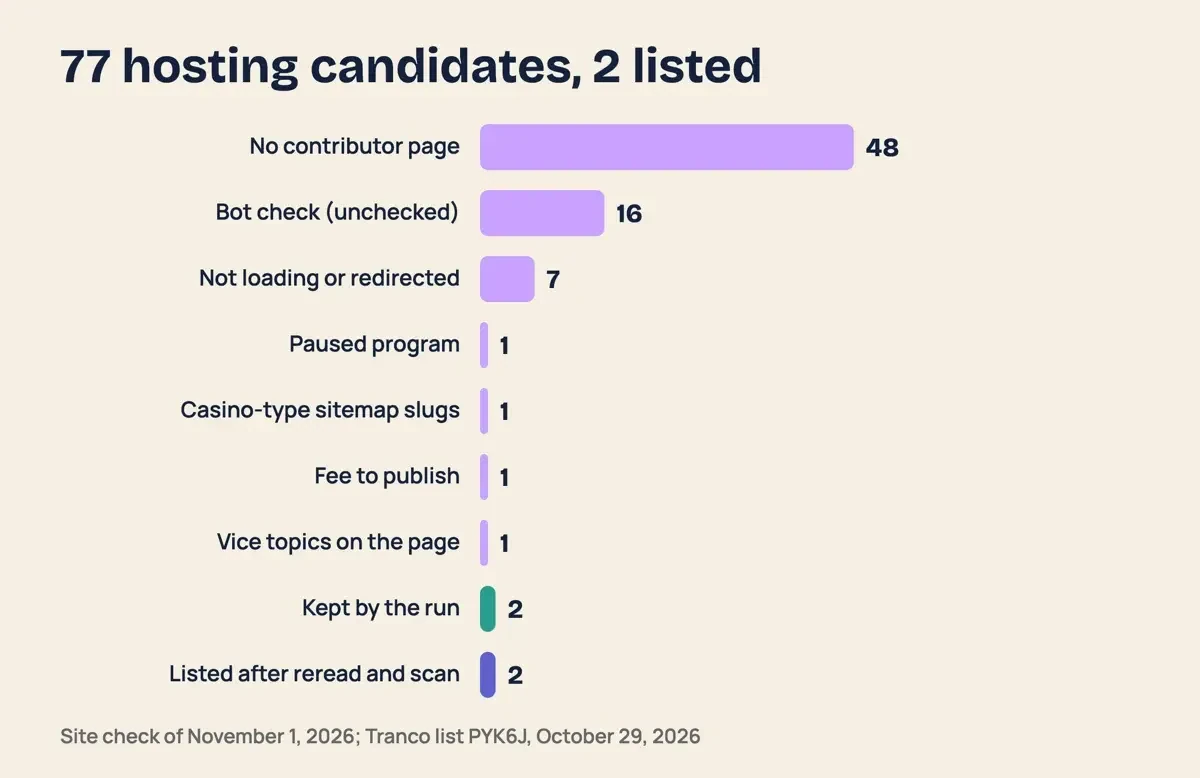 Diagram by DigitalTreed, drawn from our November 1, 2026 run, reread and hosting scan.
Pitching a host's content team: one email, five topics
Once you've chosen a site, copy its first step. Plesk wants an abstract through its form, while ScalaHosting's rules describe a full article with a bio.
Our own page leans the Plesk way: "Please do not send a finished article before we agree on the topic." Either way, the email below works as a cover note.
Subject: Pitch: {what you measured} on {stack}, with logs

Hi {editor first name},

In {month and year} I moved {kind of site} from {old setup}
to {new setup}. I logged {metric} for {number} days before and
after, from {locations}. I can share the raw logs and configs.

Working title: {title}
Readers learn: {two lines}
Outline: {four to six headings}

Disclosure: {"I have no affiliate links in this piece" or
the program and the link, labeled}

Two things I have written: {link 1}, {link 2}

{name}, {role}
Swap every braced field for your real details. Everything in the sample is invented. Keep the disclosure line even if the answer is none, because a host's editor will ask about affiliate ties anyway, and a clear answer up front saves an email. And pick writing links that show servers, not marketing.
Short on ideas? These five lean on logs and records most admins already have:
- A shared-to-VPS move: the DNS TTL you set, minutes of downtime, and what broke.
- Restoring from backup for real: local versus remote copies, with the time each restore took.
- A PHP version upgrade on a live WordPress site: the plugins that failed and how you fixed them.
- SPF, DKIM and DMARC on shared hosting: the records you set and the inbox results before and after.
- Reading an uptime SLA: what the credit pays next to what an hour down cost a store (labeled example).
The last idea pairs well with our uptime monitoring guide, which walks through what 99.9% allows. Blur client names, IP addresses and control panel usernames in every screenshot, because a host's editor will spot a leaked login long before a reader does. If you're after leads rather than a byline, our post on what a business guest post can and can't do sets fair expectations.
Affiliate links in a hosting post: what the FTC expects
Beyond the pitch, hosting posts tend to name a plan, and plenty of writers hold an affiliate link for it. The FTC's FAQ on endorsements suggests a plain line such as "I get commissions for purchases made through links in this post." Bare labels get a caution too, since consumers "might not understand that "affiliate link" means that the person placing the link is getting paid for purchases made through the link".
Placement matters as much as wording. The same FAQ says "Readers might overlook a disclosure at the very top of the page, outside of the blog." It adds: "Consumers may miss a disclosure at the bottom of a blog or page." It also says "The closer the disclosure is to your recommendation, the better." In a guest post, that points to a label near the plan you name, not only a line in the footer.
The Endorsement Guides also speak to advertisers, which here means the host. Section 255.1 lists steps advertisers should take, one of them to "Monitor their endorsers' compliance". The same section says "Advertisers are subject to liability" for, among other things, "failing to disclose unexpected material connections" with their endorsers. ScalaHosting's affiliate agreement takes that on: "We will monitor for FTC compliance to ensure disclosures are adequately added." Elsewhere it says "FTC disclosures need to be clear and conspicuous on your site."
A good model sits on WordPress.org's hosting page. It tells readers that if they sign up through it, "some will donate a portion of your fee back". It also admits "Listing is completely arbitrary". Both lines take seconds to read, and that tone is worth copying. Your guest post can do the same in one sentence near the plan you name, with the program spelled out. If the host you're writing for also runs the affiliate program, say that too, since readers can't see who pays whom.
Search engines need their own signal. In its help on qualifying outbound links, Google asks you to "Mark links that are advertisements or paid placements" with rel="sponsored", and an affiliate link is paid. Its 2017 note on guest posts flags "Stuffing keyword-rich links to your site in your articles" as part of a link scheme. For label wording, the DigitalTreed piece on using affiliate links goes deeper, and paid posts get their own sponsored blog post guide.
Part 465 also covers paid praise. Its section 465.4, headed "Buying positive or negative consumer reviews.", is about a business paying for reviews "expressing a particular sentiment, whether positive or negative". If your host comparison quotes user reviews, say where each one came from. Our article on automating customer reviews safely looks at reviews from the site owner's side.
Hosting guest post questions
Frequently asked
Do hosting companies pay guest writers?
Some say so in writing. Plesk's page offers "150-300$*" per accepted piece and notes that a byline with a bio "incurs reduced remuneration". ScalaHosting's guest post rules name no pay either way. If a page is silent, ask.
Can I put my own hosting affiliate link in a guest post?
Only if the site allows it, and with a label. ScalaHosting's rules say "We will remove irrelevant or overly promotional content, links, or images." If a paid link stays, Google's page on qualifying links asks for rel="sponsored", and the FTC's FAQ suggests a plain disclosure close to it.
Is guest posting on a hosting blog against Google rules?
Not by itself. Google's 2017 note says "Google does not discourage these types of articles in the cases when they inform users". Trouble starts when money changes hands for a followed link, which its spam policies treat as link spam.
Why did so few hosting sites pass?
Of 77 candidates, 48 turned up no page inviting contributors and 16 showed our checker a bot check. Those last ones are unchecked, not failed, so open them in your own browser and judge them yourself.
How we made this guide: Two contributor pages, two post sitemaps and 77 run records sit behind every count here, all from our November 1, 2026 run, reread and scan. Quotes come from pages read that day by plain GET with an honest user agent, and bot-blocked sites were left unchecked. Facts checked by the DigitalTreed team on November 1, 2026.
Our page for hosting writers first went up at this URL in November 2023. The November 1, 2026 rewrite swaps the old call for submissions for this vetting guide.
Sources
- Google Search Central: Spam policies for Google web search
- Google Search Central: Qualify your outbound links to Google
- Google Search Central blog: A reminder about links in large-scale article campaigns (2017)
- Google Search Central: Write high quality reviews
- Google Search Central: site: search operator
- Google Search Help: Refine Google searches
- FTC: FTC's Endorsement Guides: What People Are Asking
- Cornell LII: 16 CFR 255.1, General considerations (Endorsement Guides)
- Cornell LII: 16 CFR Part 465, Rule on the Use of Consumer Reviews and Testimonials
- Cornell LII: 16 CFR 465.4, Buying positive or negative consumer reviews
- Cornell LII: 16 CFR 465.6, Company-controlled review websites or entities
- FTC press release: Final rule banning fake reviews and testimonials (August 2024)
- FTC: Consumer Reviews and Testimonials Rule, Questions and Answers
- WordPress.org: Hosting
- ScalaHosting: Web hosting affiliate program and agreement
- Tranco: A research-oriented top sites ranking
- Tranco: Methodology
- Internet Archive: Wayback CDX server README

Comments
No comments yet. Start the conversation below.