
Quick answer
As of October 31, 2026, 4 finance sites with a live writer page passed our check, out of 260 candidates. Another 60 refused our plain requests, so we couldn't judge them either way. Run the 2-minute scorecard below first, then pitch with dated sources and a plain note of anyone who pays you.
If you searched "write for us finance", you probably write about money, from a job in banking or from paying down your own debt, and want a byline readers trust. A finance contributor page is a publication's standing invitation to outside writers, with its rules on pitches, sources and conflicts of interest. On October 31 our checker found no such page on 132 of 260 candidates, and 44 more didn't load. This URL once held our own call for finance posts; we've rebuilt it for people pitching other finance publications.
The guide follows a pitch from first search to sent email. It covers what editors and Google's YMYL rules expect, how to find writer pages, and the payday, guaranteed-return and debt relief footprints that rule a site out. Then come a 2-minute scorecard, the sites that passed, a sample pitch with five US topic ideas, and the FTC, SEC and Google rules for paid posts. The writer pages we read put trust ahead of style, so lead with your sources and with who, if anyone, pays you.
Key takeaways
- Finance editors reject promotional pieces and want conflicts disclosed before they read.
- Pair every money figure with its source link and the day you checked it.
- Google's rater guidelines treat how to invest money as a YMYL topic.
- Three footprint slugs, or payday talk on a writer page, ended our check.
- Hiding pay for a stock or token write-up may be unlawful, the SEC warned.
Note
Want to write for DigitalTreed? DigitalTreed is a digital marketing and technology publication. Finance isn't among the seven topics listed on our write for us page, but it's accepted with extra editorial review. Under the heading "Extra review." the page says: "Finance, crypto, forex, blockchain, real estate and legal topics are accepted with additional editorial review and need approval before publication." The fit check is the reader: "Our readers are bloggers, agencies, SaaS teams and startup founders." A money angle that helps one of them, such as handling client deposits or pricing a service, has a chance. The page turns down "get-rich-quick schemes" and says "No fully AI-generated content." For an editorial idea, "Send a short pitch first, not a finished article." Sponsored posts get "One relevant contextual link to your website or brand." Rates are in our media kit.
What finance editors look for in a pitch
Start with the people who'll open your email. The finance writer pages we saved on October 31 keep returning to four asks. They want a reason you can speak on the topic and numbers with a source. They also want no hidden sales pitch, and a plain note of who pays you. American Banker's BankThink page is blunt: "We do not accept explicit or veiled promotional pieces." It also says "Any potential conflicts of interest must be disclosed up front", including financial ties to any company you write about.
FXStreet, a forex news site, lists what it turns away, and one line reads "Misleading language, a promise of benefit, easy money". Banking Dive and Payments Dive add a modern rule: "The use of generative artificial intelligence is not permitted in the writing of op-eds".
Credentials help, but they aren't the only way in. Google's Search Quality Rater Guidelines draw a line worth borrowing. Under saving for retirement, they count "Reviews of retirement saving services by people with first-hand experience using these services" as valuable life experience. "Advice on how to invest for retirement" sits in the other column, as "Information or advice best left to Experts".
So if you aren't a CFP, CPA or licensed adviser, pitch what happened to you, with statements and dates. Leave allocation advice to people who hold those titles.
Numbers are the next filter. Put the source and the day you read it beside each figure, as in "CFPB, read October 31, 2026", and link the agency's page, not a blog. The CFPB's payday loan explainer shows the habit: a two-week loan with a $15 fee per $100 borrowed works out to an APR of almost 400%. An editor can check that against the page in a minute; give every figure of yours the same trail.
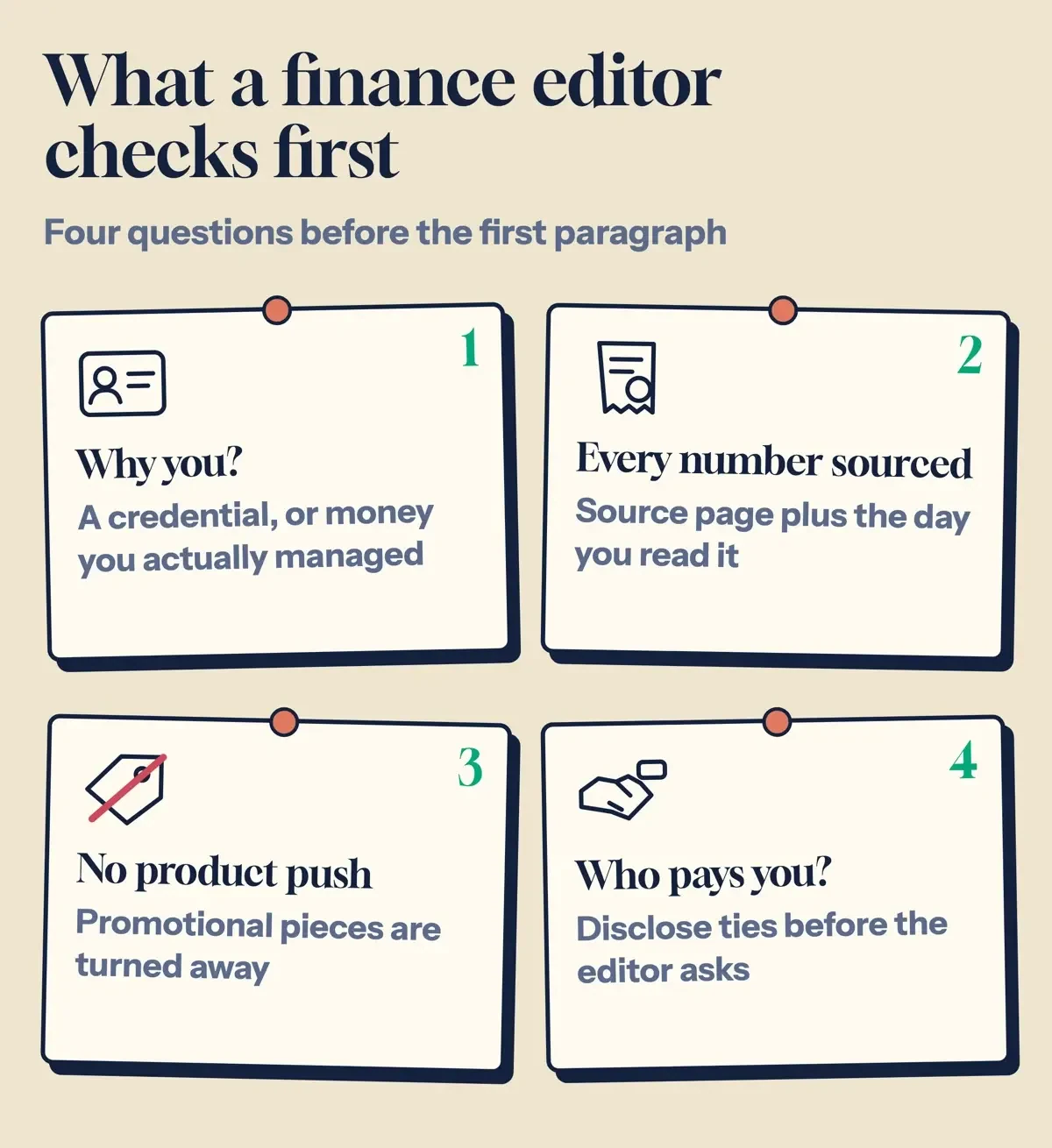 Diagram by DigitalTreed of what the finance writer pages and Google guidance we read on October 31, 2026 ask of a guest writer.
Why Google's YMYL label raises the bar for money topics
Google holds money pages to a higher standard as well. Its guide to helpful, reliable, people-first content says "our systems give even more weight to content that aligns with strong E-E-A-T" when a subject could affect people's financial stability. The next line reads: "We call these "Your Money or Your Life" topics, or YMYL for short." The rater guidelines spell out the money part. One category, YMYL Financial Security, covers "Topics that could damage a person's ability to support themselves and their families." Topics where small errors do real harm include "how to invest money". Google's overview of the rater guidelines adds that "Raters apply very high PQ standards for pages on YMYL topics", PQ meaning page quality.
Raters don't move rankings themselves. The same overview says "no single rating – or single rater – directly impacts how a given page or site ranks in Search". Even so, the full guidelines state that "Pages on clear YMYL topics require the most scrutiny for Page Quality rating", and that's the bar a finance editor has in mind.
For a guest writer, this has a practical side. Google's spam policies even use a finance case to explain site reputation abuse. Their example is an educational site hosting "sponsored reviews of payday loans written by a third-party that distributes the same page to other sites across the web". Elsewhere on that page, Google notes that "Having third-party content alone isn't inconsistent with the site reputation policy". Google isn't going after guest writing as such. Its target is the sponsored payday page copied across many sites, and a byline on that kind of page won't do a writer any good.
Finance search operators for finding contributor pages
So where are the sites that still want careful finance writers? Google's own guide to refining a search explains all of these operators, from exact-match quotes and the minus sign to site:, after: and filetype:.
The top block finds writer pages, and its minus terms keep loan and casino pages out. The bottom block vets one site you've found.
Find finance writer pages
"write for us" "personal finance" -loan
"contributor guidelines" investing
"submission guidelines" banking opinion
"pitch us" "personal finance" -casino
"guest post" "retirement planning" -payday
"become a contributor" fintech after:2026/01/01
"op-ed" "financial services" submissions
"editorial guidelines" finance filetype:pdf

Vet one finance site (replace example.com)
site:example.com "payday loan"
site:example.com "title loan"
site:example.com "guaranteed returns"
site:example.com "forex signals"
site:example.com "crypto signals"
site:example.com "debt relief"
site:example.com casino
"example.com" "guest post" price
44 of our 260 candidates didn't load at all, so paste each writer page into the DigitalTreed HTTP status checker before you spend time reading it. A 200 on the page itself means it's still online; a redirect to the homepage means that page is gone, whatever an old list says. For the vet block, Google's site: operator documentation concedes: "The list of URLs returned is not always exhaustive". A clean result is encouraging, not proof, so the footprint section below goes to the sitemap as well.
Payday loans, guaranteed returns and debt relief: finance spam footprints
Those vet searches look for a finance site that earns from the riskiest offers in the niche. For every candidate, the run pulled the URLs in its sitemap and counted slugs with "title-loans", "forex-signals", "guaranteed-returns" or "casino". It also counted the spam words it checks in every niche, such as "cbd" and "escort". A total of three or more knocked a site out, and so did a writer page that mentioned "payday", "title loan", "forex signals" or "guaranteed returns" without turning it down.
Plain "payday" and "loan" weren't counted in finance slugs, because a loan explainer is everyday finance content. On October 31 this rule removed 9 finance candidates. 5 went for sitemap words, most often "casino" and "slot-machine". Another 4 went for a writer page that named one of those offers without turning it down. One of those was a federal .gov site, a reminder that a word match can't tell a warning from an ad.
Why payday and title loans? As of October 2026, the CFPB calls a payday loan "usually a short-term, high-cost loan, generally for $500 or less, that is typically due on your next payday." A blog full of "best payday lender" pages isn't writing for the borrower that sentence describes. Our payday lender check shows how to work out one lender's real APR.
"Guaranteed" is the next giveaway. The FTC's investment scams page puts it flatly: "Investments always involve risk. There are no guaranteed returns."
The CFTC's forex fraud advisory quotes a sales line saying a deal "is guaranteed to rise double what your current investments are doing." A site that runs "guaranteed returns" headlines, or sells forex or crypto signal groups, is a poor home for your byline.
Debt relief is the third footprint. The FTC's guide to getting out of debt warns: "Only scammers will guarantee to settle all your debts or get you fast loan forgiveness."
A separate Telemarketing Sales Rule guide tells phone sellers: "You can't collect any fees from a customer before you have settled or otherwise resolved the consumer's debts." A debt "blog" where every post ends in a form asking for your total debt and phone number is collecting leads, not readers.
The run didn't count "crypto signals" or "debt relief", so search those two by hand with the vet block. Crypto sites have footprints of their own, such as presales, and our crypto write for us guide lists them.
Want to read the slugs yourself? Run the sitemap through the DigitalTreed XML sitemap validator and search its URL list for each word. Then open two or three of the posts it finds, because a slug isn't the whole story.
A 2-minute scorecard: is this finance site worth a pitch?
Once a site gets past the footprint search, five rows decide it, at about two minutes a site. For audience and payment checks, see the longer method in our guest post vetting hub.
The rows here are tuned for finance. The run logged rank, yearly titles and footprint words, and the first two rows come from our reading of each writer page.
| Check | Green | Yellow | Red |
| Writer page | Open call with clear pitch steps | Wants regular contributors, or a web form only | Missing, years stale, pay to publish, or followed links promised |
| Readers and conflicts | US readers, and the page asks you to disclose ties | Readers mostly abroad, or no conflict rule | Posts built to sell a lender, broker or signal group |
| Tranco position | Ranked in the first 100,000 | Ranked past 100,000 but inside the million | No rank, and no traffic check by a person |
| Yearly homepage titles | The same finance brand every year | Parked or another owner long ago, finance since | Repeated niche changes, or casino or pharma titles |
| Footprint words in the sitemap | None found | One or two, or a sitemap we couldn't read | Three or more, or a writer page inviting payday or signal posts |
One red, and you move on. With two yellows or more, open the three newest posts and look for unlabeled lender or broker links. Then test the guest category in our noindex tag checker, since some sites keep guest posts out of Google. For the rank row we use Tranco, which calls itself "A Research-Oriented Top Sites Ranking Hardened Against Manipulation". The list's methodology reads: "we average ranks over the lists of all four providers over the past 30 days". A strong rank shows that a site gets visits, but it can't tell you whether those visitors are Americans planning a mortgage, which is why the readers row exists.
Here's the scorecard on three of the listed sites, from the run's records and our reading of each page that day:
- American Banker: the writer page is a live call with clear steps (green). Readers are US, with a conflict rule on the page (green). Tranco 25,476 (green); yearly titles American Banker since 1996 (green); footprint words none (green).
- FXStreet: the writer page is live, but it wants regular contributors (yellow). The run's reader note says "global, forex traders", with only a standard no-position footer on the page (yellow). Tranco 20,070 (green); yearly titles Forex Street, then FXStreet, since 2000 (green); footprint words none (green).
- Payments Dive: the writer page is live, but only through a web form (yellow). Readers are US, with no conflict rule on the page (yellow). Tranco 99,252 (green); yearly titles Payments Dive since 2021 (green); footprint words none (green).
Across all four listed sites, American Banker is green on every row. No site scored a red. Yellows by cause: form only (2), no conflict rule (2), rank past 100,000 (1), regular contributors wanted (1) and non-US or global readers (1). FXStreet, Payments Dive and Banking Dive have two or more, so read a handful of recent posts on those sites first.
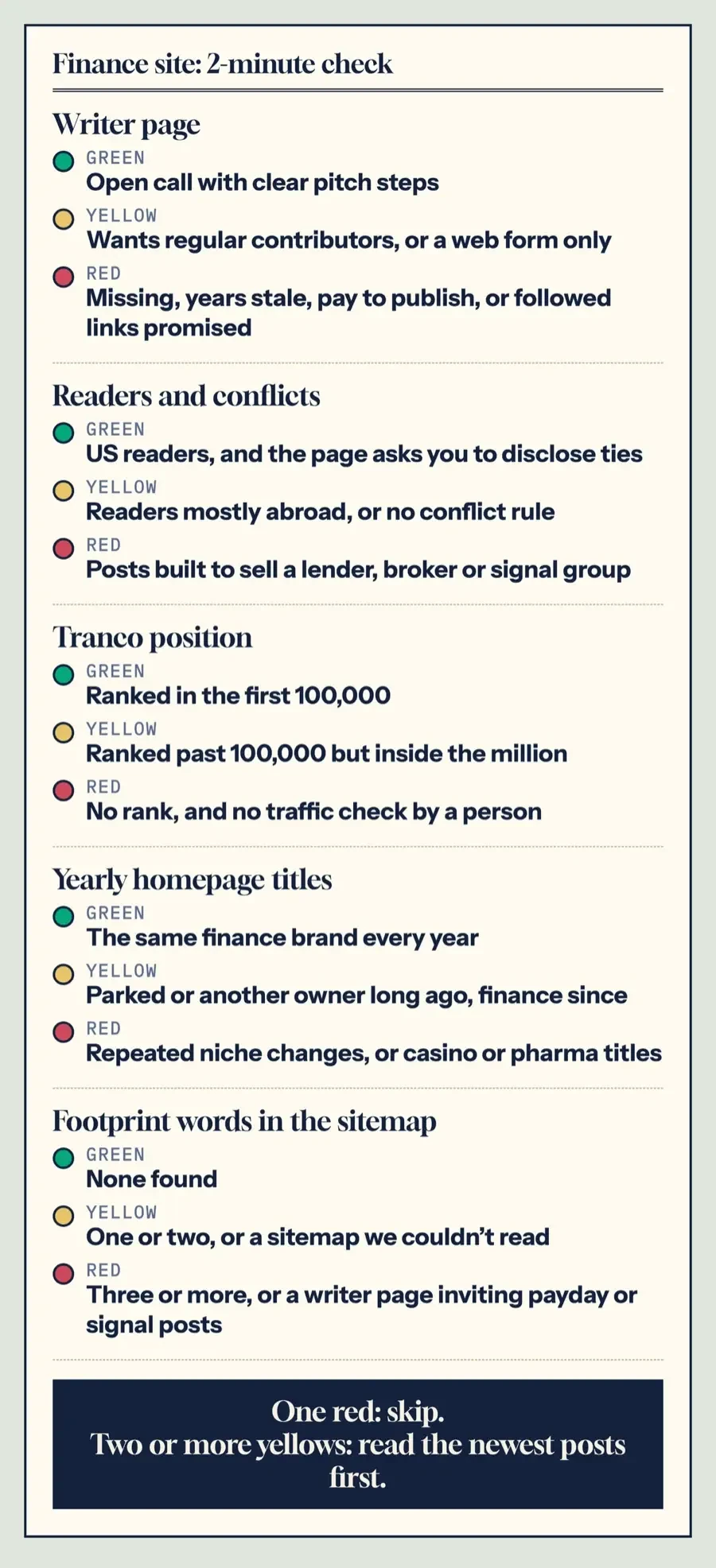 Diagram by DigitalTreed of the finance 2-minute check, with the same thresholds as our October 31, 2026 site check.
Write for us finance: the sites that survived our October 31, 2026 review
Which finance sites made it? Each one below cleared the October 31, 2026 run, and then we reread its writer page by hand the same day to make sure the call hadn't closed.
The Vetted stamp in our header art means exactly that. It doesn't promise anything about pay, reply times or traffic. The run kept five finance sites, and one came off after our reread:
- ShareSansar: a live call, but the page names "Nepal's investment community" as its audience (readers outside the US)
So the table holds four. We aimed for 15, and we'd rather list fewer than pad it with sites that failed a check. Most of the loss came early: 132 of the 260 candidates had no page we could find that asks outside writers for articles. All four take a single pitch today. The run's notes record three of the four as writing mainly for US readers, so a US angle won't suit every site. Site names aren't linked; each row's only link opens the writer page and carries rel="nofollow".
| Site | Writer page (nofollow) | What the page asks | Readers (run note) | Tranco position | First Wayback year | Checked |
| FXStreet | Editorial guidelines | Open; forex site: currency and crypto market analysis; email a proposal; wants regular contributors | global, forex traders | #20,070 | 2000 | 10/31/2026 |
| American Banker | BankThink guidelines | Open; BankThink opinion pieces under 1,000 words; full draft preferred; ties disclosed up front | US | #25,476 | 1996 | 10/31/2026 |
| Payments Dive | Submit an opinion piece | Open; payments opinion pieces through a web form; exclusive; reply within 3 weeks if accepted | US | #99,252 | 2021 | 10/31/2026 |
| Banking Dive | Submit an opinion piece | Open; banking opinion pieces through a web form like Payments Dive's; exclusive; no AI-written op-eds | US | #107,998 | 2019 | 10/31/2026 |
Readers is the run's own note on each audience. First Wayback year is the earliest capture the Internet Archive holds, which isn't always the launch year. Checked shows the date of our reread.
Three of the listed sites are trade publications. American Banker wants advice pieces "geared toward advice for the financial services industry rather than a broad consumer audience". The Dive sites ask for "the opinions of experts in the industries we cover". A personal finance story won't fit any of them well, so use the search block above to find consumer finance sites, and vet each one the same way.
FXStreet is a forex site. Its writer page rules out "easy money" pitches, but the site's own menu also lists "Broker reviews" and "Trader cashback", so don't be surprised by broker offers near your byline.
None of the four is in the 2-site finance section of our guest post hub, so the two lists add up rather than repeat. Business funding and small business money topics have their own list: see business blog write for us.
Our checker identified itself as DigitalTreed in every request, obeyed robots.txt and paused 1.5 seconds or longer between two hits on one host. A bot check or a 403 meant the site stayed out; we never tried a workaround. With no Ahrefs, Semrush or Similarweb subscription, we used the Tranco position (list PYK6J, dated October 29, 2026) as the traffic signal. Four smaller finance sites beyond the top million cleared every other check and posted recently. All four are in the table above now. Site history came from yearly Wayback Machine snapshots, pulled through the archive's CDX server API. The run read the homepage title in each one, as the Wayback Machine help guide describes.
Four smaller finance blogs outside the Tranco top million
All four finance blogs we'd parked showed search traffic in Ahrefs' no-cost traffic estimator on November 2, 2026. Each page still asked for writers on our reread. Three of them write mainly for Singapore readers, so a US retirement-account piece won't fit there.
| Site | Guidelines (nofollow) | What the page asks (our read) | Ahrefs organic estimate (monthly) | Top country (share) | Checked |
| Dr Wealth | Write for Dr Wealth | Singapore investing; 1,000+ words; up to two links to your own pages | 4,900 | Singapore (59%) | 11/2/2026 |
| Financial Horse | Write for Financial Horse | Email an original investing idea; written for Singapore investors | 1,400 | Singapore (96%) | 11/2/2026 |
| The Financial Coconut | Write for The Financial Coconut | Retirement, money and careers in Singapore and Southeast Asia | 988 | Singapore (90%) | 11/2/2026 |
| Global Value Hunter | Guest authors | Deep value investing; one link to your own blog | 18 | US (49%) | 11/2/2026 |
Dr Wealth and Global Value Hunter let you link to your own pages from the article or bio.
That's fine for an unpaid post, but if anyone pays for the placement, the link needs rel="sponsored" and a clear disclosure.
What we tested
Our checker took 260 finance candidates on October 31, 2026. It kept five, set four aside as smaller sites, and dropped 251. The largest group, 132, had no page we could find that asks outside writers for articles. Next came 60 that sent back a bot check or a refusal code such as 403 or 429, which we left alone. Then 44 didn't load. The last 15 split into footprint words (9), followed-link promises (3), no recent post (1), pay-for-link offers (1) and ended programs (1). Three of the four listed sites rank inside Tranco's first 100,000. The chart below draws the same numbers step by step.
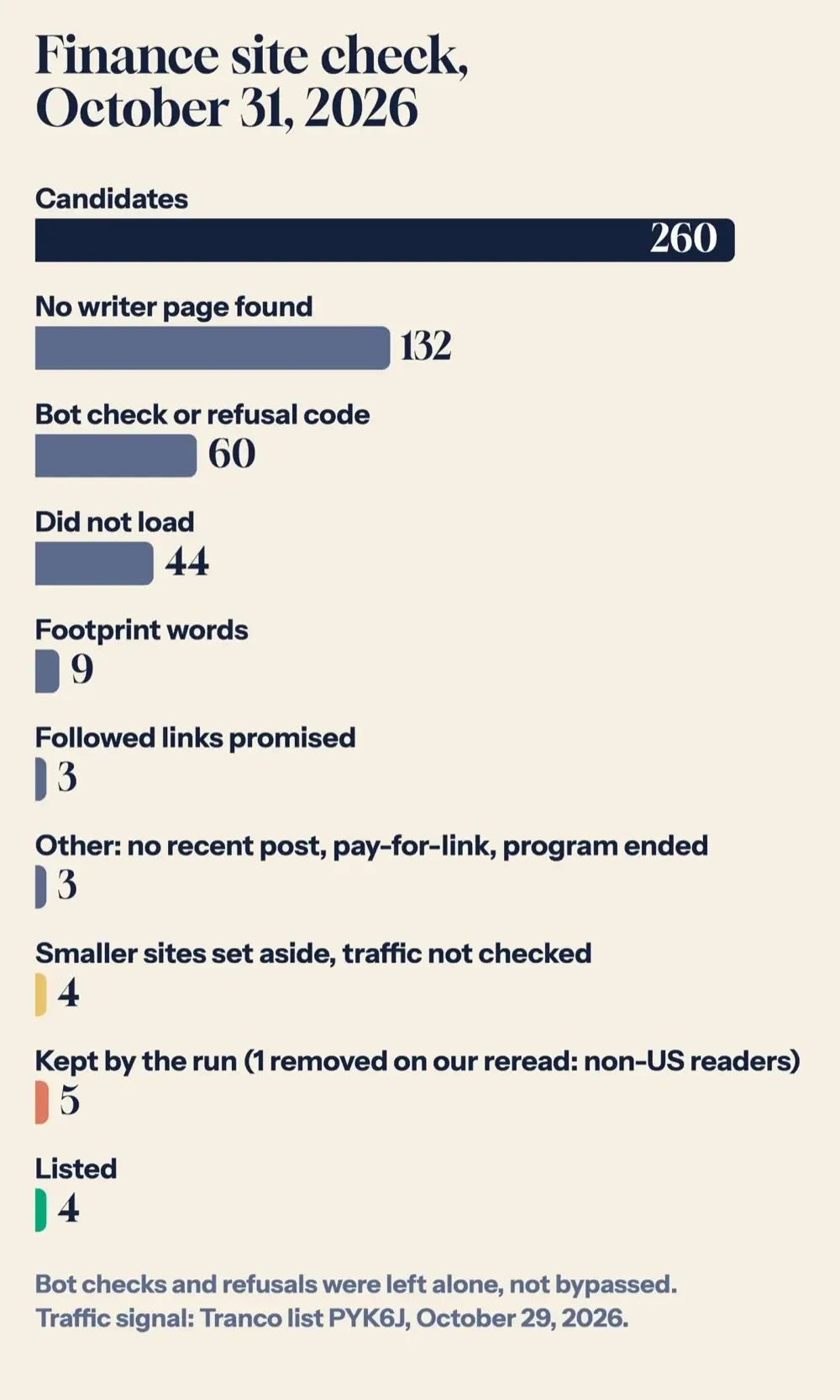 Diagram by DigitalTreed; counts from the site check we ran on October 31, 2026.
A finance pitch email and 5 topic ideas for US readers
Pitch formats differ from site to site in finance. American Banker says "Contributors may send abstracts, but we prefer the full version"; FXStreet asks you to "send us an email with your contribution proposal". Match the page; don't fall back on habit.
Our sample below is made up, with placeholders in braces. Its closing lines carry the part finance editors care about most: where the figures come from and who, if anyone, pays you.
Subject: Pitch: What {N} months of overdraft data showed our members

Hi {editor first name},

I'm a {role, such as branch operations manager or credit counselor}
with {N} years at a {bank / credit union / nonprofit}. In {month,
year}, {institution} cut its overdraft fee from {old fee} to {new fee}.
Over the next {N} months, {what you measured}, based on {source}.

I'd like to write {word count} words on what changed for members and
what other {institutions} can learn. Every number links to its
source, with the date I read it.

Disclosure: {no paid tie to any company named / I work for X}.
The piece recommends no product.

Recent work: {link 1}, {link 2}
{your name}, {credential, if any}
Once it's drafted, paste the summary into the DigitalTreed readability checker and trim whatever a busy editor would skim past. Short on ideas? These five suit US readers and rest on records anyone can open:
- What a change in your bank's or credit union's fee schedule cost real customers, with the old and new schedules linked and dated.
- Paying off one specific debt, told from your own statements: balances, APRs and dates, with nothing to sell at the end.
- A walk through the CFPB complaint database for one product type, showing how you filtered it and what turned up.
- How a freelancer or small business owner handled quarterly estimated taxes, linked to the IRS's own pages, with a note to talk to a CPA.
- How to read a fund's expense ratio and fees in its own prospectus, written as a how-to, never as a buy or sell call.
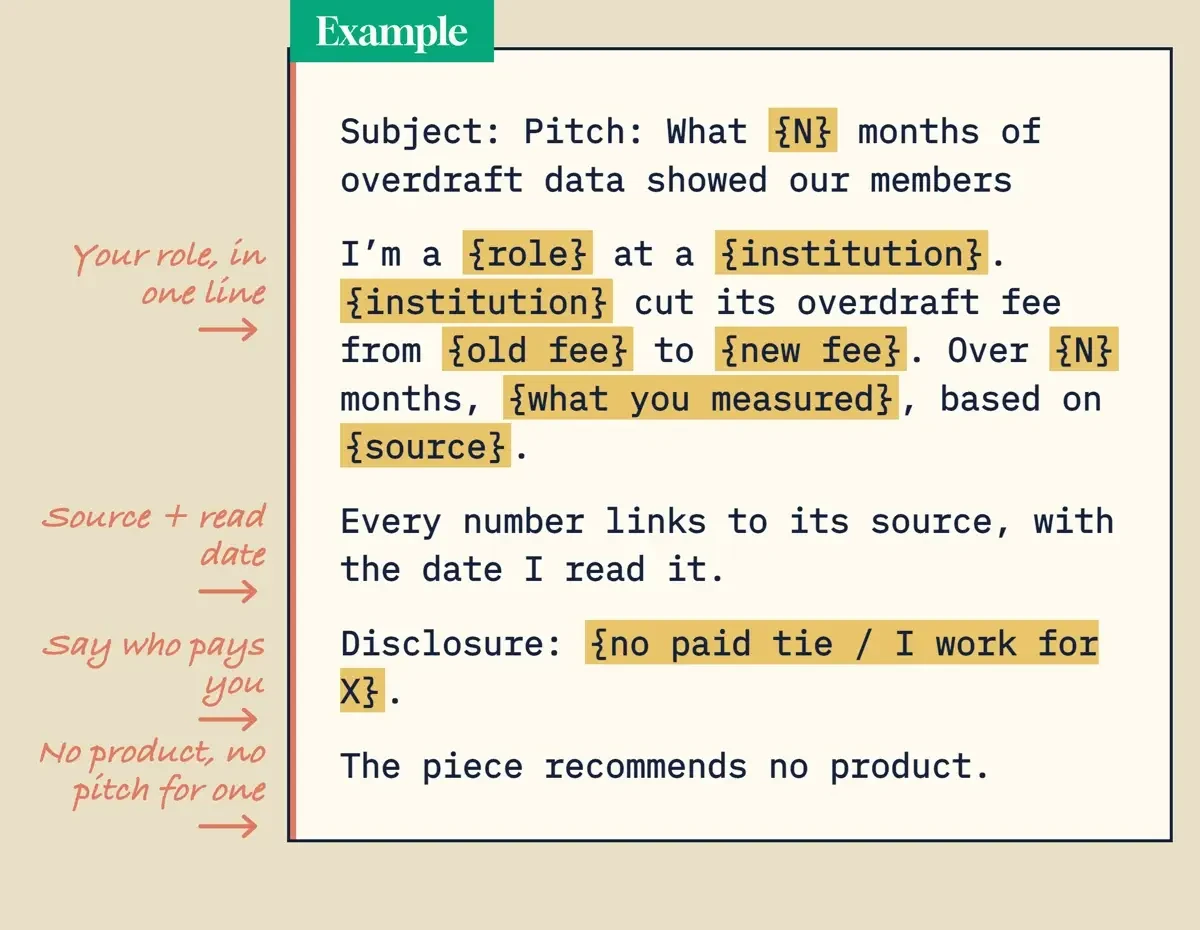 Drawn by us: a made-up finance pitch with placeholder numbers, not a real email.
Disclosure rules for paid finance posts: FTC, SEC and rel="sponsored"
All of that assumes nobody pays you. Once money, free accounts or affiliate commissions come in, three sets of rules apply. Google's link spam rules name "Advertorials or native advertising where payment is received for articles that include links that pass ranking credit". Its outbound link page says: "Mark links that are advertisements or paid placements" by adding sponsored to the rel attribute. Nofollow still works, "though sponsored is preferred". It's worth reading Google's 2017 warning on article campaigns too. One sign of a link scheme it lists is "Using or hiring article writers that aren't knowledgeable about the topics they're writing on".
The FTC looks at the same deal from the reader's side. Its Disclosures 101 guide sets the bar: "Make disclosures even if you think your evaluations are unbiased." For affiliate links, the Endorsement Guides Q&A offers a model line: "I get commissions for purchases made through links in this post." Its native advertising guide adds that a needed disclosure "must be clear and prominent". We're not lawyers, so get one to look at any contract that pays you for posts.
Securities add one more layer. On November 1, 2017, the SEC's Division of Enforcement and Office of Compliance Inspections and Examinations issued a statement on celebrity-backed promotions. It notes that celebrities and others were using social media to push stocks and other investments. Such endorsements, it says, "may be unlawful if they do not disclose the nature, source, and amount of any compensation paid". That means pay "directly or indirectly, by the company in exchange for the endorsement." If an issuer pays you to write about its stock or token, say so and say how much. Our stock tip site check shows the same problem from the reader's side.
If you sell sponsored finance posts instead, the payment risk is yours, and our guide for guest post sellers covers deposits and drafts held until you're paid.
Before you send, reread the page you're pitching for rules like the ones above: American Banker asks about conflicts at submission, and the Dive sites reject AI-written op-eds outright. A pitch that answers those rules in its first lines gives the editor one less reason to say no.
FAQ: finance guest posts
Frequently asked
Is a finance license required to write guest posts?
Not for every piece. Google's rater guidelines say "Pages that share first-hand life experience on clear YMYL topics may be considered to have high E-E-A-T". The condition is that the content stays "trustworthy, safe, and consistent with well-established expert consensus". If you tell readers what to buy, expect an editor to ask for a credential.
Can I put an affiliate link in a finance guest post?
Only where the site allows it, with a clear disclosure. The FTC's Q&A notes that people "might not understand that "affiliate link" means that the person placing the link is getting paid". Many finance editors reject anything promotional, so ask first.
Is it legal to be paid for writing about a stock?
Being paid isn't the problem; hiding it is. Section 17(b) of the Securities Act, 15 U.S.C. 77q, covers paid write-ups of a security. It bars them "without fully disclosing the receipt, whether past or prospective, of such consideration and the amount thereof". Talk to a securities lawyer before you sign.
Will a finance site keep my link?
Don't count on one. None of the writer pages in our table promises a link to your own site. American Banker asks for "online links to source materials" and "a short bio" with your title and company. A Twitter handle is optional; a website link isn't mentioned. Google's link guide expects paid links to carry sponsored, so ask about the link's attribute before you write. Never pay for a "dofollow" promise.
How we made this guide: The site names and counts come from DigitalTreed's October 31, 2026 site check, which read each candidate with plain requests. Kept writer pages were reread by hand on the same day and saved; any that failed, or didn't serve US readers, came out, and nothing was added by hand. Quotes were matched against those copies and against rule pages fetched the same day, Google's rater guidelines PDF among them. We didn't send a pitch, submit a form or use an account. Facts checked by the DigitalTreed team on October 31, 2026.
This page went live in November 2023 as DigitalTreed's call for finance articles. Rewritten October 31, 2026 for finance writers: what editors and Google expect on money topics, footprints to avoid, checked sites and a sample pitch.
Sources
- Google: Search Quality Rater Guidelines (PDF)
- Google: Search Quality Rater Guidelines, an overview (PDF)
- Google Search Central: Creating helpful, reliable, people-first content
- Google Search Central: Spam policies for Google web search
- Google Search Central: Qualify your outbound links to Google
- Google Search Central Blog: A reminder about links in large-scale article campaigns (May 25, 2017)
- Google Search Central: site: search operator
- Google Search Help: Refine Google searches
- Tranco: A Research-Oriented Top Sites Ranking Hardened Against Manipulation
- Tranco: Methodology
- Internet Archive: Wayback CDX Server API
- Internet Archive Help Center: Using the Wayback Machine
- FTC: Disclosures 101 for Social Media Influencers
- FTC: FTC's Endorsement Guides: What People Are Asking
- FTC: Native Advertising: A Guide for Businesses
- FTC Consumer Advice: Investment scams
- FTC Consumer Advice: How to get out of debt
- FTC: Debt Relief Services and the Telemarketing Sales Rule, a guide for business
- CFPB: What is a payday loan?
- CFTC: Fraud Advisory, Foreign Currency (Forex) Fraud
- SEC: Statement Urging Caution Around Celebrity Backed ICOs (November 1, 2017)
- Cornell Law School LII: 15 U.S. Code 77q, Fraudulent interstate transactions

Comments
No comments yet. Start the conversation below.