
Quick answer
As of November 1, 2026, five of the 87 website development sites we checked passed every step: Gravity Forms, AppSignal, Directus, Torque and WP Buffs. All five are blogs run by companies that sell to developers or site owners, and two of them pay writers. Pitch with the versions you tested, field numbers and a repo an editor can run.
Picture a freelance developer who moved a slow WordPress store to a block theme and halved its Largest Contentful Paint on phones within a month, measured on real visitors. They've kept the field data export to prove it. Searching "write for us website development" is how that developer goes looking for an editor who'll care. A contributor page is the place where a site's editors list what they'll publish from outside writers, what they'll refuse, and how to send it.
The sections run in the order you'd work. First come the versions, numbers and repo that let website development editors check your work. Then why every site that passed our check turned out to be a vendor's blog, and how to search for their contributor pages. After that: nulled plugins and hacked installs, a 2-minute check you can run on any web dev blog, and the five sites that passed. The final sections give you a pitch template, five topics with built-in proof, and what to disclose when a plugin or host pays you.
Key takeaways
- Name your WordPress, PHP and plugin versions in the first paragraph of a pitch.
- Give speed results at the 75th percentile, for mobile and desktop.
- All five sites that passed are blogs of software or service vendors.
- AppSignal and Directus pay writers; WP Buffs says it doesn't.
- A disclosure only in your author bio is easy to miss.
Note
Have a WordPress build you could write up? WordPress is one of the topics listed on our submission page, which calls DigitalTreed "a digital marketing and technology publication". For editorial pitches it says "We also publish practical guides written by people who have done the work they write about." You'd start small: "Send a short pitch first, not a finished article." A sponsored guest post carries "One relevant contextual link to your website or brand", and "New clients pay 50% upfront and the remaining 50% after the post is published." Rates aren't on that page; it says "Prices by niche, trial offers and payment terms are in our media kit".
Versions, numbers and a repo: the proof website development editors can check
None of the five pages asks for version numbers in those words. They ask for code, research and claims you can back up, and on a site build those claims start with the versions you tested.
AppSignal's contributor page spells out who it wants: "You have published articles about mid/senior-level Node.js, Ruby, Python, or Elixir topics before." It lists "Beginner-level topics." among the things it turns down, and it says "we ask that posts be approx 1,500 words". Then it adds a step that suits code-heavy posts: "We set up a GitHub repo for you, and you write a post."
Versions come first because the stack moves under every tutorial. WordPress.org's requirements page recommends "PHP version 8.3 or greater." and "MariaDB version 10.11 or greater OR MySQL version 8.0 or greater." PHP itself runs on a clock. The php.net support table says "Each release branch of PHP is fully supported for two years from its initial stable release." That table gives PHP 8.2 security fixes only until December 31, 2026. A tutorial tested on it today will send readers to an unsupported branch within two months. That's why the version line matters.
Write the WordPress, PHP, plugin and theme versions into the first lines of your draft. Add the date you tested.
Speed claims need numbers an editor can check. For loading, Google's page on the three vitals tells site owners to "strive to have LCP occur within the first 2.5 seconds of the page starting to load". For responsiveness it says to "strive to have an INP of less than 200 milliseconds". The Web Vitals article on web.dev covers layout shift: "pages should maintain a CLS of 0.1. or less".
Then comes the line most speed posts skip: "a good threshold to measure is the 75th percentile of page loads, segmented across mobile and desktop devices". So report before and after at the 75th percentile, split by device. Say where the field data came from, whether the Core Web Vitals report in Search Console or your own monitoring, and over which weeks. The website speed test on DigitalTreed reports response time, page weight and request counts, which helps you find the slow parts. It doesn't measure Core Web Vitals from real visitors, and an editor will know the difference.
Front-end pieces have their own version question. Which browsers can use this today? The Baseline page on web.dev defines one stage this way: "Widely available: 30 months have passed since the newly interoperable date." MDN's Baseline glossary entry warns that newly available features "may not work with older browsers and devices." If your CSS trick works only in the newest browsers, say so and show the fallback you've written. Gravity Forms, a WordPress plugin company, asks writers to "back up any claims you make with research (your opinion is not enough!)". Every claim needs a link, a number or code.
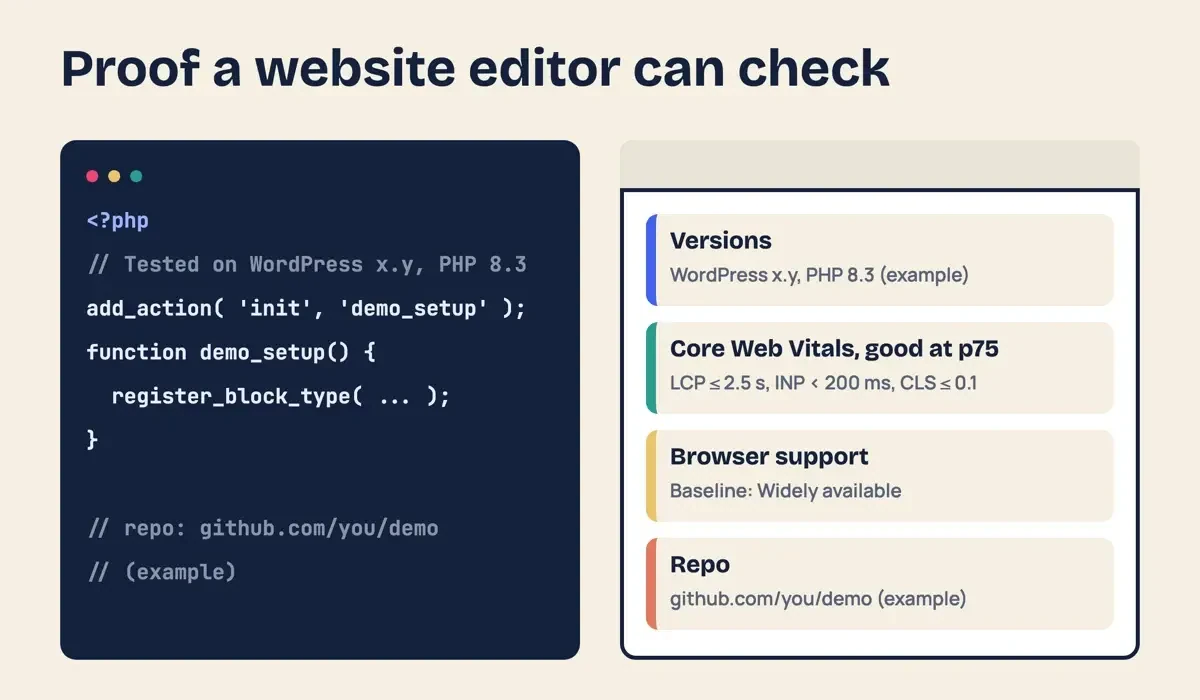 Diagram by DigitalTreed of the proof a website development editor can check, drawn from contributor pages, WordPress.org, php.net, web.dev and MDN read on November 1, 2026.
Why every site that passed is a vendor's blog
Each of the five sites on our list belongs to a company selling software or services to developers and site owners, and that shapes what its editors accept. Torque's footer reads "A Publication by WP Engine". WP Buffs sells "WordPress care plans". The Gravity Forms footer reads "Gravity Forms is a Rocketgenius invention." AppSignal's page says "AppSignal is an application performance monitoring tool", and the Directus page carries a "© 2026 Monospace Inc" line.
That isn't a warning sign. A product blog has a business reason to keep publishing.
It does mean the vendor's rules come first, and they're written down. Torque's rule is "Articles must be vendor agnostic.", and it adds "Certain exceptions will be made, although pre-approval is required." Gravity Forms welcomes links to industry sites, but adds that "linking to our competitors is not!"
So build the tutorial around the problem rather than a product, and don't name a rival plugin, host or CMS until the editor's agreed to it.
Money is the other split. AppSignal pays after its edit: "once approved, we pay you". Its page gives no amount, only "A good rate" and free stroopwafels. Directus runs a program where authors "get paid to write tutorials for the Directus community". The team will "assign a budget per tutorial within each tutorial's details". Then "Authors say which tutorials they’d like to work on and we assign them on a monthly basis."
WP Buffs answers the money question in its FAQ: "No. We do not pay for guest posts." Torque doesn't say either way.
Paid programs change what you control. AppSignal does let you republish "as long as you set up a canonical tag on the republished post", so the piece can live on your blog too. Directus reads applications on its own schedule: "We accept new guest authors into the program periodically via application form." If what you want is traffic or leads more than a fee, our article on what business guest posts really do weighs that trade.
Search strings for WordPress, CMS and front-end contributor pages
The Google Search Help article on refining searches covers exact-match quotes, a minus to drop a word, site:, filetype:, plus before: and after: for dates. It also warns: "Do not put spaces between the operator and your search term." The strings below stick to those operators and use no OR, because that page doesn't list it.
Find website development contributor pages
"write for us" WordPress tutorial -nulled -download
"guest author program" tutorials CMS
"contributor guidelines" "WordPress" developers
"write for our blog" "front-end" CSS JavaScript
"become a contributor" "headless CMS"
"guest post guidelines" "web performance" after:2026/01/01

Vet one domain (swap its name in for example.com)
site:example.com nulled
site:example.com "premium plugin" "free download"
site:example.com GPL "premium" download
site:example.com viagra
site:example.com casino
"example.com" "guest post" price dofollow
The plugin, CMS or framework you actually used is the best search word you've got.
Swap WordPress for Drupal, Craft or the headless CMS from your project, and the results tilt toward the vendor blogs that run tutorial programs and sometimes pay for them. The minus words in the first line clear out the download sites and plugin mirrors that crowd almost every search with "WordPress" in it.
Treat what the vet block returns as a hint. Google's documentation for site: describes what comes back: "Returns a list of indexed and serving URLs." It adds that "The list of URLs returned is not always exhaustive." Zero hits proves little. It may just mean Google didn't show them. Contributor lists age badly: 10 of our 87 candidates didn't load, and 55 more showed no contributor page at all.
Paste the submission page into DigitalTreed's HTTP status checker before drafting anything; you want a 200, not a redirect to the homepage.
Nulled plugins, GPL download clubs and hacked installs
Before you trust a WordPress blog with your byline, read its slugs for three footprints that keep turning up on web dev sites.
The first is nulled plugins: paid plugins handed out free with the license check stripped. WordPress's hardening guide is plain about it: "Do not get plugins/themes from untrusted sources." It goes on: "Restrict yourself to the WordPress.org repository or well known companies."
The second is the GPL download club, which is harder to spot because it sounds legal. WordPress.org's license page says "Derivatives of WordPress code inherit the GPL license." So passing a GPL plugin's code along can be allowed by its license. What the license can't tell you is what the club's changed in the files, a license check removed or a script added, before you downloaded them.
A blog whose sitemap is mostly "premium plugin free download" posts is a download site wearing a blog's layout.
Hacked installs are the third, and the owner may not even know. Google's spam policies put it this way: "Hacked content is any content placed on a site without permission, due to vulnerabilities in a site's security." On a WordPress blog you'd spot it as pharma, casino or loan pages that don't match anything else the site publishes.
Updates are the defense. WordPress's security overview says "The most important thing to do for WordPress security is to keep WordPress itself and all installed plugins and themes up to date." The hardening guide adds: "Older versions of WordPress are not maintained with security updates." A guest post on a neglected install sits next to whatever got injected, and readers who land on the spam pages may not trust the rest.
Our run screened slugs for 11 casino-type words in up to eight sitemap files per site. It needed 3 hits before dropping anyone, so a single passing mention didn't count. One website development candidate failed that screen, and one more named casino-type topics on its writer page without turning them away. Those words aren't web dev footprints, so search for nulled, GPL and free download yourself with the vet block above. Open a site's sitemap with our XML sitemap validator to read the slugs yourself.
Price sheets are the last thing to look for. Google lists "Exchanging money for links, or posts that contain links" under link spam, and it doesn't matter whether DA, traffic or a flat fee sets the number. In our run, one web dev page charged a fee to publish a post, and that alone took it off the list.
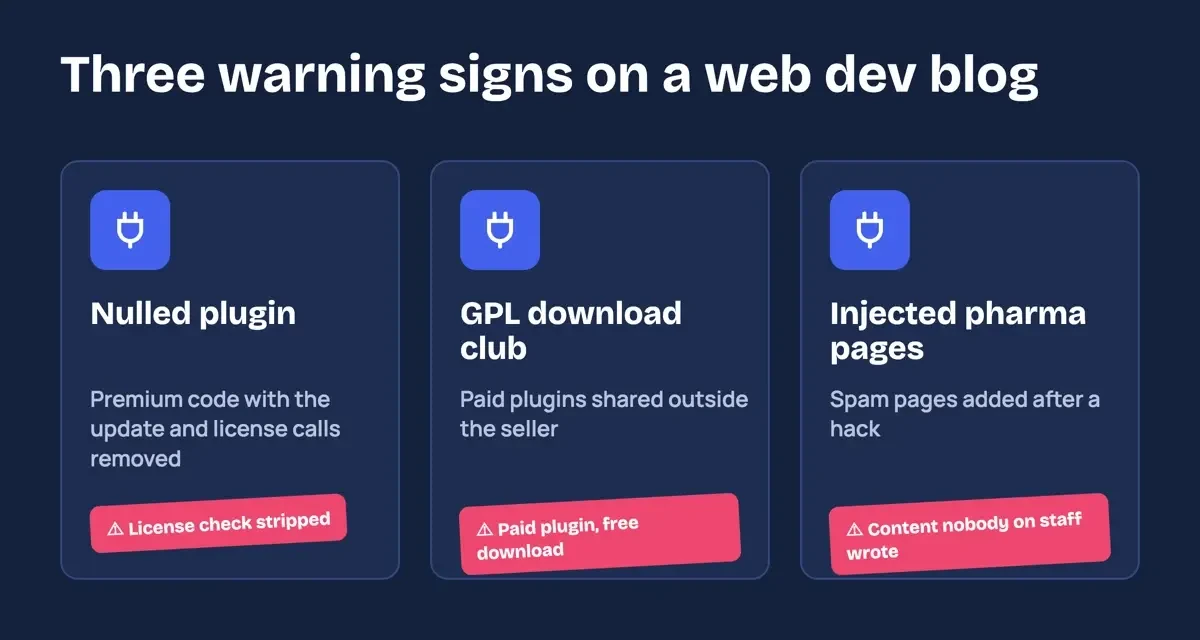 Diagram by DigitalTreed of three warning signs on web development blogs, based on WordPress.org and Google pages read on November 1, 2026.
Can a web development blog pass a 2-minute check?
Those footprints, plus rank and history, make a five-row card scored green, yellow or red. For the complete checklist, see the guest post sites hub; this card keeps only the rows that matter most for web dev blogs.
Any red ends the check. Two or more yellows: skim the latest five posts first.
| Row | Green | Yellow | Red |
| Contributor page | Up, with rules in writing and a clear route in | Open with a catch (an application window, a paused form) | Missing, paused, or priced |
| Link terms | No price and no follow promise | A link promise with no rules around it | Dofollow promised or links sold |
| Tranco rank | Top 100,000 | Anywhere below that, down to #1,000,000 | Unranked, with no other traffic sign |
| Homepage history | One web or product topic throughout | A blank stretch or an earlier owner | Three or more topic switches |
| Sitemap words | No casino-type or download slugs | A few, explained by the site's own niche | Nulled, injected or casino slugs |
The rank column uses Tranco, whose site describes it as "Hardened Against Manipulation". Tranco's notes on method say it blends several providers' rankings across a rolling 30-day window rather than taking any single day's list. A rank describes the whole domain, not the blog, and on a product site much of that popularity may come from the app or the docs. A last ten-second test: drop the URL of a guest post from last month into DigitalTreed's noindex tag checker, because a noindexed post never appears in Google.
Here's the card on three of the five listed sites, filled in from the run's records and our reread:
- Directus. Contributor page: yellow, applications are read periodically, then authors are invited. Link terms: green, no price and no follow promise. Tranco: yellow, #237,031. Homepage history: yellow, titles from 2003 to 2014 name an unrelated company called DirectUs; the CMS ran on directus.io. Sitemap words: green, no casino-type words in 1,196 URLs. Verdict: three yellows, zero reds; skim its newest five posts first.
- Torque. Contributor page: green, rules in writing and a clear route for pitches. Link terms: green, no price and no follow promise. Tranco: yellow, #260,513. Homepage history: green, WordPress news in every title since 2013. Sitemap words: green, no casino-type words in 4,871 URLs. Verdict: one yellow, no red, fine to pitch.
- WP Buffs. Contributor page: green, rules in writing and a clear route for pitches. Link terms: green, no price and no follow promise. Tranco: yellow, #728,524. Homepage history: green, WordPress in every readable title since 2015. Sitemap words: green, no casino-type words in 241 URLs. Verdict: one yellow, no red, fine to pitch.
Directus earns its history yellow because the domain had an earlier life. After a 1999 placeholder page, its titles from 2003 to 2014 name a different company, and the CMS ran on directus.io before that address began redirecting to directus.com. We've judged the history on the product, not on the old owner. AppSignal and Gravity Forms came out green on every row.
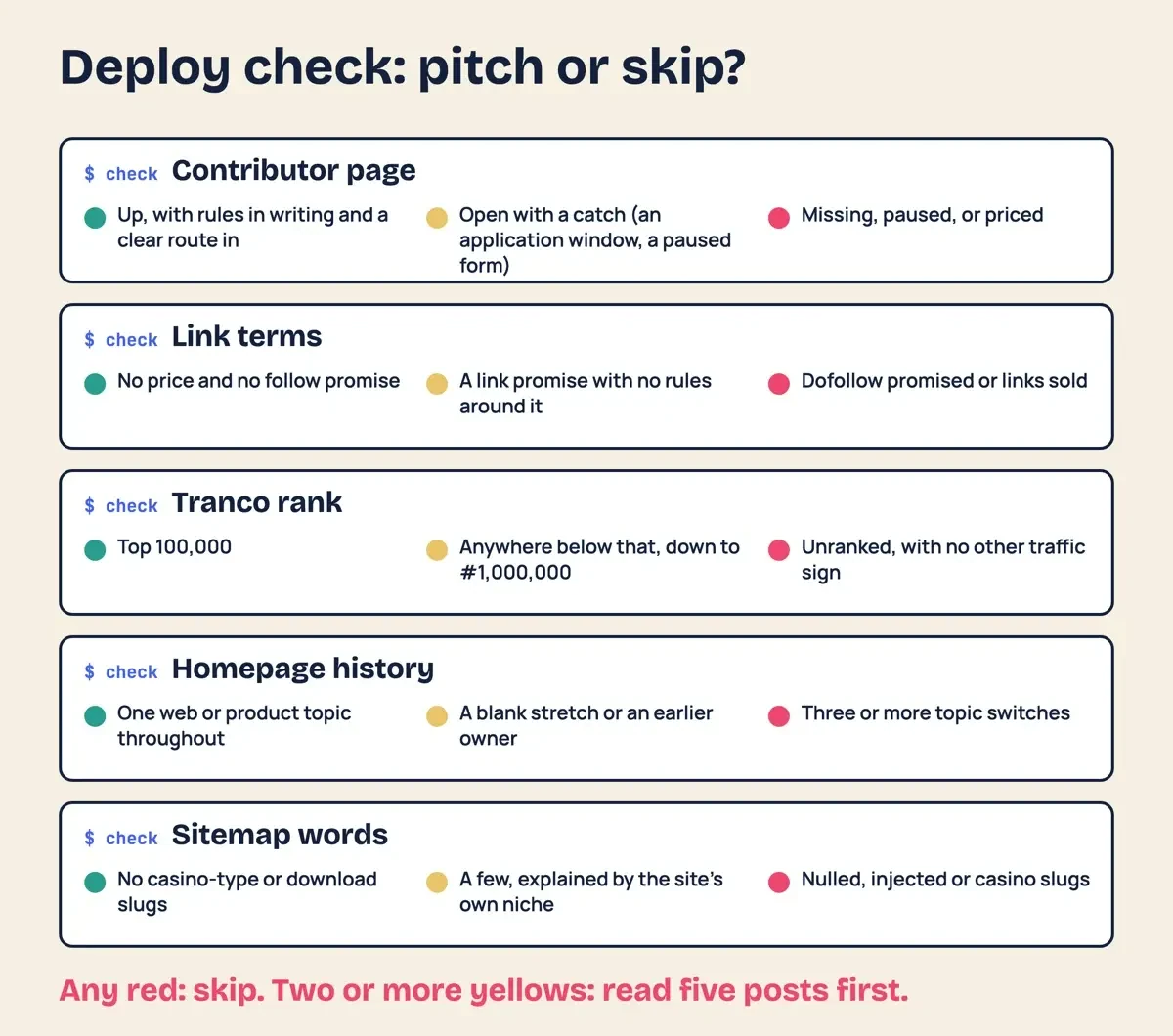 Diagram by DigitalTreed: five rows for scoring a web development blog, using the cutoffs in this guide and the site check of November 1, 2026.
Write for us website development: the five sites that passed on November 1, 2026
The Vetted stamp in this guide's header covers only this list. Each site below passed the November 1, 2026 site check and our same-day reread of its contributor page. A pass doesn't promise a reply, a link, or how any link will be tagged. We haven't linked any site name. Each row's only link, marked rel="nofollow", opens the guidelines page: it's a pointer, not an endorsement.
| Publication | Guidelines (nofollow) | Rules in brief | Tranco rank | Checked |
| Gravity Forms | Contributor page | Unpaid; pitch a headline and bullet points, not a full draft; 1,200+ words backed by research; no competitor links | #59,796 | November 1, 2026 |
| AppSignal | Contributor page | Paid; apply by form; mid and senior Node.js, Ruby, Python or Elixir topics with lots of code; about 1,500 words | #73,934 | November 1, 2026 |
| Directus | Contributor page | Paid tutorials; apply by form, then pick from tutorials the team requests; written and reviewed through GitHub | #237,031 | November 1, 2026 |
| Torque | Contributor page | Pay not mentioned; WordPress topics, 500 to 1,300 words, vendor agnostic; article file through a form | #260,513 | November 1, 2026 |
| WP Buffs | Contributor page | Unpaid; pitch form first; 1,000 to 2,000 words; one link in the author bio; AI for research or editing only | #728,524 | November 1, 2026 |
Why only five? We started with 87 website development candidates. 55 showed no contributor page on their homepage links or the usual paths the checker tried, WPBeginner, Kinsta and WP Tavern among them. WordPress's own contributor hub showed up too, but it recruits people for the WordPress project itself, not writers for a blog. Another 11 sat behind a bot check or refused our plain request outright (SitePoint, Hashnode and Toptal among them), and 10 didn't load at all.
That leaves five single drops: a fee to publish, casino-type slugs, no post since 2023, vice topics named with no refusal and a paused program. WPShout's page says it isn't taking guest writers for now, and Modern Web's guidelines are live, but its newest post dates from 2023. Treat the bot-blocked group as unknown rather than failed, because a plain request from our checker just couldn't read their pages on the day we looked.
Our checker identified itself as DigitalTreed, followed robots.txt and paused between hits on one host. It didn't log in or submit forms. We used no paid traffic tool, so traffic was judged only by rank in the October 29, 2026 Tranco list (ID PYK6J). One homepage title per year came from the Internet Archive's capture index; its documentation explains: "Results may be filtered by timestamp using from= and to= params." Old captures may show whoever held the domain before, as with Directus.
Writing about layouts, color or accessibility rather than builds? The web design guest post guide fits better. App code and engineering practice belong with the software development guest post guide, and server and hosting stories with the web hosting guest post guide. No site appears in more than one of our niche guides.
Two smaller agency blogs cleared the other checks, and a November 2, 2026 look at their traffic added both to the list below.
Two smaller agency blogs, traffic checked November 2, 2026
Both agency blogs showed organic visits in Ahrefs' free checker on November 2, 2026, and both pages still invited outside writers when we reread them. Like the five above, each belongs to a company that sells web work.
| Site | Guidelines (nofollow) | What the page asks (our read) | Ahrefs organic estimate (monthly) | Top country (share) | Checked |
| Specbee | Contributor guidelines | 1,000+ words; one link in a bio of 50 words or fewer | 4,500 | US (46%) | November 2, 2026 |
| Lform | Blog submission guidelines | Web design, development and SEO; review takes up to 10 business days | 1,500 | US (89%) | November 2, 2026 |
Pitch topics close to their services, and keep your own sales pitch out of the draft.
What we tested
The site check is the test behind this guide. On November 1, 2026 it read 87 website development candidates, kept 5 and dropped 81. The three big reasons were no contributor page (55), bot checks (11) and not loading (10). One more passed everything but the Tranco rule, and our B2B search turned up one web agency blog like it.
Later that day we fetched all five kept contributor pages again and checked every rule we quote against that copy, so each quote matches the page then. All five still invited writers on the terms we quote, so the reread removed nobody.
None of the five promises a dofollow link.
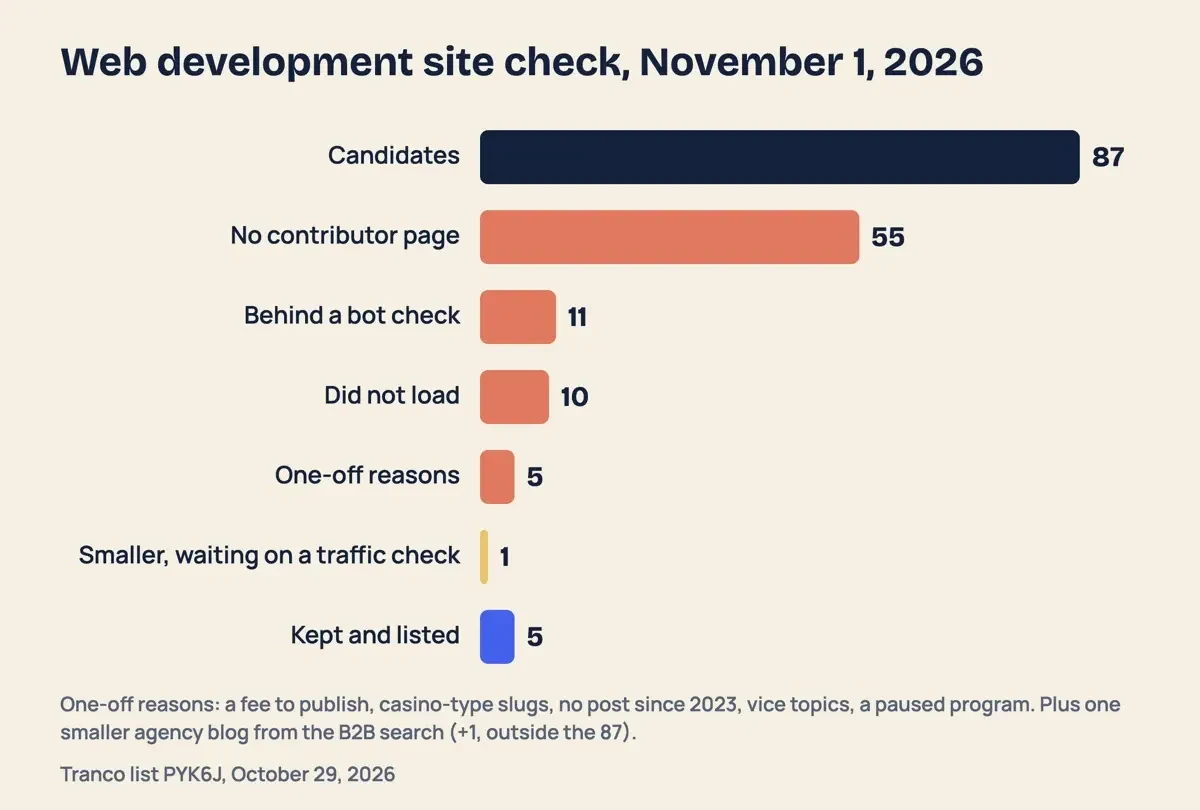 Diagram by DigitalTreed, drawn from the counts of our November 1, 2026 site check.
A pitch to a WordPress editor, and five topics that carry their own proof
With a site picked, match its first-contact rule, because these five don't agree on it.
Torque takes a summary and an article file through its form. WP Buffs wants a pitch first and says "We aim to respond within 5-7 business days." Gravity Forms asks for a headline and bullet points, adds "please don't send a whole article", and its form says "Please provide links to 2-3 previously published articles." AppSignal and Directus start with an application, not a pitch. DigitalTreed's own page also wants the topic agreed first: "Please do not send a finished article before we agree on the topic."
Google's 2017 reminder about links in large-scale article campaigns lists the questions a site should ask before it publishes a contributed article, starting with "Do I know this person?" The sample below answers that in its first lines.
Subject: Pitch: {what you changed} on WordPress {version}, with field data

Hi {editor first name},

In {month and year} I {moved / rebuilt / fixed} {what} for a
{type of site}. Tested on WordPress {version}, PHP {version},
{plugin or theme and version}.

Result at the 75th percentile, mobile: LCP {before} -> {after},
INP {before} -> {after}, CLS {before} -> {after}, from {data source}.

The post would walk through the steps with code; repo: {URL}.
Length: about {word count} words. It names no competing product.

Who I am: {role}, {years} years building sites for {clients}.
Published work: {link 1}, {link 2}
Ties: {any company in the post that pays or employs me, or none}
AI help: {none / what it did}

{name}
Every braced field is yours to fill. The sample's made up, and the numbers in your version should come straight from your own export, with the date range you pulled. Fill in the ties line even if nothing ties you to anyone, because it saves an editor an email. The AI line matters to us too, since our page says "AI-assisted content must be edited, reviewed by a person and fact-checked."
Short of an angle? Each topic below starts from files you'd already have after a real site build:
- A WooCommerce or block-theme migration with field Core Web Vitals before and after, split by device.
- Moving a site from PHP 8.1 to 8.3: what broke, which plugins needed updates, and the error log lines.
- A headless CMS setup for a small client site, with the repo and the hosting bill for one month.
- Rewriting one heavy page builder template as native blocks, with page weight and request counts.
- A plugin audit on a hacked site: what got injected, how it was found, and the cleanup steps.
Before you hit send, check your code against the WordPress Coding Standards. The handbook opens with the reason: "The purpose of the WordPress Coding Standards is to create a baseline for collaboration and review". If your tutorial assumes a fresh install, point readers to a setup guide such as our step-by-step WordPress website guide rather than re-explaining it.
Paid by a plugin or a host? Labels for the post and the link
Beyond the pitch, web dev posts name plugins, hosts and themes constantly. Earn a commission on one, and the FTC's rules come with the link. For affiliates, the FTC's answers on endorsements are direct: "You should disclose your relationship to the retailer clearly and conspicuously on your site". It also says "The same guidance applies anytime you endorse a product and get paid through affiliate links." Read plainly, that includes a guest post on someone else's blog.
Placement is where guest writers slip. That FAQ also says "The closer the disclosure is to your recommendation, the better." On wording, it says that "Paid link" right next to an affiliate link "should be an adequate disclosure of the nature of the link". A bio-only note is the weak spot. The agency's disclosure basics for creators count a connection "such as the brand paying you or giving you free or discounted products or services". They also warn: "Disclosures are likely to be missed if they appear only on an ABOUT ME or profile page".
If you got a free plugin license or a hosting credit for the test, it's better disclosed inside the post, near the mention, than in a footer.
Google wants its own signal on the link. Its page on qualifying outbound links puts it this way: "Mark links that are advertisements or paid placements (commonly called paid links ) with the sponsored value." It accepts nofollow, "though sponsored is preferred". The 2017 post also flags "Stuffing keyword-rich links to your site in your articles" as a sign of a link scheme.
Selling sponsored posts on your own dev blog instead? Our guide to guest post buyers who never pay covers deposits and holding a post in draft until it's paid.
Questions website developers ask before pitching
Frequently asked
Do website development blogs pay guest writers?
Some do. On our list, AppSignal pays after its edit and Directus sets a budget per tutorial. WP Buffs says "No. We do not pay for guest posts." Pay terms change, so reread each page before you apply.
Which PHP version should a WordPress tutorial use?
The one you tested on, stated plainly. WordPress.org's requirements page recommends "PHP version 8.3 or greater.", and php.net's table shows when each branch stops getting fixes.
Is guest posting on developer blogs against Google's rules?
Not on its own. Google's 2017 post says "Google does not discourage these types of articles in the cases when they inform users". What breaks its guidelines is "when the main intent is to build links in a large-scale way back to the author's site".
Is a disclosure in my author bio enough?
Usually not. The FTC's disclosure guide says disclosures are likely to be missed on a profile page. Put the line next to the mention.
How we made this guide: Everything here traces to one site check, run November 1, 2026: the list, the counts, the three cards and the files it saved. After the run, a script fetched the five contributor pages and each quoted source again, then matched every quote against the fresh copies. Nobody on our side pitched these sites, used their forms or opened accounts there. Facts checked by the DigitalTreed team on November 1, 2026.
From November 2023 this URL held our own call for website development posts. The rewrite made it a guide to where developers can pitch.
Sources
- WordPress.org: Requirements
- PHP: Supported Versions
- WordPress.org: License
- WordPress Developer Resources: Hardening WordPress
- WordPress Developer Resources: Security
- WordPress Coding Standards Handbook
- Google Search Central: Understanding Core Web Vitals and Google search results
- web.dev: Web Vitals
- web.dev: Baseline
- MDN: Baseline (compatibility)
- MDN: Web performance
- Google Search Central: Spam policies for Google web search
- Google Search Central: Qualify your outbound links to Google
- Google Search Central Blog: A reminder about links in large-scale article campaigns (May 25, 2017)
- Google Search Central: site: search operator
- Google Search Help: Refine Google searches
- FTC: FTC's Endorsement Guides, What People Are Asking
- FTC: Disclosures 101 for Social Media Influencers
- Tranco: A Research-Oriented Top Sites Ranking Hardened Against Manipulation
- Tranco: Methodology
- Internet Archive: Wayback CDX Server API
Comments
No comments yet. Start the conversation below.