
Quick answer
As of October 31, 2026, 2 of the 146 web design sites we checked passed every step: UXmatters and The A11Y Project. Two more cleared the batch run and came off on our reread, one for an empty writer page and one for unlabeled referral links to a marketplace. Pitch with your own before-and-after screenshots and a live demo.
Say you rebuilt a dental clinic's site last spring, kept the before and after screenshots, and watched the booking form stop losing people on phones. So you search "write for us web design" and hope to land on a publication whose readers build sites for a living. A web design submission page is a publication's own page telling outside writers what it runs and the way it wants pitches.
The guide runs in the order you'd work. It starts with the proof design editors ask for and the Google strings that find their submission pages. Next come three footprints of a download site dressed as a magazine (nulled themes, roundup farms, DA price sheets) and the WCAG rules W3C spells out. After that you'll find a two-minute card for any design blog and the two sites that held up on October 31, 2026. The last stretch gives you a sample email to an editor, five topic ideas, then what the FTC asks of theme and tool affiliate links.
Key takeaways
- Design editors want your own before-and-after screenshots, not a template roundup.
- A live CodePen or GitHub Pages demo lets an editor test your claim.
- Text needs a 4.5:1 contrast ratio for WCAG 2.2 AA, large text 3:1.
- Search a design blog for "nulled" and "free premium" before you pitch it.
- Only 2 of 146 web design sites cleared our October 31, 2026 check.
Note
Got a WordPress or site-build story for us? Our submission page describes DigitalTreed as "a digital marketing and technology publication". Web design isn't its own line in the topic list there, but WordPress is, next to SEO, Business and AI tools and a few more, so you'd pitch a rebuild as a WordPress story. The page puts it this way: "Good pitches are specific: a clear problem, who it is for, and what you learned solving it." It also says "No fully AI-generated content". A paid guest post gets "One relevant contextual link to your website or brand", and "For new collaborations, you pay 50% upfront, and the remaining 50% after publication." For rates, it says "Prices by niche, trial offers and payment terms are in our media kit".
Before-and-after screenshots, live demos and WCAG: what design editors want
Design editors ask for work only you could've written, from a project you can name. UXmatters, one of the two sites on our list, has contributor guidelines that ask for "research findings that have practical applications in UX design". They also set a floor: "The minimum length is 1000 words." It doesn't pay. It's even specific about screenshot size: "Generally, screenshots should have a uniform width of 474 pixels."
So send captures from your own project at the width the page asks for, and keep the full-size originals, since UXmatters also says "please send us your full-sized images".
Build the case study around one project. Show the old page and the new one at the same width, give the date range of every number, and name each change you made and why you made it.
Google's people-first content questions ask "Does the content provide original information, reporting, research, or analysis?" A rebuild you ran, with dated analytics behind it, is original information in exactly that sense.
Next, give the editor something to click. CodePen's embedded Pens documentation says "You can embed Pens on your website with our copy-and-paste Embed code." For a bigger build, GitHub describes GitHub Pages as a host that "takes HTML, CSS, and JavaScript files straight from a repository on GitHub". That lets a reviewer open the demo and the repo side by side.
The A11Y Project takes pitches as a GitHub issue, and "How-tos are guides to implementing accessible code." So a how-to pitched there should come with code that runs.
Accessibility is the third check. If your case study changes colors, focus states or forms, say which WCAG success criteria you tested and with what tool. And leave the template roundup at home. UXmatters won't take "sponsored submissions or articles that include links whose purpose is to commercially benefit authors or their company". The A11Y Project says it's "not too keen on partnership deals, promotions, backlinking, or referral schemes". A roundup of twenty themes with affiliate buy links runs into both.
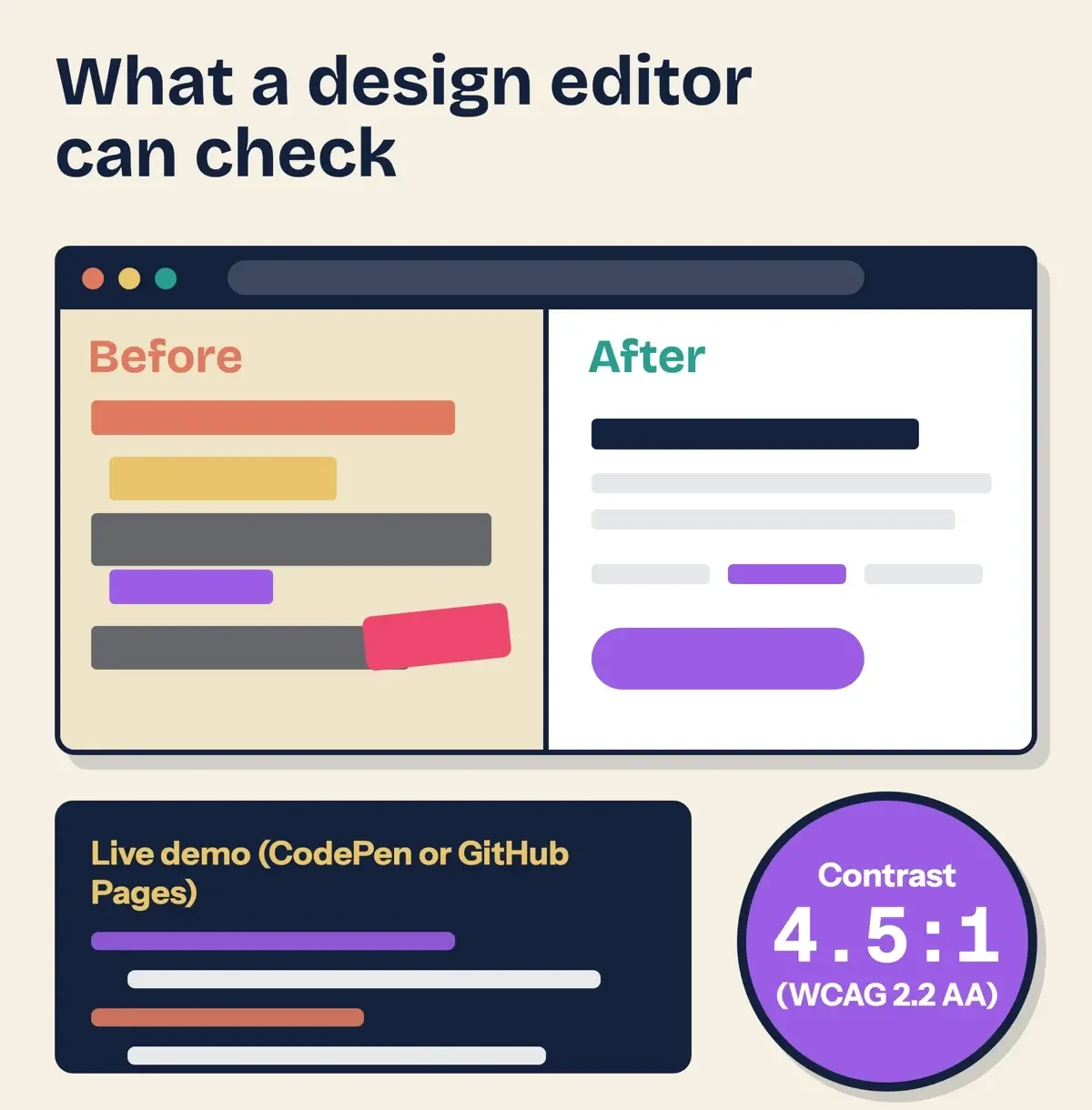 Diagram by DigitalTreed of the proof a design editor can check in a pitch, drawn from contributor pages and W3C and CodePen documentation read on October 31, 2026.
Google strings that surface design contributor pages
Once your case study is ready, you need the pages that invite it. Google's refine searches help page documents quotes, the minus sign, site:, filetype:, and the before: and after: date limits, and the strings below use nothing else. The page warns: "Do not put spaces between the operator and your search term." We left out intitle: and inurl: because that page doesn't list them.
Find design submission pages
"write for us" "web design" -themes -nulled
"contributor guidelines" "UX" "case study"
"write for us" accessibility WCAG
"submit an article" "front-end" CSS -download
"guest post guidelines" "UI design" after:2026/01/01
"style guide" "UX" contributors filetype:pdf

Vet one design domain (swap its name in for example.com)
site:example.com nulled
site:example.com "free premium"
site:example.com "free download" theme
site:example.com "DA" "guest post" price
site:example.com casino
"example.com" "guest post" price
Swap UX for the field you actually work in. The accessibility, UI and front-end strings each surface a different set of editors.
The minus words in the find block remove most theme download pages, which crowd "web design" results, and the after: line keeps you to pages updated in 2026. Treat the vet block as a sample, not proof. Google's site: operator page says the operator "Returns a list of indexed and serving URLs." A page Google never indexed won't show up, so zero hits proves little. Lists of design blogs age badly, since 26 of our 146 web design candidates didn't load at all and 90 more showed no contributor page anywhere we looked. Run each submission page through DigitalTreed's HTTP status checker before you write. You want a 200 status, not a redirect to the site's front page.
Nulled themes, roundup farms and DA price sheets
Those vet strings matter most on design blogs, because a download site can wear a design magazine's layout. Three footprints give it away. Worst of the three: posts that hand out paid themes or plugins for free. Slugs with "nulled", "cracked" or "free premium theme" usually point to a paid product copied off its seller's store, with no way to know what was changed in the code. WordPress's own hardening guide is blunt: "Do not get plugins/themes from untrusted sources." Google's spam policies cover the risk on the search side, with malware defined as software "specifically designed to harm a computer".
The second footprint is a roundup farm, which you'll recognize by its slugs. Hundreds of posts open with a number and end in themes, templates or mockups, and the download buttons lead to a marketplace. There's a milder version on CSS Author, a design blog since 2012. Our scan found 31 numbered roundups and 34 "free premium" slugs among 9,884 URLs. We opened one freebie page. It says "License: CC BY 4.0" and carries a banner for "20M+ Premium Assets", and nine of its links run through 1.envato.market.
The mockup page credits its original source and its license, which is what you'd want from a freebie.
When we requested one of those short links with our plain checker, it answered with a 302 redirect to a separate tracking host rather than going straight to Envato. Envato's own affiliates page asks "How do I create a referral link in Impact?", which is how its partners get referral links. We can't see whose account a link belongs to, and we didn't dig further.
We'd still want a label, so we looked for one anywhere on the site: the two saved pages, the homepage footer, and the about, privacy, licence and offers pages. None uses the word "affiliate", "commission" or "referral"; the privacy page only says the site may "include or offer third party products or services". An unlabeled referral link isn't proof of bad faith, but our card asks for a visible label, and that's why CSS Author's scan row is red. The roundup we opened, an older list of themes, skips the redirect. It links its 29 picks straight to their store pages with no referral code.
DA price sheets are the third footprint. Picture a writer page that prices posts by Domain Authority or sells "dofollow" links. Google lists "Exchanging money for links, or posts that contain links" as link spam, whatever metric sets the price. In our run, two design pages promised dofollow links and one priced them, so all three went out at once. The run's own word check read sitemap slugs for 11 casino-type terms and dropped a site at three hits, so one stray mention wasn't enough. No design candidate failed it, and none of those words is a design footprint, so we wrote our own scan. Read a site's slugs yourself by loading its sitemap in our XML sitemap validator.
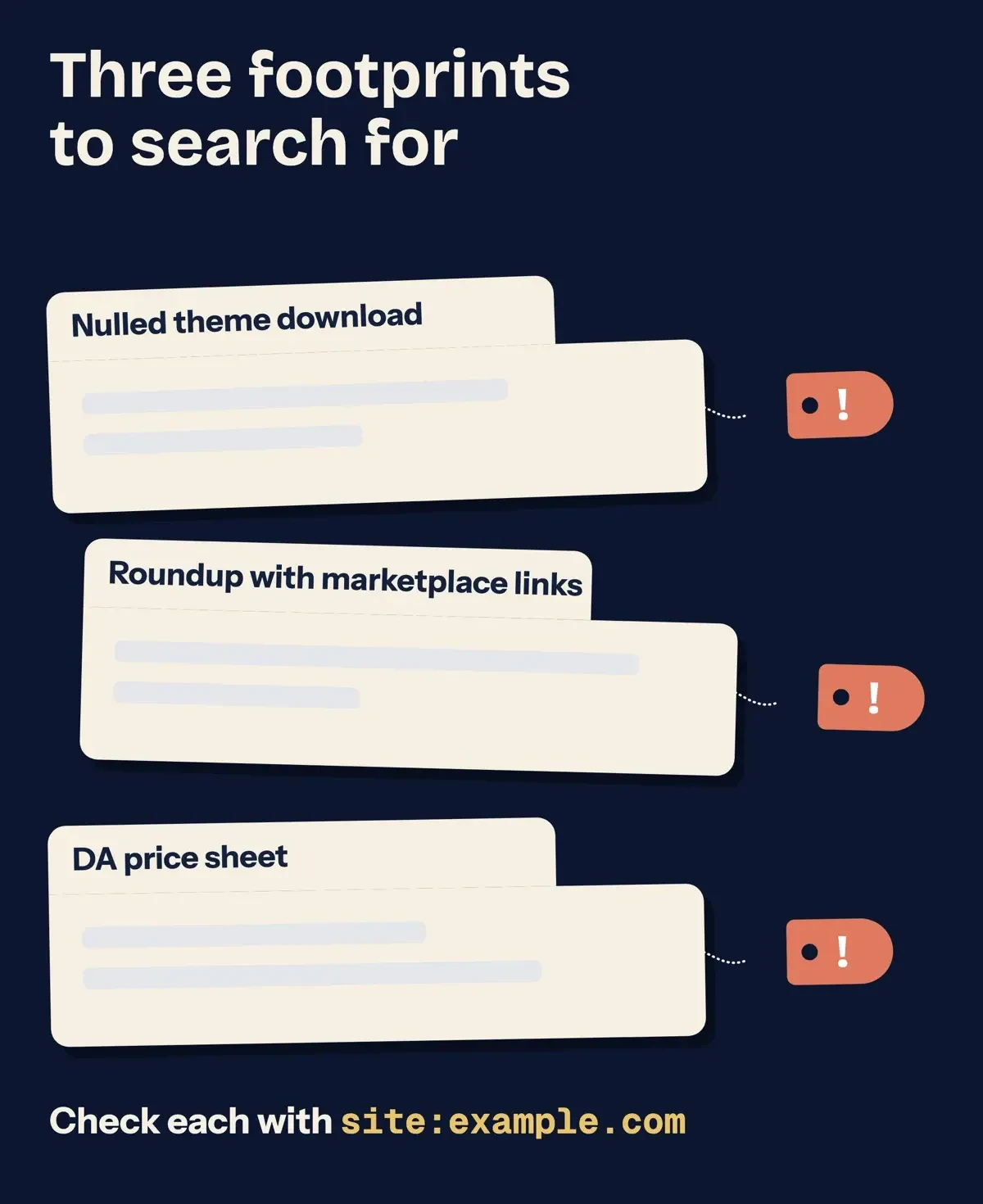 Diagram by DigitalTreed of three warning signs on design sites, based on WordPress and Google pages and our October 31, 2026 scan.
WCAG in one page: the parts W3C spells out
That accessibility check showed up in both listed sites' rules, so it's worth having W3C's own wording in front of you. W3C's WCAG 2 overview says "The WCAG 2.2 has 13 guidelines." and "The guidelines are organized under 4 principles". The fourth principle is the one people forget; W3C's WCAG at a glance page sums it up as "Maximize compatibility with current and future user tools." Each guideline has testable success criteria, and "The success criteria are at three levels: A, AA, and AAA".
Color contrast is success criterion 1.4.3 in WCAG 2.2, a level AA rule. The rule reads "The visual presentation of text and images of text has a contrast ratio of at least 4.5:1", with a few exceptions. Bigger type gets a lower bar: "Large-scale text and images of large-scale text have a contrast ratio of at least 3:1".
Put both numbers in any case study that touches a palette, beside the hex values you tested and the tool that measured them, so an editor can rerun the check.
The glance page turns all 13 guidelines into one-line summaries, so it's the quickest W3C page to keep open while you write a case study. Two of them catch most design articles: "Provide text alternatives for non-text content." and "Make all functionality available from a keyboard". Alt text on the before-and-after images is easy to forget in a design case study, and so is a dropdown menu that nobody can open without a mouse. Before you send screenshots, run the live page through our image alt text checker. Then tab through it.
Which version should you cite? W3C published WCAG 2.2 on October 5, 2023, and the overview says "W3C encourages you to use the latest version of WCAG."
US clients will ask about the law. The Justice Department's ADA web guidance covers "businesses that are open to the public (Title III)". It says "Existing technical standards provide helpful guidance concerning how to ensure accessibility of website features." and then names WCAG and the Section 508 Standards. We aren't lawyers, though, so keep legal claims out of a design pitch and stick to what you tested.
Would this design blog pass a two-minute look?
Those footprints and the freshness of a site's posts fit on a card with five rows. A single red stops the check. Two yellows: read the latest five posts before you draft anything. The long checklist lives in our guest post sites hub; the card below covers just the design rows.
| Row | Green | Yellow | Red |
| Contributor page | Live, with written rules and a named way to pitch | Up, with a catch (a broken form, a vendor angle) | Empty, paused, priced, or promising dofollow |
| Tranco rank | Within the first 100,000 places | From place 100,001 to the millionth | No rank, traffic unknown |
| Homepage history | One design or UX site throughout | A blank or for-sale stretch | Three or more topic changes |
| Newest post | In the last 6 months | 6 to 24 months back | Over 24 months back |
| Design scan | No footprint slugs | Freebie or roundup slugs, links labeled | Nulled, crack or DA slugs, or unlabeled referral links to a marketplace |
Rank comes from Tranco, a research list billed as "Hardened Against Manipulation". Its methodology page says "we average ranks over the lists of all four providers over the past 30 days". Visitors to a domain aren't the same as readers of its blog, and the rank only measures the first.
One more test takes ten seconds: paste a recent guest post into the noindex tag checker we built, since a post carrying noindex won't show in Google.
Here's the card on the two listed sites and on CSS Author, from the run's records, our reread and our scan:
- UXmatters. Contributor page: green, written rules and a named way to pitch. Tranco: yellow, #123,335. Homepage history: green, a UX magazine in every yearly title since 2005. Newest post: green, October 19, 2026. Design scan: green, no footprint slugs in 3,435 URLs. Verdict: one yellow and no red.
- The A11Y Project. Contributor page: green, written rules and a named way to pitch. Tranco: yellow, #138,724. Homepage history: green, the same accessibility project since 2013, with one blank capture in 2023. Newest post: yellow, March 10, 2025, 19 months back. Design scan: green, no footprint slugs in 108 URLs. Verdict: two yellows and no red.
- CSS Author. Contributor page: yellow, written rules, but the form shows a raw shortcode. Tranco: yellow, #409,156. Homepage history: green, a design resources blog in every title since 2012. Newest post: green, October 23, 2026. Design scan: red, 31 numbered roundups; freebie downloads through unlabeled referral links. Verdict: one red, so it's off our table.
The A11Y Project's yellows are rank and age: its newest post is 19 months old. A reply may take a while, though the page still says it pays $75 per published post, as of October 2026. UX Mastery, the other site we removed, scores two reds, an empty writer page and a newest feed item 32 months back.
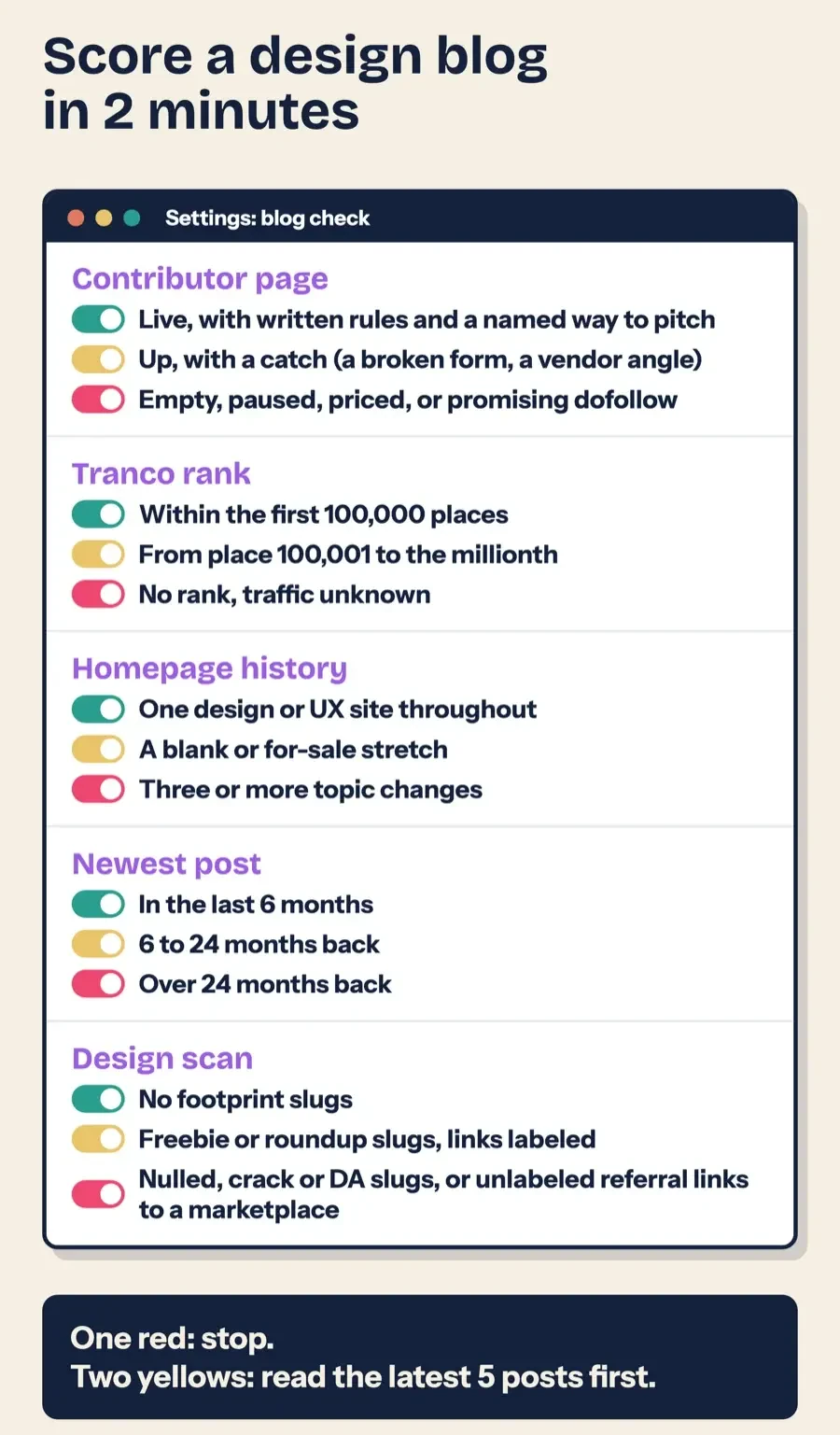 Diagram by DigitalTreed: five rows for scoring a design blog, using the cutoffs in this guide and the batch run of October 31, 2026.
Write for us web design: the two sites that held up on October 31, 2026
That card, plus the run's own checks, cut four sites down to two. Our header's Vetted stamp means only this. Each site below passed the October 31, 2026 batch run, a same-day reread of its writer page and our design scan. Traffic, a reply and a followed link are all outside what it covers. Our reread took out two of the run's four. UX Mastery's writer page has a heading and nothing under it. CSS Author came off for the unlabeled referral links described in the footprint section. We print names as plain text. Each row's single link points at the contributor page, marked rel="nofollow", because we're pointing you to a page rather than vouching for a site.
| Publication | Contributor page (nofollow) | Rules in brief | Tranco | Newest post we dated | Checked |
| UXmatters | Writing for UXmatters | Open; proposal first, then a full draft of 1,000+ words; no sponsored pieces or commercial links; unpaid | #123,335 | October 19, 2026 | 10/31/2026 |
| The A11Y Project | Contributor page | Open; accessibility posts pitched as a GitHub issue or by contact; pays $75 per published post | #138,724 | March 10, 2025 | 10/31/2026 |
Why only two? Of 146 design candidates, 90 showed no contributor page in any place our checker looked, Designmodo, 1stWebDesigner and Creative Bloq among them. Another 26 failed to load. Then 20 more sent back a 403 or 429 status or a challenge page, so we stopped there; SitePoint, UX Collective and Codrops were in that group. Webdesigner Depot's contributor page looked fine, but archive.org answered our history request with a 403, which left the domain's earlier years a blank to us. We didn't route around the block; we dropped it.
Single-digit groups went for dofollow promises (2), no readable history (1), no recent post (1), a language change (1) and priced links (1). The 20 bot-blocked sites may well take guest posts. A plain request couldn't read their pages, so they aren't rows here.
Our checker's user agent said DigitalTreed, it obeyed robots.txt, and it paused 1.5 seconds or more between hits on the same host. It never signed in. With no paid traffic tool, our only traffic signal was the Tranco list PYK6J from October 29, 2026. No design candidate both ranked past the top million and cleared every other check, so this guide skips the Smaller sites table. Yearly homepage titles were pulled through the Wayback CDX API, whose docs note: "Results may be filtered by timestamp using from= and to= params." The Wayback Machine help page explains what a capture is. Keep in mind that an early capture can belong to a previous owner.
Pitching visual identity or logo work? The graphic design guest post guide is the better fit. Build stories about stacks and hosting belong with the website development guest post guide. None of our lists share a site.
What we tested
Of 146 web design candidates, the run kept 4 and dropped 142. The biggest reasons: no contributor page 90, not loading 26 and bot checks 20. The reread and the design scan then removed two, leaving two. Our build script writes these numbers to test/web-design-counts.json, which the bar chart reads.
The run's sitemap check looked only for casino-style words, which is why we added a design scan. It reads each kept site's sitemaps and RSS feed. Then it counts slugs with "nulled", "crack", "warez", "free premium", "free download" or DA-price words. It also counts numbered roundups: slugs that open with a number and name themes, templates, plugins, fonts, mockups or icons. On October 31, 2026 it read 3,435 URLs from UXmatters and 108 URLs from The A11Y Project, then 9,884 from CSS Author and 2,556 from UX Mastery.
Three sites came back clean on every word. CSS Author had no nulled, crack or DA slugs. It did have 31 numbered roundups, 34 "free premium" slugs and 78 "free download" slugs in the first 40 sitemap files we read. Those counts are why we opened its pages and checked the links, and the links are where the red came from.
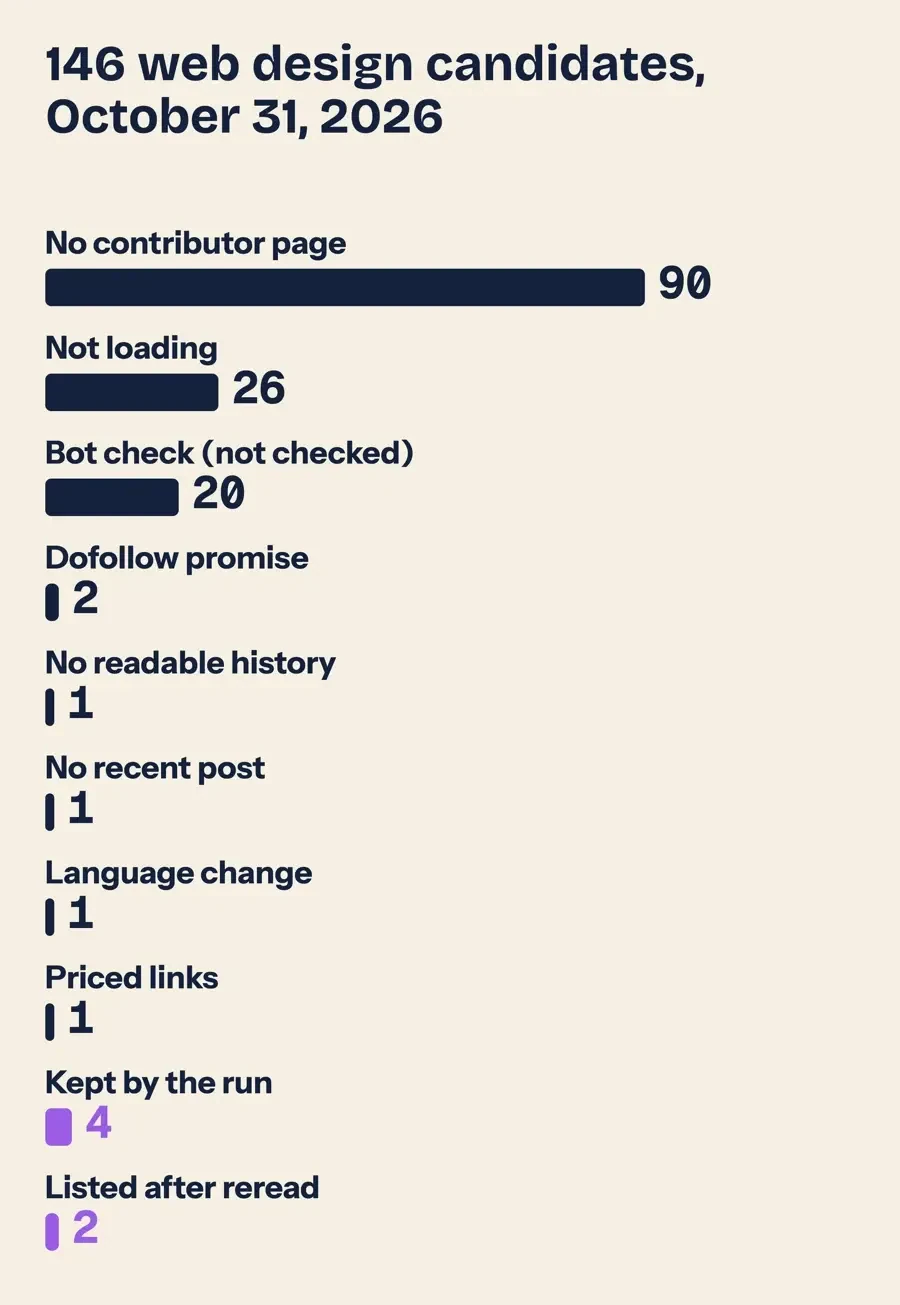 Diagram by DigitalTreed, drawn from our October 31, 2026 run, reread and scan.
Pitching a design editor: a sample email and five topic ideas
With a site chosen, match its first-contact rule, because our two listed sites don't agree on it and a pitch in the wrong format can sit unread. UXmatters prefers a plain-text proposal before a draft, though it'll look at complete drafts. The A11Y Project wants a GitHub issue with a clear subject line, or, if you don't use GitHub, a message that names the kind of post you're pitching.
Our own page leans the same way: "Please do not send a finished article before we agree on the topic."
In a 2017 post about large-scale article campaigns, Google lists the question editors ask first: "Does this person's message fit with my site's audience?" The sample answers it in its opening lines.
Subject: Proposal: rebuilding a {industry} booking flow for {WCAG level}

Hi {editor first name},

Between {start month} and {end month} I rebuilt the booking flow
for a {industry} site. Mobile form completions went from {A}
to {B} per week; I can share the analytics export.

The article would show the old and new screens at the same
width, the contrast fixes (with ratios), the keyboard path
through the form, and a live demo: {CodePen or GitHub Pages URL}.
Length: roughly {word count} words.

Who I am: {role}; {years} years building sites for {clients}.
Published work: {link 1}, {link 2}
Disclosure: {ties to any theme, plugin or tool named, or none}
AI help: {none / what it did}

{name}
You'll fill in every braced field yourself; the sample itself is made up, and the numbers should come straight from your own analytics export.
Keep the disclosure line even when the answer is none. UXmatters refuses links that benefit an author commercially, and the line tells its editor up front whether yours do. The AI line matters to us as well, since our page says "AI-assisted content must be edited, reviewed by a person and fact-checked."
Stuck for an angle? Each idea below runs on files a working designer already keeps:
- A before-and-after contrast audit of one site: every failing pair, the new hex values and the measured ratios.
- Keyboard-only checkout: the tab order you found, what broke, and the fixed version as a live demo.
- Replacing a page builder with plain blocks: page weight and load time before and after, with the test settings.
- A design system started from one client's brand guide, with the token file in a public repo.
- Form errors that people understand: three versions tested with real users, and what changed the completion rate.
Before you send, check every number against its export, and blur client names, emails and order numbers you weren't cleared to show in a screenshot. Then shrink the screenshots in our image compressor, since an editor may open your email on a phone.
Theme and tool affiliate links: what the FTC asks you to disclose
Beyond the pitch, design posts tend to name a theme, a plugin or a host, and a commission on any of them brings the FTC's rules along with the link. Its Endorsement Guides FAQ answers an affiliate marketer directly: "You should disclose your relationship to the retailer clearly and conspicuously on your site". That's true of hosting plans and paid plugins too.
The wording has to be plain. The FAQ warns that "a "buy now" button would not be adequate". Its suggested fix is short: ""Paid link" right next to an affiliate link should be an adequate disclosure of the nature of the link." Placement counts too, because "The closer the disclosure is to your recommendation, the better." It also says "The same guidance applies anytime you endorse a product and get paid through affiliate links." The rule behind the FAQ is Part 255 of Title 16, which holds advertisers liable for "failing to disclose unexpected material connections".
So a theme link you've placed in a guest post on someone else's site still needs its own label, even when the host site has a disclosure page.
Search engines want a signal of their own. Google's guide to qualifying outbound links asks for rel="sponsored" on paid and affiliate links and accepts nofollow, "though sponsored is preferred". Selling sponsored posts on your own design blog instead? Our guide for sellers whose buyers vanish covers deposits and keeping a post in draft until it's paid.
Questions design writers ask before pitching
Frequently asked
Do web design blogs pay guest writers?
Some do. The A11Y Project's page says "Each post that has been reviewed and published will be paid $75.00 USD." UXmatters says "contributing authors receive no compensation" and gives each author a profile page instead.
Which WCAG version should a design article cite?
The newest, unless a client contract names another. W3C's overview says "content that conforms to WCAG 2.2 also conforms to WCAG 2.1 and WCAG 2.0", and that "W3C encourages you to use the latest version of WCAG."
Is guest posting on design blogs against Google's rules?
No, not by itself. Google's 2017 note says "Google does not discourage these types of articles in the cases when they inform users". It becomes a problem when the posts exist mainly to place links.
Is a "buy now" button enough to disclose a theme affiliate link?
No. The FTC's FAQ says "a "buy now" button would not be adequate" and suggests a plain label such as "Paid link" beside the link.
How we made this guide: Every listed site, count and card example traces back to the batch run of October 31, 2026, plus what that run wrote to disk. Later that day we fetched every kept writer page again, plus the source pages we quote and two CSS Author pages as raw HTML. A script then checked each quote against those copies. During the check we sent no pitches, filled in no forms and created no accounts. Facts checked by the DigitalTreed team on October 31, 2026.
Our own call for web design posts opened at this URL in November 2023. Since the October 31, 2026 rewrite it's been a guide for writers pitching design publications.
Sources
- W3C WAI: WCAG 2 Overview
- W3C: Web Content Accessibility Guidelines (WCAG) 2.2
- W3C WAI: WCAG 2 at a Glance
- ADA.gov: Guidance on Web Accessibility and the ADA
- FTC: FTC's Endorsement Guides, What People Are Asking
- eCFR: 16 CFR Part 255, Guides Concerning the Use of Endorsements and Testimonials in Advertising
- Google Search Central: Spam policies for Google web search
- Google Search Central: Qualify your outbound links to Google
- Google Search Central Blog: A reminder about links in large-scale article campaigns (May 25, 2017)
- Google Search Central: Creating helpful, reliable, people-first content
- Google Search Central: site: search operator
- Google Search Help: Refine Google searches
- WordPress Developer Resources: Hardening WordPress
- CodePen: Embedded Pens
- GitHub Docs: What is GitHub Pages?
- Envato: Affiliates
- Tranco: A Research-Oriented Top Sites Ranking Hardened Against Manipulation
- Tranco: Methodology
- Internet Archive: Wayback CDX Server API
- Internet Archive Help Center: Using the Wayback Machine
Comments
No comments yet. Start the conversation below.