
Quick answer
Write for us graphic design searches turn up few open doors. Of 80 design sites we checked on November 1, 2026, one passed: Graphic Design USA (GDUSA). Before you pitch any design publication, check its newest post, what rights it takes in your images, how it credits work, and whether its sitemap looks like a free-font or mockup download farm.
If you searched "write for us graphic design", you likely have a brand project, a type specimen or a print job worth writing up. A design contributor page is a publication's public invitation for outside work, listing what it accepts, the route for sending it and the rights it takes in your images. We opened 80 candidates for this guide, and only one still asked for articles, kept posting and passed our sitemap check. Until this rewrite, the page was our own invitation for design articles. Design isn't one of our topics now, so the page points you to publications that cover it.
It starts with what design editors look at and how branding, type, packaging and print pitches differ. Then come image rights, licenses and credits, the search strings, and the download-farm footprints that pass for magazines. After that: a 2-minute check, the one site that passed, a pitch with five story ideas, the FTC on paid placements, and options for design site owners. Our view: a short list you can trust beats a long one you'd have to check again.
Key takeaways
- Just one of 80 design sites survived our November 1, 2026 review.
- Design editors judge your images before your words.
- Client work often belongs to the client; ask before you send it.
- US rules exclude "typeface as typeface" from copyright, but font files carry licenses.
- Paid design placements need rel="sponsored" and a plain label.
What design editors look at before they read a word
Before your first sentence gets read, a design editor has already looked at your pictures. GDUSA's submission form asks for a "Main Image" and "Supporting Images" ahead of the author fields, and its second form caps uploads at "Images (Max 3)". That order tells you what matters. Images first.
A blurry mockup, or a stock photo of a laptop on a desk, usually ends the read before the editor reaches your second paragraph.
It's Nice That takes this further. Its page says: "If you would like to submit your creative work for a potential feature on the site." It also says "We review submissions weekly." It isn't asking for an article at all. It wants a project it can write up itself, so a strong portfolio piece can get you there without a byline. If your project is finished and photographed, send it there too, since a feature their editors write may reach more designers than an article you write yourself.
Words still count, and Google's guide to helpful, people-first content asks: "Does the content provide original information, reporting, research, or analysis?" For a designer, original analysis means the brief, the routes you rejected and why, the print proofs, and what the client did with the result. A list of ten logo trends from other people's work answers none of that.
So bring three things to every pitch: images you own or have cleared, a credit line for everyone on the project, and a short story with numbers.
Branding, type, packaging and print each pitch differently
Those three things look different in each corner of the field. The rules below come from the US Copyright Office FAQ, federal regulations and the publications we read.
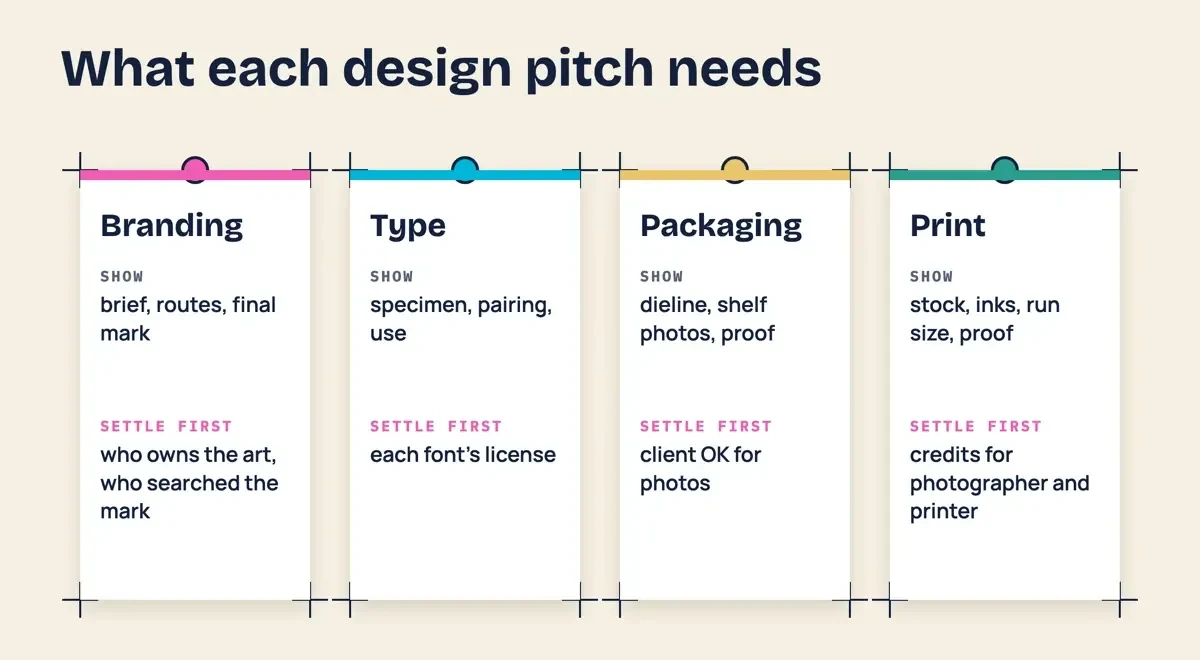 Diagram by DigitalTreed of how a graphic design pitch changes by specialty, based on contributor pages and US Copyright Office and USPTO pages read on November 1, 2026.
Branding and logos
A logo sits between two kinds of law. The Copyright Office says "Copyright does not protect names, titles, slogans, or short phrases." It adds that "copyright protection may be available for logo artwork that contains sufficient authorship". The USPTO's trademark basics page says "A trademark can be any word, phrase, symbol, design, or a combination of these things that identifies your goods or services."
So a rebrand story is really two stories: the artwork and the mark. Credit whoever handled the trademark side, and describe the mark's legal status only in the client's own words. New to the strategy side? The beginner guide to brand strategy on DigitalTreed covers the terms editors expect you to know.
Type and lettering
Type has a rule of its own. Federal rules at 37 CFR 202.1 list "Typeface as typeface" among works not subject to copyright. They list "mere variations of typographic ornamentation, lettering or coloring" too.
The font file is a different matter: it's software, and it comes with a license of its own. Read it once.
The SIL Open Font License is a widely used free one. Its home page says "You can freely modify and redistribute OFL fonts", though some projects need a name change. The OFL FAQ answers a question designers often have about logos: "You remain the author and copyright holder of that newly derived graphic or object." A type article that names each font's license, desktop or web, is worth more to an editor than a pretty pairing.
Found a typeface in a client's old files and can't name it? Our guide to finding the font used in an image walks through the matching tools.
Packaging
Packaging titles often run on finds, not essays. The Dieline's "Contribute" page is a post headed "Published April 20, 2007" that asks: "Have any packaging that you love and want to share with the world?" That's a tip line for new packs, not a call for articles, so we didn't list it. If you send a find anyway, send a launch with shelf photos and the dieline itself rather than a 1,500-word essay on trends.
Print and editorial design
Print work gets judged on production. GDUSA's menu lists sections such as "Package Design" and a print design survey, and its form asks for start and end dates for events. Pitch print work with the paper stock, the inks, the printer's proof and the run size. Those details prove you were in the room.
A cost story helps too. What did the job cost per piece?
Image rights, licenses and credits: settle them before you pitch
Once an editor likes the images, they'll want to know whether you're allowed to send them. The Copyright Office's visual arts page quotes the law: graphic works include "two-dimensional and three-dimensional works of fine, graphic, and applied art".
Ownership is the trap, and the Office's What is Copyright? page says "works created by an employee within the scope of employment are owned by the employer". It adds that the same doctrine "also applies to certain independent contractor relationships", and that "Copyright ownership can also come from contracts like assignments". So the logo you made at an agency, or under a contract that assigned rights, may not be yours to publish. Check first.
Holding the files doesn't settle it either. The Office's FAQ on ownership says the right belongs to the author or assignees, "not of the one who only owns or possesses the physical work itself". Get the client's written OK before you send their work, and say in your pitch that you have it.
Your idea isn't protected either: the Office's general FAQ says "Copyright does not protect facts, ideas, systems, or methods of operation".
Next, read the publication's terms, since GDUSA's form asks you to tick this box: "I agree that GDUSA has full rights to this content and can edit it." That line covers the article and its images, so upload only what you're able to grant on those terms. A portfolio license from a client usually isn't enough.
Stock and open images need credits. The Creative Commons license list says CC BY allows reuse "so long as attribution is given to the creator". Each license on that page carries the line "Credit must be given to you, the creator." Write the credit into your caption, with the license name, before the editor has to ask.
Your own contracts are a question for a lawyer, not for this guide.
Search strings that find design publications, not download farms
With your rights sorted, you can start looking, and Google's documentation explains that "A site: query is a search operator" limited to one site, in its site: operator guide. Its search tips page warns: "Do not put spaces between the operator and your search term."
Swap in the specialty you write about. These strings look for pages that invite articles, not downloads:
"graphic design" "submit an article"
"branding" "contributor guidelines" -font -mockup -template
"packaging design" "send us" "project"
"typography" "pitch us" -"free font"
"print design" "guest contributor" -psd -download

Then vet each result:
site:example.com free font
site:example.com mockup download
site:example.com "guest post" price
One catch is specific to design: "pitch" is also a typeface name. Our run's URL hints pulled up "Fonts in Use: Pitch" and a Typewolf page on "Pitch Font Combinations", neither of them a call for writers. Read the page before you count it.
Free-font farms, mockup bundles and asset shops dressed as magazines
Those search results will also surface design sites that look like magazines but earn from downloads. Their posts are roundups of "free" fonts, mockups and templates, each with a download button, and a guest post there sits among them.
Watch for "contributor" pages that are really seller sign-ups. Craftwork's page is titled "Become an author and sell your design packs". Vecteezy's contributor page says "Earn money for every download your creative resources receive." Both are seller programs for design assets, and neither one gives you a byline for an article you wrote.
Free-font farms are worse, because the font may not be theirs to give. The OFL FAQ allows selling open fonts only inside a bundle, "so the OFL font is not sold by itself". A site that sells open fonts one by one, or hosts paid fonts for free, tells you how it treats other people's rights, your images included. Skip it.
Check a site's own sitemap before you pitch: run it through the free XML sitemap validator on this site, then read the slugs. Our run counted gambling, CBD and loan words and dropped a site at 3 hits. We added design words of our own: free-font, mockup download, nulled, crack and keygen. On 5,006 GDUSA post URLs, those design words found nothing.
Zero hits is what you'd want from any design site.
How do you check a design publication in 2 minutes?
Before any pitch, run this card on the site. The full checklist lives in the hub guide to finding and vetting guest post sites, and this is the short version for design. Green is fine, yellow means look closer, and red means skip.
| Check | Green | Yellow | Red |
| Submission route | Rules in writing, plus a route for articles | A form or a work-only inbox, rules not shown | Missing, a years-old tip line, or a price list |
| Newest post | Within 3 months | 3 to 24 months back | Older than 24 months |
| Homepage history | Same field in every yearly title | Gaps or a rename | A different trade or a parked page |
| Rights and credits | Says what you grant and how images are credited | Silent on rights | Asks for work you can't license |
| Sitemap footprints | None | Hits that are design coverage | 3+ off-topic hits, or free-font and nulled slugs |
| Tranco rank | Top 100,000 | 100,000 to 1 million | Not in the top 1 million |
For the first row, paste the contributor URL into the free HTTP status tool on DigitalTreed. A redirect to a contact page, or a 404, counts as no page. Here's the card applied to three design sites, using only what our run recorded and what we read on the same day.
- GDUSA. Submission route: yellow, a form for articles, events and ideas; the Contributor Policies it asks you to accept aren't linked. Newest post: green, October 30, 2026. Homepage history: green, graphic design in every yearly title from 2006 to 2026. Rights and credits: green, the form says GDUSA gets full rights and can edit. Sitemap footprints: yellow, three "cbd" slugs in 5,006 posts, all packaging stories. Tranco rank: yellow, #279,410. Verdict: three yellows and no red.
- The Dieline. Submission route: red, a tip-line post from April 20, 2007. Tranco rank: green, #85,535. The run stopped at the first row, so the rest wasn't scored. Verdict: one red, so it's off the table.
- It's Nice That. Submission route: red for articles, since it takes projects to feature. Tranco rank: green, #37,332. Verdict: off the table for writers, but a real route for designers with a finished project.
The yellows on GDUSA are worth reading, not ignoring. Its CBD slugs are packaging news about CBD brands, which is design coverage, and you'll see the details below.
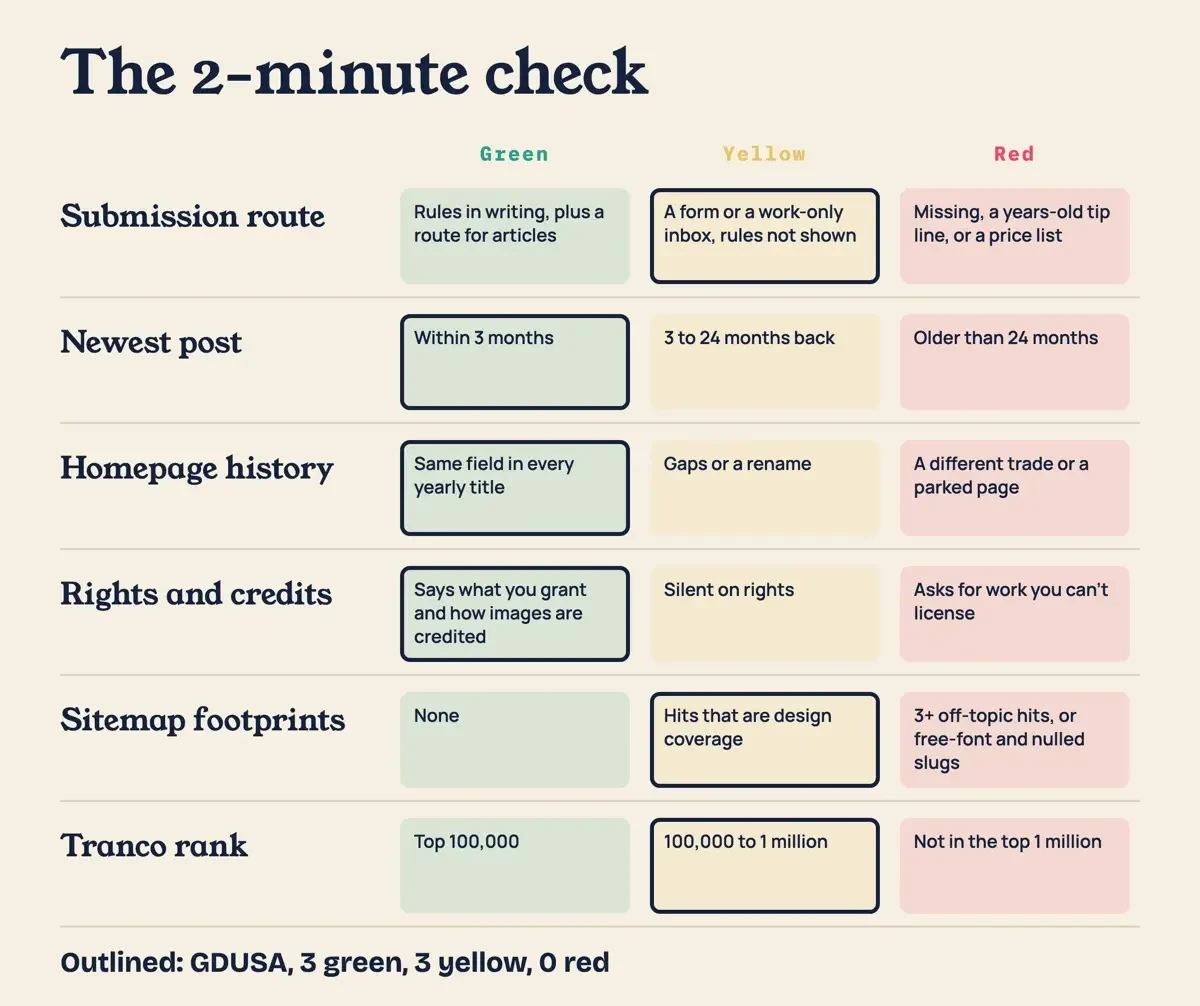 Diagram by DigitalTreed of the 2-minute check for design sites, scored from our November 1, 2026 run and same-day reread.
Write for us graphic design: the one site that cleared our November 1, 2026 review
After the card, here's the honest result: of 80 graphic design candidates, one passed every check. We didn't pad it with sites that failed, because a list that sends you to dead pages and download farms costs you more than a short one.
| Site | Focus | Newest post | Tranco rank | Guidelines | Checked |
| Graphic Design USA (GDUSA) | Design trade news: branding, packaging, print, in-house teams | October 30, 2026 | #279,410 | Submit an Article | November 1, 2026 |
GDUSA's yearly homepage titles in the Wayback Machine read as a graphic design magazine from 2006 to 2026. Its feed held 40 posts from September 12, 2026 to October 30, 2026, so it clears our rule that a listed site needs a post in the last 24 months. Its newest was "New KFC Restaurant Design Is More Stage Than Store".
Here's the catch: the run couldn't read GDUSA's sitemap, so we read all six of its post sitemaps ourselves on the same day. Three of 5,006 slugs carry "cbd", which is our run's cut for a drop. Another 22 mention cannabis, and its menu lists a Cannabis Industry Graphics competition.
So we opened all three CBD stories and ten of the cannabis ones. They run from 2017 to 2024, so cannabis packaging looks like a long-running beat there rather than a sudden change of direction. Each one covers a pack, an identity or a design award. They include agency case studies, a packaging maker's new range, paper-stock stories, and a byline on why CBD products need a packaging treatment. None carried a sponsored label or read as a link placement, so we kept GDUSA on that basis and scored the row yellow. If you'd rather skip any site with cannabis coverage, that's a fair call, and the yellow is there so you can make it.
Open two of them yourself before you pitch.
Why so thin? 49 sites had no page asking for articles, 18 answered with a bot check we didn't try to get around, and nine didn't load. The last three fell to link selling, a dofollow promise or spam words in the sitemap. A bot check means we couldn't check, not that the site failed. Those sites may be fine, so open them in a browser and run the card yourself before you write them off. Dead pages are different: a contributor link that no longer loads usually means nobody is reading pitches there either, whatever the old guest post lists say.
Some of the best-known names don't take outside articles at all: It's Nice That asks for projects, and The Dieline's page is a 2007 tip line.
No smaller design site passed every other check this time, so there's none waiting for a traffic check. Pitching web layouts or UX instead? Our web design guest post guide lists different sites, checked the same way.
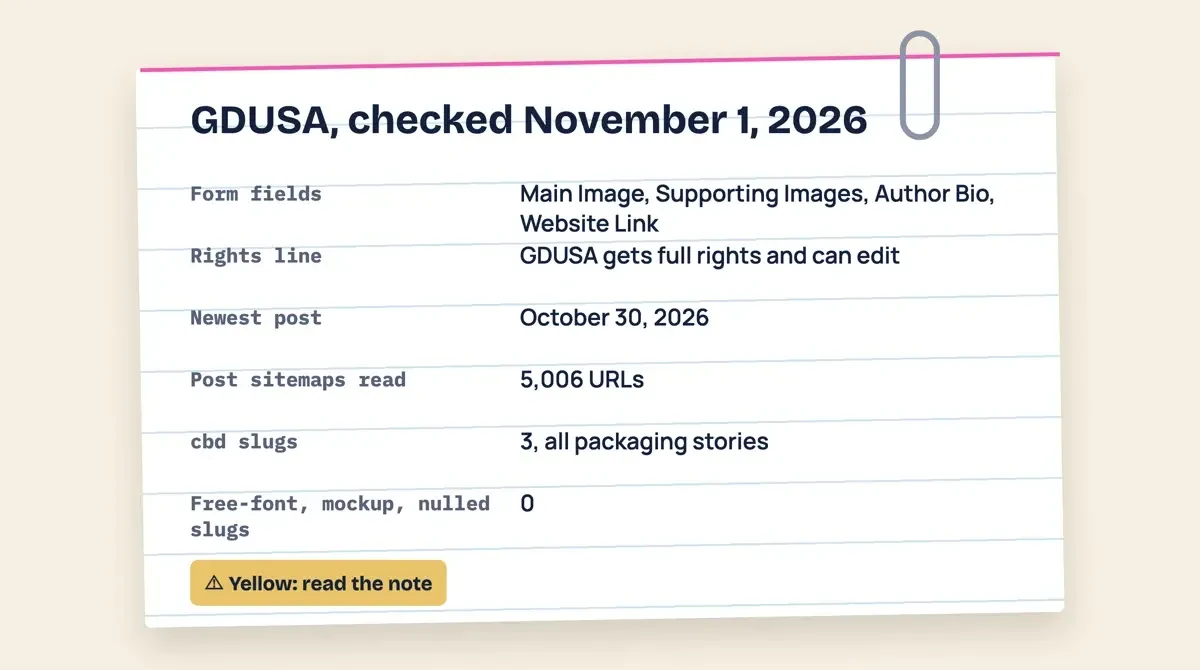 Diagram by DigitalTreed of what we confirmed on GDUSA's pages on November 1, 2026: form fields, rights line, newest post and sitemap scan.
What we tested
Our checker opened 80 graphic design candidates on November 1, 2026 with plain requests and an honest user agent. It looked for a contributor page, the Tranco rank (list PYK6J), and yearly homepage titles from the Internet Archive's CDX server. Then we reread the kept page, read GDUSA's feed and post sitemaps, opened 13 of its CBD and cannabis stories, and checked every quote here against saved copies. No Ahrefs or Similarweb data was available to us.
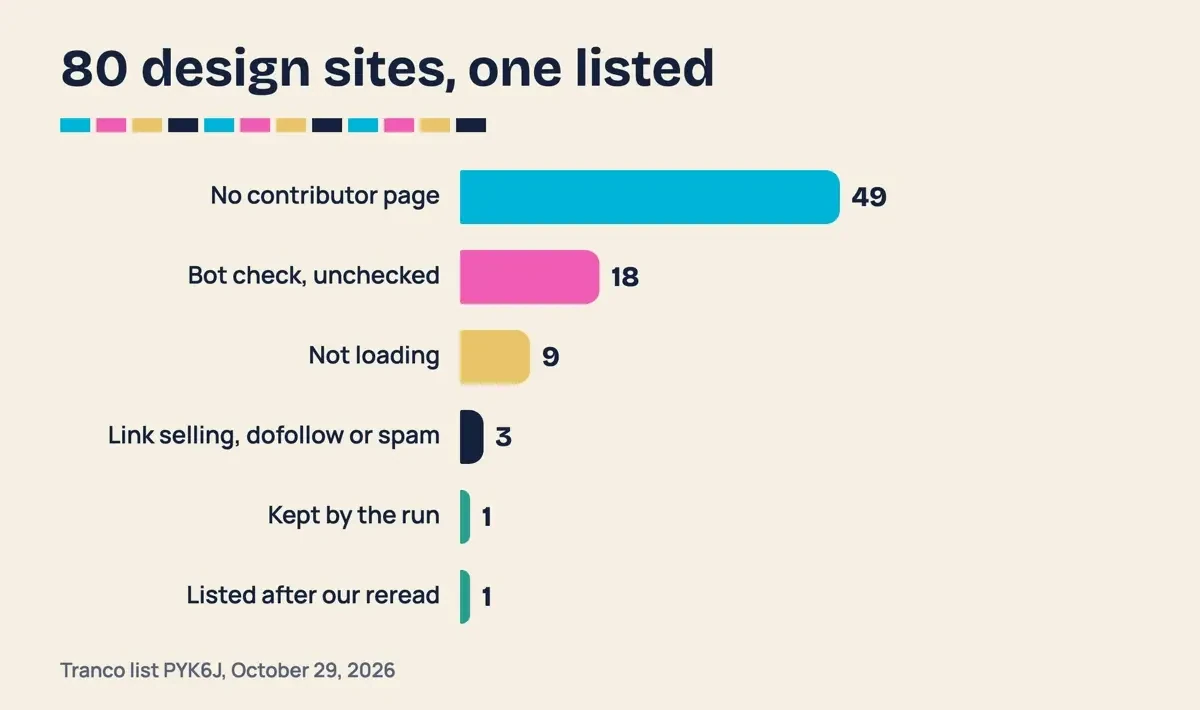 Diagram by DigitalTreed, drawn from our November 1, 2026 site check and same-day reread.
A pitch for a design editor, plus five story ideas
Once a site passes, shape the pitch around the images. GDUSA takes a form, so paste the same parts into its fields and keep a copy of everything you sent, images included, for your own records. Email editors get it as written.
Google's 2017 post on article campaigns lists a question a careful editor asks: "Does this person's message fit with my site's audience?" Your opening lines should answer it.
Subject: Packaging case: {brand} {product} redesign, {month year}

Hi {editor first name},

I led the {packaging / identity / print} redesign for {brand},
a {city}-based {industry} company. It reached shelves in {month}.

The piece would show the old and new packs side by side, the
dieline, two rejected routes and why we dropped them, and the
press proof. Length: about {word count} words.

Images: {number}, all shot by {photographer}, cleared for
editorial use by {client} in writing on {date}.
Credits: {agency}, {designer names}, {photographer}.
Fonts: {font} ({license}), {font} ({license}).
Disclosure: {free licenses, paid ties or none}

{name}, {role}
Portfolio: {link}
The sample's made up; fill each braced field from your own records. Keep the clearance date and the credit line even when they feel obvious, because they answer the editor's rights question before it's asked. Write alt text for every image too, and test it in our image alt text checker.
Need a story? These five come from files most working designers keep anyway:
- A packaging redesign: old and new packs, the dieline, the press proof and what changed on shelf.
- Pairing type for a brand system, with each font's license and what it cost the client.
- A print job that went wrong: the proof, the fix and the printer's spec sheet.
- A nonprofit rebrand: the brief, three rejected routes and the final mark.
- A brand guide a small team actually uses: what made the cut and what didn't.
Choose the one where your images are strongest, because a modest project with great photos beats a famous one you can't show.
Paid placements, free font licenses and the FTC
After the pitch, think about money and free things, because both bring rules. Google's spam policies list "Buying or selling links for ranking purposes" as link spam. Its outbound link guide tells sites to "Mark links that are advertisements or paid placements" with rel="sponsored", and its 2019 nofollow post says that for this, "either is fine".
Where Google worries about rankings, the FTC worries about readers. Its Disclosures 101 for influencers says: "Disclose when you have any financial, employment, personal, or family relationship with a brand." It adds: "Financial relationships aren’t limited to money."
That matters in design, where foundries and software makers hand out free licenses. The endorsement rule at 16 CFR 255.5 says material connections can include "free or discounted products". So if a foundry gave you the font you praise, say so in the article. A free software seat is a product too.
The FTC's influencer page adds: "Disclose the relationship if you got anything of value to mention a product."
Labels must be plain too: a native ads guide from the FTC lists "Sponsored Advertising Content" as a clear term and says "Advertisers should not use terms such as “Promoted”". Its endorsement FAQ adds that, as a disclosure, a “buy now” button would not be adequate. We're not lawyers, so check any paid deal with one.
If you sell sponsored posts on your own design blog, the payment risk is yours. Our guide for sellers dealing with guest post scammers covers deposits and invoices. For what a paid post can really do for a business, read how business guest posts can grow your business.
Do you run a design site or buy design placements?
Design isn't among the seven topics our submission page lists, so there's no pitch-us box here, but site owners and advertisers have two other routes.
For site owners, our page says: "If you run a website with real readers, list it on our marketplace and get paid for sponsored posts." The publisher section of our submission page has the steps. It also says "The payment is held in escrow, so you know the money is there before you start writing." Publishers are expected to run "A real site with original content and genuine traffic, not a link network." and "We review each listing before it goes live."
The terms: "You earn the order price minus our 20% commission, minus TDS where it applies." We earn that commission, so read this section as coming from an interested party.
Advertisers will find prices by niche, trial offers and payment terms in the DigitalTreed media kit. Either way, the advice above holds: a design site with real readers and clean rights terms is worth more than ten that sell downloads.
Questions graphic designers ask before pitching
Frequently asked
Do graphic design magazines pay guest writers?
The page won't always tell you. The GDUSA form we read mentions no fee either way, so ask before you write, and get the answer in writing.
Can I show client work in a guest post?
Only with the client's OK. The Copyright Office's overview says work made by an employee on the job belongs to the employer, and contracts can assign rights too.
Is a typeface protected by copyright in the US?
The federal rule at 37 CFR 202.1 lists "Typeface as typeface" among material not subject to copyright. Font files are software with licenses, so check each one.
Is guest posting on design sites against Google's rules?
Not by itself. Google's 2017 note on article campaigns says it doesn't discourage guest articles that inform users. Its spam policies target "Buying or selling links for ranking purposes".
How we made this guide: The table, counts and card scores come from our batch site check. We then read the kept page, its feed and its sitemaps a second time that day. A script checked each quote here against saved copies of the source pages. During the check nobody pitched a site, signed up or sent a form to one. Facts checked by the DigitalTreed team on November 1, 2026.
Back in November 2023, this address carried our own call for design posts, until we rebuilt it in November 2026 as a guide for designers pitching other publications.
Sources
- U.S. Copyright Office: What is Copyright?
- U.S. Copyright Office: Copyright in General (FAQ)
- U.S. Copyright Office: What Does Copyright Protect? (FAQ)
- U.S. Copyright Office: Who Can Register? (FAQ)
- U.S. Copyright Office: Visual Arts registration
- LII: 37 CFR 202.1, Material not subject to copyright
- USPTO: What is a trademark?
- SIL Open Font License
- SIL: OFL FAQ
- Creative Commons: About CC Licenses
- FTC: Disclosures 101 for Social Media Influencers
- FTC: FTC's Endorsement Guides, What People Are Asking
- FTC: Native Advertising, A Guide for Businesses
- LII: 16 CFR 255.5, Disclosure of material connections
- Google Search Central: Spam policies for Google web search
- Google Search Central: Qualify your outbound links to Google
- Google Search Central Blog: Evolving nofollow (September 10, 2019)
- Google Search Central Blog: A reminder about links in large-scale article campaigns (May 25, 2017)
- Google Search Central: Creating helpful, reliable, people-first content
- Google Search Central: site: search operator
- Google Search Help: Refine Google searches
- Tranco: A Research-Oriented Top Sites Ranking Hardened Against Manipulation
- Tranco: Methodology
- Internet Archive: Wayback CDX Server API
Comments
No comments yet. Start the conversation below.