
Quick answer
Here's how to get sponsors for your blog: list brands that already pay creators in your niche. Send each a short pitch with one dated number and one price, then follow up once. Price from your own hours; the 2025 US median for writers was $36.98 an hour. And label every deal.
Most bloggers wait for a brand to find them. That can take years, and the brands that do write first often want a cheap link, not your readers.
Pitching flips it.
You pick the brand, the idea and the price, and you can do it with a small blog if your readers are a clear group. If you're still deciding whether the blog itself pays off, start with our look at whether blogging is worth it for a business.
Four parts do the work: a list of brands that fit, a short media kit, the pitch email (there's a template to copy) and a price. The rules come after the yes.
Key takeaways
- Brands buy a clear, defined audience, not a big page-view count.
- Build a list of 20 brands that already sponsor creators in your niche.
- Give every media kit number a source and a date range.
- Send one follow-up after about a week, then stop.
- Label every sponsored post and mark paid links with rel="sponsored".
Get ready before you write to a single brand
Before any pitch, know what brands are buying: a defined audience, not a page-view count.
There's no official minimum, and we found no study that sets one. Fit beats size. A camping-stove maker will care more about 4,000 monthly readers who car-camp than 40,000 who landed on one viral post.
So check three things first. Your blog needs a clear topic you can say in one line and a few posts that show how you'd handle a sponsor's product. It also needs a site that loads and works on a phone. Any brand you pitch will open your site before it replies, and it won't wait while you fix things. A quick pass with the DigitalTreed website audit flags broken pages and slow templates to fix first.
If the posts aren't there yet, write those first. Our blog post writing guide covers the structure, and this plan for promoting blog posts covers getting readers to them.
A pitch can't fix a thin blog.
One more thing to settle now: what you won't promote. Write down two or three categories you'll turn down. It makes later replies faster and keeps the blog believable.
Find brands that already pay creators in your niche
Once the blog's ready, build the list. The fastest source of likely sponsors is other people's disclosed posts. The FTC's guides on endorsements say a paid connection "must be disclosed clearly and conspicuously" (16 CFR 255.5). A plain "Sponsored" label can meet that rule without naming the brand. Many still name the sponsor. Those are the ones to list.
Every disclosed post you find is a brand with a budget for creators.
Google's own search operators make this quick (Google Search Help: Refine Google searches). Put a phrase "inside quotes" for an exact match. Add "site:" in front of a domain to search one site, and "-" in front of a word to leave it out. Don't put a space after the colon.
"sponsored by" camp cooking recipefinds disclosed posts in your topic.site:competitorblog.com "sponsored"shows who paid one blog you compete with."thanks to" "for sponsoring" dutch oven -amazoncatches other wording and drops store pages.
Then check whether a brand spends on ads at all. Google calls its Ads Transparency Center "a searchable repository of advertisers and the ads they've served." It covers Search, Display, Gmail and YouTube (Google Advertising Policies Help: Ads transparency). Search it by advertiser or website name, filter by date and location, and any brand running US ads this season shows it has a marketing budget.
One that has run none in a year probably doesn't.
Add two more sources by hand: the sponsors read out on podcasts in your niche, and the sponsors named in newsletters you subscribe to. Both are paying for readers like yours, and they've shown they'll pay.
Now cut the list to 20. Keep the brands whose products you'd use, whose buyers look like your readers, and where you can find a named person: a partnerships, influencer or marketing manager. A generic info@ inbox rarely answers, and you won't know who read it. When you find an address, check it with an email verifier before you send, so a bounce doesn't cost you the contact.
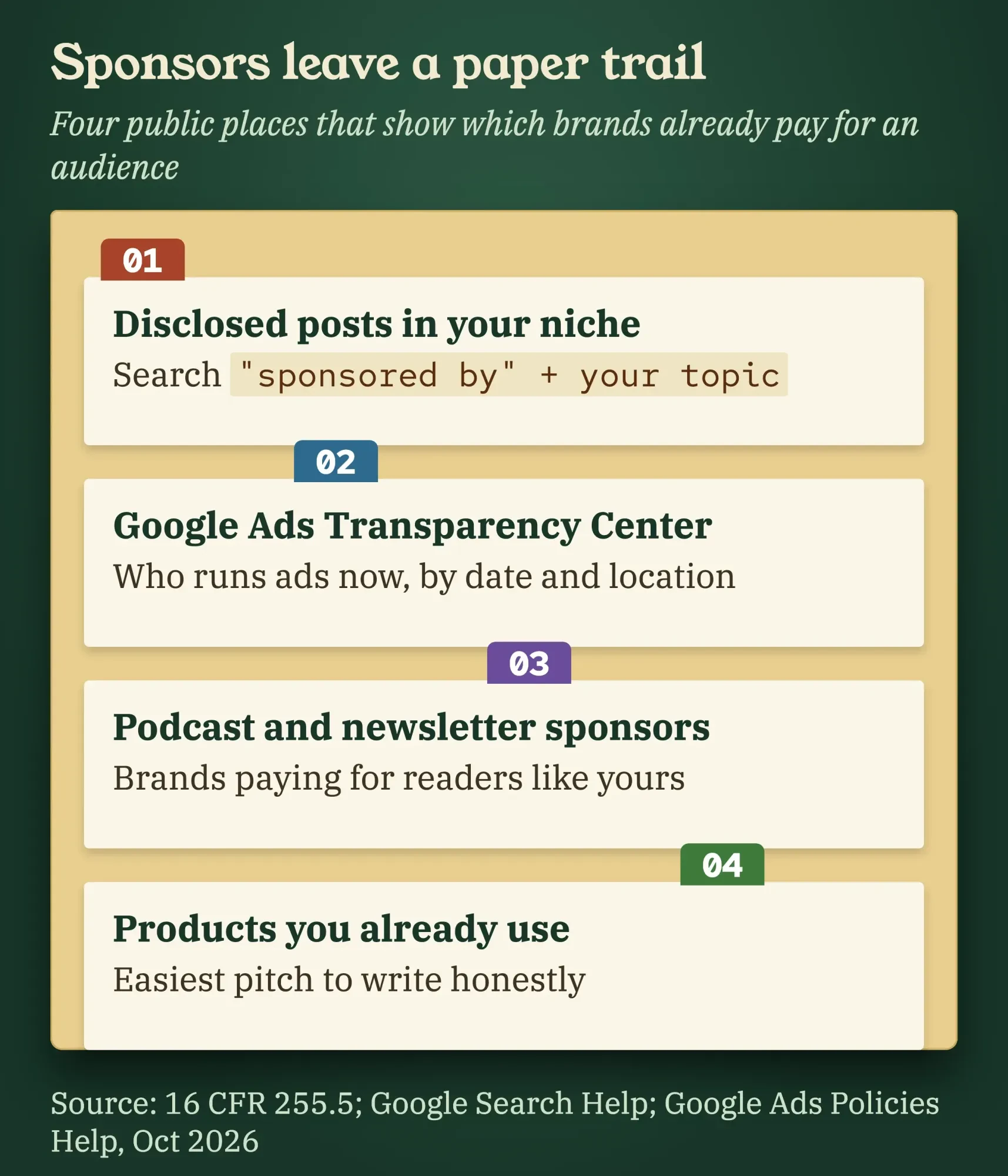 Diagram by DigitalTreed. Sources: 16 CFR 255.5 (eCFR); Google Search Help and Advertising Policies Help, read October 27, 2026.
A one-page media kit with dated numbers
Next comes the page a brand forwards to its boss: your media kit. Keep it to one page: who you are in two lines, who reads you, three numbers, what you sell and how to reach you. Our media kit guide covers each block and a filled-in example, so here's only what changes for a blog pitch.
Every number needs a source and a date range.
"48,000 monthly readers" invites doubt; "31,200 users, July 1 to September 30, 2026, Google Analytics 4" doesn't. No reports yet? Start with the GA4 guide on DigitalTreed, which covers the reports to export. Add one line about where readers live, because a US brand often can't use readers outside the US.
Put the same facts on a "Work with us" page on the blog. It gives brands a link to check, and it brings in inbound requests you didn't have to pitch for.
The sponsorship pitch email template
This is the pitch we'd send for a small blog. It's under 180 words, it names one idea and one price, and it carries what the FTC's email guide asks for, including a postal address and an opt-out. Copy it, then replace everything in brackets. The camp-cooking blog in it, Snake River Camp Kitchen in Twin Falls, Idaho, is a made-up example.
Subject: Sponsored recipe idea for [product] on Snake River Camp Kitchen

Hi [first name],

I run Snake River Camp Kitchen, a blog of tested camp-cooking recipes for
families who car-camp in the West. [One specific line about their product
and why your readers would care. Name the product. No flattery.]

Who reads us: [one line: who they are, where they live, what they buy].
From [start date] to [end date], the blog had [number] [metric], per
[Google Analytics 4 / Search Console]. Media kit: [link]

My idea: one recipe post built around [product], with step photos, plus a
mention in our [weekly] newsletter to [number] subscribers.
Price: $[amount] for both. The post is labeled "Sponsored" at the top and
your links carry rel="sponsored".

Would a 15-minute call next week work? If the timing's wrong, tell me
when your team plans [season] campaigns and I'll write back then.

[Your name]
[Blog name] | [site URL] | [phone]
[Street address or registered P.O. box, city, state, ZIP]
Not a fit? Reply "no thanks" and I won't email you again.
Each line has a job. The subject says exactly what the email is, and the first paragraph proves you know the product. The numbers come with dates and a source, the offer is one package at one price, and the ask is a short call. A brand manager should be able to say yes or no without opening an attachment.
The signature isn't decoration. Treat a pitch selling your sponsorship as a commercial email. The FTC's CAN-SPAM guide says the law "doesn't apply just to bulk email" and "makes no exception for business-to-business email" (FTC: CAN-SPAM Act compliance guide). It says "Your message must include your valid physical postal address", and that can be "a post office box you've registered with the U.S. Postal Service".
The same guide wants "a clear and conspicuous explanation of how the recipient can opt out", and "The subject line must accurately reflect the content of the message." The guide also says you "must disclose clearly and conspicuously that your message is an advertisement"; "Sponsored" in the subject and the price line do that here. Opt-outs have a deadline too. If someone opts out, you must honor it "within 10 business days".
Those lines cost nothing.
Missing them can: the same guide puts the cap at "up to $53,088" per email, the figure in 16 CFR 1.98 for penalties assessed after January 17, 2025.
Send it from your own domain name, too. If you're still on a free inbox, create a business email first.
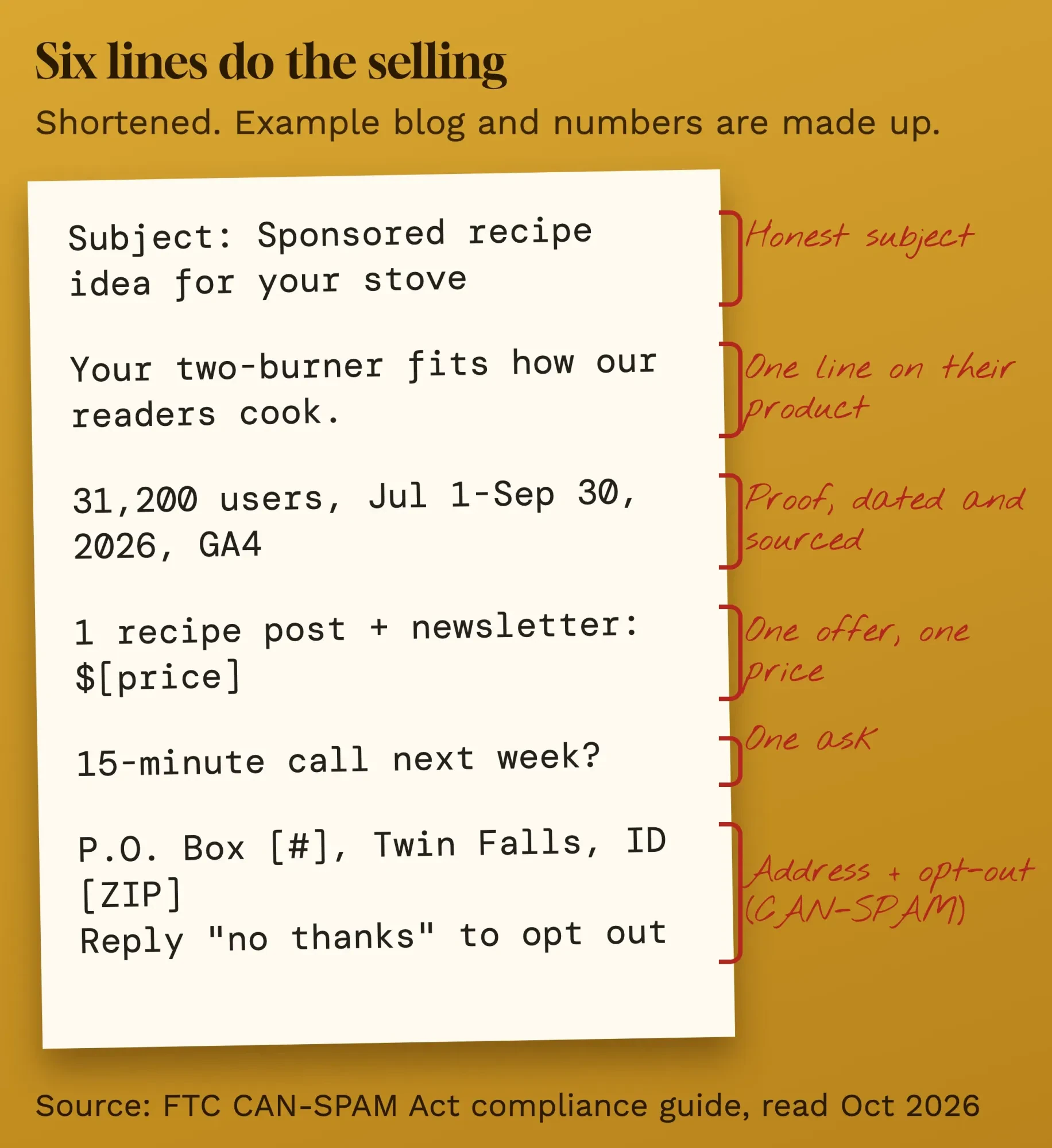 Diagram by DigitalTreed of our pitch template. Address and opt-out lines from the FTC CAN-SPAM guide, read October 27, 2026.
Write the product line fresh for every brand. If it could be pasted into an email to any other company, rewrite it.
Follow up once, then track what you sent
After you hit send, give the brand about a week. If there's no reply, send one short follow-up in the same thread with one new detail: a season they're likely planning for, or a recent post that fits. Then stop.
That timing is our habit, not a rule, but a third email to a stranger starts to look like spam.
Keep a simple sheet of brand, contact, date sent, follow-up date, reply and price discussed, and after 20 pitches you'll see which subject lines got answers. Tag the media kit link in each email with a free UTM builder, one tag per brand. If the kit is a page of your blog, Google Analytics can show which brands clicked through to it. A PDF hosted elsewhere won't.
Cold pitches aren't the only channel. Some brands book creators through sponsorship marketplaces, and you can list the blog there as a second source of leads. Read each platform's fee and its rules on disclosure before you sign up.
And sponsorship is one of three ways a blog earns from brands. Ad networks are the hands-off option; our AdSense approval guide covers getting in. Selling banner space to a brand directly is the third, covered in how to sell ad space on your website.
How much should you charge for a sponsored post?
Then comes price. Charge at least what the post costs you in hours, then add for the extras a brand wants. That sounds basic, but there's no good market rate to copy.
We went looking on October 27, 2026. The one US blog rate page with a clear sponsored-post price that turned up was, by its own page date, from April 2014. That's over 12 years old. The current rate studies we found price Instagram, TikTok, YouTube and LinkedIn posts, not blog posts. Influencer Marketing Hub, for example, lists Instagram micro creators (10,000 to 100,000 followers) at "$100–$500+ per post". It calls its ranges "planning benchmarks, not fixed rate cards" (vendor data, updated October 6, 2026). Use social numbers like these only for the social posts you add to a package; our influencer rates guide has more.
So start from time. Federal labor data put the 2025 median pay for writers and authors at $36.98 an hour (BLS Occupational Outlook Handbook). Count every hour: the idea, testing, photos, writing, the brand's review and the edits after.
Extras go on top. Three creators at Buffer published their own rates "as of October 2026" (Buffer, vendor data). One adds "about 35% for 90 days and 50% for six months" when a brand wants to run the post as an ad. A fourth teammate, Buffer's communications director, lists "$200 to add a mention in her newsletter". Those are LinkedIn and Instagram creators. Treat them as a shape, not a price list.
Example (made up): Snake River Camp Kitchen counts 8 hours for one sponsored recipe post and 1 hour for a newsletter mention. It prices each at 1.5 times its hourly floor, rounded up to the next $50. Then it adds 35% of the post fee when the brand wants 90 days of ad use.
| Item | Hours | Floor at $36.98 an hour | Quote |
|---|---|---|---|
| Sponsored recipe post with photos | 8 | $295.84 | $450 |
| Newsletter mention | 1 | $36.98 | $100 |
| Brand runs the post as an ad for 90 days (+35% of the post) | none | none | $157.50 |
| Total | 9 | $332.82 | $707.50 |
The floor tells you when to walk away.
Below $332.82 for this package, the blog is paying to work. Above it, the price is a judgment call based on how well your readers match the brand's buyers.
Two more choices change the number. If a brand offers commission instead of a fee, that's an affiliate deal with its own rules; our affiliate links guide covers it. And if a brand asks you not to work with its competitors for 60 or 90 days, charge for the deals you'll turn down.
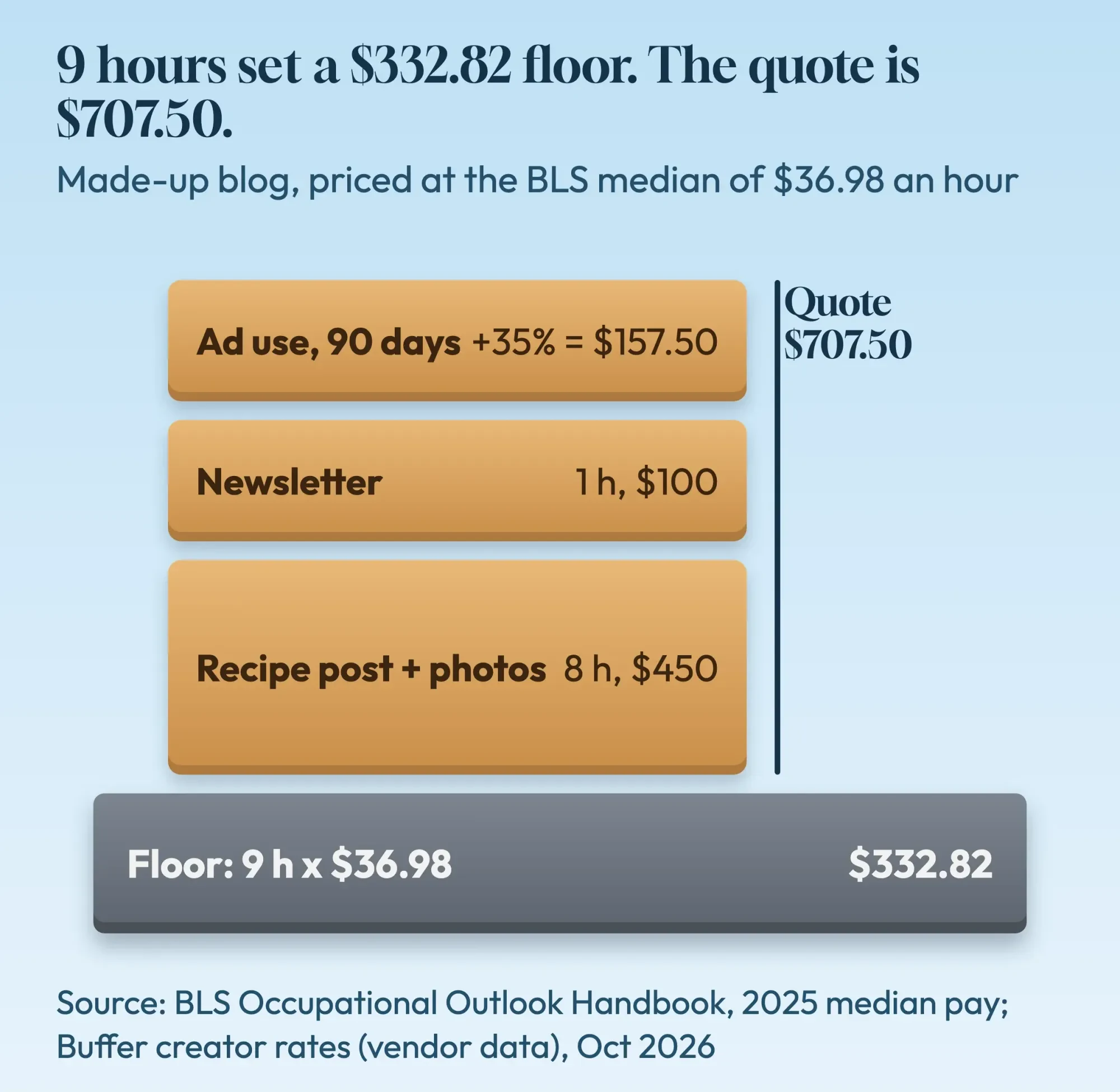 Diagram by DigitalTreed. Source: BLS Occupational Outlook Handbook (2025 median pay); Buffer creator rates (vendor data), October 2026. Snake River Camp Kitchen is made up.
Say it's sponsored, in the FTC's words
Once a brand says yes, a disclosure duty comes with the money. The rule is 16 CFR 255.5(a). A connection "that might materially affect the weight or credibility of the endorsement" and that "is not reasonably expected by the audience" must be "disclosed clearly and conspicuously". That includes "free or discounted products". Online, "the disclosure should be unavoidable" (16 CFR 255.0(f)).
The FTC's plain-language version is Disclosures 101 for Social Media Influencers. Its first rule reads "Disclose when you have any financial, employment, personal, or family relationship with a brand". On placement, it says "Place it so it's hard to miss". On wording, it says "Use simple and clear language" and lists terms like "advertisement," "ad," and "sponsored" as fine. It warns against "vague or confusing terms like "sp," "spon," or "collab"".
Brands carry this too. The Guides say advertisers "are subject to liability" for "failing to disclose unexpected material connections" (16 CFR 255.1(d)). So promise the label in your pitch, as the template does.
One rate page we read while researching this post says its sponsor tag "can be removed for a higher price". Don't sell that.
The label isn't an upsell; it's the condition of taking the money.
Links have their own rule, from Google rather than the law. Google's Search Central page tells you to "Mark links that are advertisements or paid placements (commonly called paid links) with the sponsored value". It adds that nofollow "is still an acceptable way to flag them, though sponsored is preferred" (Google Search Central: Qualify your outbound links). Its spam policies list "Exchanging money for links, or posts that contain links" as link spam unless the links carry rel="nofollow" or rel="sponsored".
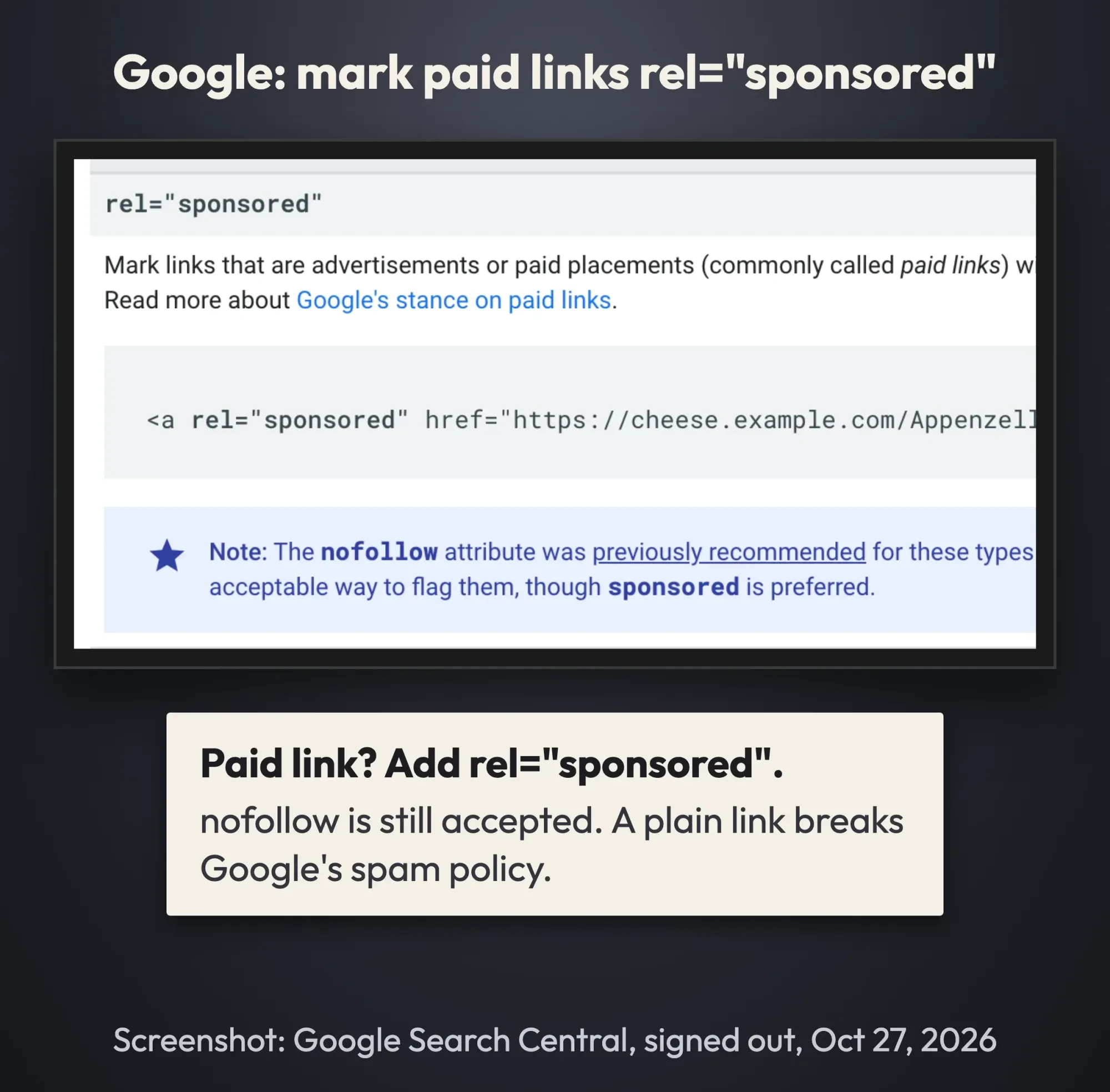 Screenshot: Google Search Central, "Qualify your outbound links to Google", signed out, October 27, 2026, annotated by DigitalTreed.
In the post itself, both pieces look like this:
<p><strong>Sponsored:</strong> This recipe is paid for by Example Stove Co.,
which also sent us the stove we cooked on.</p>

<p>We cooked it on the
<a href="https://example.com/two-burner-stove" rel="sponsored">Example Stove Co. two-burner stove</a>.</p>
If a brand asks for a plain followed link, it's asking you to break Google's rule. Say no, politely. Our sponsored blog posts guide goes deeper: where the label lands on a phone, paid reviews, and a clause-by-clause deal.
After the yes: deliver, label, report
After the yes, put the deal in writing before you start, even in a one-page email. List what you'll publish, by when, how many review rounds, the price, the payment date, and that the label and rel="sponsored" stay. Then deliver on time and send the brand a short report 30 days later with views and clicks on their links. That report is what gets you the second deal.
Our take: pitch fewer brands, better. Twenty brands that already sponsor creators, each with a product line written just for them, will beat 200 copies of the same email.
Want help building the posts and the plan behind a blog that sponsors notice? We do content marketing for small businesses. This is work we sell, so line our quote up next to someone else's.
How we made this guide: Eram N.'s rewrite was checked against primary sources on October 27, 2026. We read the current text of 16 CFR Part 255 and section 1.98 from the official eCFR and two FTC guides (Disclosures 101 and CAN-SPAM). We also read Google's pages on outbound links, spam, search operators and ads transparency, and the BLS pay page. Our own work was the search for published blog rates, the worked price and the screenshot of Google's rel="sponsored" text. We also checked the pitch template line by line against the FTC's email guide. Sources sit inline next to each rule and figure.
This is a practical guide, not legal advice. If a deal involves health claims, kids, alcohol or money products, ask a lawyer who handles advertising before you publish.
First published August 2021. Rewritten October 27, 2026: the old post was a short list of general tips with no rules or prices. The new one covers finding brands that already sponsor, a one-page media kit and a pitch email template with the CAN-SPAM lines. It adds follow-up, pricing from your own hours with a worked example, FTC disclosure and Google's rel="sponsored" rule.
Frequently asked
Do the FTC disclosure rules apply to a small blog?
Yes. As of October 2026, the FTC's Endorsement Guides FAQ sets no follower or reader minimum. It says the FTC Act "applies across the board," so a blog with a few hundred readers needs the same label as a large one.
Is "Promoted" a clear enough label for a sponsored post?
No. The FTC's native advertising guide calls "Promoted" or "Promoted Stories" "at best ambiguous" in this setting. As of October 2026, it lists "Ad," "Advertisement," "Paid Advertisement" and "Sponsored Advertising Content" as terms likely to be understood.
Do I pay tax on blog sponsorship money?
Usually, if the blog is your own business. As of October 2026, the IRS self-employment tax page says you must file and pay that tax if net earnings from self-employment were $400 or more. The rate is 15.3%. Ask a tax professional about your own case.
Sources
- eCFR: 16 CFR Part 255, Guides Concerning Use of Endorsements and Testimonials in Advertising
- eCFR: 16 CFR 1.98, Adjustment of civil monetary penalty amounts
- FTC: Disclosures 101 for Social Media Influencers (November 2019)
- FTC: CAN-SPAM Act: A Compliance Guide for Business
- Google Search Central: Qualify your outbound links to Google
- Google Search Central: Spam policies for Google web search
- Google Search Help: Refine Google searches
- Google Advertising Policies Help: Ads transparency
- U.S. Bureau of Labor Statistics: Writers and Authors, Occupational Outlook Handbook
- Buffer: What to Charge for a Sponsored Post (vendor data, October 2026)
- Influencer Marketing Hub: Influencer Rates 2026 (vendor data, updated October 6, 2026)
Comments
No comments yet. Start the conversation below.