
Quick answer
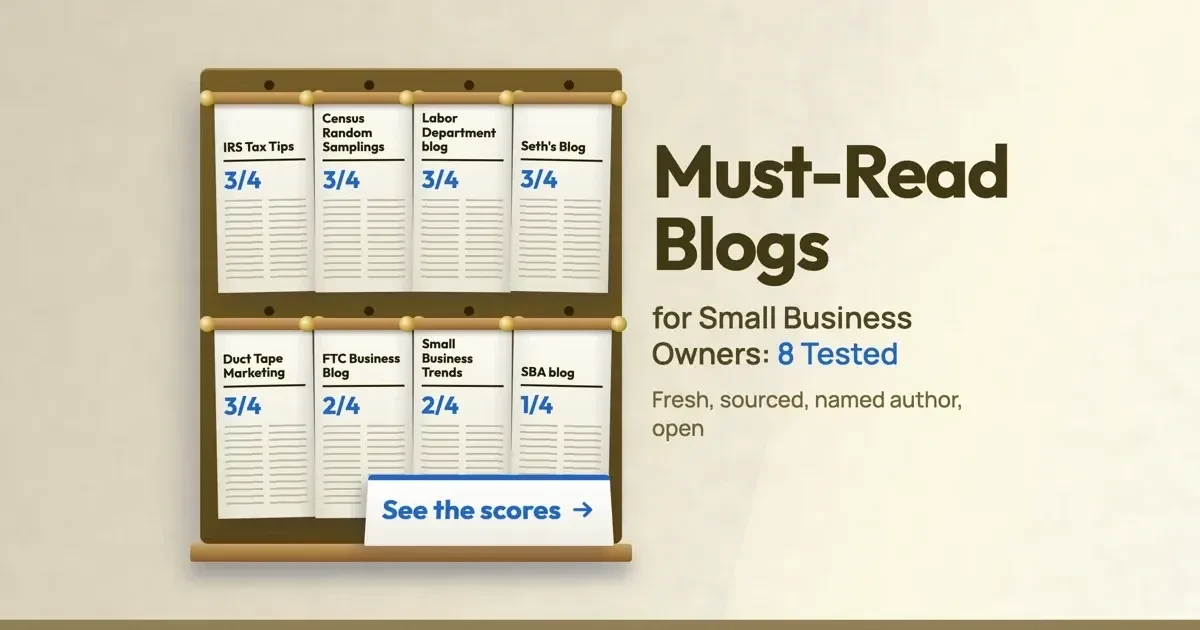
The must-read blogs we'd start with are IRS Tax Tips, Census Random Samplings, the Labor Department blog, Seth's Blog and Duct Tape Marketing. Each passed 3 of our 4 checks as of November 2026, and no blog we scored passed all 4. Pick by the check you care about most, then follow two of them.
Must-read blogs are the ones whose posts you'd act on, even with maybe 20 minutes a week to read while running a shop or a firm. So each should post often, show where its facts come from, name who wrote it and keep its posts free to read.
We scored 8 blogs, five federal and three independent, from their own pages on November 11, 2026. The table keeps the low scores, and the checklist at the end lets you score any other blog the same way.
Key takeaways
- None of the 8 blogs we scored passed all four checks.
- IRS Tax Tips posted 10 tips in 40 days and linked its sources.
- The FTC Business Blog's newest post was 62 days old on November 11.
- Seth's Blog posts daily but linked no sources in its 2 newest posts.
- A paid link needs a clear disclosure under the FTC Endorsement Guides.
How we judged must-read blogs: four checks
We wrote down four checks before we opened a single post, and each one ends in a plain pass or fail. A blog that misses one can still be worth your time, but you'll know which part to double-check.
- Fresh: the newest post is 30 days old or less, and the 10 newest fall within 90 days.
- Sourced: each of the 2 newest posts links twice or more to a form, data table, rule or other site.
- Named author: both of those posts name a person, not just the agency or a staff team.
- Open: neither post shows paywall wording or a link marked sponsored or affiliate.
The sourcing and author checks come from Google's helpful content guidance, which asks whether a page shows "clear sourcing, evidence of the expertise involved". The open check comes from the FTC. Under 16 CFR 255.5, a paid connection between a writer and a seller "must be disclosed clearly and conspicuously." Earning money is fine, and the blog still passes if you can see how it's paid. It's a plain summary of the rule, not legal advice.
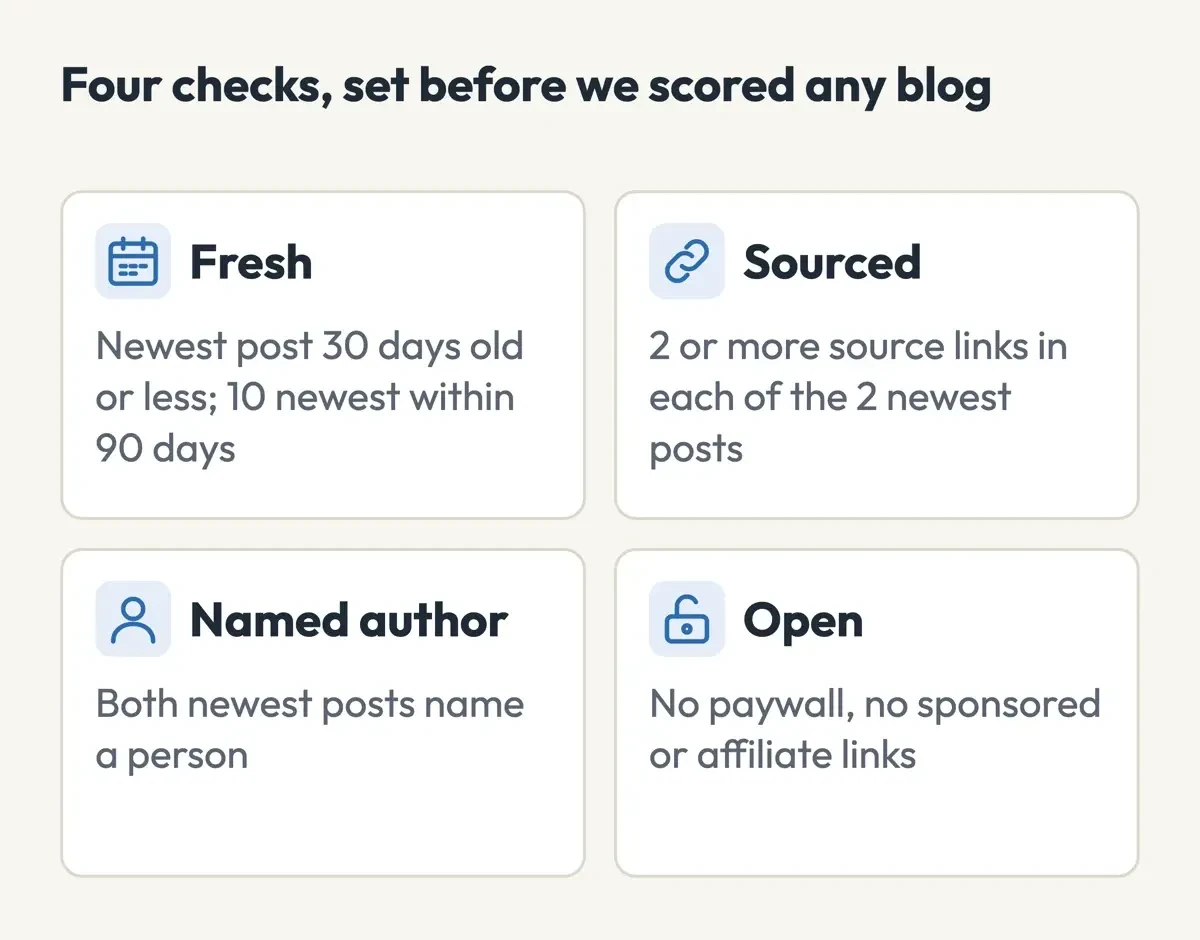 Diagram by DigitalTreed: the four checks and the pass rule for each, set before we scored any blog.
Traffic, followers and awards didn't count.
Fame doesn't predict accuracy. A big audience doesn't mean a post links its source. A blog with 50 readers that cites the IRS form it's explaining is more useful to you than a famous one that doesn't.
What we tested
On November 11, 2026 we saved each blog's index page or RSS feed, plus its 2 newest posts. Each page came from one plain GET request that named our checker in its user agent, with normal certificate checks, and the script read only those saved copies.
SCORE's blog, the SBA Office of Advocacy blog and NFIB's news page returned a 403 error to our script. We left them unscored rather than guess at their dates or links.
Scores for 8 blogs on the four checks
Days old counts back from November 11, 2026, and the span is the gap between the newest and the 10th-newest post.
| Blog | Newest post (days old) | 10 newest posts span | Source links in 2 newest posts | Fresh | Sourced | Named author | Open | Score |
|---|---|---|---|---|---|---|---|---|
| IRS Tax Tips | November 10 (1) | 40 days | 8 + 11 | Pass | Pass | Fail | Pass | 3/4 |
| Census Random Samplings | November 4 (7) | 428 days | 5 + 11 | Fail | Pass | Pass | Pass | 3/4 |
| Labor Department blog | July 30 (104) | 94 days | 7 + 4 | Fail | Pass | Pass | Pass | 3/4 |
| Seth's Blog | November 11 (0) | 7 days | 0 + 0 | Pass | Fail | Pass | Pass | 3/4 |
| Duct Tape Marketing | November 5 (6) | 29 days | 0 + 0 | Pass | Fail | Pass | Pass | 3/4 |
| FTC Business Blog | September 10 (62) | 176 days | 2 + 5 | Fail | Pass | Fail | Pass | 2/4 |
| Small Business Trends | November 11 (0) | about 1 day | 0 + 0 | Pass | Fail | Pass | Fail | 2/4 |
| SBA blog | October 23 (19) | 577 days | 6 + 0 | Fail | Fail | Fail | Pass | 1/4 |
Five blogs tied at 3 of 4. None reached 4, and the tied five got there in opposite ways. IRS Tax Tips, Census and Labor linked their sources but posted slowly or left the writer unnamed. Seth's Blog and Duct Tape Marketing posted often and named their writers, but their two newest posts had no counted source links.
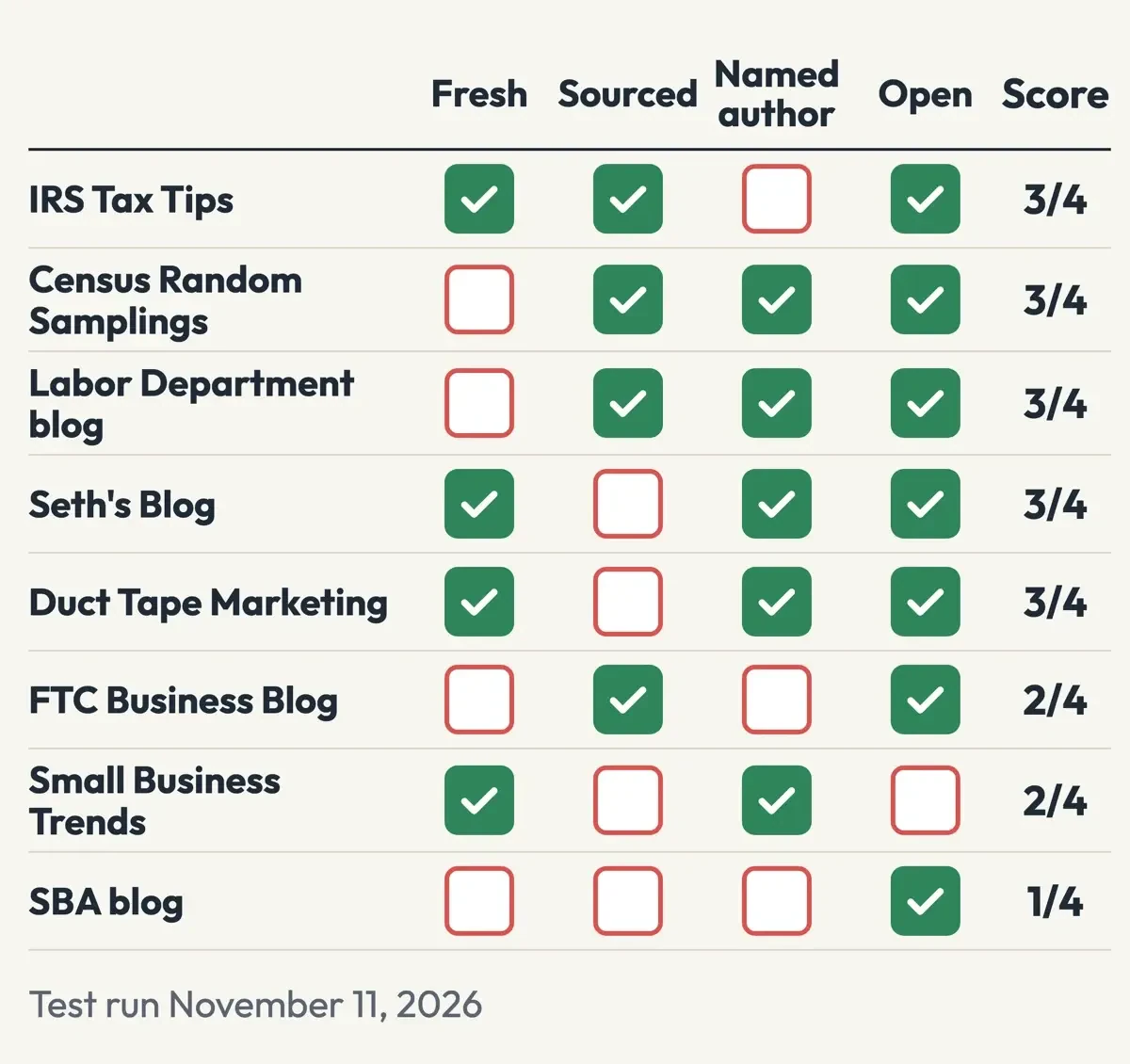 Diagram by DigitalTreed: pass and fail for 8 blogs on 4 checks, from our test run on November 11, 2026.
Two of our choices move the scores. Links to a blog's own other posts didn't count, since they point to more of that blog rather than to the place a fact came from. We also read every remaining link and dropped author profiles, social accounts, podcast players and book stores. That cost Seth's Blog 2 links and Duct Tape Marketing 6.
Government blogs: sourced, but slow or unsigned
Four of the five government blogs linked their sources: the forms, data and rules behind each post. The SBA blog didn't, because its October 7 post linked no source page. None showed paywall or sponsored-link wording either.
IRS Tax Tips
IRS Tax Tips posted 10 numbered tips between October 1 and November 10, 2026. Its index page says the tips are for "taxpayers, businesses and tax professionals". That's about 7.5 a month, using 10 posts / 40 days x 30. It's the fastest federal blog we scored. The two newest had 8 and 11 source links, all to IRS pages except one YouTube video. They include the amended-return page, Form 4506 for copies of old returns and the final-return page for a deceased taxpayer. No tip names a writer, though. Tax Tip 2026-81, on veterans' benefits, carries only its number and date, so it fails our author check.
Census Random Samplings
The Census Bureau's Random Samplings blog names its writers and links straight to its data: 5 and 11 source links in the two newest posts. It's slow, though, at 10 posts across 428 days. The two newest posts were written by Benjamin Gurrentz and Brian Glassman, and both link to the survey pages, methods notes and papers behind their numbers. Its November 4, 2026 post found "nearly 4 in 10 census tracts" with high social vulnerability or low resilience to disasters also had high concentrations of "hard-to-survey" populations. That's handy context if you sell into local markets.
Labor Department blog
The Department of Labor blog names its authors, and its sources reached other sites more than any federal blog we scored. Six of the 7 counted links in its newest post left dol.gov, including two Federal Motor Carrier Safety Administration pages and the Freedom Haulers site at dot.gov. That post, on the Freedom Haulers program, was dated July 30, 2026, which made it 104 days old on our check day. So the blog failed fresh. Its July 24 post by Julie Hocker, on the ADA, linked a Labor statistics page and national ABLE account data. It's still worth a look if you're hiring veterans or apprentices.
FTC Business Blog and SBA blog
The FTC Business Blog scored 2 of 4. Its newest post, announcing a rule guidance program, was signed by the director of the Bureau of Consumer Protection. The post before it was signed "BCP Staff", and the 10 newest posts spanned 176 days. That's under two posts a month. The SBA blog scored 1 of 4. Its October 7 post is signed by the agency and links to no source page. The October 23 post names Kevin Barber, an assistant administrator, and links 6 SBA pages, but the 10 newest posts reach back 577 days, to March 2025. That's half a post a month.
Independent blogs: fresh and named, thin on sources
All three independent blogs posted within the last week and named a person on every post we read. All three also failed sourcing, with zero counted links in their two newest posts, so they work more like a column or a show than a reference.
Seth's Blog, written by Seth Godin, put out 10 posts between November 4 and November 11, 2026. That's more than one a day. Seven of the 10 feed items carry a 10:03 UTC timestamp, so a new post lands at about the same time each day. They're short. Our two samples ran about 50 and 220 words. The only body links in one of them pointed to the author's own book, and the other had none. Read it for ideas on marketing, customers and work, not for facts you'd cite in a plan or a pitch.
Duct Tape Marketing published 10 posts between October 7 and November 5, 2026, which works out to about 10.3 posts a month by the same 30-day formula. Nine of the 10 feed items list John Jantsch as author. The two newest were podcast pages. The episode with Gina London links to the guest's website and a podcast player, which we didn't count as sources. If you'd rather listen than read, that format suits you, but every claim in an episode rests on the guest rather than on a linked source.
Small Business Trends posted 10 feed items on November 10 and 11 alone, each with a named author, and scored 2 of 4. Both posts we read had related-article links marked rel="sponsored", which fails our open check. One said maintenance can extend machinery life by up to 50%, credited to research it didn't link. Treat the independent blogs as opinion and interviews. Zero source links doesn't make a post wrong, but check any number they give against a primary page before you act on it. A 50% claim with no linked study isn't a reason to change your maintenance budget.
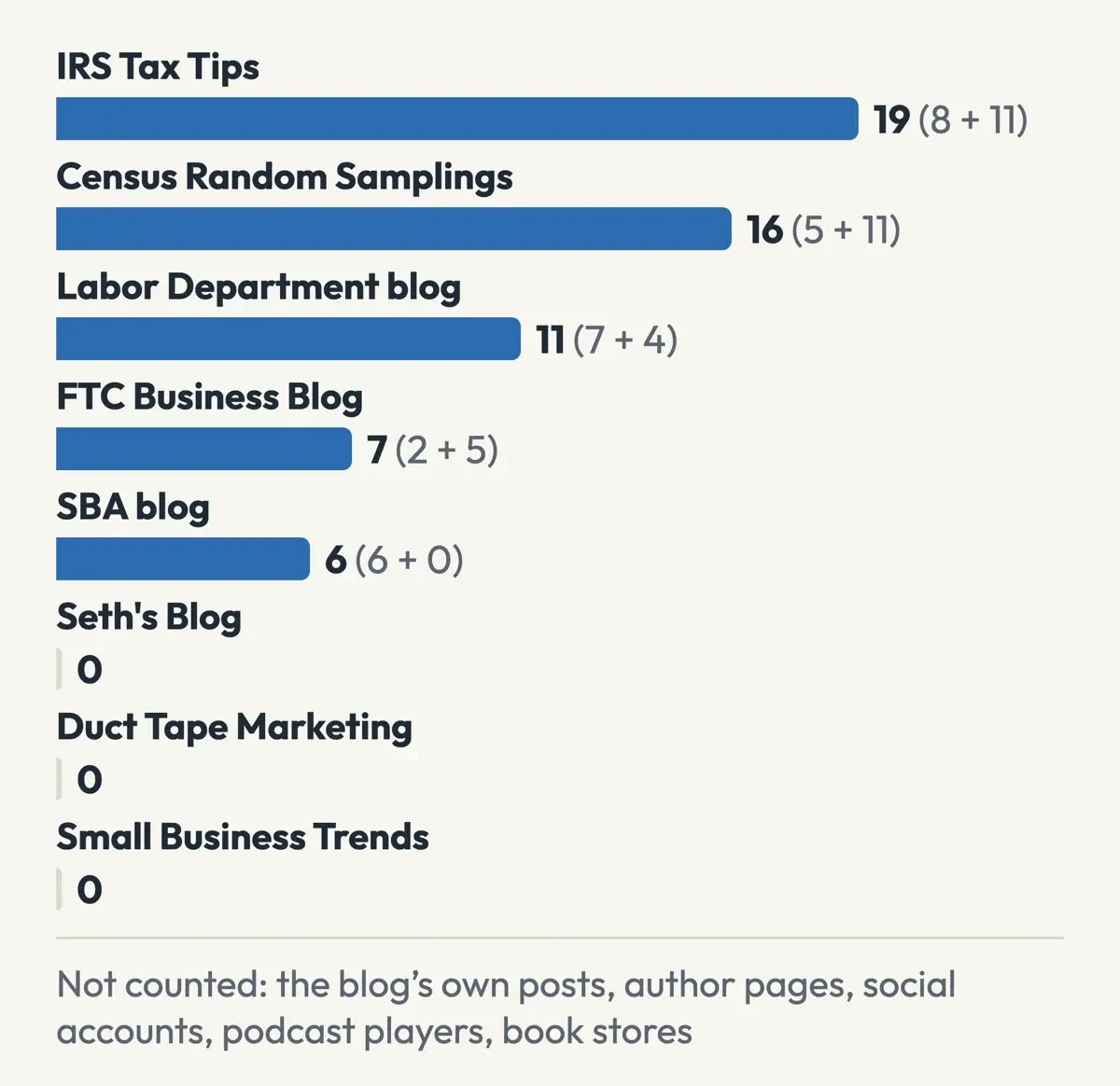 Diagram by DigitalTreed: source links counted in the 2 newest posts of each blog, November 11, 2026.
Which must-read blogs should you follow first?
With about 20 minutes a week, we'd follow two or three of these, matched to the jobs you handle. The SBA blog, at 1 of 4, and Small Business Trends, with its sponsored links, are left off.
- Taxes and deadlines: IRS Tax Tips. It's fresh and sourced, but no writer is named.
- Advertising, reviews and data rules: FTC Business Blog. It's sourced, but slow, so read it monthly.
- Local market numbers: Census Random Samplings. It's sourced and signed, but posts less than once a month.
- Hiring and workplace programs: the Labor Department blog. It's sourced and signed, but last posted in July.
- Marketing ideas: Seth's Blog for daily essays, or Duct Tape Marketing for podcast interviews. Neither links sources.
For a compliance question, the government picks pass the check that matters most, because they link the rule itself. If a tip touches your own return, payroll or hiring, we'd take the linked IRS or Labor page to a CPA or an employment lawyer before acting on it.
If you plan a newsletter of your own, our email marketing plan for small businesses covers the sending side.
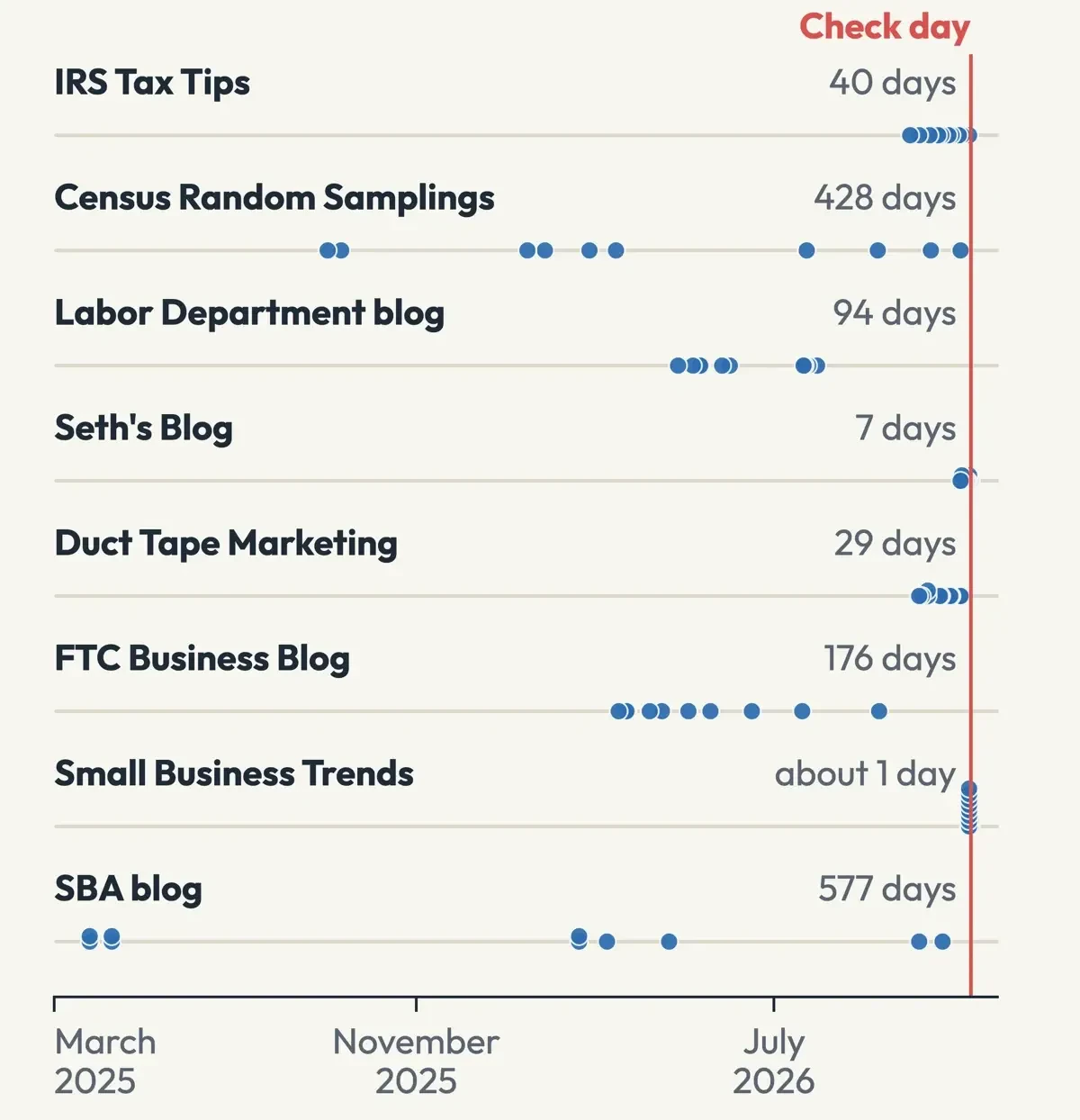 Diagram by DigitalTreed: dates of the 10 newest posts per blog, from saved index pages and feeds.
Run the four checks on any blog yourself
Scores move. The Labor Department blog posted 10 times between April 27 and July 30, 2026, then went 104 days without a post, so fresh turned into a fail. No script is needed to rerun the four checks. A blog's index page or feed and its two newest posts are enough.
- Open the blog's index page or feed and write down the dates of the 10 newest posts.
- Pass fresh if the newest is 30 days old or less and all 10 fall within 90 days.
- Open the 2 newest posts and count body links to forms, data, rules or other sites.
- Skip links to the blog's own posts, author pages, social accounts and stores.
- Pass sourced if each post has at least 2 counted links.
- Pass named author if both posts name a person, not only the company or staff.
- Pass open if neither post has a paywall or a link marked sponsored or affiliate.
If you write a business blog, the same list works in reverse. Our blog marketing explainer and beginner blogging walkthrough cover the setup. When a post carries a paid link, our affiliate links walkthrough covers placement and labels. Once posts are live, our blog promotion plan helps readers find them, and the website audit tool runs a technical check on the pages themselves.
Our history of Google algorithm updates traces how Google's quality rules tightened over the years. Our verified guest post pick states its method the way this list does.
Frequently asked
How do I get IRS Tax Tips by email?
The IRS news bulletins page lists IRS Tax Tips as an email subscription, next to IRS Newswire and IRS Guidewire.
Can I follow the FTC Business Blog by email?
Yes. The FTC's stay connected page has a Business Blog email sign-up, alongside its consumer alerts.
Is the word "affiliate link" enough of a disclosure?
Not always. The FTC endorsement FAQ says readers might not understand that phrase and suggests plain wording about commissions.
Why does a byline matter on a blog?
Google's guidance asks "Do pages carry a byline, where one might be expected?"
How we made this guide: We saved index pages, feeds and the 2 newest posts of 8 blogs on November 11, 2026. A local script scored them on four checks set beforehand, and quotes were matched to the saved copies. Facts checked by the DigitalTreed team on November 11, 2026. No blog paid for a mention.
First published July 2020, naming five news and lifestyle sites with no sources. Rewritten November 11, 2026 for US small business owners, with stated checks and a scored test.
Sources
- IRS: IRS Tax Tips (index)
- IRS: Tax Tip 2026-81, What veterans should know about tax-free benefits (November 10, 2026)
- IRS: IRS news bulletins (email subscriptions)
- FTC: Business Blog (index)
- FTC Business Blog: Announcing the Bureau of Consumer Protection's New Guidance Program (September 10, 2026)
- FTC Business Blog: Veterans, here's help to protect your small business (July 20, 2026)
- FTC: Stay connected
- FTC: FTC's Endorsement Guides, What People Are Asking
- LII: 16 CFR 255.5, Disclosure of material connections
- U.S. Small Business Administration: Blog (index)
- SBA blog: National Veterans Small Business Week 2026 (October 23, 2026)
- SBA blog: Supplier matchmaking expo leads to NRC award (October 7, 2026)
- U.S. Census Bureau: Random Samplings blog (index)
- U.S. Census Bureau: New data show how socially vulnerable communities are harder to survey (November 4, 2026)
- U.S. Department of Labor: Blog (index)
- U.S. Department of Labor: Freedom Haulers (July 30, 2026)
- Seth's Blog (home page)
- Duct Tape Marketing: Blog (index)
- Duct Tape Marketing: How to build executive presence and communicate with confidence
- Google Search Central: Creating helpful, reliable, people-first content

Comments
No comments yet. Start the conversation below.