
Quick answer
Amazon Associates commission rates are a percentage of each qualifying sale, set by product category, and Amazon's home page puts the ceiling at 10%. As of October 2026, Amazon's public rate page lists 10% for Luxury Beauty, 4.5% for Kitchen and 0% for Gift Cards. The rate matters less than you'd think, though: many clicks never become a qualifying sale.
Key takeaways
- Amazon advertises commissions of up to 10%, varying by category.
- Most categories pay 1% to 5%; Luxury Beauty pays 10%.
- A sale counts only inside a 24-hour session.
- Returns, paid ads and your own orders never earn.
- January's commissions arrive in late March.
An Amazon Associates commission is the share of a sale Amazon pays you when a reader clicks your tagged link and buys. Simple enough.
The hard part is the word "qualifying".
This page is the second stop in our Amazon series. If you haven't joined yet, start with how Amazon Associates approval works. We read Amazon's current policies and eleven of its help pages on October 27, 2026, and then tested the rules on a dozen made-up reader journeys.
One more thing first. Back in 2020, this post printed a category table that's now out of date. We swapped it for Amazon's current table, with a date, in the next section.
What are Amazon's commission rates by category?
Amazon's commission rates by category are on its Standard Commission Income Statement page, which opens without a sign-in. Here is the US table as of October 2026. The Associates home page promises "up to 10%" and says commission income "differ based on product category".
| Category (US, as of October 2026) | Rate |
| Luxury Beauty, Luxury Stores Beauty, Amazon Explore | 10% |
| Digital Music, Physical Music, Handmade, Digital Videos | 5% |
| Physical Books, Kitchen, Automotive | 4.5% |
| Apparel, Shoes, Jewelry, Watches, Luggage, Handbags, Amazon devices | 4% |
| Toys, Home, Furniture, Pets, Beauty, Sports, Outdoors, Tools, Baby, Headphones | 3% |
| PC, PC Components, DVD & Blu-Ray | 2.5% |
| Televisions, Digital Video Games | 2% |
| Grocery, Amazon Fresh, Health & Personal Care, Physical Video Games and consoles | 1% |
| Gift Cards, Wireless Service Plans, Alcoholic Beverages, Vehicles, Coach | 0% |
| All other categories | 4% |
Members should still check their own rate card. Amazon's how much you earn page points them to "the Program standard commissions on Associate Central".
Rates move. So check the date on any rate table you find online, including this one.
Amazon can change those numbers, and old copies don't update themselves. Our 2020 post is proof; it reported cuts in that year's rates. When you weigh a category, also weigh its refund rate and typical price.
Two public details still help. Commission is paid on the sale price, not the list price. And the Commission Income Statement warns that rounding to the cent may make your effective rate "slightly higher or lower" than your rate card.
Trade-ins have their own rate: Amazon's Trade-In help page lists 4% of the accepted trade-in value, as of October 2026.
A sale counts only inside the 24-hour session
That brings us to the rule that decides most payouts. Amazon's Commission Income Statement, updated April 14, 2026, opens a "Session" when a reader clicks your link. It ends at whichever comes first: 24 hours after the click, the reader's first order for a physical product, or a click on some other Associate's link to Amazon.
Inside that session, an item counts if it's bought at once or added to the cart. A cart item still earns if the order is placed no later than 89 days after the click. Amazon's cart help page adds that a new click on one of your links "opens a new 24-hour window".
The newest rule is the last link in the chain.
Since April 14, 2026, the item must also be shipped to the reader and paid for within 180 days of the purchase, or it doesn't qualify at all. Amazon's what changed page lists it as an added time limit. That mostly hits pre-orders with distant release dates.
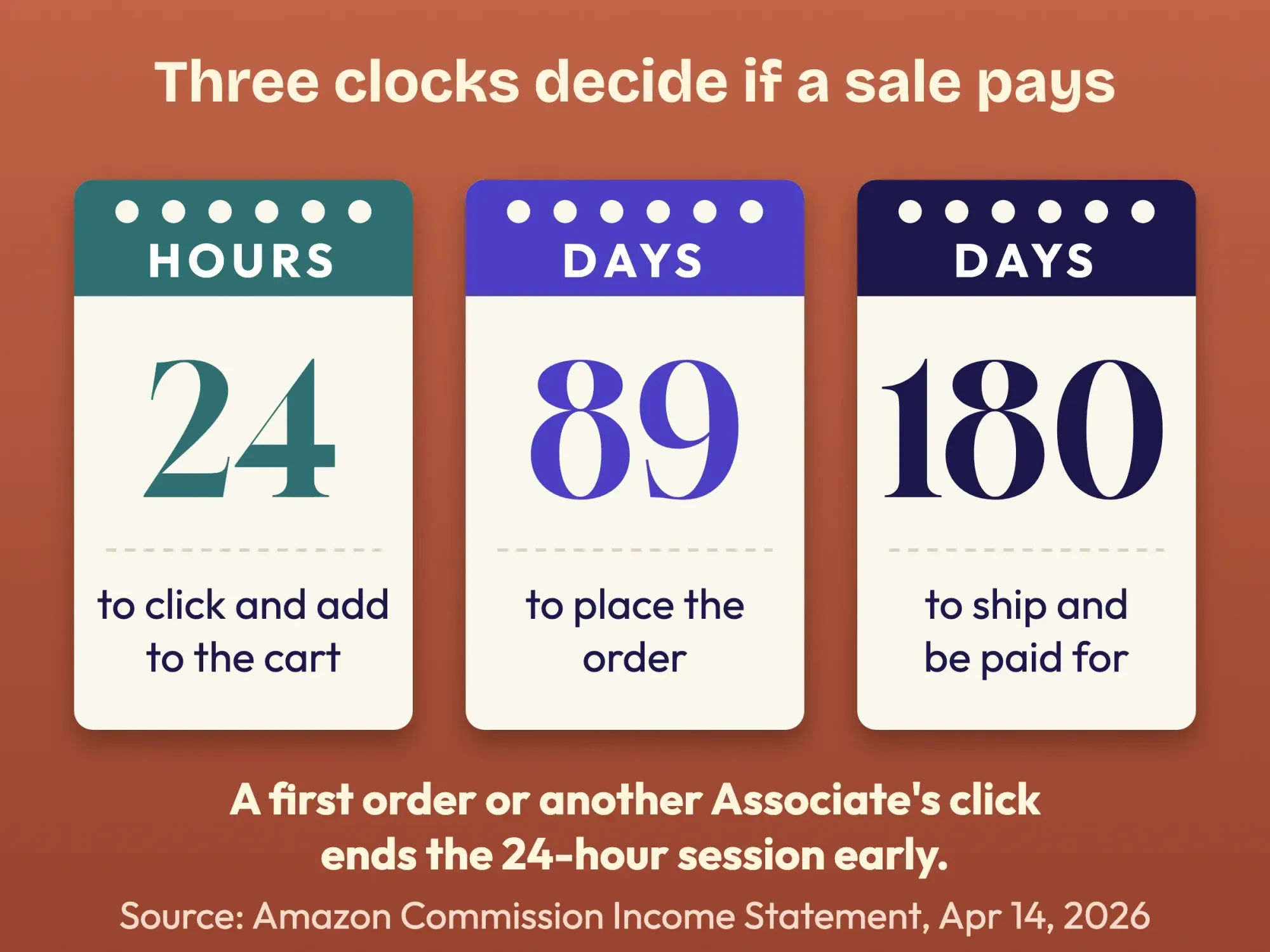 Diagram by DigitalTreed. Limits from the Amazon Associates Commission Income Statement, updated April 14, 2026, read October 2026.
The order rule surprises people most. If a reader buys a snorkel mask, then adds a towel an hour later, the towel doesn't count. The first order already closed your session.
Commission is figured on the sale, minus fees and tax
Once a sale qualifies, Amazon applies your rate to "Qualifying Revenue", not to the checkout total. The Commission Income Statement defines it as the amount Amazon receives minus shipping, gift-wrapping and handling fees. It also strips out taxes, service charges, credits and rebates, plus card processing fees and bad debt, so the base is usually smaller than what the reader paid.
Here's how that plays out on one order.
Example: Tidepool Gear Notes is a made-up snorkeling blog in Port Townsend, Washington. A reader buys a mask listed at $79.99 but selling that day for $64.00, and pays $5.99 for shipping and $4.48 in sales tax (all numbers invented). The commission base is $64.00. Even at the 10% ceiling Amazon advertises on its home page as of October 2026, that order pays $6.40 at most.
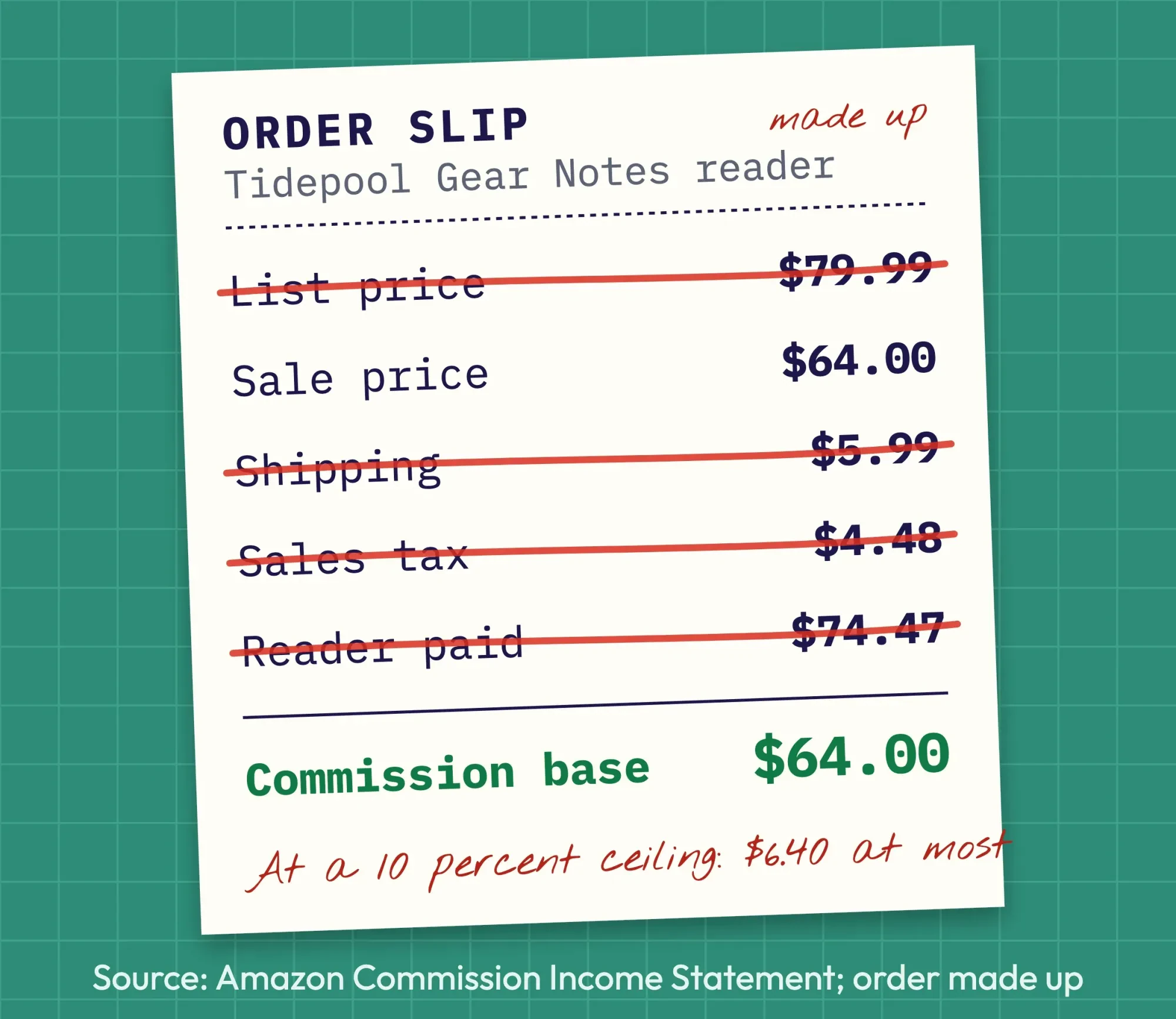 Diagram by DigitalTreed. Made-up order; deductions from the Amazon Associates Commission Income Statement, read October 2026.
Your real figure is $64.00 times the percentage your rate card shows for that category as of October 2026. If Amazon files the mask under Sports, at 3%, it pays $1.92. That's one order. A month of traffic is a bigger sum, and it's the next post's job.
We ran 12 reader journeys through the rules
Rules like these read clearly until you try to apply them to a real reader, so we wrote them into code.
On October 27, 2026, we turned the session and disqualification rules into a short Python script. Then we fed it 12 journeys a reader of Tidepool Gear Notes might take, from a quick mask purchase to a pre-order shipping in 200 days. It ran on this machine only, with no Amazon account and no requests to Amazon. Three of the 12 journeys earned. We picked them to probe the edges, so 3 of 12 isn't a real-world conversion rate.
What it does show is how narrow the window is, because at least two of the nine misses came from readers who were still happily shopping on Amazon.
| Journey (made up) | Earns? | Rule that decided it |
| Buys a mask 20 minutes after the click | Yes | Inside the session |
| Adds fins in hour 5, checks out on day 30 | Yes | Cart order within 89 days |
| Comes back on day 2 and adds a wetsuit | No | Session ended at 24 hours |
| Orders a mask, then adds a towel | No | First order closed the session |
| Clicks our paid social ad to Amazon | No | Paid-ad traffic, April 2026 |
| Pre-order that ships 200 days later | No | 180-day shipping limit |
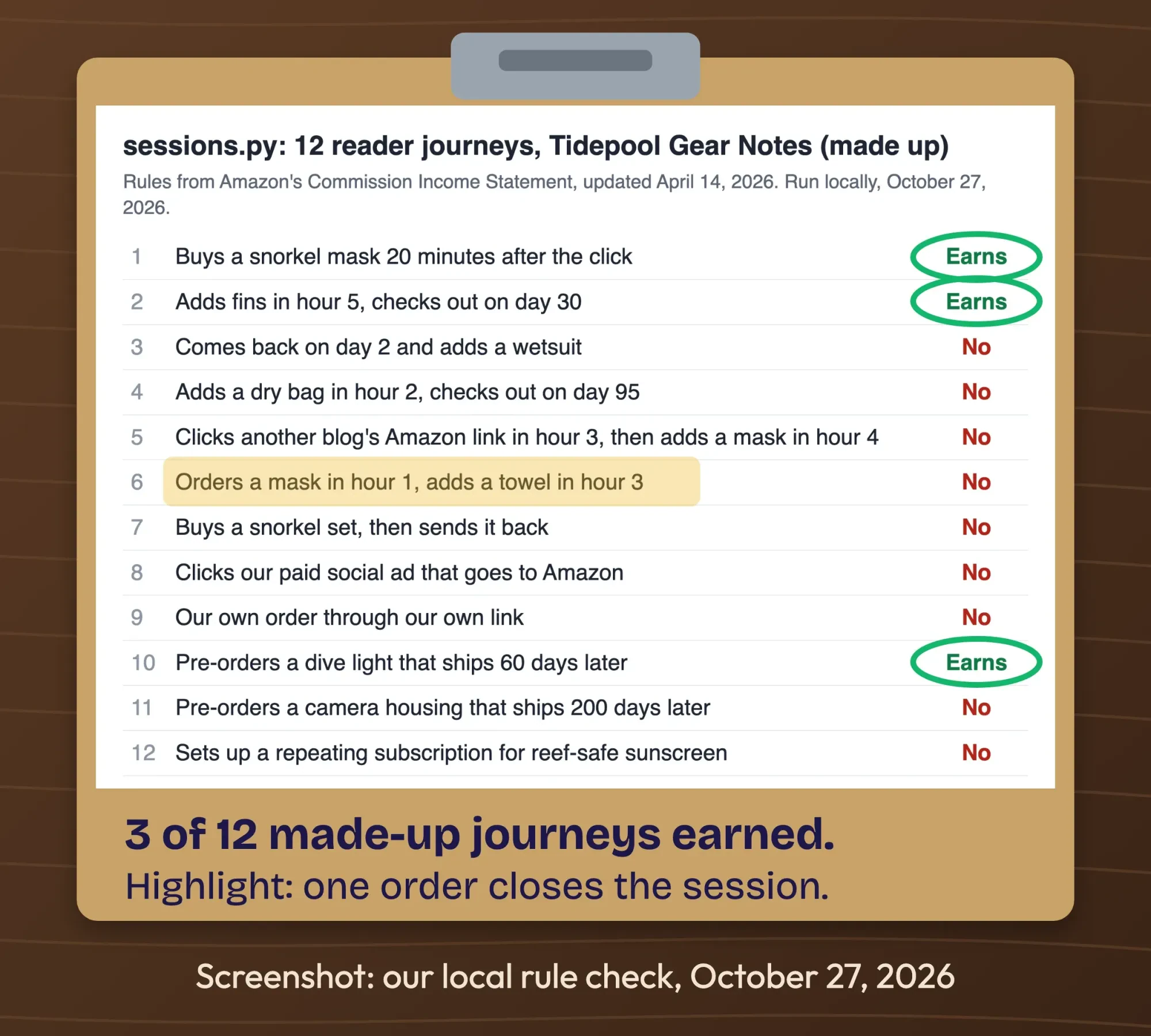 Screenshot: our local scenario report, October 27, 2026, annotated by DigitalTreed. Blog and journeys are made up.
The surprise for us was journey 6. A reader who orders once and then keeps browsing looks like the best kind of reader, but under the session rule only that first order pays you anything.
Some purchases never earn
Even inside a session, the Commission Income Statement disqualifies whole groups of orders. These are the ones a small US blog is most likely to hit:
- Any order where a cancellation, return or refund has started
- Readers sent by an ad you paid for, which since April 14, 2026 means any paid or boosted ad linking to Amazon, with limited exceptions
- Clicks on a link shown on a search engine, such as a paid search ad
- Redirecting links that send readers to Amazon without a click on the page in between
- Links that aren't properly formatted, so the sale isn't tracked
- Products bought as a subscription, unless the agreement says otherwise
- Your own orders, and orders by friends, family or staff
Amazon's personal-use help page explains the last one plainly: it's "an advertising program rather than a discount program".
Some products don't pay at all.
The Products Statement excludes items sold through Product Ads and prescription drugs or other Amazon Pharmacy products. It also excludes alcohol when a licensed US alcohol business runs the site.
Redirects deserve a quick check. If you've used link plugins or short links over the years, paste one into our Redirect Checker and confirm the reader still clicks through to Amazon, not around it. Our post on how to use affiliate links covers clean link placement.
Bounties, bonuses and trade-ins pay on their own terms
Not every payout is a percentage of a product sale. The Commission Income Statement calls these "Special Commission Income", and it lists three kinds. Each has its own trigger.
A Bounty Event happens when a reader clicks your link to a bounty-specific Amazon page and completes the action listed in the Appendix. A Bonus Event follows the same pattern, except the reader starts from a regular Amazon link instead of a bounty page, and finishes a bonus action. Amazon's rate page lists the amounts as of October 2026, such as $12.00 for a Prime Free Trial sign-up. One catch is easy to miss. A product tied to a Bounty Event is excluded from standard commission, so you earn the bounty or nothing.
Trade-ins are the clearest case.
The same rate page lists 4% of the accepted trade-in value for books and consumer electronics. Amazon's two pages disagree on video games: the Trade-In help page says 4%, the rate page says 0%. Don't count on game trade-ins. Only items Amazon accepts count. Example: a reader of our made-up blog trades in an old camera graded at $85.00, which pays $3.40 at the October 2026 rate.
Two more rules round this out. Onsite commission for Influencer content now applies only to direct purchases of the same item variant, per the April 2026 change list. And the statement warns against claiming credit from Amazon and another program for the same traffic.
When does Amazon pay affiliate commissions?
Amazon pays affiliate commissions monthly, about two months after the month you earned them. Its payment schedule page spells it out: "Payment for January is made in late March." December's earnings arrive in late February.
The month closes "at 11:59 p.m. the last day of the month", according to the month-end help page. That cutoff is the line between one payment and the next.
Commissions are earned after the order ships, not when the reader clicks Buy, so an order that's cancelled or hasn't shipped won't show in your earnings report.
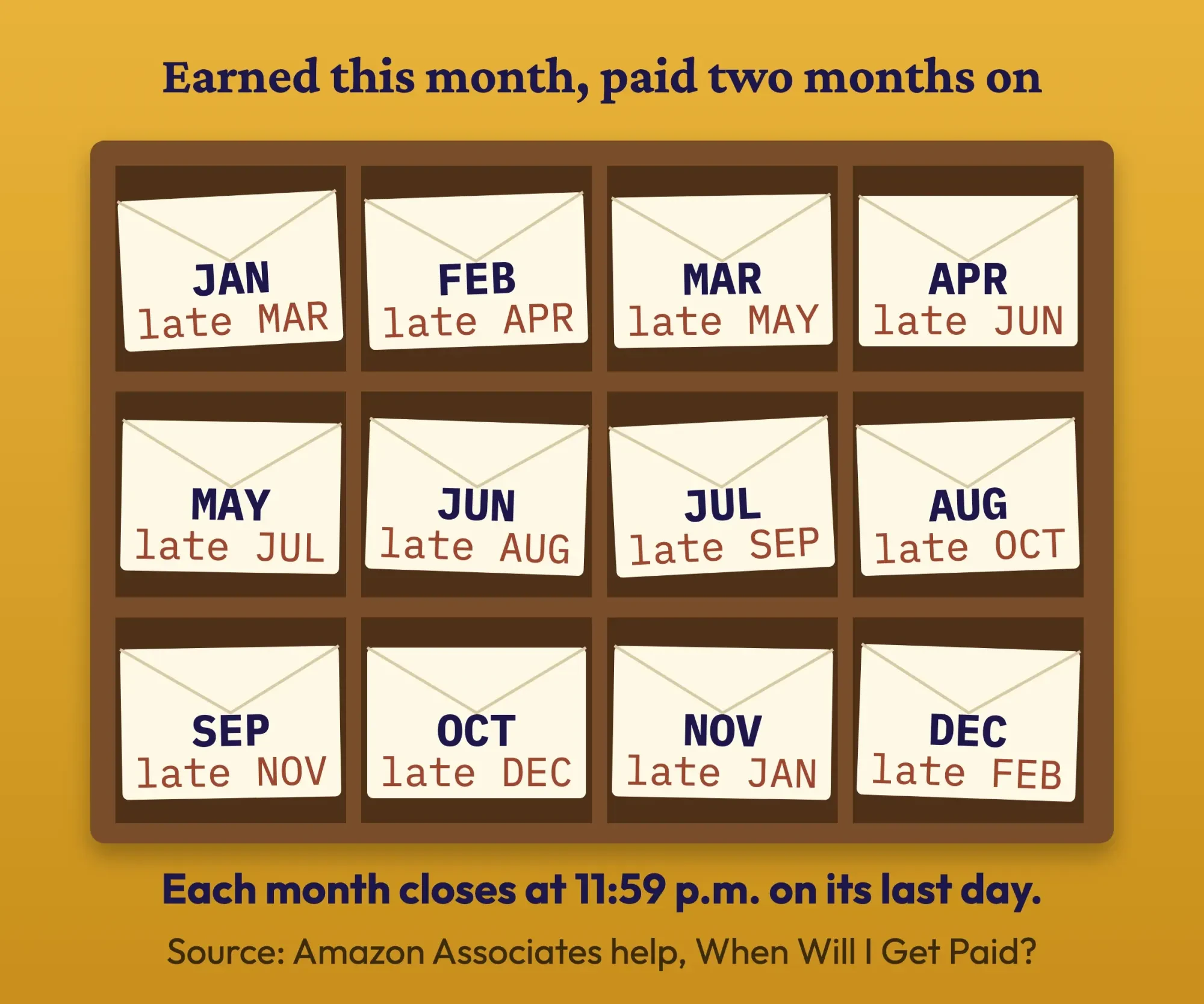 Diagram by DigitalTreed. Schedule from the Amazon Associates help page "When Will I Get Paid?", read October 2026.
If you're paid by check, you can set a higher minimum. Amazon's threshold page says it must be submitted by the first day of the payment month.
That option exists for checks only.
The standard payout minimums and the tax interview live in our Amazon Associates approval guide, which also walks through payment set-up. This isn't tax advice, and a tax professional is the right person to ask what you'll owe.
Rates can change on two business days' notice
So plan for change. Section 13 of the Operating Agreement lets Amazon change the terms by posting a notice or emailing you. Apart from rate increases, which aren't bound by that minimum, a change takes effect no sooner than "two business days" after notice. Rate cuts fall under that window too, and the agreement says your continued participation after the effective date counts as accepting the change.
Our take: build your plans on the rules, which change rarely, and check the rate card each quarter. Don't let one category carry the whole site. Brand deals from blog sponsors and the plans in diversifying revenue streams give you income Amazon can't reprice.
Want to know what this means in dollars? Our next post turns rates and click rates into how much Amazon affiliates make per 1,000 visitors.
Need help planning the reviews and buying guides that earn those clicks? We do that work for US sites; here's what our content team offers. That's our paid service, so read this paragraph as a pitch.
Frequently asked
Do I lose Amazon commission if a customer returns the item?
Yes. If you've already been paid, Amazon's negative balance help page says it deducts the amount from future commission income. You won't have to send money back.
Do I earn commission on items I did not link to?
Yes, if the reader adds them during your session. Amazon's qualifying items page says your links can go to search results, the home page or any other Amazon page.
Do Amazon pre-orders earn commission?
Yes, but they stay pending. Amazon's pre-order help page says the commission remains pending until the launch date, when the item can ship.
When do Amazon Associates earnings show in Payment History?
Amazon's Payment History page says the credit line for your earnings appears "starting from the 5th of each month". The payment line follows later, once the money is sent.
How we made this guide: The DigitalTreed team went through Amazon's rules and rate page on October 27, 2026. We read Amazon's Program Policies and Commission Income Statement (updated April 14, 2026), its Operating Agreement (updated October 15, 2025) and eleven Associates help pages. Category rates come from Amazon's public Standard Commission Income Statement page, read the same day. We built and ran the 12-journey rule check ourselves, offline. You'll find each Amazon page linked beside the claim it backs up.
First published August 2020. Rewritten October 27, 2026: we replaced the outdated 2018 and 2020 rate tables with Amazon's current US table. The post now explains the session rules, Qualifying Revenue, disqualified orders, bounties and trade-ins, and the payout calendar, with our rule check.
Sources
- Amazon Associates: Program Policies and Commission Income Statement (updated April 14, 2026)
- Amazon Associates: Operating Agreement (updated October 15, 2025)
- Amazon Associates: Operating Agreement, What's Changed (effective April 14, 2026)
- Amazon Associates: program home page
- Amazon Associates help: How much do I earn for generating sales through my links?
- Amazon Associates help: What items qualify for commission income?
- Amazon Associates help: How long do visitors have to add an item to their Shopping Cart?
- Amazon Associates help: Standard Commission Income Statement (rates, bounties, trade-ins)
- Amazon Associates help: Can I earn advertising fees promoting Amazon Trade-in?
- Amazon Associates help: Why is there a deduction for personal use?
- Amazon Associates help: Why do I have a negative account balance?
- Amazon Associates help: Pre-order purchases
- Amazon Associates help: When Will I Get Paid?
- Amazon Associates help: When does the month end?
- Amazon Associates help: When do I see my earnings in the Payment History?
- Amazon Associates help: Payment Threshold Settings
Comments
No comments yet. Start the conversation below.