
Quick answer
To diversify revenue streams, add one or two offers next to what you already sell, like add-on services, retainers or a small digital product. Test each for 30 to 60 days before you build it. Our rule of thumb: keep any one client under about a quarter of revenue. And budget for the tax paperwork each new stream brings.
Diversifying revenue streams means earning from more than one client, service or type of payment, so losing any single one doesn't put the business at risk. That's the whole idea. The hard part is picking which stream to add first, and testing it without betting a quarter's profit on a guess.
We wrote this for a US service business: a shop, a consultant, an agency or a freelancer. It covers five streams, how to test each one cheaply, and the sales tax and IRS rules that come with them.
Key takeaways
- Measure top client share, top service share and recurring share first.
- Our rule of thumb: worry when one client tops 25% of revenue.
- Start with add-ons for clients who already pay you.
- Set a pass mark and an end date before testing any new stream.
- Self-employment tax is 15.3% once net earnings reach $400 in a year.
One client or one service shouldn't be able to sink you
That risk usually doesn't arrive as one dramatic loss. It shows up first as uneven income.
In the Federal Reserve's 2024 survey of small employers, 51% named uneven cash flows as a financial challenge, and 56% named paying operating expenses. In the 2025 round, 56% of firms that applied for financing did it to meet operating expenses.
Most US businesses are small enough to feel one lost client right away. The SBA's Office of Advocacy counts 36,207,130 small businesses, 99.9% of all US firms. And the Census Bureau says 30.4 million of them had no employees in 2023, with $1.8 trillion in receipts between them.
That's about $59,000 a year for the average business without employees, by our math.
At that size, one client who pays $20,000 a year is a third of your income. When that client leaves, the problem isn't strategy. It's rent.
How concentrated is your revenue right now?
So before you add a new stream, find out how exposed the current one is. Pull last year's invoices into a spreadsheet and work out three numbers:
- Top client share, which is your biggest client's revenue divided by total revenue.
- Top service share, the same math for your best-selling service.
- Recurring share, meaning revenue that renews on its own each month, like retainers and care plans, divided by the total. It's the number that tells you how steady next month will be.
There's no official cutoff for any of these. Our rule of thumb: worry when one client tops 25%, or when less than a fifth of revenue repeats without a new sale.
If you sell online, your analytics can show which pages and offers bring buyers. Our comparison of website analytics tools explains what each one is good at, and the GA4 walk-through on our site covers counting sales as key events.
Start with add-ons for clients who already pay you
Those numbers usually point to one fix first: sell more to the clients you have. An add-on is a smaller service that's attached to the main one. A web designer adds hosting and monthly updates, a bookkeeper adds payroll, and a landscaper adds seasonal cleanup.
Add-ons are cheap to test because the hardest part of any sale, earning trust, is already done. You've done it. You don't need ads, a new website or a new audience. You need a price, a one-paragraph description and an email to your last 10 clients.
Price them like you mean it. We broke down what a digital marketing agency costs, including how agencies split one-off projects from monthly work, and the same split works for most services.
Our take: start with add-ons, then a workshop or a retainer pilot, and leave digital products and licensing until those are running. They're slower to build and they bring the most paperwork.
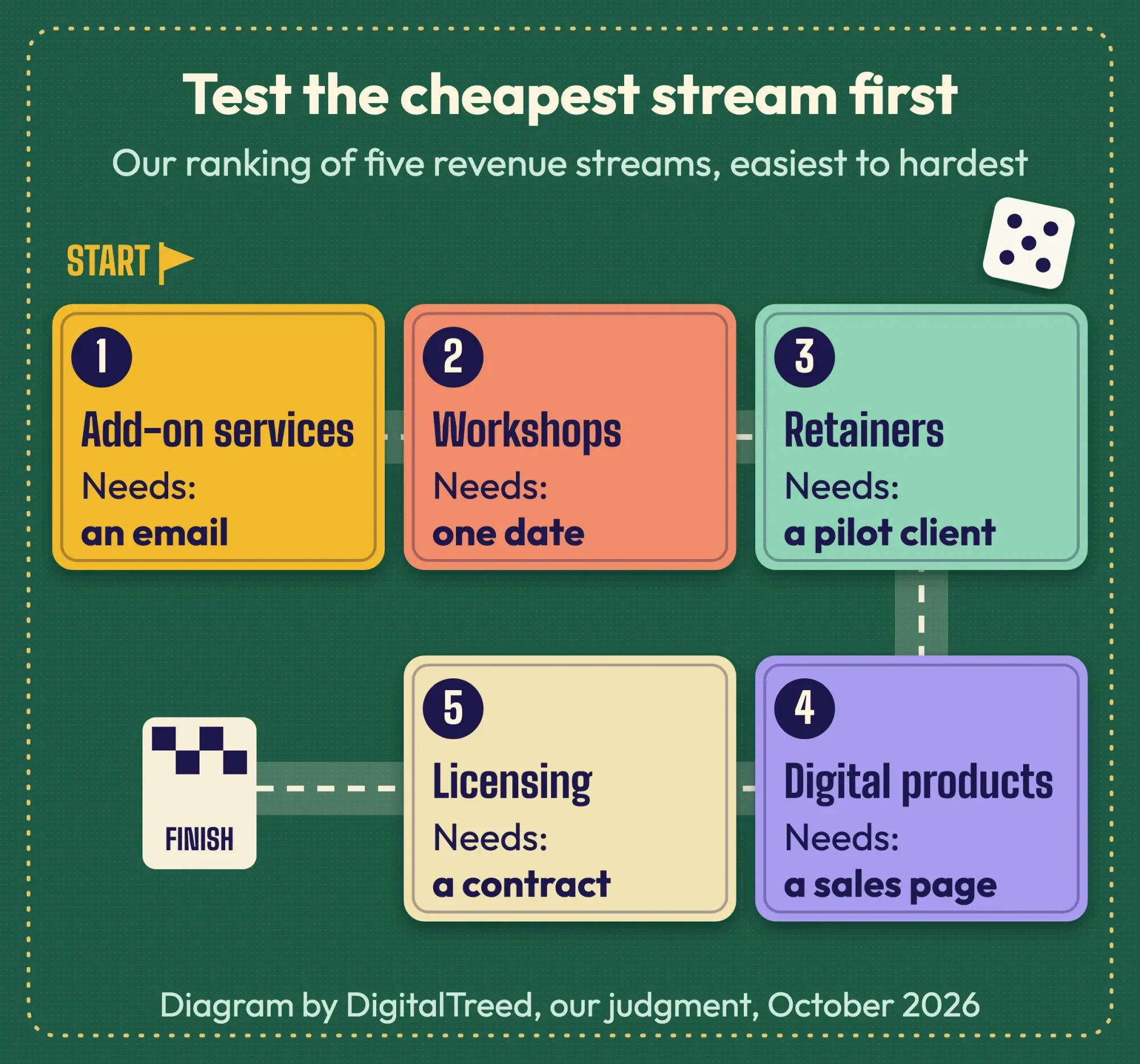 Diagram by DigitalTreed: our ranking of the five streams by how cheap they are to test, October 2026.
Retainers trade a bigger invoice for steadier months
Once add-ons sell, a retainer goes one step further.
Your client pays a fixed amount each month for a defined amount of work, so you earn less per hour than on a rush project but you know what's coming in next month.
The risk is scope creep. A retainer without a written scope can turn into unlimited work for a fixed fee surprisingly fast. Write down what's included, how many hours or deliverables you'll deliver, what happens to unused hours, and how either side can end it.
Test it with one client. Offer a three-month pilot with a clear end date and a review call in week 10. If the client renews, you've got a product. If not, you've lost nothing but a quarter of slightly lower margins.
Keep the new offer in the same voice as your main one. Our branding strategy plan explains why customers trust a business that sounds the same on every page.
Digital products scale, but the buyer's state decides the tax
Still, retainers sell your hours. A digital product doesn't: a template, a checklist, a short guide or a recorded course is built once and sold many times.
That's the appeal, and also the trap. It's easy to spend three months building a course nobody asked for. So check demand first. Run the topic through our free keyword suggestions tool to see what people actually search, then put up a sales page with a price and a payment link before you build anything.
Two questions from the SBA's market research guide matter here: "Is there a desire for your product or service?" and "What do potential customers pay for these alternatives?"
Then pick how to take payment. A platform that acts as merchant of record handles sales tax for you, for a cut. Gumroad, for example, lists 10% plus $0.50 per direct sale (30% when buyers find you through its Discover marketplace) as of October 2026 and says it handles sales tax collection [vendor data]. Selling from your own site keeps more money, but tax collection is then your job. We've covered what it costs to take card payments separately, and whether your business needs a website yet if you don't have one.
If you want a product page or a small shop built properly, that's web development work we do every week. (Full disclosure: we sell it, so we're not neutral here.)
Workshops are the fastest way to see if people will pay
Unlike a digital product, a workshop can be tested in days. You don't need weeks.
Pick one date, one topic you'd already teach clients for free, and a room or a video call with 10 to 15 seats.
Sell the seats before you write the slides. Set a minimum, say eight tickets, and a promise to refund everyone in full if you don't hit it. If you sell out, run it again next month. If three people buy, you've still learned something, and it didn't cost much.
One paperwork note. Ticket money paid through a payment app or marketplace may come with a Form 1099-K, which the IRS says is required once payments total over $20,000 in more than 200 transactions. Smaller amounts still count as income, which comes up again below.
Licensing and partnerships only pay if you own the work
Beyond selling your own time, there's licensing: letting another business use something you made, like a template, a training course or a set of photos, for a fee or a royalty. Partnerships are looser: a referral deal with a firm that serves the same customers, or a joint offer you both sell.
Check ownership first. Client work you were paid to make may not be yours to license, because your contract may have assigned the copyright to the client. Under federal law, a transfer of copyright ownership is only valid in a signed writing. And commissioned work counts as work made for hire only in listed categories when both sides sign an agreement saying so. So read your client contracts before you license anything you built for one.
Referral and affiliate deals need a disclosure. The FTC wants that relationship disclosed "clearly and conspicuously" on your site. Its FAQ even offers sample wording: "I get commissions for purchases made through links in this post." Our post on sponsored blog posts and FTC disclosure goes into the wording.
Run a blog or newsletter? Paid placements can become a stream too. A media kit is how you price and pitch them.
Test each new stream for 30 to 60 days before you build it
So every stream above can be tested before it's built. Here's the routine we'd use for any of them:
- Write the offer in one paragraph. Say who it's for, what they get, the price and the start date. If it won't fit in one paragraph, it isn't ready to sell.
- Set a pass mark and a budget. Decide in advance what counts as a yes, for example 5 paid sign-ups, and the most you'll spend testing it.
- Offer it to people who know you. Email past clients and your list first. Strangers cost ad money. Your own clients cost an email.
- Tag every link. Add UTM tags to each link you share, so your analytics shows which email or post brought each sale.
- Take money, not compliments. Count pre-orders, deposits or booked calls. Likes and "sounds great" aren't a result.
- Keep, change or drop it. At the end date, compare the result with your pass mark. If it missed by a wide margin, drop it and don't look back.
The UTM builder on our site makes the tags for step 4. It takes seconds.
That kill rule matters most. Most failed streams don't fail fast, and that's the problem. They limp along for a year, eating evenings, because nobody set a date to decide.
Is a downloadable product taxable? We checked five states
Once a test works, the next question is tax.
Testing tells you whether people will buy. Tax tells you what you keep, and for digital products that depends on where each buyer lives.
On October 25, 2026, we read the revenue department pages of five states for one question: does a seller charge sales tax on an e-book or a piece of software sold as a download? The answers split three ways. Washington and Pennsylvania said yes to both. California said no today, but its rule for software changes on January 1, 2027. New York's page answered only for software. Texas's remote seller page gave a revenue threshold instead of a product rule.
| State (page read October 25, 2026) | E-book sold as a download | Prewritten software or app, downloaded |
|---|---|---|
| Washington DOR | Taxable: tax applies to "all digital products" | Taxable, as prewritten software under WAC 458-20-15502 |
| Pennsylvania DOR | Taxable at 6%, e-books listed | Taxable, downloaded apps listed |
| California CDTFA, through December 31, 2026 | Generally not taxable | Generally not taxable with no physical copy |
| California CDTFA, from January 1, 2027 | Still not taxable: "digital book" is excluded | Taxable, and software as a service too |
| New York Tax Department | Not covered on the page we read | Taxable however it is delivered |
California's change comes from Senate Bill 122. The CDTFA guide says that beginning January 1, 2027, sales and use tax "generally applies to the retail sale of a digital product" in the state. The definitions page limits that to prewritten software and software as a service, and leaves out e-books, music and video.
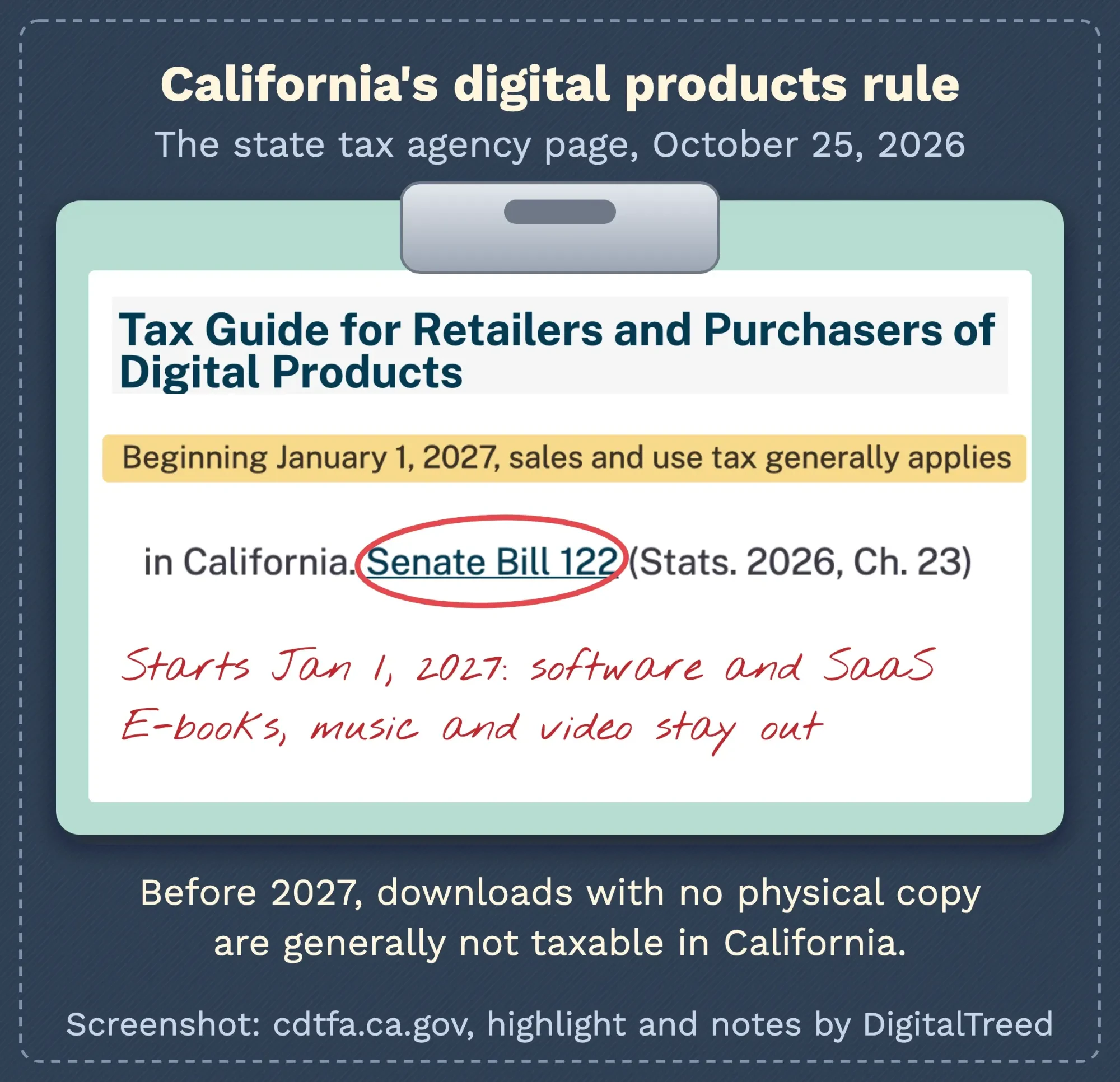 Screenshot: CDTFA, Tax Guide for Retailers and Purchasers of Digital Products, taken October 25, 2026, highlight added by us.
You may owe tax in states where you have no office. In 2018 the Supreme Court overruled the physical presence rule in South Dakota v. Wayfair, upholding a law that reached sellers with more than $100,000 of sales or 200 or more transactions a year in the state. Each state sets its own number, and they don't all match. Texas, for one, doesn't require a remote seller to collect if its Texas revenue is under $500,000 over the previous 12 calendar months.
Check your own states before your first sale. Or use a platform that'll collect the tax for you.
Every new stream adds tax paperwork
That's the state side. The federal side is income and self-employment tax, and it applies to every stream on this page.
For a sole proprietor or single-member LLC, profit from a workshop or a template is self-employment income. The IRS sets the self-employment tax at 15.3%, which covers Social Security and Medicare, once net earnings reach $400 in a year. New income can also mean quarterly payments: the IRS expects estimated tax payments if you'll owe $1,000 or more when you file.
The 1099 rules changed for 2026. Businesses that pay you for services report it on Form 1099-NEC once payments reach a threshold, and the IRS says that threshold increased to $2,000 for tax years beginning after 2025. Royalties are different: a licensee reports them on Form 1099-MISC from just $10. And when you pay a partner or contractor yourself, get a Form W-9 first and keep it for four years.
Where royalties go on your return depends on your work. The IRS says you report them on Schedule E in most cases, but on Schedule C if you're in business as a self-employed writer, inventor or artist.
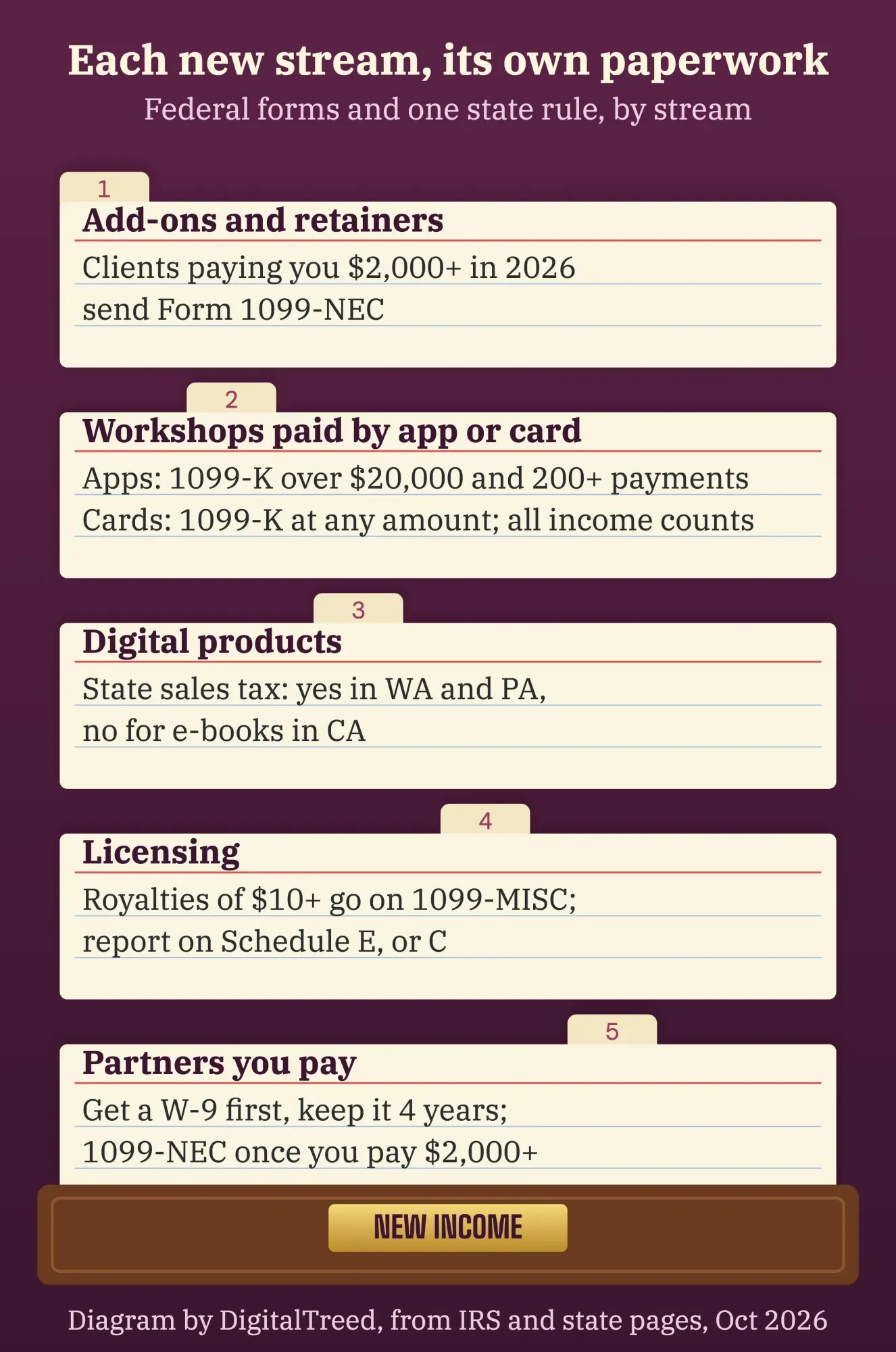 Diagram by DigitalTreed, from IRS and state revenue pages read October 25, 2026.
Please treat this section as a map of the IRS and state pages we read, not tax or legal advice for your business.
A CPA or enrolled agent can tell you what applies to your setup, and that hour is worth booking before your first quarterly payment.
Example: how Tidemark Studio could get its biggest client from 35% to 26%
Now put the pieces together for one business.
Example: Tidemark Studio is a made-up two-person web design studio in Bellingham, Washington. Last year it earned $180,000. Website builds brought in $162,000, or 90%, and hosting brought in the other $18,000. Its biggest client paid $63,000, which is 35% of the total.
Over the next year, the owners plan four new streams and fewer new builds:
- Care plans that bundle hosting with monthly updates, replacing the $18,000 of hosting: 20 clients at $150 a month, or $36,000 a year.
- SEO and content retainers: 4 clients at $1,200 a month, or $57,600.
- A website launch checklist kit: 300 sales at $49 is $14,700, minus Gumroad's 10% plus $0.50 per sale ($1,620), so $13,080.
- Four half-day workshops: 12 seats at $199 each time, or $9,552.
- One template license to a local agency at $250 a month, or $3,000.
With builds cut to $120,000, the plan totals $239,232. Builds fall to 50% of revenue, and $96,600, about 40%, now repeats every month without a new sale. The $63,000 client is still welcome, but it's now 26% of the business instead of 35%.
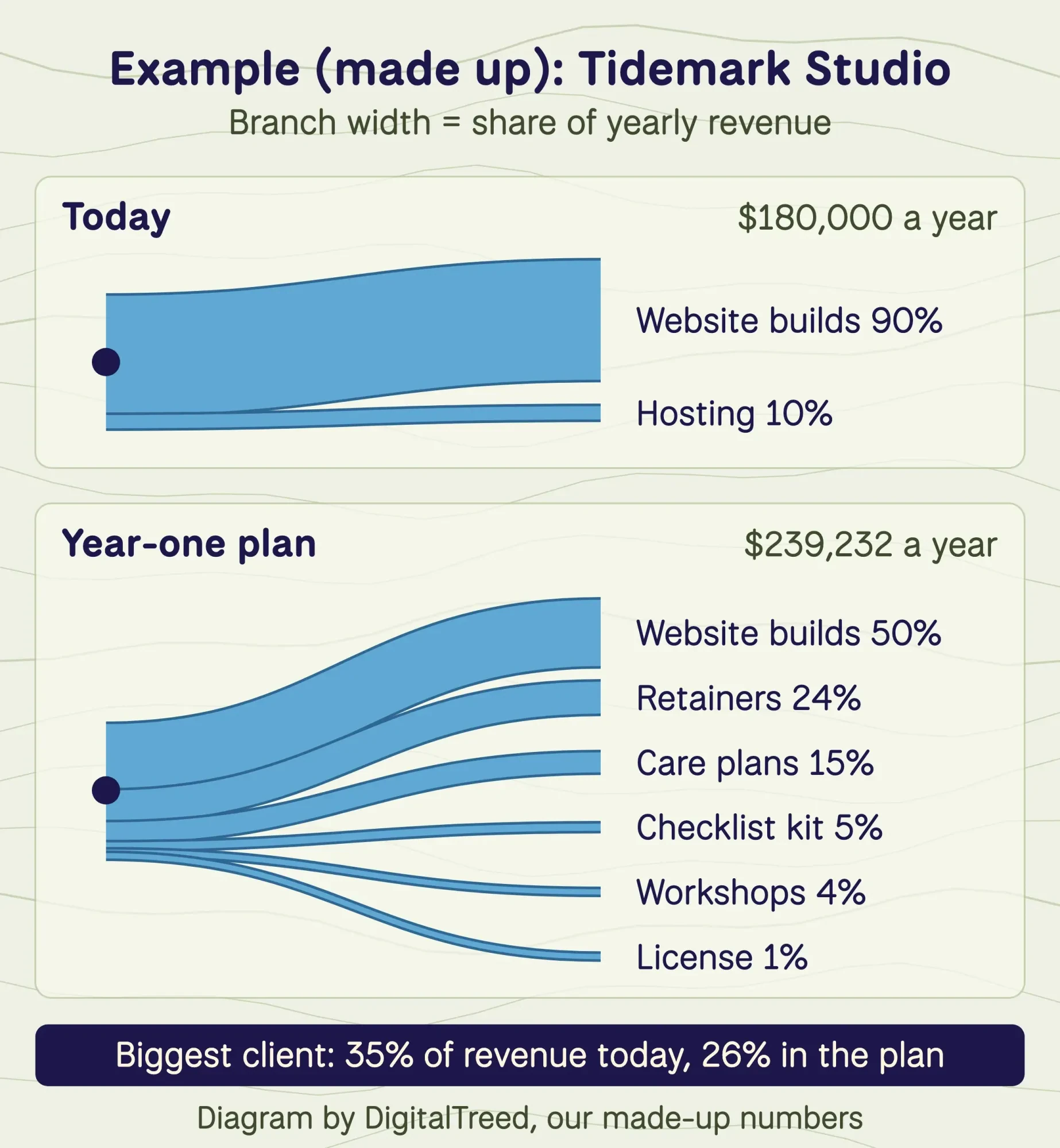 Diagram by DigitalTreed: the made-up Tidemark Studio example, our numbers.
Two catches. Washington taxes digital goods, so Gumroad, as merchant of record, collects that sales tax on the kit; if the studio sold it from its own site instead, collecting it from Washington buyers would be the studio's job. And the workshops, after $600 of room rental, leave $8,952 of profit that's subject to the 15.3% self-employment tax on most of it, so more than $1,000 before income tax. Our guide to building an online store covers checkout and sales tax setup if you sell direct.
When diversifying is the wrong move
None of this helps if the main business is broken, though. Adding streams spreads your time thinner, and some businesses need focus more than options.
Skip it for now if your core service loses money, because a new stream won't fix your pricing. Skip it if you're already turning work away, since you won't deliver a second thing well. And never launch three streams at once: you won't know which one worked.
One new stream, tested properly, beats five half-built ones.
If you'd like help setting up the page, shop or tracking for your first test, tell us what you sell and get a quote.
Frequently asked
How many revenue streams should a small business have?
There's no official number. For a small service business, we'd aim for two or three that you run well, with no single client above about a quarter of revenue. That's our rule of thumb, not a legal or IRS rule.
Do I need a new LLC or partnership to team up with another business?
Not always. A written referral or license agreement is often enough to start. The SBA says partnerships can be a good choice for "groups who want to test their business idea before forming a more formal business."
If I get a 1099-K, do I owe extra tax?
No. The form doesn't add tax; it reports payments. But the IRS says that no matter the amount reported, income from selling goods or services must all go on your tax return.
How we made this guide: on October 25, 2026 we read each IRS page and instruction cited here, the Census and SBA figures and both Federal Reserve survey reports. We also read the revenue department pages of Washington, Pennsylvania, California, New York and Texas. We screenshotted California's digital products guide with no account signed in and checked the Tidemark Studio math line by line (the studio itself is made up). The stream rankings and test budgets are our judgment. Each fact links to its source where it appears. Eram N. reads and approves this rewrite before we publish it.
First published July 2023. Rewritten October 25, 2026: now a plan for US service businesses, with a concentration check, five streams and how to test each, our five-state sales tax check, the 2026 IRS 1099 changes and a worked example. The generic list and the YouTube links are gone.
Sources
- SBA Office of Advocacy: Frequently Asked Questions About Small Business 2026
- U.S. Census Bureau: characteristics of employer and nonemployer business owners (2023 data)
- Federal Reserve Banks: 2025 Report on Employer Firms (2024 Small Business Credit Survey)
- Federal Reserve Banks: 2026 Report on Employer Firms (2025 Small Business Credit Survey)
- SBA: Market research and competitive analysis
- SBA: Choose a business structure
- IRS: Self-employment tax (Social Security and Medicare taxes)
- IRS: Estimated taxes
- IRS: Instructions for Forms 1099-MISC and 1099-NEC (Rev. December 2026)
- IRS: Understanding your Form 1099-K
- IRS: Forms and associated taxes for independent contractors
- IRS: Publication 525, Taxable and Nontaxable Income
- South Dakota v. Wayfair, Inc. (2018), via Cornell LII
- Washington Department of Revenue: Digital products including digital goods
- Washington State Legislature: WAC 458-20-15502, computer software
- Pennsylvania Department of Revenue: Digital products
- CDTFA: Publication 109, Internet sales, nontaxable sales
- CDTFA: Tax guide for retailers and purchasers of digital products
- CDTFA: Digital products definitions
- New York Department of Taxation and Finance: Computer software (ST bulletin)
- Texas Comptroller: Remote sellers and marketplace FAQ
- 17 U.S.C. 204, execution of transfers of copyright ownership (Cornell LII)
- 17 U.S.C. 101, definitions including work made for hire (Cornell LII)
- FTC: Endorsement Guides, what people are asking
- Gumroad: Pricing (vendor page)

Comments
No comments yet. Start the conversation below.