
Quick answer
How much Amazon affiliates make comes down to one sum: visitors x click rate x order rate x order value x category rate, minus returns. In our made-up kitchen example, 1,000 visitors earn about $34. Amazon promises no amount at all, so treat any income claim you read as one site's luck, not a forecast.
Key takeaways
- Earnings are five numbers multiplied together, minus returns.
- Our made-up kitchen example earns $34.20 per 1,000 visitors.
- A 10% category didn't beat a 4.5% one in our example.
- Returns, your own orders and 0% categories pay nothing.
- Use your own Search Console and Associates reports, not anyone's screenshot.
How much do Amazon affiliates make? Nobody can tell you your number, and Amazon won't try. Its Operating Agreement says it makes no "representation, warranty, or covenant regarding the amount of traffic or commission income you can expect".
What we can give you is the math.
This page is step 3 of our Amazon series. If you haven't joined yet, start with how Amazon Associates approval works. The rates per category have their own page, so here we only borrow a few of them.
Amazon affiliate earnings are five numbers multiplied
Amazon affiliate earnings are the commission Amazon pays you on qualifying orders that start with a click on your tagged link. Picture a reader on your stand mixer review who clicks your link, buys the mixer on Amazon, keeps it past the return window and never thinks about you again.
You get a slice of what they paid. That slice depends on five things:
- Visitors: people who reach the page with your links
- Click rate: the share who click through to Amazon
- Order rate: the share of those clicks that end in an order
- Order value: what the average order is worth
- Category rate: the percentage Amazon pays for that kind of product
Then take returns off. Amazon pays a percentage of "Qualifying Revenue", and its Commission Income Statement defines that as what Amazon receives, less shipping, taxes, gift wrap and similar charges.
Category rates top out at 10%.
The program's home page reads "Earn up to 10%", yet most categories pay far less, which is why the other four numbers in the sum matter so much.
Example: Sheet Pan Notes and its first 1,000 visitors
So let's run the five numbers once, slowly.
Example: Sheet Pan Notes is a made-up kitchen-gear blog in Pueblo, Colorado. Every traffic and sales number below is made up too. Only the rate is real: Kitchen pays 4.50% as of October 2026, per Amazon's help page.
Say 1,000 people read its mixer roundup in a month, and 20% of them click one of the product links, which gives the blog 200 clicks to Amazon. If 8% of those clicks order, that's 16 orders. At $50 an order, that's $800 of sales.
Now take off 5% for returns, which leaves $760. Then 4.5% of $760 is $34.20.
That's $0.0342 per visitor.
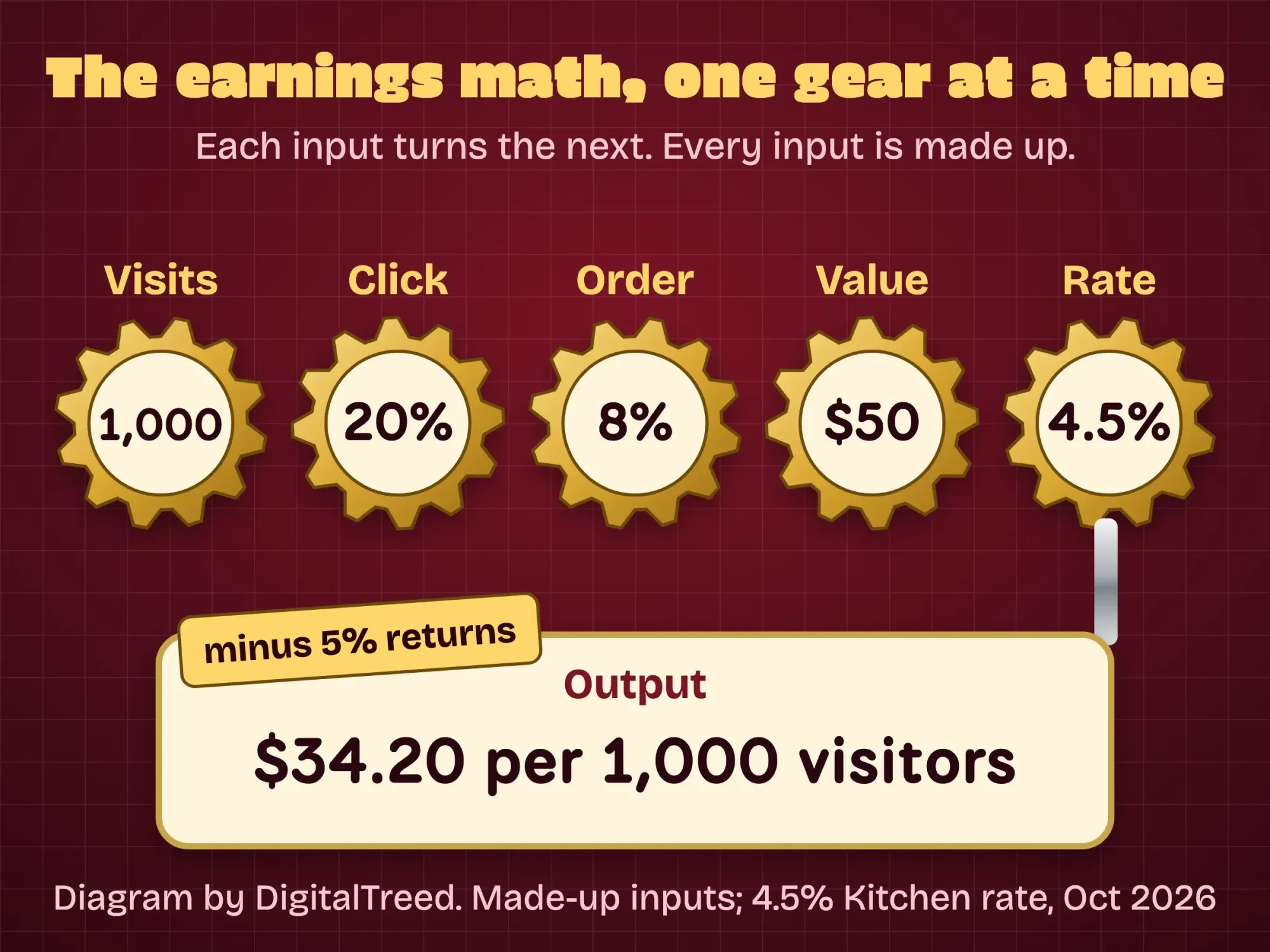 Diagram by DigitalTreed. Every input is made up for this example; the 4.5% Kitchen rate is from Amazon Associates help, October 2026.
We built a small calculator page to check that sum. It ran on our own machine on October 27, 2026, with no Amazon account and no live data. It gave the same $34.20, and the screenshot below is that page.
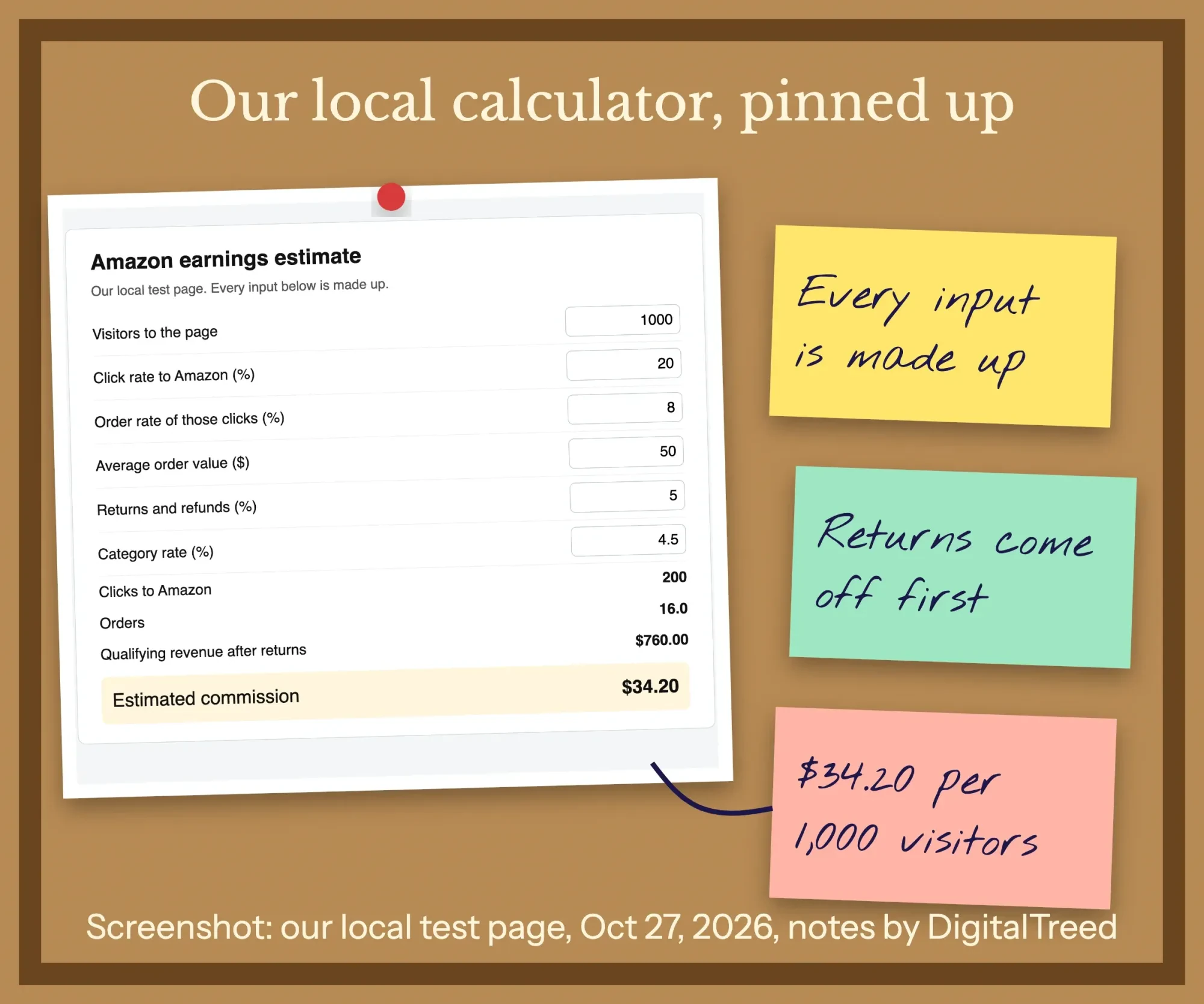 Screenshot: our local test page, October 27, 2026, with notes by DigitalTreed. All inputs are made up.
How much traffic does $1,000 a month take?
At the example's made-up rate of $34.20 per 1,000 visitors, $1,000 a month takes about 29,240 visitors to pages like that one. That's every month, not once.
Change one input and the answer moves a lot.
When we raised only the click rate from 20% to 30% in our calculator, the same 1,000 visitors earned $51.30 instead of $34.20, with nothing else changed. A $50 order rising to $80 gave $54.72. Those are levers you can pull with better pages and better product picks.
Where do the visitors come from? For most blogs, search. Monthly search ranges in Google Keyword Planner are a fair place to start, as our guide explains, but treat them as rough ranges rather than promises of traffic.
A page that ranks for a 2,000-search keyword won't get 2,000 visitors. It gets its share of the clicks, which is the next number to measure.
Three niches, nearly the same money
Rates get most of the attention when people pick a niche, so we ran the same made-up 1,000 visitors through three niches whose rates sit far apart on Amazon's list.
| Made-up niche | Clicks | Orders | Avg order | Returns | Rate (Amazon, Oct 2026) | Earned |
| Kitchen gear | 200 | 16 | $50 | 5% | 4.50% | $34.20 |
| Headphones | 150 | 9 | $120 | 10% | 3.00% | $29.16 |
| Luxury skincare | 100 | 5 | $70 | 4% | 10.00% | $33.60 |
The 10% category didn't win. That rate covers only Amazon's Luxury Beauty category; regular Beauty pays 3.00%. In our made-up inputs, luxury buyers clicked and ordered less, so the high rate only caught up. Headphones had the biggest orders but the lowest rate of the three on Amazon’s list, and the most returns.
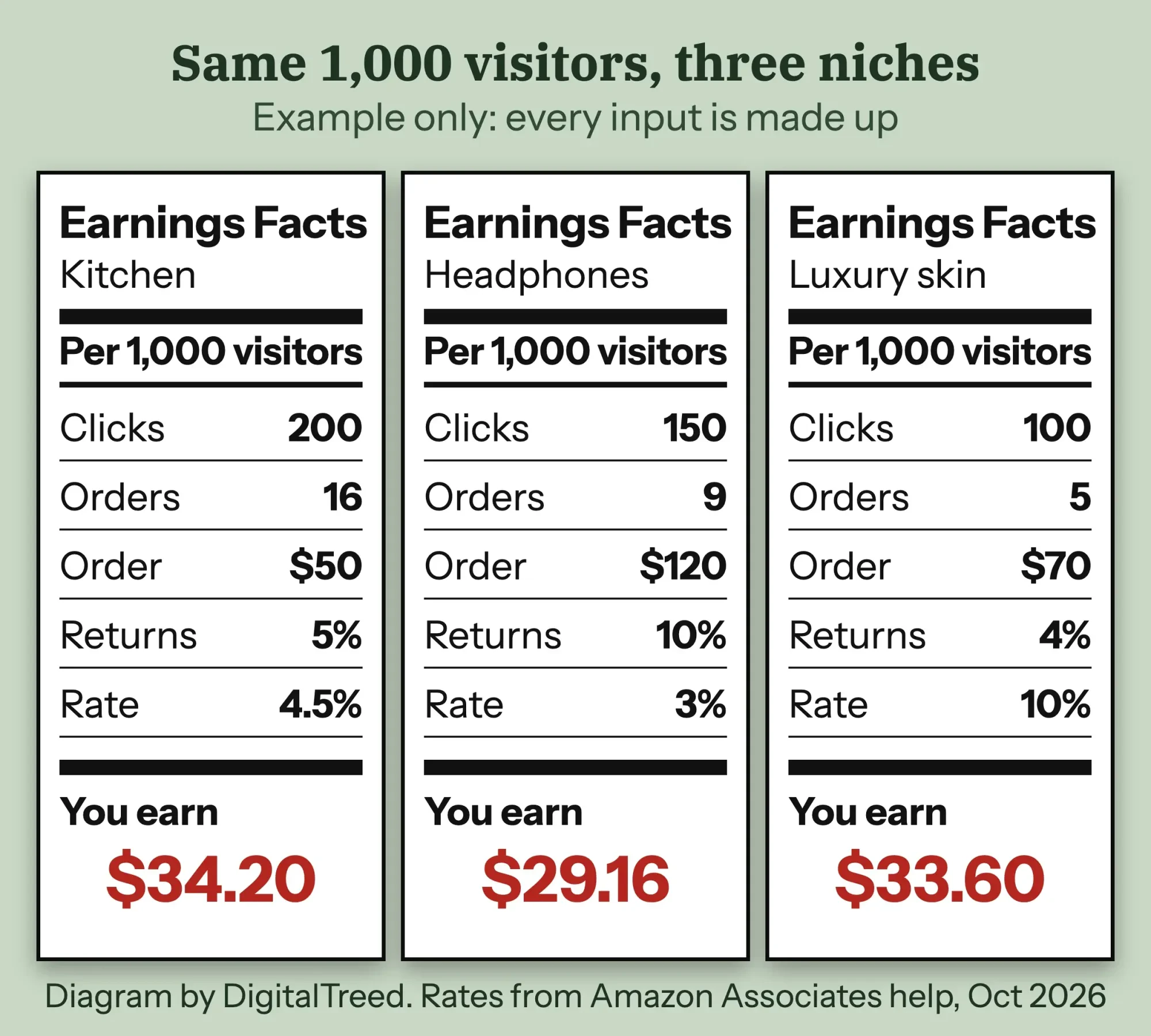 Diagram by DigitalTreed. Example only: traffic, click, order and return figures are made up. Rates from Amazon Associates help, October 2026.
So don't pick a niche from the rate alone. Our guide to affiliate product research covers what makes a product worth promoting, and every category rate sits in our Amazon Associates commission rates guide.
The niche you can write about honestly usually wins.
How do you find your own numbers?
Made-up inputs are fine for learning the math, but once your page is live, your own data is the only forecast worth trusting with real time or money. You need two reports, and both are free.
The first is Google Search Console. Its Performance report shows impressions, clicks and CTR, which it defines as "The click count divided by the impression count." That gives you visitors from search, page by page. If the report is new to you, our Search Console guide explains where to find it and how to filter it down to the single page that carries your links.
The second is Amazon's own reporting. Its help page on reports says the dashboard shows "clicks, ordered items, shipped items and conversion rates". The Earnings report then lists clicks, items shipped, revenue and the commission paid on each product.
Between the two, you have all five numbers.
One gap remains: which spot on the page got the click. Give each placement its own tracking ID, and tag newsletter or social links with UTM parameters from the UTM Builder tool so your analytics can tell those visits apart. Give a new page at least a month before you judge it.
Amazon's help warns that short date ranges mislead. An order can show up with no click in the same period, because the item went into the cart weeks earlier.
What Amazon counts, and what it doesn't
That cart delay is one of several rules that change the result, and they all sit in Amazon's Commission Income Statement.
A click opens a session that ends after 24 hours, once the customer orders, or when they click another Associate's link. Anything added to the cart in that window still counts if it's ordered within 89 days, says the Commission Income Statement.
And it doesn't have to be the product you linked.
Amazon's help page on the 24-hour window says you earn on "any qualifying items" added in that window. That's why your report can show a coffee grinder sold from a mixer review.
Then come the leaks. An order with a return, refund or cancellation is excluded. Your own orders earn nothing either; Amazon's personal orders page calls the program "an advertising program rather than a discount program".
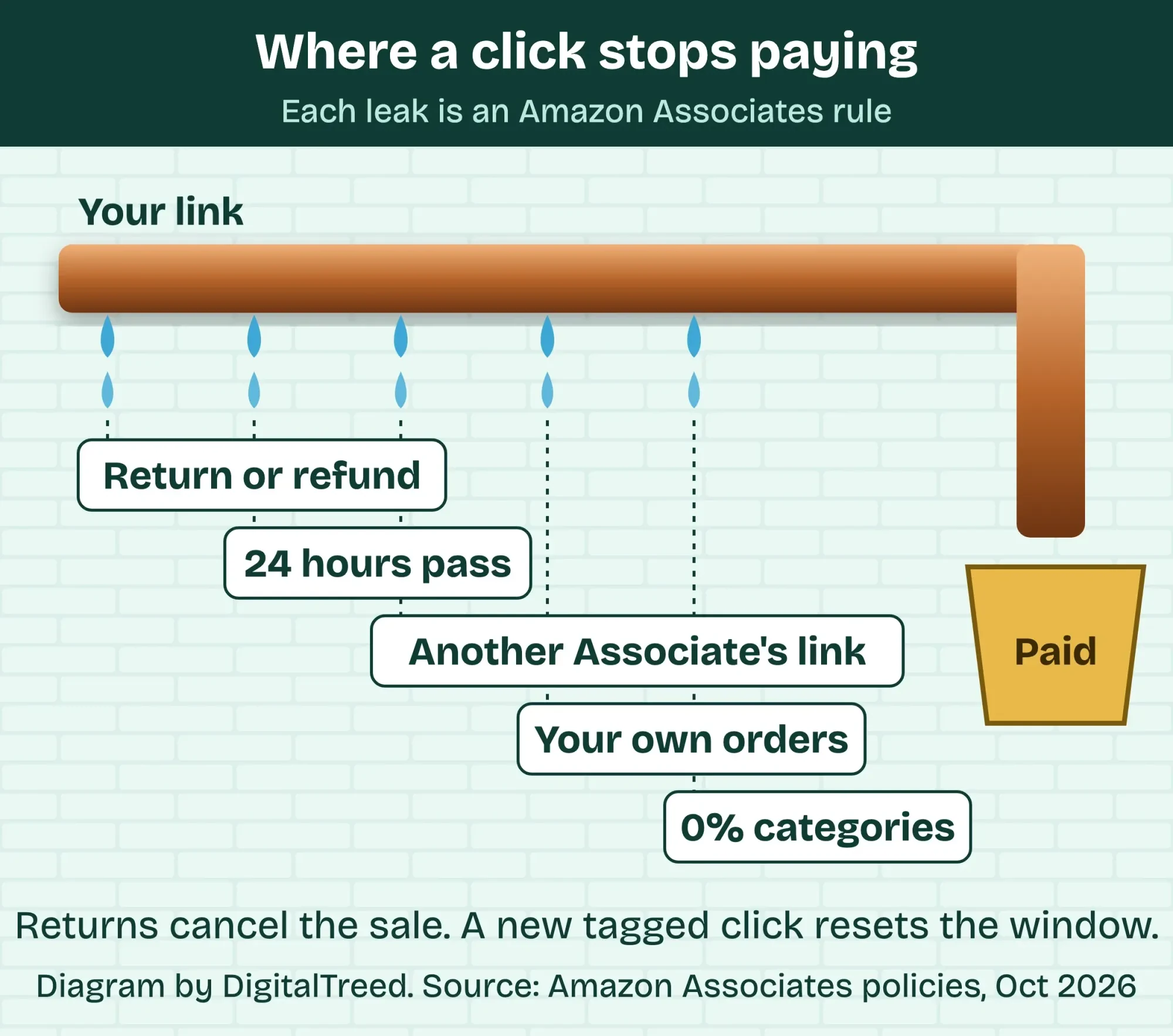 Diagram by DigitalTreed. Rules from Amazon Associates Program Policies, the Commission Income Statement and help pages, read October 2026.
Some categories pay 0%, including gift cards and wireless service plans, as of October 2026, per Amazon's help page. Our rates guide lists them all, with bounties and payout timing.
We rechecked our own 2020 math
Those rules made us look again at what this page used to say. The 2020 version told readers they could make "$100 to $25000" and worked one example.
When we redid that example on October 27, 2026, two numbers didn't hold up. It took 30,000 searches at a 13% click-through rate and got 3,750 visitors, but 13% of 30,000 is 3,900. Then it ran 3,750 visitors through 40% clicks, 5% orders and $75 orders. That's $5,625 in sales, and its $365.63 answer only works at a 6.5% rate.
No category on Amazon's list pays 6.5% as of October 2026.
The 13% also had no source, and the $100 to $25,000 range came from nowhere we could find. So we dropped both. That's the habit we'd suggest to you: when a post quotes an income figure, find where it came from before you plan around it.
Raise the inputs you control
Once you know your numbers, each one points to a fix, and most of them come down to better pages for the readers you already have.
Click rate rises when links sit where readers decide. Our guide to using affiliate links on your site covers placement, labels and tracking.
Visitors come from pages that match buying searches, like "best stand mixer for bread" rather than "what is a stand mixer". Our keyword suggestions tool turns up those longer phrases. The basics are in SEO for beginners.
Order rate follows trust. Google's guide to writing reviews asks for "evidence such as visuals, audio, or other links of your own experience". Its spam policies call pages that copy merchant descriptions without added value "thin affiliation".
Disclosure is part of that trust, and the FTC expects it. The FTC's endorsement Q&A says "The closer the disclosure is to your recommendation, the better." Google also asks you to mark affiliate links with rel="sponsored". This is a summary of public guidance, not legal advice.
Our take: chase order rate before traffic. A page people trust earns more from every visitor, and it holds up when Google updates. When you're ready to build the whole site, our guide to building an Amazon affiliate website is the next step.
Want help writing review pages that earn trust? DigitalTreed plans and writes that kind of page for US small businesses; see what our content team does. We sell this service, so read this paragraph as our pitch.
Frequently asked
Do Amazon affiliates earn on subscriptions or pre-orders?
Mostly no. The Commission Income Statement excludes products bought as a subscription unless the agreement says otherwise. It also excludes pre-order products that aren't available on a product page.
Can I send paid ad traffic to my Amazon links?
Not through keyword ads on Amazon's name. The Commission Income Statement disqualifies purchases from ads bidding on "amazon" or other Amazon trademarks. It also disqualifies links shown on a search engine itself.
Do I pay tax on Amazon affiliate income?
Usually yes, as self-employment income. The IRS says you generally owe self-employment tax with net earnings of $400 or more. It expects estimated tax payments if you'll owe $1,000 or more. Ask a tax professional about your case.
Why does my Amazon report show orders with no clicks?
Because of the cart window. Amazon's Earnings report help says items added in the 24-hour session can be bought within 90 days, while the Commission Income Statement says 89. So a short date range can show orders without matching clicks.
How we made this guide: The DigitalTreed team went through these numbers on October 27, 2026. We read Amazon's Operating Agreement, its Program Policies and Commission Income Statement (updated April 14, 2026) and six Associates help pages. We also read Google's and the FTC's guidance and two IRS pages. We built the calculator and ran every example on our own machine with made-up inputs. Amazon's signed-in fee schedule wouldn't open without an account, so rates come from its public help page. Sources are linked where they're used.
First published August 2020. Rewritten October 27, 2026: the unsourced $100 to $25,000 claim and the old example are gone. In their place are the five-number formula, a made-up worked example, three niches compared, Amazon's counting rules and how to read your own reports.
Sources
- Amazon Associates: Associates Program Operating Agreement (updated October 15, 2025)
- Amazon Associates: Program Policies and Commission Income Statement (updated April 14, 2026)
- Amazon Associates: program home page
- Amazon Associates help: Associates Program Standard Commission Income Statement
- Amazon Associates help: How long do visitors have to add an item to their Shopping Cart?
- Amazon Associates help: How To use reports
- Amazon Associates help: How to read the Earnings Report
- Amazon Associates help: Why is there a deduction for personal use of the program?
- Google Search Console Help: Performance report (Search results)
- Google Search Central: How to write high quality reviews
- Google Search Central: Spam policies for Google web search
- Google Search Central: Qualify your outbound links
- FTC: FTC's Endorsement Guides, What People Are Asking
- IRS: Topic no. 554, Self-employment tax
- IRS: Estimated taxes

Comments
No comments yet. Start the conversation below.