
Quick answer
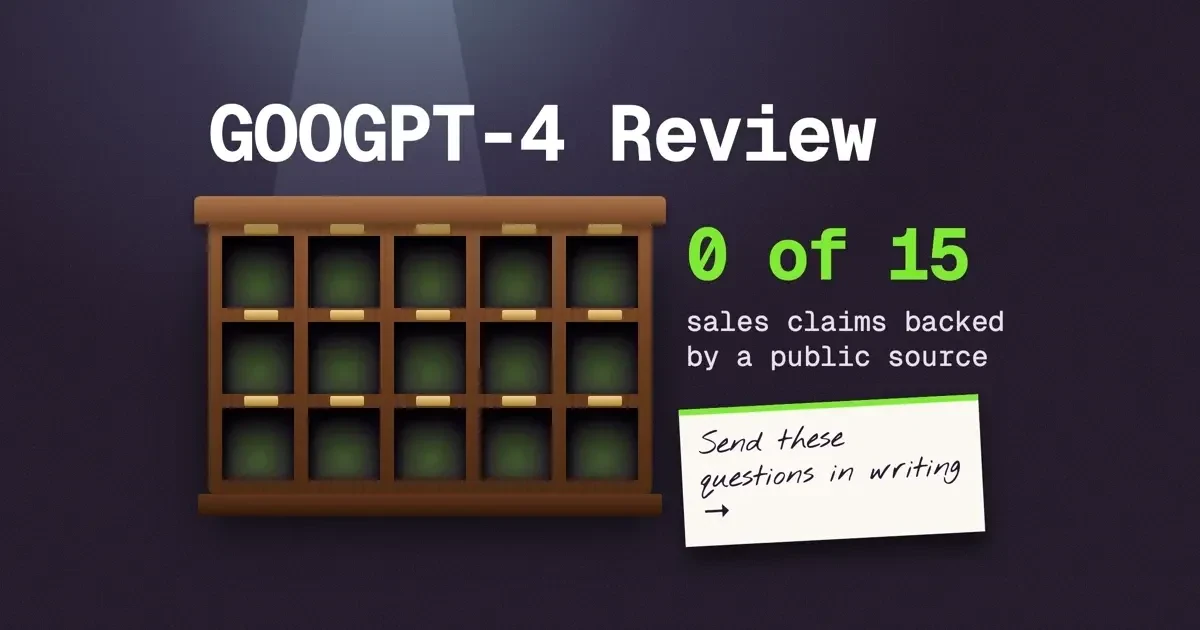
No GOOGPT-4 review can confirm the sales claims today. As of November 11, 2026, we found no live sales page or seller, and 28 of 31 likely web addresses returned no DNS record. None of the 15 claims in our 2023 post had a public source either. If a bundle like it promises income, ask for a written earnings claim statement before you pay.
If you found our 2023 GOOGPT-4 review while weighing an AI launch offer, you saw big promises for one price. Websites, videos, a chatbot and daily profits.
GOOGPT-4 is a name from a 2023 sales pitch for an all-in-one AI bundle. The old post described it straight from sales copy, down to a license to resell it. That post cited no sources, and with no seller to buy from, we couldn't test the software. This review checks the claims, not the product. Three lines in that copy can still be tested: the model names, the daily-profit promise and the resale license. Google's and OpenAI's pages date the models, and FTC rules cover income promises. It's a summary, not legal or financial advice. A licensed attorney or CPA should see any business offer you're about to pay real money for.
Key takeaways
- Ask for a written earnings claim statement before paying for any income promise.
- We found no live GOOGPT-4 sales page, seller or price in November 2026.
- None of the 15 claims in our 2023 post had a public source.
- OpenAI shut down API access to the original gpt-4 model on October 23, 2026.
- Write the card issuer within 60 days of the first bill with the error.
What the GOOGPT-4 sales copy claimed vs what we could verify
Our 2023 post repeated the seller's pitch almost line by line, so the first job was finding that seller. On November 11, 2026, we checked 31 web addresses a buyer might try, from googpt4.com to googpt-4.ai, using plain DNS lookups and registry records.
Twenty-eight of the 31 names returned NXDOMAIN, the DNS answer for a name that has no records. The .com registry had no record for googpt4.com or googpt-4.com, and the Wayback Machine held no captures of either, so there's no old sales page to read. The Verisign registry record for googpt.com shows that name was registered on March 28, 2022, through GoDaddy. Yet the archive's November 30, 2023 and July 12, 2025 captures of it show only a page offering the domain for sale. That's a parked name, not a product.
Nothing was bought. No account was opened.
Only googpt.ai and googpt.xyz returned an address, and neither page names GOOGPT-4. The third, googpt.com, gave SERVFAIL, meaning no answer.
The first, googpt.ai, forwards visitors to gptgo.ai. Its March 15, 2023 archive capture is titled "GooGPT - Google Search engine combines ChatGPT for free," and it never mentions websites, videos, NFTs or a license. The second, googpt.xyz, serves a tiny script that forwards to a placeholder page.
With no seller page to read, we checked each claim against 34 saved official and archive pages, counting it as backed only if a page named GOOGPT-4 and repeated it. Three archive captures say "googpt," two for-sale pages and the free search tool, but none of them says GOOGPT-4.
| Claim in our 2023 post | Type | Public source found |
|---|---|---|
| World's first of its kind | Superlative | No |
| Combines Google and GPT-4 | Brand link | No |
| Taps Google LaMDA and GPT-4 | Brand link | No |
| Chatbot that beats ChatGPT | Performance | No |
| Consistent everyday profits | Earnings | No |
| Get paid daily | Earnings | No |
| Big revenue boost | Earnings | No |
| Resell to clients at lucrative prices | Earnings | No |
| Rebrand and sell it as your own | Resale license | No |
| Websites from text prompts | Performance | No |
| Videos in seconds | Performance | No |
| Art and NFTs instantly | Performance | No |
| 70+ writing features | Count | No |
| Millions of stock images and videos | Count | No |
| 30-day money-back guarantee | Guarantee | No |
By type, the 15 were four earnings claims, four performance claims, two brand links, two counts, one superlative, one resale license and one guarantee. None cleared that bar. No saved page from Google, OpenAI or the FTC names GOOGPT-4. We ran no search-engine queries or sign-in marketplace checks, so a listing could still exist. Not finding one doesn't prove the software never worked in 2023, but we found no seller page, price list or refund terms to hold anyone to. If you'd planned to resell AI-written copy, our guide to ChatGPT rewriting and plagiarism covers the copying risk first.
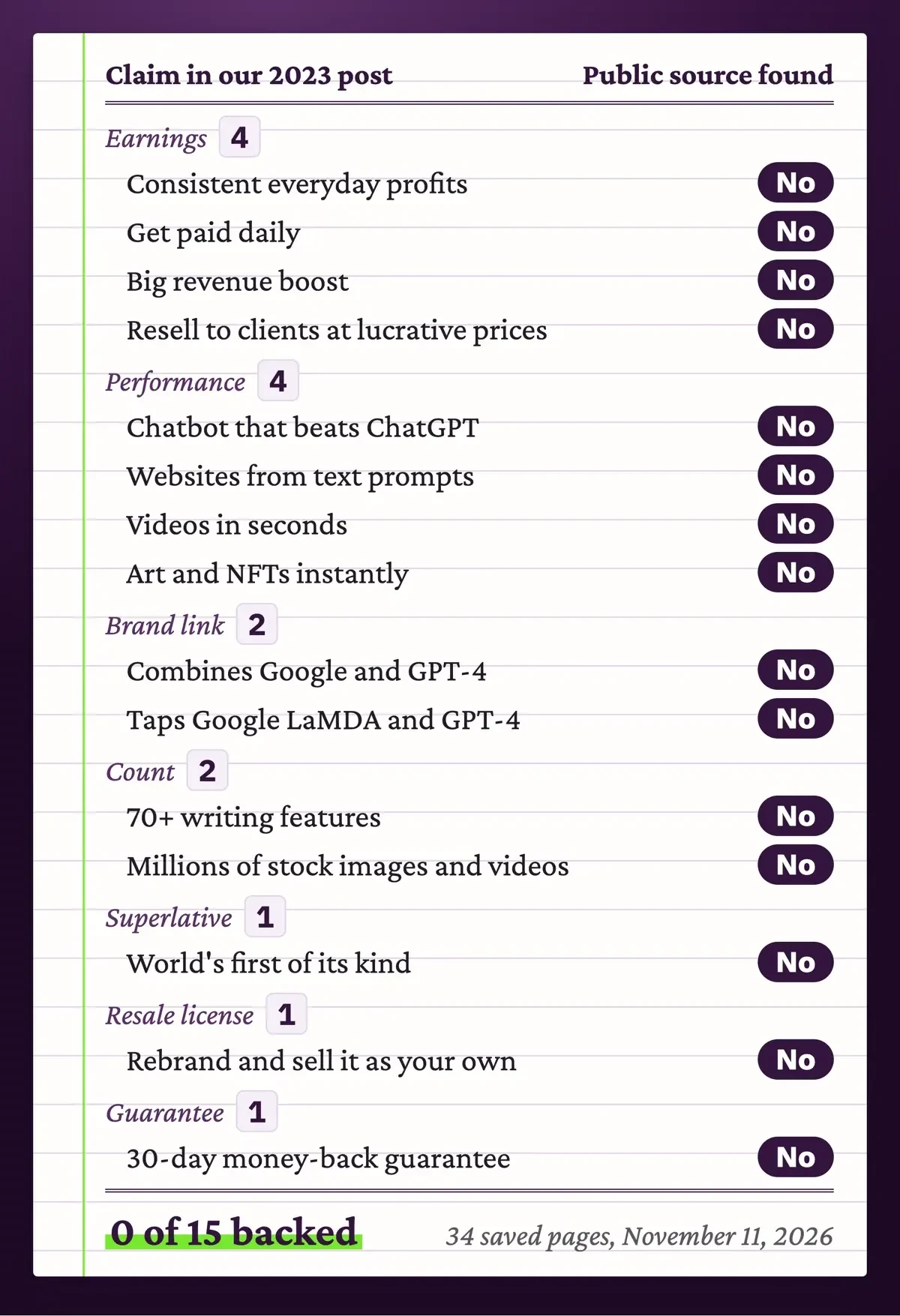 Diagram by DigitalTreed, from our claim check of 34 saved pages on November 11, 2026.
What we tested
We ran two small scripts on November 11, 2026, both sending plain requests that named us in the user agent. The first, domain_check.py, ran DNS, registry and header checks on the 31 names. The second, claims_check.py, matched the 15 claims against 34 saved pages and wrote a report we opened at 127.0.0.1. It lists 0 of 15 backed.
Does GOOGPT-4 really run on Google and GPT-4?
Two of the 15 claims were brand links. One said the tool tapped "Google LaMDA and GPT-4." There's no seller left to ask, but Google and OpenAI each date their own models.
Google introduced LaMDA on May 18, 2021, calling it "our latest research breakthrough" in its LaMDA announcement. On February 6, 2023, Google's Bard announcement opened that chatbot to trusted testers on a "lightweight model version of LaMDA." Three months later, Google's PaLM 2 announcement of May 10, 2023 said "developers can sign up to use the PaLM 2 model." LaMDA's own name, "Language Model for Dialogue Applications," describes a model built for conversation. By the time our post went up on November 15, 2023, Google was pointing developers to PaLM 2. Neither Google page names an outside product, so a seller claiming LaMDA access that fall would have to show which Google API it called.
The GPT-4 half now has a firm end date. OpenAI's API deprecations page says it announced the retirement of older snapshots, gpt-4-0613 and the gpt-4 alias among them, on April 22, 2026. Then it adds: "Access to these models was shut down on October 23, 2026." OpenAI's GPT-4 model page now carries a Shut down label, and its snapshot list marks gpt-4, gpt-4-0613 and gpt-4-0314 as Shut down. A tool that still sells GPT-4 today can't be calling any of them through OpenAI's API.
A name built from Google and GPT-4 can suggest a tie that neither maker's page shows. The FTC's page on business offer and coaching scams warns that promoters "say or suggest that they're affiliated with well-known online sellers when that's not true." Ask the seller which model and API it calls. Get the reply in writing. Our Grok vs ChatGPT comparison shows what checking a maker's own page looks like.
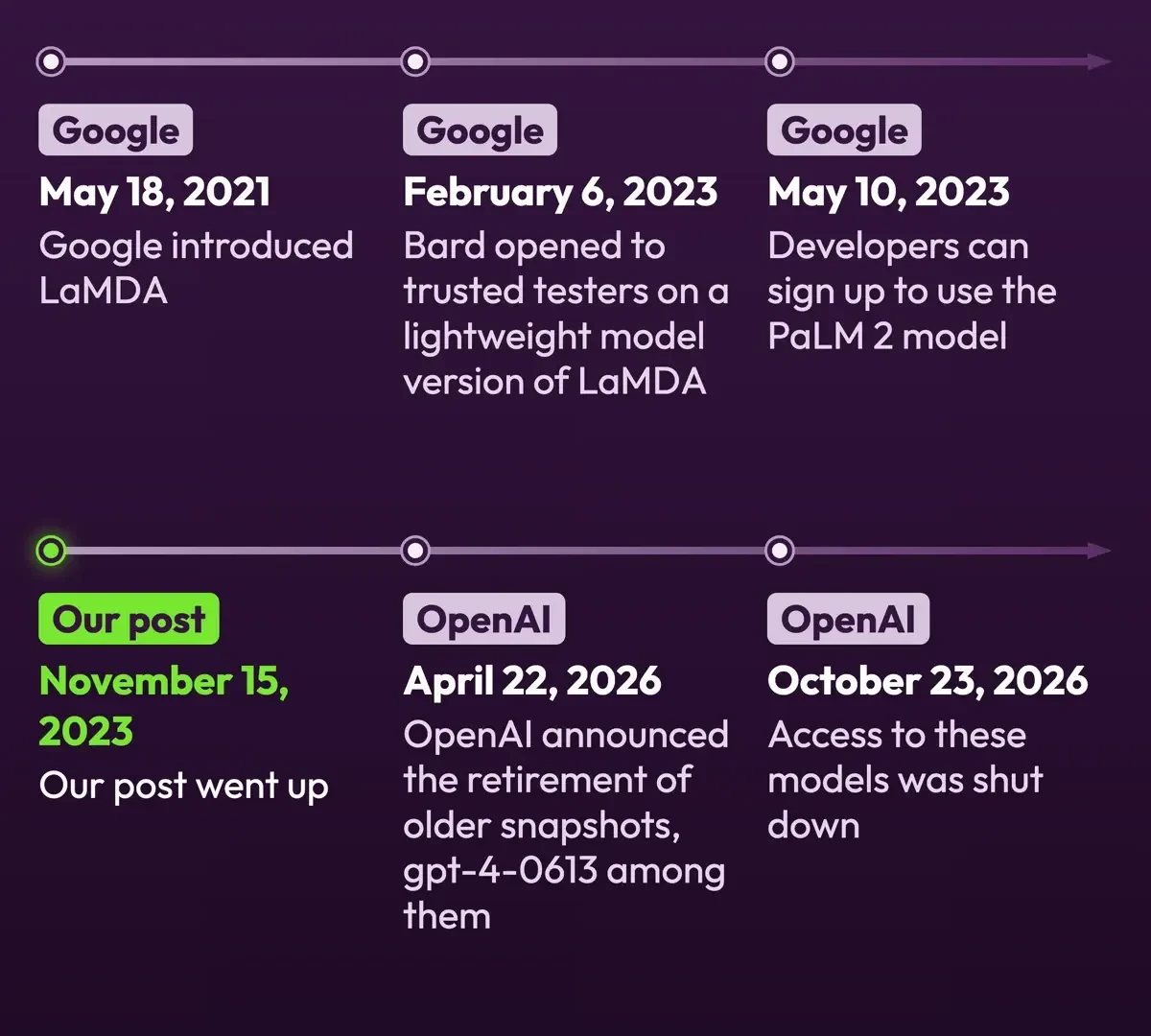 Diagram by DigitalTreed, from Google and OpenAI pages read November 11, 2026.
What the FTC did about AI money claims
Beyond the model names, four of the 15 old claims promised income, such as "Get Paid Daily," and one sold a license to rebrand the tool. Since 2024 the FTC has sued sellers that paired AI tools with income promises like these.
On September 25, 2024, the agency announced Operation AI Comply, five actions against firms using AI hype. Then-Chair Lina M. Khan said "there is no AI exemption from the laws on the books." Three of the five went after online store schemes selling AI-powered tools with promises of steady income. Two of those, Ascend Ecom and FBA Machine, allege over $40 million between them ($25 million plus $15 million).
The FTC alleged Ascend Ecom cost consumers at least $25 million. A June 23, 2025 proposed order would ban its operators from selling business opportunities. FBA Machine was accused of taking over $15 million, and its owner agreed in July 2025 to a permanent ban on selling business opportunities. The third, Ecommerce Empire Builders, sold training near $2,000 and done-for-you stores for tens of thousands. Its pitch promised an "AI-powered Ecommerce Empire," per the FTC's case page. It accepted a similar ban in May 2025. All three case pages still say pending. In all three, the FTC's releases tie AI-powered software to promises of income that it says didn't materialize.
The pattern didn't stop in 2025 and 2026. In August 2025 the FTC sued Air AI, alleging it sold coaching plus "licenses to resell their services" and made deceptive claims about refund guarantees. The March 24, 2026 Air AI settlement carries an $18 million judgment, mostly suspended, with $50,000 paid for consumer relief. The order also bans "Making earnings claims without adequate substantiation or disclosure," and the FTC says such orders have the force of law once a judge signs them.
Not every AI case held. On December 22, 2025, the FTC reopened and set aside its Rytr order over an AI review writer, saying the complaint didn't meet the FTC Act's requirements. Our post on automating customer reviews safely covers the separate rules for fake reviews. Accuracy claims need backing too: the Workado final order of August 28, 2025 requires competent and reliable evidence for its AI detection claims.
None of these cases names GOOGPT-4, so they aren't a verdict on it, though they share its pitch: AI branding, income promises, resale rights and refund guarantees.
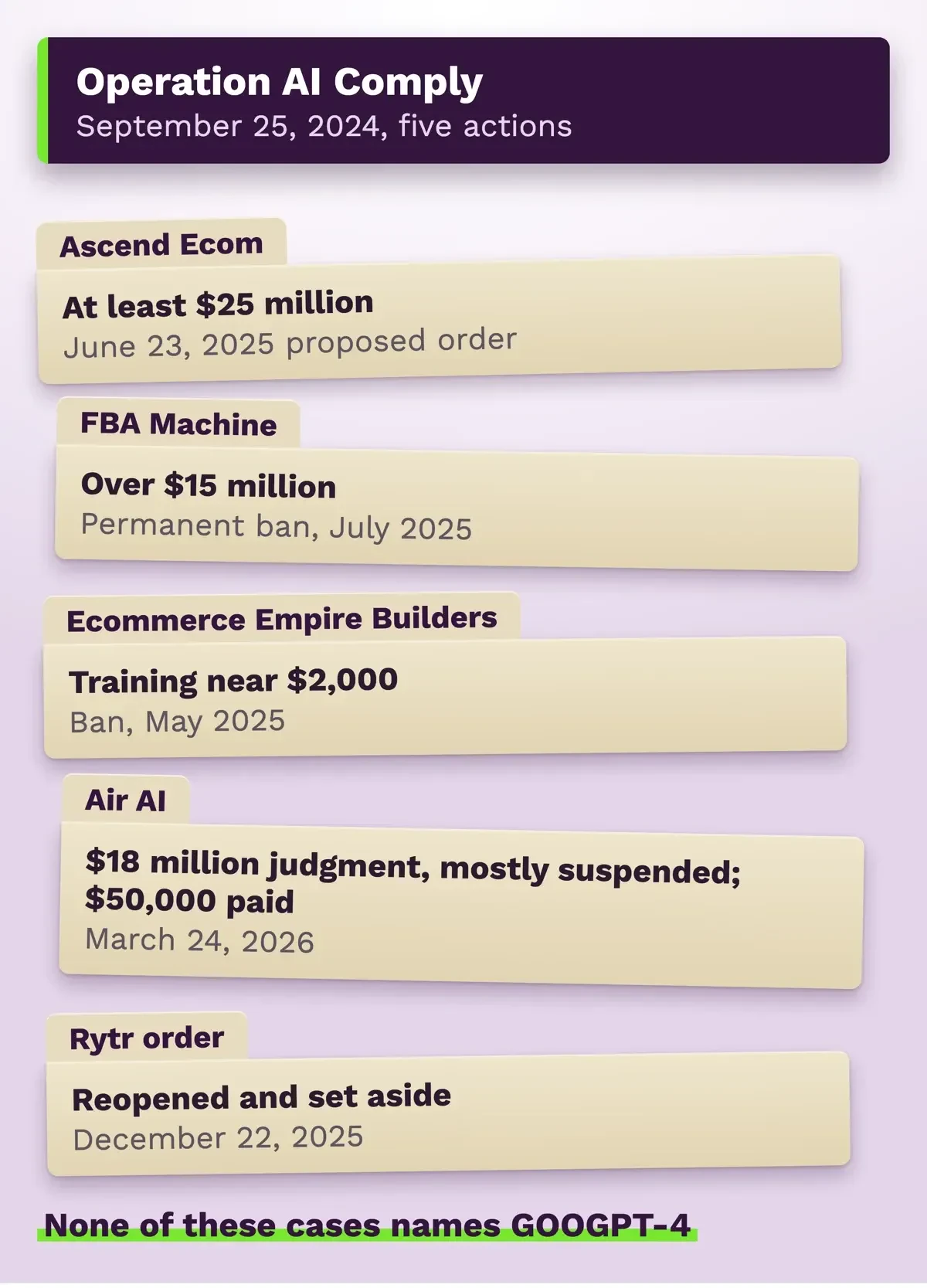 Diagram by DigitalTreed, from FTC press releases and case pages read November 11, 2026.
Earnings claims and the Business Opportunity Rule
Those orders against Ascend Ecom, FBA Machine, Ecommerce Empire Builders and Air AI, agreed or proposed, all ban selling business opportunities. The FTC's Business Opportunity Rule defines that term in three parts, and a bundle is covered only if all three fit.
Under 16 CFR 437.1, a business opportunity exists when a seller pitches a new business and the buyer must pay. The third part is a promise that the seller will supply locations, outlets, accounts or customers, Internet customers included, or buy back what the buyer makes. A plain software license with no such promise doesn't always meet that part. The same section defines an earnings claim as any statement of "a specific level or range of actual or potential sales, or gross or net income or profits." Its examples include "earn a six-figure income," and charts or math showing possible results count as well. Our old post's "consistent everyday profits" line gave no figure, so that's an attorney's call.
When the rule applies, 16 CFR 437.4 says the seller needs a reasonable basis and written proof before making the claim. You'd get a single document titled "EARNINGS CLAIM STATEMENT REQUIRED BY LAW." It has to give the dates the earnings were made and the number and percentage of earlier buyers who reached them.
The FTC's Air AI complaint alleged exactly this gap: no required disclosure documents or earnings claims statements.
Timing matters as well. 16 CFR 437.2 requires the disclosures "at least seven calendar days before" you sign or pay. 16 CFR 437.3 adds a box listing fraud or deceptive-practice lawsuits against the seller or its officers from the past 10 years. The FTC's Business Opportunity Rule summary says the aim is giving buyers what they need "to assess the risks of buying a work-at-home program or any other business opportunity."
Outside that rule, false money claims still carry risk for sellers. The FTC's 2021 Notice of Penalty Offenses Concerning Money-Making Opportunities says "certain acts or practices used to attract participants to money-making opportunities are unfair or deceptive." The page lists the FTC decisions behind it, such as Macmillan (1980), plus a release warning that false money-making claims "Could Lead to Big Penalties." We're summarizing here, and none of it is legal advice. Our guide to legit work-from-home jobs and scams covers income offers that aren't software.
Eight checks before you buy an all-in-one AI bundle
Send these questions to a seller in writing. Then wait at least seven days for answers, the gap 16 CFR 437.2 sets.
- Find the seller's legal name, street address and phone number on the sales page.
- Ask which AI model and API each feature uses, and get the answer in writing.
- Check each named model on its maker's page, such as OpenAI's deprecations list.
- For any income promise, ask for the earnings claim statement and its buyer count.
- If clients or customers are promised, ask for the business opportunity disclosure document.
- Read the full refund terms before you pay, not after.
- Run the trial yourself on your own text instead of trusting demo videos.
- Pay by credit card and save every receipt, sales page and email.
In our claim check, 4 of the 15 old claims were earnings claims and 1 was a resale license, so checks 4 and 5 would have come first. Count every upsell too, since the FTC's coaching page says "Be ready for the upsell" and to stop when asked for more. For the money-back promise, the FTC's guarantee advertising guides say buyers should be able to "see the written warranty or guarantee for complete details" before the sale. Our old post repeated a 30-day guarantee but never showed its terms. AI images and video have limits of their own, set out in our ChatGPT image generation guide for business.
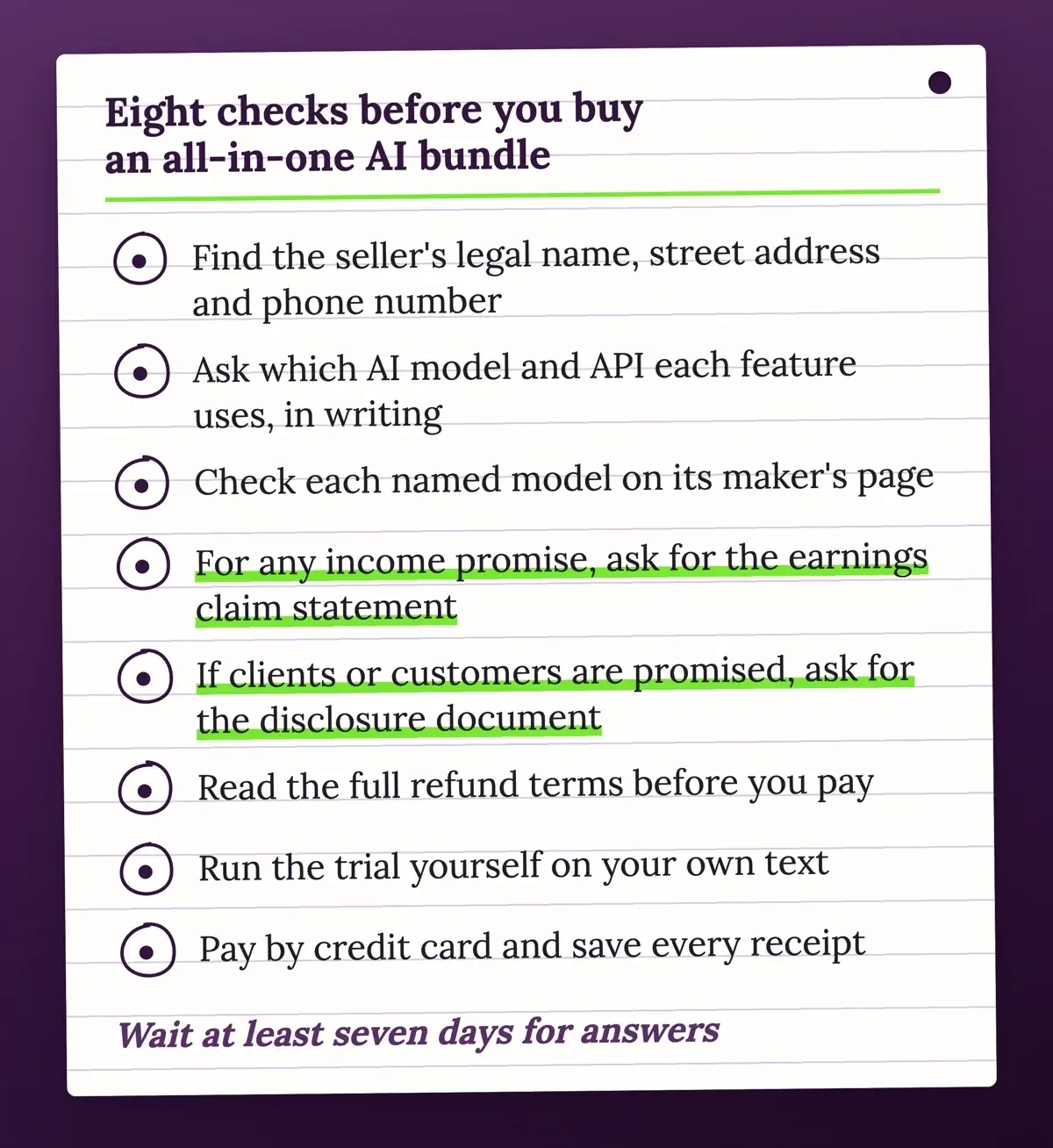 Drawn by us: eight checks built from the FTC and Business Opportunity Rule pages cited in this guide.
If a purchase goes wrong, the FTC's guide to getting money back after a scam says: "Report it to the credit card issuer immediately." Call first, then write. Its credit card dispute guide says a billing-error letter must reach the issuer "within 60 days after the first bill with the error was sent to you." The issuer then has 30 days to acknowledge it and 90 days to resolve it.
After that, report the offer at ReportFraud.ftc.gov. The FTC's coaching page also points you to the attorney general in your state and in the seller's state. It adds that honest offers don't need high-pressure tactics, because "an offer that's good today should be good tomorrow, too." Our Shipmentsfree.com guide walks through cancel-and-dispute steps for a charge that repeats, and our Chatgot check applies similar tests to a multi-model AI chat app. Before a large purchase or a dispute, it's worth paying a licensed attorney or CPA to read the contract and the tax side.
Frequently asked
Is GOOGPT-4 the same as googpt.ai?
No. On November 11, 2026, googpt.ai forwarded to gptgo.ai, whose own page calls it "Free ChatGPT and Search Engine." Neither page names GOOGPT-4. You can check any domain's registration on ICANN Lookup.
What if I paid for an AI bundle with a debit card?
The FTC says to call your bank or credit union right away and request a refund. It notes that "Federal law protects you from unauthorized use of your debit card."
Does a white-label license make a bundle a business opportunity?
Only if all three parts of 16 CFR 437.1 fit. Its required payment covers money owed "either by contract or by practical necessity," so count upsells.
Is the FTC still looking at AI claims in 2026?
Yes. On July 1, 2026, the FTC sought comment on a proposed AI accuracy policy statement, with comments due July 31, 2026.
How we made this guide: DNS and registry checks on 31 addresses, a script matching 15 old claims to 34 saved pages, and official pages saved as text. Facts checked by the DigitalTreed team on November 11, 2026.
First published November 15, 2023 as a product review of GOOGPT-4. Rewritten November 11, 2026 as a dated claim check and a buyer's guide to FTC rules.
Sources
- Verisign RDAP: googpt.com registration record
- ICANN Lookup
- Google: LaMDA, our breakthrough conversation technology
- Google: An important next step on our AI journey (Bard)
- Google: Introducing PaLM 2
- OpenAI API: Deprecations
- OpenAI API: GPT-4 model page
- FTC: When a Business Offer or Coaching Program Is a Scam
- FTC: FTC Announces Crackdown on Deceptive AI Claims and Schemes
- FTC: Ascend Ecom case page
- FTC: Permanent ban for e-commerce business opportunity scheme operator (FBA Machine)
- FTC: Empire Holdings Group (Ecommerce Empire Builders) case page
- FTC: FTC Sues to Stop Air AI
- FTC: Air AI and its owners will be banned from marketing business opportunities
- FTC: FTC Reopens and Sets Aside Rytr Final Order
- FTC: Final order against Workado, LLC
- FTC: Public comment on a proposed policy statement addressing AI accuracy
- Cornell LII: 16 CFR 437.1, Definitions
- Cornell LII: 16 CFR 437.2, Obligation to furnish written documents
- Cornell LII: 16 CFR 437.3, The disclosure document
- Cornell LII: 16 CFR 437.4, Earnings claims
- FTC: Business Opportunity Rule
- FTC: Penalty Offenses Concerning Money-Making Opportunities
- Cornell LII: 16 CFR 239.2, Disclosures in warranty or guarantee advertising
- FTC: What To Do if You Were Scammed
- FTC: Using Credit Cards and Disputing Charges
- FTC: ReportFraud.ftc.gov
Comments
No comments yet. Start the conversation below.