
Quick answer
To become a freelance web developer, learn the skills clients can check: fast pages, accessible design, safe forms and one platform such as WordPress. Then build three portfolio projects with real numbers. US payroll web developers earned a median $44.54 an hour in May 2025, so price above that, not below.
Key takeaways
- Clients pay for fast, accessible, safe sites, not a list of languages.
- Three portfolio projects beat twenty tutorials.
- Show before-and-after numbers in every case study.
- BLS state medians for web developers run $24.30 to $62.71 an hour.
- Good first clients often already have a slow or broken site.
A freelance web developer builds and fixes websites for several clients as an independent business. Many clients are small businesses: a dental office, a roofer, a shop that wants online booking.
This post used to be five vague steps from 2020.
We've rebuilt it around one role, seen from your side of the deal. If you haven't picked a freelance skill yet, start with our plan for how to start freelancing, which covers pricing math, contracts and taxes for any trade. This page stays on web work: the skills, a portfolio, US rates and the first clients.
What do small-business clients actually pay for?
A small-business owner can't read your code, and they won't try. What they'll notice is whether the site loads fast on a phone. They'll notice when the contact form doesn't send, or when a customer calls to say the menu won't open. They'll also notice a hacked homepage, usually on a Saturday. So the skills that sell are the ones that show up in those moments, and you can learn every one of them.
Speed comes first. Google's Web Vitals guidance says "LCP should occur within 2.5 seconds" of the page starting to load. It also asks for an INP of "200 milliseconds or less" and a CLS of 0.1. Learn what those three numbers mean, and how to move them.
Accessibility is next, and it's a selling point. Under the Department of Justice web guidance, the ADA covers "businesses that are open to the public (Title III)". That guidance points to the WCAG 2.2 standard, which asks for text contrast of "at least 4.5:1" and tap targets of "at least 24 by 24 CSS pixels".
Put it in every quote you send.
Security matters even on a five-page site, because every contact form and plugin is a way in. The OWASP Top 10:2025 is the shared list to learn from. Its first entry is "Broken Access Control", and "Software Supply Chain Failures" sits third, which is a plugin problem as much as a code one.
Then pick a platform clients already own.
W3Techs, a vendor that surveys sites, says "WordPress is used by 39.6% of all the websites" as of October 27, 2026 (W3Techs CMS survey). So expect plenty of early work fixing WordPress sites, not writing new apps. It's not glamorous.
Not sure where builders end and code begins? We compared no-code builders with custom code on cost and speed.
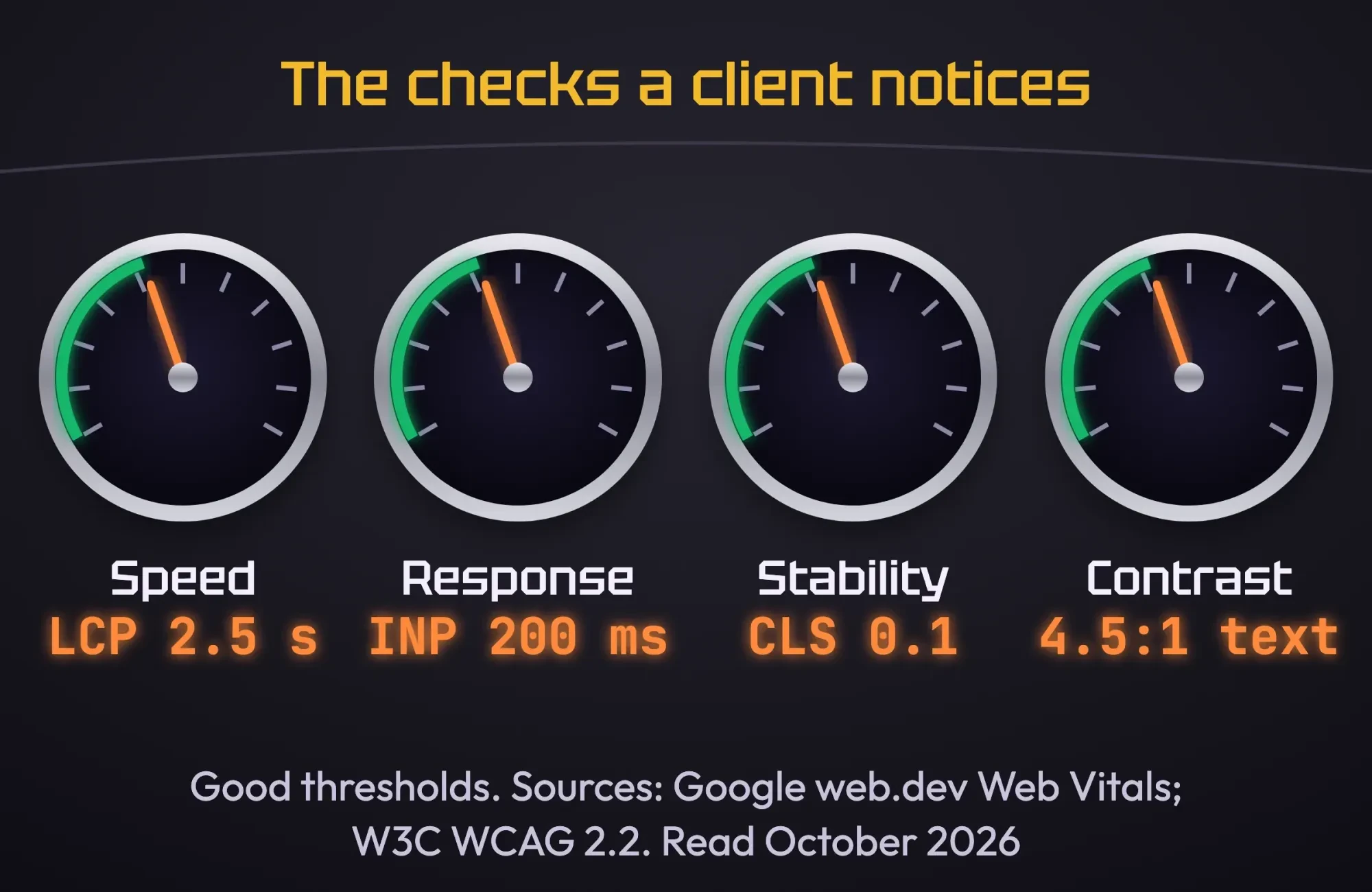 Diagram by DigitalTreed. Source: Google web.dev Web Vitals and W3C WCAG 2.2, read October 2026.
Learn the basics, then one platform, then the checks
Learn HTML, CSS and plain JavaScript first, then one platform, then the checks clients care about. MDN's free Learn web development course is a good spine. It says it's "Designed to take you from "beginner" to "comfortable" (not "beginner" to "expert")", which is the right goal for a first paid job.
Here's the order we'd follow:
- HTML and CSS until you can build a phone-friendly page from a sketch.
- Enough JavaScript to validate a form and handle a click.
- Git, so every client project has a history you can roll back.
- WordPress: install it, build a theme or a block layout, and fix a broken plugin.
- Speed and accessibility checks, run on every page you ship.
- A little server work: DNS, SSL and moving a site between hosts.
Our step-by-step WordPress website guide walks through a five-page business build, which is close to the most common job you'll quote. For the checks, use this pre-launch audit list for small sites before you hand anything over.
Skip the framework race for now.
A dentist won't pay extra because the booking page uses the newest library. They'll pay because it works, it's fast and nobody calls to complain about it. You can learn React later, when a client's project needs it. If a site you built fails on a phone, the owner won't care how tidy the code was; they'll just remember the calls they lost that week.
A portfolio that answers a buyer's three questions
Once you can build, you need proof. A web developer portfolio needs three projects, and each should answer one question a buyer is quietly asking. Can you build a site like mine? Can you fix the one I've got? Can you make it do the thing I need?
- A small business site built from a made-up brief: five pages, a contact form, fast on a phone.
- A rebuild with before-and-after numbers: load time, layout shift, accessibility issues fixed.
- One working feature owners pay for: online booking, a quote form, or a small store.
Label made-up projects as concept work. Always.
Buyers don't mind concepts. They'll mind a lot if they find out later that the "client" never existed.
Host the portfolio on GitHub Pages if you like. GitHub says Pages is available "in public repositories with GitHub Free". A published site "may be no larger than 1 GB", and there's a soft bandwidth limit of 100 GB a month (GitHub Pages limits). That's plenty.
Each case study gets one short page: the problem, what you did, the numbers, plus links to the live demo and the code.
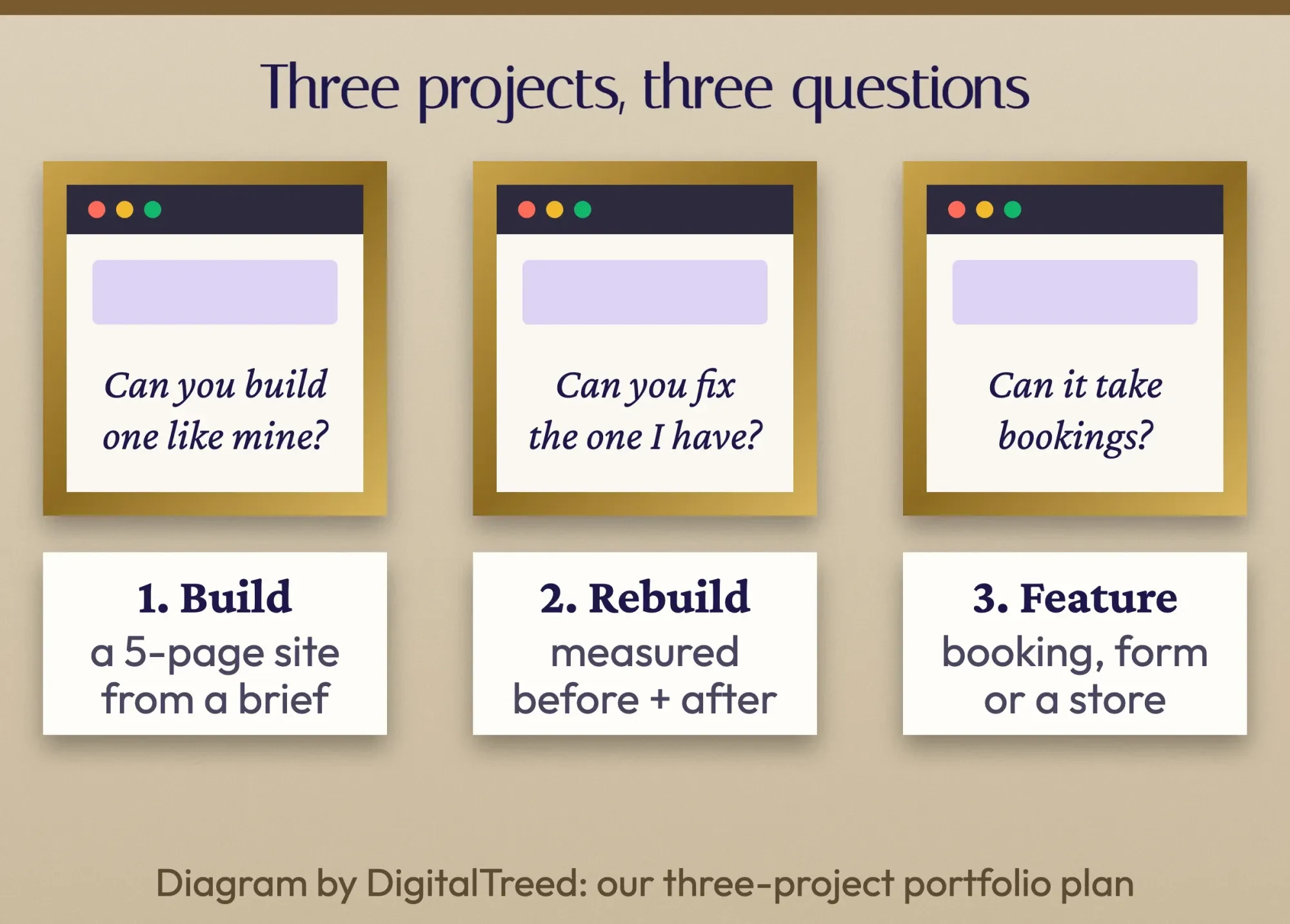 Diagram by DigitalTreed. Our three-project portfolio plan for a freelance web developer.
We built a slow page on purpose, then fixed it
That middle project is the one that wins work, so we built one to see what the numbers look like.
We built a one-page concept site for a made-up practice, Ridgeline Dental, in two versions, on October 27, 2026. Version one used a 2.75 MB PNG hero image with no width or height set. Version two used the same picture as a 1,200-pixel WebP of 5 KB, with its size set and a high fetch priority. We loaded each one 3 times in headless Chrome 156 at phone size, on a simulated slow 4G line with the processor slowed 4 times.
The median Largest Contentful Paint fell from 16,476 ms to 1,204 ms, and layout shift went from 0.19 to 0. Version one also jumped down the screen when the image arrived, which is the shift a visitor feels as a tap on the wrong button. Version one failed Google's Web Vitals targets for LCP and CLS; version two passed both. We didn't measure INP, because that needs real taps and clicks.
One image did all of that. One.
Big difference, small fix. Remember it.
These are lab numbers from our own Mac, not field data, and real client sites are messier. Still, that's the shape of a case study a dentist understands: "your page took 16 seconds, now it takes about 1".
That's the pitch.
Want the field data Google itself uses? We cover it in our PageSpeed Insights walkthrough.
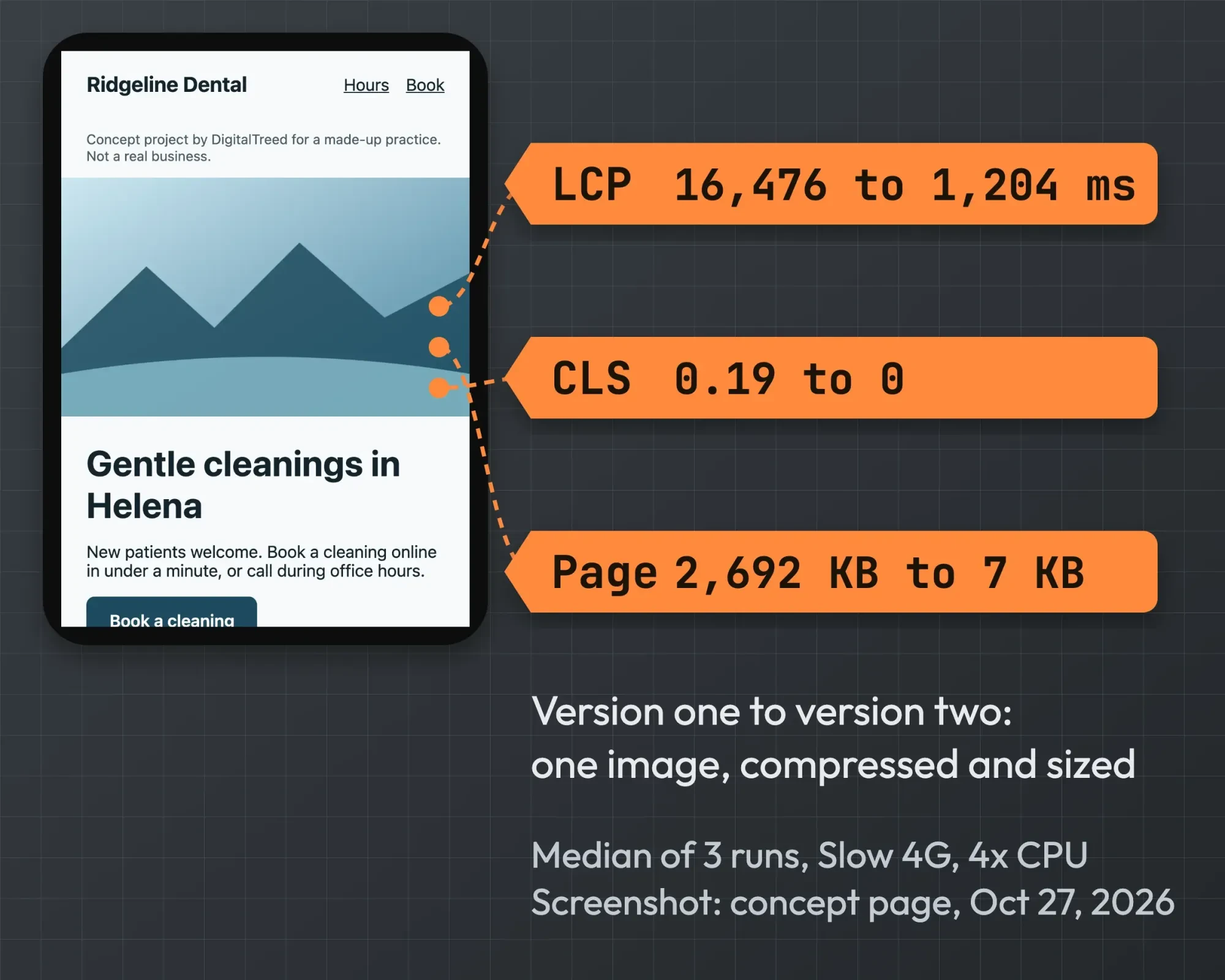 Screenshot: our concept page (version two) at 390 pixels wide, October 27, 2026. Numbers are medians of 3 headless Chrome runs on simulated Slow 4G.
What do freelance web developers charge in the US?
Now for price. There's no official freelance rate. But BLS, the Labor Department's statistics office, publishes what payroll web developers earn. Its May 2025 wage data puts the median at $44.54 an hour, with the middle half between $30.88 and $60.69. We pulled those figures through the official BLS data API on October 27, 2026.
| Web developers, US payroll, May 2025 | Hourly wage | Where a freelancer might sit |
| 10th percentile | $23.12 | Learning, no portfolio yet |
| 25th percentile | $30.88 | First paid projects |
| Median | $44.54 | Solid portfolio, repeat clients |
| 75th percentile | $60.69 | Known for a niche or a platform |
| 90th percentile | $78.03 | Senior, or a hard specialty |
Find your rung first.
Treat those May 2025 wages as floors, not prices. A freelancer pays for unbilled hours, software and their own benefits, which our freelancing starter guide turns into a rate. Web and digital interface designers earn a bit more, with a BLS median of $50.00 an hour.
Location moved the wage a lot in May 2025. The same BLS data gives state medians from $24.30 in Arkansas to $57.48 in California and $62.71 in Washington. Montana's median is $29.84, across only 550 payroll jobs.
Here's why that matters to a freelancer.
You can sell to clients anywhere, so your own town's wage needn't set your price. A developer in Helena who wins two clients in Seattle is pricing against the Washington market, whatever the local wage in Montana happens to say about it.
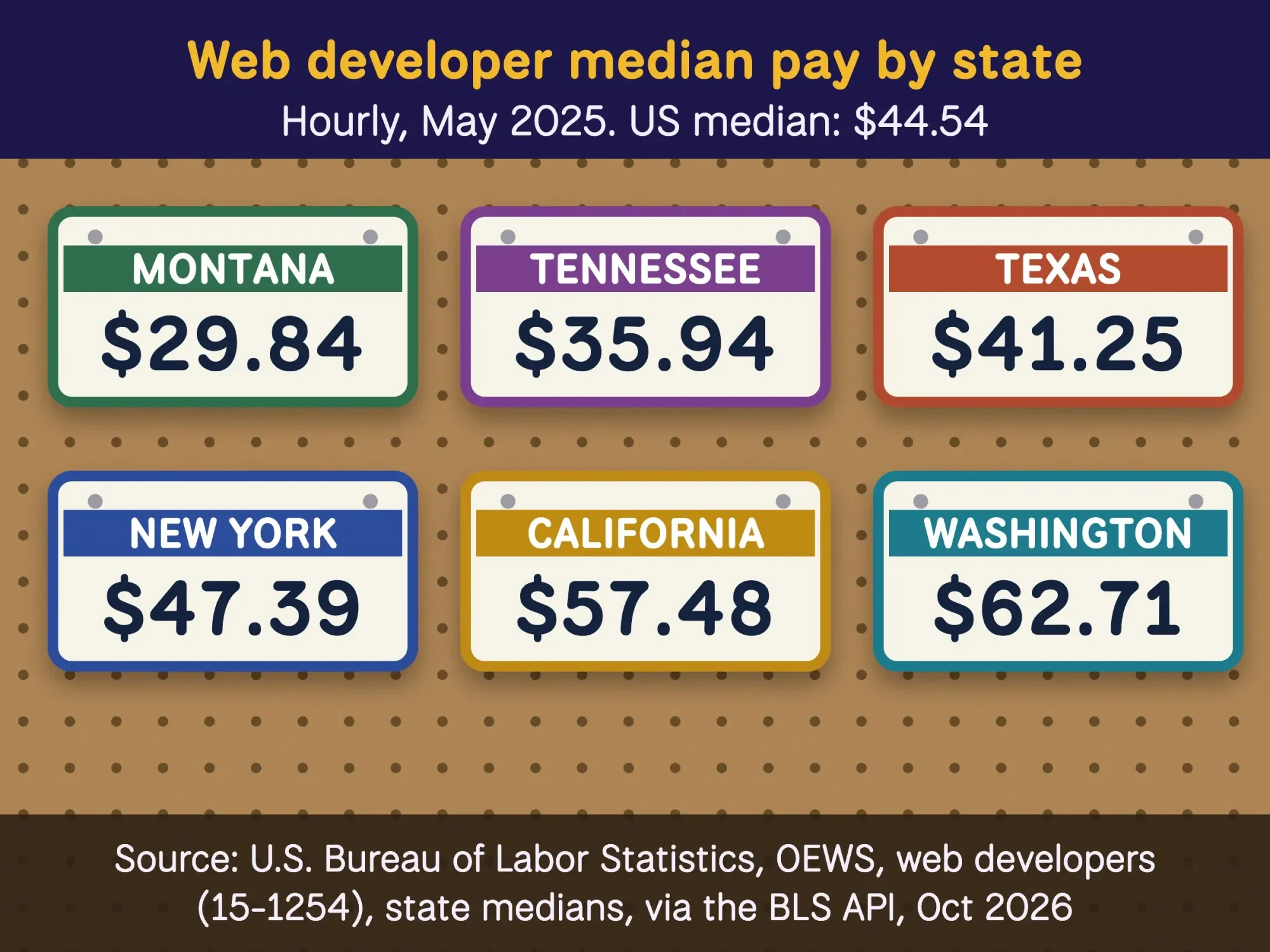 Diagram by DigitalTreed. Source: U.S. Bureau of Labor Statistics, Occupational Employment and Wage Statistics, May 2025, web developers (15-1254), state medians, read via the BLS API October 2026.
Example: Juniper Gate Web is a made-up solo developer in Helena, Montana. Its owner quotes a five-page site for Ridgeline Dental at $70 an hour, between the national 75th and 90th percentile wages. They estimate 40 hours, so the price is $2,800 as of October 2026. Simple math.
They bill it in three milestones: 40% to start ($1,120), 40% when the design is approved ($1,120) and 20% at launch ($560). Each invoice comes from our Free Invoice Generator, with the milestone named on the line and a payment link filled in.
Milestones keep a long build from turning into a long wait for money. If the client goes quiet after design approval, you've still been paid for 80% of the work, and you've got a clear, friendly reason to follow up.
Your first clients already have a slow or broken site
Now that you've got a portfolio and a price, go looking for a nearby business whose site is already costing them. Run their homepage through the DigitalTreed website speed test. Note one fix you'd make, and send a short, friendly message with that single finding.
Be specific, and don't pitch a full rebuild in the first message. Pick businesses you'd actually like to work for, because a first client who trusts you often becomes the reference that gets you the second and third.
Offer a small paid fix first.
Think compressed images, a contact form that finally sends, or a broken plugin put right.
A small job done well is an easier yes than a cold quote for a full rebuild. It also gives you your first real before-and-after case study.
Agencies are the other quiet source. Ask the small web shops near you whether they ever hand off overflow work, like WordPress fixes or landing pages. A portfolio with numbers makes that ask easier. When a shop's own developer is out sick and a launch is due Friday, the freelancer who already said hello is the one they'll phone first. Be that one.
It helps to read the buyer's side. We've written it up: what owners check when they bring on a web designer or a full stack developer. Both list the questions they'll ask you and the red flags they'll watch for. Answer those before anyone asks.
Our take: learn the checks before the frameworks, build three projects with numbers, and price from the BLS ladder upward. The developer who can say "I made it 15 seconds faster" gets the call.
We get paid to build small-business sites, so factor that bias into how you read this. If a project's too big for one person, we take on full website builds for small businesses too.
Frequently asked
Can I host a client's business website on GitHub Pages?
No. GitHub's Pages limits say it's "not intended for or allowed to be used as a free web-hosting service to run your online business, e-commerce site" or SaaS. Keep it for portfolios and demos.
What is a good Core Web Vitals score?
LCP within 2.5 seconds, INP of 200 ms or less and CLS of 0.1, measured at the 75th percentile of page loads. Google's web.dev guidance says to split that by mobile and desktop.
Do small business websites have to meet the ADA?
The DOJ guidance says businesses open to the public must make online services accessible, and they "have flexibility in how they comply". It notes separate rules for state and local governments, published April 24, 2024. This is a summary, not legal advice; a lawyer can apply it to a client.
How many web developers work in the US?
BLS counted 70,190 payroll web developers in May 2025, plus 113,330 web and digital interface designers. Both counts come from an employer survey, so treat them as jobs, not freelancers.
How we made this guide: Every number here was checked by the DigitalTreed team on October 27, 2026. We pulled the BLS wages ourselves through the official data API and read the Google, W3C, Justice Department, OWASP and GitHub pages that day. We also built and measured the two versions of the concept page described above. You'll find each source linked beside the line it supports.
First published July 2020. Rewritten October 27, 2026: we turned the old five tips into a US plan for freelancers. It adds BLS wages by state, a three-project portfolio, our speed test and first-client steps.
Sources
- U.S. Bureau of Labor Statistics: Occupational Employment and Wages, May 2025, web developers (15-1254)
- U.S. Bureau of Labor Statistics: Occupational Employment and Wages, May 2025, web and digital interface designers (15-1255)
- U.S. Bureau of Labor Statistics: Public Data API
- Google, web.dev: Web Vitals
- W3C: Web Content Accessibility Guidelines (WCAG) 2.2, Recommendation of December 12, 2024
- U.S. Department of Justice, ADA.gov: Guidance on web accessibility and the ADA
- OWASP Top 10:2025
- GitHub Docs: What is GitHub Pages?
- GitHub Docs: GitHub Pages limits
- MDN Web Docs: Learn web development
- W3Techs: Usage statistics of content management systems (vendor survey, October 2026)

Comments
No comments yet. Start the conversation below.