
Quick answer
We can't call MP4Juice safe or legal: we couldn't confirm who runs it, and YouTube's Terms ban downloads it hasn't authorized (as of October 2026). The answer changes only with permission, and copying a song without it can cost $750 to $30,000 per work in US statutory damages. For free music you can keep, start with the YouTube Audio Library or a CC0 track.
Say you own a shop and need 30 seconds of music for a reel, and a search for a free MP3 lands on MP4Juice. A YouTube converter is a website that takes a video link and hands back an MP3 or MP4 file outside YouTube's own apps. The file shows up fast. Nothing on it says whether you're allowed to keep it, post it or put it in an ad.
So we start with who runs MP4Juice and what YouTube's terms say about downloading. Then comes whether converting a song is illegal under US law, and where the safety risk sits. After that, the free music you can download legally, which free tracks can go in a video or an ad, and a three-step license check.
Key takeaways
- YouTube's Terms allow downloads only where YouTube authorizes them, like Premium.
- A converter copy of a song comes with no license attached.
- US statutory damages run $750 to $30,000 per work, $150,000 if willful.
- Creative Commons treats music synced to video as an adaptation, so ND tracks fail.
- A license tag inside a file proves nothing, so save the source's license page.
What is MP4Juice, and who runs it?
MP4Juice is one of many converter sites that ask for a YouTube link and offer a download button. We couldn't confirm who runs it. We didn't open it for this guide either, because our rules keep us off converter sites, and none of the official pages we read name an owner. We found no regulator or court record about it, so we won't call it safe, unsafe, legal or illegal. What we read instead were YouTube's Terms, the Copyright Act, the FTC and CISA malware pages and each free source's own license page. Each claim below carries a link to its own source. If you searched for the site itself, you won't find a link to it here.
What we can check is the rulebook around it. Two sets of rules apply to every converter download, whoever runs the site: the contract you accepted by using YouTube, and US copyright law. Neither one depends on the converter's name.
That's also why this post replaces our 2023 article, which walked through converter steps and linked five other converter guides. Both are gone, and YouTube's own terms come first instead.
What YouTube's terms say about downloading
YouTube's answer is short, and it's written into the contract. The YouTube Terms of Service (effective January 5, 2022, read October 30, 2026) let you "view or listen to Content for your personal, non-commercial use." Downloading is on the list of things you're not allowed to do. The ban covers any Content except "as expressly authorized by the Service" or with "prior written permission from YouTube and, if applicable, the respective rights holders."
A third-party converter isn't part of the Service. It doesn't hand you written permission from the rights holder, either. The Terms also ban attempts to "circumvent, disable, fraudulently engage with, or otherwise interfere with" features that "prevent or restrict the copying or other use of Content." Break the agreement "materially or repeatedly," and YouTube says it may "suspend or terminate your Google account." For a shop that runs its channel, Gmail and Google Business Profile on one account, that's not a small risk. We'd weigh it before the legal question, because it hits the account your business logs in to every day.
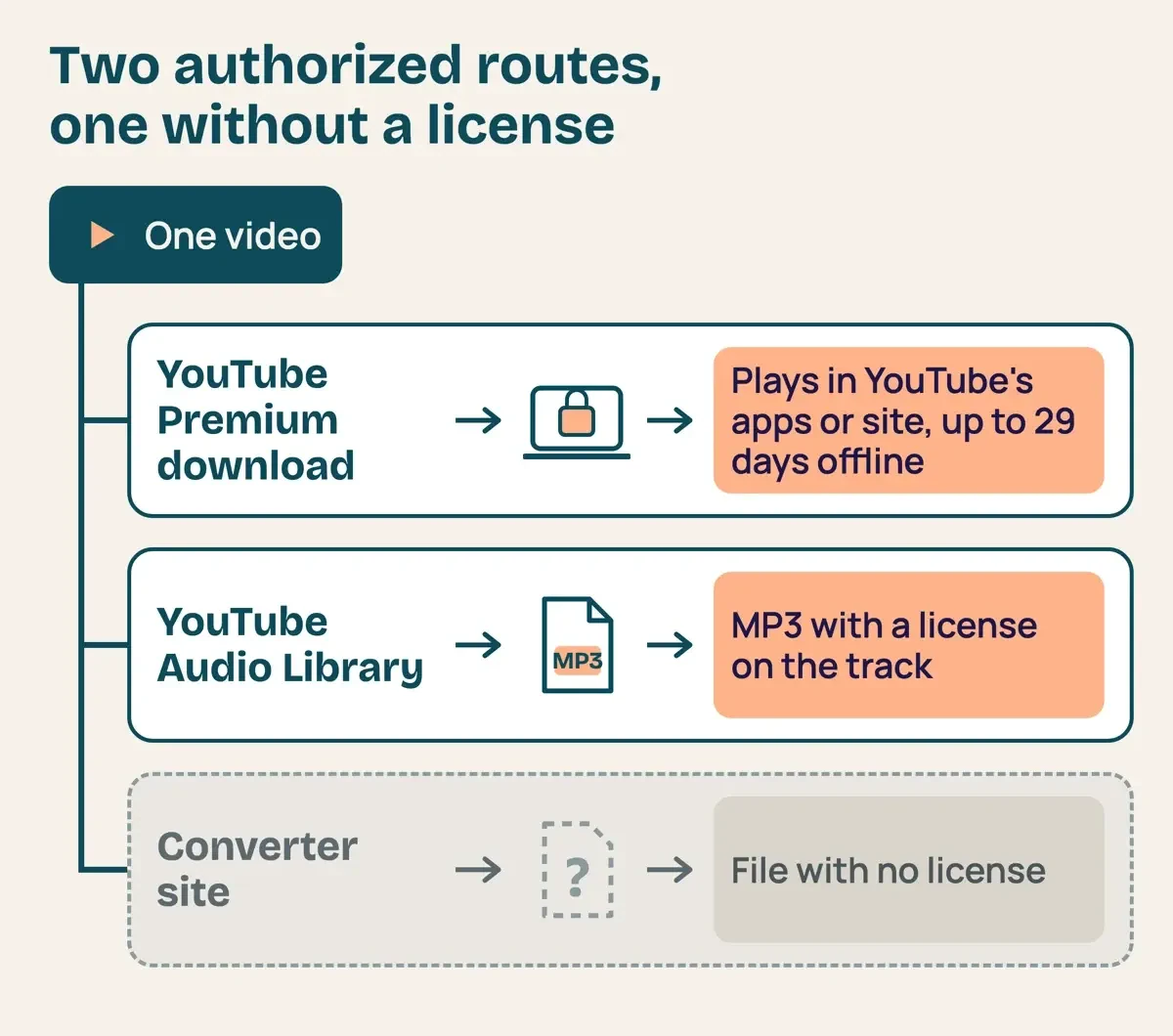 Diagram by DigitalTreed, based on the YouTube Terms of Service and YouTube Help, October 2026.
So what does YouTube authorize? Its offline viewing help page covers Premium downloads, which play offline for up to 29 days before the device has to reconnect. That copy stays inside YouTube's apps or browser. It isn't a loose MP3 you can drop into an editor. We cover the Premium steps in downloading songs from YouTube the official way, so this post stays on the converter question.
Is converting a YouTube song illegal in the US?
The Terms are a contract, but copyright is federal law, and it starts with the owner's exclusive rights. Section 106 of the Copyright Act, on the Copyright Office's Title 17 chapter 1 page, gives the owner the right "to reproduce the copyrighted work in copies or phonorecords." Saving a song as an MP3 makes a copy. Without the owner's permission or a legal exception, that copy can infringe.
Fair use is the main exception, and it's narrower than most people hope. Section 107 names purposes like criticism, comment, news reporting, teaching, scholarship and research. A court then weighs four factors: the purpose of the use, the nature of the work, how much was used, and the effect on the market.
On that last factor, the Copyright Office's Fair Use Index says courts ask whether a use is "displacing sales of the original." Courts decide "on a case-by-case basis," and there's "no formula" for a safe amount. The Index also says a creative work like a song is "less likely to support a claim of a fair use" than a factual one.
A whole song in a promo reel is creative, used in full, and replaces a license sale. That's three factors against you.
A separate rule targets digital locks. The Title 17 chapter 12 page holds section 1201(a)(1)(A): "No person shall circumvent a technological measure that effectively controls access to a work protected under this title." Whether a given converter does that is a question for a court, and we can't settle it here. The Copyright Office's section 1201 page shows exemptions get reviewed every three years. Renewed ones will run from October 2027 to October 2030.
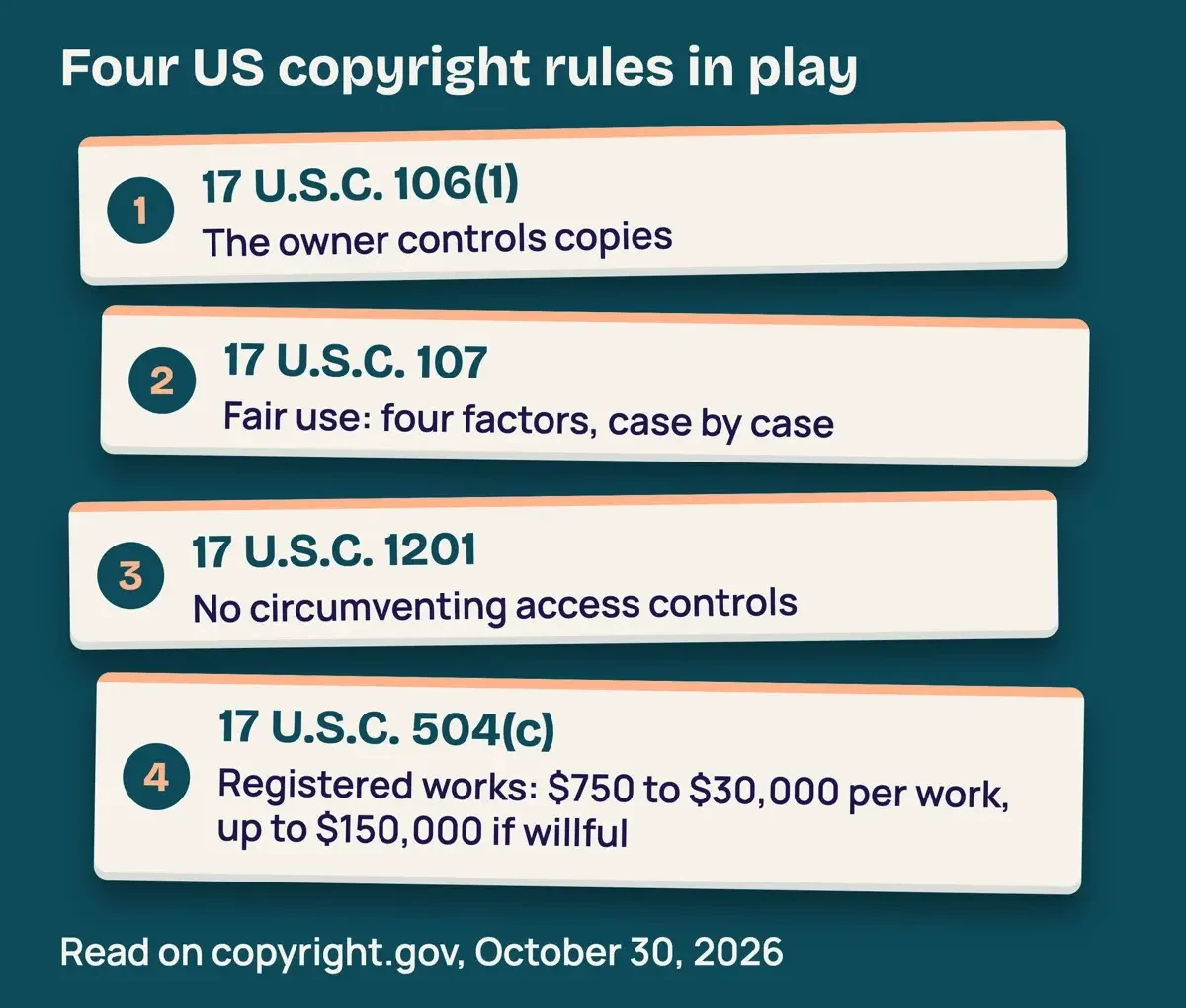 Source: 17 U.S.C. 106, 107, 504 and 1201 on copyright.gov, read October 30, 2026. Drawn by us.
Then there's the money. Under section 504(c) on the chapter 5 page, an owner can seek statutory damages "not less than $750 or more than $30,000" per work, as of October 2026. A court can raise that to $150,000 per work when it finds the infringement willful. There's a smaller forum, too. The Copyright Claims Board FAQ describes a federal option for disputes "up to $30,000 total," and 17 U.S.C. 1504 caps statutory damages there at $15,000 per timely registered work. For a work that wasn't registered in time, the same section sets the cap at $7,500 per work, or $15,000 in one proceeding.
Here's an example with those section 504 numbers. Statutory damages also take timely registration: section 412 bars them for infringement that began before registration, unless the work was registered within three months of publication. Five registered songs ripped for five client videos are five works. The statutory floor alone is 5 x $750 = $3,750, before anyone argues about willfulness. That's our reading of the statute, not legal advice, so take a specific use to a copyright attorney.
Where the safety risk comes from
Legal risk is half the picture, and the other half lives on the phone or laptop you'd download to, which is where the FTC and CISA come in. The FTC's malware guide says it plainly: "Don't use unfamiliar websites to download free stuff like music, movies, shows, or games." It also says "Don't click on ads to download software," because scammers place bogus software ads on search engines and social media. A converter page you've never used before fits that first line exactly.
CISA makes the same point from the security side. Its malicious code guide warns that "it is not uncommon that free software contains a Trojan horse." It also tells you to block pop-ups, since "Pop-up blockers disable windows that could potentially contain malicious code." Neither agency names MP4Juice.
Already used a converter? The FTC page lists signs worth checking:
- your browser's home page changes or redirects you to sites you didn't pick
- you get a lot of pop-up ads, including ones on sites that never show them
- new browser toolbars or add-on programs appear
- the computer slows down, freezes or crashes
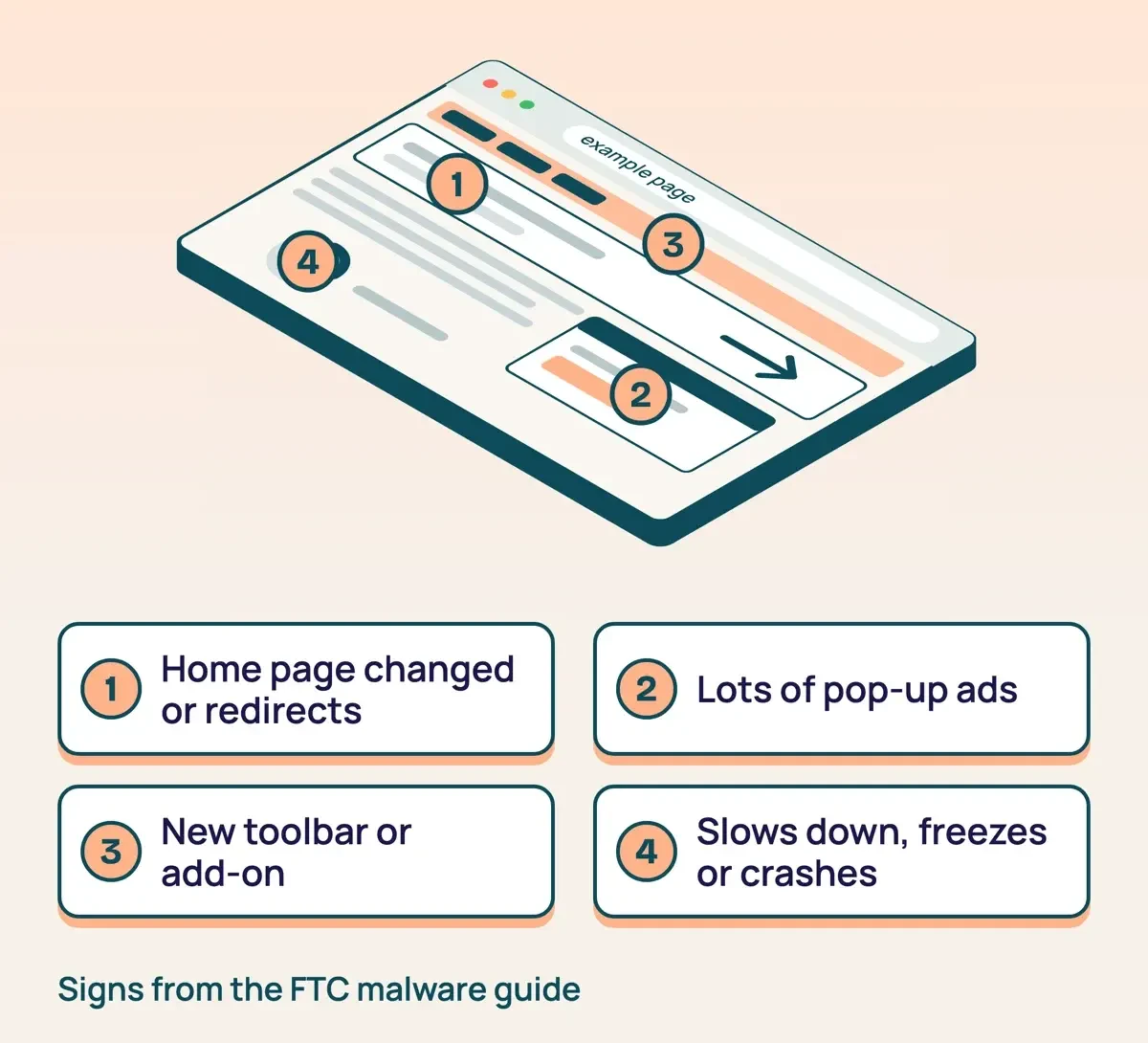 Drawn by us from the FTC list of malware signs, October 2026. Not a real website.
If you spot one, the FTC's steps are to stop logging in to accounts, update your security software, run a scan, change your passwords and turn on two-factor sign-in. We'd also open the browser's extensions list, since the FTC names new toolbars and add-ons as a warning sign, and remove anything you didn't install. The same page points you to IdentityTheft.gov if you think someone stole your information. For the basics, our online security steps cover passwords and updates. On a shared office computer, our post on malware entry points in business networks is the next read.
Free music you can download legally
Once the converter's off the table, plenty of music is still free and legal to download. The catch is the license. Each of the six routes below has its own, from CC0, which allows commercial use without asking, to a borrowed library album that's only for listening.
The YouTube Audio Library is the closest swap for a creator. YouTube Help describes "royalty-free production music and sound effects" and calls the tracks "copyright-safe." Its filters cover genre, mood, artist, attribution and duration, which helps when a reel needs exactly 30 seconds, and a DOWNLOAD link gives you an MP3. Some tracks carry a Creative Commons license, and for those "you must credit the artist in your video's description." If you'd rather skip credits, filter by Attribution not required. YouTube's copyright help lists the Audio Library as a music source, but it's honest about limits. No option, it says, will "guarantee avoiding copyright issues on YouTube, like a copyright strike or Content ID claim."
The Free Music Archive FAQ puts its key point in capitals: "FREE doesn't mean you are free to use, alter or build upon all songs without any conditions." Most of its music sits under Creative Commons licenses, shown on the left side of each track page.
A track marked CC0 is the easiest case. The deed says "You can copy, modify, distribute and perform the work, even for commercial purposes, all without asking permission."
Old recordings are another route, though the dates are tricky. Under section 1401 of the Copyright Act, federal protection for sound recordings first published before January 1, 1923 ended on December 31 of the third year after enactment. The law was approved October 11, 2018, so that date was December 31, 2021. Recordings from 1923 through 1946 get 100 years in total, so a 1930 record stays protected through 2030.
There's a limit, though. The Music Modernization Act page says this part covers recordings "fixed before February 15, 1972," so it won't help with modern pop songs. A track that only sounds old proves nothing, so check the first publication year on the archive's own record before you use it.
If sampling old sounds appeals to you, the Library of Congress runs Citizen DJ. It says "all sounds on this website are completely free-to-use for your remixing needs."
Your library card may help, too. The hoopla About page promises "Books, videos, and music - all free from your public library!" Borrowed albums are for listening, though, so don't drop one into an ad without reading the app's terms.
Which free tracks can go in a video or an ad
A free download and a free license aren't the same thing. Most mix-ups happen when a song moves into a video. The Creative Commons 4.0 legal code says that for music, "Adapted Material is always produced where the Licensed Material is synched in timed relation with a moving image." So a NoDerivatives track can't go in any video you share, even unedited.
The NonCommercial rule is the other trap. Creative Commons' license list defines it as "not primarily intended for or directed towards commercial advantage or monetary compensation." A business ad is aimed at exactly that.
We turned those rules into one table. It sets 10 kinds of free music against three uses and the credit rule:
| Kind of free music | Keep a copy | Use in a video you post | Use in a business video ad | Credit needed |
| CC0 (public domain dedication) | Yes | Yes | Yes | No |
| CC BY | Yes | Yes | Yes | Yes |
| CC BY-SA | Yes | Yes, video under same license | Yes, ad under same license | Yes |
| CC BY-ND | Yes | No | No | Yes |
| CC BY-NC | Yes | Yes, if noncommercial | No | Yes |
| CC BY-NC-SA | Yes | Yes, if noncommercial, same license | No | Yes |
| CC BY-NC-ND | Yes | No | No | Yes |
| YouTube Audio Library track | Yes | Yes, in your videos | Read the track license | Only if the track is CC |
| US sound recording first published before 1923 | Yes | Yes | Yes | No |
| Song ripped from a YouTube video by a converter | Needs permission | Needs permission | Needs permission | Needs permission |
Only 3 of the 10 rows give a plain yes to all three uses: CC0, CC BY and pre-1923 US recordings. Four rows rule out a business video ad, and both NoDerivatives licenses fail in any posted video.
Making a video for a client? Start with the CC0 and CC BY rows, and treat everything else as a question for the rights holder.
What we tested
On October 30, 2026, a local script built that table from 13 quotes in our saved copies of the official pages. It stops if a quote is missing; all 13 were found.
We also made three 1-second WAV tones and wrote a copyright tag into two. Reading them back gave the CC BY tag, no tag, and "All rights reserved." Writing that CC BY tag took one function call, so a tag proves nothing alone.
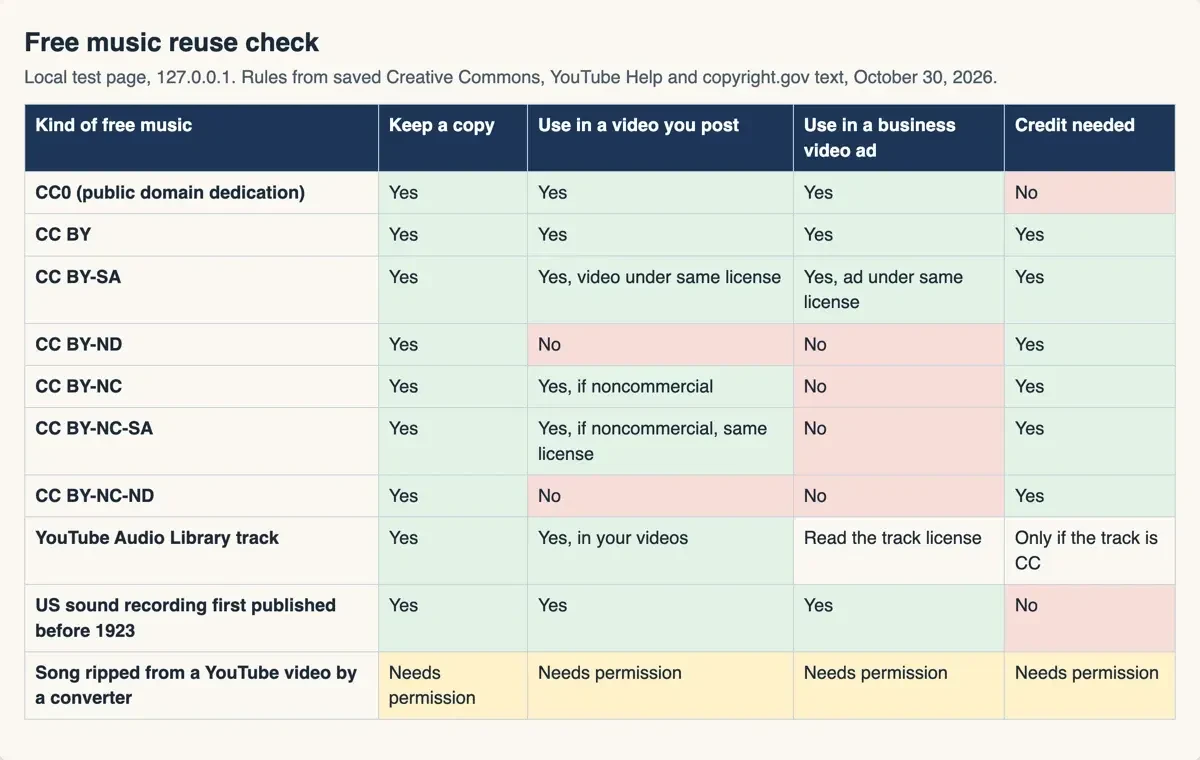 Screenshot: our local test page on 127.0.0.1, October 30, 2026.
A three-step license check before you download
That test points to one habit. Before any track goes into a reel, a podcast or a store playlist, run these three checks in order:
- Find the source: the artist's page, the Audio Library or the archive's track page, never a file someone reposted.
- Read the license on that page, and match it to your use with the table above.
- Save proof: a PDF or screenshot of the license page, with the date, next to the file.
For a small team, a plain spreadsheet with the track name, source URL, license and download date is enough to find the proof again when someone asks.
Proof matters most when a claim lands months later. A Content ID claim can hit a video even when you used licensed music, and the saved page is what you'll show the claimant. Our explainer on why a YouTube video gets blocked lists the dispute and appeal windows you'd be working against. Podcasters meet the same question when Apple asks them to confirm Content Rights for any music, a step covered in starting a business podcast. Once the license is on file, the YouTube ranking tips we publish help the video get found.
Our take: skip converters for anything you'll publish. Even a private copy sits outside YouTube's Terms. Pick an Audio Library or CC0 track, save its license page, and you won't wonder later. If people copy your own videos or posts, protecting website content from copying walks through the same law from the owner's side.
MP4Juice questions
Frequently asked
Can I play YouTube music in my store?
Not under the standard Terms. The YouTube Terms allow listening for "your personal, non-commercial use." Section 106(4) of the Copyright Act also gives a song's owner the right "to perform the copyrighted work publicly," so playing it in a store needs the owner's permission.
Are US government recordings free to use?
Generally yes. Section 105 on the chapter 1 page says copyright "is not available for any work of the United States Government."
What if a Creative Commons track gets a Content ID claim?
Contact the artist. The Free Music Archive FAQ says FMA "cannot address Content ID claims directly."
How do I credit a Creative Commons track from the Audio Library?
Copy YouTube's text. The Audio Library help page tells you to click the Creative Commons icon in the License type column, copy the text, then paste it into your video description.
How we made this guide: We read YouTube's Terms and Help pages, Title 17 on copyright.gov, and FTC, CISA, Creative Commons and Free Music Archive pages. A local script checked the table and three WAV tags. Facts checked by the DigitalTreed team on October 30, 2026.
First published November 2023 as an MP4Juice converter how-to. Rewritten October 30, 2026: the safety and legal answer from YouTube's Terms and US law, with no converter steps, plus legal free music.
Sources
- YouTube Terms of Service
- YouTube Help: Watch videos offline with YouTube Premium
- YouTube Help: Use music and sound effects from the Audio Library
- YouTube Help: Copyright and fair use
- U.S. Copyright Office: Title 17, Chapter 1 (sections 105, 106, 107)
- U.S. Copyright Office: Fair Use Index
- U.S. Copyright Office: Title 17, Chapter 4 (section 412)
- U.S. Copyright Office: Title 17, Chapter 5 (section 504)
- U.S. Copyright Office: Title 17, Chapter 12 (section 1201)
- U.S. Copyright Office: Section 1201 rulemaking
- U.S. Copyright Office: Title 17, Chapter 14 (section 1401)
- U.S. Copyright Office: Music Modernization Act
- Cornell LII: 17 U.S.C. 504
- Cornell LII: 17 U.S.C. 1401
- Cornell LII: 17 U.S.C. 1504
- Copyright Claims Board: FAQs
- FTC: Malware, how to protect against, detect and remove it
- CISA: Protecting Against Malicious Code
- Creative Commons: About CC Licenses
- Creative Commons: Attribution 4.0 legal code
- Creative Commons: CC0 1.0 deed
- Free Music Archive: FAQ
- Library of Congress: Citizen DJ
- hoopla: About
Comments
No comments yet. Start the conversation below.