
Quick answer
Google ranking factors are the signals Google's systems weigh to order results, and Google doesn't publish a list or a count. Its own pages confirm a short set: relevance, links, helpful content, Core Web Vitals, the mobile version, freshness, location and spam policies. We checked 30 popular claims: 11 hold up, 14 are myths, 5 are unproven.
Key takeaways
- Google publishes no list or count of its ranking factors.
- Of 30 claims checked, 11 are confirmed, 14 are myths and 5 unproven.
- Page speed counts through Core Web Vitals; LCP should load within 2.5 seconds.
- E-E-A-T, word count and the keywords meta tag are not ranking factors.
- Answer the search better than the page above you before chasing speed or links.
Google ranking factors are signals, not a 200-item checklist
A ranking factor is any piece of evidence Google uses to decide which page shows first for a search. Google's How Search Works page names the big groups: "the words of your query, relevance and usability of pages, expertise of sources, and your location and settings."
Think of a county fair judge who scores pies and pickles on taste and looks, but never with the same weights for both. Google says the same about search: "The weight applied to each factor varies depending on the nature of your query." No single list fits every search.
So where did "200" come from?
We went looking on October 26, 2026. Google's old Inside Search page, saved by the Wayback Machine in August 2013, said "Today Google's algorithms rely on more than 200 unique signals". Today's ranking systems guide talks about "many factors and signals" and gives no number at all. Wayback copies still show that line in January 2016 and July 2017, and later captures only redirect. Google hasn't given a count since, yet it still headlines most of the lists you'll find this year.
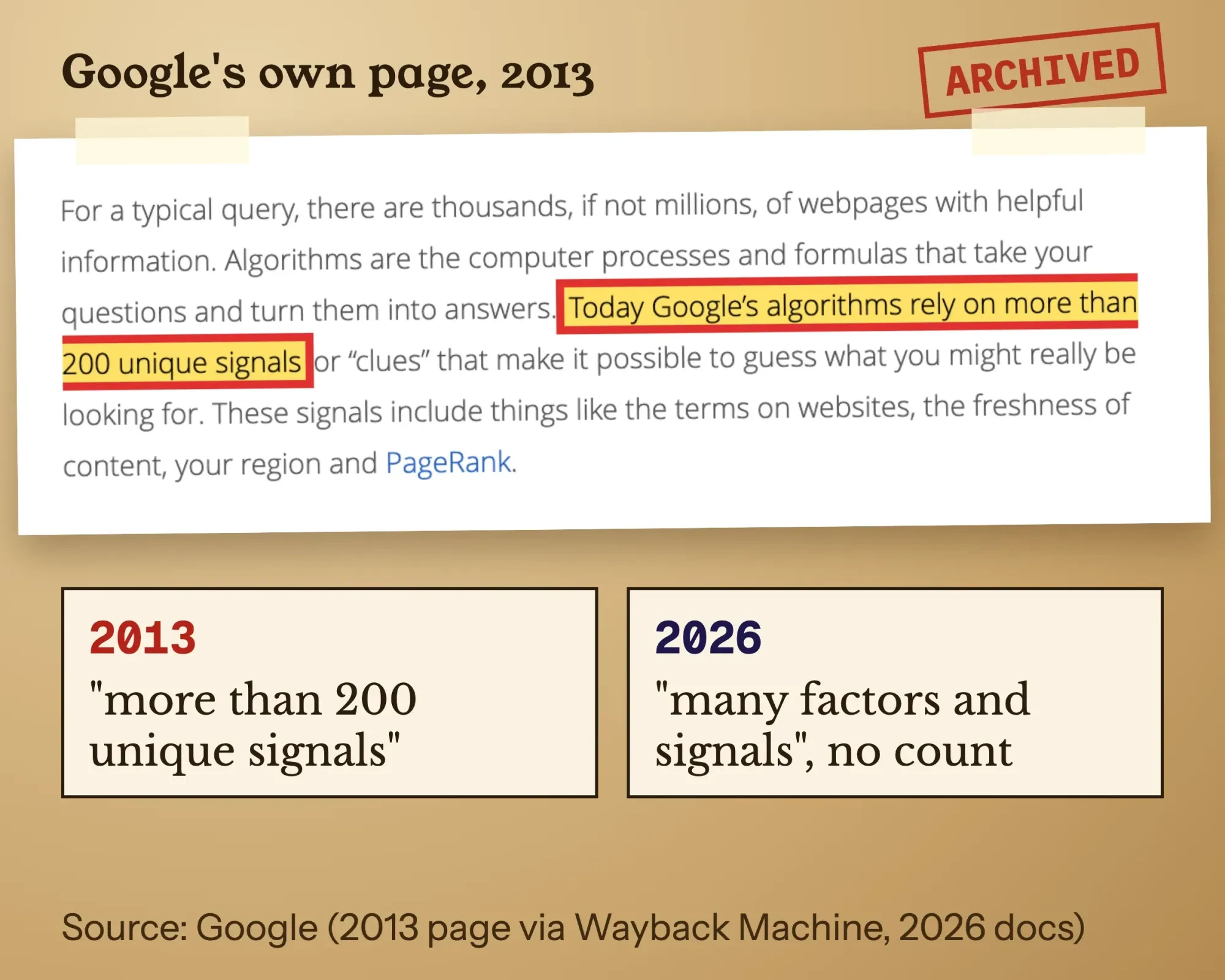 Screenshot: Google Inside Search "Algorithms" page as saved by the Wayback Machine on August 21, 2013, captured October 26, 2026.
That one old sentence is the seed of every "200 ranking factors" list, including the earlier version of this page. Nobody outside Google has the real list. Google's page on third-party SEO tools is blunt about it: "Third-party tools don't have access to our internal ranking data."
So we stopped counting and started checking.
Our scorecard: 30 claims checked against Google's own pages
That check is the core of this guide. We took 30 claims that keep showing up in ranking-factor lists, sales emails and SEO forums, looked up each one in Google's own documentation that same day. Each got one of three labels. Confirmed means a current Google page says it's used in ranking, or names a system that does it. Myth means a Google page says no. Unproven means Google hasn't said yes, or what it said years ago no longer matches its current docs.
| Claim | Label | Google page |
|---|---|---|
| Searcher's words in headings and body text | Confirmed | How Search Works |
| Links from other prominent sites | Confirmed | How Search Works, ranking systems guide |
| Helpful, people-first content | Confirmed | Helpful content page |
| Core Web Vitals | Confirmed | Page experience page |
| The mobile version is what gets ranked | Confirmed | Mobile-first indexing page |
| Freshness, for searches that need it | Confirmed | Ranking systems guide |
| Searcher's location and settings | Confirmed | How Search Works |
| Interaction data, in aggregate | Confirmed | How Search Works |
| Spam policy breaches push pages down | Confirmed | Spam policies |
| Original content ranks ahead of copies | Confirmed | Ranking systems guide |
| Local: relevance, distance, prominence, reviews | Confirmed | Business Profile help |
| Someone outside Google has the list of 200 factors | Myth | Third-party SEO page, 2013 page vs today's guide |
| Meta keywords tag | Myth | SEO Starter Guide |
| Meta description as a ranking factor | Myth | 2009 Search Central post |
| A minimum word count | Myth | SEO Starter Guide, helpful content page |
| E-E-A-T is a ranking factor | Myth | SEO Starter Guide |
| Duplicate content penalty for your own pages | Myth | SEO Starter Guide |
| Heading order and number | Myth | SEO Starter Guide |
| Keywords in the domain name boost rank | Myth | SEO Starter Guide |
| .com ranks better than .org | Myth | SEO Starter Guide |
| Subfolders beat subdomains | Myth | SEO Starter Guide |
| Buying Google Ads lifts organic rank | Myth | How Search Works |
| Domain Authority is a Google metric | Myth | Third-party SEO page |
| AI-written content is penalized by default | Myth | 2023 AI content post |
| New dates or mass edits make a site look fresh | Myth | Helpful content page |
| HTTPS gives a ranking boost today | Unproven | 2014 post vs page experience page |
| Title tag keywords outweigh body text | Unproven | Title link guide |
| Schema markup lifts rankings | Unproven | Structured data guidelines |
| Social shares and likes | Unproven | SEO Starter Guide |
| Dwell time, bounce rate, Google Analytics data | Unproven | How Search Works |
The count: 11 confirmed, 14 myths and 5 unproven.
Myths outnumber the real factors, and that tells you a lot about where SEO budgets leak.
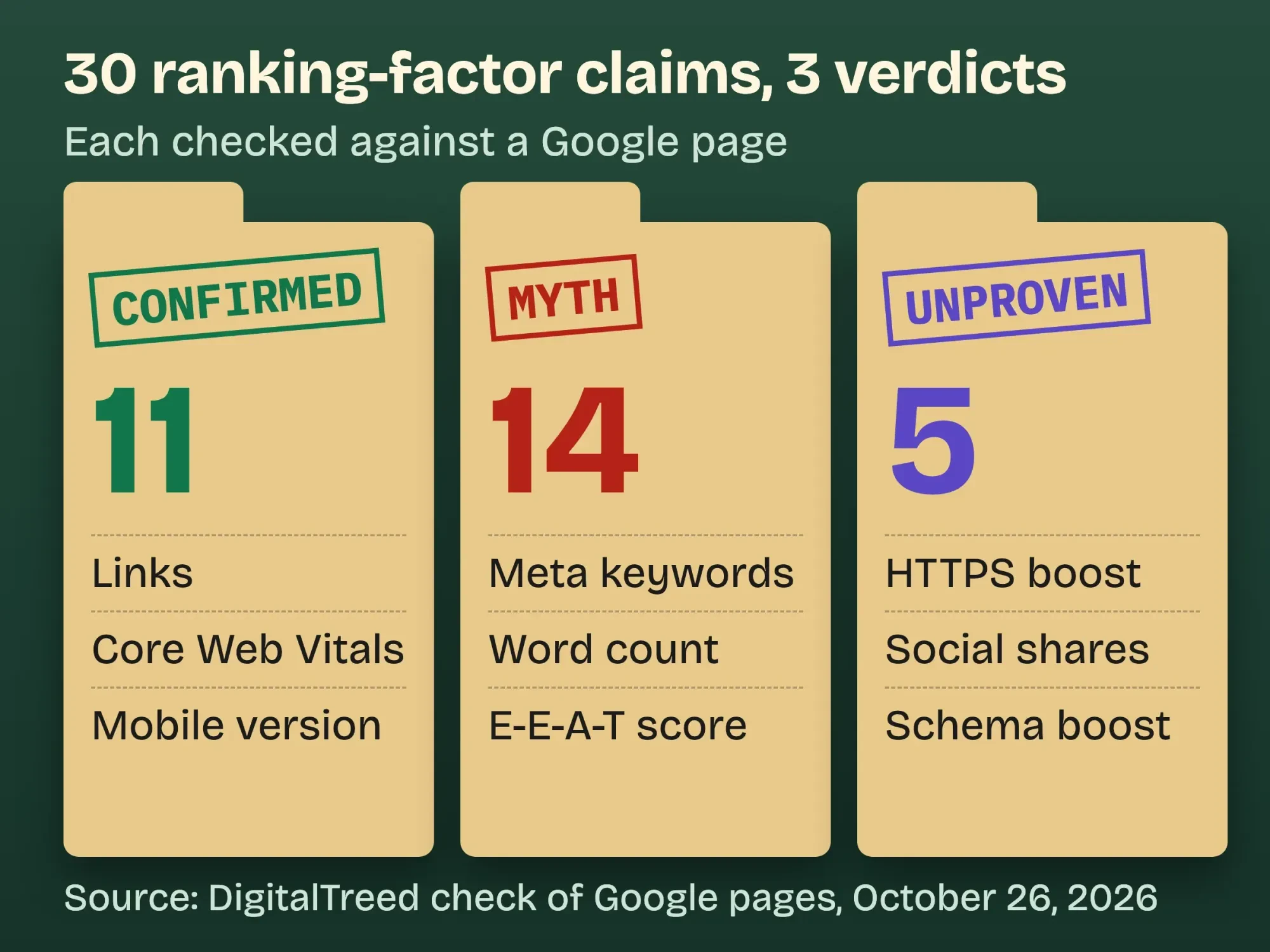 Diagram by DigitalTreed: 30 claims sorted against Google's own pages on October 26, 2026.
Each row is explained below, with the Google page linked at the claim. New to all this? Start with how Google finds and stores pages in our beginner course on SEO, then come back.
Confirmed google ranking factors: what Google says it uses
Those 11 confirmed rows are where your time and money belong. None of them is a trick, and each one is something Google describes in plain words on its own site.
Relevance: your page uses the searcher's words
Relevance comes first. Google says "The most basic signal that information is relevant is when content contains the same keywords as your search query". Keywords in "the headings or body text of a webpage" make a page look more relevant. Google also looks for related material, like photos or a list of options, instead of the same word repeated.
That doesn't mean repeating a phrase 40 times. Keyword stuffing sits on Google's list of spam practices, so it can sink a page instead of lifting it.
Links from other sites
Links still count. The ranking systems guide says PageRank, the link system Google launched with, "continues to be part of our core ranking systems." Google also checks "if other prominent websites link or refer to the content," per How Search Works. Bought links are a different story, because Google's spam rules name "Buying or selling links for ranking purposes" as link spam.
Our checklist for off-page work sorts the links worth earning from the ones to skip.
Helpful, people-first content
Google's helpful content page says its ranking systems "are designed to prioritize helpful, reliable information that's created to benefit people". The separate helpful content system from 2022 isn't its own thing anymore: in March 2024 it "became part of our core ranking systems," according to the retired systems list.
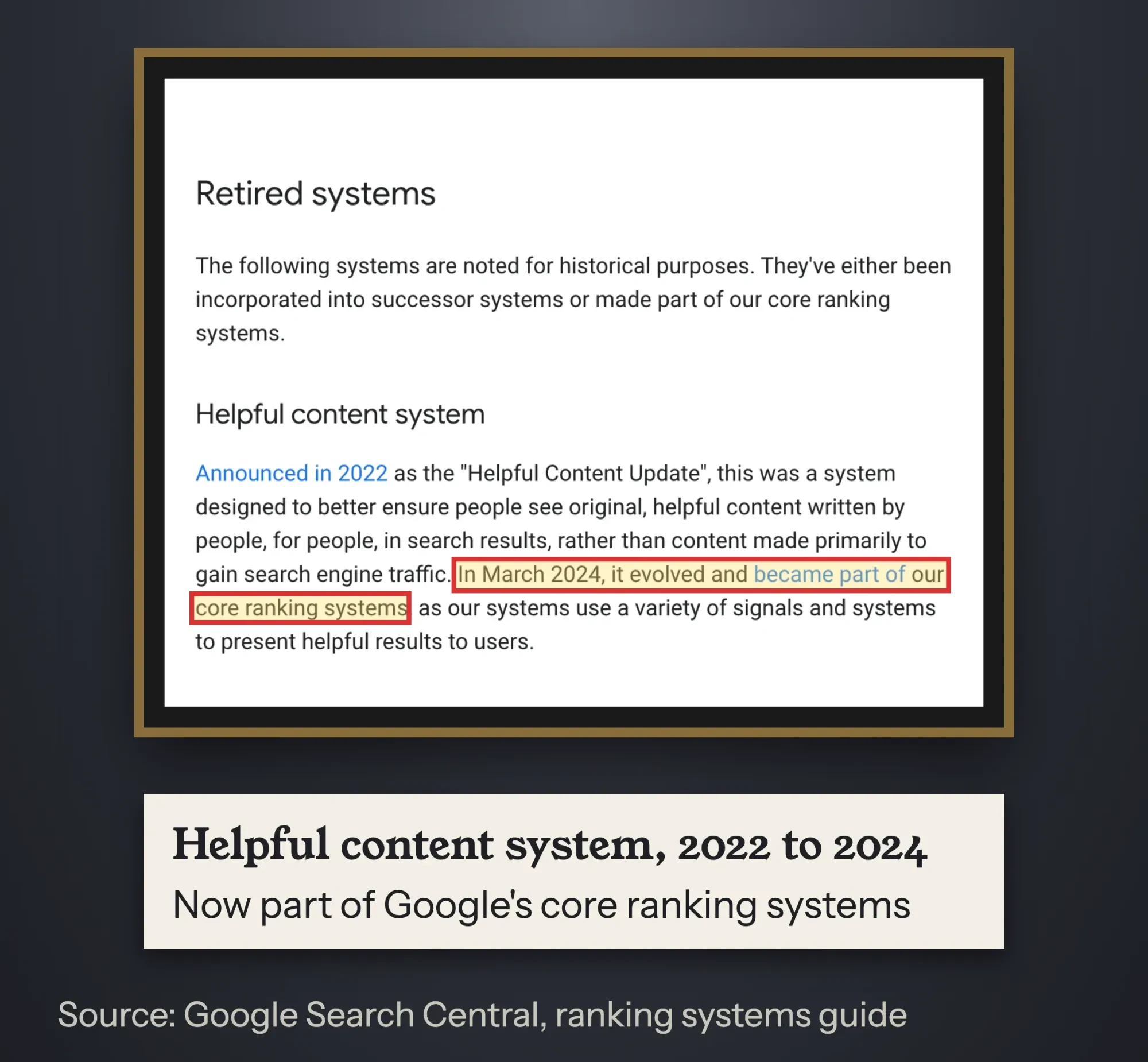 Screenshot: Google Search Central, "A guide to Google Search ranking systems", Retired systems section (page updated December 10, 2025), captured October 26, 2026.
In practice, helpful means you answer the question fully, from real experience, without padding, and our SEO content writing guide walks through Google's self-check questions one by one.
Page speed counts, through Core Web Vitals
Is page speed a ranking factor? Yes, in the form of Core Web Vitals. Google's page experience page, updated in September 2026, says it flat out: "Core Web Vitals are used by our ranking systems."
The Core Web Vitals page sets the targets. The main content should load (LCP) within 2.5 seconds. A tap or click should get a response (INP) in under 200 milliseconds. Layout shift (CLS) should stay under 0.1.
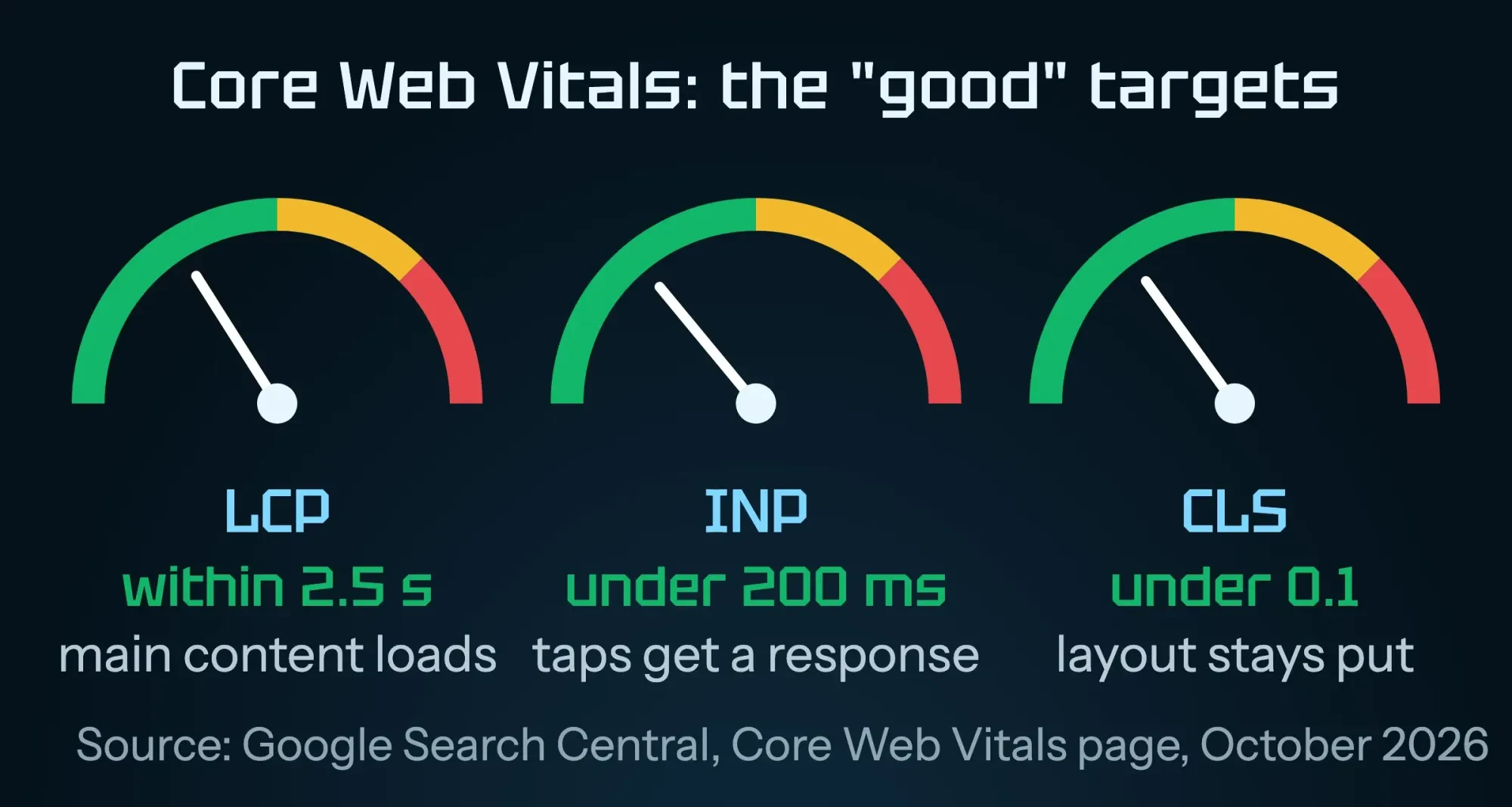 Diagram by DigitalTreed: Core Web Vitals targets from Google Search Central, as of October 2026.
Don't chase a perfect score, though.
Google's own page warns that good results "doesn't guarantee that your pages will rank at the top". It adds that Google "always seeks to show the most relevant content, even if the page experience is sub-par". Run a page through our speed test tool to see where you stand, and read our walkthrough of PageSpeed Insights if field data and lab data disagree.
The mobile version of your site
Google ranks your mobile pages, not your desktop ones. Its mobile-first indexing page says Google "uses the mobile version of a site's content, crawled with the smartphone agent, for indexing and ranking."
If your phone layout hides your service list or your reviews, Google may never count them.
Freshness, location and clicks
Three more signals depend on the search as much as on your page. Google runs "query deserves freshness" systems for searches where new content is expected, like news or a product launch. Your location shapes results too, which is why a search for pizza shows places near you. Clicks are the touchy one. How Search Works says Google uses aggregated, anonymized interaction data and turns it into signals for its machine-learned systems.
Searcher behavior counts, then, in bulk. What Google hasn't published is any rule like "longer visits rank higher."
Spam policies push pages down
Spam policies work in the other direction. Google's spam policies say "Sites that violate our policies may rank lower in results or not appear in results at all." Detection runs "both through automated systems and, as needed, human review". The policies now also cover "attempting to manipulate generative AI responses in Google Search," so tricks aimed at AI answers count as spam too.
Local results: relevance, distance and prominence
The map results have their own rules. Google's help page for Business Profiles names three local signals: how well your profile matches the search, how far you are from the searcher, and how well known you are. On that last one it says "More reviews and positive ratings can help your business's local ranking."
It also says "There's no way to request or pay for a better local ranking on Google."
Our plain-English local SEO explainer and step-by-step Business Profile walkthrough cover the setup.
Signals and named systems are different things
Ranking lists also mix signals up with systems, and that's where much of the confusion starts. A signal is a piece of evidence. A system is the software that weighs it.
Google's ranking systems guide names 17 current systems and 4 retired ones. RankBrain "helps us understand how words are related to concepts." SpamBrain is one of its spam detection systems. Our Google algorithm updates guide covers how they arrived and what to do when an update hits you.
Two systems matter more to small sites than their fame suggests. The exact match domain system makes sure Google doesn't "give too much credit" to domains built to match a search, so a name like best-gutters-lafayette.com buys you very little. And site diversity means Google "generally won't show more than two web page listings from the same site in our top results."
You can't optimize for a system; you can only give it better evidence.
Google ranking factors myths Google has denied
Now the myths. Each of these has a Google page that says no, often in so many words.
Meta tags, word count and headings
The keywords meta tag does nothing. The SEO Starter Guide from Google says "Google Search doesn't use the keywords meta tag." A 2009 Search Central post adds "we still don't use the description meta tag in our ranking."
Write a good description anyway, since Google sometimes shows it as your snippet and it can win the click even though it won't move your position.
Length is a myth too.
The Starter Guide says "there's no magical word count target, minimum or maximum". Google's helpful content page asks whether you're writing to a word count Google prefers, and answers in brackets: "(No, we don't.)". Heading order doesn't matter to Google either: "it doesn't matter if you're using them out of order."
E-E-A-T as a score
E-E-A-T stands for experience, expertise, authoritativeness and trust, and Google's human raters use it to judge results. But the Starter Guide's answer to "Thinking E-E-A-T is a ranking factor" is short: "No, it's not". The helpful content page gives the fuller version: "While E-E-A-T itself isn't a specific ranking factor, using a mix of factors that can identify content with good E-E-A-T is useful." Raters "have no control over how pages rank."
There's no E-E-A-T score to raise, then. There's only evidence, like real bylines and first-hand detail, that other signals can pick up.
Domains, URLs and duplicate pages
Keywords in your domain have "hardly any effect beyond appearing in breadcrumbs," the Starter Guide says. Your .com or .org doesn't matter unless you target another country: "Otherwise Google Search doesn't care which TLD you're using". Subdomains versus subfolders is a business choice, not a ranking one. And the "duplicate content penalty" isn't real for your own pages, because having one page at two URLs is "not something that will cause a manual action."
Copying someone else's site is a different story: Google runs original content systems meant to show the original "ahead of those who merely cite it."
Paid ads and third-party scores
Buying Google Ads won't lift your organic rank. Google says its results "are not influenced by whether a business, individual, or organization buys ads."
Domain Authority and Authority Score aren't Google numbers either; they're estimates built by Moz and Semrush, and Google's tools page says third-party tools "can't guarantee performance." Read what Domain Authority does measure before you pay anyone to raise it.
AI content and fake freshness
AI-written content isn't penalized for being AI-written. Google's AI content guidance says "Appropriate use of AI or automation is not against our guidelines." The problem is churning out pages without value, which Google's generative AI page ties to its scaled content abuse policy.
Re-dating old posts doesn't work either. The helpful content page asks if you're "changing the date of pages to make them seem fresh when the content has not substantially changed." Adding or cutting lots of pages to look fresh gets a blunt "(No, it won't)".
And you don't need special markup for AI Overviews. Google's AI features page says "There's also no special schema.org structured data that you need to add." Our GEO guide covers what does help with AI answers.
Unproven: what Google hasn't confirmed
That leaves five claims in the gray zone, where they might carry some weight but Google either hasn't said so or has said something different since.
HTTPS as a boost
In 2014, Google announced HTTPS as "a very lightweight signal" that touched "fewer than 1% of global queries". Its 2026 page experience page groups HTTPS with page experience, then says "Beyond Core Web Vitals, other page experience aspects don't directly help your website rank higher in search results."
That's why we can't call HTTPS confirmed today. Keep it anyway, because it protects the forms and logins your visitors use.
Keywords in the title tag
Almost every list calls title tags a top factor. Google's title link guide only says "It's sometimes helpful to have a few descriptive terms in the <title> element". How Search Works names headings and body text, not titles, though we'd still write a clear title for every page, since it's usually the blue link people click. And a meta tag analyzer shows you the title and description a page sends to Google.
Schema markup
Structured data makes a page eligible for rich results, like review stars. Google hasn't said it lifts rankings. Its structured data guidelines say a structured data manual action "doesn't affect how the page ranks in Google web search."
That's a strong hint the markup isn't a ranking lever.
Social shares
Likes and shares aren't on any Google list we read. The Starter Guide names "Social media promotion" as a way to help people find your site, which is about discovery. Social posts can bring visitors and links. We found no Google page that says the shares themselves rank you.
Dwell time, bounce rate and Google Analytics
Google confirms it uses interaction data in aggregate, on How Search Works, but it hasn't published that time on page, bounce rate or your Google Analytics account feed rankings.
Anyone selling "dwell time optimization" is guessing.
Example: sorting a pitch for a Lafayette gutter company
Here's how the scorecard works on a real-looking sales pitch. Example: Bayou Gutter Co. is a made-up gutter installer in Lafayette, Louisiana. The owner gets an email offering a "200-factor SEO package" for a monthly fee, with 8 items listed.
Sorted against the scorecard, the pitch falls apart fast, because adding meta keywords, buying a keyword domain, padding every page to 2,500 words and raising Domain Authority are all myths. That's half the package gone. A paid "high-DA" link network is worse than a myth: it's link spam under Google's own policies. Two items survive. Fixing a slow phone layout is confirmed, through Core Web Vitals and the mobile version, and asking happy customers for Google reviews is confirmed for local results. The last item, "social signal boosting", is unproven at best.
Bayou Gutter keeps 2 of 8 items.
What to work on first
Google doesn't publish an order, so this part is our judgment, built only from the confirmed list. For a small shop or service site, we'd go in this order:
- Make sure Google can find and index your key pages. Search Console's page indexing report shows what's missing; our Search Console guide walks through it.
- Answer each service or product question fully on its own page, in the words your customers use.
- Fix the mobile version and Core Web Vitals on your top pages.
- Fill out your Business Profile and ask every happy customer for a review.
- Earn links and mentions from real local sources, like suppliers, your chamber of commerce and local news.
The website audit tool on our site is free; it runs a page through a set of SEO checks and lists what to fix. If it turns up crawl or index problems, the technical audit checklist goes step by step, and the advanced SEO guide covers bigger sites.
Our take: most small sites don't lose because of a missing factor. They lose because their page answers the search worse than the page above it, so fix that first, then speed and mobile, then links.
Frequently asked
Do internal links help Google rankings?
They help Google find and judge your pages. As of October 2026, Google's link best practices say it uses links as a signal of relevance and to find new pages to crawl. The same page says every page you care about should have a link from at least one other page on your site.
Do nofollow links help rankings?
Google doesn't say they do. As of October 2026, its page on qualifying outbound links says links with nofollow, sponsored or ugc will generally not be followed. It adds that the linked pages may still be found through sitemaps or links from other sites.
Does Google use AI to rank pages?
Yes, in parts. As of October 2026, Google's ranking systems guide names BERT and neural matching as AI systems that help it understand queries and pages. It also says MUM is not currently used for general ranking in Search.
Do Google ranking factors change?
Yes, the systems change all the time, but the confirmed basics have stayed put for years. Google retires and merges systems, as it did with helpful content in 2024, and announces its bigger core updates, and our updates guide tracks them, with recovery steps.
Give any fix time to show. The SEO Starter Guide says "Some changes might take effect in a few hours, others could take several months." Check Search Console a few weeks after a change before you judge it.
And when someone sends you a fresh list of 200, check it against Google's own pages first.
Prefer to hand the work off? Our SEO service starts from the same confirmed list. We're paid for that service, so count this paragraph as an ad.
How we made this guide: we replaced Eram N.'s July 2020 post, which was built on an older third-party article, with Google's own pages. On October 26, 2026, we read 17 Google Search Central and Google help pages, plus Google's 2013 Inside Search page on the Wayback Machine, and labelled 30 claims against them. We didn't run ranking experiments on any live site: the scorecard is a careful reading of Google's documents. A link to the Google page it quotes sits beside every quote.
First published July 2020. Rewritten October 26, 2026: a new scorecard that labels 30 ranking-factor claims Confirmed, Myth or Unproven against Google's own pages. It also adds Core Web Vitals targets, local factors and the Bayou Gutter Co. example.
Sources
- Google Search Central: A guide to Google Search ranking systems
- Google: How Search Works, ranking results
- Google Inside Search: Algorithms (Wayback Machine snapshot, August 21, 2013)
- Google Search Central: Understanding Google page experience
- Google Search Central: Understanding Core Web Vitals and Google search results
- Google Search Central Blog: HTTPS as a ranking signal (August 2014)
- Google Search Central: Mobile-first indexing best practices
- Google Search Central: Creating helpful, reliable, people-first content
- Google Search Central: SEO Starter Guide
- Google Search Central Blog: Google does not use the keywords meta tag in web ranking (September 2009)
- Google Search Central: Spam policies for Google web search
- Google Search Central Blog: Google Search's guidance about AI-generated content (February 2023)
- Google Search Central: Google Search's guidance on generative AI content on your website
- Google Search Central: Google Search's guidance on third-party SEO tools and advice
- Google Search Central: General structured data guidelines
- Google Search Central: AI features and your website
- Google Business Profile Help: Tips to improve your local ranking on Google
- Google Search Central: Influencing title links in Google Search

Comments
No comments yet. Start the conversation below.