
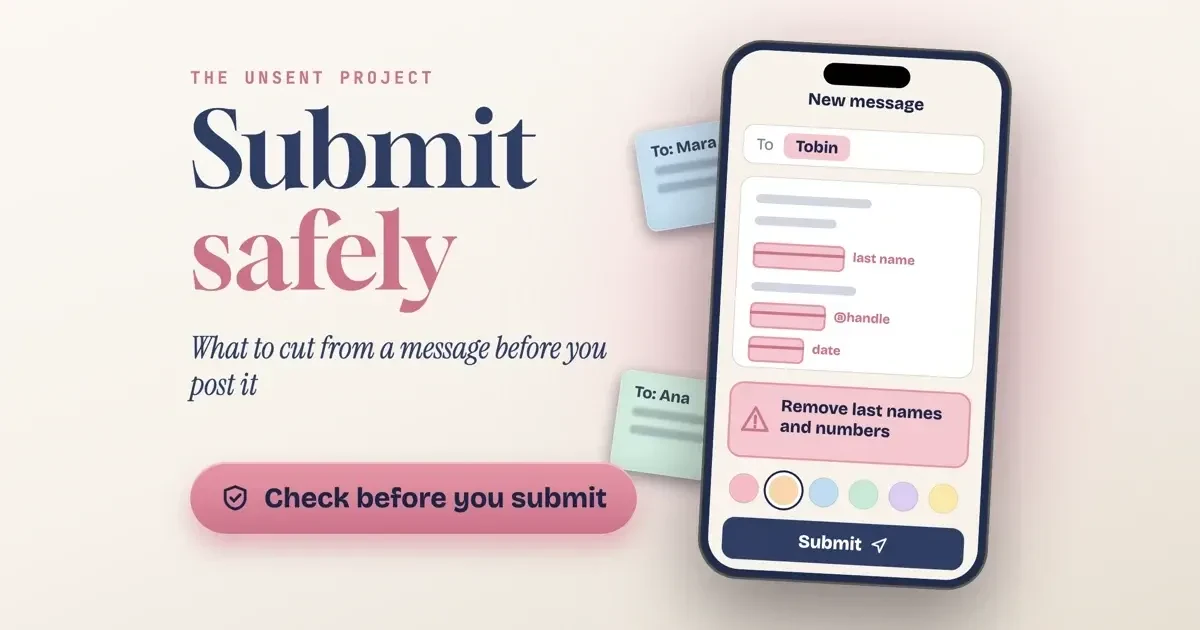
Quick answer
The Unsent Project is an online archive of anonymous texts to first loves, and its about page counts over 11,000,000 as of November 2026. You search it by first name, and each message sits on the color its writer chose. Before you submit, cut last names, handles, dates and places, because the terms say posts can't be deleted.
If you've seen Unsent Project screenshots on social media, you likely have two questions. Is there a message to my name, and should I write one? The second answer turns on one line in the Unsent Project terms: a posted message stays public and searchable for good.
First comes what the project is, then searching by name and what the colors mean. After that: how submitting works, what the terms and privacy policy say, and privacy tips with the draft check we ran. Last come look-alike and copy sites, and what we'd do before sending one.
Key takeaways
- The terms say a posted message stays searchable and can't be deleted.
- Write to a first name only; last names, handles and dates break the rules.
- A message's color shows only what its writer picked for that person.
- Our local checker matched our hand labels on 9 of 12 made-up drafts.
- The real form asks for no email, phone number or payment.
What is the Unsent Project?
The clearest description is the project's own, on its About The Unsent Project page. It calls itself "a collection of over 11,000,000 unsent text messages to first loves" and says "Messages are submitted anonymously from people all over the world." That count is the site's own figure as of November 2026. First love is looser than it sounds, too. The about page says the term "is open to interpretation," and people have written "to lovers, best friends, exes, parents, siblings, and even pets." It isn't only breakups.
On where it came from, the site gives one line. "Rora Blue started the Unsent Project in 2015 to figure out what color people see love in." That's the only fact about its creator we repeat here. The artist's own site, rorablue.com, had a banner for an Unsent Project sticker pack on November 2, 2026. The Terms of Use say the website is operated by The Unsent Project LLC. The about page gives the project's aim as "to provide an emotional outlet for those that need it."
How searching by name works
A name search box is the main thing the Unsent Project archive home page offers. It has the placeholder "Search for a name..." and a filter button, and the about page says the texts sit in "our online archive which can be searched by name." Before the archive appears, the site shows a notice about explicit content and its terms, with an Accept button you press to enter.
Because the submit form asks for a first name only and the terms ban last names, a common name pulls up messages to every person who shares it. None of them proves a message is about you. The same limit applies to any tool claiming to unmask an anonymous person, like the anonymous Instagram story viewers we looked at. If you search by hand and a message feels like yours, hold it loosely: it's a feeling, not proof.
We didn't run any searches for this guide. The Terms of Use bar searching "by any means (automated or otherwise) other than through our currently available, published interfaces." So our checks stayed with reading public pages, the same ones any visitor sees.
What do the colors mean?
Color is the reason the project exists. According to the about page, "submissions are displayed on the color the submitter associates with their first love." Its steps say to "select the color that you associate with them and click submit." A color means one thing here: the writer picked it for that person. We found no color key on the five public pages we read. If a chart online says red means passion or blue means sadness, that's someone else's reading of the colors, however confident it sounds, and not the site's. A blue card to Tobin (made up) tells you the writer sees Tobin in blue. Nothing more.
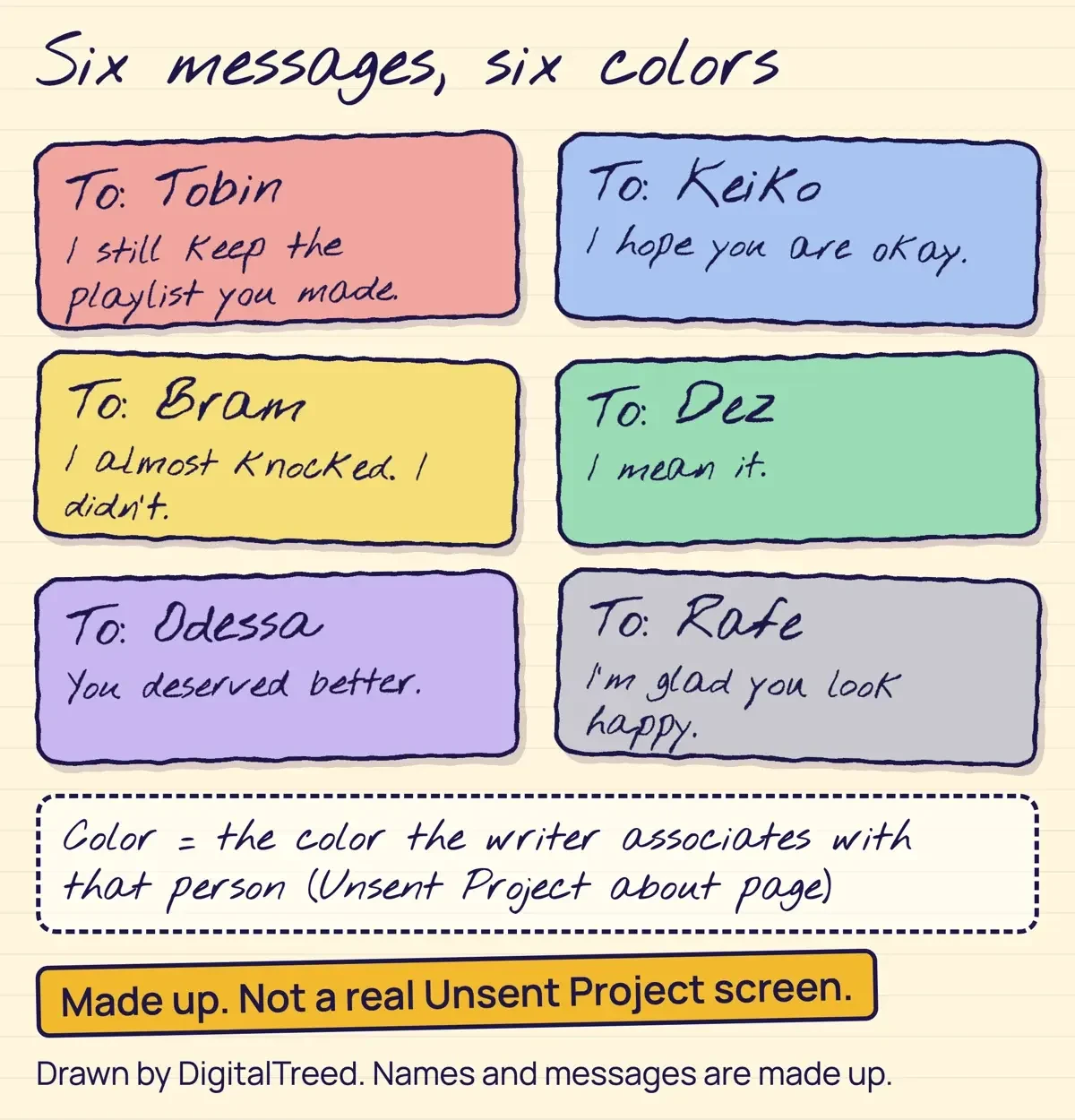 Drawn by us. Names and messages are made up; not a real Unsent Project screen. Color meaning from the site about page, November 2, 2026.
On the submit page, you pick that color right after you write the message.
How submitting works, step by step
Once you open the Submit To The Unsent Project page, the form is short. Here's what the saved page showed on November 2, 2026, in the order you'd use it:
- A To field with the placeholder "First Name". That's the person you're writing to.
- A message box that reads "Type Your Message Here...".
- A color choice. You pick the color you see that person in.
- A checkbox reading "I agree to the terms of submission." In the saved page code, the submit button starts out disabled.
- The submit button. Your message goes to review, not straight into the archive.
From there, a person decides. The about page says "Each submission needs individual manual review," and that the review is there "to ensure it does not contain harmful content or violate our terms of submission." It adds that the site relies "on our community of moderators to screen incoming submissions." The terms then warn "we cannot guarantee your submission will be reviewed or posted." Read that twice. No page we read gives a time frame, so nobody outside the site can tell you how long a message waits.
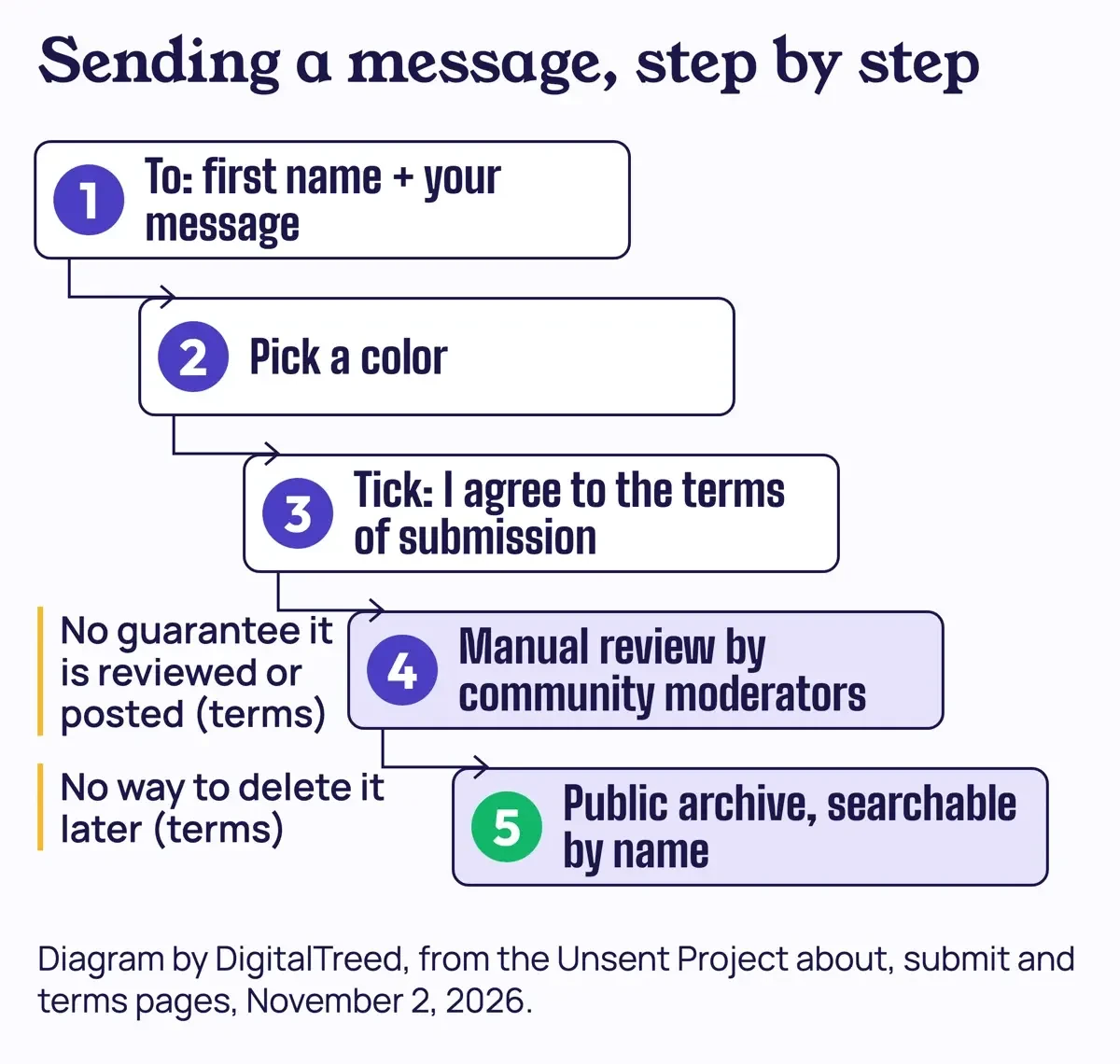 Diagram by DigitalTreed, from the Unsent Project about, submit and terms pages, November 2, 2026.
If a message is approved, the terms decide what happens to it next.
What the terms and privacy policy say about your message
The terms of submission and the privacy policy share one address, theunsentproject.com/terms. The terms point to the policy at that same page, and when we requested /privacy on November 2, 2026, the server answered with a 404. These lines affect a writer most, quoted as of November 2026:
| What the page says | What that means for a writer |
|---|---|
| "Any information you type into your submission can be seen and searched for by any person on the internet indefinitely." | Anyone can find it, with no end date. |
| "You understand there is no way to delete an Unsent Project submission from the project or internet." | Write it as permanent, because the site says it is. |
| "a non-exclusive, worldwide, royalty-free, sublicensable, transferable right and license" | The site can reuse and adapt your words without paying you. You still own them. |
| "We may use analytics tools (e.g. Google Analytics)" | Your visits may be measured by a tool such as Google Analytics. |
| "We do not sell your personal information for the intents and purposes of the California Consumer Privacy Act (CCPA)." | That's the site's own statement under California law. |
Two more details came from the page code. The home and about pages we saved load Google's tag script and Google's AdSense script. Both load on the submit page too, the one you'd type your message into. That fits the Terms of Use line that partners "may place advertising on the Services." The policy says the site collects "IP addresses and general locations" and keeps data with Amazon Web Services. The FTC's guide How Websites and Apps Collect and Use Your Information explains the mechanics. Sites "may track your online activity by using a cookie or pixel to identify you even after you leave the site."
There's one tension worth knowing. The terms say a message can't be deleted. Yet section 8 of the policy lists a "right to request access to, rectification or erasure" under laws such as the California Consumer Privacy Act, by email. We can't tell you how the site answers such a request, because we didn't send one. The terms are marked "Effective: December 14, 2021" and the policy "Last updated: March 5, 2025."
What if a message that's already up seems to name you, with a last name or a detail only you'd know? The Terms of Use say "We reserve the right to remove Content that violates the User Agreement," and they list impersonation and harassment among the examples. Doxing is banned outright in the terms of submission. The contact address on the site's home, about, submit and terms pages is [email protected], so that's where we'd send the message's text and the rule it breaks. We can't promise how fast they act, or whether they will.
Privacy tips before you press submit
Since a message can't be deleted later, the safest edit happens before you submit. The terms list what can't go in, starting with doxing, defined as "any private or identifying information of their persons." A message can't contain:
- usernames or social handles, such as an @name
- last names, in the message or in the To field
- addresses or phone numbers
- dates, including birthdays and anniversaries
- links to any outside site
- information about the person's family or where they work
- anything that names you as the writer, including a signed name at the end
That list covers the obvious things. The harder part is detail in plain words: a school hallway, a band name, or a town and a year together. A nickname only your friends used gives you away just as fast. CISA's Staying Safe on Social Network Sites page puts it simply: "Only post information you are comfortable with anyone seeing." Its Protecting Your Privacy tips add that you should "be cautious about providing your birth date, Social Security number, or other personal information online." Small facts add up fast. Our guide to free people search by Social Security number shows what people-search sites do with them.
Our own test is one question. If the person, or a friend you share, read it, would they know exactly who wrote it? If yes, cut details until the answer is maybe.
Your browser leaves a trail too, separate from anything you type. The FTC's tracking guide suggests you "delete cookies and clear your browsing and search history" if you don't want ads based on past activity. It adds that private browsing "doesn't block websites from seeing your online activity." For what an analytics tool records on a visit, our website analytics tools guide shows it from the site owner's side.
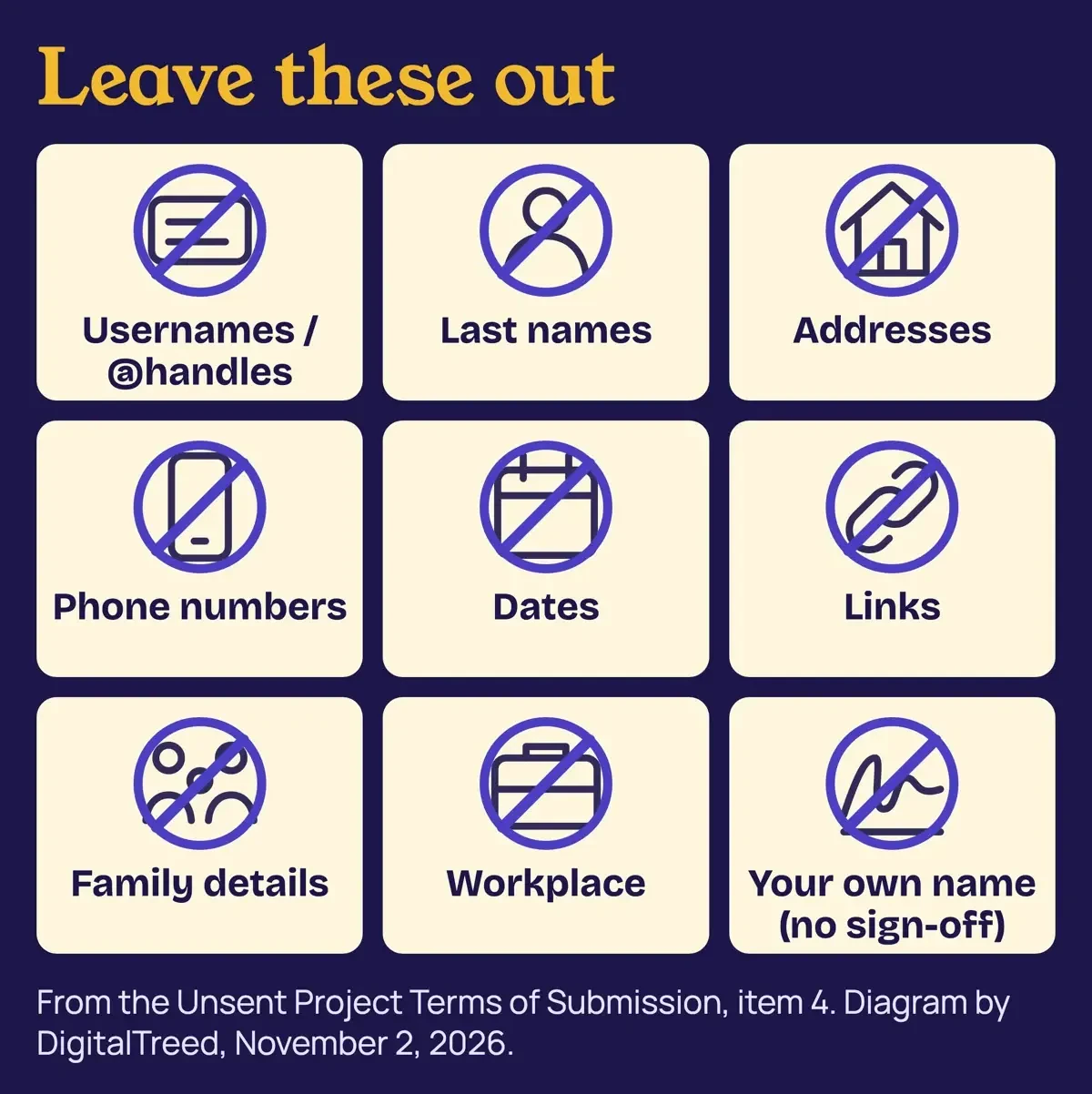 Diagram by DigitalTreed, from the Unsent Project Terms of Submission, item 4, November 2, 2026.
To see how far a script gets on that list, we wrote a small local one, test/draft_check.py, which flags emails, phone numbers, links, @handles, dates and street addresses. It also looks for family words, workplace phrases, a signed name, a two-word To field and two capitalized words in a row. It never contacts the Unsent Project and submits nothing.
What we tested
We ran draft_check.py on 12 drafts we made up, each with our own hand label. Run 1 agreed on 8 of 12. One miss was a bug: the sign-off rule was case-sensitive and skipped Love, Keiko, so we fixed that rule alone. Run 2 agreed on 9 of 12. Draft 4 got an extra link flag from the domain inside an email address, and draft 9 flagged Pinecrest Diner as a possible full name, not a workplace. Draft 12 described a hallway by the band room, a floor and the year everything changed, with no number or name, and the script found nothing.
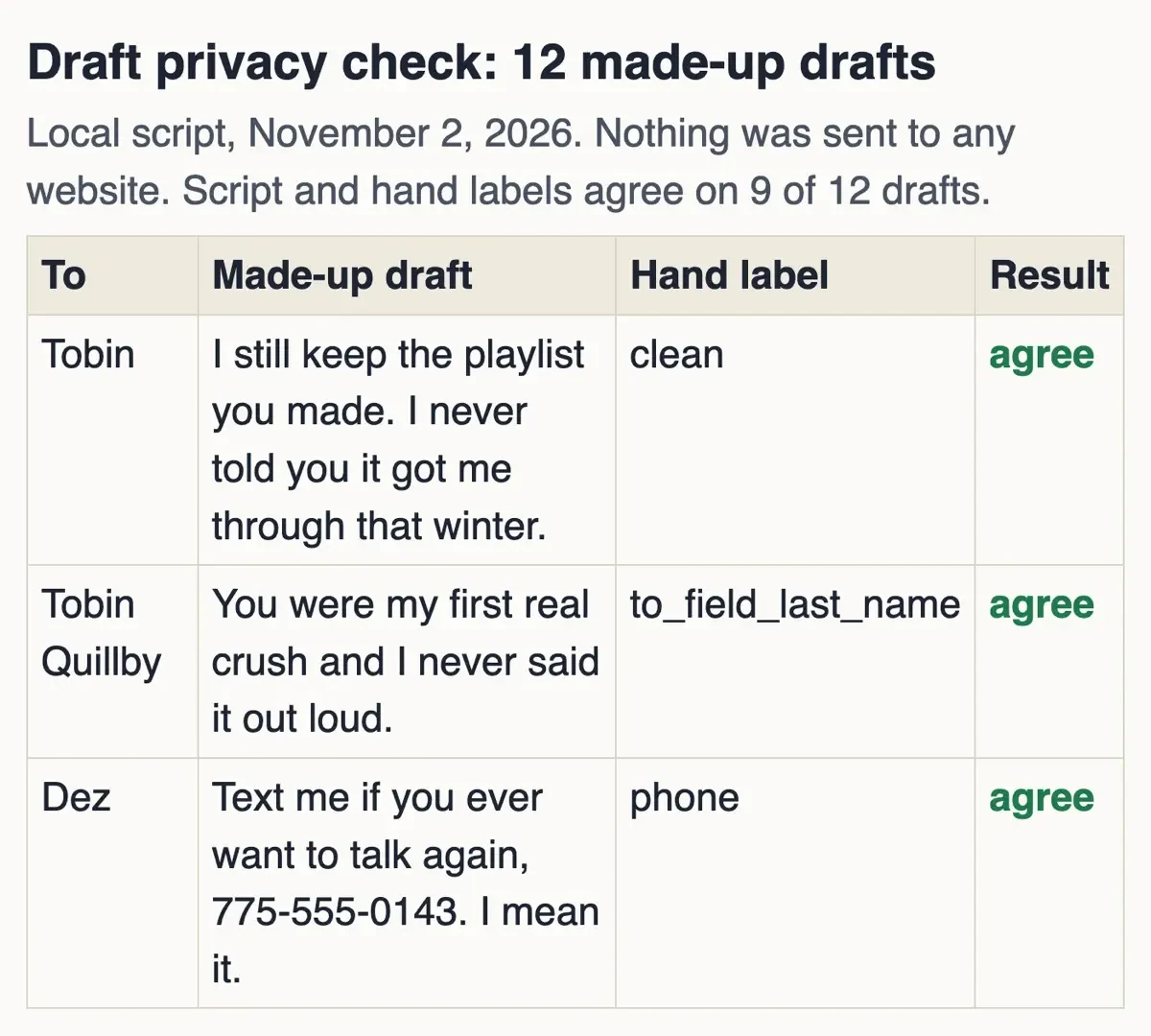 Screenshot: our draft privacy check on 127.0.0.1, November 2, 2026. All 12 drafts are made up.
Look-alike and copy sites
That script checks a draft. It can't tell you whether the site in your browser is the real one. The project's own pages live at theunsentproject.com, and its contact email uses that same domain. We don't name or link any other site here, and we didn't test any, because lists of copies go stale and links send them visitors. Three checks help. First, read the address bar. CISA's guide to social engineering and phishing says "Malicious websites may look identical to a legitimate site." It adds that "the URL may use a variation in spelling or a different domain." Our look-alike finance domain check shows how to compare two addresses side by side.
Second, look at what the page asks for. Its terms say "Purchases made on the Unsent Project have no correlation to the status of your submission." The real form wants a first name, a message and a color, so a page asking for payment, an email or a phone number wants too much. Third, don't sign in with a social account just to read messages, since the real archive asked us for no sign-in on any page we opened. The FTC's phishing guide shows how fakes borrow a real brand's look: "At first glance, this email looks real, but it's not." We've seen the same login trick on free follower sites that ask for your Instagram login.
Already clicked something odd? Our phishing link recovery steps apply here too. To report a site that took money or data, use the FTC's ReportFraud.ftc.gov. The USAGov scam reporting tool also "helps you find the best agency or organization to report the scam."
Sharing a screenshot of your own message on Instagram ties it to your account. If you post one anyway, our guide to hiding Instagram stories from anonymous viewers covers the settings.
What we'd do before sending one
So here's how we'd handle a message of our own. Write the draft in a notes app first, not on the site, so nothing goes out by accident. Cut every name except the first one, plus every date, place and handle. Then run it past a checker for the format details and read it once more for the plain-word ones. Wait a day before you paste it in, because a message that still feels right tomorrow is worth sending, and one that doesn't has done its job.
Some of these messages are heavy to write. If writing one brings up more than you can carry alone, the 988 Suicide and Crisis Lifeline is "available 24/7/365."
The National Institute of Mental Health's Find Help page puts it plainly: "Call or text 988 or start a chat online to connect with a trained crisis counselor." An archive can hold a message; a counselor can answer one.
In danger right now? NIMH also says "In life-threatening situations, call 911 or go to the nearest emergency room."
Frequently asked
Can you delete an Unsent Project submission?
The terms say no, though the privacy policy lists erasure requests by email where a law gives that right. California's CCPA page notes "There are exceptions to the right to delete."
Can you write your message in another language?
No. The Terms of Submission say "You are required to submit in English."
How many messages can you send?
One per 24 hours. The terms allow "a maximum of 1 submission to the project in any 24-hour period," and "Any duplicate submissions will be deleted."
How old do you have to be to use the Unsent Project?
At least 18. The Terms of Use say "you must be at least 18 years old to use the Services."
How we made this guide: On November 2, 2026, a script saved the Unsent Project's public pages and every government page cited here. It used plain requests and an honest user agent. We submitted nothing, searched no names and quoted no real messages; every message shown is made up. Facts checked by the DigitalTreed team on November 2, 2026.
First published May 2025 with a message count of 5 million and no sources, then rewritten November 2, 2026 from the site's own pages and US government guidance.
Sources
- The Unsent Project: About
- The Unsent Project: Archive home page
- The Unsent Project: Submit page
- The Unsent Project: Terms of Submission, Terms of Use and Privacy Policy
- Rora Blue: artist site and shop
- CISA: Staying Safe on Social Network Sites
- CISA: Protecting Your Privacy
- CISA: Avoiding Social Engineering and Phishing Attacks
- FTC: How Websites and Apps Collect and Use Your Information
- FTC: How To Recognize and Avoid Phishing Scams
- FTC: ReportFraud.ftc.gov
- USAGov: Where to report a scam
- California Attorney General: California Consumer Privacy Act (CCPA)
- 988 Suicide and Crisis Lifeline
- National Institute of Mental Health: Find Help
Comments
No comments yet. Start the conversation below.