
Quick answer
As of October 29, 2026, only YouTube shows its math, and its own example pays $405 for 1 million engaged Shorts views. TikTok publishes no rate for Creator Rewards, and a clip under 1 minute or on a Business Account earns $0 there. Check clip length and account type first.
If a clip from your shop just passed 1 million views, you've probably wondered how TikTok vs YouTube Shorts pay compares. The YouTube Shorts revenue share is a monthly split of Shorts Feed ad money among creators in YouTube's Partner Program. TikTok's Creator Rewards Program pays for videos of at least 1 minute, at amounts TikTok sets.
We start with the two money pots and the math each app shows. Then our own test answers the 1 million views question. After that come clip length, the bars each app sets before it pays, and why a business account changes the answer. We end with where we'd post a bakery's next clip. Our example, Ashgrove Bakery, is made up.
Key takeaways
- YouTube's own example pays $405 for 1 million engaged Shorts views.
- TikTok publishes no per-view rate and asks members to keep their metrics confidential.
- One 1-million-view Short won't get a new channel into YouTube's program.
- A TikTok Business Account earns nothing from Creator Rewards.
- 1-to-3-minute clips can earn on both apps once each bar is cleared.
TikTok and Shorts pay from two different pots
Start with where the money sits, because the two programs aren't built the same way. YouTube pools the money from ads that play between videos in the Shorts Feed each month, then splits it among monetizing creators by their share of views. Its Shorts monetization policies say "monetizing creators will keep 45% of their allocated revenue, regardless if music was used or not." TikTok pays from its own criteria instead. Its US Creator Rewards Program Terms base rewards on "total legitimate video views and other signals," in TikTok's "sole discretion."
Those other signals are named in TikTok's March 18, 2024 launch post for the program: "originality, play duration, search value and audience engagement." So two TikTok clips with the same view count can earn different amounts, and you can't see the weights. On YouTube, the same count can also earn different amounts, for reasons the help page spells out: the month, the country and how much licensed music ran. Here's how the two programs line up, as of October 29, 2026:
| TikTok Creator Rewards | YouTube Shorts revenue share | |
| Where the money comes from | Rewards TikTok sets from views and other signals | Ads between Shorts, pooled each month |
| Your cut | Not published | 45% of your slice of the Creator Pool |
| Rate per 1,000 views | Not published | Changes by month and country |
| Who can join | 18+, 10,000 followers, 100,000 views in 30 days | 1,000 subscribers, plus 10 million Shorts views in 90 days or 4,000 watch hours in 12 months |
| Video length that counts | At least 1 minute | Shorts up to 3 minutes |
| Business accounts | Excluded | No exclusion in the eligibility list |
| Payout | Monthly, once rewards reach $50 | Monthly, through AdSense for YouTube |
YouTube's column gives you the formula, the 45% share and the music split, but not the size of the pool in your country in any given month.
TikTok's column gives you less: its terms list who can join and which views don't count, but no weights for its four metrics and no rate.
YouTube shows its math, TikTok keeps its rate private
That gap starts with YouTube, which publishes a worked example on the same policy page. In it, one country logs 100 million engaged Shorts views in a month, and the ads that run between those Shorts earn $100,000 for the whole feed. One in five of those Shorts uses a single music track, so half of their share pays for music licensing. That leaves a Creator Pool of $90,000.
Now add your Short. It has 1 million engaged views, which is 1% of the country's total, so you're allocated $900 before YouTube's share comes off. The 45% share then leaves you $405.
As a formula, that's Creator Pool x your share of engaged views x 45%, or $90,000 x 1% x 45% = $405. Music in your own Short doesn't shrink your slice, since YouTube says your allocation "is not affected by your use of a music track."
YouTube's page labels all of this a "hypothetical example," so treat $405 as a worked sum, not a promised rate.
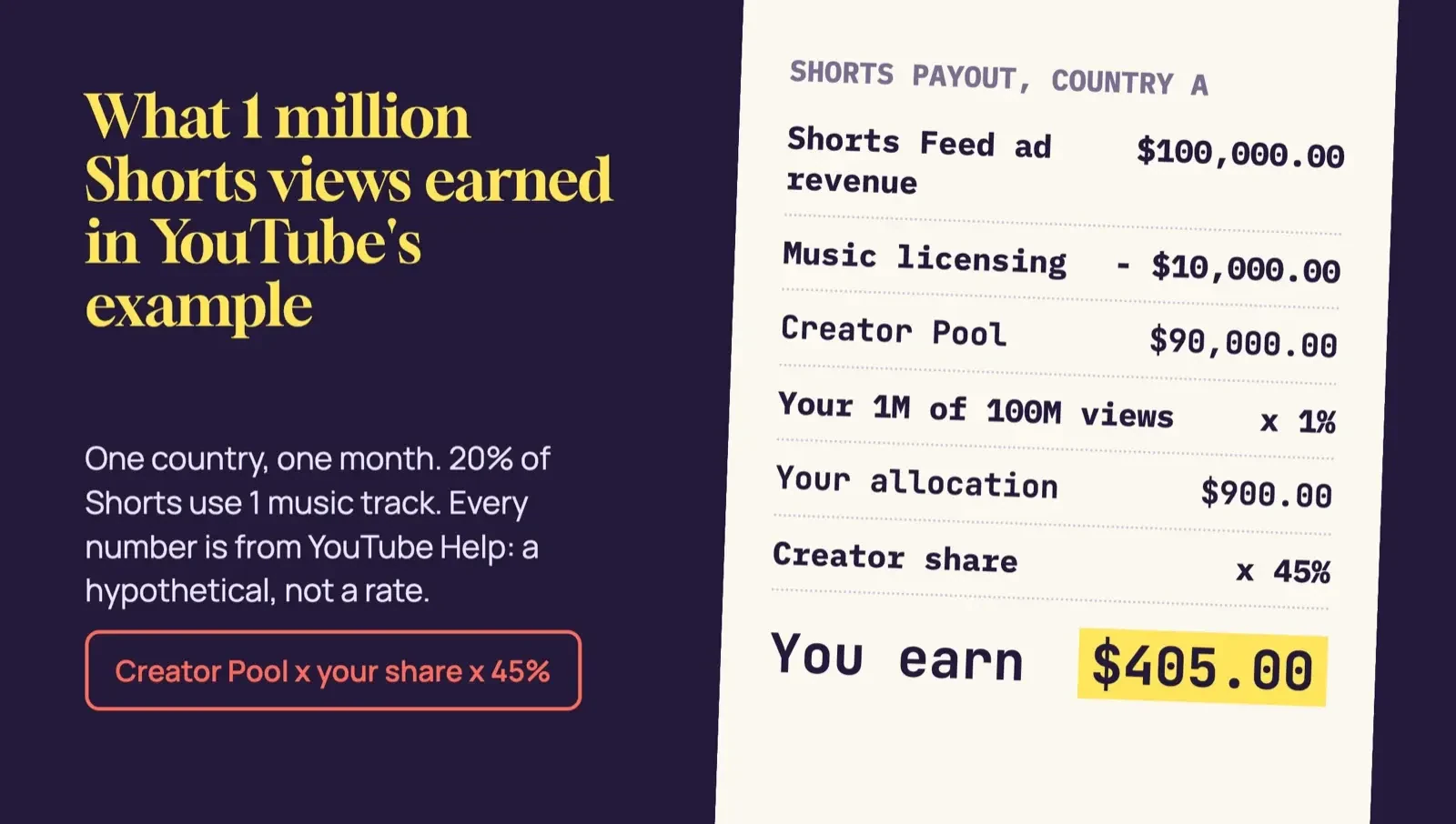 Diagram by DigitalTreed, from the hypothetical example in YouTube Help: YouTube Shorts monetization policies, read October 29, 2026.
TikTok has nothing like it in public. Neither its US terms nor its launch post gives a rate per view or per 1,000 views. The launch post says members get a dashboard page "for RPM and qualified video views" on each video. So the number exists. It just stays inside the account, because the terms tell members to keep "the details of any reporting metrics" from the program "strictly confidential." A TikTok RPM you see in a video or forum is one creator's result at best. We didn't use any of those numbers.
YouTube isn't fully open either. Its revenue report shows an RPM too, and only to channels already earning.
TikTok's terms add one more unknown, since they let it "impose a monthly or annual cap on each Creator's available rewards." With public inputs, you can sketch a YouTube estimate before you join. A TikTok estimate stays a guess.
Which pays more for 1 million views?
So which pays more for 1 million views? On the public record, YouTube is the only side with a dollar figure, and even that comes with conditions most small channels haven't met yet. That $405 covers one country and one month, and a change in the month's ad money or the country's total views moves the figure. We ran YouTube's inputs and three example sets through the formula, and the same views paid between $101.25 and $405.00.
Those three example sets each change one input: more music in the country's Shorts, less ad money, or four times the total views.
The bigger condition is getting paid at all. YouTube's Partner Program page lets a channel apply with 1,000 subscribers and 10 million qualified Shorts views in the last 90 days. A single 1-million-view Short is a tenth of that view bar.
Even inside the program, YouTube's list of program changes adds a monthly test. From February 1, 2027, members need 10 million qualified Shorts views over the last 90 days to earn from the Creator Pool in any given month.
On TikTok, the honest answer runs from $0 to an amount nobody outside your account can see. It's $0 if the clip is under 1 minute, if the account is a Business Account, or if you aren't in the program yet. Past those bars, TikTok sets the amount.
TikTok's $50 payout minimum is a threshold, not a rate. As math only, $50 / (1,000,000 views / 1,000) = $0.05, so 1 million views alone would reach it only at $0.05 or more per 1,000 views. TikTok publishes nothing that says whether it pays that.
For a channel already in YouTube's program, that makes Shorts the one you can estimate ahead of time. On TikTok, our test can only say whether a clip qualifies, not what it pays.
What we tested
On October 29, 2026, we ran a Python script, test/run_test.py, offline on example inputs. It rebuilt YouTube's example and got the same $90,000 pool, $900 slice and $405 payout. Three example input sets paid $337.50, $202.50 and $101.25 for those same 1 million views. A fifth run, outside the program or before accepting the Shorts Monetization Module, paid $0.00. Four made-up TikTok profiles went through five rules from the US terms: one met all five, and three earned $0 on a Business Account, a 45-second clip and 6,000 followers.
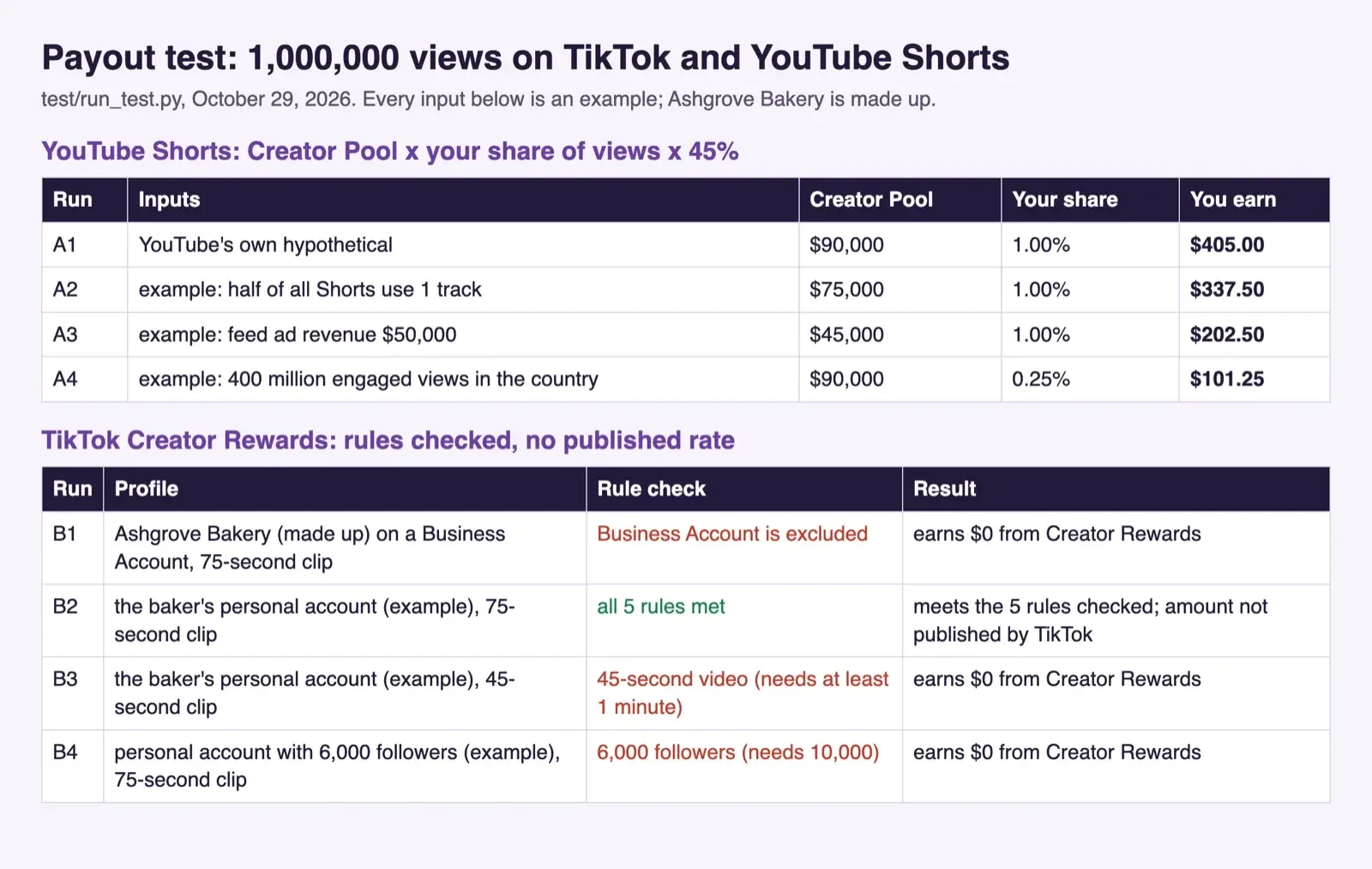 Screenshot: our test report on 127.0.0.1, October 29, 2026. Example inputs; Ashgrove Bakery is made up.
Clip length decides which feed can pay you
Before any bar comes length. It matters most when one clip goes to both apps. TikTok's terms reward videos "with a duration of at least 1 minute." YouTube's three-minute Shorts page says you "can now create YouTube Shorts up to three minutes in length." Square or vertical uploads up to that length count as Shorts.
Older uploads follow older rules, though: that three-minute limit covers square or vertical videos uploaded on or after October 15, 2024.
Put those together and there's a window. A vertical clip from 1 to 3 minutes long can earn on both apps, as long as each account has cleared that app's own bar and the clip is yours. Our script ran four example lengths. A 45-second clip counts as a Short but can't earn from Creator Rewards. Clips of 75 and 150 seconds pass on both apps. At 200 seconds, TikTok's length rule passes, but YouTube files the upload as a regular long-form video, not a Short.
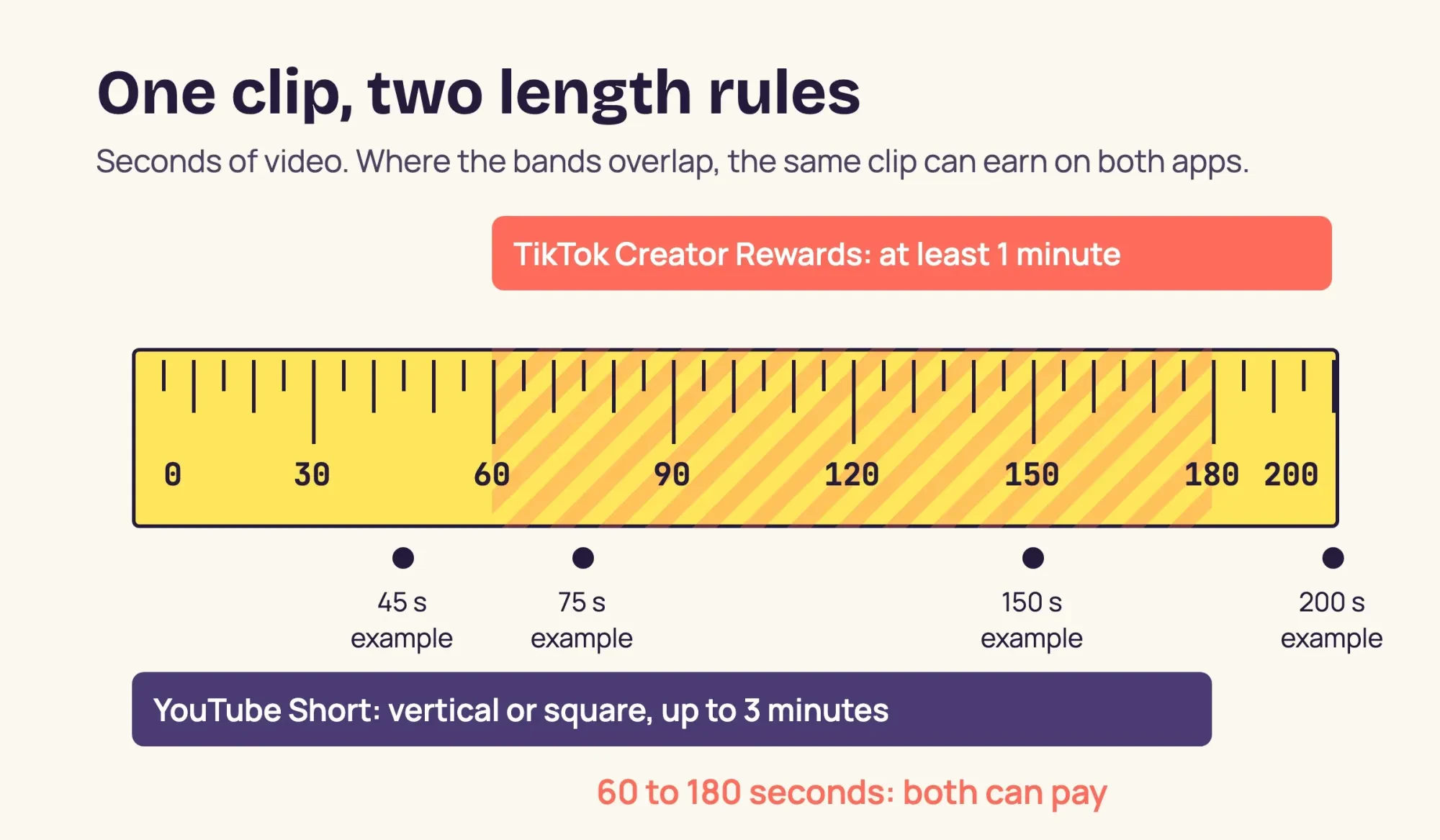 Drawn by us, from TikTok US Creator Rewards terms and YouTube Help on three-minute Shorts, read October 29, 2026; lengths tested are examples.
Neither policy we read bars posting your own clip on both apps. YouTube's policy names "reuploading other creators' content from YouTube or other platform" among views that won't pay. That rule sits in its channel monetization policies on reused content, and the same Shorts policy also blocks "Shorts over one minute in length that contain claimed content." TikTok's terms let it "mute, remove or disqualify" videos with "unauthorized uses of music," so longer clips are safest with your own sound or a track you've cleared. To cut one clip for both vertical feeds, see our CapCut desktop crop guide for the 9:16 frame.
The bars before either app pays a cent
Even a clip of the right length earns nothing until the account clears each app's bar. On paper the numbers look close, but they aren't. TikTok's terms want a creator who's 18 or older, with "at least 10,000 authentic followers." The account must also have "at least 100,000 authentic total video views in the last 30 days," and you need a payment account in your own name. If TikTok turns you down, you can re-apply after 30 days.
YouTube's bar for Shorts ad money is 1,000 subscribers plus one of two view counts. That's 4,000 qualified watch hours in 12 months, or 10 million qualified Shorts views in 90 days. The same page asks for 2-Step Verification, one AdSense for YouTube account and no active Community Guidelines strikes. YouTube says a decision comes "typically in about 1 month." A lower tier opens at 500 subscribers and 3 public uploads in 90 days, plus 3,000 watch hours or 3 million Shorts views, per YouTube's table of monetization tiers. That tier brings memberships, Super Thanks and Shopping, but no Shorts Feed ads, as the expanded program overview lists.
The bar moves soon. Starting February 1, 2027, new channels need 8,000 watch hours in 365 days or 20 million Shorts views in 90 days, plus the 1,000 subscribers. Channels already in the program keep their place, but YouTube asks them to accept updated terms in YouTube Studio by January 31, 2027.
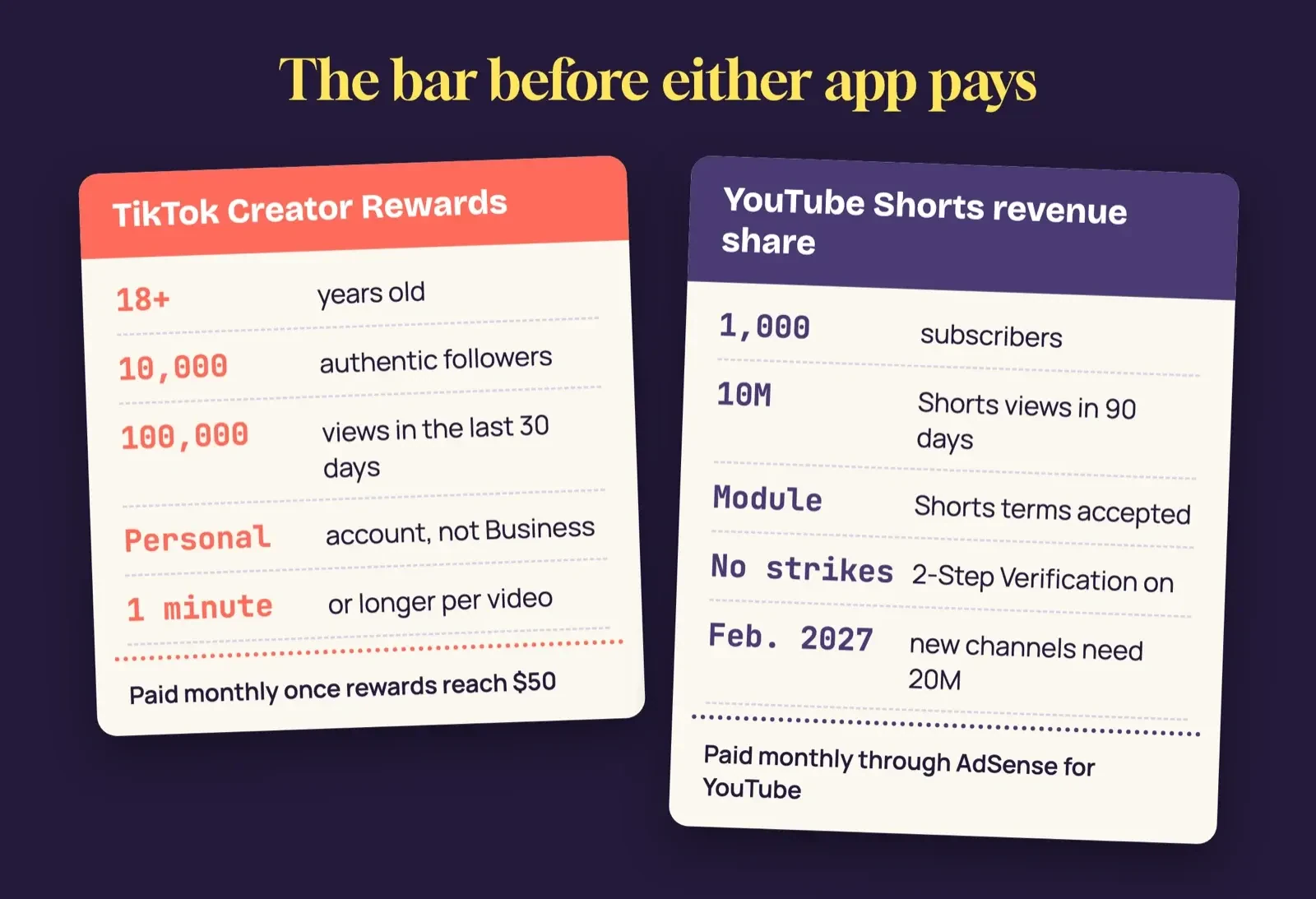 Diagram by DigitalTreed, from TikTok US Creator Rewards terms and YouTube Help partner program pages, read October 29, 2026.
Our script ran three example YouTube channels against both dates. A 1,400-subscriber channel with one 1-million-view Short wasn't eligible on either date. With 4.2 million Shorts views, it reached only the 500-subscriber tier, on both dates. At 2,100 subscribers and 11 million views, it could apply on October 29, 2026. On February 1, 2027, a brand-new applicant with exactly those numbers would get the lower tier only, because the entry bar for Shorts views doubles to 20 million.
Compare the two bars in views, and the gap is wide. TikTok asks for 100,000 views in 30 days, while YouTube asks for 10 million Shorts views in 90 days, which is 100 times the views over 3 times the days.
TikTok's follower bar is 10 times YouTube's subscriber bar, though. For a small shop that means tracking the 90-day Shorts view count on YouTube and the follower count on TikTok.
On both apps, paid reach doesn't help: YouTube's tier table excludes views from ad campaigns, and TikTok's terms leave "paid or incentivized" metrics out of its rewards.
A business account changes the answer
For a bakery, one setting can decide the TikTok side before views matter. TikTok's terms shut out any "non-personal account, such as a Business Account or Organization Account," from Creator Rewards. If your shop's TikTok runs as a Business Account, that one setting takes view pay off the table. In our test, Ashgrove Bakery's Business Account earned $0 from Creator Rewards with a 75-second clip and 14,000 followers, all example inputs. The baker's personal account, with the same clip, passed all five rules we checked. Even so, TikTok's terms leave the amount entirely to TikTok, so our test can say the clip qualifies but can't put a dollar figure on it.
The clause also shuts out accounts of a government organization, politician or political party, so it's about who owns the account, not its size.
YouTube's eligibility list has no line like that. It checks things like 2-Step Verification, a linked AdSense for YouTube account and active strikes, and a bakery channel can meet them the same way any other channel does.
So a business that wants view pay from short clips has the clearer route on YouTube. Still, for a shop, a clip's real job is usually to sell, and view pay comes second. How to make money on TikTok lists TikTok Shop, affiliate sales and brand deals, none of which need Creator Rewards. On the YouTube side, YouTube Shopping for business shows how to tag your own products, and YouTube channel memberships open at the 500-subscriber tier, far below the Shorts ad bar. And if a brand wants to pay you for a clip, what influencers charge gives you a price to start from.
Where we'd post a bakery's next clip
So where should Ashgrove Bakery post its next clip? We'd cut it to 60 to 90 seconds and post it to both apps. That length clears TikTok's 1-minute rule and stays well inside YouTube's 3-minute cap for Shorts. The 75-second cut in our test passed the length rule on both apps, with 15 seconds of room above TikTok's minimum and well over a minute below YouTube's cap. Our take: for a business, YouTube Shorts is the better bet for view pay, because the rules are public and a business channel can join. On TikTok, a Business Account earns nothing from views, so judge each clip there by orders, calls and messages instead.
Every month, check the channel's 90-day Shorts views against the 10 million bar, and don't count on a payout before it's cleared.
For those clips, our 90-day YouTube plan sets a pace a small team can keep, and getting your first 1,000 YouTube subscribers covers the subscriber bar. Want the editing done for you? DigitalTreed's video editing service cuts short clips for both apps as paid work. That service is how DigitalTreed gets paid, so count this paragraph as an ad. It's worth buying only if trimming clips eats hours your team can't spare, because both apps pay the same whoever does the editing.
Shorts and TikTok payout questions shops ask
Frequently asked
Does YouTube Premium pay for Shorts views too?
Yes. YouTube's Shorts policy says creators get 45% of the net Premium revenue set aside for Shorts, split by their share of subscription Shorts views in each country.
When do TikTok and YouTube actually pay?
TikTok pays on the 15th through PayPal's Hyperwallet, per its US terms. YouTube adds last month's earnings between the 7th and 12th and pays by the 21st to 26th once the balance reaches the payment threshold, per its payment schedule.
Do Shorts views from before I joined count?
No. YouTube's policy page says views from before you accept the Shorts Monetization Module aren't eligible for revenue sharing.
Is creator pay from either app taxable?
Yes. The IRS gig economy tax center says this income is taxable even when no Form 1099 arrives. TikTok's terms also allow it to withhold tax from rewards. That's background, not tax advice; ask a tax preparer about your shop.
How we made this guide: Every rule here comes from published pages, not a creator dashboard: nine YouTube Help pages and one IRS page, saved as text. TikTok's US terms and launch post came from Internet Archive copies dated October 22, 2026. TikTok's Creator Rewards help page came back empty in the archive, so we don't define a qualified view. The payout script ran offline on example inputs; the screenshot is its report on 127.0.0.1. Facts checked by the DigitalTreed team on October 29, 2026.
First published March 2025 as a TikTok-only look at 1 million views. Rewritten October 29, 2026: this version compares TikTok's Creator Rewards Program with the YouTube Shorts revenue share. It drops the old Creator Fund figures and adds our payout test.
Sources
- YouTube Help: YouTube Shorts monetization policies
- YouTube Help: YouTube Partner Program overview and eligibility
- YouTube Help: Changes to the YouTube Partner Program (February 1, 2027)
- YouTube Help: Choose how you want to monetize
- YouTube Help: Overview of the expanded YouTube Partner Program
- YouTube Help: Three-minute YouTube Shorts
- YouTube Help: YouTube channel monetization policies
- YouTube Help: Get paid with AdSense for YouTube
- YouTube Help: Check your YouTube revenue
- TikTok: Creator Rewards Program Terms, US (last update July 20, 2026)
- TikTok Newsroom: Introducing the New Creator Rewards Program (March 18, 2024)
- IRS: Gig economy tax center


Comments
No comments yet. Start the conversation below.