
Quick answer
Traditional dress captions for Instagram work best when they name the outfit, the occasion and who you were with. We wrote 84 of our own in 14 copy-ready lists, from saree to Nowruz, as of November 2026. Keep each under Instagram's 2,200-character limit and 5 hashtags, and never caption someone's powwow regalia without asking them first.
Posting from a cousin's sangeet, a quinceañera or a Seollal lunch? These traditional dress captions for Instagram are the 84 lines we wrote ourselves, six for each outfit or holiday. Every list sits in a copy box, so one tap copies one caption.
Where a museum, tourism board or library page explains an outfit, we used its words, so the yukata lines say summer festival and the hanbok lines say Seollal. Where no readable source exists, as with the dashiki, the list has captions and no history. Our take: if someone dressed you, thank them in the caption.
Key takeaways
- Instagram's Help Center now lists 5 hashtags per post; the API page says 30.
- Our longest caption uses 90 of the 2,200 characters Meta allows.
- Guest captions that thank whoever dressed you beat borrowed slogans.
- Powwow regalia isn't a costume, so this post gives it no captions.
- Federal law lets only enrolled tribal members keep eagle feathers.
Saree, lehenga and salwar kameez captions
A South Asian wedding weekend can mean a new outfit for each event, from the mehndi to the reception. The Met's collection lists a silk wedding sari from the 18th or 19th century. It also holds a silk sari with its blouse piece from Aurangabad. Both are silk. A caption can name the fabric too, or the aunt who did the pinning.
Saree captions
These six lean on the pleats, the pallu and the safety pins.
- Yards of silk, a handful of safety pins, and every pleat finally behaved.
- Borrowed my mom's wedding saree for the night and felt her whole story on my shoulders.
- The pallu did most of the talking tonight.
- Draped by my aunt in under ten minutes, a skill I still don't have.
- Some outfits you just wear. A saree, you learn.
- Cotton saree for the temple, silk saree for the reception, one very tired me.
Lehenga captions
We wrote these lehenga lines for sangeet and reception photos, so they're about mirror work, a loose dupatta and the dance floor.
- Twirled once for the camera and twice for me.
- Sangeet night, mirror work, and a dupatta that kept escaping.
- My cousin's wedding, my grandmother's earrings, my own two left feet.
- Lehenga on, playlist loud, mehndi still drying.
- Embroidery by hands I'll never meet, thanks from me anyway.
- The lehenga is heavy and the dance floor didn't care.
Salwar kameez captions
These salwar kameez lines are for ordinary days, like Sunday at a grandmother's or an office lunch, and the dupatta gets its own line because it keeps slipping.
- Comfort that still looks like I tried. Salwar kameez for the win.
- Cotton suit, chai in hand, Sunday at my nani's.
- The dupatta stayed on all day. That alone deserves a post.
- Office lunch in a kurta and salwar, and three people asked where I got it.
- Packed for the visit home: three suits and a suitcase of snacks for the cousins.
- Simple print, perfect fit, and my mom's tailor still has my measurements from high school.
Posting from a rakhi instead? Our Raksha Bandhan wishes for clients and teams pair well with a sibling picture.
Kimono and yukata captions
The Japan National Tourism Organization's kimono and yukata guide separates the two: "Kimono is a form of traditional formal wear, while yukata is more casual." JNTO adds that yukata is cotton, or cotton mixed with hemp, and is "often just worn during summer festivals". Its ryokan guide calls the yukata a cotton robe that inn guests wear. We wrote summer and festival lines for the yukata and kept the kimono for weddings and rentals, since JNTO lists the tea ceremony and traditional weddings as kimono occasions.
- Summer festival, cotton yukata, and a paper fan I refused to put down.
- First time in a yukata, and the obi took longer than the fireworks.
- Rented a kimono in Kyoto and walked slower all afternoon, on purpose.
- Lined up for takoyaki in a yukata and felt like part of the street.
- My grandmother's kimono, aired out once a year and worn today for my sister's wedding.
- Wooden sandals, cotton yukata, very careful steps.
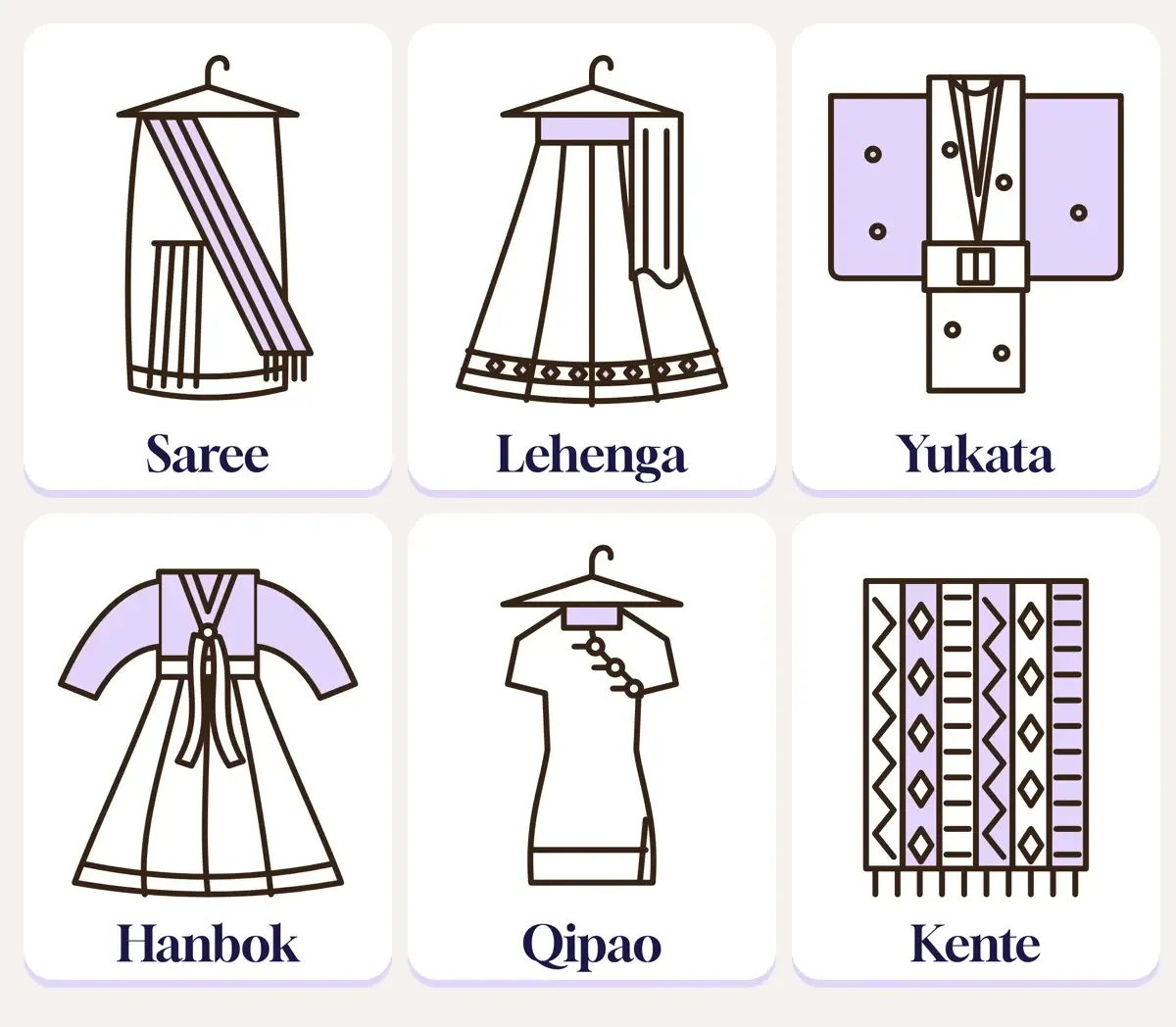 Drawn by us: the outfits in this guide as flat line drawings, with no faces or brands.
Hanbok and qipao captions
Korea.net's report on hanbok as national heritage lists the parts: "Hanbok consists of a jeogori (top) and either a chima (skirt) or baji (trousers)". A knotted ribbon called the otgoreum closes the top.
Hanbok captions
Another Korea.net piece, on hanbok and its history, says it's "popularly worn today on special occasions such as weddings and birthdays". The Library of Congress's Lunar New Year blog post adds two Seollal customs. People wear hanbok for sebae, a deep bow to elders, and eat tteokguk, a rice cake soup. Line 1 has both.
- Seollal morning in hanbok, bowing to my grandparents before the rice cake soup.
- Jeogori ribbon tied on the third try. Worth it.
- My first hanbok since my first birthday, and this one actually fits.
- Wore hanbok to the palace and let the colors do the posing.
- Family photo day, everyone in hanbok, and nobody blinked. A small miracle.
- Hanbok for the bow, sneakers for the walk home.
Qipao and cheongsam captions
Our six lines use both names for the high-collared dress, qipao and cheongsam. Keep the one your family says. The Met's collection lists a 1932 silk cheongsam with metallic thread, which is why none of the lines call the dress a trend.
- High collar, straight shoulders, and posture my grandmother would approve of.
- Wore my grandmother's qipao to the banquet, and the aunties knew it at once.
- Silk cheongsam, red lanterns, and a toast to the new year.
- The frog buttons took forever. The photos took one try.
- Tea ceremony at the wedding, in a red qipao we'll keep for the next bride in the family.
- Cheongsam for dinner in Chinatown with the whole family.
Quinceañera dress captions
The Library of Congress research guide on the quinceañera calls it "a fifteenth-birthday celebration for girls of Hispanic heritage". The day typically starts with a mass or blessing, then a reception, and the guide lists a court of 14, the switch from flats to heels and a last doll. Its guide to Hispanic American traditions lists the quinceañera among celebrations that began in Spain before reaching the Americas. Our six lines follow that order, from the mass to the waltz, so there's more to caption than the dress.
- Fifteen, and the dress finally matched the dream.
- Mass in the morning, waltz at night, cake somewhere in between.
- My court of honor showed up and showed out.
- Swapped flats for heels with my dad's help, and everybody cried, including me.
- The ballgown was heavy, and the hugs from my abuelita were heavier.
- One night, fifteen years of family in one room.
Kente and dashiki captions
Like the quinceañera lines, both lists below name the event instead of calling the look African. Kente gets a graduation, a naming ceremony and Sunday service, while the dashiki gets an office Friday, a family reunion and a Juneteenth cookout.
Kente captions
The Fowler Museum at UCLA's book page for Wrapped in Pride traces kente to "the Asante peoples of Ghana and the Ewe peoples of Ghana and Togo". It describes a strip-woven cloth with royal roots. The Met lists a cotton kente from about 1965 and an early-to-mid-20th-century kente of silk and possibly cotton, both as prestige cloth. If yours was a gift, say who gave it.
- Graduation day, kente stole on, and my family's names in every thread.
- Wearing kente to my cousin's wedding and standing a little taller.
- Strip by strip, color by color, this cloth came a long way to be here.
- Kente at the naming ceremony, gold and green for the new baby.
- My grandfather's kente, folded with care for decades, out for one special day.
- Sunday service in kente, and the choir matched my energy.
Dashiki captions
Every museum page we found on the dashiki blocked our checker, so these lines make no history claim and stick to the print, the fit and the people.
- Dashiki Friday at the office, and the compliments kept coming.
- Printed cotton, open collar, family reunion in full color.
- Wore my dad's dashiki from the seventies, and it still looks brand new.
- Juneteenth cookout, matching dashikis, one very proud grandma.
- Bright print, easy fit, and no one is rushing me today.
- The dashiki my uncle brought back from Accra, worn to the gallery opening.
Commenting on a couple's photo from the same reunion or wedding? Try our comments for couple photos.
Festival outfit captions: Eid, Diwali, Lunar New Year and Nowruz
Two of these four holidays have new clothes in their written customs: Britannica says so for Eid al-Fitr, and UNESCO and the UN say so for Nowruz. For Diwali and Lunar New Year, our lines lean on lamps and the color red. Name the holiday first, so friends who don't celebrate it still get the photo.
Eid captions
Britannica's Eid al-Fitr entry says the festival marks the end of Ramadan. On it, "people attend official receptions, visit friends, give presents, and wear new clothes." The entry also recommends eating something, commonly dates, before the prayer and wearing your nicest or newest clothes. Line 4 follows that order.
- Eid Mubarak from the newest outfit in my closet, saved for this morning.
- A month of fasting, one early prayer, and a brand-new kurta.
- New clothes, old traditions, and the whole family at the door.
- Eid morning: dates first, prayer next, photos after.
- Matching outfits with my siblings, by our mom's strict order.
- Henna on my hands and the Eid outfit my grandmother sewed.
Diwali captions
India's tourism site describes Diwali, or Deepavali, as a five-day festival of lights. It mentions clay lamps called diyas, rangoli at the door and Lakshmi puja on day three. Its festivals calendar lists Diwali as upcoming on November 8, as of November 2026. Our lines add sweets, a new kurta and rangoli on a New Jersey driveway.
- Diyas lit, rangoli done, and a new outfit for the Lakshmi puja.
- Happy Diwali from my family to yours, with every lamp in the house lit.
- Festival of lights, sweets in both hands, and silk I haven't spilled on. Yet.
- Diwali in New Jersey: rangoli on the driveway and lamps on every step.
- New kurta, old family recipes, five days of visiting.
- The lights were the plan. The outfit was a bonus.
Lunar New Year captions
The Library of Congress post on Lunar New Year says many people wear red clothing, and children get red envelopes, so three of our six lines have red in them. A Library of Congress teaching post puts the holiday between mid-January and mid-February. The first post adds that people of Korean and Vietnamese descent mark it too, as Seollal and Tet.
- Red for luck, new clothes for a fresh start, dumplings for everyone.
- Happy Lunar New Year from the family table, red envelopes and all.
- Wore red head to toe so the new year knows I'm ready.
- Ao dai for Tet, flowers on the table, and everyone home again.
- Lion dance outside, new outfit inside, cousins everywhere.
- Bowed to my elders for sebae, then tucked the envelope safely away.
Nowruz captions
UNESCO's International Day of Nowruz page says "New clothes are worn, visits are made to family and friends" at Nowruz. The UN's Nowruz observance page ties those new clothes to a fresh start and puts the day on the spring equinox, usually March 20 or 21.
- Nowruz Mobarak: new clothes, a clean house, and spring on the calendar.
- Haft-sin table set, new outfit on, and grandma's sabzi polo on the stove.
- First day of spring, first wear of this dress.
- Visiting the elders first, in the clothes we saved for today.
- Spring is here, the goldfish is fine, and the outfit is new.
- Stepping into the new year in an outfit my aunt picked out.
Captions for wearing a friend's tradition
A friend's family dressed you for a wedding, a new year meal or a Diwali party, and you want a photo up tonight that won't make your hosts wince. Our six guest lines thank a host, a friend's mom or a shop owner, or say you were invited, and not one makes the outfit about your new look.
- Invited, dressed, and taught to tie it by the bride's sister. Thank you for the lesson.
- My first saree, draped by my best friend's mom and worn to her wedding with a lot of care.
- Thank you to my host family for the yukata, and for fixing my obi twice.
- Hanbok rental day in Seoul, and the shop owner made sure I wore it right.
- Honored to be invited, and to wear the kente the couple gave us.
- Wore what the hosts suggested, asked what it meant, and listened.
Tag the person who helped only if they're fine with it. Leave their kids out unless the parents say yes, and use our settings for hiding Instagram stories to share with close friends only. Curious who can see what you've liked under the host's post? Our liked posts guide covers that setting.
Native regalia: a respect note, not a caption list
Weber State University's powwow guide says dancers' clothing is called regalia: "Sometimes it will be referred to as an outfit, but it is NOT a costume". The Council of Three Rivers American Indian Center's powwow etiquette page asks visitors not to touch regalia, and it notes that pieces are often family heirlooms.
Grand Valley State University's powwow etiquette list says to "ask before you shoot (this includes video as well)". It adds that some pieces, real eagle feathers among them, are reserved for people qualified to wear them, and federal law limits who may keep those feathers. The U.S. Fish and Wildlife Service's National Eagle Repository page says only enrolled members of federally recognized tribes may privately keep bald or golden eagle feathers. Its Native American programs FAQ describes their permit. So a Native reader posting their own regalia doesn't need our words. A guest's photo of a dancer isn't theirs to caption until the dancer says yes.
Is it OK to post a tradition that isn't yours?
Usually, yes. It's fine when you were invited to wear it and the caption shows that. Trouble starts with lines that turn someone's heritage into a theme. So our test script scans all 84 captions for 14 words and phrases we chose to avoid. One is a slur for Native women that we won't print. The others: costume, exotic, ethnic, oriental, tribal, gypsy, spirit animal, dress up as, geisha, native look, boho, desi girl and patriot. Only costume comes from the powwow pages above. The rest isn't anyone's rule, it's our call. We also left out jokes about bodies, weight or skin. Comments on other people's photos are a separate job, covered in our impressive comments for girls list.
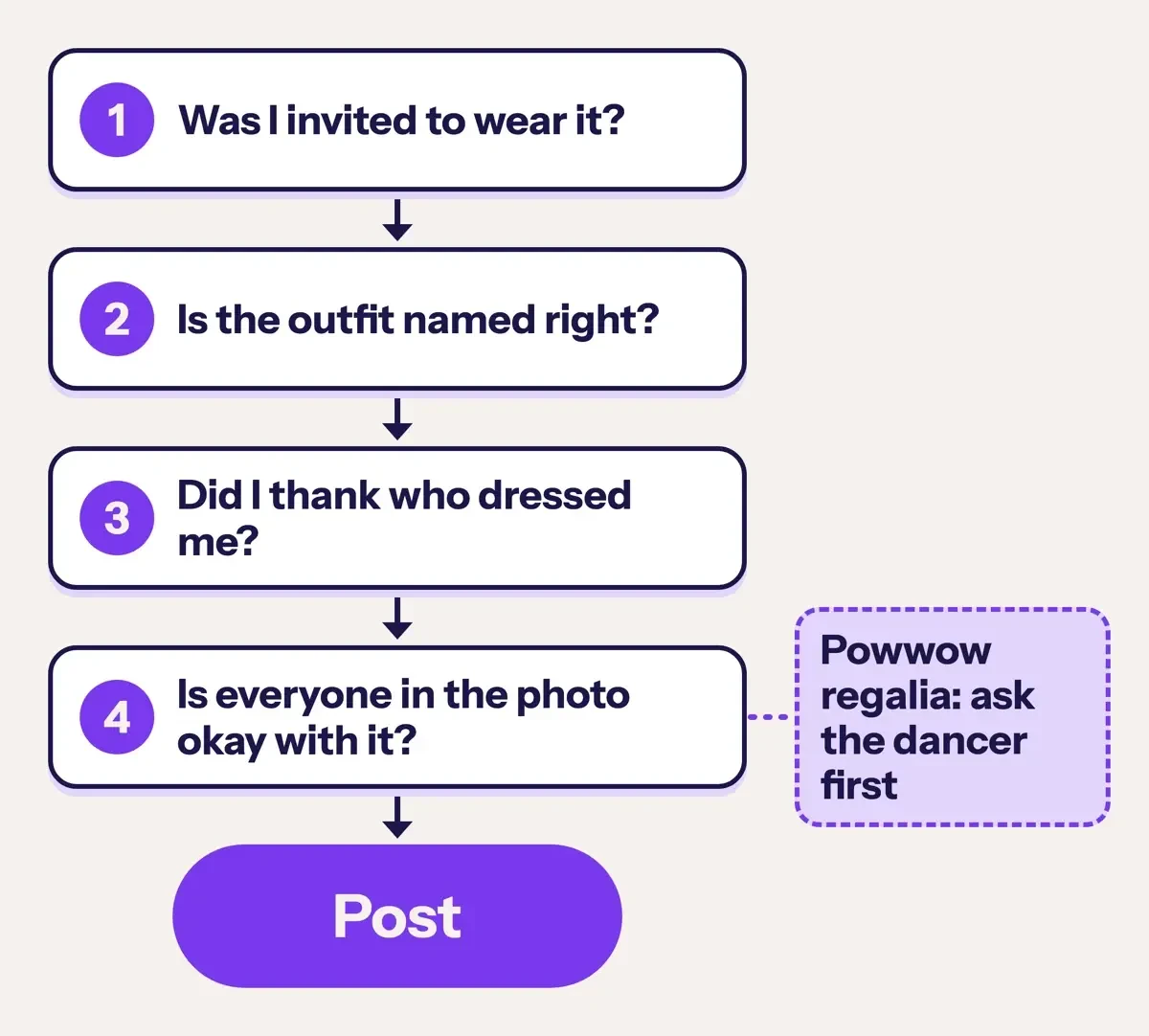 Diagram by DigitalTreed: the questions we ask before posting a caption about someone else's tradition.
The fourth question in the chart covers the host's kids and any powwow dancer in the frame.
Instagram caption limits, hashtags and alt text
Meta's IG User Media reference says a caption can hold "Maximum 2200 characters, 30 hashtags, and 20 @ tags." That page covers posts made through the API, and it's the only Meta page we found that gives a character count at all, as of November 2026. The same page allows up to 1,000 characters of alt text. The Help Center is stricter on hashtags. Its hashtag page now says "You can use up to 5 tags on a post." Spaces and characters like $ or % won't work in a hashtag. We'd stop at 5. Video has its own rules, covered in our YouTube hashtag limits guide.
Instagram's alt text help page says automatic alt text "uses object recognition technology". For screen reader users, we'd write our own, like "red silk lehenga with mirror work and a gold dupatta". You can replace it under Accessibility before you share, or later through Edit.
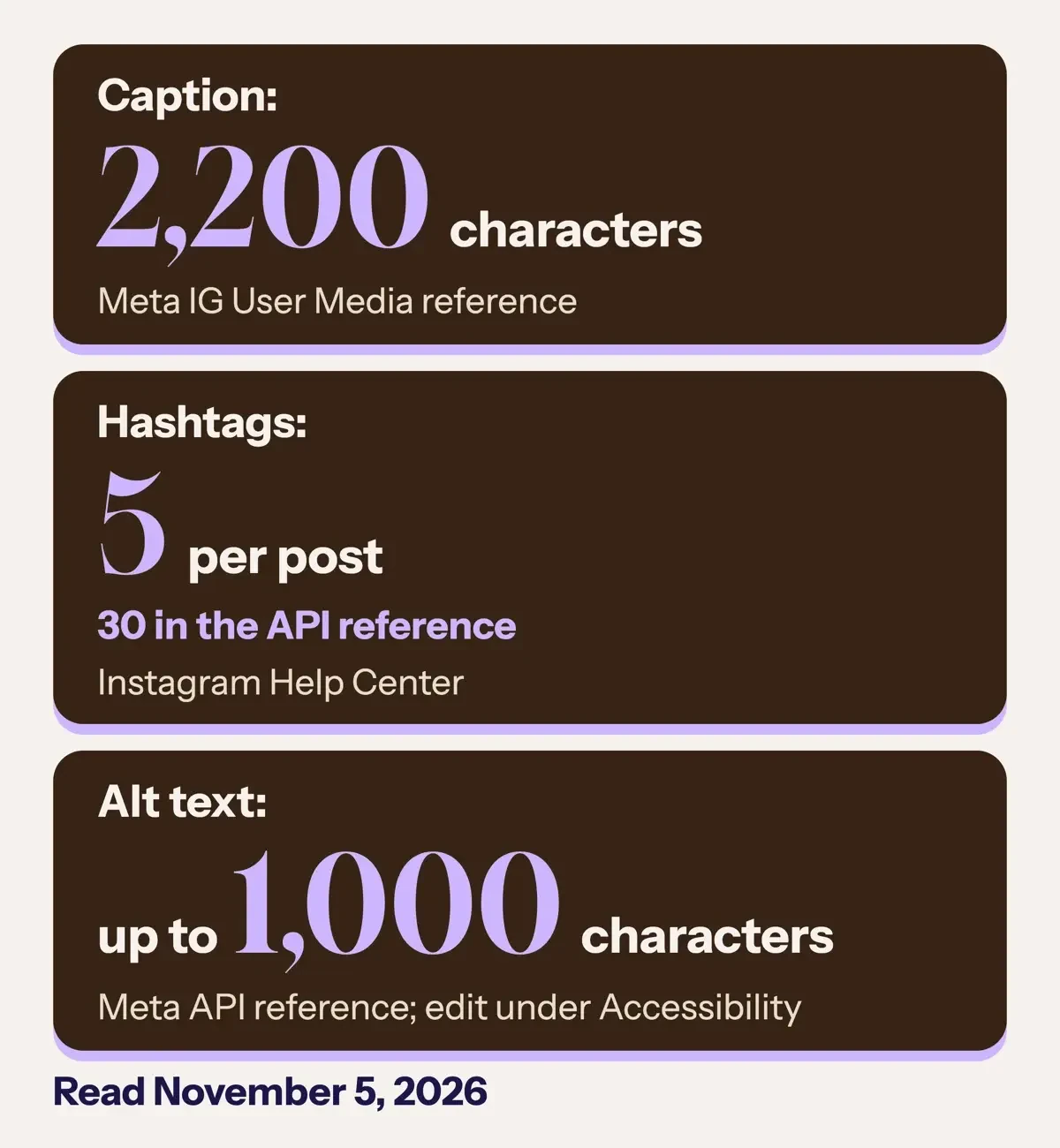 Source: Meta IG User Media reference and Instagram Help Center, read November 5, 2026.
Instagram's caption help page shows the path: Create, Post, pick the photo, then Write a caption and Share. Need a crop or a color fix first? Our free photo editors guide compares what each one really gives you free.
What we tested
We ran every caption through test/check_captions.py, a 107-line script of our own, on November 5, 2026. It counts characters, hashtags and @ tags, and flags HTML, emoji, watch-list words and near duplicates. It also scores each line against the 75 list lines from the 2024 post. All 84 passed. The longest is 90 characters, 4.1% of the API caption limit, and the closest old match scored 0.52 out of 1.
Caption check results by list
Every length below is in characters. The last column is each list's highest similarity score in test/results.json against the 75 old captions, where 1 would be a copy.
| List | Captions | Shortest | Longest | Hashtags | Duplicates | Closest to old post |
|---|---|---|---|---|---|---|
| Saree | 6 | 42 | 87 | 0 | None | 0.52 |
| Lehenga | 6 | 45 | 69 | 0 | None | 0.49 |
| Salwar kameez | 6 | 47 | 90 | 0 | None | 0.48 |
| Kimono and yukata | 6 | 50 | 86 | 0 | None | 0.43 |
| Hanbok | 6 | 47 | 79 | 0 | None | 0.44 |
| Qipao | 6 | 55 | 88 | 0 | None | 0.42 |
| Quinceañera | 6 | 43 | 78 | 0 | None | 0.52 |
| Kente | 6 | 57 | 78 | 0 | None | 0.47 |
| Dashiki | 6 | 55 | 74 | 0 | None | 0.45 |
| Eid | 6 | 52 | 72 | 0 | None | 0.51 |
| Diwali | 6 | 49 | 77 | 0 | None | 0.45 |
| Lunar New Year | 6 | 53 | 68 | 0 | None | 0.45 |
| Nowruz | 6 | 46 | 73 | 0 | None | 0.48 |
| Guest | 6 | 64 | 90 | 0 | None | 0.44 |
All 84 lines together run 5,492 characters, which is more than twice the 2,200-character cap, so a whole list never belongs in one post. Pick one line, then add a detail only you know. For more ways to reuse the same photo, see our Story ideas you can measure.
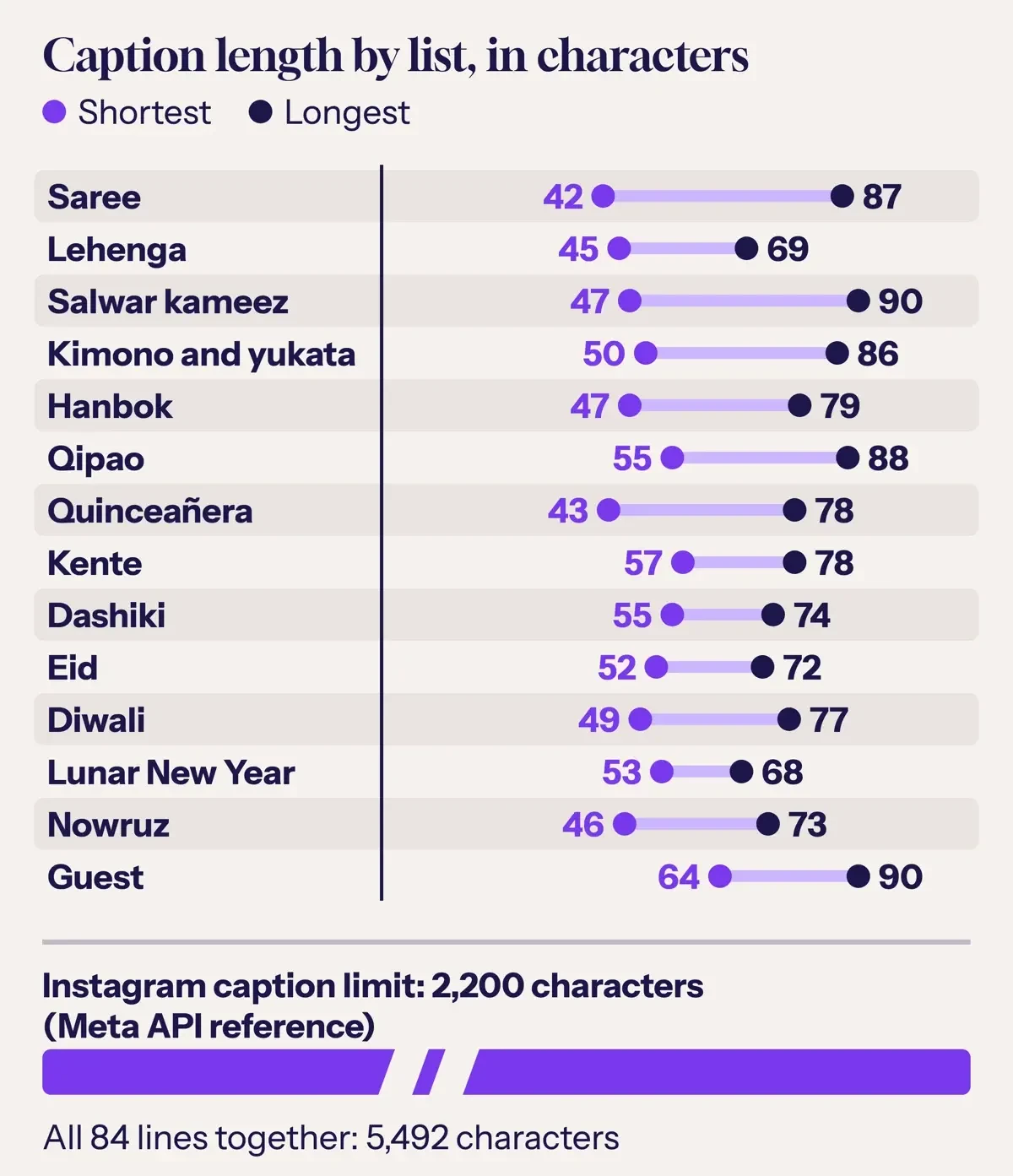 Diagram by DigitalTreed: shortest and longest caption per list from test/results.json (November 5, 2026).
Frequently asked
How many hashtags should I put on a traditional outfit post?
Up to 5. Instagram's hashtag help page says a comment with more than 5 tags on one photo or video won't post.
Can I add alt text after the photo is already posted?
Yes. Instagram's alt text page says to open Options, then Edit, then Accessibility, write the alt text and tap Done.
Can I post a photo of a powwow dancer I met?
Ask first. The COTRAIC etiquette page says to check with the Powwow Host, then ask the dancer, and never to enter the arena for photos.
When is the International Day of Nowruz?
March 21. The UN observance page says the General Assembly proclaimed it in 2010.
How we made this guide: We wrote all 84 captions on November 5, 2026 and kept text copies of the 28 source pages. For the Met's five objects, we saved its Open Access API records. Each quote here was compared with them word for word. Smithsonian pages put a bot check in front of our checker, so we cite none of them. Facts checked by the DigitalTreed team on November 5, 2026.
First published April 2024 with 75 unsourced captions. Rewritten November 5, 2026 with new lines only.
Sources
- Meta for Developers: IG User Media reference
- Instagram Help Center: Use hashtags on Instagram
- Instagram Help Center: Add a caption before sharing your post
- Instagram Help Center: Edit the alternative text for a post
- Japan National Tourism Organization: Guide to enjoy the kimono and yukata experience
- Japan National Tourism Organization: Japanese ryokan guide
- Korea.net: Hanbok embodies age-old philosophies
- Korea.net: 'Hanbok lifestyle' designated National Intangible Cultural Heritage
- Library of Congress: Celebrating Lunar New Year with the Library of Congress's collections
- Library of Congress: Chinese New Year celebrations, primary sources
- Library of Congress: Quinceañera, Hispanic American traditions and celebrations
- Library of Congress: Hispanic American traditions and celebrations
- Fowler Museum at UCLA: Wrapped in Pride, Ghanaian kente and African American identity
- The Met: Kente (prestige cloth), Asante-Akan artist, ca. 1965 (bot check, opens in a browser; data from the Met's Open Access API)
- The Met: Kente (prestige cloth), Asante-Akan or Ewe artist (bot check, opens in a browser; data from the Met's Open Access API)
- The Met: Cheongsam, 1932 (bot check, opens in a browser; data from the Met's Open Access API)
- The Met: Wedding sari, 18th to 19th century (bot check, opens in a browser; data from the Met's Open Access API)
- The Met: Sari with blouse piece, Aurangabad (bot check, opens in a browser; data from the Met's Open Access API)
- Incredible India: Diwali
- Incredible India: Festivals and events
- Britannica: Eid al-Fitr (403 bot-block, opens in a browser)
- UNESCO: International Day of Nowruz
- United Nations: International Nowruz Day
- Weber State University: About Native American powwows
- Council of Three Rivers American Indian Center: Pow wow etiquette
- Grand Valley State University: Powwow etiquette
- U.S. Fish and Wildlife Service: National Eagle Repository (403 bot-block, opens in a browser)
- U.S. Fish and Wildlife Service: National Native American Programs FAQ (403 bot-block, opens in a browser)


Comments
No comments yet. Start the conversation below.