
Quick answer
A Twitter impression is one time a post appears on someone's screen, and X counts repeats, so one person can add 2 or more (as of October 30, 2026). Buying them from a site like Useviral breaks X's authenticity policy, and for a US business it can break FTC rule 16 CFR 465.8. Start with replies and the 48-hour For You window.
Picture a small US shop that posts on X a few times a week, with most posts stuck between 100 and 300 views. A search for Twitter impressions brings up Useviral and similar packages. An impression is a single showing of a post on a screen.
First up: what counts as an impression, and where to see your impressions and engagement rate. Then how For You decides who sees a post, what we tested, organic ways to raise impressions, what happens if you buy impressions, and a weekly impressions check.
Key takeaways
- One person viewing a post twice counts as two impressions on X.
- X's published code weights a predicted reply at 5.0 and a like at 0.66.
- For You drops posts older than 48 hours before it ranks anything.
- Paying others to inflate Views breaks X's authenticity policy.
- Bought views with no engagement cut our example rate from 2.5% to 0.27%.
What counts as an impression on X?
So what is the number you're trying to grow? X's developer page on post metrics defines an impression as a "Count of times the post appeared on a user's screen." It also says the count is "Not unique," which means one person who scrolls past twice adds two. That isn't reach, and it isn't followers. In the app, X shows the public number as a view count. Its view counts help page says any logged-in person who views a post counts, wherever they see it. Home, Search and profiles all count, and so does a follower or a stranger, and opening the same post on the web and then on your phone counts twice.
Your own looks count too, and promoted posts carry a view count like any other post. Embedded posts on other websites don't.
That's why a post with 300 views wasn't necessarily seen by 300 people. It's a count of showings, and it says nothing yet about whether anyone cared.
Where to see your impressions and engagement rate
That count sits on the post itself. X says view counts appear next to the analytics icon on each post in your timeline, and next to the date and time once you open a post. A fresh post may need up to a minute before its number shows. Not every post gets one, though. X lists Community posts, X Circle posts and older posts as types without a view count, so an old post with no number isn't broken or hidden from you.
For more than the raw count, X's developer page on post metrics, linked above, lists engagements as a private metric for your own posts. Engagements divided by impressions, times 100, is the engagement rate this guide uses. Keep that ratio in mind, because it's the number that bought views wreck later in this guide.
Here's how it reads on a real-looking post. Say a post shows 300 views and picked up 6 likes, replies and reposts between them, which is an example, not one of our accounts. Its engagement rate is 6 / 300 x 100 = 2%. That 2% says more about the post than the 300 does, since a dull post seen by many people still scores low. Track both, but judge posts by the rate.
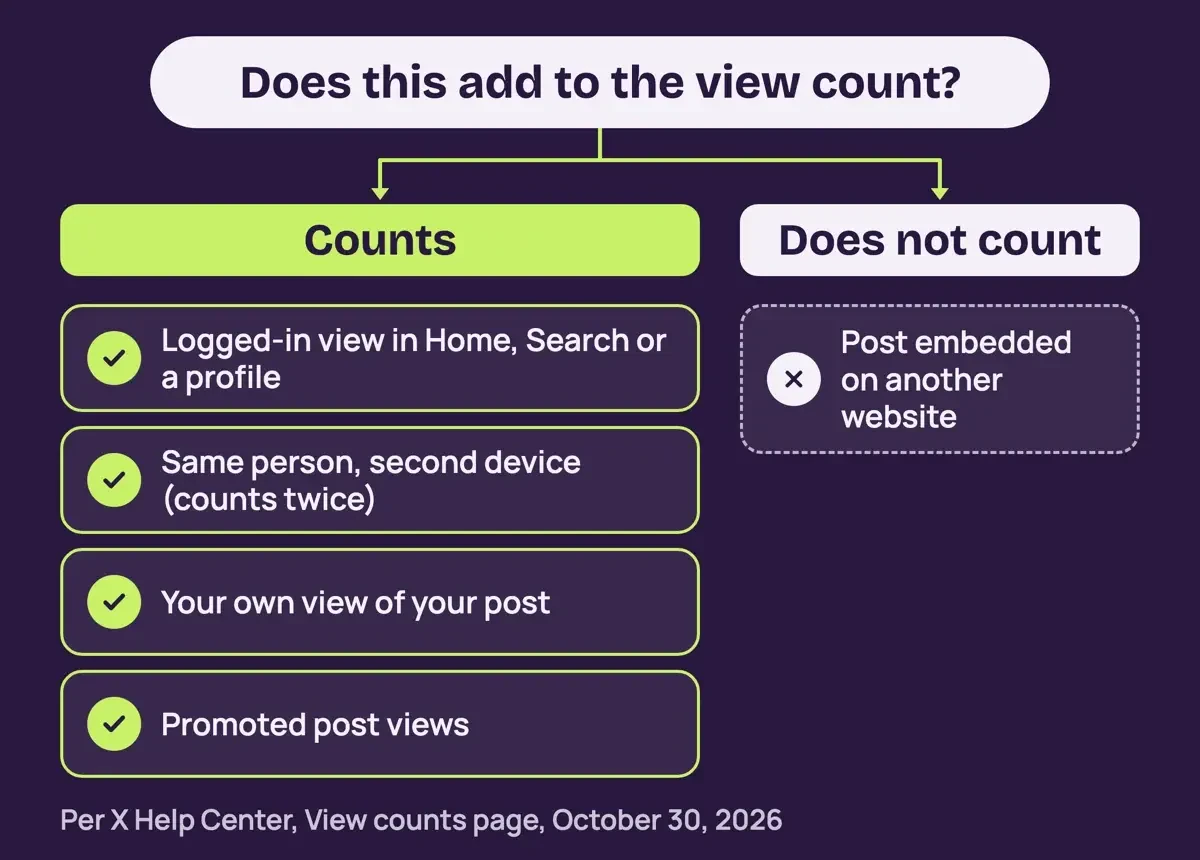 Diagram by DigitalTreed, from the wording on the X Help Center view counts page, October 30, 2026.
If you pull numbers through the X API instead, the same developer page splits them into organic and promoted metrics. It adds that "Non-public, organic, and promoted metrics are only available for posts created within the last 30 days." So you'll want to note your numbers every week instead of trying to rebuild a quarter later. Once you can read the count, the next question is what decides how many screens a post reaches.
How For You decides who sees a post
That decision mostly happens in For You, so its rules matter more than any trick. The For You help page describes a feed that blends accounts you follow with recommended posts from accounts you don't. A model trained on likes, reposts and replies then ranks the lot.
That ranking is personal, so two of your followers can see the same post in very different spots, or not at all.
X also publishes the code behind it. The For You help page still links to the 2023 twitter/the-algorithm code, but the newer x-algorithm repository on GitHub carries an update dated October 26, 2026. It says For You pulls recent posts from accounts a viewer follows and finds others from accounts they don't. A model then predicts, for each post, how likely that viewer is to take each action on it, from a like or a reply to a mute or a report. The README adds up each weight times that predicted probability to get the score.
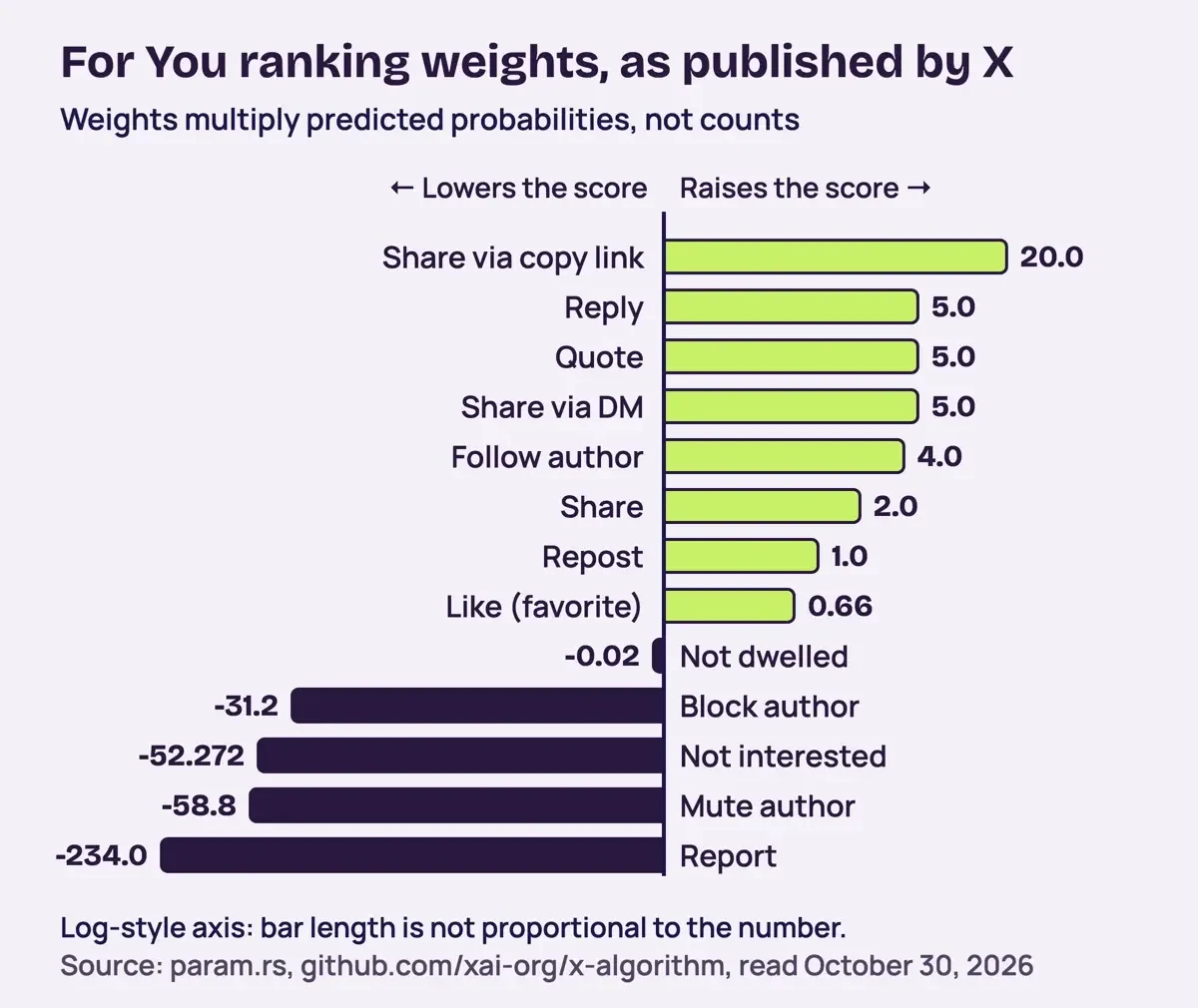 Diagram by DigitalTreed, from the param.rs file in the xai-org/x-algorithm repository, read October 30, 2026.
Those weights sit in param.rs. These are the ones you can move:
| Predicted action | Weight in param.rs | Plain reading |
| Share via copy link | 20.0 | People copying your link to send on |
| Reply | 5.0 | The strongest everyday signal |
| Quote, or share via DM | 5.0 each | Posts worth passing on |
| Follow the author | 4.0 | A post that earns a follow |
| Repost | 1.0 | Lower than a reply |
| Like (called favorite) | 0.66 | Lowest in this table |
| Not interested / mute / report | -52.272 / -58.8 / -234.0 | Negative feedback pulls the score down |
Don't read those numbers as swaps. Comments in the same file call it incorrect to say "one report cancels 468 likes." The reason they give is that the weights multiply predicted probabilities, not raw counts, and a report is more than 1,000 times rarer than a like to begin with. So it needs a big weight to matter at all. What the table shows is direction. Posts people reply to, share and follow from rank higher, and posts people mute or report rank lower.
Timing has a hard edge too. The README's filter table lists an age filter that drops "Posts older than 48 hours" before scoring. So a post gets about two days to find readers in For You. Posting in bursts doesn't help either. Per the README, each post after an author's first in a feed gets multiplied by a decaying factor, down to a floor. Ten posts in an hour don't buy ten slots. Accounts with few impressions get one lift, though: the README lists a New-Author Boost that moves posts from authors below an impressions threshold toward a target position.
What we tested
Those weights come straight from the file, not from a screenshot. On October 30, 2026, we saved param.rs from GitHub and parsed its action block. It holds 28 weights: 18 positive, 5 negative and 5 at zero, including profile clicks. Next, we wrote a one-page engagement-rate check in plain HTML and served it on 127.0.0.1, so the math ran locally and touched no X account. With example inputs of 1,200 impressions and 30 engagements it shows 2.50%. Adding 10,000 bought views with no engagement drops it to 0.27%.
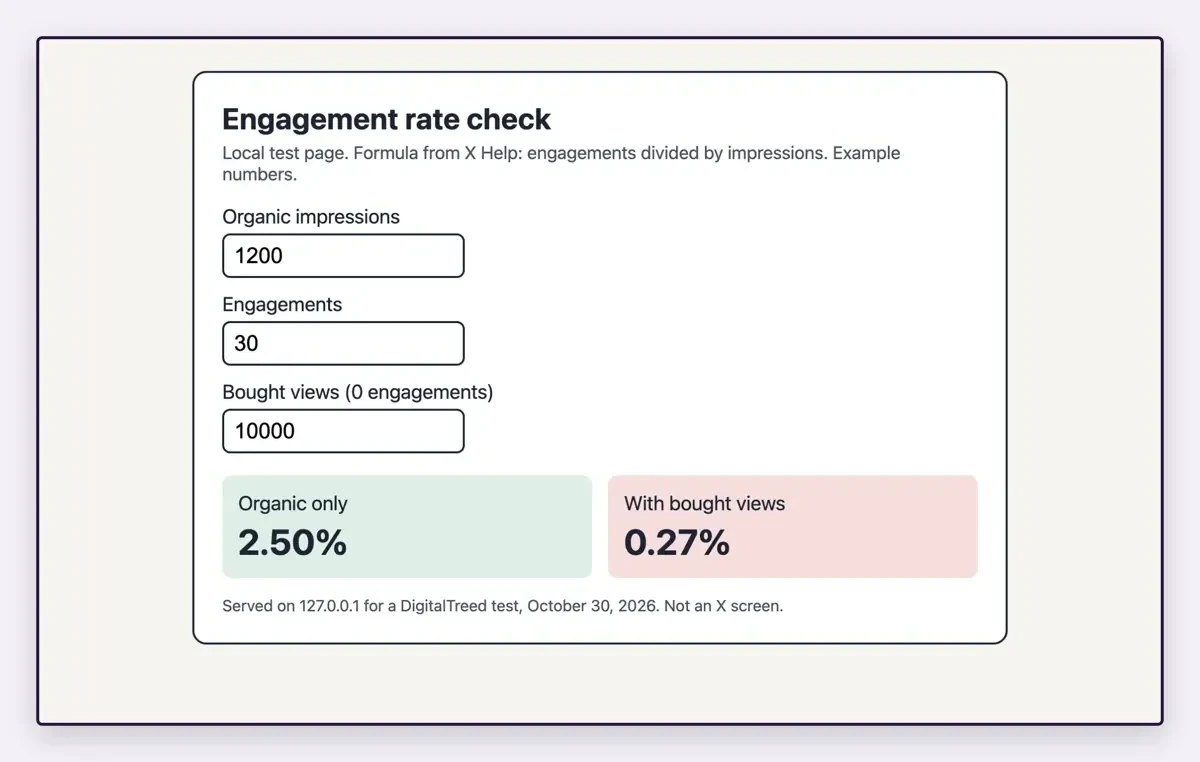 Screenshot: our engagement rate test page on 127.0.0.1, example numbers, October 30, 2026. Not an X screen.
Organic ways to raise impressions
With those rules and that test in hand, the useful levers are the ones that change predicted actions. None of them is a hack, and each one ties back to an X page or the published code. First, post when your followers are online. Their feeds are the in-network half of For You, the part the README says comes from recent posts by accounts a viewer already follows. With a 48-hour cutoff, a post published at 2 a.m. for a lunch crowd is already aging when they wake up. X doesn't publish a best time, so look at your last 20 posts and find the hour that earned the most views on day one, then post at that hour.
Write posts people answer. A predicted reply carries a weight of 5.0, so a question your customers can actually answer beats a polished announcement. Then reply back, because a real back-and-forth gives people a reason to return. X's data dictionary shows how the platform groups replies and replies of replies under the original post's conversation ID.
Replies you leave on other people's posts work differently, though. The README's filter table removes "Reposts and replies from accounts the viewer does not follow" from For You before scoring. So outside your own followers, a sharp reply under a big local account mostly reaches people who open that conversation. That's still worth doing, but it won't land in strangers' feeds on its own. Treat those replies as a way to get noticed and followed, not as an impressions engine.
Make posts worth reading to the end. The README's October 13, 2026 note says retrieval is now also trained to surface posts that people read all the way through. Dwell time is a scored action in param.rs as well, so a clear photo or a short clip that makes people stop and look has a real job to do. When you share a link to your site, run the page through our social preview checker so the card shows an image and a real title.
Use threads for longer points. X's thread help page calls a thread "a series of connected posts from one person." It adds that threads of 4 or more posts get cut short behind a Show this thread prompt, so put the hook in post one. Keep hashtags to two as well. X's hashtag page recommends "no more than 2 hashtags per post as best practice."
X's spam rules also list excessive, unrelated hashtags as a problem, so stuffing more tags in can work against you.
These habits move predicted replies and shares slowly. That's why paid shortcuts tempt.
What happens if you buy impressions from a site like Useviral?
Those shortcuts are why this post used to point readers to Useviral, a paid growth service. We don't anymore, and we didn't open or test the site for this rewrite. We couldn't confirm who runs it. This section covers the rules for any paid view or impression package, not one seller, because the same policy and the same federal rule apply whoever sells it.
X's rules come first. Its authenticity policy, dated April 2025, bans "coordinating with and/or compensating others to conduct account metric inflation." The features it lists include Views, Likes and Follows. It also bans "using or promoting third-party services" for those deals, which reaches anyone who uses such a site, not only the people running it. The X Rules put it under Platform Manipulation and Spam. Enforcement can mean restricted reach, which may pull posts from For You and Following or limit a post to the author's profile. Accounts can also be locked behind an anti-spam challenge, and X says severe violations get an account permanently suspended at first detection.
US law adds a second layer for businesses. Under 16 CFR 465.8, it's an unfair or deceptive practice to "Purchase or procure fake indicators of social media influence" that you knew or should have known were fake. It applies when those numbers misstate your influence or importance for a commercial purpose, and the FTC's own examples are bot views and bot followers. The rule's definitions in section 465.1 name views, likes, followers and reposts as indicators. The FTC's August 2024 announcement quotes them as "followers or views generated by a bot or hijacked account." For how it applies to your own business, ask a lawyer.
Sellers fall under 465.8(a) and buyers under 465.8(b). Our Twitter marketing guide for small businesses covers the paid-post labels that apply when you pay a creator instead.
Then there's the math, which hurts even if nobody ever notices. Here's what our test page showed for the example post as bought views with no engagement pile up:
| Bought views (example) | Impressions | Engagements | Engagement rate |
| 0 | 1,200 | 30 | 2.5% |
| 1,000 | 2,200 | 30 | 1.36% |
| 10,000 | 11,200 | 30 | 0.27% |
| 50,000 | 51,200 | 30 | 0.06% |
The formula is engagements divided by impressions, times 100, so 30 / 11,200 x 100 = 0.27%. A report built on that figure says your posts are failing when they aren't, and you'd lose the one honest signal you had about what your customers like.
How people react to your posts can also follow the account around. The repository describes a set of offline jobs that label an account from how others respond to its posts, counting "blocks, reports and spam reports relative to favorites." Blocks and reports also carry negative weights in param.rs, so those reactions can weigh on a post's score and on how the account is labeled. The README doesn't say how those labels treat bought views, so we won't guess past that.
There's an account risk as well. X's policy names login data shared "with a potential malicious third-party application or website" as one way accounts get compromised. Never hand a growth site your X password.
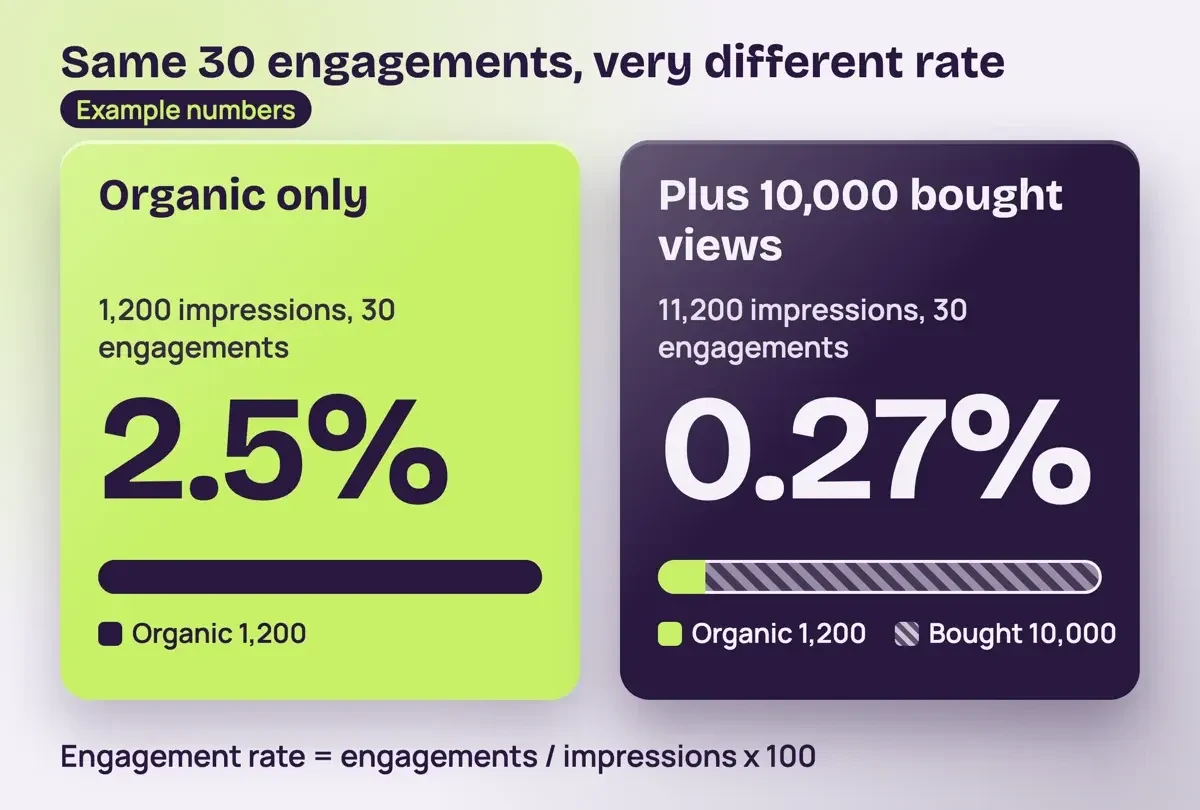 Diagram by DigitalTreed, example numbers from our local test, October 30, 2026.
A weekly impressions check for a small account
Instead of a package, here's the routine we'd run, and it takes about 20 minutes a week. Note the views and engagement rate for each post from the last seven days. Mark the three with the most replies and write down what they share, whether that's a question, a photo from the shop floor, or a tip customers asked for. Next week, post two more like them at your best hour, and answer every reply on day one. After a month you'll know which topics earn replies, which hours work, and whether threads or single posts do better for you. Keep one sheet: columns for date, hour, views, engagements, rate and replies are enough.
Once a month, turn that sheet into a one-page social media report: the three posts with the highest rate, the hour that worked, and one post type to drop. That report feeds next month's content calendar. A quarterly social media audit then tells you whether X earns its 20 minutes a week against your other channels. If people reach your profile and leave, check that your profile and link previews say plainly what you sell. Section 465.2 of the same FTC rule covers fake reviews, and automating review requests the honest way covers that side.
Our take: an impression only counts for something if a real person saw the post. Grow them with replies and timing, and leave paid packages alone. Rather hand the weekly routine to someone? The DigitalTreed social media team does it for clients as a paid service, so our view isn't neutral here.
Twitter impressions questions
Frequently asked
Do my own views count as impressions?
Yes. X's view counts page says that if you're the author, looking at your own post also counts as a view.
Is the Following timeline ranked by the algorithm?
No. X's For You page says Following shows posts only from accounts you follow, in reverse chronological order.
When did the FTC rule on fake views take effect?
October 21, 2024, per the Federal Register notice published August 22, 2024.
Does mass reporting by strangers bury a post?
Less than people fear, according to X. Its ranking code comments say reports from bad actors "will primarily affect recommendations for users who are similar to the bad actors."
How we made this guide: We read six X Help Center pages without signing in and left out two analytics articles that need sign-in. We also read X's developer docs and ranking code, 16 CFR 465, the FTC's announcement and the Federal Register. We parsed the weights file and ran a local test page. Nothing was bought. Facts checked by the DigitalTreed team on October 30, 2026.
First published December 2023 as a guide that promoted a paid growth service. Rewritten October 30, 2026: how X counts impressions, the published ranking weights, organic growth, and the rules on bought views.
Sources
- X Developer Platform: Metrics
- X Developer Platform: Data dictionary
- X Help Center: View counts
- GitHub, twitter/the-algorithm (2023 code linked from the For You help page)
- X Help Center: For You Home Timeline Recommendations
- GitHub, xai-org/x-algorithm: README
- GitHub, xai-org/x-algorithm: home-mixer/params/param.rs
- X Help Center: How to create a thread on X
- X Help Center: How to use hashtags
- X Help Center: Authenticity
- X Help Center: The X Rules
- eCFR: 16 CFR 465.8, Misuse of fake indicators of social media influence
- eCFR: 16 CFR 465.1, Definitions
- FTC press release, August 14, 2024: Final rule banning fake reviews and testimonials
- Federal Register: Trade Regulation Rule on the Use of Consumer Reviews and Testimonials


Comments
No comments yet. Start the conversation below.