
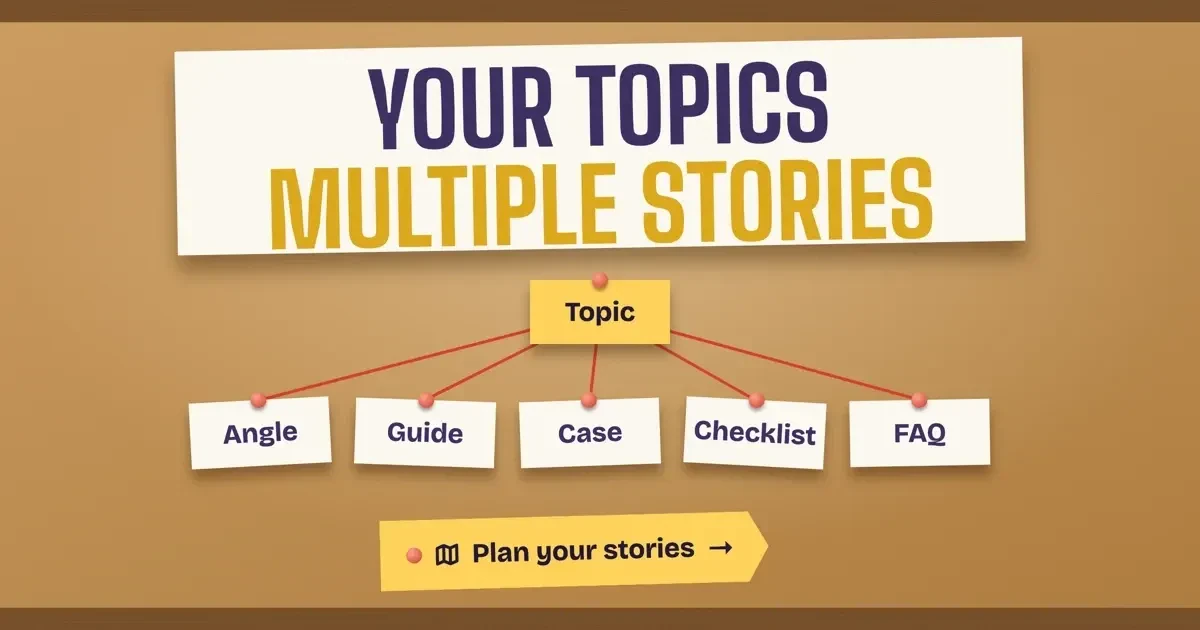
Quick answer
Your Topics | Multiple Stories has no official definition as of October 31, 2026, and no platform or Google page we read owns it. Low-quality sites use it for 3 different things; the useful one is a plan of 1 pillar topic with 4-6 angle stories linked both ways. Start with the worked plan for a made-up pool service below.
If you saw "your topics multiple stories" in a search suggestion or a newsletter, you may have wondered whether it's a Google feature you missed. It isn't. A topic cluster is a group of pages: one pillar page covers a broad topic, and focused posts each take one angle on it. It's the only meaning we'd use on a small business blog.
First: is the phrase an official term, and what are its three meanings? Then come the useful meaning, choosing a pillar topic and its angles, and a worked plan. The last three parts cover how to link every story, when angles turn into scaled content abuse, and how to tell if the cluster is working.
Key takeaways
- No platform or Google page we read defines Your Topics | Multiple Stories.
- Give each story its own search query, or fold it into another page.
- Link the pillar to every story, and every story back to the pillar.
- Two city pages that only swapped the town name scored 0.59 overlap.
- Google's scaled content policy applies whether people or software write the pages.
Is Your Topics | Multiple Stories an official term?
No. We read 11 Google pages and 2 HubSpot pages about content and site structure on October 31, 2026. Not one of them contains the words "multiple stories." The trend pages we opened never say who coined it, what product it belongs to or where it was announced.
We searched the text of all three for words like "created by," "launched by" and "coined," and found nothing.
They don't agree on what it means, either. The low-quality sites that publish the phrase give it three meanings that don't fit together:
- A content strategy: one core topic told through several angles, posts and formats.
- A storytelling device: many voices and points of view on one subject. Our own April 2025 post took this line.
- A personalization feature: readers pick topics and get a feed of stories, described as if it were a real app setting.
The oldest dated pages we found are from December 2024, and one site runs the same article in six more languages, all dated December 12, 2024. As far as we can tell, that's how a trend keyword spreads. It gets copied from site to site until it looks established, though nobody ever defined it.
We won't link those pages, because none of them is a source for anything, and only the first meaning gives you work to do on Monday.
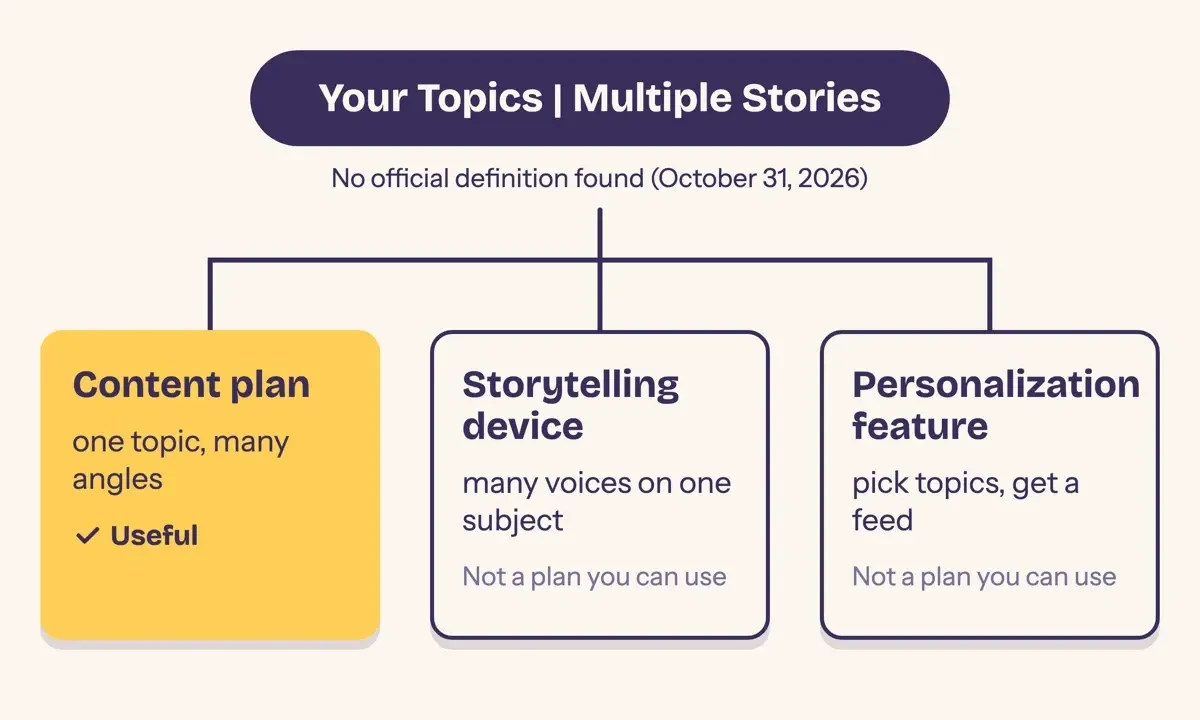 Diagram by DigitalTreed, from the trend pages and our old post, read October 31, 2026.
The useful meaning: one topic, many stories
So the useful reading is an old idea under a new label. HubSpot, a vendor that sells content software, describes it on its own blog. "Topic clusters are an SEO content strategy that links a broad pillar page to a set of focused cluster pages," the post says. Its knowledge base article on pillar pages defines the center: "A pillar page is a comprehensive resource page that covers a topic in depth." Put simply, the pillar answers the broad question. Each story answers one smaller question in full, like a five-step guide to cleaning a cartridge filter that doesn't try to cover the whole summer.
Google's guidance points the same way, though it never says topic cluster. Its page on helpful, people-first content says "People-first content means content that's created primarily for people, and not to manipulate search engine rankings." One self-check question reads like a warning against the opposite plan. "Are you producing lots of content on many different topics in hopes that some of it might perform well in search results?"
That's why depth on one topic beats one thin post on each of ten topics. A pool service with five useful pages on summer pool care has something real to say on every page. If the same business writes about pools, solar panels, pest control and roofing in one month, it's guessing. Google's question describes that guess. We go through the rest of its list in SEO content writing tips from Google's own checklist.
Pick the pillar topic and its angles
Once the idea is clear, the plan starts with the pillar topic. Pick the broad question your customers ask before they call you, not the keyword with the biggest number in a tool. For a pool service in Tucson, that's "how do I keep my pool clear all summer?" A bookkeeper's might be "what do I file in my first year?" Start there.
Then choose the angles. Our cover shows the five story types we'd start with, one per reader mood:
- Angle: a sharp opinion or a common mistake, for the reader who isn't sure they have a problem yet.
- Guide: step-by-step instructions for someone who is ready to do the job.
- Case: one real job from start to finish, including what went wrong.
- Checklist: a short list to print or save before a deadline or a season.
- FAQ: the questions customers ask on the first call, answered plainly.
Give each story its own search query, written the way people type it. If two angles keep landing on the same query, they're one page, so fold the weaker one into the stronger one. Our post on search intent mapping shows how to tell a how-to query from a near-me query. The keyword research tools comparison covers what each tool can and can't tell you about search volume.
Five stories at one a week is five weeks of publishing, so you'll want the dates on a calendar before the first draft. If there's no calendar yet, begin with how to create a content strategy for your brand.
A worked plan for Saltbush Pool Care (made up)
Here's the plan on a site that looks real. Saltbush Pool Care is a made-up pool service in Tucson, Arizona; we searched the name on October 31, 2026 and found no business using it. The pillar is "Pool care through a Tucson summer," and each card from our corkboard cover became one page with its own query:
| Card | Page | Search query it targets | What it adds that the pillar doesn't |
| Topic | Pool care through a Tucson summer | pool care in a tucson summer | The map: what changes from May to September, with a link to every story |
| Angle | Five mistakes first-year pool owners make in July | first year pool owner mistakes | Why water clouds up fast, for owners who don't know they have a problem yet |
| Guide | How to clean a cartridge pool filter at home | how to clean a cartridge pool filter | Five numbered steps a homeowner can do |
| Case | One green pool, three visits | green pool cleanup | The order of work on one job (made up here; a real site uses a real job) |
| Checklist | Before the monsoon: a pool checklist | monsoon pool checklist | Six things to do in early June |
| FAQ | Pool service questions on the first visit | pool service questions | Access, schedule and what one visit includes |
No two rows answer the same question, and that's the test for every new card.
The Case card is the one people fake most often, and readers trust it most when it's real. Write yours from a job you actually did, with the dates and the photos you took. No real job to write up yet? Leave that card empty for now instead of inventing one. Our post on showing expertise, authority and trust on your website explains why that first-hand detail counts with readers and with Google. Each story still needs a normal post shape, and our blog post template with 8 steps works for all five.
Publish in an order that keeps every link live. We'd put the pillar up first with the two stories that are ready. Then add one story a week, and edit the pillar's links each time a new one goes out. That way no link points to a page that doesn't exist yet, and you're never sitting on five finished drafts while you wait for the last one. It also gives you a few weeks of Search Console data on the first stories before you write the rest. If the checklist gets no impressions while the guide does well, you'll know which kind of story your readers want next.
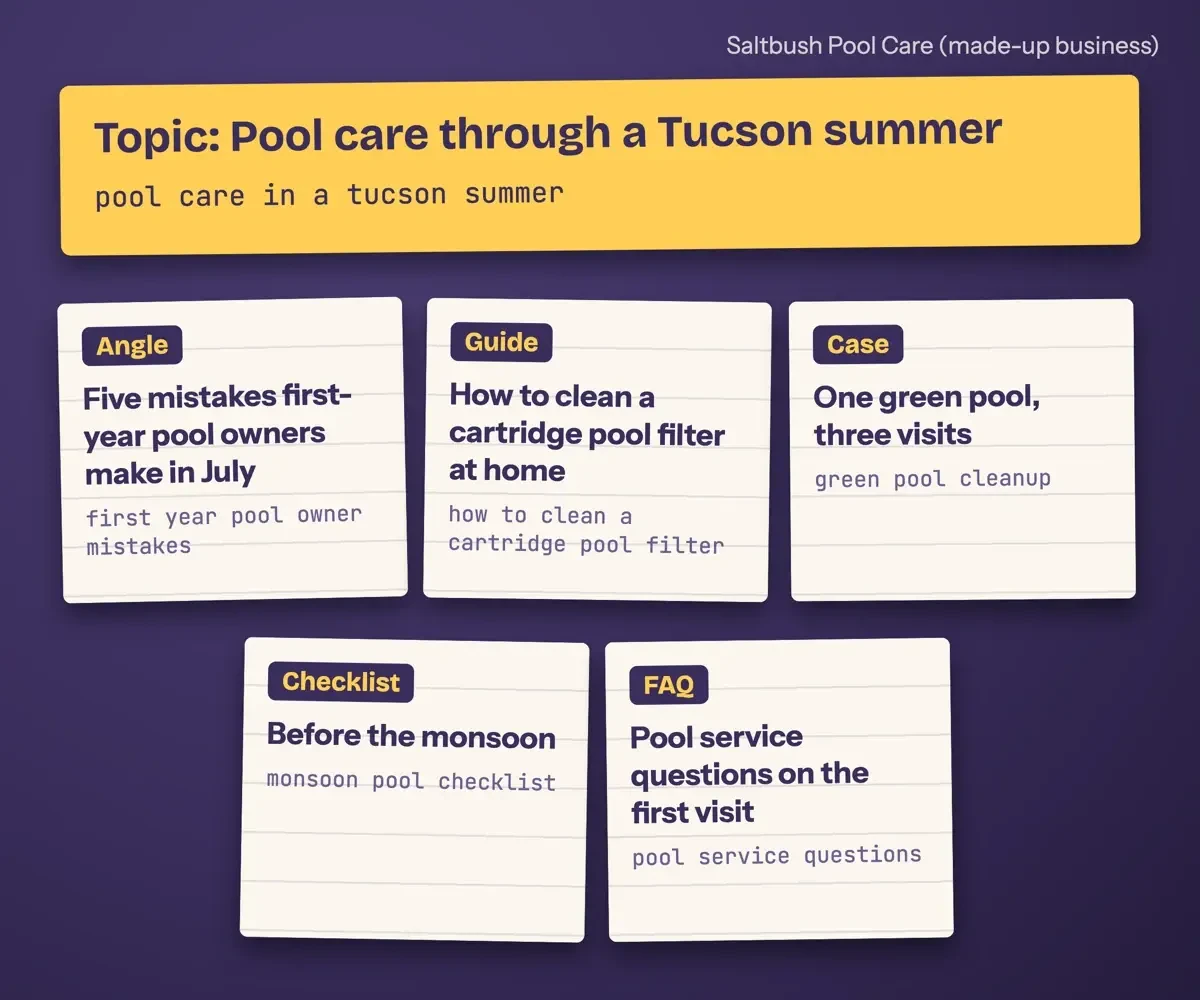 Diagram by DigitalTreed of the made-up Saltbush Pool Care plan, October 2026.
Link every story to the pillar and back
With the pages planned, links are what turn five posts into one cluster. HubSpot's knowledge base sums up the pattern. The pillar "links to high-quality content for supporting subtopic keywords," and each story "should include a link back to your pillar page." We'd add one more link from each story to its closest sibling, so someone who finishes the filter guide can go straight to the green pool case.
Google's documentation explains why this helps beyond navigation. "Every page you care about should have a link from at least one other page on your site," says its guide to crawlable links. Its page on ecommerce site structure gives a general rule: the more links a page has to it within a site, "the higher the relative importance of the page."
Our local pillar ended up with five inbound links. No story had more than three.
The words inside each link matter too. Google says "Good anchor text is descriptive, reasonably concise, and relevant to the page that it's on and to the page it links to." In the Saltbush drafts, the filter guide links to "the full summer pool care routine," never to a bare URL. Don't chase a link count, either. "There's no magical ideal number of links a given page should contain," the crawlable links guide says.
Folders and breadcrumbs help a little. They don't replace links. On sites with more than a few thousand URLs, the Search Central SEO Starter Guide notes that folders of similar topics can help Google learn how often those URLs change. Yet the ecommerce page says "Google generally doesn't look at the structure of URLs to work out the structure of a site." A breadcrumb trail "indicates the page's position in the site hierarchy," according to Google's breadcrumb documentation. On an older blog, how to find internal links and linking opportunities shows which stories nobody links to yet. Fix those first.
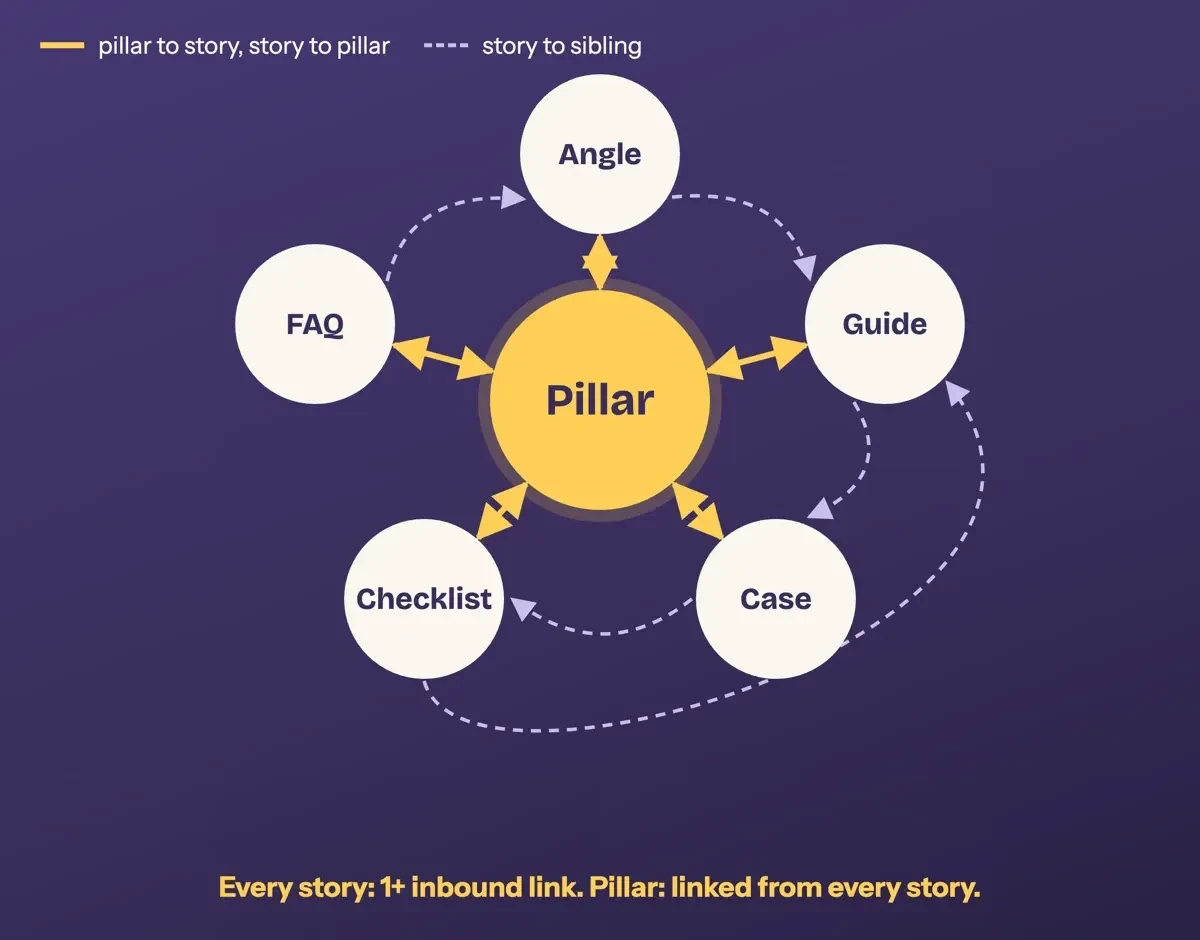 Diagram by DigitalTreed from our local test drafts, October 31, 2026.
When many angles turn into scaled content abuse
The same plan goes wrong once the angles stop being different. Google's spam policies define the problem. "Scaled content abuse is when many pages are generated for the primary purpose of manipulating search rankings and not helping users." It doesn't matter who types the pages. Google's March 5, 2024 Search Central blog post said the policy applies "no matter whether content is produced through automation, human efforts, or some combination of human and automated processes."
Paying writers instead of using AI won't make 40 thin variations of one page safe. Neither will a careful editor who only changes the city.
City pages are the classic trap. The same policy page lists doorway abuse, with this example: "Having multiple domain names or pages targeted at specific regions or cities that funnel users to one page." Twenty pages of pool cleaning in Marana, Oro Valley and every other nearby town, each a copy with the town swapped, fit that example. The same list also names "Creating substantially similar pages that are closer to search results than a clearly defined, browseable hierarchy." A pillar with linked stories is that browseable hierarchy. Twenty swapped city pages aren't.
Plain duplicate content is a smaller problem. The starter guide says "Having duplicate content on your site is not a violation of our spam policies, but it can be a bad user experience." Google's canonicalization page also calls some duplication normal. When two of your pages really cover the same ground, keep the stronger one and move anything useful from the weaker page into it. Then either redirect the weaker URL to it or mark the stronger one as canonical. That step, the duplicate URL guide says, helps "To consolidate signals for similar or duplicate pages."
If both pages earn clicks for different queries, they aren't duplicates. Leave them alone.
What we tested
We wrote eight local drafts for the made-up Saltbush cluster on October 31, 2026, including two city pages that differ only in the town name. A script on this computer mapped the links and scored each pair by shared three-word runs, flagging 0.40 or more. Google sets no such number; we chose ours before the run.
All six plan pages passed the link checks, with a top overlap of 0.014. The city pages scored 0.59 and repeated their target phrase 4 times each in under 80 words.
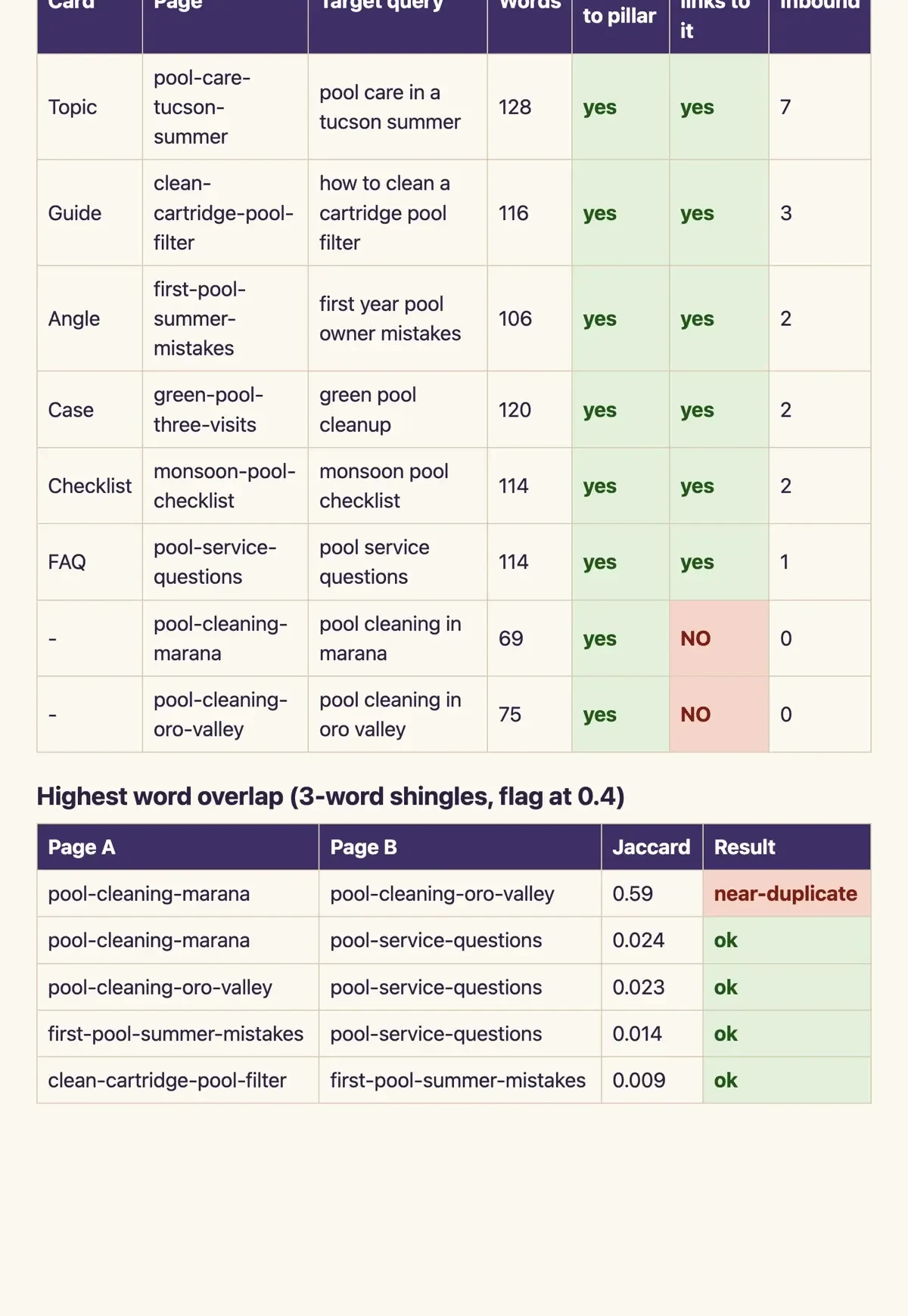 Screenshot: our cluster check on 127.0.0.1, October 31, 2026.
How to tell if the cluster is working
Once the cluster is live, judge it page by page. The Search Console Performance report "shows important metrics about how your site performs in Google Search results." Switch between its Pages and Queries tabs to see which queries each story earns. If two stories keep showing up for the same ones, they're too close, and one should absorb the other. Give it time before you decide. The starter guide says "Some changes might take effect in a few hours, others could take several months."
It also says there's "no magical word count target, minimum or maximum." A short checklist that answers its question sits fine next to a long pillar.
Our take: treat Your Topics | Multiple Stories as a label for a plan you'd want anyway. It has no rules of its own. Pick one topic your customers care about and write four to six stories that each do a different job. Link them both ways, and run a near-duplicate check before you publish. New to search? Our guide to how search works and your first rankings starts with crawling and indexing.
Your Topics | Multiple Stories questions
Frequently asked
Is Your Topics | Multiple Stories a Google feature or an app?
Not one we could find. None of the 11 Google pages we read, including the helpful content page, contains the words "multiple stories." The trend pages don't name a company, app or launch behind the phrase either.
Do I need HubSpot or another tool to build a topic cluster?
No, a spreadsheet and your own links do the job. HubSpot's knowledge base says "Creating topic clusters in HubSpot doesn't affect your website's SEO directly."
Can I use AI to write the angle stories?
Only with a real review. Google's generative AI content guidance says using such tools "to generate many pages without adding value for users may violate" its spam policy.
How we made this guide: We read 11 Google pages, 2 HubSpot pages, three trend pages and six translated copies of one. We describe those trend pages but don't link them. The cluster check ran on eight local drafts, and nothing was published. Facts checked by the DigitalTreed team on October 31, 2026.
First published April 2025 as an essay on diverse narratives. Rewritten October 31, 2026 as a plain answer on the phrase, with a worked topic-cluster plan and a local near-duplicate check.
Sources
- Google Search Central: Creating helpful, reliable, people-first content
- Google Search Central: SEO Starter Guide
- Google Search Central: Spam policies for Google web search
- Google Search Central Blog: March 2024 core update and new spam policies (March 5, 2024)
- Google Search Central: Link best practices for Google
- Google Search Central: Help Google understand your ecommerce site structure
- Google Search Central: Breadcrumb structured data
- Google Search Central: What is canonicalization
- Google Search Central: How to specify a canonical URL
- Google Search Central: Using generative AI content
- Search Console Help: Performance report (Search results)
- HubSpot Knowledge Base (vendor): Pillar pages, topics and subtopics
- HubSpot Blog (vendor): Topic clusters

Comments
No comments yet. Start the conversation below.