
Quick answer
Of the plans that state a plain lookup limit, Mangools Agency costs the least per lookup, as of October 28, 2026. The math: $48.85 a month on yearly billing / 36,000 lookups x 1,000 = $1.36 per 1,000. Basic, with 100 a day for $18.85, works out to $6.28. On yearly billing, Moz Pro Standard costs $79 a month and covers 150 lookups a month. Count your lookups first.
You do your own SEO for a small US business, and four pricing pages each lead with a giant keyword count. A keyword research tool is a program that estimates how often people search a phrase and how hard it is to rank for it. This keyword research tools comparison sets Semrush, Ahrefs, Moz Pro and Mangools side by side on database claims, difficulty scores, lookup limits and USD prices. Ubersuggest's pricing page blocked our reader, so it gets no numbers.
We start at a glance, then cover database counts, why one keyword gets four difficulty scores, lookups per plan, Keyword Planner, what we tested and which tool fits.
Key takeaways
- Count monthly lookups first, because plan limits differ far more than prices.
- Moz Pro Standard allows 150 keyword queries a month, Mangools Basic 100 a day.
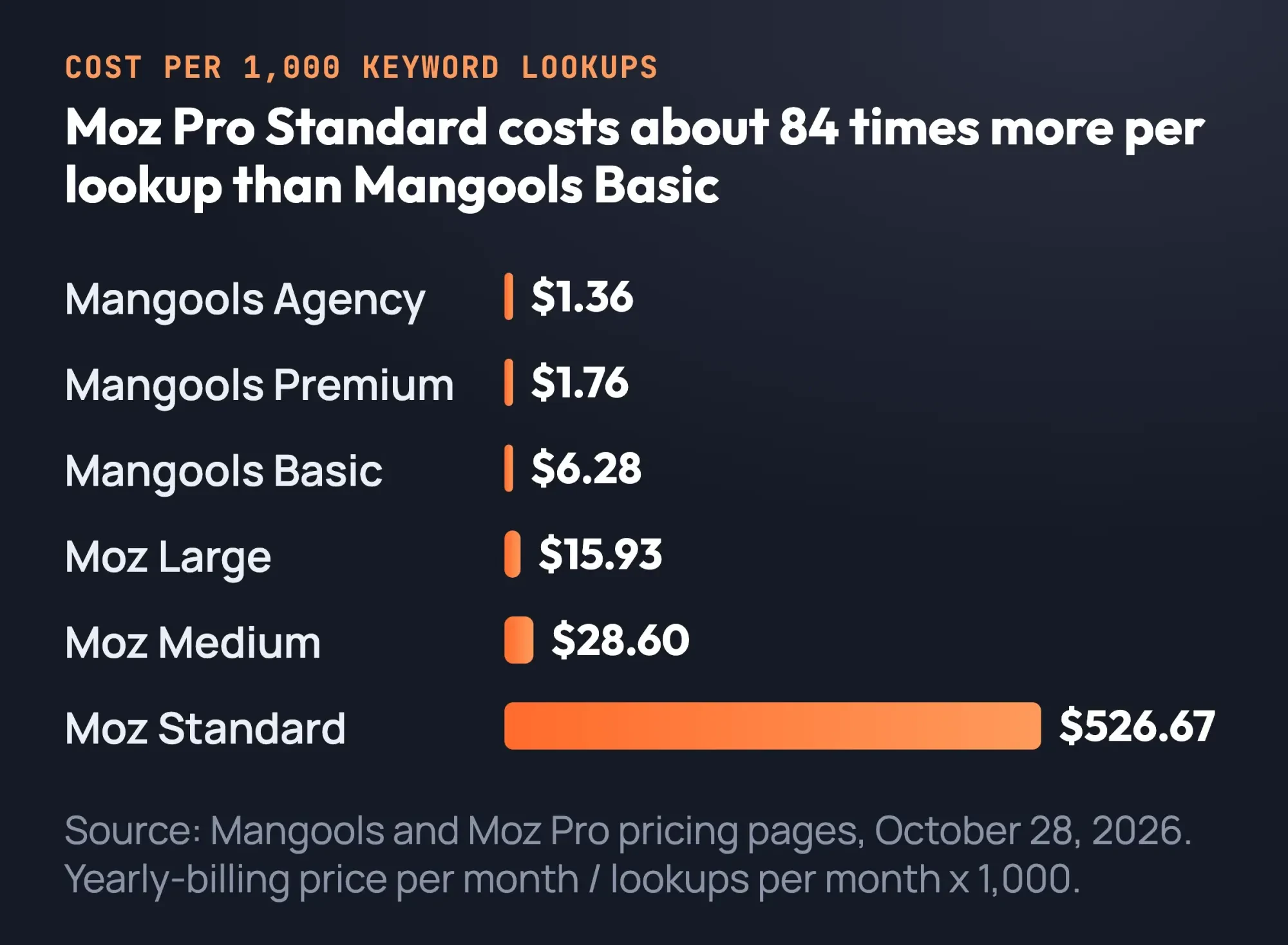
- Per 1,000 lookups, costs ran from $1.36 to $526.67 in our calculation.
- Difficulty scores use different inputs, so compare keywords inside one tool only.
- Keyword Planner is free but needs Google Ads billing details first.
Keyword research tools comparison at a glance
Here are the numbers that change a decision, all taken from each vendor's own pricing page on October 28, 2026, with no sign-up and no trial account. Monthly means billed month to month. Yearly means the rate when you pay for a year up front. The limit column quotes each page's own wording, because the tools don't count a lookup the same way. If you want whole SEO suites sorted by job instead, that's in our roundup of SEO analysis tools.
| Tool and plan compared | Monthly | Yearly rate | Keyword limit on that plan | Free option |
|---|---|---|---|---|
| Semrush SEO | $139 | $117.33/mo | Not stated for this plan | 10 reports a day |
| Ahrefs Starter (cheapest Ahrefs plan) | $29 | Not listed | Not stated on the pricing page | Ahrefs Free (site data) |
| Ahrefs Lite | $129 | $1,290/yr | 1,000 credits per user a month | Ahrefs Free (site data) |
| Moz entry plan (one website) | $49 | Not listed | Not stated on the pricing page | Not stated |
| Moz Pro Standard | $99 | $79/mo | 150 keyword queries a month | Free trial (Medium plan) |
| Mangools Basic | $30.50 | $18.85/mo | 100 keyword requests a day | 5 lookups a day |
| Ubersuggest | Not read | Not read | Not read | Not read |
All prices are in USD as of October 2026. Semrush lists its SEO plan at $139 a month, or $117.33 a month on yearly billing. Its free plan allows "10 reports per day across all vital tools" (Semrush pricing). Ahrefs lists Lite at $129 a month with "1,000 credits per user" (Ahrefs pricing). Moz lists Standard at $99, or "$79/mo when you pay yearly", plus a $49 entry plan for a single website (Moz Pro pricing).
Its Monthly tab, read on October 28, 2026, lists Basic at $30.50, Premium at $40.50 and Agency at $70.50 a month. Monthly Basic costs $11.65 more. On the default yearly tab, Basic is $18.85 a month, or $226.20 a year, against a crossed-out $366.00, as of October 2026 (Mangools plans and pricing). Ubersuggest's pricing page answered our reader with a bot check. We didn't guess, so every Ubersuggest cell stays blank; open the page in your browser, and our Ubersuggest guide covers how the tool works.
The next plan up costs a lot more at some vendors and very little at others, as of October 2026. Semrush's Starter is $199 and Pro+ is $299 a month. Ahrefs' Standard is $249 and Advanced is $449, and it also sells a $29 Starter plan. Moz's Medium is $179 and Large is $299 on monthly billing. Mangools' Premium is $26.35 and Agency is $48.85 a month on yearly billing. All of these come from the four pricing pages linked above.
Read the limit column before the price column.
What the database numbers really count
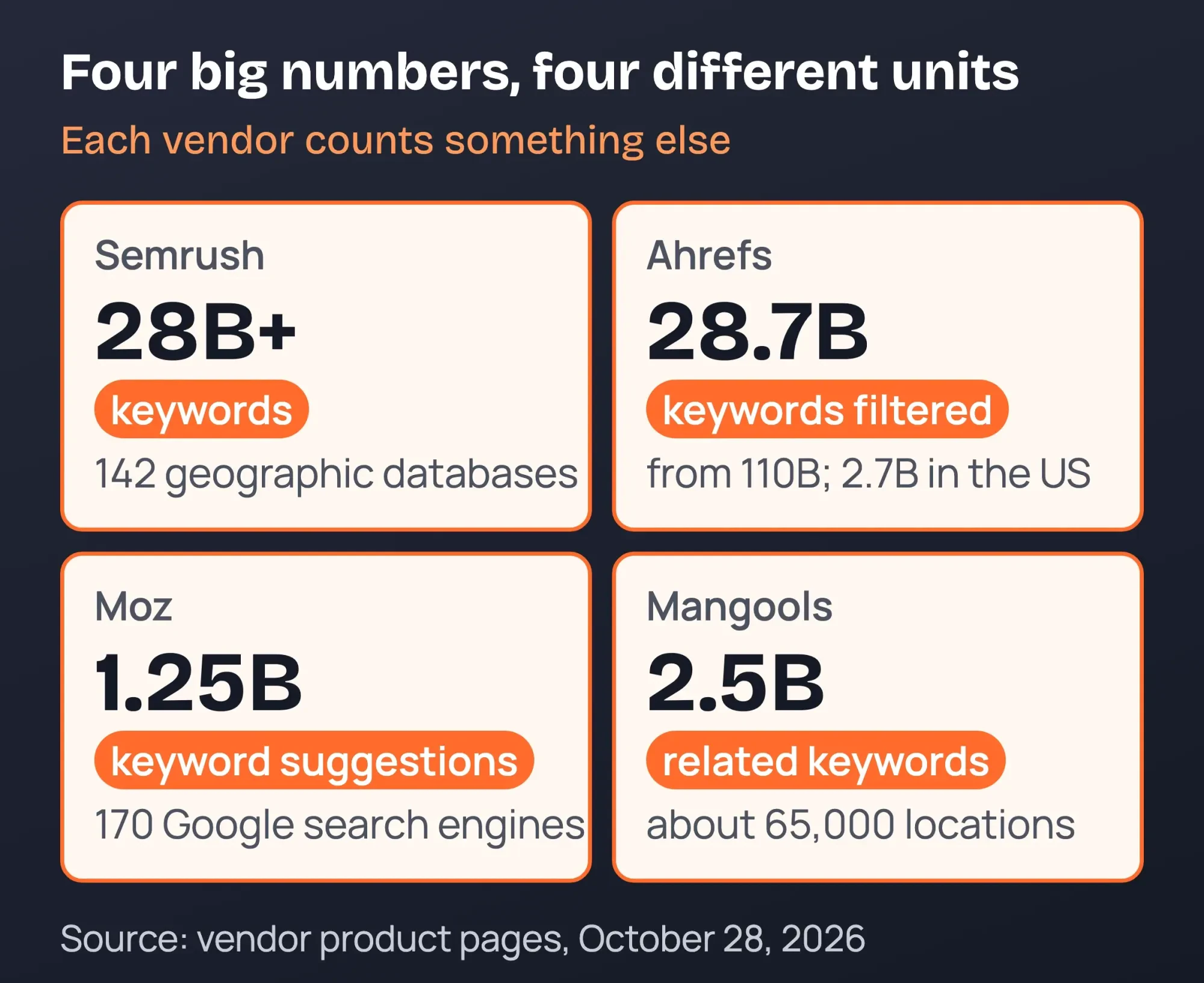
Every vendor puts one big number on its keyword page, and it's tempting to compare those numbers as if they were scores in the same game. They don't count the same thing, though. Semrush says it has "over 28 billion keywords across 142 geographic databases" (Semrush keyword research). Ahrefs' Keywords Explorer page shows "28.7B Keywords filtered from 110B discovered in total" and 2.7 billion in the US alone (Ahrefs Keywords Explorer).
Moz counts "1.25 billion keyword suggestions" across 170 Google search engines (Moz Keyword Explorer). Mangools counts "2.5 Billion related keywords" and about 65,000 locations, from countries down to cities and districts (Mangools KWFinder). That's four different units: keywords, filtered keywords, suggestions and related keywords. Even one vendor can disagree with itself. Ahrefs' free generator page says "over 8 billion queries" (Ahrefs keyword generator), a different figure from its own Keywords Explorer page.
None of these counts is wrong. They just aren't comparable.
 Source: Semrush, Ahrefs, Moz and Mangools product pages, October 2026
For a store that sells in the US, the US count is the one to ask about. Of the four, only Ahrefs states a US figure on the page we read. It's 2.7 billion. Before 28 billion becomes a reason to pay more, ask each vendor how many US keywords it holds and how often it refreshes their volumes.
Why does one keyword get four different difficulty scores?
Once you've got a list, difficulty is the next column you'll sort by. It's also the number that varies most between tools, since each vendor builds it from different inputs. Here's what each help page says goes into it:
- Semrush KD% runs "from 0 to 100" and uses referring domains, the dofollow and nofollow ratio, the authority of ranking domains and SERP features (Semrush: What is KD%?).
- Ahrefs calculates KD "based solely on the average number of backlinks to the top-ranking pages," as its Keywords Explorer page puts it.
- Moz Difficulty runs "on a scale of 1-100" and roughly tracks "a weighted average of the PA of the top 10" (Moz Help: Difficulty).
- Mangools KD "is now based on Moz (DA, PA) and Majestic (CF, TF) metrics" (Mangools KD update).
So a score of 35 means different things in different tools. Semrush splits its scale into six bands, with 0-14 as "Very easy", 15-29 as "Easy", 30-49 as "Possible" and the top band, 85-100, as "Very hard". Moz says keywords get "significantly tougher to rank for at a Difficulty score of around 40." Ahrefs looks at backlinks alone. A keyword whose top pages have few links scores low there, however strong those pages are.
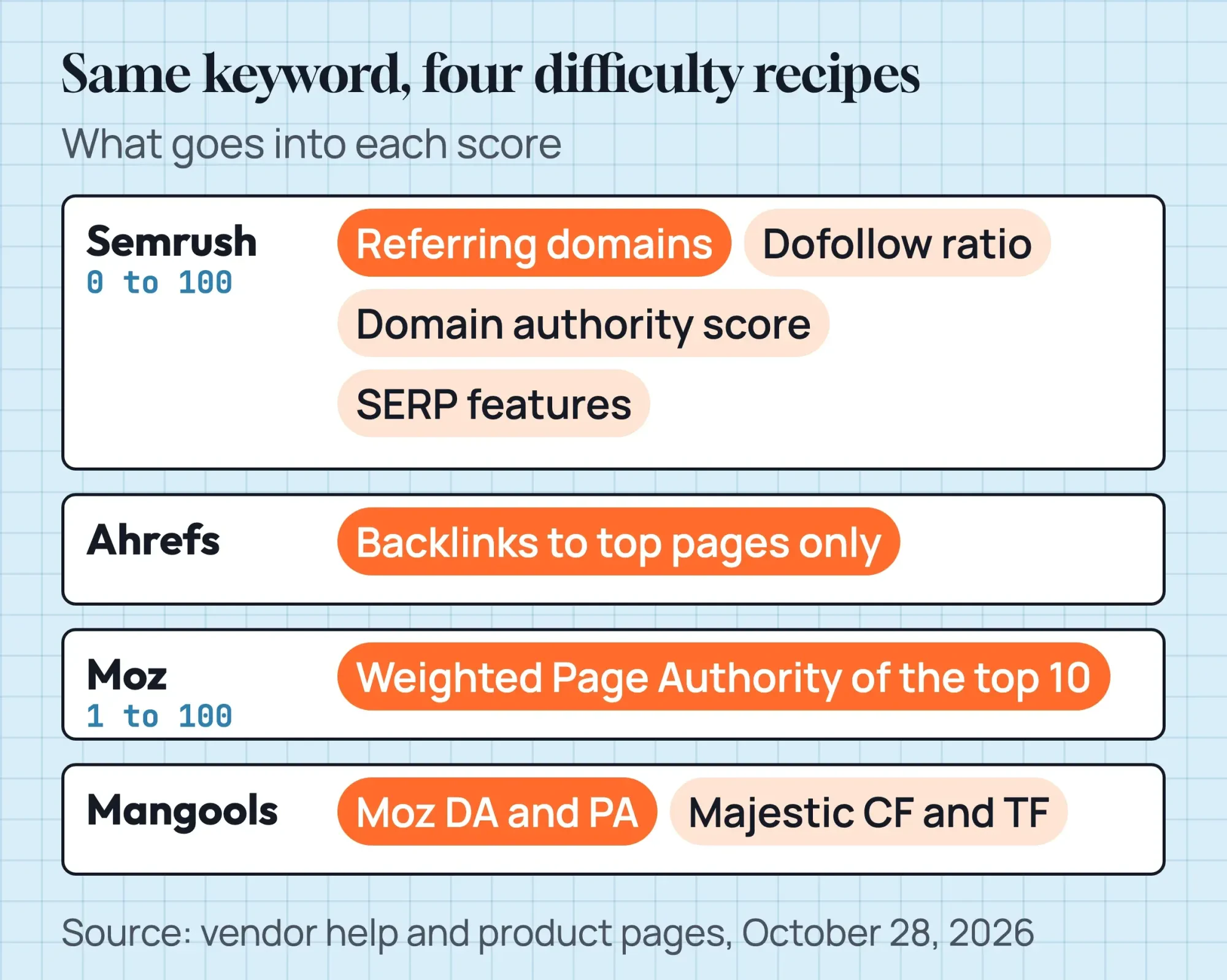 Diagram by DigitalTreed, from each vendor's help or product page read October 28, 2026
Our take: pick one tool and rank keywords against each other inside it. Don't mix them. A Semrush 30 and a Moz 30 aren't the same reading. If you're torn between the two biggest suites, our Ahrefs vs Semrush guide compares them beyond keywords.
Lookups per plan, the limit that bites first
That leaves the limit you'll hit in your first busy week. Moz's comparison table lists "Keyword Queries/mo" of 150 on Standard, 5,000 on Medium and 15,000 on Large. Mangools lists keyword research requests per 24 hours: 100 on Basic, 500 on Premium and 1,200 on Agency. Both sit on the pricing pages linked in the table above, read October 28, 2026. Those units are far apart. At 30 days a month, Mangools Basic allows 3,000 lookups, which is 20 times Moz Standard's 150. A store that checks 160 product terms in one sitting would use up Moz Standard's month in an afternoon. Our Moz Pro guide explains what else each tier adds.
How many lookups do you need? A rough way to count is to list every product category, service and customer question you want a page for. Then allow three lookups each: the main term, one variation and one competitor check. Forty categories come to 120 lookups before you've looked at a single blog idea, and a seasonal relaunch adds more on top. If your total stays under about 150 a month, the smallest plans and the free tiers are worth a try first.
If it's over 150, Moz Standard is out before price even comes up.
Semrush is harder to pin down. Its help page lists "Pro SEO: Up to 3,000 requests/day", with 5,000 for Guru and 10,000 for Business (Semrush Keyword Overview limits). The pricing page we read on October 28 sells plans called SEO, Starter and Pro+, and none of those three names appears in that limits list. So we couldn't tie a daily limit to a plan you can buy today. Ask Semrush support to confirm your plan's daily keyword limit in writing before you buy, and see our Semrush guide for where its keyword reports live.
Ahrefs is vaguer. Lite users get 1,000 credits a month. Standard and up get unlimited credits per user. Its pricing page doesn't say how many credits one keyword lookup uses, so we didn't try to convert 1,000 credits into a number of lookups you could plan around. Our Ahrefs guide walks through Keywords Explorer if you want to watch how fast a month of credits goes.
 Source: Mangools and Moz Pro pricing pages, October 2026; math by DigitalTreed
The chart covers only the two vendors that state a plain lookup limit, so a missing bar for Semrush or Ahrefs means a missing number, not a worse deal.
Where Google Keyword Planner fits
Before you pay anything, there's a free baseline from Google itself. Google calls Keyword Planner "a free resource to help advertisers build keyword lists for search campaigns" (Google Keyword Planner). The catch is sign-up. Google's help page says "You must complete your account setup by entering your billing information to access basic features" (Google Ads Help: Use Keyword Planner).
So a card goes on file before you see a single keyword idea.
Two of its columns don't mean what the paid tools mean. "Avg. monthly searches" is "by default" averaged "over a 12-month period". Competition is "the number of advertisers that showed on each keyword" (Google Ads Help: Keyword Planner metrics). It measures ads. It doesn't tell you how hard ranking is. Moz also averages volume over 12 months (Moz Help). So a December jump in gift searches gets smoothed out in both.
The other free route is a capped tier of a paid tool. Mangools' free allowance is "5 lookups per 24 hours, 15 related and 5 competitor keywords per lookup" (Mangools KWFinder). That's enough to sanity-check a short list. It won't build one. Semrush's free plan shares its 10 daily reports across every tool, so a keyword check and a site check draw from the same pool. For a first list, Keyword Planner and our free keyword ideas tool get you the terms worth checking in a paid tool. The setup screens are in our Keyword Planner walkthrough.
What we tested
On October 28, 2026, we saved each pricing page and ran a Python script on the saved copies. It pulled each price and keyword limit, then divided price per month by lookups per month and multiplied by 1,000, counting daily limits as 30 days.
Results ran from $1.36 on Mangools Agency to $526.67 on Moz Pro Standard ($79 / 150 x 1,000, from Moz Pro pricing). All of them use yearly-billing prices as of October 2026, from the pricing pages above.
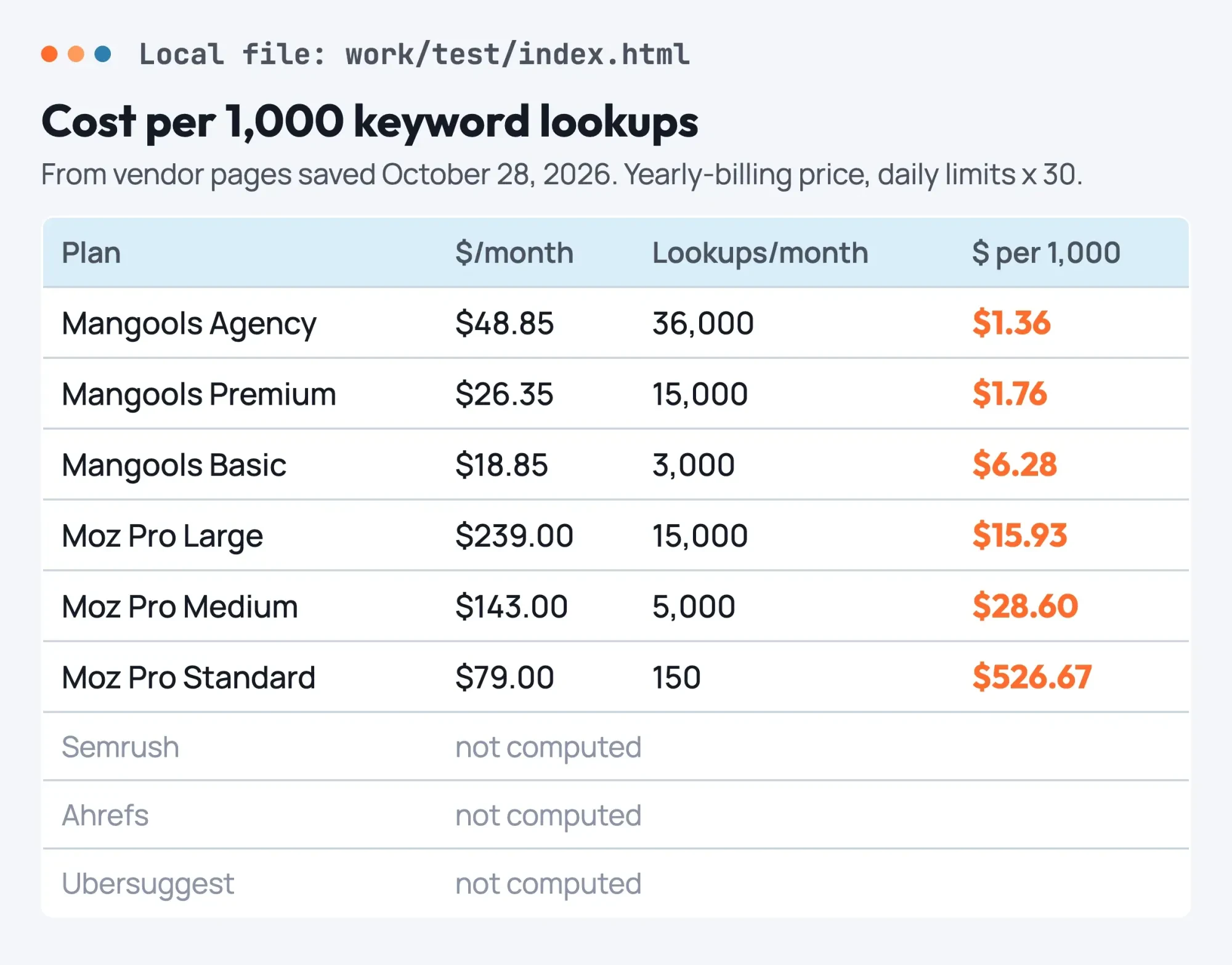 Screenshot: our local test page, October 28, 2026
Which keyword tool fits your business
With the limits in hand, the choice is simpler than the marketing suggests. Take Northpine Outfitters, a made-up online store in Bend, Oregon, that sells hiking boots for wide feet. Its owner plans about 600 keyword lookups a month while building product and buying-guide pages for the spring hiking season, and that figure is made up too. Moz Standard's 150 queries won't cover that. The cheapest Moz fit is Medium at $143 a month on yearly billing, as of October 2026 (Moz Pro pricing). That's more than seven times the Mangools Basic price. Mangools Basic covers it at $18.85, with 2,400 lookups to spare. Here's how we'd sort the choice:
- Choose Mangools if keyword lookups are the main job and the budget is under $50 a month (Agency is $48.85 billed yearly, as of October 2026).
- Choose Moz Pro Medium or Large if you also want Moz's rank tracking and link data in one plan.
- Choose Semrush or Ahrefs if you'll use their competitor and backlink reports, then confirm the keyword limit first.
- Stay on Keyword Planner and free tiers if you check 5 keywords a day or fewer, the free allowance of KWFinder.
Northpine's owner would land on Mangools Basic and revisit the choice in six months. By then the owner will know whether backlink data is worth Semrush's $117.33 a month, or Ahrefs' $107.50 ($1,290 / 12), on yearly billing as of October 2026. Count your lookups for a normal month, then buy the smallest plan whose stated limit covers them. For the method behind good keyword picks, our intermediate SEO course covers search intent and content briefs, and our Mangools guide shows KWFinder's screens. We sell SEO services, so weigh our advice knowing that. For a second opinion before you pay, request a keyword research quote.
Frequently asked
Do these keyword tools have a free trial?
Semrush offers seven days free on its pricing page, and Moz offers a Moz Pro trial on its Keyword Explorer page.
Can I get a refund on Mangools?
Yes, within 48 hours of payment, says its pricing FAQ. That doesn't apply to 2 consecutive subscriptions.
Does Ahrefs offer discounts?
No. Its pricing FAQ says "We never run discounts", though yearly billing saves up to 17%.
How we made this guide: We read the pricing and help pages of five vendors on October 28, 2026, and linked each figure where it appears. Ubersuggest's pages showed a bot check, so none of its numbers appear. We ran the cost math with a local script on saved copies of those pages. Facts checked by the DigitalTreed team on October 28, 2026.
First published July 2020. Rewritten October 28, 2026: database claims, difficulty methods, keyword limits and USD prices side by side, plus a cost-per-lookup test.
Sources
- Semrush: SEO and AI Search plans and pricing
- Semrush Knowledge Base: Keyword Overview (limits)
- Semrush: Keyword research features
- Semrush Knowledge Base: What is KD%?
- Ahrefs: Plans and pricing
- Ahrefs: Keywords Explorer
- Ahrefs: Free keyword generator
- Moz Pro: Pricing
- Moz: Keyword Explorer
- Moz Help: Difficulty
- Moz Help: Monthly volume
- Mangools: Plans and pricing
- Mangools: KWFinder
- Mangools: Keyword difficulty update
- Ubersuggest: Pricing (bot check to our reader)
- Google: Keyword Planner
- Google Ads Help: Use Keyword Planner
- Google Ads Help: About Keyword Planner forecasts

Comments
No comments yet. Start the conversation below.