

Quick answer
Google Ads for lawyers comes in two forms. With search ads you pay per click; with Local Services Ads you pay per valid lead, after Google checks your bar license. One vendor's 2026 benchmark puts the average legal click at $9.87. Either way, the ad must still pass your state's advertising rules.
That last part is the one most firms skip.
We wrote the kind of first-draft search ad a personal injury firm might launch on a Monday, for a made-up firm in Visalia, California. Then we checked it line by line against the ABA Model Rules and California's advertising statute. Ten of its 16 lines got flagged. The rewrite you'll see below got zero, and it still tells a hurt person what they need to know.
This guide covers paid search only. For the organic side, see our law firm SEO guide. New to pay-per-click? Our PPC marketing guide explains the basics first.
Key takeaways
- Search ads charge per click; Local Services Ads charge per valid lead.
- Google Verified replaced Google Screened and the other Local Services badges.
- LocaliQ's 2026 benchmark puts the average legal click at $9.87.
- Start the Local Services paperwork a month before you want leads.
- Every ad must still pass your own state's lawyer advertising rules.
Two ad products, two ways to pay
Google Ads for lawyers means two different products that sit in different places on the results page. With search ads, you choose keywords, write the ad and pay when someone clicks. Google's page on actual cost per click explains what you're charged. You "only pay what's minimally required to clear the Ad Rank thresholds and beat the Ad Rank of the competitor immediately below you."
Local Services Ads work the other way round. Google's getting started page says that "you can advertise your business on Google and receive leads directly from potential customers". Its US category list includes Lawyers plus personal injury, family, criminal, DUI, immigration, estate and bankruptcy lawyer services, among others.
| As of October 2026 | Search ads | Local Services Ads |
|---|---|---|
| You pay for | A click on your ad | A valid lead: a call, message or booking |
| Who writes the ad | You do | Google builds it from your profile |
| What sets your position | Ad Rank: bid, ad and page quality, context | Your bid and your profile quality |
| Checks before you run | A Google Ads account | Screening, bar license check, Google Verified badge |
| Budget you set | Average daily (one day can reach 2x) | Average weekly (monthly max = weekly x 30.4 / 7) |
That table is the whole decision in miniature.
Our take: if your practice area is on Google's Local Services list, start there, because you only pay when someone actually reaches you. First ask your state bar how it treats paying per lead (more on that below). Add search ads for the cases and cities the Local Services categories can't target, and for the times you want to control every word.
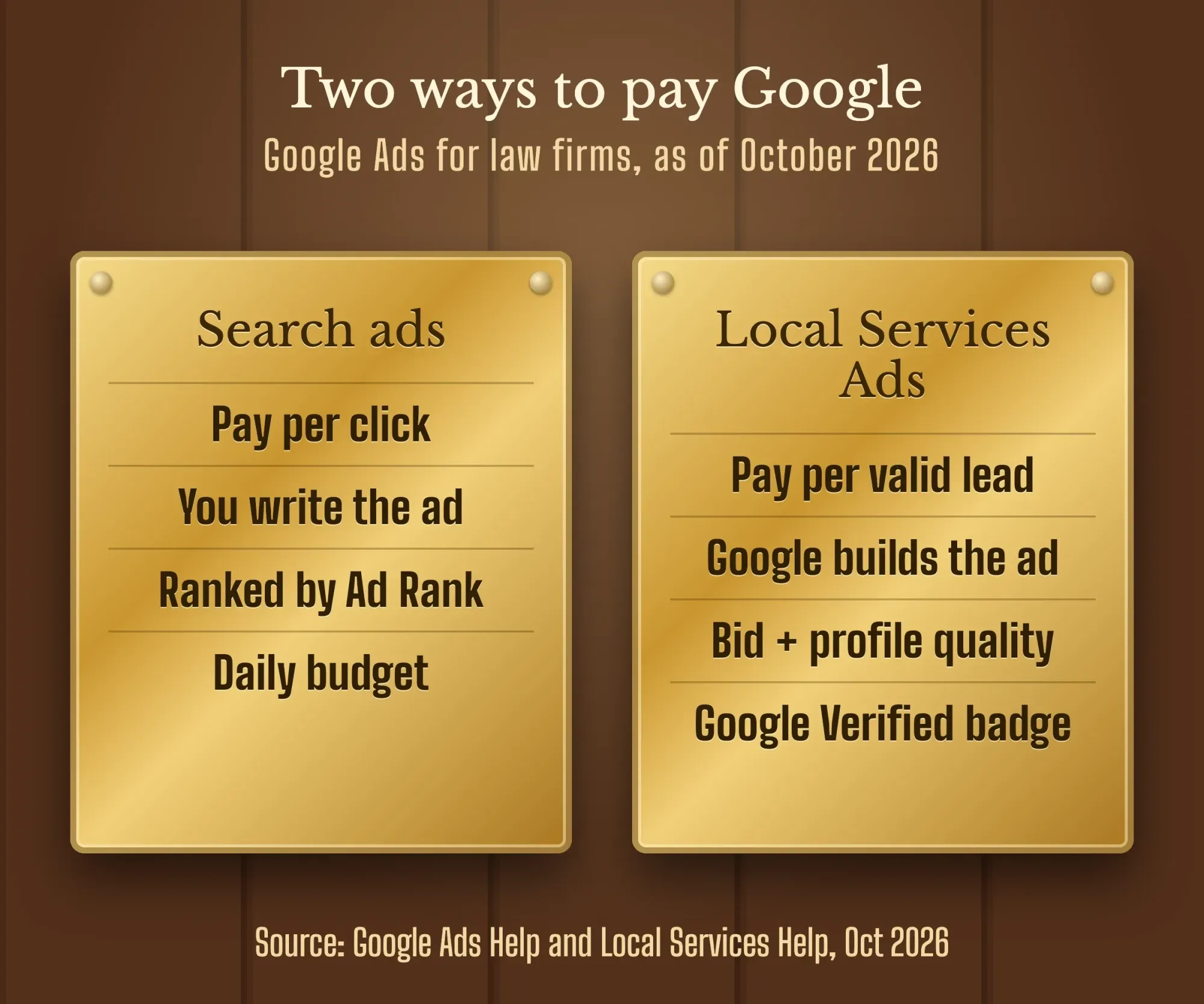 Diagram by DigitalTreed, October 2026, based on Google Ads Help and Local Services Help pages.
Google Screened is now Google Verified
That badge row needs an update for anyone who read older guides. Google announced the change in an August 20, 2025 post. It said the badges would be unified from October. In its words, "Google Verified will replace other LSA badges and programs, like Google Guaranteed, Google Screened, License Verified by Google and the Money Back Guarantee."
So if an agency still sells you "Google Screened for lawyers," the name is out of date.
The Google Verified help page adds that ranking "won't be affected by this change."
The checks themselves are still there. Google's screening page says every business "must pass Google's screening and verification process," which "may include background, business registration, insurance, and license checks, and minimum review requirements". For a personal injury firm, the US requirements list names these:
- Business owner identity verification
- Business check and business representative check (select users only)
- Professional liability insurance, where local law requires it
- "State bar license checks for each personal injury lawyer in the firm"
Google says it validates licenses "against the state or country databases," and that "Businesses aren't charged for the background check". Where a D-U-N-S number is needed, it warns the application "can take up to 30 days". If the firm already has a Business Profile on Google, it must also verify that it owns or manages that profile. Our guide to claiming and verifying a Business Profile covers how.
Start the paperwork a month before you want leads.
The badge isn't a gate to starting, though. The same getting started page describes "pre-badge ads" for professional categories once you've sent a license, headshots and reviews and set a budget. Those listings show below providers who've finished every check.
You pay per lead, and Google defines the lead
Now to the money side of Local Services Ads. Google's page on how leads work is blunt: "With Local Services Ads, you pay for valid leads". It doesn't publish a price list for lawyers. It says "Lead prices may vary depending on your location, the job type, the type of lead, or your bidding mode."
What counts as a valid lead matters more than most firms expect.
An answered call counts. So does a message, a voicemail or a booking request. A missed call during business hours counts if the caller "stays on the line for more than 20 seconds". Follow-up calls from the same number aren't charged again "provided there is interaction within 15 days."
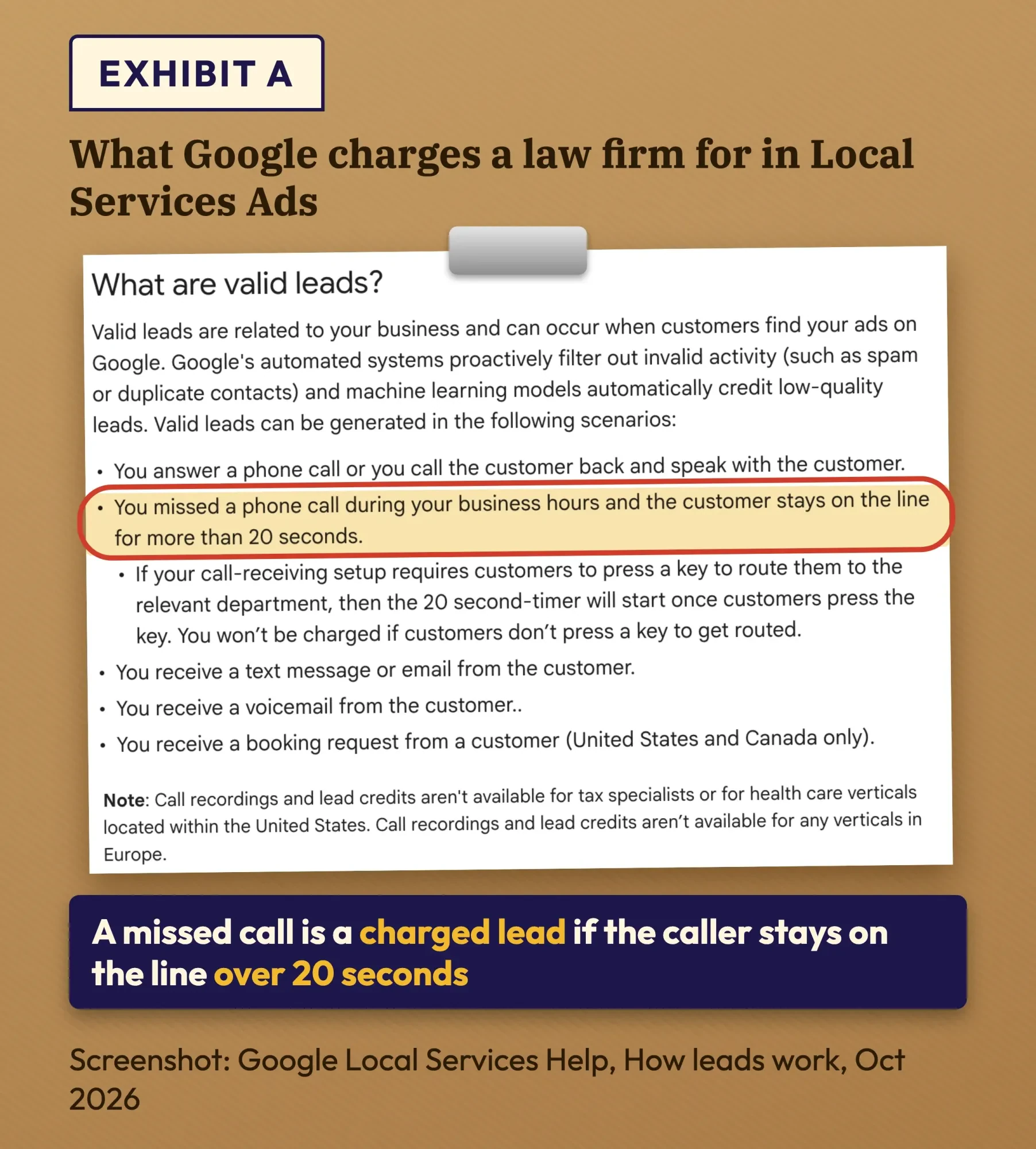 Screenshot: Google Local Services Help, How leads work, public page, signed out, October 26, 2026.
Bad leads can be refunded, within limits. Google "continuously assesses lead quality over a 30-day period," and its lead credits page says credits usually land "within 30 days". But it also says Google "no longer supports credits for “job type not serviced” and “geo not serviced” leads". If your profile lists a practice area or county you don't take, those calls are yours to pay for.
You set the price you're willing to pay through bidding. Google's bidding page offers Maximize leads, Target cost per lead and Max per lead. It recommends "a minimum budget of 10 leads per week" and says it "takes about 2 weeks to see accurate results."
Here's the catch for busy offices. Local Services ranks ads by "bid and overall profile quality," and Google's ranking page warns that "Missed calls may negatively affect your responsiveness."
Your intake desk is part of your ad budget.
Spending is capped, too. Google's budget page gives the formula: "average weekly budget x 30.4 ÷ 7". Once you hit that monthly max, your ad stops until next month or until you raise the budget.
What drives the cost of a Google Ads click for law firms?
Search ads price clicks, not leads, and the price comes out of an auction. Google's Ad Rank page says "Ad Rank scores are based on 6 factors". They're your bid, your ad and landing page quality, Google's minimum thresholds, how close the competition is, the search's context and your assets' expected effect.
Quality Score is often blamed for high costs. Google's Quality Score page says it's a diagnostic and that "Quality Score is not an input in the ad auction". The things it measures still matter, because they feed Ad Rank.
So what does a legal click cost? Google doesn't publish legal click prices on its public help pages, and the best dated figure we found is vendor data. LocaliQ's 2026 search advertising benchmarks, last updated June 1, 2026, draw on "thousands of our customers' advertising campaigns". For Attorneys and Legal Services, it reports an average cost per click of $9.87 against $5.42 across all industries. It also reports a 5.55% conversion rate and a $131.63 average cost per lead.
Treat those as one vendor's averages, not your price.
A divorce search in a small county and a truck-crash search in a big metro sit in very different auctions. To see your own numbers, run your practice area and city through Keyword Planner, which our Google Keyword Planner guide explains. Google's own Keyword Planner help adds that "campaign performance depends on a variety of factors," including bid, budget, ad quality and location targeting.
What $3,000 a month buys a two-lawyer injury firm
Those averages are easier to judge with a budget in front of you. Example: Calloway Ruiz Injury Law in Visalia, California, is a made-up two-lawyer firm with $3,000 a month for search ads, as of October 2026.
Google's average daily budget page says to divide a monthly figure by 30.4, so the daily budget is $98.68. On a busy day Google can spend up to "two times your average daily budget", but over a month it can't pass "30.4 times your average daily budget".
| Calloway Ruiz (made up), October 2026 | Number | How we got it |
|---|---|---|
| Average daily budget | $98.68 | $3,000 / 30.4 (Google formula) |
| Most Google can spend in one day | $197.37 | 2 x daily (Google) |
| Most Google can spend in the month | $3,000 | 30.4 x daily (Google) |
| Clicks at a $9.87 average CPC | About 304 | $3,000 / $9.87 (LocaliQ, vendor data) |
| Leads at a 5.55% conversion rate | About 17 | 304 x 5.55% (LocaliQ, vendor data) |
| Leads at a $131.63 cost per lead | About 23 | $3,000 / $131.63 (LocaliQ, vendor data) |
So the same vendor averages give anywhere from 17 to 23 leads a month, and they don't agree because each average comes from different campaigns. That's exactly why you can't plan a law firm budget on an industry average.
Plan on a test month instead, and tag your ad's landing page with our UTM builder to tell which ads brought which leads.
If the firm also ran Local Services Ads at $700 a week, as of October 2026, Google's monthly max formula caps that side at $3,040 a month. How many leads that buys depends on the lead prices Google shows in the account, which it doesn't publish.
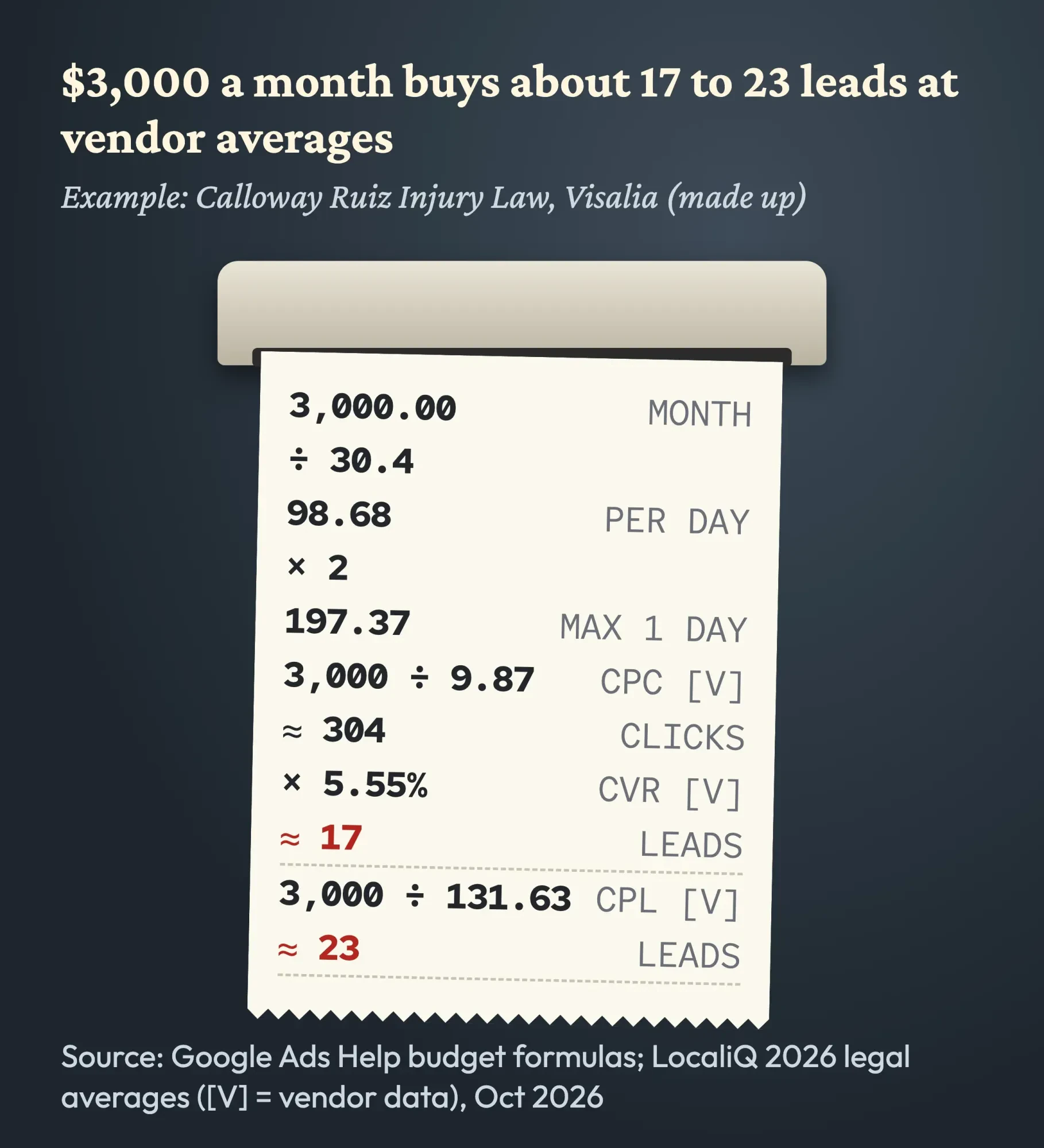 Diagram by DigitalTreed, October 2026: Google Ads budget formulas plus LocaliQ 2026 legal averages (vendor data). The firm is made up.
What the ABA Model Rules say about paid ads
Budgets are the easy part. The ad itself has to follow your state's lawyer advertising rules, and each state writes its own. We quote the ABA Model Rules here because they're the common reference point; your state's version may differ.
The base rule is Model Rule 7.1: "A lawyer shall not make a false or misleading communication about the lawyer or the lawyer's services". Its Comment [1] says the rule "governs all communications about a lawyer’s services, including advertising."
Paying for ads is allowed.
Rule 7.2(a) says "A lawyer may communicate information regarding the lawyer’s services through any media," and 7.2(b)(1) lets a lawyer "pay the reasonable costs of advertisements". The Comment on Rule 7.2 lists "Internet-based advertisements" by name.
Paying for leads gets more careful wording.
Comment [5] to Rule 7.2 covers this. It says "A lawyer may pay others for generating client leads, such as Internet-based client leads, as long as the lead generator does not recommend the lawyer". It also sets fee-sharing conditions. And it bars paying a lead generator that implies it "has analyzed a person’s legal problems when determining which lawyer should receive the referral". Local Services Ads charge per lead, so ask your state bar's ethics line how your state reads that comment.
Two more parts of Rule 7.2 shape ad copy. Paragraph (c) bars saying a lawyer is "certified as a specialist" unless the certifying body is approved and "clearly identified in the communication". And (d) says every communication "must include the name and contact information of at least one lawyer or law firm responsible for its content."
The Model Rules treat search ads apart from solicitation.
The Comment on Rule 7.3 draws the line. A communication is not a solicitation "if it is in response to a request for information or is automatically generated in response to electronic searches". In the Comment's terms, a call back to someone who asked for information answers a request. It isn't a cold call. Cold calls are another matter: Rule 7.3(b) limits live contact when "a significant motive for the lawyer’s doing so is the lawyer’s or law firm’s pecuniary gain."
Results and comparisons are where ads slip. Comment [3] to Rule 7.1 warns that true past results can mislead if they create "an unjustified expectation that the same results could be obtained for other clients". It says the same about "an unsubstantiated comparison" with other firms, and notes that a disclaimer "may preclude a finding" that a statement misleads.
California adds lines a 30-character headline can trip
California shows how much stricter a state can get. The State Bar's Rule 7.1 Comment [2] says an ad with "an express guarantee or warranty of the result of a particular representation is a false or misleading communication". Comment [3] says anything stating or implying “no fee without recovery” is misleading "unless the communication also expressly discloses whether or not the client will be liable for costs."
The state's statute goes further. Business and Professions Code section 6157.2, last amended by SB 37 with effect from January 1, 2026, says an ad "shall not contain or refer to" any of these:
- "A guarantee or warranty of success regarding the outcome of a legal matter"
- Statements that the lawyer "can generally obtain immediate cash or quick settlements"
- A contingency offer unless it "also advises whether a client will be held responsible for any costs"
- Awards from an organization that charges for them or gives them for membership
The same section requires the name of a responsible California lawyer or firm and "the city, town, or county of at least one bona fide office location". The statute's landing-page allowance for short formats covers only joint advertisers. That's why our rewrite below keeps the firm name and city in the ad text.
One more California rule changes how you handle Google's mix-and-match ads. Section 6159.1 says "A true and correct copy of any advertisement" must be "retained for one year" by whoever pays for it. Google builds each responsive ad from the parts you give it, so it isn't obvious which mix counts as the copy. Saving the full set of headlines and descriptions at each change is the cautious habit; your bar counsel can say what the rule expects.
We wanted Florida too.
The Florida Bar's website blocked our visit on October 26, 2026, so we haven't quoted its rules; check your own bar's current rules directly.
Ten of 16 lines in a typical injury ad needed a lawyer's eye
That's a lot of rules for 30 characters, so we tested how a normal first draft does. On October 26, 2026, we wrote 12 headlines and 4 descriptions for the made-up Calloway Ruiz Injury Law. We wrote them the way a busy firm or a generalist agency might. Then we ran them through a short script that checks Google's 30 and 90 character limits and flags phrases tied to the rules quoted above. The first draft got 14 flags on 10 of its 16 lines, and two headlines were too long to publish at all.
A flag means "a lawyer should read this line," not "this breaks the rules."
Here's what changed between the draft and the rewrite:
- "We Guarantee Results" was cut. California bans a guarantee outright.
- "No Fee Unless We Win" became "No fee if no recovery. You may still owe case costs, and we explain them up front."
- "Best Injury Lawyer in Visalia" became "Visalia Car Accident Lawyer."
- "Certified Injury Specialist" was cut, since nobody at the made-up firm holds a named certification.
- "$2.4 Million Recovered for Client" was cut. It was too long, and a past result needs context an ad can't hold.
- "Get Fast Cash for Your Claim" became "Free Case Review."
The rewrite had zero flags, and it kept the firm name and the city in the ad text.
One line needed a person, not a script. "Spanish-Speaking Staff" passed our check, but California's Comment [5] limits claims that a lawyer can serve clients in another language. That comment asks the ad to state "the employment title of the person" who speaks the language. Whether "Staff" is a specific enough title is a question for your bar counsel, not a script.
For the writing side (limits, pinning and Ad Strength), our guide to Google Ads copy goes deeper. Our search ads team can also build and check the campaign for you. We bill for that work. Keep that in mind as you read.
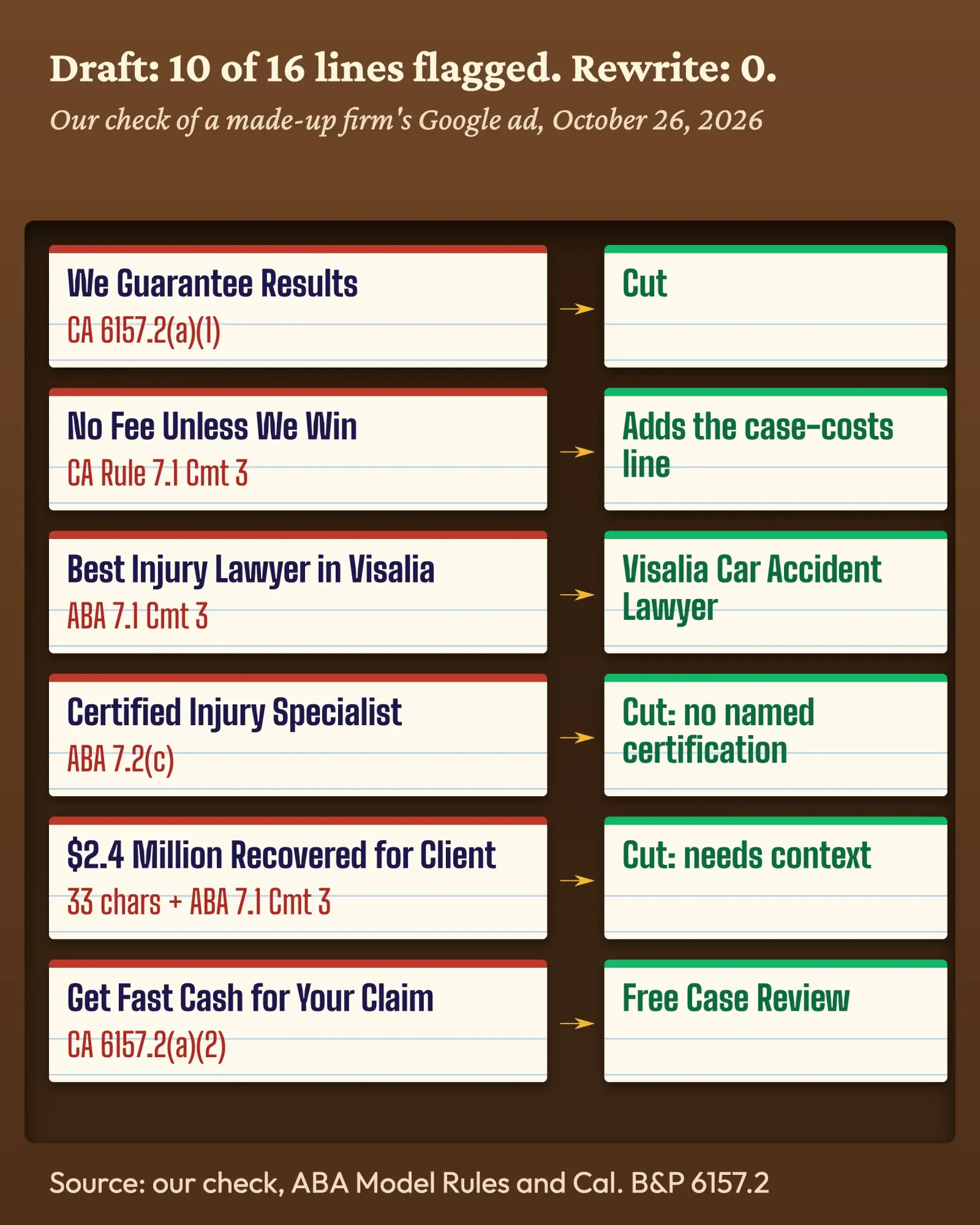 Diagram by DigitalTreed: our check of a made-up firm's draft ad, October 26, 2026. Rules: ABA Model Rules and California B&P 6157.2.
Five ways to waste less on legal clicks
Clean copy keeps you out of trouble with the bar. These five settings keep your budget from leaking.
- Add negative keywords. Google's negative keywords page puts it simply: "One key to a highly targeted campaign is choosing what not to target". Searches for law school, paralegal jobs or free legal aid rarely become clients.
- Target where you practice. Location targeting lets you pick between people in an area and people interested in it.
- Run ads when someone answers. Google's ad scheduling page suggests showing ads "during business hours when you are available to handle customer inquiries."
- Count calls, not clicks. Google can measure calls from ads by counting "calls that last longer than a minimum duration you set". Our call tracking guide and GA4 guide cover the rest.
- Fix the landing page. A slow page wastes the click you paid for, so test it in our page speed tool.
Paid search isn't your only option, either. Our list of free ways to advertise a small business covers the $0 side. For people who visited your site and didn't call, see our retargeting ads guide.
Frequently asked
How does Google bill a law firm for Local Services Ads?
It charges your card or bank account automatically. As of October 2026, Google's Local Services payment page says you're charged 30 days after your last payment or when you reach your payment threshold, whichever comes first. That threshold rises in steps each time you reach it within a 30-day period, up to a set maximum.
Can a law firm bid on another firm's name in Google Ads?
Google itself allows it as a keyword. As of October 2026, Google's trademark policy says it will not restrict trademarks used as keywords. It can restrict a trademark used in the ad text by a direct competitor. Your state bar may still have its own view, so check before you run it.
Do reviews affect where a Local Services Ad ranks?
Yes. As of October 2026, Google's Local Services ranking page lists your rating and number of reviews as part of profile quality. Average response time, high-quality images and the verification checks you've completed count too. Profile quality and your bid together set your position.
Questions to ask before you hire someone to run it
With the rules and the costs in view, hiring help gets easier to judge. Ask who owns the Google Ads account. It should be yours. Ask whether they'll show you every headline before it runs, so your firm can review it against your state's rules.
Ask how they count a lead: a click, a form, or a call that lasted long enough to matter. And ask what they'll change after the first two weeks, which is how long Google says Local Services bidding needs to show accurate results.
A good answer names a number you can check.
For a costed plan built around your firm's practice areas, request a quote from DigitalTreed.
Not legal advice: this guide quotes ethics rules and one state statute so you can read them yourself. It doesn't tell you whether a particular ad is allowed in your state. Rules differ by state, and they change. Before an ad runs, check it with your state bar's ethics resources or a lawyer who advises on professional responsibility.
How we made this guide: Quotes and figures were matched to their pages on October 26, 2026. We read the ABA Model Rules 7.1 to 7.3 with their Comments. Then came the State Bar of California's Chapter 7 rules and two sections of California's Business and Professions Code, copying every quote word for word. We read through more than 20 Google Ads and Local Services help pages signed out. Our hands-on part is the draft-ad check and the budget math above, both run on a made-up firm with scripts we wrote. Sources are linked inline where they're used.
We didn't open a Google Ads or Local Services account for this guide, so on-screen steps may look a little different. Every revision waits for approval from Aijaz Alam, whose byline this is.
First published October 2023. Rewritten October 26, 2026: the old post gave five general marketing tips. This version covers search ads and Local Services Ads for law firms, the Google Verified badge and what clicks and leads cost. It adds a worked budget, the ABA and California rules in their own words, and a tested before-and-after ad.
Sources
- Google Local Services Help: Getting started with Local Services Ads (United States)
- Google Local Services Help: About Google Verified badge
- Google blog: Google Verified makes it easier to find trusted local businesses (August 20, 2025)
- Google Local Services Help: Understand the screening and verification process
- Google Local Services Help: Business screening and verification requirements
- Google Local Services Help: How leads work
- Google Local Services Help: About Automated Local Services Ads lead credits
- Google Local Services Help: About ad rankings
- Google Local Services Help: How bidding works for Local Services Ads
- Google Local Services Help: How to edit your budget
- Google Ads Help: Actual cost-per-click (CPC)
- Google Ads Help: About Ad Rank
- Google Ads Help: About Quality Score for Search campaigns
- Google Ads Help: About average daily budgets
- Google Ads Help: Use Keyword Planner
- Google Ads Help: About negative keywords
- Google Ads Help: About targeting geographic locations
- Google Ads Help: About Ad Scheduling
- Google Ads Help: Measure calls from ads
- LocaliQ: Search Advertising Benchmarks, 2026 (vendor data, updated June 1, 2026)
- ABA Model Rule 7.1: Communications Concerning a Lawyer's Services
- ABA Model Rule 7.1: Comment
- ABA Model Rule 7.2: Communications Concerning a Lawyer's Services: Specific Rules
- ABA Model Rule 7.2: Comment
- ABA Model Rule 7.3: Solicitation of Clients
- ABA Model Rule 7.3: Comment
- State Bar of California: Rules of Professional Conduct, Chapter 7 (Rules 7.1 to 7.5)
- California Business and Professions Code section 6157.2
- California Business and Professions Code section 6159.1


Comments
No comments yet. Start the conversation below.