

Quick answer
SEO for law firms means getting your firm found when local people search for the legal help you offer. Start with an accurate Google Business Profile, one page per practice area, honest reviews and LegalService schema. Every claim must also pass your state bar's advertising rules.
Law firm SEO is mostly about trust. Google says that of its quality signals, trust is most important. Its systems give extra weight to that on topics that affect people's money or safety. Legal problems often affect both.
This guide is for solo lawyers and small US firms doing their own SEO. It covers each job in order, and the ad rules that limit each one. We read every rule quoted here on October 22, 2026.
Key takeaways
- Your Google Business Profile must use a real, staffed office. Google says a virtual office "isn't eligible for a Business Profile."
- Build one strong page per practice area. Cloned city pages can count as doorway pages under Google's spam rules.
- Your website is lawyer advertising. "Best," "specialist," "guaranteed" and settlement amounts all need care under your state's rules.
- You may ask every client for a review. You may not pay for one, ask only happy clients, or reveal client facts in a reply.
- Use LegalService schema. schema.org marks the older "Attorney" type as deprecated.
What is SEO for law firms?
Law firm SEO is the work that gets your firm's Google Business Profile and website in front of people searching for a lawyer near them. Think "divorce lawyer Tampa" or "how to contest a will in Florida." It covers your profile, practice pages, reviews, schema and links.
It differs from SEO for a coffee shop in one big way: almost everything you publish is lawyer advertising. The Comment on ABA Model Rule 7.1 says statements about a lawyer's services "must be truthful," and that even truthful statements can be misleading. So every step below has an ethics check built in.
New to SEO? Our SEO for beginners guide explains the basics in plain words first.
Key facts about law firm SEO
- Google says local results are "mainly based on relevance, distance, and popularity," per its local ranking tips (checked October 25, 2026).
- A virtual office "isn't eligible for a Business Profile," per Google's Business Profile guidelines as of October 2026.
- The FTC's consumer reviews rule, 16 CFR Part 465, took effect on October 21, 2024, per the eCFR.
- Google's local business markup guide says map coordinates need "at least 5 decimal places."
- The schema.org Attorney page says "This type is deprecated" and points to LegalService, as of October 2026.
Where does your firm stand on Google today?
Before you change anything, see what a client sees. Open a private browser window and search your main practice area plus your city, such as "estate planning lawyer Orlando." Write down what you find, so you can compare the same search again in 3 months.
- Note whether your firm shows in the map results and which firms rank above you.
- Click your own profile. Check the name, address, hours, phone and category.
- Open your website on a phone. Does it say clearly who you help, where and how to call?
Then run our free website audit on your homepage. It checks titles, speed, broken links and schema, and gives you a fix list. Our guide to running your first SEO audit explains what each result means.
If you later hire help, Google's own advice is to give an SEO only read access to Search Console at the audit stage. The same page warns: "No one can guarantee a #1 ranking on Google."
How should a law firm set up Google Business Profile?
A Google Business Profile is free, as of October 2026, per Google Business Profile. For local searches, it is often the first thing a client sees. Lawyers have their own rules here. Google limits how many profiles a firm and its lawyers may have, and where they may be based.
Google's guidelines for representing your business name lawyers as "individual practitioners." That changes how many profiles a firm can have:
- The firm gets one profile for each staffed office.
- Each public-facing lawyer may also have a profile in their own name. "Support staff should not create their own Business Profiles," Google says.
- A lawyer can't have one profile per practice area. Google says a practitioner "shouldn't have multiple Business Profiles" for their specializations. Real estate agents fall under the same practitioner rule; our local SEO guide for real estate agents shows each profile setup.
- A solo lawyer under a brand name uses one profile, named "[brand]: [lawyer name]."
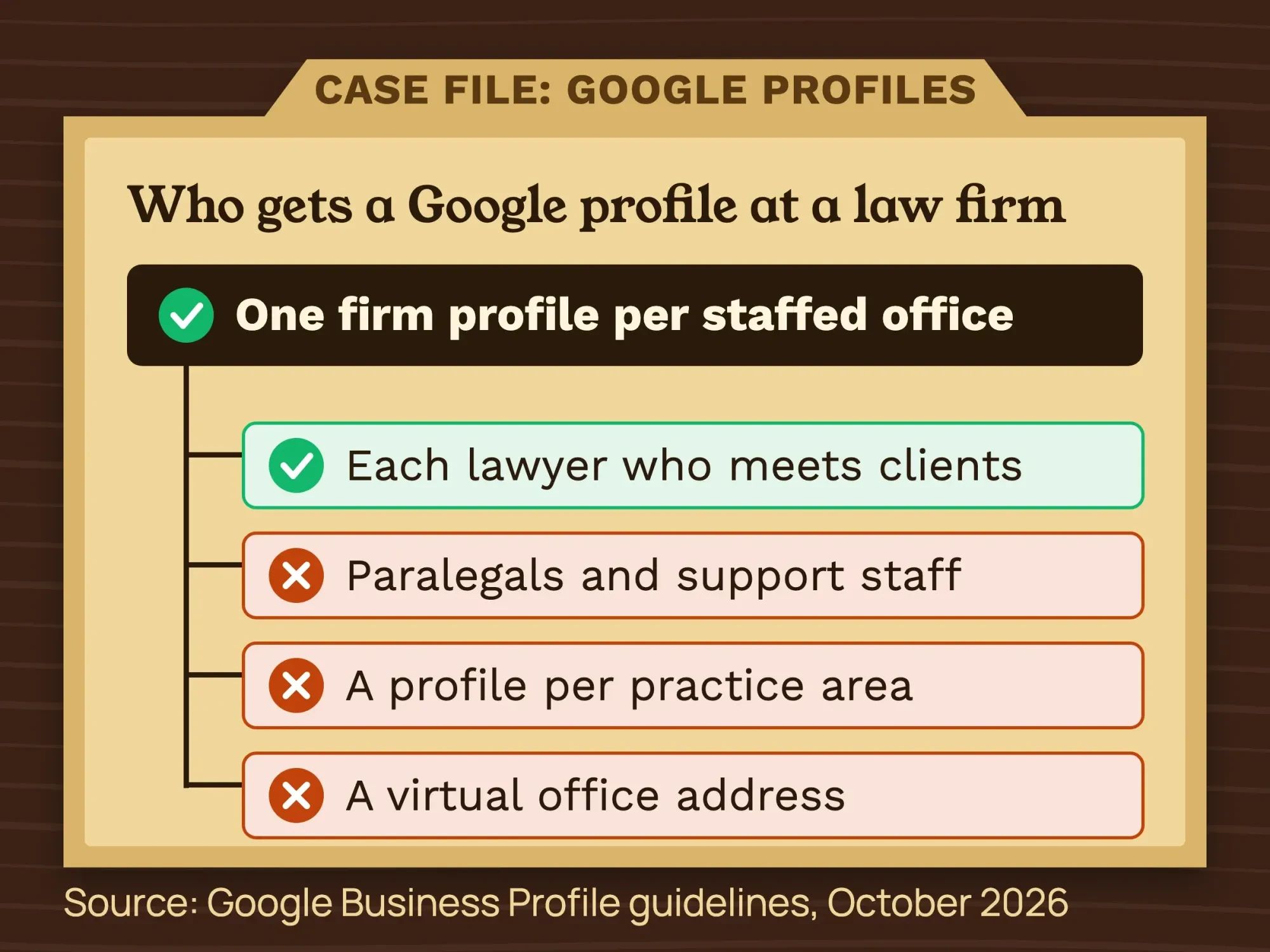 Diagram by DigitalTreed, based on Google Business Profile Help, "Guidelines for representing your business on Google," October 2026.
The address rules matter too. A virtual office is not eligible, and a co-working desk qualifies only with signage, staff and walk-in hours. The profile name must match your real-world name, so "Rivera Family Law | Divorce Lawyer Tampa" breaks the rules.
How does local SEO for lawyers work in the map results?
Google says local results are "mainly based on relevance, distance, and popularity," per its tips to improve your local ranking. Relevance is how well your profile matches the search. Distance is how far you are from the searcher. You can't change distance, so put your effort into relevance and the third factor below.
The third factor, which Google calls prominence, is how well known your firm is. Google says it uses "how many websites link to your business and how many reviews you have." It also says businesses with "complete and accurate info" are more likely to show up.
So fill in every field, and keep your firm name, address and phone the same everywhere they appear. That means your site, your bar directory listing and other directories. Google adds: "There's no way to request or pay for a better local ranking on Google."
For the setup steps, see our Google Business Profile optimization guide. For verification and suspension appeals, use our Google Business Profile guide. Our complete guide to local SEO explains how map rankings work.
What should each practice-area page include?
Build one page for each practice area you really handle. A family law firm might have pages for divorce, child custody, child support, alimony and prenups. One focused page gives Google a clear match for each search and answers a client's questions before they call.
Don't clone those pages for every nearby town. Google's spam policy on doorway abuse names "pages targeted at specific regions or cities that funnel users to one page" as one example. 20 pages that only swap the town name fit that description.
Each practice page should answer what a client wonders before calling:
- Who the page is for, in plain words ("parents in Hillsborough County dealing with custody").
- How the process works, step by step, and roughly how long each stage takes.
- How you charge, and what to bring to the first meeting.
- Local details you know firsthand, such as the county court that hears these cases.
- The name and contact details of the lawyer responsible for the page.
That last item is a rule, not a tip. Under ABA Model Rule 7.2(d), each communication "must include the name and contact information" of a lawyer or firm responsible for it. Add a short "general information, not legal advice" line to articles, too.
How do you find the keywords clients search?
Google's SEO Starter Guide says to "think about the words that a user might search for." Write each phrase the way a client would say it: the problem, the place and the word "lawyer." For the writing itself, follow our SEO content writing tips, built on Google's own checklist. A phrase like that tells you which page to write and what to call it.
- List each practice area with your city or county, such as "child custody lawyer Hillsborough County."
- Add the questions clients ask on the first call, such as "how long does a divorce take in Florida."
- Type each phrase into our free keyword suggestion tool. It shows what Google's autocomplete offers for it.
- Check search volume in Google Keyword Planner. Our Keyword Planner guide shows how to read its numbers.
- Give each main phrase one page, so 2 pages never compete for the same search.
Then put the phrase in the page title. Google says a good title "is unique to the page, clear and concise, and accurately describes the contents of the page." The same guide warns that keyword stuffing is against its spam policies.
What should a lawyer bio page show?
Bio pages show who stands behind your advice. Google's people-first content guidance asks: "Is it self-evident to your visitors who authored your content?" It also asks whether bylines lead to more about the author. For a law firm, that means a real bio for every lawyer who writes or appears on the site.
- Your bar admissions and the states where you are licensed, so a reader can check them on the state bar's site.
- Your practice areas, years in practice and a real photo.
- A byline on each article you write, linking back to your bio.
- Awards only with the group that gave them, and only if the claims rules below allow it.
Keep it accurate. Google calls "false credentials" a form of deception that makes a page untrustworthy. Your bar's advertising rules apply to bio pages, too. They cover social posts as well; our social media strategy guide lists the rules for lawyers and tax pros.
What can a law firm website claim under attorney advertising rules?
Less than most marketing copy. Lawyer advertising rules are set state by state. Many states base theirs on the ABA Model Rules, but the wording differs. ABA Model Rule 7.1 bars false or misleading communications about a lawyer's services. The version in each state where you're licensed is the one that binds you.
The Comment on Rule 7.1 warns that past results "may be misleading" if they create "an unjustified expectation" of the same outcome. It says a disclaimer may help.
Specialist claims have their own rule. Rule 7.2(c) bars implying a lawyer is "certified as a specialist" unless an approved or ABA-accredited body certified them, and that body is named.
Our claims check: 7 homepage phrases under Florida's rules
We used Florida's rules for our claims check because they are detailed and public. The Rules Regulating The Florida Bar, Chapter 4 (PDF, dated October 1, 2026) say websites "are treated the same as other advertising media." Our reading: each of the 7 phrases below needs proof, a disclosure or a rewrite to fit that text.
| Phrase on the site | What the rule says | Rule |
|---|---|---|
| "We win" or "Results guaranteed" | Can't be read as "a prediction or guaranty of success" | Florida 4-7.13(b)(1) |
| "$1.2M settlement" with no context | Past results only if "objectively verifiable" and the client consents; may create unjustified expectations | Florida 4-7.13(b)(2); ABA 7.1 Comment [3] |
| "Tampa's best divorce lawyer" | Words that characterize skill or reputation must be objectively verifiable | Florida 4-7.13(b)(3) |
| "Board certified specialist" | Name the certifying body; it must be approved or accredited | ABA 7.2(c); Florida 4-7.14(a)(4)-(5) |
| A paid "Top Lawyer" badge | The awarding group must be bona fide, with objective criteria | Florida 4-7.14(a)(3) |
| "No fee unless we win" | Must disclose all fees and expenses the client might owe | Florida 4-7.14(a)(7) |
| Practice areas you don't handle | Misleading if you don't practice or plan to practice there | Florida 4-7.13(b)(4) |
This table is our own check of 7 common homepage phrases against the rule text, read on October 22, 2026. It shows what the rules say, not whether a phrase is allowed in your state. In the picture below, a strike marks a claim Florida treats as misleading. The red notes show what the other claims need.
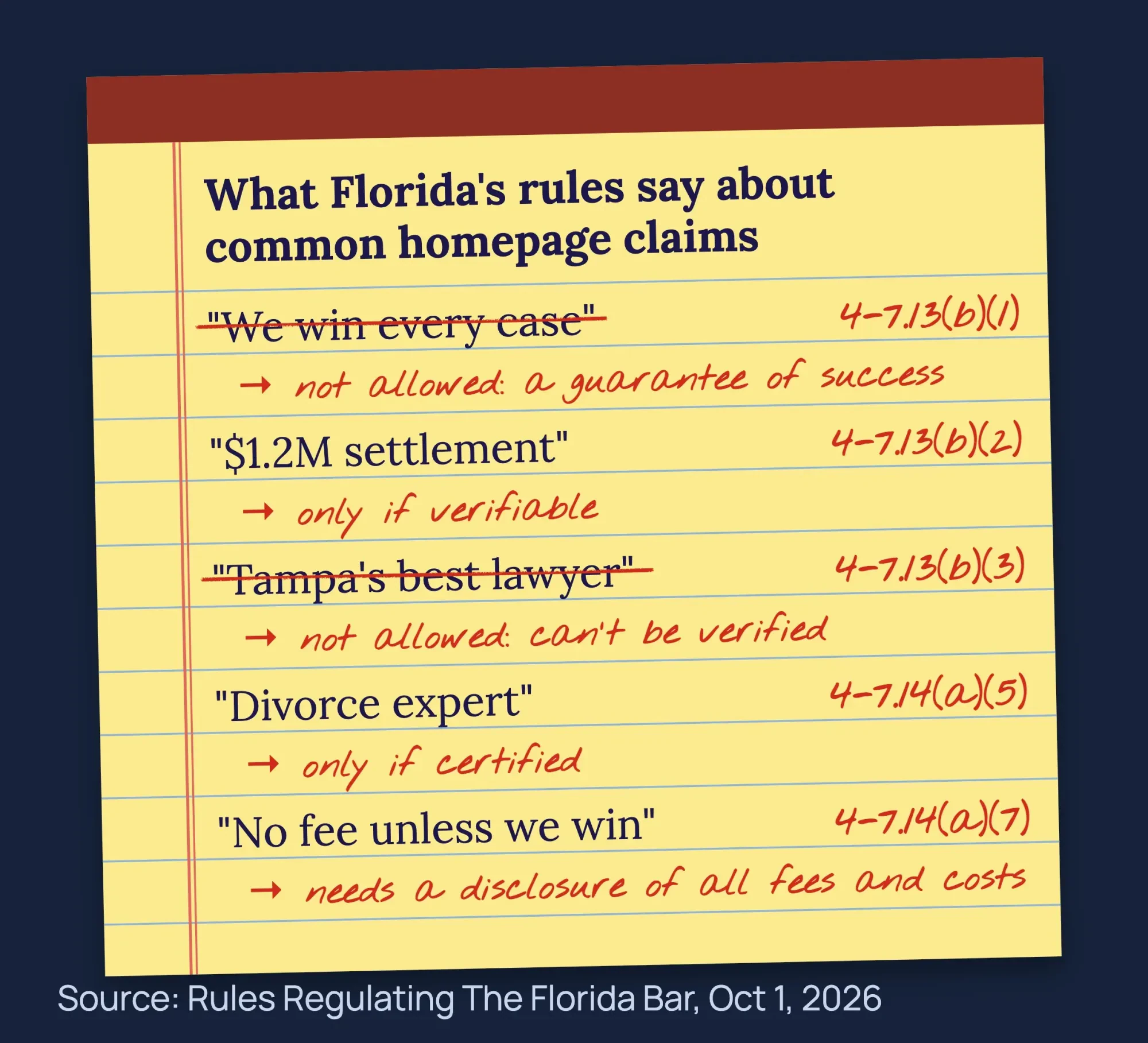 Illustration by DigitalTreed, based on Rules Regulating The Florida Bar 4-7.13 and 4-7.14 (October 1, 2026).
Some good news: under the ABA model, your website is not solicitation. The Comment on ABA Rule 7.3 says a website aimed at the general public is not one. Neither is a result "automatically generated in response to electronic searches."
Other states write their own versions. New York, for example, publishes its Rules of Professional Conduct (PDF). We could not open that file on October 22, 2026, so we don't summarize it here. Read your own state's rules before you publish.
Note
This is general information, not legal advice. Check your state bar's advertising rules or ethics hotline before you publish.
How do you get reviews without breaking the rules?
You can ask for reviews, and Google has a page of tips for getting reviews in its help center. The limits come from 3 places: Google, the FTC and your duty of confidentiality. The rules below cover who you ask, what you may offer and how you reply.
- Ask every client the same way. Google's Maps content policy bans offering "incentives" for reviews and asking only happy clients ("selectively solicit positive reviews").
- Give nothing for a review. The FTC's rule on consumer reviews, 16 CFR 465.4, bans incentives tied to reviews "expressing a particular sentiment."
- Keep staff out. Google's policy bans reviews based on "a conflict of interest," including "current or former employment."
- Never threaten a reviewer. Section 465.7 of the same rule bans groundless legal threats used to stop or remove a review.
The FTC announced the rule on August 14, 2024, and said it can seek civil penalties against violators. Florida adds its own testimonial rules, including a required disclaimer that a client "may not obtain the same or similar results."
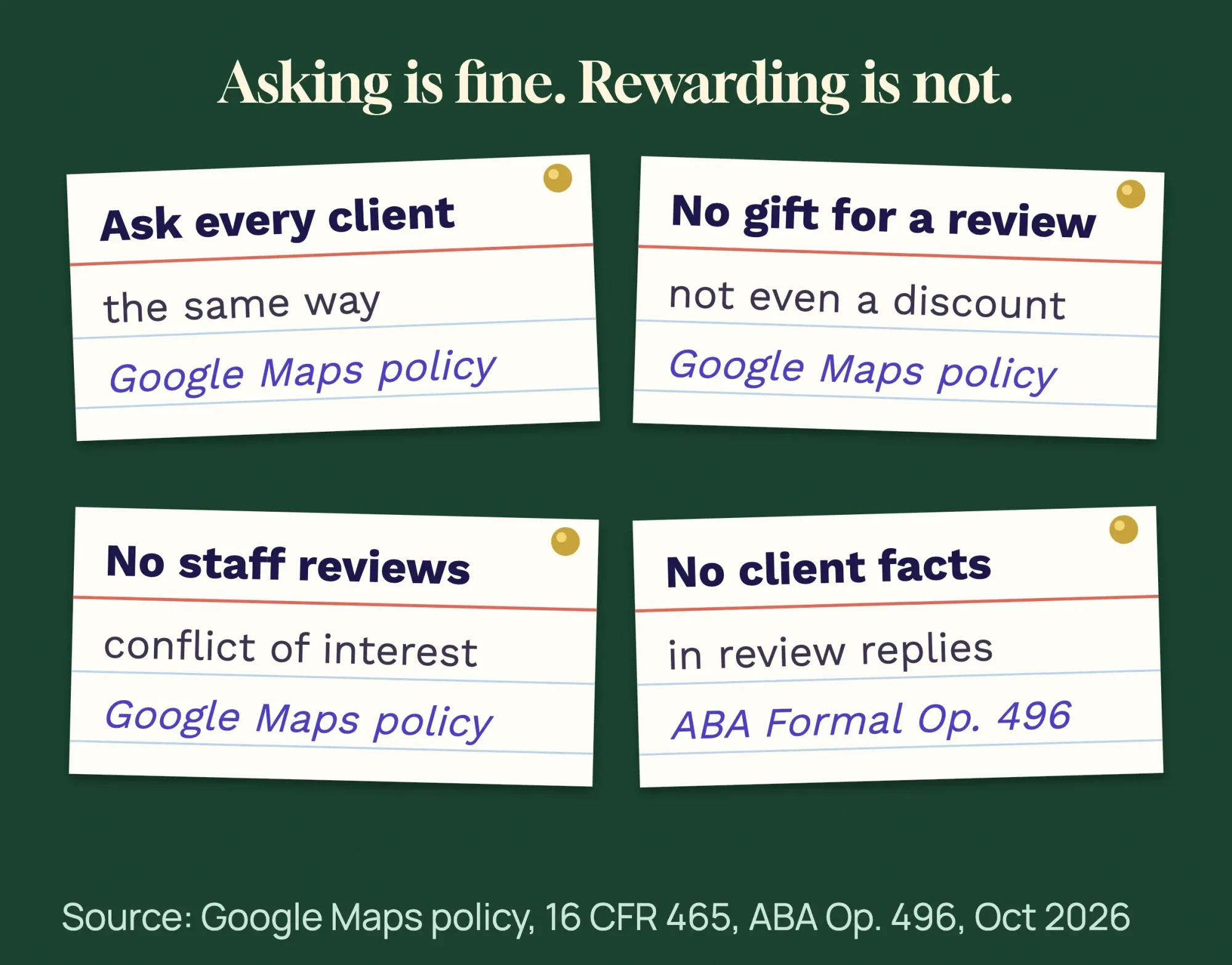 Diagram by DigitalTreed, based on Google's Maps content policy, 16 CFR Part 465 and ABA Formal Opinion 496, October 2026.
Replying is where lawyers get into trouble. ABA Formal Opinion 496 (PDF, January 13, 2021) says a negative review alone does not let you reveal client information. It even suggests lawyers "should consider ignoring a negative post."
If you do reply, keep it short and fact-free. For example: "We take all feedback seriously. Our duty of confidentiality means we can't discuss any matter online. Please call our office."
To make asking easy, create a Google review link with our free generator and send the same email to every client when a matter closes. Our guide to setting up automatic review requests shows how to do this without cherry-picking.
Which schema should a law firm use?
Use LegalService. Schema is code that tells Google facts about your firm, such as its name, address and hours. The schema.org vocabulary defines a LegalService as a business that provides "legally-oriented services, advice and representation, e.g. law firms." You add it once to your site's code for each office.
Older guides say to use "Attorney." The schema.org Attorney page now says: "This type is deprecated - LegalService is more inclusive and less ambiguous."
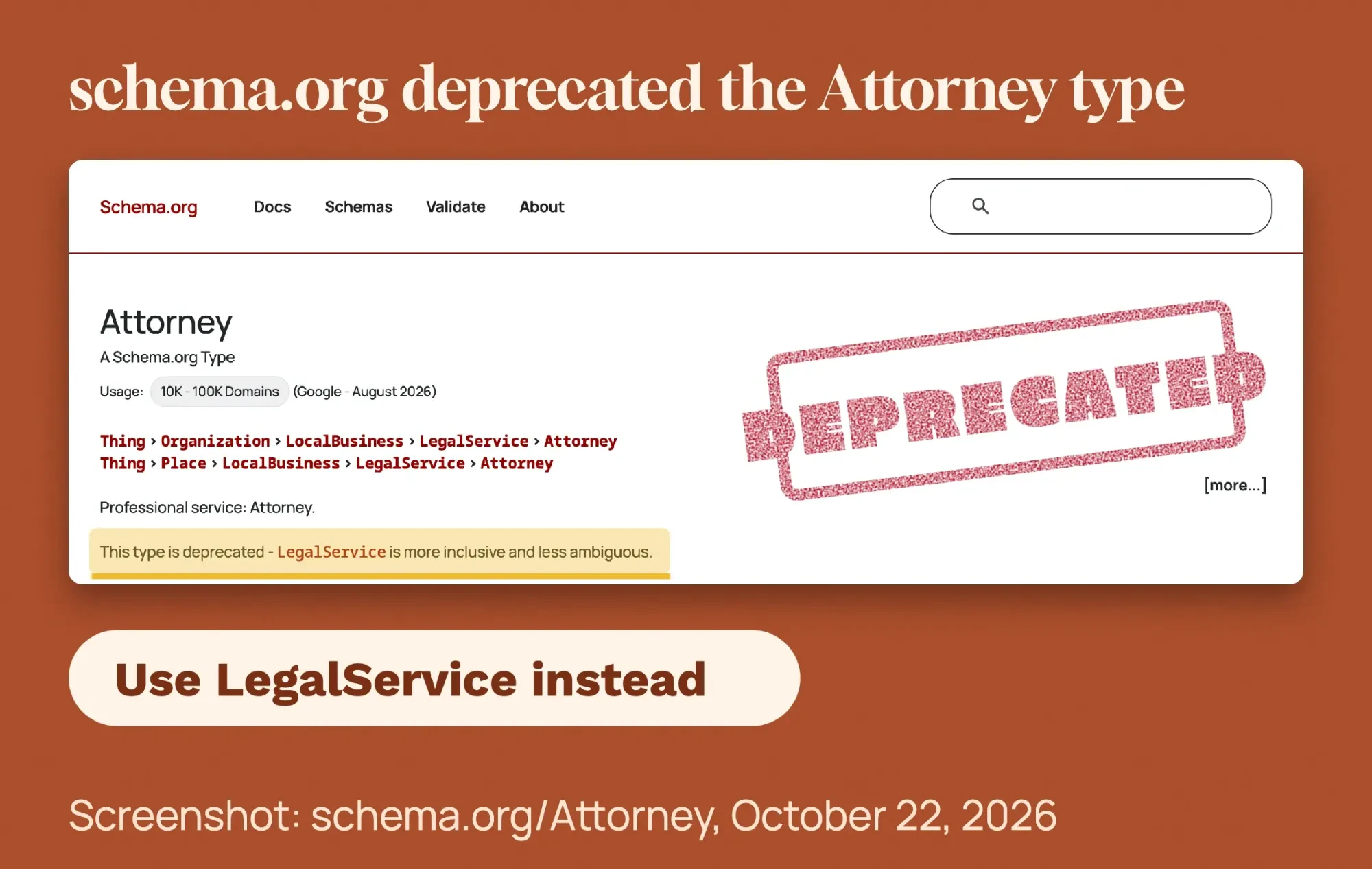 Annotated screenshot: schema.org, Attorney type page, October 22, 2026. The stamp is ours.
Here is a basic block for one office. Google's local business structured data guide requires a name and address, and asks for coordinates with "at least 5 decimal places."
<script type="application/ld+json">
{
  "@context": "https://schema.org",
  "@type": "LegalService",
  "name": "Rivera Family Law",
  "url": "https://www.example.com/",
  "telephone": "+1-813-555-0142",
  "address": {
    "@type": "PostalAddress",
    "streetAddress": "100 Example Blvd, Suite 200",
    "addressLocality": "Tampa",
    "addressRegion": "FL",
    "postalCode": "33602",
    "addressCountry": "US"
  },
  "geo": { "@type": "GeoCoordinates", "latitude": 27.94752, "longitude": -82.45843 },
  "openingHoursSpecification": [{
    "@type": "OpeningHoursSpecification",
    "dayOfWeek": ["Monday", "Tuesday", "Wednesday", "Thursday", "Friday"],
    "opens": "09:00",
    "closes": "17:00"
  }]
}
</script>
Leave out star ratings for your own reviews. Google shows review stars for local businesses only on sites that review other businesses, per its review snippet guidelines on "self-serving reviews."
After you add the code, test it with our free schema markup validator. Our Rich Results Test guide shows how to check it in Google's own tool, too.
Profiles, practice pages and schema take careful hours to get right. Want to hand them off? Our SEO service for small businesses covers local SEO, profiles, on-page work and technical fixes. It starts with a free audit. (DigitalTreed sells this service.)
On paying for help, the Comment on ABA Rule 7.2 says a lawyer may pay vendors such as "website designers" for marketing work. If you're hiring one, our guide on how to hire a web designer covers the contract and who owns the site.
Does a law firm website need technical SEO?
Yes, but only the basics for most small firms. Google's page experience guide gives a short self-check. It asks: "Do your pages have good Core Web Vitals?" It also asks whether pages are secure and display well on phones. Most of these are quick checks you can do yourself.
- Speed: Google says Core Web Vitals "are used by our ranking systems." A perfect score still doesn't guarantee a top spot.
- Security: every page loads over HTTPS. Search Console has an HTTPS report that shows what to fix.
- Phones: open each practice page on your own phone and check that it reads well.
- Pop-ups: Google's check also asks you to avoid "intrusive interstitials" that cover the main content.
Our PageSpeed Insights guide shows how to read your speed scores. For a full check of crawling and indexing, use our technical SEO audit checklist.
How do local links help a law firm?
Links from trusted local sites tell Google your firm is real and known in your area. Good sources are your state and county bar directories, local news, law school alumni pages and community groups you take part in. Keep your firm name, address and phone the same on each one.
Be careful with anything that looks like paying for a recommendation. Rule 7.2(b) says a lawyer "shall not compensate, give or promise anything of value to a person for recommending the lawyer's services," with listed exceptions. Paid directory listings are one of the costs its Comment allows.
For the basics, see our guides to what a backlink is and the off-page SEO checklist. Paid search ads are a separate topic, covered in our post on legal advertising and lead generation.
How do you know if law firm SEO is working?
Track 3 things each month: searches, calls and cases. Clicks alone don't bring in cases. Searches show you're found, calls show a page worked, and signed cases show the work paid off. Check all 3 on the same day each month.
- Google Search Console shows which searches bring people to your site. Our Google Search Console guide walks through setup.
- Your Business Profile's performance view shows calls, website clicks and direction requests.
- Your intake form or call log shows how each new client found you. Ask on the first call.
Sharing links in emails or bar newsletters? Tag them with our free UTM builder. Each one then shows up as its own source in your analytics.
Example: a 2-lawyer family law firm in Tampa
Example: Rivera Family Law is a made-up firm with 2 lawyers and 1 paralegal in one staffed Tampa office. All names and numbers here are invented.
- Profile: one firm profile named "Rivera Family Law." Each lawyer adds a practitioner profile; the paralegal does not.
- Pages: 5 practice pages, each naming the responsible lawyer and the Hillsborough County court details. No clone pages for Brandon or Clearwater.
- Claims: the homepage swaps "Tampa's best divorce lawyer" for "Divorce and custody cases in Hillsborough County since 2014." A settlement figure comes down until the firm checks it with The Florida Bar.
- Reviews: every client gets the same email with the review link when a matter closes. Replies never mention a case.
- Schema: one LegalService block, tested, with no star ratings.
None of this needs new software. It is mostly careful writing and a weekly hour on the profile and reviews.
Should you do law firm SEO yourself or hire help?
Many small firms can start alone. Google's page on whether you need an SEO says: "If you run a small local business, you can probably do much of the work yourself." Hire help when the weekly work takes more hours than you can spare. Our guide to digital marketing agency cost shows what US agencies charge and what to ask before you sign.
If you hire help, Google suggests asking questions like these:
- "Can you show me examples of your previous work and share some success stories?"
- "What kind of results do you expect to see, and in what timeframe? How do you measure your success?"
- "What's your experience in my industry?"
- Will you share every change you make to my site, and explain why?
Walk away from anyone who guarantees rankings or claims a "special relationship" with Google, as the same page warns. It adds: "Ultimately, you are responsible for the actions of any companies you hire." Under the bar rules above, your website is your advertising. So you answer for every claim a vendor writes on it.
Common law firm SEO mistakes
- One Business Profile per practice area, or one at a virtual office.
- Keywords stuffed into the profile name.
- Dozens of city pages with only the town name changed.
- "Specialist," "expert" or "best" with no certifier or proof.
- Settlement amounts with no context or disclaimer.
- Thanking a reviewer by mentioning their case.
- A discount or gift card for reviews, or staff reviewing the firm.
- Hiring an SEO firm that guarantees a #1 ranking.
Frequently asked
Is SEO worth it for a small law firm?
Our take: yes, if people in your area search for your practice area. Firms that get nearly all their work by referral need less, but every firm needs an accurate profile and clear practice pages.
How much does law firm SEO cost?
The basics can cost $0. A Google Business Profile is free as of October 2026, and so are our audit and schema tools. Agency prices vary widely, so ask for a written scope before you sign anything.
How long does SEO take for a law firm?
Our take: expect months, not weeks. Google says no one can guarantee a #1 ranking, so be wary of anyone who promises one.
Can a lawyer reply to a bad Google review?
Yes, but reveal nothing about the client or the matter. ABA Formal Opinion 496 says a negative review alone does not allow disclosure, and suggests considering no reply at all.
Does a law firm need special SEO for AI Overviews?
No. In its guide to AI features, Google says "there are no additional requirements to appear in AI Overviews or AI Mode." The same SEO basics apply. Keep your Business Profile up to date, too.
Do I need a disclaimer on my law firm website?
Many states require specific disclaimers for results or testimonials. Florida, for example, requires one on testimonials. This is general information, not legal advice; check your state bar's rules and an ethics attorney.
Your next step
This week, search your main practice area and city in a private window. Then fix your Business Profile name, address and category first.
Want someone to handle the rest? Our search engine optimization service starts with a free audit. Terms are agreed in writing before work begins.
How we made this guide: we built it from the rule texts themselves. Our sources are ABA Model Rules 7.1 and 7.2 and the Comments on Rules 7.1 to 7.3. We also read ABA Formal Opinion 496, Florida Bar Chapter 4, 16 CFR Part 465 and Google's help pages. We checked every quote and date against its source on October 22, 2026. The claims table and the schema.org screenshot are our own work from that day. The New York rules were behind a bot check, so we don't summarize them.
First published October 2025. Rewritten October 22, 2026: profile rules for lawyers, a claims check against ABA and Florida rules, review rules, LegalService schema and a worked example. Updated October 23, 2026: added local ranking factors, keyword research, bio pages, technical basics, hiring help and an AI Overviews FAQ. Updated October 25, 2026: added 5 sourced facts, direct answers under each question and a label for our claims check.
Sources
- ABA Model Rule 7.1: Communications Concerning a Lawyer's Services
- ABA: Comment on Rule 7.1
- ABA Model Rule 7.2: Communications Concerning a Lawyer's Services: Specific Rules
- ABA: Comment on Rule 7.2
- ABA: Comment on Rule 7.3, Solicitation of Clients
- ABA Formal Opinion 496, Responding to Online Criticism, January 13, 2021 (PDF)
- Rules Regulating The Florida Bar, Chapter 4, October 1, 2026 (PDF)
- New York Rules of Professional Conduct (PDF)
- eCFR: 16 CFR Part 465, Rule on the Use of Consumer Reviews and Testimonials
- FTC: Final rule banning fake reviews and testimonials, August 14, 2024
- Google Business Profile Help: Guidelines for representing your business on Google
- Google: Business Profile
- Google Maps: Prohibited and restricted content
- Google Business Profile Help: Tips to get more reviews
- Google Search Central: Creating helpful, reliable, people-first content
- Google Search Central: Spam policies, doorway abuse
- Google Search Central: Local business structured data
- Google Search Central: Review snippet structured data
- Google Search Central: Do you need an SEO?
- Google Business Profile Help: Tips to improve your local ranking on Google
- Google Search Central: SEO Starter Guide
- Google Search Central: Understanding page experience
- Google Search Central: AI features and your website
- schema.org: LegalService
- schema.org: Attorney

Comments
No comments yet. Start the conversation below.