

Quick answer
Does my business need a website? For most US small businesses, yes. In BrightLocal’s 2026 consumer survey (vendor data), 54% said they check a business’s website after reading positive reviews. It doesn’t have to be this month. If you’re local, booked by referrals and not hiring or selling online, a Google Business Profile can carry you for a while.
You've got a Facebook Page, maybe a Google Business Profile with a few dozen reviews, and the phone rings often enough. So does your business need a website, or is that just something web designers say?
We should say up front that we're paid to build websites. Read our yes with that bias in view.
Here's the honest version: when a site can wait, when it can't, what one costs to run, and the two legal basics that come with it.
We've also left out the scary statistics that float around this topic. Several of the popular ones don't trace back to any study we could find.
Key takeaways
- Most businesses need a website, because customers look you up before they call.
- A site can wait only if all five lines of our test are true.
- Register the domain in your own name now, whatever you decide.
- A basic site costs about $240 a year to run on a builder.
- A contact form brings privacy rules, and the ADA covers public-facing businesses.
Most businesses need one, but not all of them this month
Most businesses need a website because customers look you up before they call, and nearly all of them have the means. Pew Research Center’s 2026 fact sheet says 97% of US adults use the internet, and its mobile fact sheet puts smartphone ownership at 91%.
Reviews usually start the check, and the website often finishes it. BrightLocal's Local Consumer Review Survey, run with a panel of 1,002 US adults and published in February 2026, found that 97% read reviews for local businesses. After reading positive ones, 54% go on to the business's website. BrightLocal sells review software, so treat the exact figure with some care.
Still, the direction is hard to argue with: a good review makes people curious, and curious people click.
Timing is the other half of the answer.
A site you can't keep current, on a domain someone else registered, can hurt more than having none. And if you're fully booked and planning no changes, the next section may describe you exactly.
You can wait if all five of these are true
So a website can wait when your work comes from a small area, by word of mouth, and nobody needs more from you than hours and a phone number. This is the test we'd use. It's our judgment, built on Google's and Meta's own rules covered below, and every line has to be true:
- You serve one town or a small area, and most jobs come from referrals or walk-ins.
- You qualify for a Google Business Profile: you have a storefront, or you travel to customers.
- Customers only need your hours, phone, directions, photos and reviews.
- You don't take bookings, orders or payments online, and you aren't hiring.
- You don't run ads that need a page of your own to land on.
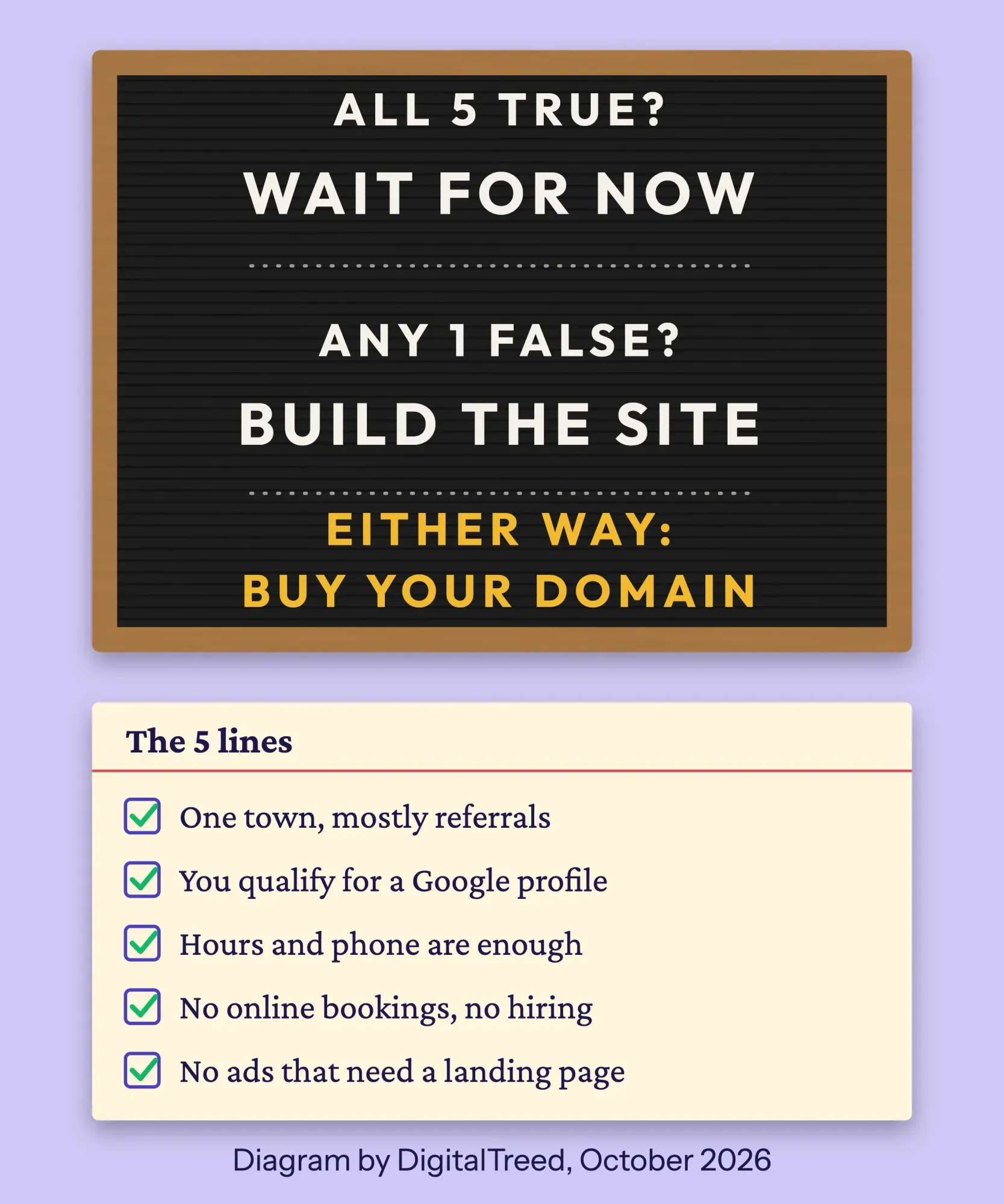 Diagram by DigitalTreed: our five-line test, October 2026.
If that's you, skip the website for now, but buy the domain. The U.S. Small Business Administration's marketing guide says that once you register a domain, "no one else can use it for as long as you continue to own it." A .com cost $11.08 a year at Porkbun as of October 24, 2026.
That's cheap insurance for your name.
Our take: register the domain this week, whatever you decide, and build the site on the day any line above stops being true. That day tends to arrive with a first hire or a first online deposit, so look at the list again every January.
Is a Google Business Profile enough without a website?
That test leans on a Google Business Profile, the free listing that shows your hours, reviews and map pin in Google Search and Maps. It costs nothing, and it can carry a small local business a long way. It still has limits, and Google's own help pages spell them out.
The first limit is who can have one. Google's guidelines for representing your business say a business that rents a mailing address it doesn't operate from, "also known as a virtual office," isn't eligible. A business without a storefront that travels to customers gets one service-area profile and should hide its address.
So an online-only business, like a remote bookkeeper who never meets clients, may have no profile to fall back on.
The second is room. Google's help page on editing your profile says you can share your website there, and some categories can add links for online orders, reservations or appointments. Those links have to point somewhere.
A profile can't hold your privacy policy, your terms or a job application form.
The third is ranking. Google's local ranking tips list what local results are "mainly based on": relevance, distance and popularity. The same page calls that last factor prominence and says it draws on "how many websites link to your business." A website gives your chamber of commerce, your suppliers and the local paper an obvious place to link.
| What you need | Google Business Profile | Facebook or Instagram Page | Your own website |
|---|---|---|---|
| Show hours, phone and reviews | Yes | Yes | Yes, if you add them |
| Open to an online-only business | Often not (eligibility rules) | Yes | Yes |
| Take bookings or payments | Through links you add | Some tools, under Meta's terms | Yes, with the tool you pick |
| Hold a privacy policy and terms | No | No | Yes |
| Who sets the rules | Meta | You, within your host's terms | |
| Yearly cost | Free | Free | About $240 on a builder (Oct 2026) |
Whichever way you go, set the profile up properly. Our guide to optimizing a Google Business Profile walks through every field, and our free Google Business Profile course covers setup from scratch.
A Facebook Page lives under Meta's terms
Unlike a profile, a Facebook Page is open to almost any business. It's good at photos, events and quick messages, and many owners treat it as their website. In BrightLocal’s 2025 survey of US small and mid-size business owners and managers (vendor data, sample size not published), 50% said they use Facebook, while only 40% said they have a dedicated website.
Here's the catch: you don't own it. Meta’s Terms of Service say the company can "suspend or disable your account" for conduct that breaks its rules. It may also disable an account when it thinks someone else got in and it can't confirm who the owner is. Your Page hangs off those personal accounts.
We're not saying Meta will shut you down.
But if one hacked login could take away the only place customers find you, that's a single point of failure. Add a second admin to the Page today, whatever you decide about a website.
Any one of these means a website is worth building now
So a website stops being optional the moment you need something a profile or a Page can't do. One of these is enough:
- You don't qualify for a Business Profile, because you work online only or from a virtual office.
- You take bookings, deposits or quote requests and want them in one place you control.
- You're hiring, and applicants want to see who you are first.
- You run paid ads and need a page you can change and measure.
- Your buyers check licenses, insurance or past work before they call, as they do with contractors, clinics and law firms.
- You want to come up when people ask AI tools for a recommendation.
That last one is new and growing fast. BrightLocal's 2026 survey found that 45% of consumers had used ChatGPT or other generative AI tools for local recommendations, up from 6% the year before. Those tools read web pages. A site that lists your services, area and prices in plain text gives them something to read.
Retail is its own case. The Census Bureau's latest published figures, released August 18, 2026, put e-commerce at 17.1% of US retail sales in the second quarter of 2026, with revised estimates due November 19, 2026. Most retail still happens in person. If your customers buy at the counter, a site that shows what's in stock and when you're open may beat a full online store.
We built a made-up lawn crew's page and tested it
Those triggers are easier to see on a real page, so we made one.
Example: Sandhill Lawn & Snow is a made-up two-person lawn care and snow removal crew in Omaha, Nebraska. It runs on a Facebook Page and a service-area profile, and the owner wants commercial snow contracts plus a third worker. Put it through the five-line test and it fails twice, on hiring and on buyers who check insurance.
It needs a site, then.
Our test date was October 24, 2026. We wrote three versions of its home page as plain HTML files on our own computer. Then we ran each one through the server code behind our Schema Markup Validator, using its paste option. Schema is a hidden block of code that tells search engines your business name, address and phone in a format they can read.
The first version looked like a rushed launch: the title "Home," no description and no schema. Our validator found no JSON-LD block at all, so there was nothing to check. The second added a description and a LocalBusiness block with only the name and phone, and it got 1 issue under "Missing required fields": address.
Version three added the city, state, ZIP and country, plus a service area and web address, and passed as "Valid," with 0 issues.
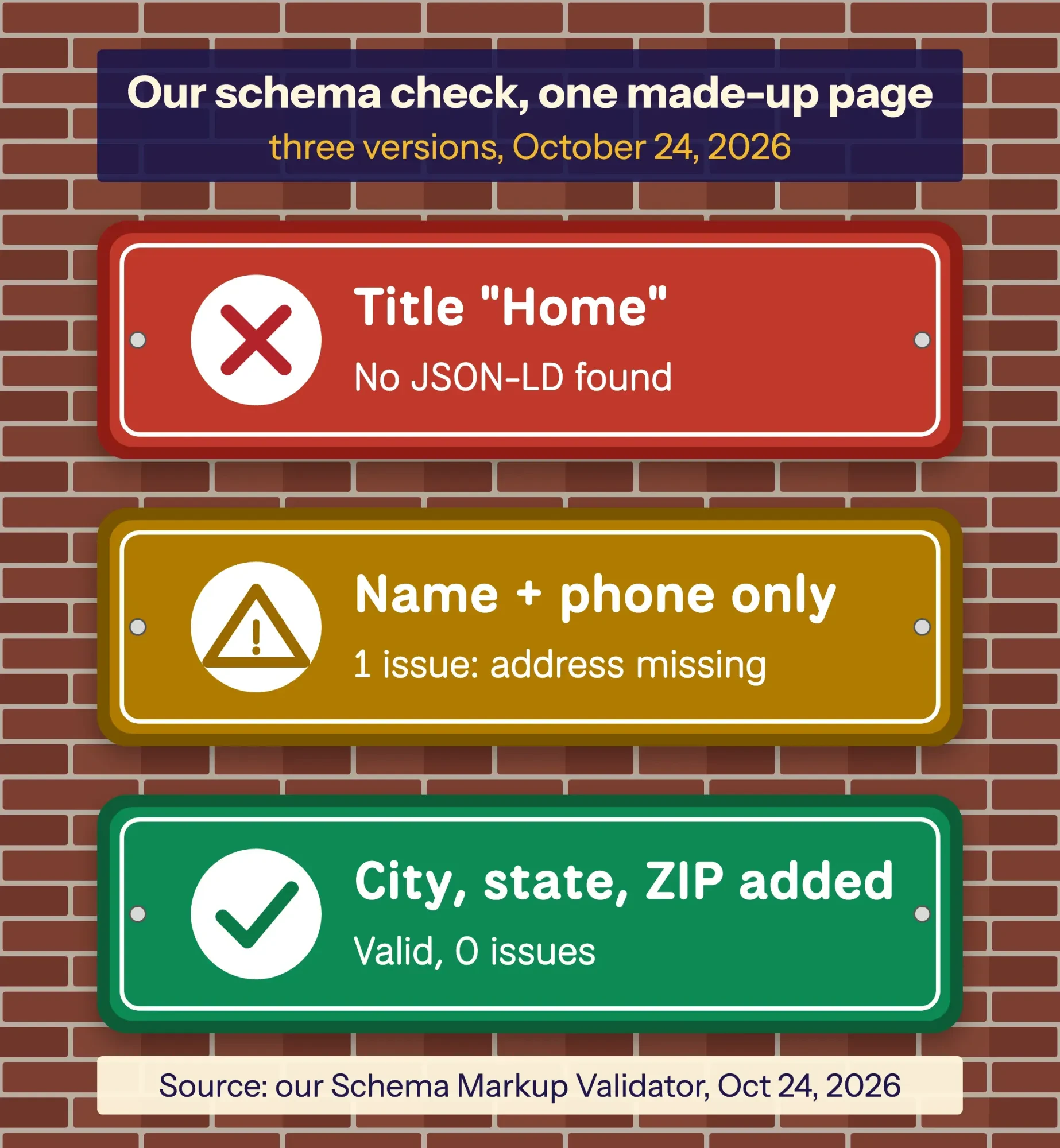 Diagram by DigitalTreed: our test of a made-up business page, October 24, 2026.
It lines up with Google’s LocalBusiness documentation, which lists two required properties, address and name, and treats the phone number as recommended. We left out the street address, since a crew that travels to customers hides its street address on its profile anyway.
One tool sat this out. Our Meta Tag Analyzer refused both localhost and our local dev address with "That host is not allowed." The guard is there on purpose, so nobody can point a public tool at private servers, and we left it alone.
Its first title ran past our 600 px desktop preview
The schema fix was quick. The title took more thought, because the crew's first proper title didn't fit. We measured each title with the same code our SERP Snippet Preview runs in your browser: Arial at 20 px in a 600 px column. Those limits are our own measurements of Google's results page, last checked October 20, 2026.
Google doesn't publish them.
Our first try, "Lawn Care and Snow Removal in Omaha, NE | Sandhill Lawn & Snow," measured 622 px. That's 22 px too wide, so the preview cut it on desktop. We moved the city to the front and dropped "NE" and "and." The new title, "Omaha Lawn Care & Snow Removal | Sandhill Lawn & Snow," came in at 542 px and fit. The 127-character description fit on desktop and mobile.
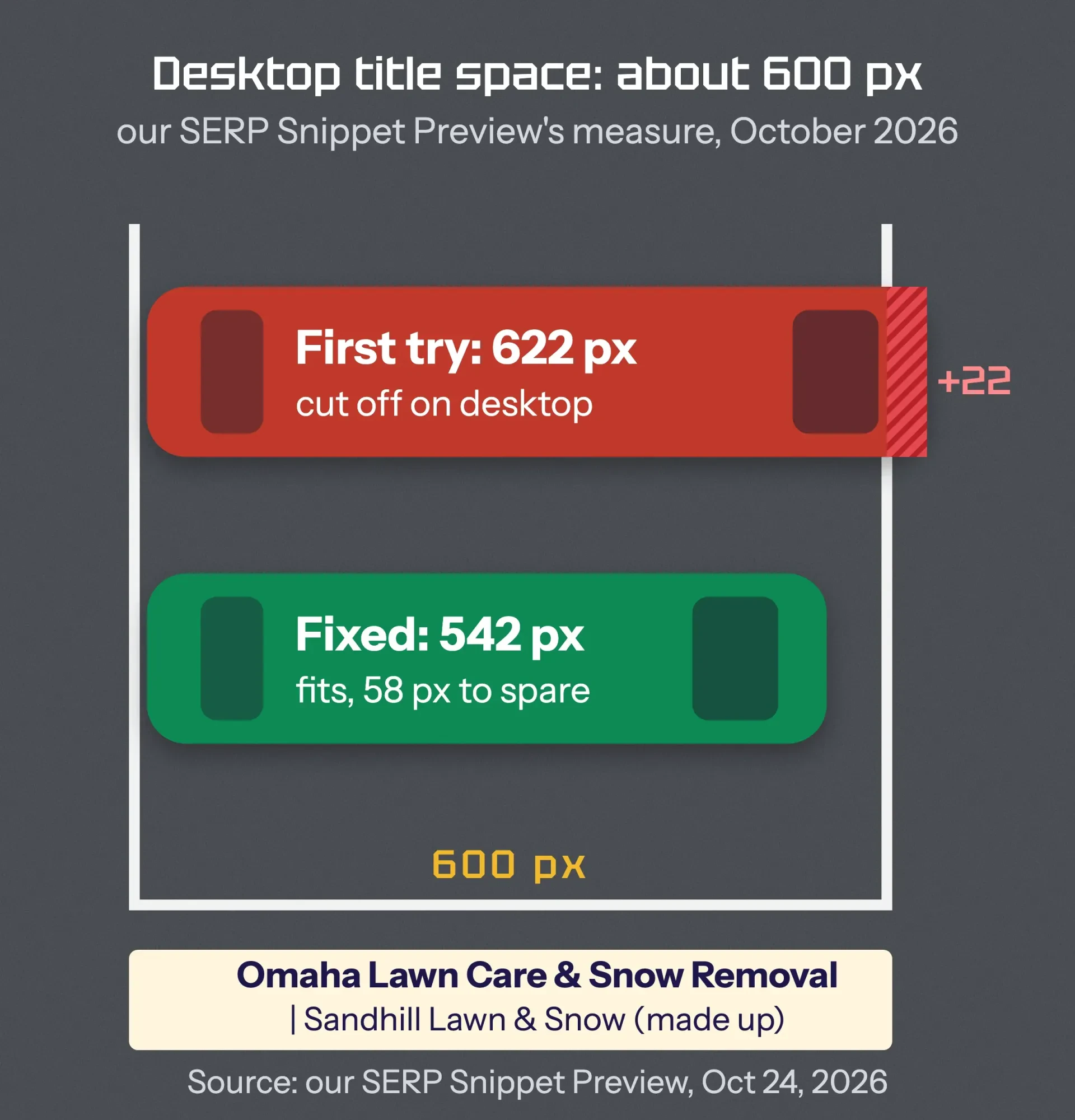 Diagram by DigitalTreed: title widths from our SERP Snippet Preview code, October 24, 2026.
Pixels aren't the bigger lesson. A page called "Home" tells nobody what you do, and fixing that took two edits.
What a basic site costs to run, as of October 2026
Once the page reads well, the bill is the next question. A basic small-business site costs about $240 a year to run on a website builder as of October 2026, before your own time. Here's that math with prices we read ourselves.
Start with the domain: $11.08 a year for a .com at Porkbun, as of October 24, 2026. Check the renewal price on other endings, because they differ: a .co there cost $15.76 to register but $31.20 to renew.
A builder plan covers the rest. When we checked Squarespace’s pricing for our no-code vs custom development comparison in October 2026, its Basic plan was $19 a month on yearly billing, or $25 paid month to month. That's $228 a year, and annual plans include the first year of a domain.
Keep a separate .com at Porkbun and your year comes to $239.08 at October 2026 prices.
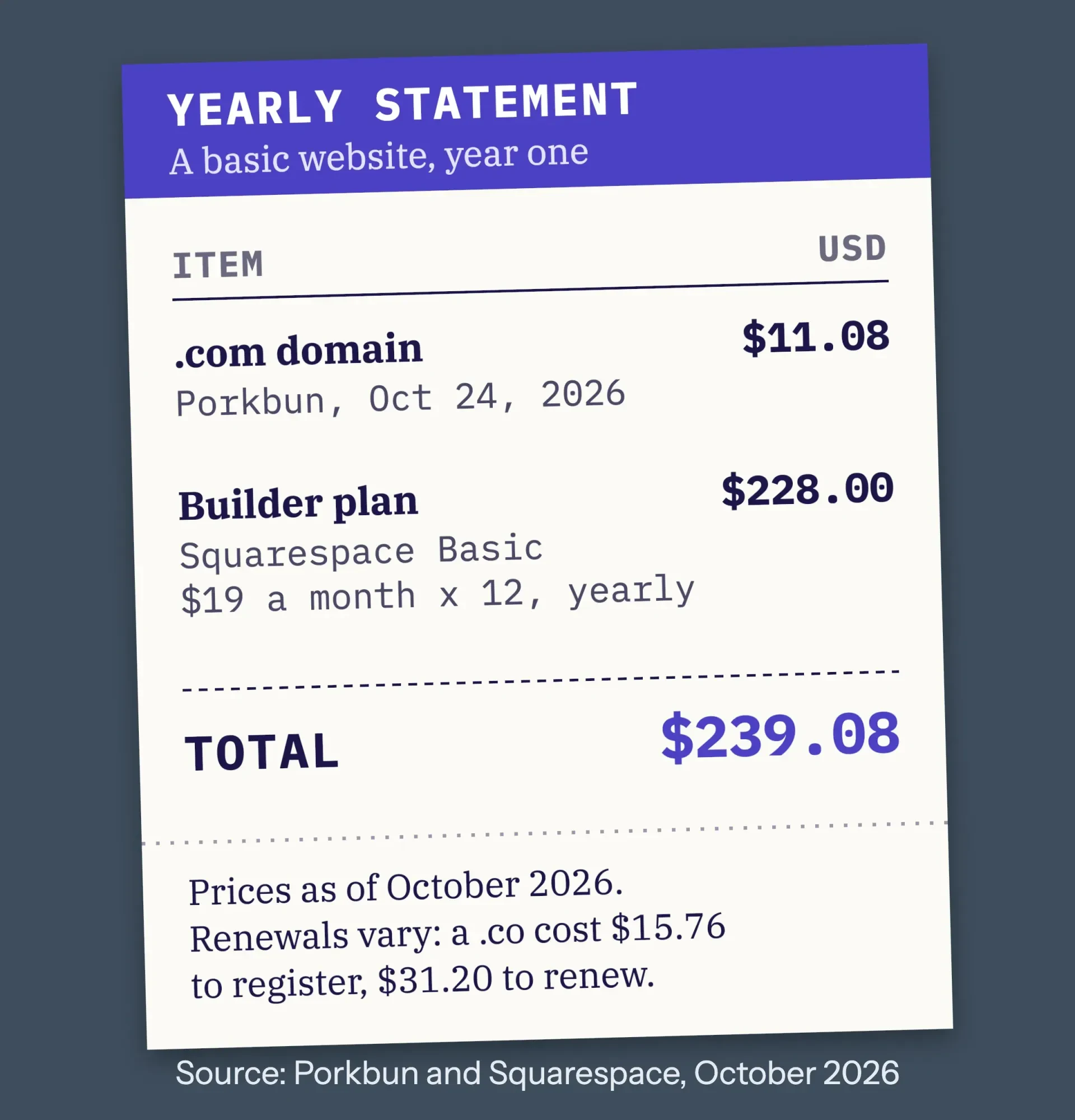 Source: Porkbun and Squarespace pricing pages, October 2026. Our math.
Doing it yourself on WordPress can cost less in year one. Hiring someone costs more up front, and the website designer hiring guide on our blog covers those prices and why the domain must be in your name, not theirs.
Your own hours are the cost nobody quotes you.
Two legal basics come with your first contact form
That $239 covers the site, but a contact form brings privacy rules with it, because it collects names and email addresses. The California Attorney General's CalOPPA guide says the law covers operators of commercial websites that collect personally identifiable information about Californians. It requires them "to conspicuously post a privacy policy and to comply with it."
Even a Nebraska crew could fall under it once Californians fill in its quote form.
Accessibility is the other basic. The Justice Department's web accessibility guidance says the ADA applies to "businesses that are open to the public," which must give people with disabilities full and equal enjoyment of their goods and services. Our WordPress website guide covers both topics in more depth.
This section isn't legal advice: we're web builders, not attorneys. Use it to find the rules, and talk to a lawyer licensed in your state if your site will collect health, payment or children's data.
Frequently asked
Is a free website builder plan good enough for a business?
It works for a test, not for a real launch. As of October 2026, Wix's plans page says a free site uses a username.wixsite.com address. A Premium plan is needed to connect your own domain and remove Wix branding. Customers trust your own .com more than a builder's subdomain.
Does a small business website need HTTPS?
Yes. Without it, Chrome can show a Not secure symbol next to your address. Chrome's help page also says visitors who turn on Always use secure connections get a warning on sites without HTTPS, as of October 2026. Ask your builder or host to confirm a certificate is switched on.
Can customers message me from my Google Business Profile?
Yes, once the profile is claimed and verified. As of October 2026, Google's help page on editing your profile says verified businesses can add a WhatsApp or text messaging option. That covers quick questions, but bookings and quote forms still need a page you control.
Start with five pages and your own domain
If you've decided to build, a first site needs five pages, not fifty. This is the order we'd follow:
- Register the domain in your own name, under your own login.
- Claim or finish the Business Profile on Google, if you qualify.
- Search your business name and "your service + your town" on your phone, and note what shows up.
- Build five pages: home, services with prices or "from" prices, about, contact or booking, and a privacy policy.
- Add the site's address to your profile and to every social bio.
- Run the live site through the free website audit tool on our site and fix the red items first.
Hiring someone to build it? Our website development process guide shows each stage and what you sign off along the way.
Once the site is live, getting found nearby is the next job. Our complete guide to local SEO starts there, and SEO for beginners explains how Google reads a site.
Want it built for you? Our developers build small-business sites like this one. We charge for that work, which is one more reason the five-line test comes first.
How we made this guide: our team did the reading for this guide on Saturday, October 24, 2026. That meant Google's Business Profile help pages and LocalBusiness documentation, Meta's terms and the SBA's marketing guide. It also meant the Census Bureau's quarterly e-commerce release, Pew Research Center's 2026 fact sheets, both BrightLocal surveys, the California Attorney General's CalOPPA guide and the Justice Department's ADA guidance. The lawn crew test ran the same day on files on our own computer, with our validator's server code and our snippet preview's measuring code, and no real business or listing was involved. Each fact links to its source where it appears. Aijaz Alam reads and approves the rewrite before it goes live.
First published April 2020. Rewritten in full October 24, 2026: new text on when a business needs a website and when it can wait, Google's and Meta's own rules, dated costs, two legal basics and our own page test.
Sources
- Pew Research Center: Internet, Broadband Fact Sheet (2026)
- Pew Research Center: Mobile Fact Sheet (2026)
- BrightLocal: Local Consumer Review Survey 2026 (vendor data)
- BrightLocal: SMB Marketing 2025 (vendor data)
- U.S. Small Business Administration: Marketing and sales
- Porkbun: Domain pricing
- Google Business Profile Help: Guidelines for representing your business on Google
- Google Business Profile Help: Edit your Business Profile
- Google Business Profile Help: Tips to improve your local ranking on Google
- Meta: Terms of Service
- U.S. Census Bureau: Quarterly Retail E-Commerce Sales, 2nd quarter 2026
- Google Search Central: Local business structured data
- Squarespace: Pricing
- California Attorney General: Making Your Privacy Practices Public (CalOPPA guide)
- U.S. Department of Justice: Guidance on Web Accessibility and the ADA
Comments
No comments yet. Start the conversation below.