

Quick answer
Here's how to hire a web designer: write a one-page brief, get 3 written quotes for that same brief, and check portfolios and references. Ask who owns the domain, code and design. Sign a contract with milestones and a written copyright transfer. Hold the final payment until the finished site passes your own checks.
Price is the first worry when you hire a web designer, so start with a neutral anchor. The Bureau of Labor Statistics puts the median US web designer's wage at $104,000 a year (May 2025 data, as of October 2026).
That is about $50 an hour for an employee in 2025. Freelancers and agencies also cover their own taxes, software and unpaid time. So if a quote for a whole site is a few hundred dollars, ask who does the work and where.
Key takeaways
- Register the domain, hosting and Google accounts in your business's name. The designer gets access, not ownership.
- Send every designer the same brief, so the 3 quotes you get are comparable.
- Under US copyright law, a transfer of ownership must be in writing and signed. A handshake is not enough.
- Put WCAG 2.2 AA, a redirect map and a test before the final payment into the contract.
- Paying a US freelancer $2,000 or more for services in 2026 usually means a Form 1099-NEC, unless they're a corporation. Ask your CPA.
How to hire a web designer in 7 steps
To hire a web designer, pick a route, write a one-page brief, shortlist 3 to 5 designers and ask each the same 12 questions. Then compare written quotes line by line, sign a contract that moves ownership to you, and test the site before the final payment.
The sections below explain each step.
- Pick the route. Decide between a website builder you run yourself, a freelancer or a small agency. Your budget, time and goals decide this.
- Write a one-page brief. List the goal, pages, features, content, budget range and deadline. Every designer gets the same page.
- Shortlist 3 to 5 designers. Ask businesses whose sites you like who built them, or browse Upwork or Clutch. Look for live sites like yours, in your industry or size. Ask for 1 or 2 clients you can call.
- Ask the hard questions. Use the 12 questions below. Who does the work, who owns what, and what happens after launch.
- Compare written quotes. Line up what each quote includes, not only the total. Copy, photos, revisions and care plans change the price.
- Sign a contract. Scope, milestones, a written copyright transfer, accounts in your name, accessibility and a redirect map.
- Test before the final payment. Check speed, alt text, links, redirects and forms. Pay the last milestone when it all works.
Key facts before you hire a web designer
- US web and digital interface designers on staff earned a median $104,000 a year in May 2025, per the Bureau of Labor Statistics handbook.
- A copyright transfer, such as handing a custom design to you, is valid only "in writing and signed" by the owner, under 17 U.S.C. 204(a).
- After a change of registrant, the registrar must lock the domain against moves to another registrar for 60 days, per the ICANN Transfer Policy. Some registrars let you opt out first.
- For tax years beginning after 2025, a Form 1099-NEC is due for each person paid $2,000 or more for services, per the IRS 1099-NEC instructions.
- The Justice Department's ADA web guidance is dated March 18, 2022. It says the Department has no regulation with detailed web standards for businesses open to the public (ada.gov).
Freelancer, agency or website builder: which fits?
A freelancer fits a small, clear scope with one person to talk to. A small agency fits a site that must bring leads and needs copy, SEO setup or integrations. Building it yourself on a website builder fits 1 to 5 simple pages, a tight budget and spare hours each week. Before you hire, check whether a builder would do the job: our no-code vs custom development guide compares the cost over three years.
This table is our framing; prices are in the cost section below.
| Route | Good when | Watch for |
|---|---|---|
| Website builder, done by you | 1 to 5 simple pages, tight budget, you have spare hours | Your time; template limits; accessibility is your job |
| Freelancer | A clear, small scope and one person to talk to | One person is a single point of failure; handover terms |
| Small agency or studio | The site must bring leads and needs copy, SEO setup or integrations | Junior staff after the pitch; long care-plan lock-ins |
| Marketplace gig | One small fixed task | A template swap sold as "custom" |
If you have time and a small budget, building it yourself is a real option. Our WordPress website tutorial shows the steps and the year 1 and 2 costs. Selling online changes the job, so read our ecommerce website development guide before you hire for a store.
For the full do-it-yourself path, see our step-by-step guide to making a WordPress website.
Our take: for a local service business that needs calls or bookings, a freelancer or small studio with local clients is usually the best fit. Big agencies make sense when the site is part of a larger marketing plan. For the monthly side of that plan, our guide to digital marketing agency pricing compares retainers, hourly rates and ad spend.
Web designer or web developer: what is the difference?
A web designer is the person who plans what people see on a site and how they move through it. A web developer writes the code behind it. O*NET, the US Labor Department job database, says designers "develop and test layouts, interfaces, functionality, and navigation menus."
Developers also set up servers and connect tools like booking or payments. On small sites built with WordPress, Wix, Squarespace or Shopify, one freelancer often does both. Ask who will do each part. Need a customer login or booking portal? Our guide on how to hire a full stack developer covers rates, skill tests and code ownership.
How much does it cost to hire a web designer?
There's no set price to hire a web designer. US designers on staff earned a median of about $50 an hour in May 2025, per the BLS figures below. Vendor data puts freelancers on Upwork at $15 to $30 an hour. Firms shortlisted on Clutch charge around $100 to $149 an hour (as of October 2026).
The best anchor is pay. The BLS Occupational Outlook Handbook says the median wage for web and digital interface designers was $104,000 in May 2025 (as of October 2026). The lowest 10% earned less than $53,750.
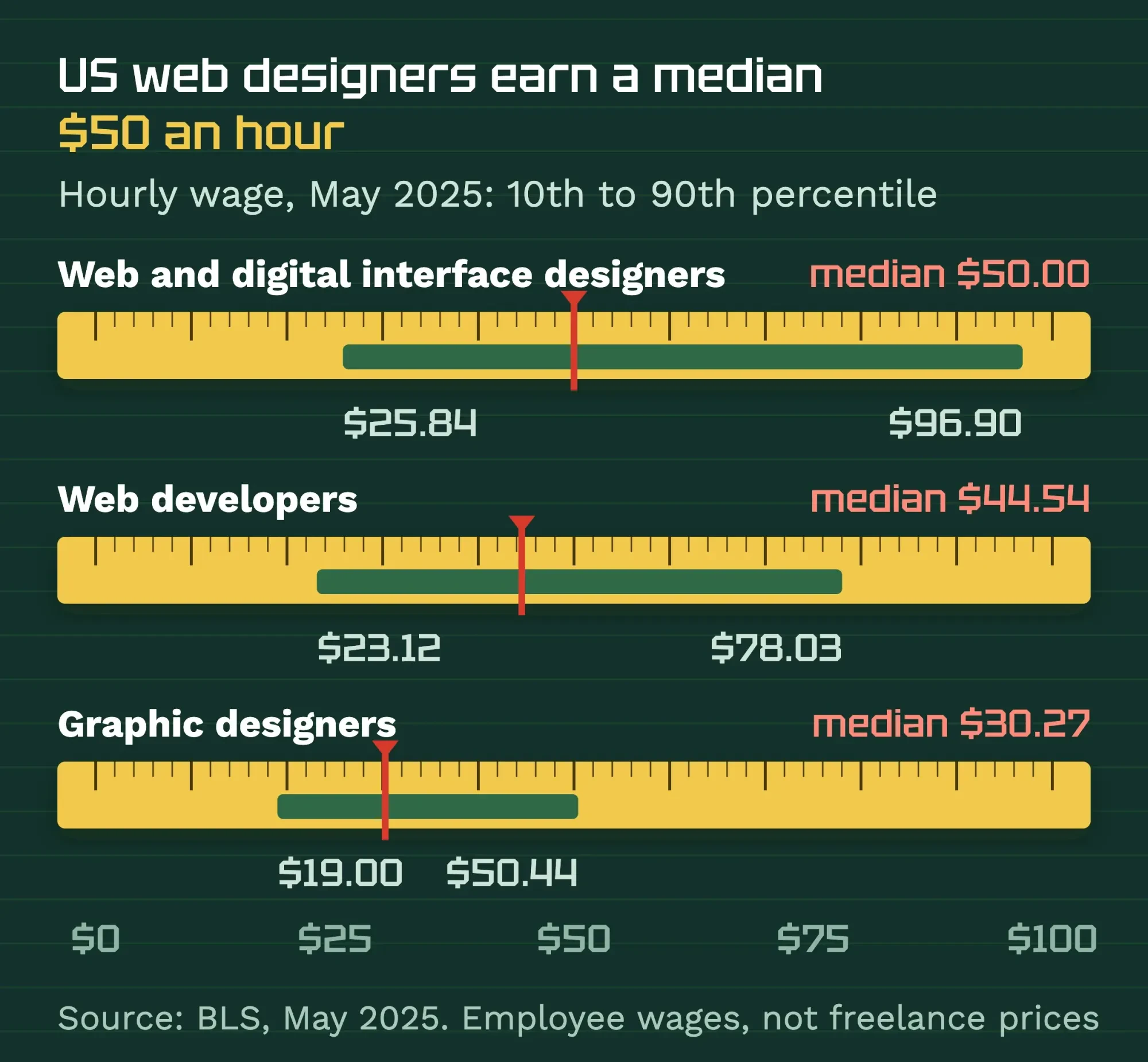 Source: BLS, May 2025. Wages of employees, not freelance prices. Chart by DigitalTreed.
Vendor figures sit on both sides of that anchor. They mix countries and project sizes, so read them as signals, not quotes.
| Source (vendor data) | What it says | As of |
|---|---|---|
| Upwork, a global freelance marketplace | Freelance web designers on Upwork tend to charge $15 to $30 an hour | October 2026 |
| Clutch, a directory of agencies | Web design companies shortlisted on Clutch charge around $100 to $149 an hour | October 2026 |
| Clutch | Most projects reviewed on Clutch cost less than $10,000 | October 2026 |
The Upwork hiring guide gives the $15 to $30 range (vendor data, as of October 2026). It covers freelancers worldwide. Clutch's web design pricing page gives $100 to $149 an hour for firms it shortlists (vendor data, as of October 2026).
Here is our own math, as wage context and not a price. A simple site that takes 40 hours, at the $50 BLS median, is $2,000 of US wages alone (BLS May 2025 data). A business adds overhead on top.
So when quotes differ a lot, ask what is in each one. Copywriting, photos, the number of revision rounds, accessibility testing and the care plan usually explain the gap.
Should you pay hourly, a fixed price or a monthly plan?
Web designers charge in 3 main ways. A fixed price covers an agreed scope and is paid in milestones. An hourly rate pays for the hours worked, and a monthly plan covers the build and the upkeep for one fee. This table is our framing, not a rule.
| Pricing model | How it works | Watch for |
|---|---|---|
| Fixed project price | One price for an agreed scope, paid in milestones | Work outside the scope costs extra, so the brief must be clear |
| Hourly | You pay for the hours worked | The total can grow; ask for an estimate and a cap |
| Monthly plan | One monthly fee covers the build and the upkeep | The minimum term, and what you keep if you cancel |
Our take: for a new small-business site, a fixed price with milestones is the easiest to compare and control. Hourly suits small fixes after launch.
What does a website cost after launch?
After launch, a website keeps costing money. The build isn't the last bill. Expect domain renewal, hosting, updates and backups, license renewals and maybe a care plan. Ask each designer to list these costs, with yearly amounts, before you sign:
- Domain renewal. ICANN says a domain is yours "for the period of time you registered" and must be renewed before it expires.
- Hosting, plus any business email you add. Hosting, plus any business email you add. A free monitor can watch it; see our small business guide to website uptime monitoring.
- Updates and backups. WordPress's own guide says you "should always update WordPress" and suggests a backup first.
- Paid themes, plugins, fonts and photos. Ask which licenses renew each year.
- A care plan, if you want the designer to do the updates for you.
Our WordPress website tutorial breaks down year 1 and year 2 costs for a do-it-yourself WordPress site. Put every renewal date in your calendar. If a domain lapses, ICANN warns you risk losing it "for a short time or possibly for good."
What should your brief say?
A web design brief is one page that tells every designer the same thing: your goal, pages, features, content, budget, deadline and accessibility target. Without it, you get 3 quotes for 3 different websites, and you can't compare them. Put in:
- The goal and the one action you want, such as calls, bookings or quote requests.
- The list of pages, and who your customers are.
- 3 sites you like, and what you like about each.
- Content: who writes the copy and who supplies the photos.
- Must-have features, such as booking, payments, forms or a blog.
- Budget range, deadline, and who will update the site later.
- Accessibility target: WCAG 2.2 level AA.
If you already have a site, run it through our free website audit tool first. Note the pages that get traffic, because they must keep their addresses or get redirects.
Bring your logo, colors and fonts too. Our branding strategy guide helps if you don't have them yet.
Questions to ask a web designer: our 12-question checklist
Ask who does the work and who owns the domain, code and design. Ask how accessibility is tested, how many revisions are included and what happens after launch. Ask for live sites and a client you can call. Send every designer the same 12 questions below, so the answers line up.
Google's page Do you need an SEO? also covers web consultants. It suggests asking for "examples of your previous work" and to "check your SEO's business references." These 12 questions go further:
- Can I see 3 live sites you built for small businesses, and call one of those clients?
- Who will do the work: you, your staff or subcontractors? Where are they based?
- Which platform will you build on, and can I edit pages myself afterward?
- Will the domain, hosting and all accounts be in my business's name?
- Will you transfer copyright in the custom design, code and content to me in writing on final payment?
- Which themes, plugins, fonts and photos are licensed, and in whose name?
- How do you meet WCAG 2.2 AA, and how do you test it?
- How many revision rounds are included, and what counts as one?
- What is the timeline, and what do you need from me by when?
- If page addresses change, will you set up 301 redirects and give me the list?
- What happens after launch: training, a bug-fix window, care plan price and how to cancel?
- Will you explain every SEO change you make?
The platform answer matters for years. If you sell products, compare the two big options in our WordPress vs Shopify guide before you agree.
Also ask how each page will look and work on a phone. Google's mobile-first indexing guide says it "uses the mobile version of a site's content" for indexing and ranking.
So the phone version is the one Google judges.
Red flags when you hire a web designer
The biggest red flags are a domain registered in the designer's name and no written contract or copyright transfer. Full payment up front and a promised #1 Google ranking are others. So is a price far below US pay, with no clear answer about who does the work.
Google names one outright: "No one can guarantee a #1 ranking on Google." The same Google page on hiring help warns about agencies "that email you out of the blue." Watch for these too:
- The designer registers the domain or hosting in their own name.
- No written contract, or a contract with no copyright transfer.
- A price far below US pay, with no answer about who does the work.
- Full payment up front, with no milestones.
- An "accessibility overlay" plugin sold as ADA compliance.
- Portfolio sites that are down, slow or don't match the claimed dates.
- Asking for your registrar or hosting password by email instead of a user account.
How do you check a designer's portfolio?
Open each portfolio site yourself, on a laptop and on your phone. Then contact one of those businesses and ask who built the site and whether they'd hire that designer again. A live site and a client who answers are better proof than any screenshot in a pitch.
To see whether a site existed when the designer says it did, look up its address in the Wayback Machine. The Internet Archive's help page says it "can't guarantee" that any site has been archived. So a missing site proves nothing, but a match is a good sign.
Who owns your website and domain?
Your business owns the website only as far as the contract and signed transfers say. By law, copyright starts with whoever made the design, so you need a signed, written transfer. The domain belongs to its registrant, and that should be your business, not your designer.
Under 17 U.S.C. 201(a), copyright "vests initially in the author." The author is whoever made the work: your freelancer, or the agency that employs your designer.
To move ownership to you, 17 U.S.C. 204(a) says a transfer must be "in writing and signed" by the owner. A "work made for hire" line alone may not do it.
The Copyright Office Circular 30 (PDF) explains why. Commissioned work counts as made for hire only in 9 listed categories, with a signed agreement. A website may not fit any of them, so ask for a signed copyright transfer as well. This is general information, not legal advice; check with an attorney for your situation.
Your domain is a separate question. ICANN's registrant rules give the registrant "sole responsibility for the registration and use of your domain name." That registrant should be your business, not your designer.
We checked our own domain, digitaltreed.com, in the .com registry's public registration record (RDAP, at rdap.verisign.com) on October 22, 2026. It showed the registrar, BigRock Solutions Ltd, a "client transfer prohibited" lock and an expiry date of February 23, 2027. It did not show the owner.
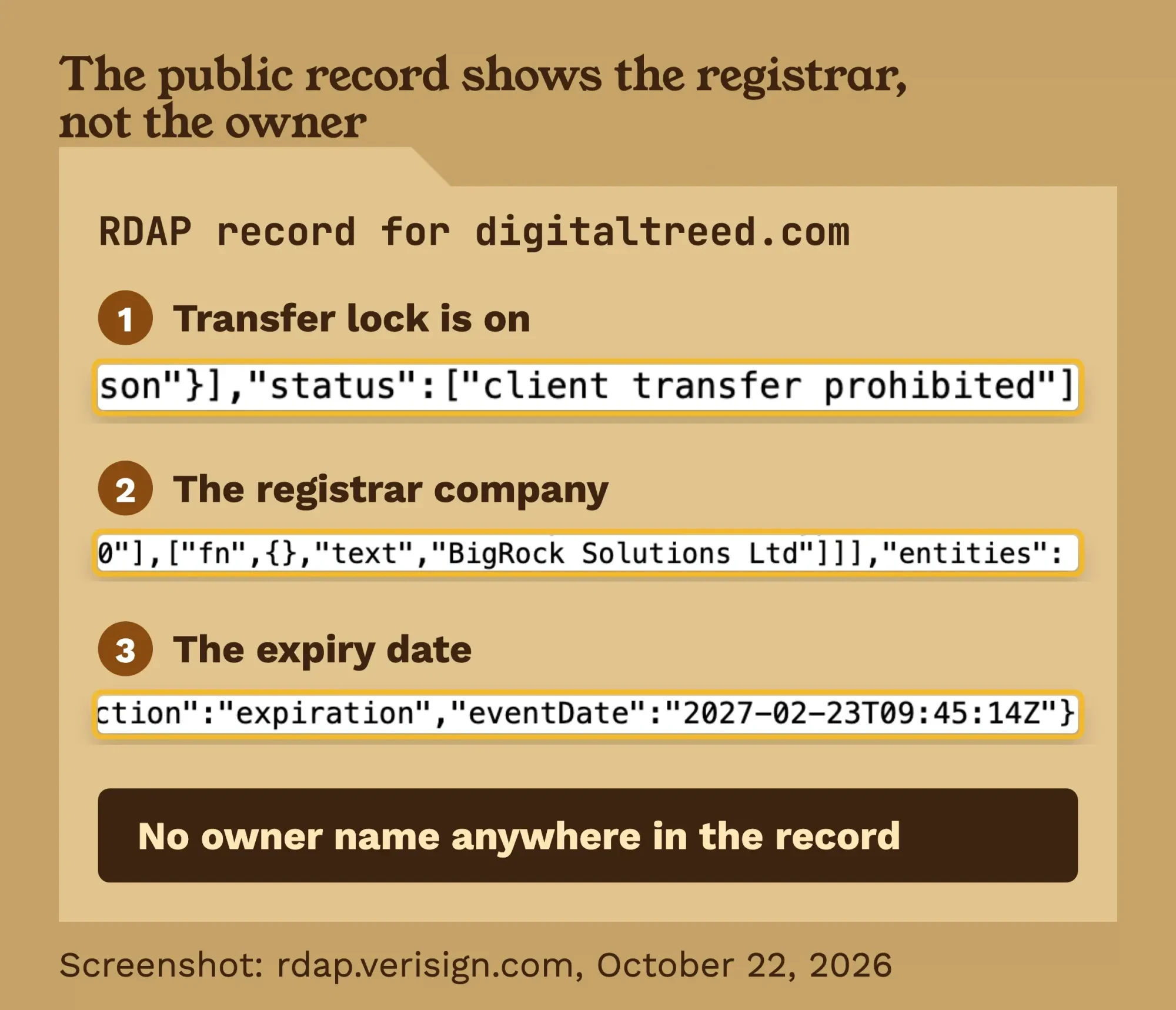 Screenshot: public RDAP record for digitaltreed.com at rdap.verisign.com, October 22, 2026.
So a lookup can't prove you own your domain.
Search your domain on ICANN Lookup to see your registrar. Then log in to that registrar and check that the registrant is your business.
Fix it early.
Under the ICANN Transfer Policy, changing the registrant later triggers a 60-day lock on moving the domain to another registrar, unless you opt out first.
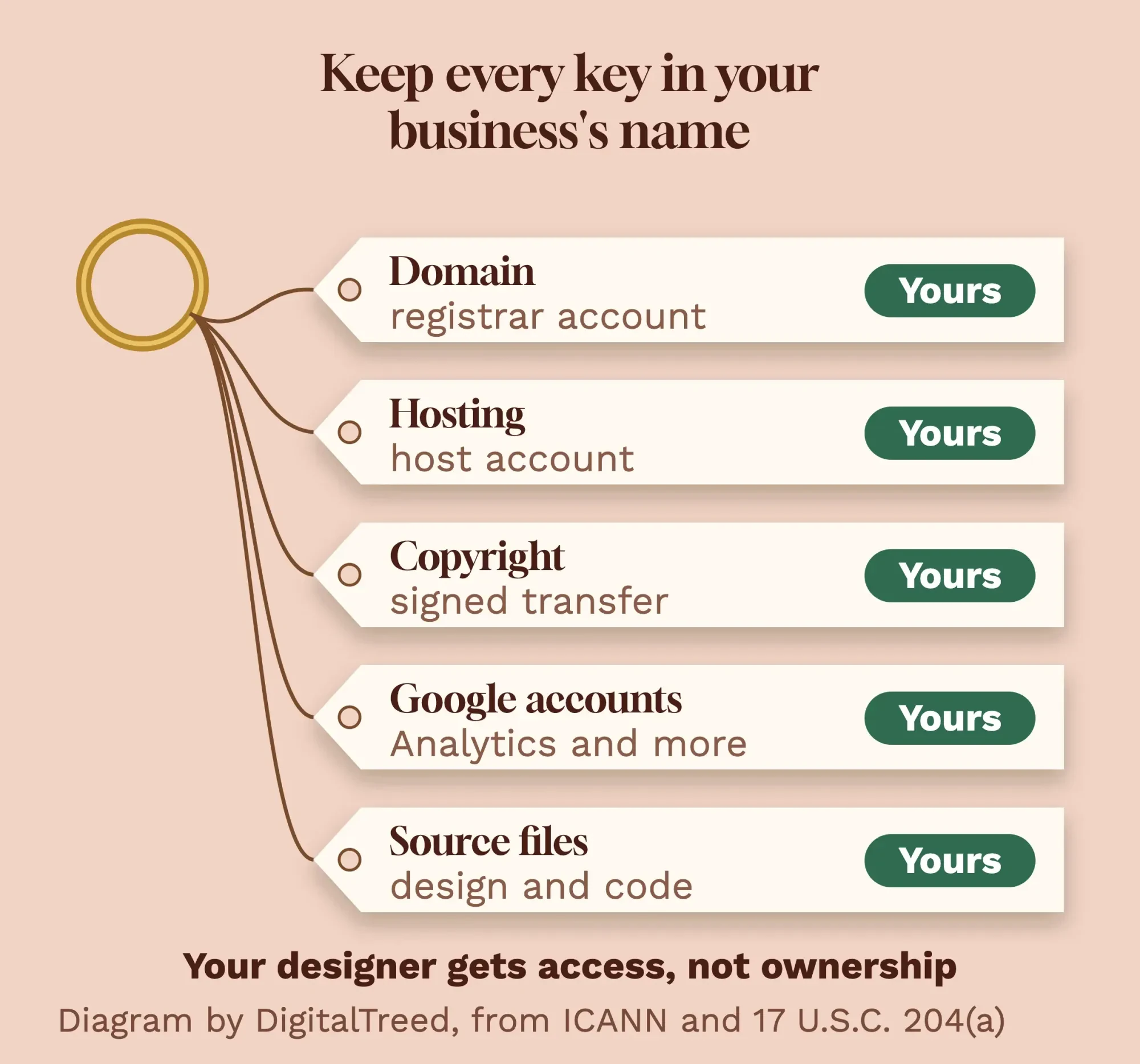 Diagram by DigitalTreed, based on ICANN rules and 17 U.S.C. 204(a).
The same goes for Google Analytics, Search Console and your Google Business Profile. Our local SEO guide explains why that profile matters so much for a local business.
What goes in a web design contract?
A web design contract should set the scope, price, milestones and timeline. It also needs a signed copyright transfer and accounts in your business's name. Add the deliverables, an accessibility target, a redirect map and an acceptance test before the final payment.
A contract puts every answer above in writing. Have an attorney review your template once, then reuse it. This is general information, not legal advice; check with an attorney for your situation. A good contract covers:
- Scope: pages, features, integrations, content duties and the number of revision rounds.
- Price and milestones, such as a deposit, design approval and launch.
- Timeline, with dates for both sides.
- Ownership: a signed copyright transfer of the custom work on final payment, plus a list of licensed parts.
- Accounts: domain, hosting, email, analytics and Search Console in your name.
- Deliverables: design files, theme files, custom code, admin logins and a short how-to video.
- Accessibility: WCAG 2.2 AA, and how it will be tested.
- Launch: a 301 redirect map and a working sitemap.
- An acceptance test before the final payment, and a bug-fix window after it.
- Termination: what you get if the project stops halfway.
This is the hardest part to get right on your own. Our web development service agrees the scope, a fixed price and the timeline in writing before any work starts. (DigitalTreed sells this service.)
How do you work with your designer during the build?
Name one person to collect feedback and approve each stage. Deliver your copy, photos and logins on time. Send feedback as one list per revision round. Your part affects the timeline as much as the designer's, so plan it. Our take:
- Name one person on your side who collects feedback and approves each stage.
- Deliver copy, photos and logins by the dates in the contract.
- Gather feedback from your team first, then send it as one list per revision round.
- Approve each milestone by email, so there is a record. Our guide to the website development process shows what you approve at each stage, from the brief to launch day.
- Keep files, logins and the redirect map in a shared folder your business owns.
Does your new website need to meet the ADA?
If your business is open to the public, the Justice Department says the ADA applies to your website too. It doesn't have a detailed technical rule for those sites, so most designers build to WCAG 2.2 level AA. Write that target, and how it will be tested, into the contract.
The Justice Department's web accessibility guidance (March 18, 2022) says the ADA applies to "businesses that are open to the public" too. For them, the Department "does not have a regulation setting out detailed standards" today.
Most designers aim for the WCAG 2.2 standard at level AA. That target is common practice, not a DOJ rule for private businesses. This is general information, not legal advice; check with an attorney for your situation.
The DOJ guidance lists practical items: color contrast, alt text on images, video captions, labelled forms, keyboard use and text zoom. It also warns that a "clean" report from an automated checker or overlay "does not necessarily mean everything is accessible."
Alt text is one item you can check yourself. Run key pages through our free image alt text checker, then try the site with only the Tab key.
How do you keep your Google traffic in a redesign?
To keep your Google traffic in a redesign, keep your best page addresses. Or send each old address to its new page with a permanent 301 redirect. Expect rankings to move for a few weeks or more while Google catches up.
Google's guide to site moves with URL changes warns of "temporary fluctuation in site ranking during the move." As a general rule for a medium-sized site, Google says showing the new addresses can take "a few weeks or more".
Google recommends permanent redirects, "such as 301 and 308," from every old address to its new one. Ask your designer for that list in writing.
After launch, paste your top old URLs into our free redirect checker. Each one should land on the new page in one hop. If you see a loop, our guide to the too many redirects error explains the fix.
How do you test the site before the final payment?
Test the site yourself before you release the final payment. Check mobile speed, alt text and form labels, HTTPS, broken links and redirects, every form, and your own logins to the domain, hosting and admin. The 6 checks below take about an hour, and it's the designer's job to fix what fails.
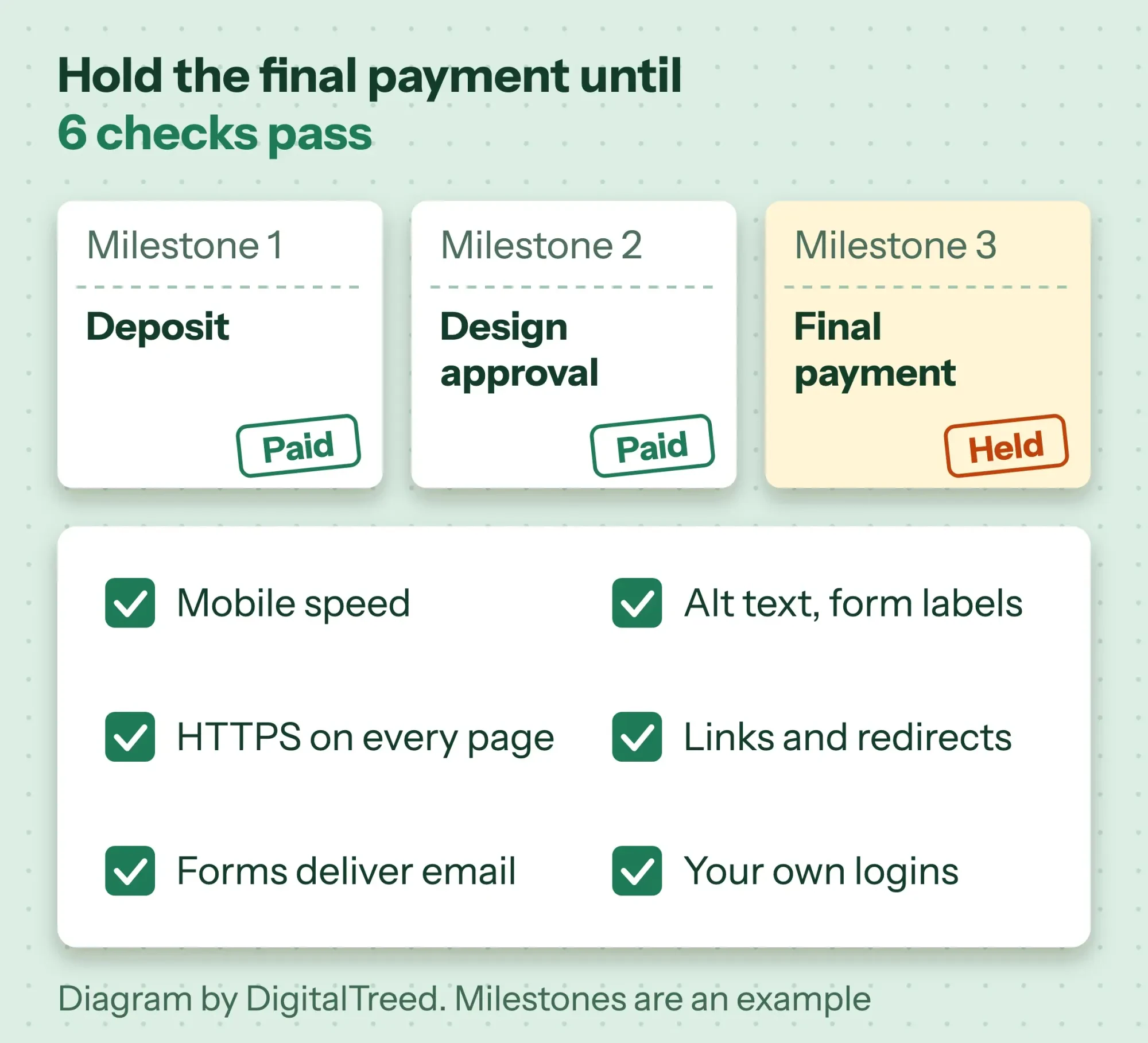 Diagram by DigitalTreed. Milestones are an example, not a rule.
- Speed on mobile: test the home page and one inner page with our free website speed test.
- Alt text on images and labels on every form field.
- HTTPS on every page, with no browser warnings.
- No broken links, and old URLs that redirect.
- Every form sends, and you receive the email.
- You can log in to the domain, hosting and admin with your own accounts.
For the speed numbers, our PageSpeed Insights guide explains what each score means. Our guide to running your first SEO audit covers the checks to repeat each month.
Do you have to send your web designer a 1099?
Often, yes. The IRS instructions for Form 1099-NEC require one for each person paid $2,000 or more for services, for tax years beginning after 2025. We re-checked that threshold on irs.gov on October 22, 2026.
Collect a Form W-9 before the first payment. Payments to corporations are generally not reported. Card and payment-app payments are reported by the processor on Form 1099-K, not on a 1099-NEC.
Also make sure the person is truly a contractor, not an employee. The IRS explains the tests on its independent contractor or employee page. This is general information, not tax advice; check with a CPA for your situation.
Example: a dental practice in Boise hires a designer
Example: a made-up 2-dentist practice in Boise, Idaho, needs 8 pages and a link to its existing booking software. It sends one brief to 3 designers.
Quote A is a marketplace freelancer with a template and no copy. Quote B is a local freelancer with a custom WordPress design, copy not included. Quote C is a small agency with copy, accessibility testing and a 30-day bug window.
The practice picks B after the 12 questions. The contract adds a copyright transfer, WCAG 2.2 AA, a redirect map for 15 old URLs and 3 milestones. The domain stays in the practice's own registrar account.
Before the last payment, the office manager runs the 6 checks and finds 2 images without alt text. The designer fixes them the same day.
Total payments in 2026 pass $2,000, so the practice collects a W-9 before the first payment and expects to file a 1099-NEC.
Frequently asked
How much does it cost to hire a web designer?
There is no neutral price list. US designers on staff earn a median $50 an hour, per BLS (May 2025). Vendor figures from Upwork and Clutch run from $15 to $149 an hour (as of October 2026). Get 3 quotes for the same brief.
Should I hire a freelancer or an agency?
A freelancer suits a small, clear scope. An agency suits a site that must bring leads and needs copy, SEO setup and ongoing care.
Should I pay a web designer hourly or a fixed price?
Our take: for a new small site, a fixed price with milestones is easier to compare and control. Hourly suits small fixes after launch. Ask for a cap either way.
Who owns my website after it is built?
You own what your contract and signed transfers give you. Ask for a written copyright transfer on final payment, and keep the domain in your name. This is not legal advice.
How long does it take to build a small business website?
There is no neutral figure. Our take: a simple 5 to 10 page site often takes several weeks, and late copy or photos are the usual delay.
Do I need a contract with a freelance web designer?
Yes. A written, signed contract is the only way to make scope, payments and ownership clear. The copyright transfer itself must be in writing.
Your next step
Write your one-page brief today, using the list above. It takes about 30 minutes and makes every quote comparable.
Then send it to 3 designers. If you'd like us to be one of them, request a free quote and we'll reply with a fixed price in writing.
How we made this guide: it's built from BLS wage data, O*NET, the US Copyright Act and Copyright Office, and ICANN policy. We also used the Justice Department's ADA guidance, IRS instructions and Google Search Central. Vendor prices come from Upwork and Clutch and are labelled. On October 22, 2026, we looked up our own domain's public RDAP record, took the screenshot and checked every number against its linked source. Updated October 23, 2026: added pricing models, costs after launch, a phone check, a portfolio check and a section on working with your designer.
First published May 23, 2023. Rewritten October 22, 2026: a step-by-step hiring process, US wage and vendor cost data, and 12 questions. New sections cover ownership, the contract, ADA, redirects, a final test and the 1099. Updated October 25, 2026: a short answer under each question heading and five sourced key facts. The 7 steps are now a plain list, and the 12 questions are labelled as a checklist.
Sources
- US Bureau of Labor Statistics: Web Developers and Digital Designers, Occupational Outlook Handbook
- O*NET OnLine: 15-1255.00 Web and Digital Interface Designers
- 17 U.S.C. 201, Ownership of copyright (Cornell LII)
- 17 U.S.C. 204, Execution of transfers of copyright ownership (Cornell LII)
- US Copyright Office: Circular 30, Works Made for Hire (PDF)
- ICANN: Registrants' Benefits and Responsibilities
- ICANN: Transfer Policy
- ICANN Lookup
- US Department of Justice: Guidance on Web Accessibility and the ADA
- W3C: Web Content Accessibility Guidelines (WCAG) 2.2
- Google Search Central: Do you need an SEO?
- Google Search Central: Site moves with URL changes
- IRS: Instructions for Forms 1099-MISC and 1099-NEC
- IRS: About Form W-9
- IRS: Independent contractor (self-employed) or employee?
- Google Search Central: Mobile-first indexing best practices
- ICANN: Renewing Domain Names
- WordPress.org: Updating WordPress
- Internet Archive: Using the Wayback Machine
- Upwork: How to hire a web designer (vendor)
- Clutch: Web design pricing (vendor)


Comments
No comments yet. Start the conversation below.