
Quick answer
A SaaS affiliate program pays partners for subscribers, so you choose how long to pay as well as how much. HubSpot pays 30% of each payment for up to a year; Shopify pays affiliates up to $150 once. Count churn before you copy either: "lifetime" can cost more than twice as much.
Key takeaways
- Pay partners for customers who keep paying, not for clicks or sign-ups alone.
- In our example, 20% for 12 months costs about a $100 bounty.
- Make the cookie longer than your free trial and your sales cycle.
- Give affiliates, referring customers and resellers different deals.
- Your affiliates' claims are your problem under the FTC's endorsement rules.
Most guides to a SaaS affiliate program are written for the people who join one. This one's for the company that runs it: a US software or B2B business with paying subscribers that wants partners to bring more.
The math isn't a store's math.
A store pays once for one order. You're paying for a customer who might stay three months or three years. That customer may come from a blogger, a happy customer or an agency that sets the product up for clients. Selling products or running a local shop instead? Start with our guide to starting an affiliate program as a store or local business.
Software pays for subscriptions, so every deal has a clock on it
A SaaS affiliate program is a deal where a software company pays outside partners for the customers they send. The pay is usually a share of the subscription or a fixed fee per paying account.
That "paying" part changes everything.
A sign-up isn't revenue yet. Many people start on a free trial, some never pay, and some pay twice and cancel.
So settle two questions before you pick a rate.
First, what event earns the commission? It could be a trial, a first payment, or a payment that's still standing after your refund window. Second, how long does a customer keep earning: once, for a year, or for as long as they pay?
Rates come last, and they're much easier once those two answers are fixed.
Five real programs, five ways to pay
So what do software companies actually choose? We read five public program pages from four of them on October 27, 2026, signed out, and put the terms side by side. Every figure is as of October 2026. Terms change often, so check the linked page before you quote it.
No two of them pay the same way.
| Program | What it pays | Tracking window | Tiers |
|---|---|---|---|
| HubSpot Affiliate Program | 30% of each payment for up to 1 year | 180 days | Starter, Sprocket, Elite by sign-ups a month |
| Semrush affiliate program | $50 to $300 per sale at the Basic tier, plus $10 per free trial on most toolkits | 120 days | Basic to Platinum by sales a quarter |
| Shopify Affiliate Program | Up to $150 once per qualified referral, by location | 30 days; trials tracked up to 400 days | None listed |
| Shopify partners who build a store | 20% of the monthly plan fee plus 0.1% of eligible sales, for 4 years | The store is transferred to the merchant | Not tiered |
| Google Workspace Referral Program | USD 8, 15 or 23 once per new user (US rates, by plan) | Link plus single-use promo codes | Affiliate Program for 100+ users a year |
The Shopify rows surprised us. A blogger who sends a new store earns up to $150 once. A partner who builds the store and transfers it to the client earns "20% of monthly base platform fee or subscription fee" for 4 years, per Shopify’s partner earnings page. The affiliate fee applies to Basic, Grow and Advanced plans; Starter and Lite plans aren't eligible for the partner share.
One company, two partner types, two very different deals.
That's the pattern worth copying. People who set up and support your product for clients get paid for longer than people who send a click.
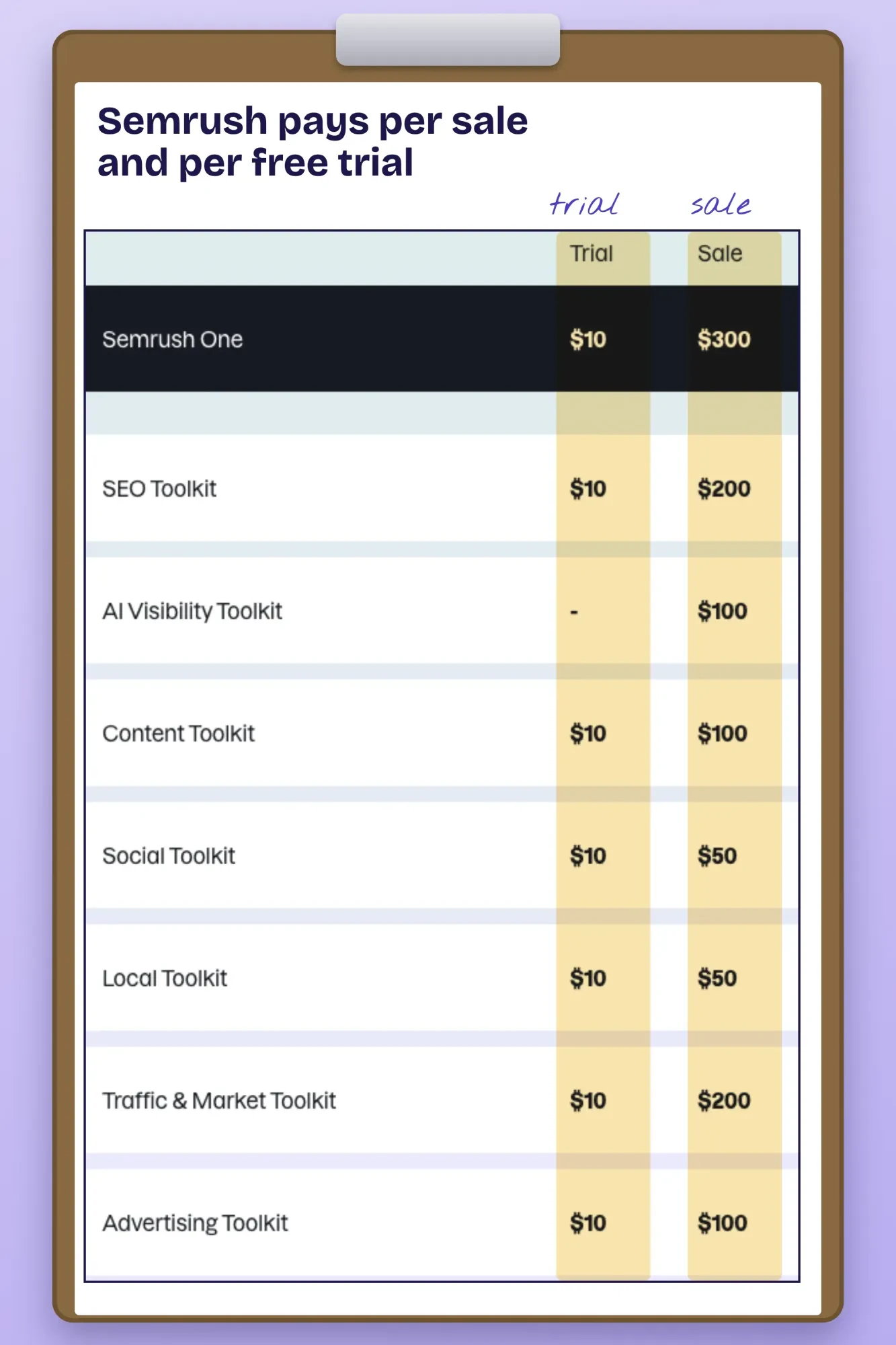 Screenshot: Semrush affiliate program page, signed out, October 27, 2026. Cropped to the commission table by DigitalTreed; highlights and labels ours.
Semrush shows the other common shape: a flat fee per sale, set by product, plus a small fee for every trial. To work out your own number from margin and refund rate, use our guide to affiliate commission rates for merchants.
Recurring or one-time commission?
Those programs split between a fee paid once and a share paid every month. For most SaaS companies, recurring commission for a set period, usually 12 months, is the safer pick. Here's why, with churn counted.
Example (made up): Yardlog is a scheduling app for lawn-care crews in Lake Charles, Louisiana. It charges $49 a month. We'll assume 4% of customers cancel each month, which is our own assumption for this example and isn't a benchmark you'll find published anywhere.
Yardlog weighs three offers for one referred customer. A $100 bounty is paid once. Twenty percent for 12 months pays $9.80 for each month the customer stays, while twenty percent for life pays $9.80 for as long as they stay.
With 4% leaving each month, the average customer pays for 9.68 of the first 12 months, which is $474.43 of revenue, so the 12-month offer costs $94.89 on average. Lifetime costs $245.00, because the average customer stays 25 months.
The bounty and the 12-month deal cost about the same.
They don't carry the same risk, though. The $100 goes out in full even if the customer cancels in month two, while the recurring payout only comes out of money a customer really paid. It also keeps partners keen on sending people who'll stay.
Lifetime is the expensive one: 2.6 times the 12-month cost here, and more if your churn turns out lower than you think.
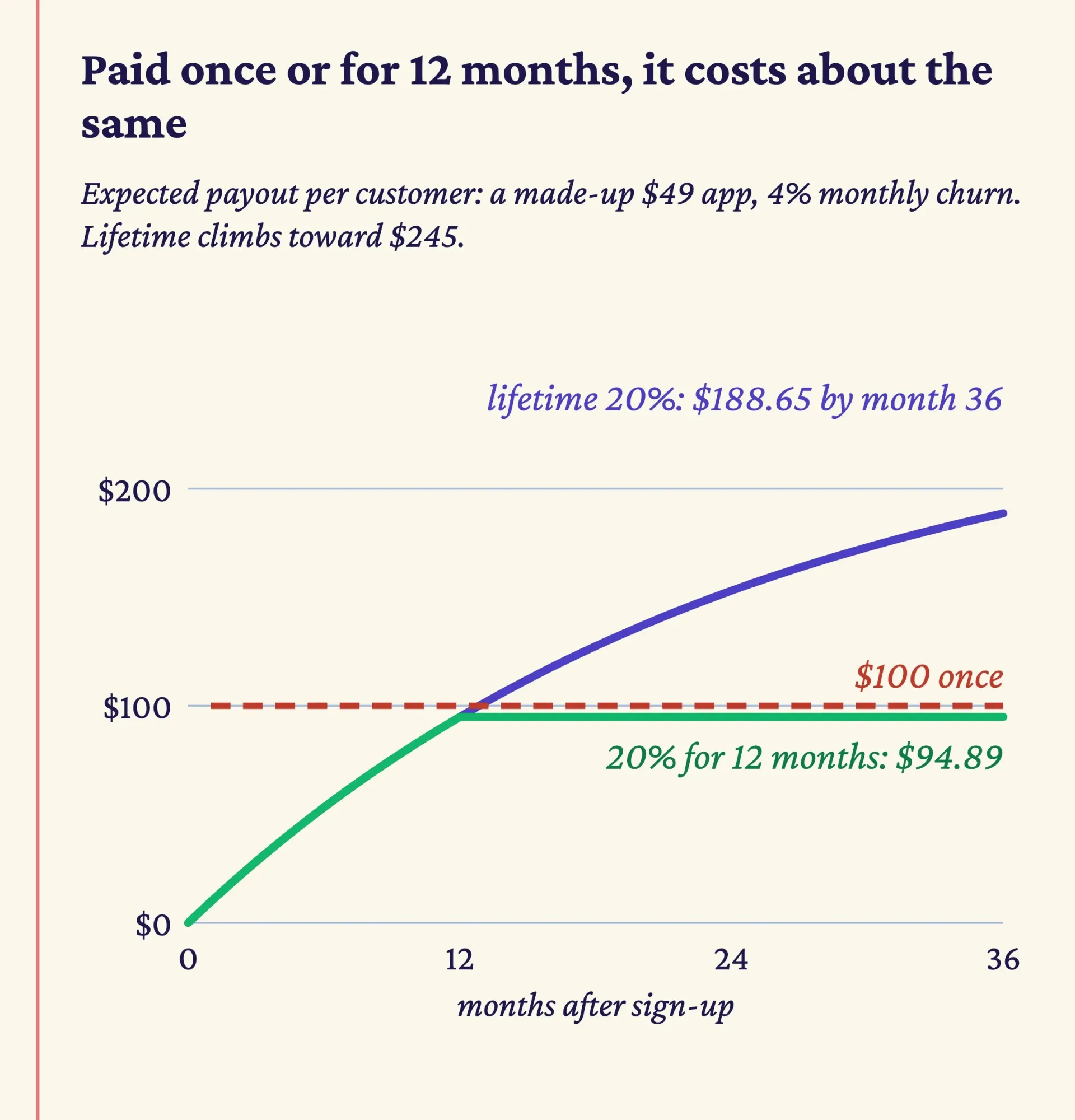 Diagram by DigitalTreed. Yardlog, its price and its churn are made up; math recomputed October 27, 2026.
Two details keep the cost honest. Base the commission on what you'll actually keep after card fees, not the sticker price; our Stripe fee calculator shows that number for your plan. And hold the first payout until your refund window has passed.
Annual plans need one more line in your terms. Say whether a year paid upfront (a made-up $490 for Yardlog) earns 20% once, or whether you split it by month.
Make the cookie longer than your trial and your sales cycle
Once you know what you pay for, decide how long a click counts. That tracking window, often called the cookie, should outlast the time a buyer takes to pay you.
If it's shorter, partners send the customer and you keep the commission. They'll notice.
The programs we read set long windows: 180 days at HubSpot and 120 at Semrush. Shopify's is 30 days from the click. But its affiliate page adds that a referral on a free trial is tracked "for up to 400 days" until it becomes a paid store.
For any product with a trial, that second rule matters more than the first.
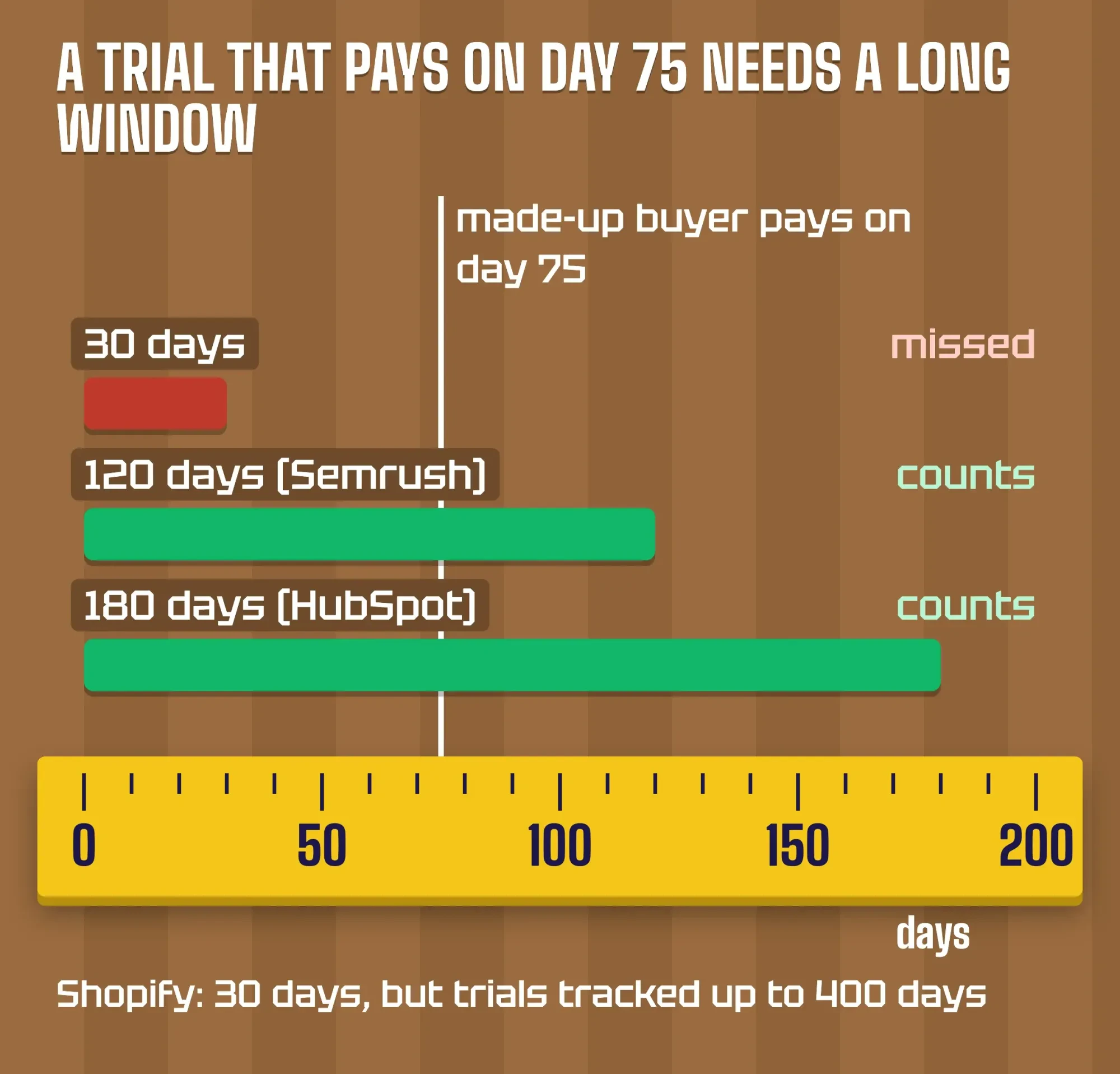 Diagram by DigitalTreed. Windows from the HubSpot, Semrush and Shopify program pages, read October 27, 2026; the day-75 buyer is made up.
B2B buying is slow, and several people sign off; our B2B vs B2C marketing guide explains why. Set your window from your own data. Count the days between a first visit and a first payment for your last 50 customers, then pick a window that's longer than it took most of them.
Three partner types: affiliate, referral and reseller
Then there's the question of who gets that window and that rate. Not every partner should get the same deal. They don't do the same work.
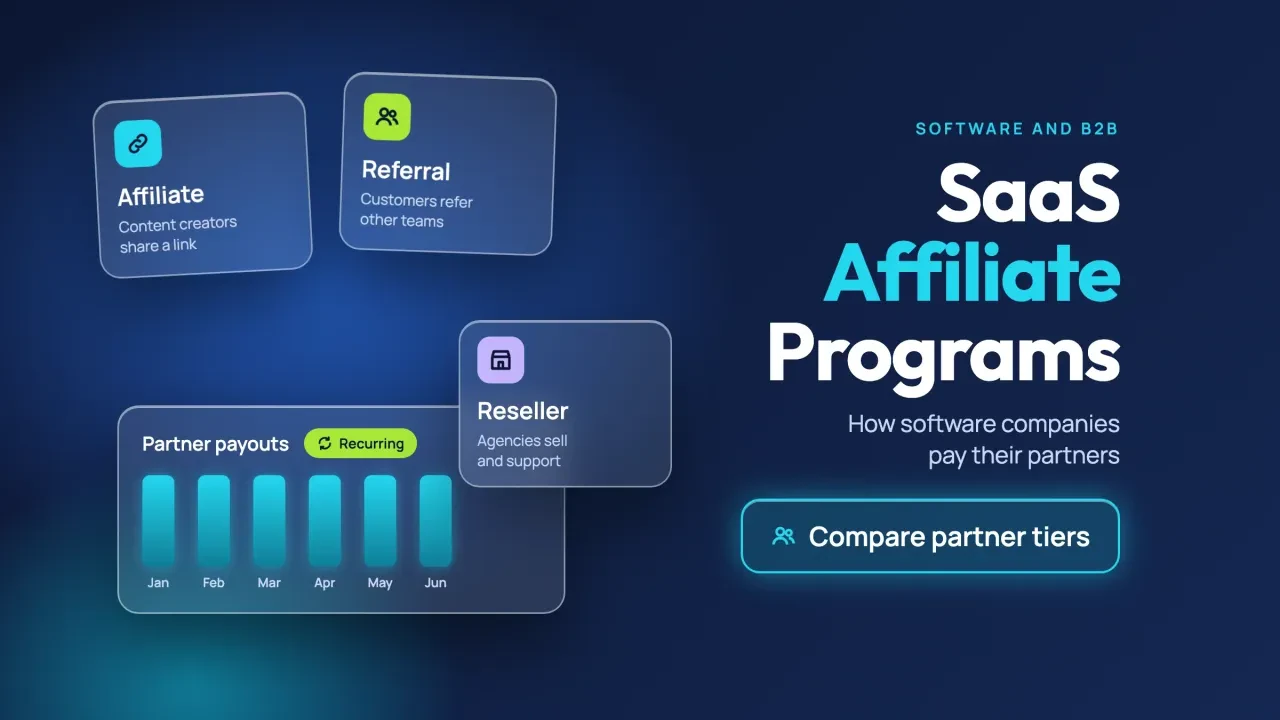
Affiliates are content creators who share a link. They review your product, compare it with others and send readers. You'll usually pay them per customer: recurring for a set period, or a flat fee.
Referral partners are your own customers, referring other teams. They send fewer people, but warm ones. Google Workspace draws the line by volume. Its referral program is for people referring up to 99 users a year. Anyone at 100 or more is pointed to the Affiliate Program, which it says pays higher rates. A one-time reward or an account credit suits this group.
Resellers are agencies that sell and support your product.
They set it up, train the client and take the support calls. So it's fair that they earn a longer revenue share, like Shopify's 4-year cut for partners who build stores.
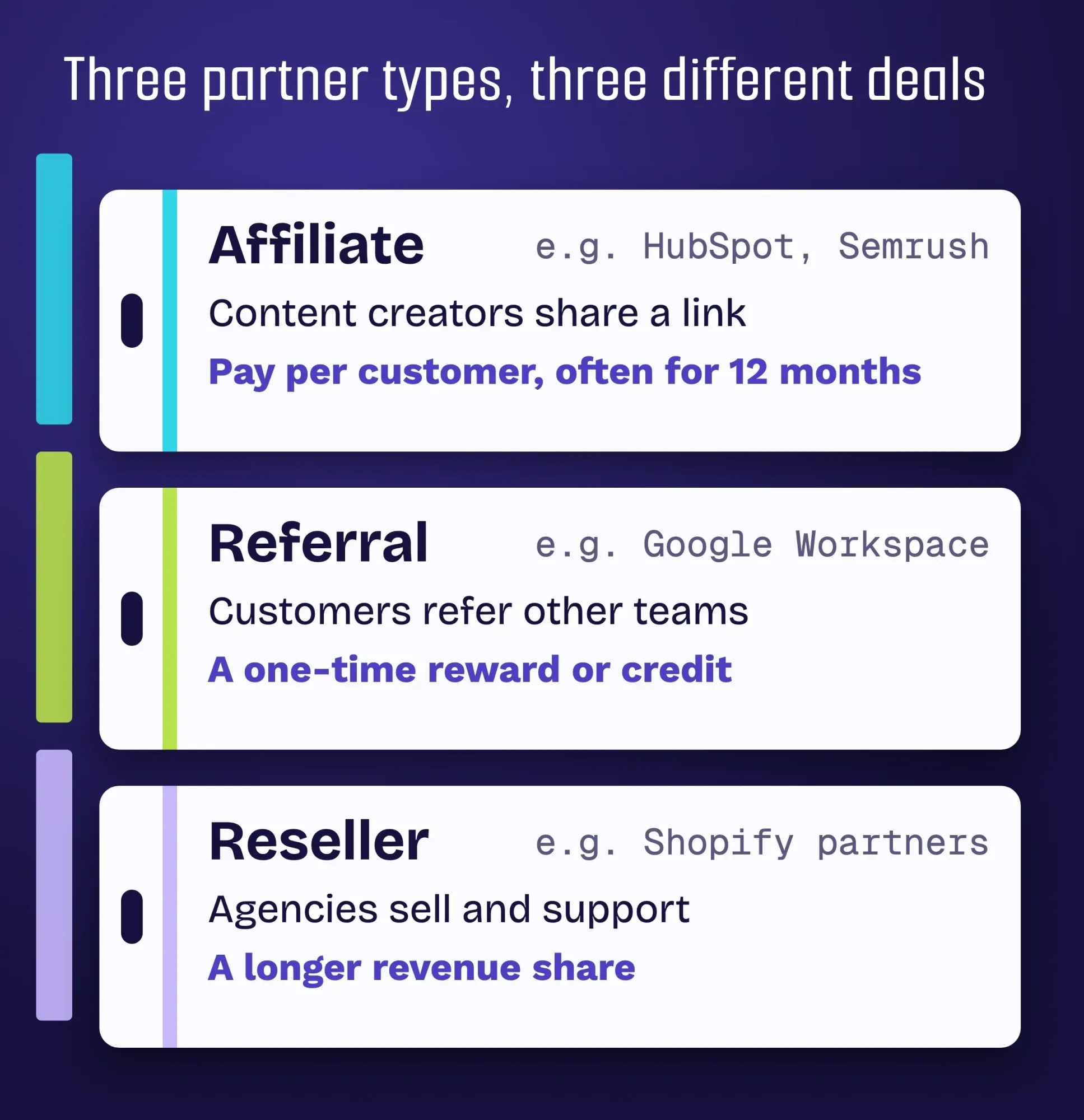 Diagram by DigitalTreed. Program examples from HubSpot, Google Workspace and Shopify pages, read October 27, 2026.
Performance tiers can sit on top of any of these. HubSpot moves affiliates from Starter to Sprocket at 30 sign-ups a month, and to Elite at 100, where commission becomes custom. Semrush raises its per-sale fee each quarter, from Basic (0 to 4 sales) up to Platinum (50 or more).
Pay for leads when your sales team closes the deal
Those deals assume the partner closes the sale, but sales-led companies have one more problem. If a salesperson closes most of your deals, a partner can't control whether a lead buys. A small fee per qualified lead or trial, plus a share when the deal closes, is fairer to both sides.
The programs we read already do a version of this. Semrush pays $10 for every free trial on most toolkits on top of the sale fee, and HubSpot's middle tier lists "30% recurring and/or cost per sign up". But neither page says what counts as a valid sign-up. Yours should.
Don't leave that vague in yours.
Write down what you'll count as a qualified lead: a work email, a company size, a booked demo that actually happens. Then log where each lead came from in your CRM, so the partner's name is still attached when the deal closes months later. Our guide to setting up a CRM covers the fields to add.
Track trials and renewals where the money is
That CRM record is half the tracking. The other half lives in your billing system, because a trial that converts in month three won't show a fresh click from the partner's page.
If you bill with Stripe, two pieces do the heavy lifting. A Checkout Session can carry a client_reference_id. Stripe’s API reference says it "can be used to reconcile the Session with your internal systems", so put the partner's ID there or in the customer record.
Then you'll credit the partner each time the subscription's invoice.paid event arrives, and stop when invoice.payment_failed or a cancellation comes in; Stripe’s subscription webhooks guide lists both events.
Most affiliate apps do this for you once they're connected, and our comparison of affiliate networks and software for merchants covers the options and their fees. For your own launch emails to partners, tag each link in the DigitalTreed UTM builder. Then Google Analytics 4 shows which partner sends visitors who convert.
This wiring is where small programs break.
If you'd like it built into your sign-up and billing flow, our web developers do this work. We're paid when you hire us, so get a second quote too.
Your terms carry the FTC duty, and Google won't police your brand name
That tracking tells you who to pay. Your terms decide what partners may say, and the FTC holds you to them.
Under 16 CFR 255.1(d), "Advertisers are subject to liability for misleading or unsubstantiated statements made through endorsements". It adds: "An advertiser may be liable for a deceptive endorsement even when the endorser is not liable."
The same section says advertisers should "Provide guidance to their endorsers", "Monitor their endorsers' compliance" and "Take action sufficient to remedy non-compliance". It's "not a safe harbor", it says, but it should cut "an advertiser's odds of facing a Commission enforcement action."
In practice, that's three things. Give partners a short claims guide: what they can and can't promise. Spot-check your top partners' pages each quarter, since you won't hear about a bad claim any other way. And keep a clause that lets you hold or cancel commission when a partner won't fix a claim. The affiliate's own duties are in our affiliate links guide, including the disclosure line and the rel="sponsored" tag Google asks for on paid links.
Brand bidding is the next gap. Google's trademarks policy for ads says Google Ads "will not restrict: Using trademarks as keywords". Your terms have to do it.
Otherwise an affiliate can buy ads on your brand name and earn commission on people who were already looking for you and would've bought anyway.
Coupon sites are the last one. Google Workspace's page says "Promotion codes cannot be posted publicly." If your partners get discount codes, borrow that line.
How do you pay affiliates and report it to the IRS?
Once the terms are set, sort out the tax paperwork before the first payout. Collect a Form W-9 from each US partner before you pay them, because the IRS says Form W-9 is used "to provide your correct Taxpayer Identification Number (TIN)". Then file Form 1099-NEC for anyone you pay $2,000 or more in a year.
That threshold is new. The IRS instructions for Forms 1099-MISC and 1099-NEC say that "For tax years beginning after 2025", it "increased to $2,000". They add that it "may be adjusted for inflation beginning in calendar year 2027."
The threshold used to be lower, so check last year's list of who got a form.
How you pay matters too. Card payments and "third-party network transactions" go on Form 1099-K, filed by the payment company. The same instructions say those "are not subject to reporting on Form 1099-MISC or Form 1099-NEC."
Partners outside the US use different forms. Ask a CPA before you pay them.
A first-month launch plan
Rules and forms ready? You can launch in about four weeks. Start with people who already like your product.
- Pick the event that earns commission (a first payment after your refund window) and the period (12 months is a safe default).
- Write one page of terms: rates by partner type, tracking window, payout day and minimum, brand-bidding and coupon rules, and the claims guide.
- Connect tracking to billing and test it with one fake partner and one real card.
- Invite 10 to 20 customers and 3 to 5 creators who already write about your category.
- Check payouts against billing after the first month, then fix the terms before you recruit more.
Our take: start with 20% for 12 months, a window longer than your trial, and a separate deal for agencies. It's easy to raise a rate later. It's very hard to take "lifetime" back.
Want the partner sign-up page, tracking and billing hooks built for you? Talk to DigitalTreed about web development. We're paid for that work, so compare at least one other quote.
Frequently asked
What is a good commission for a SaaS affiliate program?
There's no official benchmark, so work from your own margin and churn. For scale, Semrush pays its top tier $450 per Semrush One sale. It adds a quarterly content bonus of $200 to $1,500 by tier (Semrush affiliate page, October 2026).
When do SaaS companies pay affiliates?
Usually monthly, after a hold. Shopify issues commissions "only once a month on the 22nd of each month, for the prior month's referrals". Partners need a $10 balance before they can withdraw (Shopify Affiliate Program FAQ).
Should I run my affiliate program in-house or on a network?
Big programs often use a platform rather than build one. HubSpot says "Impact is our trusted third-party affiliate platform" for links, tracking and payments (HubSpot Affiliate Program). Compare network and app fees before you choose.
How do affiliates move up a tier?
By volume held over time. HubSpot says sign-ups per month "must remain consistent for a 3-month period" before an affiliate moves to the next tier (HubSpot Affiliate Program). A rule like that stops one lucky month from locking in a higher rate.
How we made this guide: Eram N.'s rewrite was fact-checked on October 27, 2026 against the companies' and agencies' own pages. We read five software partner programs signed out and compared their terms in one table. We took the Semrush screenshot ourselves and worked out the Yardlog payout math by hand and in a short script. The rules come from the eCFR, the IRS, Google and Stripe, each linked inline where it's used.
Nothing here is legal or tax advice. Have an advertising lawyer read your affiliate terms and a CPA set up your payouts, especially if partners live outside the US.
First published August 2020. Rewritten October 27, 2026: the old post listed "high ticket" programs for affiliates to join, with figures from 2020 and no sources. The new one is for the company paying partners. It compares five real programs and adds recurring vs one-time math, tracking windows, partner tiers, lead payouts, billing tracking, FTC and trademark rules, and US tax forms.
Sources
- HubSpot: Affiliate Program
- Semrush: Affiliate program
- Shopify: Affiliate Program
- Shopify Help Center: How Partners earn on Shopify
- Google Workspace: Referral Program
- eCFR: 16 CFR 255.1, General considerations (Guides Concerning Use of Endorsements and Testimonials in Advertising)
- Google Advertising Policies Help: Trademarks
- Google Search Central: Qualify your outbound links to Google
- Stripe API reference: The Checkout Session object
- Stripe Docs: Using webhooks with subscriptions
- IRS: Instructions for Forms 1099-MISC and 1099-NEC (12/2026)
- IRS: About Form W-9
Comments
No comments yet. Start the conversation below.