
Quick answer
There's no standard rate. The programs we read on October 27, 2026 paid anywhere from a flat fee of up to $150 per referral to 30% a month for up to a year. Your own margin sets the right number, not a list. Pay more than it allows and every affiliate sale loses money.
Key takeaways
- Commission comes out of what's left after cost, fees and refunds.
- Only 3 of 6 big programs we opened printed a rate.
- Percent suits stores; flat fees and recurring suit subscriptions.
- Count the network fee inside your commission budget.
- Budget time to check what affiliates publish, as the FTC expects.
Most guides to affiliate commission rates for merchants hand you a range and stop.
That's the wrong way round, since a rate that works for a software company can sink a grocery brand, because the two keep very different amounts of each sale.
So this guide works from your numbers. You'll see what real programs printed on their own pages and the four structures, with when each fits. Then come one worked example, the costs on top, and the FTC rule that comes with the program.
Your margin sets the ceiling on any rate
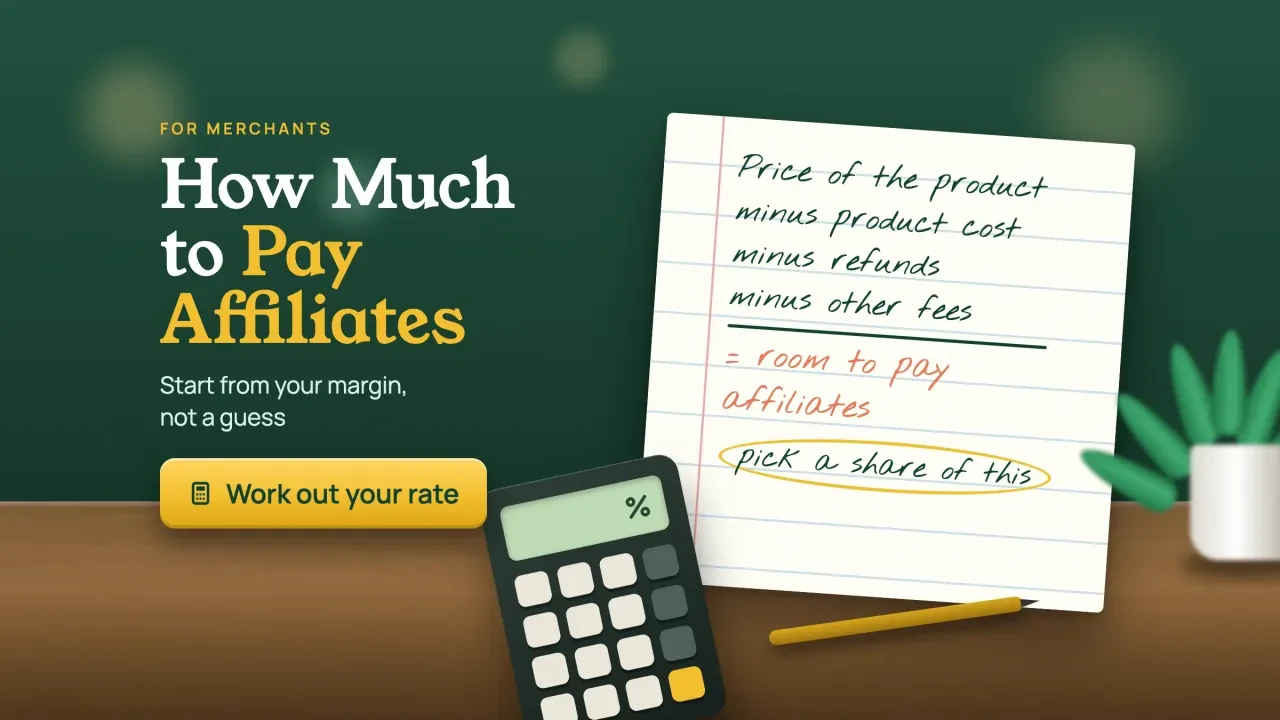
The most you can pay an affiliate is what's left of an order after the product, the fees and the refunds.
Everything else is a choice about how much of that leftover you'll give away to win a new customer.
That's why rates differ by industry, and Aswath Damodaran at NYU Stern publishes margins by sector for US public companies, with data as of January 2026. Gross margin, the share of sales left after the cost of goods, was 71.72% for system and application software and 56.88% for apparel. General retail kept 33.18% and grocery 26.31%.
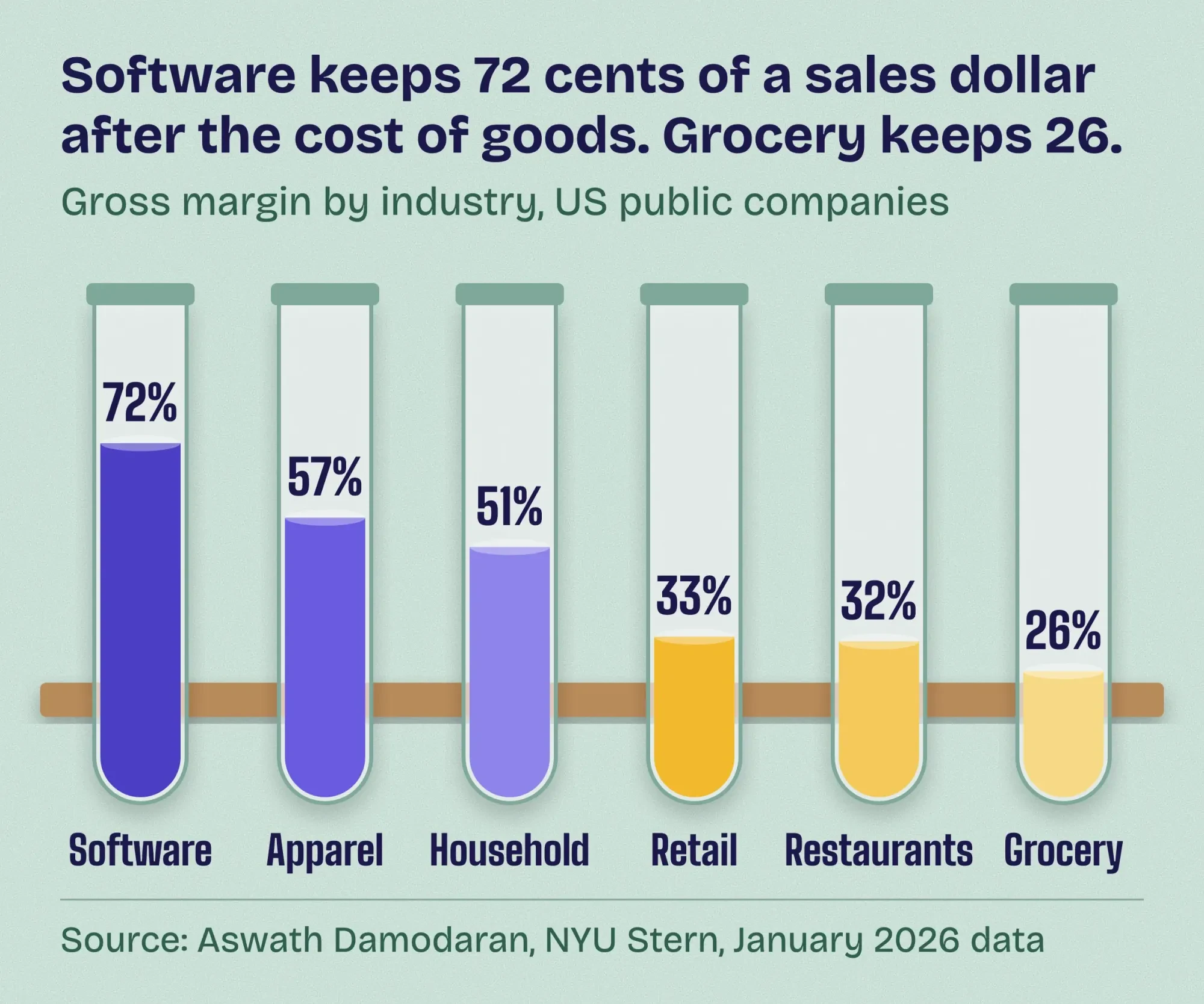 Source: Aswath Damodaran, NYU Stern, Margins by Sector (US), data as of January 2026, public companies. Diagram by DigitalTreed.
Those are big public companies, so your shop's numbers will differ. The shape holds, though. A software seller can hand 30% to a partner and still make money.
A grocer can't, because 30% is more than its whole gross margin.
So check yours first.
Say your shop sells something people buy once and rarely send back. You can afford a richer first-order commission than a shop whose customers return a third of what they order.
Gross margin isn't the end of it either, because card fees, packing, shipping you don't charge for and refunds all come out before the affiliate's share. Our Stripe fee calculator shows the card fee on a given order price, so that line holds a real number.
What six well-known programs printed on October 27, 2026
Before setting a rate, most owners look at what others pay. We did the same and found less than we expected.
On October 27, 2026, we opened the public affiliate pages of six well-known programs. We used a plain browser, signed in to nothing, and wrote down what each page printed. Three gave a number. Etsy’s affiliate page explained what its commission is paid on but showed no rate. Walmart’s affiliate home page promised "transparent commission-rate tables", yet the page we opened had none, and Amazon's fee schedule page sent us to a sign-in screen. So we haven't quoted an Amazon rate at all.
| Program | Structure | What the page printed | Tracking window |
|---|---|---|---|
| Shopify (store software) | flat fee per paid signup | up to $150, varies by location | 30 days |
| HubSpot (CRM software) | recurring percent | 30% a month for up to a year | 180 days |
| Kinsta (web hosting) | one-time bonus plus recurring | up to $500, plus 10% a month | 60 days |
| Etsy (marketplace) | percent of qualifying sale | no rate shown | no number shown |
| Walmart (retail) | not stated on the page | no rate shown | not shown |
| Amazon (retail) | not read | sign-in page | not read |
The printed numbers come from Shopify’s affiliate page, which says commission amounts "vary by referral location", HubSpot’s affiliate page and Kinsta’s affiliate page. All three sell software or hosting, where margins are wide and a customer pays every month.
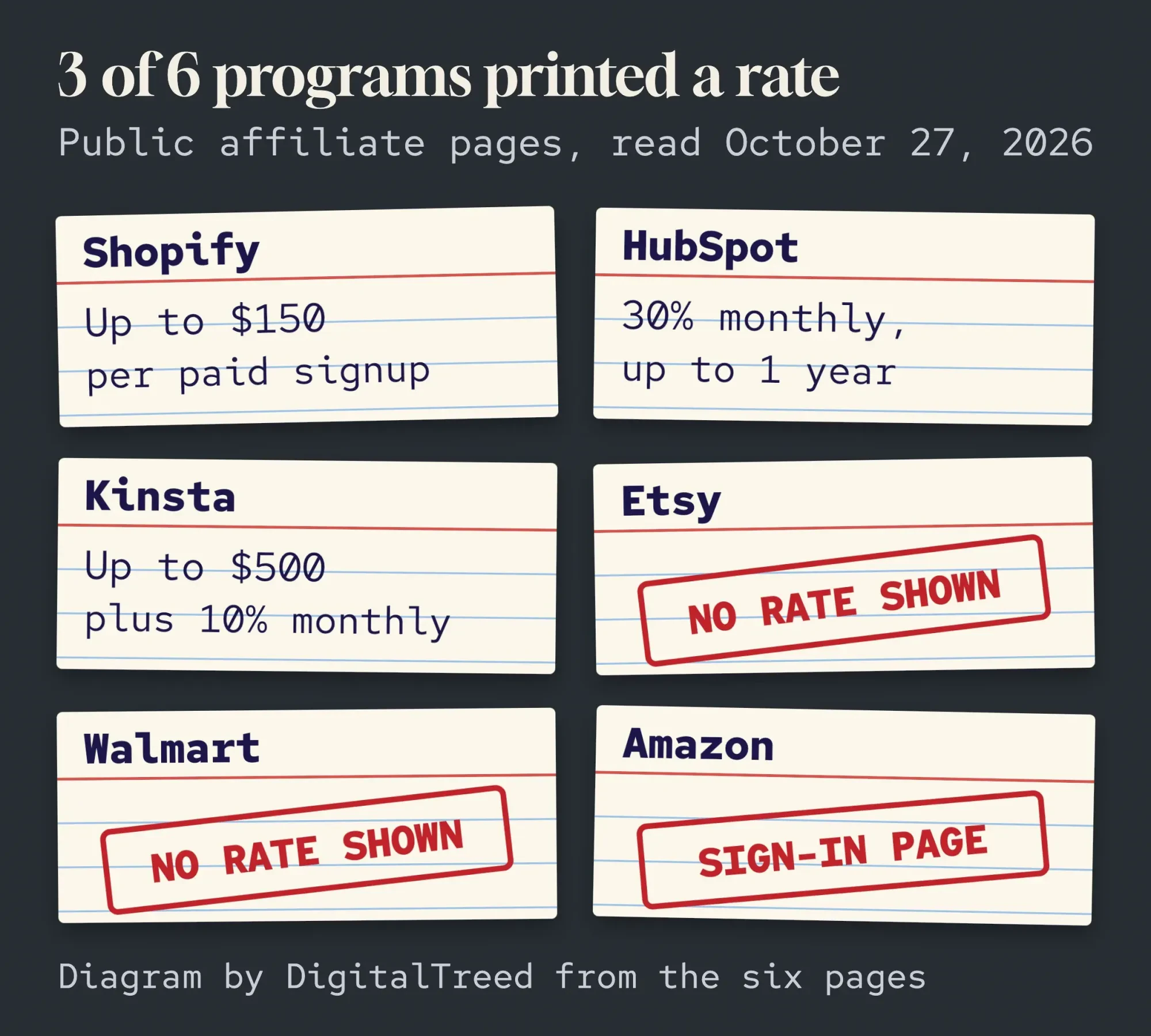 Diagram by DigitalTreed from the six public affiliate pages we opened on October 27, 2026.
Our take: copy the habit of publishing clear terms, not the big programs' rates.
Their margins and brand pull aren't yours, and an affiliate choosing between your program and a hidden rate card will notice the one that says what they'll earn.
Percent, flat fee, tiered or recurring: match it to what you sell
Once you know your room per order, the structure decides how that money reaches the affiliate, and there are four common ones you can mix and match. Here they are.
Percent of the sale
This is the default for stores. The affiliate earns more on bigger baskets, which is fair, and your cost rises and falls with revenue. Awin’s pricing page uses a 6% commission on a $100 sale in its own example, as of October 2026.
Flat fee per sale or signup
A fixed amount suits one product at one price, or a free signup that turns into a paid plan. Shopify pays a flat amount per qualified referral, and affiliates get it at a glance.
The catch: a flat fee doesn't shrink when you run a discount, so price it on your lowest likely order.
Paying creators a set fee for a post is a different deal. Our influencer rates breakdown covers that side.
Tiered rates
Tiers raise the rate as an affiliate sells more in a month or a quarter. They reward your best partners without paying the top rate to someone who sends two orders a year. A setup we'd sketch for a small store has three levels. Everyone gets the base rate, a set number of sales in a month earns a higher one, and the top rate is one you've already checked against your margin. Keep it to two or three steps, and don't set the top tier from hope.
Recurring commission
Subscriptions can pay a share of every renewal. HubSpot caps it at a year, while Kinsta pays monthly for life. A cap protects you if the plan is cheap or churn is high. Software and B2B sellers have more to weigh, such as reseller tiers and paying for leads, which our piece on SaaS affiliate programs goes into.
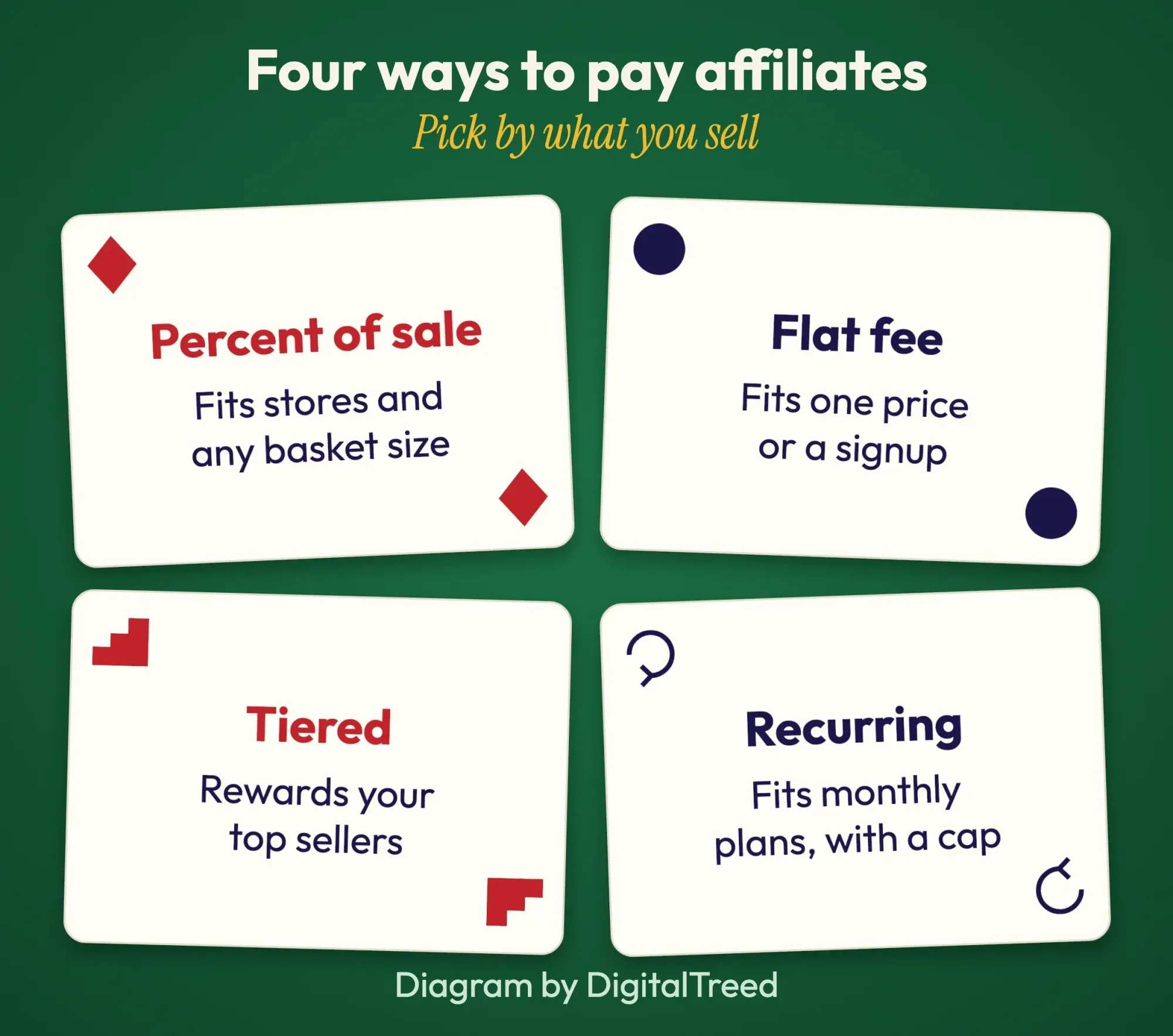 Diagram by DigitalTreed. Examples of each structure come from the affiliate pages of Awin, Shopify, HubSpot and Kinsta, read October 27, 2026.
Some programs pay per lead or per click instead. Those suit sellers who close the sale later by phone. They're also easier to game, so most small stores skip them.
Example: a rate for a $40 granola box
Now here's the method on one made-up business, with every number shown so you can swap in yours.
Example: Canyon Crunch Granola is a made-up granola maker in Provo, Utah, and these are its October 2026 numbers. It sells a $40 box and charges shipping separately. Ingredients and packaging cost $14. Card fees run about $1.50 an order, and picking, packing and the shipping box cost $4. About 5% of orders get refunded, so the owner sets aside $2 per order for that.
That leaves $18.50 of room on each box in October 2026: $40 minus $14, $1.50, $4 and $2.
Now the split. The owner decides a new customer is worth up to 40% of that room, or $7.40, which is 18.5% of the order.
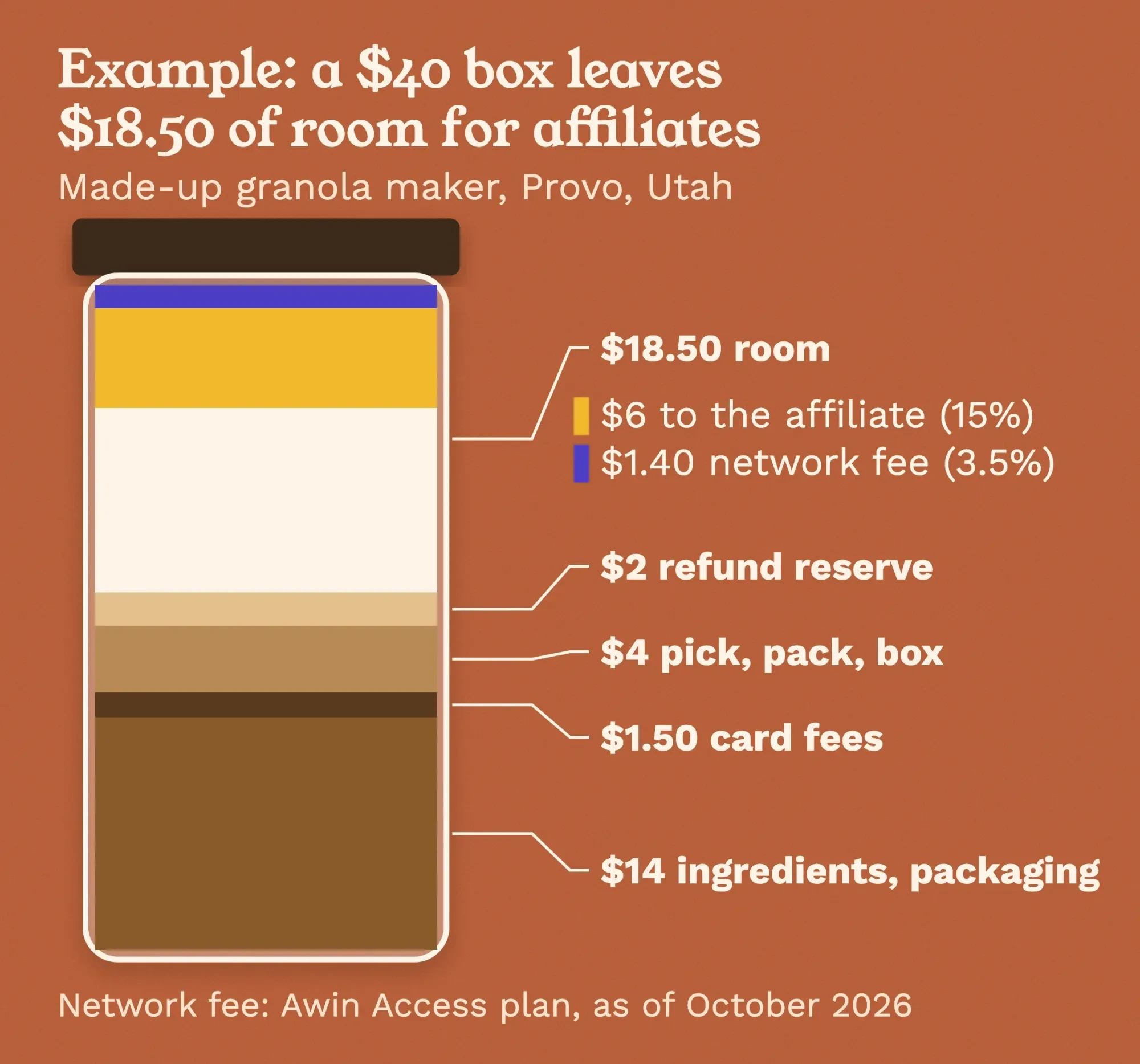 Illustration of a made-up example business. Network fee from Awin's pricing page, read October 27, 2026. Diagram by DigitalTreed.
The network takes its cut from the same budget. On Awin’s Access plan, that's a 3.5% tracking fee per transaction as of October 2026, or $1.40 on this box, so the affiliate rate is 15%, or $6. Add the two and you're at $7.40, exactly the 40% the owner planned. That's the whole budget.
Two checks before going live. If customers reorder, a first order that only breaks even can still pay off, so some owners pay on the first order alone. And if 15% looks low next to other granola brands, fix the margin or add a volume bonus. Don't just raise the base rate.
Want someone to check these numbers before launch? Send them through our quote form and our team will work through them with you. We sell this kind of help, so read our view as a seller's view.
How long should your affiliate cookie last?
Once the rate is set, match the tracking window to how long your buyers take to decide. On the pages we read, Shopify tracked referrals for 30 days, Kinsta used "a 60-day tracking cookie", and HubSpot offered "a 180-day cookie window". Some buyers take weeks to compare quotes, as they do with software or a home service. For them, a 30-day window will quietly cut out affiliates who did the real work.
A granola box is often bought the same day. Few people shop around.
A long window wouldn't win many extra sales there. It would mostly pay affiliates for customers who came back weeks later on their own.
Whatever window you pick, track it yourself too: give each affiliate a tagged link from our UTM builder, and their visits and sales show up in Google Analytics. The GA4 reports guide shows where to find them.
The costs on top of the commission
But the commission isn't the only cost. A network or tracking platform charges too, and its fee usually rises with your sales. Awin listed its Access plan at $49 a month plus 3.5% per transaction, as of October 2026, and its Accelerate plan started at $99 a month plus 2.5%.
impact.com listed Starter at $30 a month plus 2.5% of revenue in October 2026, for stores on platforms such as Shopify and WooCommerce.
Then there's paperwork. US affiliates are usually paid as independent contractors, so collect a Form W-9 from each one before the first payout. The IRS uses it to match payments to a taxpayer number. Running the program in-house with a plugin or app changes these costs, so compare the options in our roundup of affiliate networks and software for merchants.
We aren't tax advisers, so ask a CPA what your business has to file for its affiliates.
Rules that keep the rate affordable
Even a fair rate can lose money when the terms are loose. It's tempting to copy a big brand's terms word for word. But they've got legal teams and fraud tools that you don't, so keep your rules short and enforce the ones you write. These close the usual gaps:
- Pay on the product total, not on tax or shipping.
- Hold each commission until your return window closes, then pay.
- Cap or tier any lifetime recurring commission on cheap plans.
- Ban affiliates from bidding on your brand name in search ads.
- Don't pay coupon sites for codes your customers would have found anyway.
- Pay your own customers for referrals through a referral reward instead.
That last one is worth a look before you sign up strangers. A happy customer sending a friend often costs less than an affiliate, and these loyalty program ideas include simple referral rewards.
Your terms should also say what affiliates must do on their side, such as labeling paid links. Point new partners to our walkthrough on using affiliate links, written from their point of view.
Are you responsible for what your affiliates say?
That's a yes, in large part, and it affects how you write your terms. The rule is 16 CFR 255.1(d), part of the FTC endorsement rules. It says, "Advertisers are subject to liability for misleading or unsubstantiated statements made through endorsements or for failing to disclose unexpected material connections between themselves and their endorsers."
It also expects you to guide, monitor and correct your affiliates. Our guide to starting an affiliate program walks through those duties step by step. For the rate, the lesson is simple: hold back part of the budget for the time it takes to check what affiliates publish. We're not lawyers, and none of this is legal advice. If your affiliates make health, money or safety claims, have an attorney review your terms.
Frequently asked
Should you set a minimum payout for affiliates?
A small one is common, and it saves you sending tiny transfers. "A minimum balance of $10 USD is required before withdrawals can be made," HubSpot’s affiliate page said on October 27, 2026. Put your floor in your terms so nobody is surprised.
Should affiliates earn commission on shipping and tax?
Most merchants say no. Etsy’s affiliate page says its commission "is earned on each qualifying sale (excluding tax, delivery, returns and cancellations)". That's a sensible model for your own terms.
Do affiliates get paid when a referral starts on a free trial?
That's up to you, and it should be in writing. Shopify tracks a referred free trial until it becomes a paid store "for up to 400 days", and pays only on paid plans.
How often should you pay affiliates?
Monthly is common, a month or so after the sale. Shopify’s affiliate page says it adds commissions to affiliates' balances once a month, on the 22nd, for the prior month's referrals. That gap gives returns time to come in.
Got your room per order and a rate you can defend? The next job is the program itself: terms, tracking and recruiting. To hand that set-up to someone else, request a quote from us and we'll send back a priced list of each task.
How we made this guide: We traced each rate, fee and quote back to the page it came from, and the last one was checked on October 27, 2026. On that day we opened six affiliate program pages without signing in and recorded what each one printed; the table above is that record. The margin figures come from NYU Stern's January 2026 dataset, and the law and tax lines from the eCFR and the IRS. The granola business is made up. You'll find each source linked right beside the fact it supports.
First published August 2020. Rewritten October 27, 2026: turned a list of programs for bloggers into a merchant's guide to setting affiliate commission rates. It adds dated program terms, a worked example, network fees, and the FTC and IRS rules.
Sources
- Aswath Damodaran, NYU Stern: Margins by Sector (US), data as of January 2026
- Shopify: Affiliate Program (vendor page, read October 27, 2026)
- HubSpot: Affiliate Program (vendor page, read October 27, 2026)
- Kinsta: Affiliate Program (vendor page, read October 27, 2026)
- Etsy: Affiliates and Creator Collective (vendor page, read October 27, 2026)
- Walmart: Affiliate Program home page (vendor page, read October 27, 2026)
- Awin: Advertiser plans, US (vendor pricing, read October 27, 2026)
- impact.com: Pricing (vendor pricing, read October 27, 2026)
- eCFR: 16 CFR Part 255, Guides Concerning the Use of Endorsements and Testimonials in Advertising
- IRS: About Form W-9
Comments
No comments yet. Start the conversation below.